Errol Leslie Thompson Flynn was born on June 20, 1909 in Battery Point, Tasmania, Australia
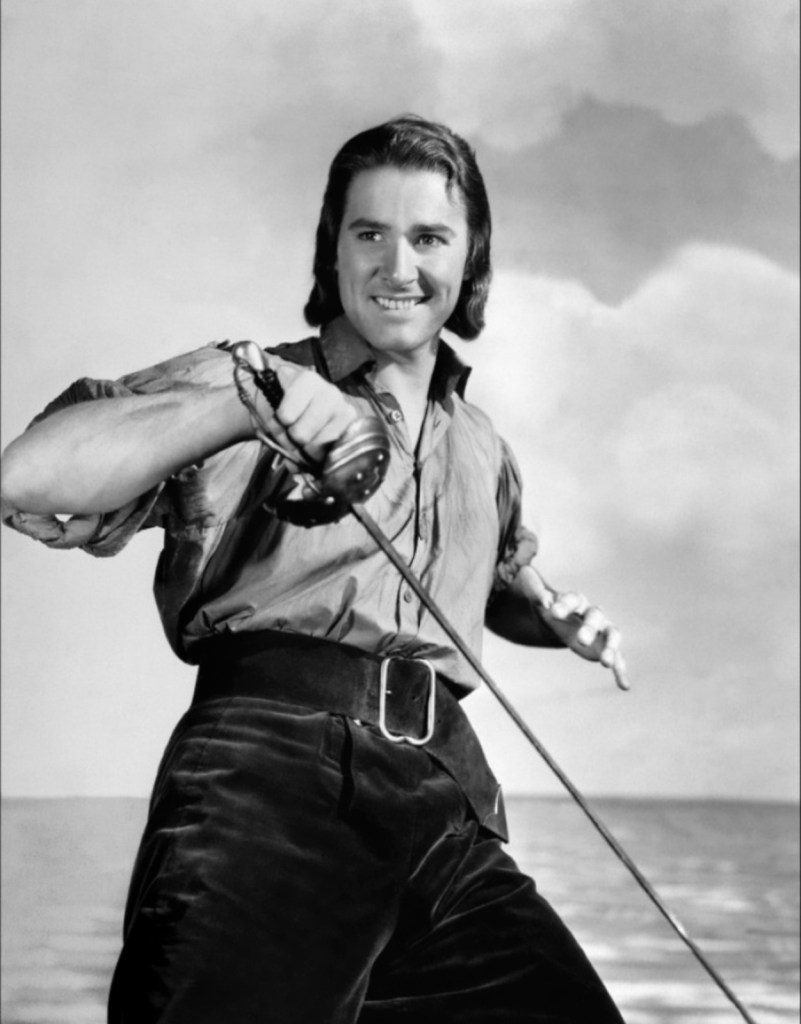
Above Flynn as “Captain Blood”
Errol’s father was Theodore Thomson Flynn, a British-Australian Zoologist and Marine biologist.
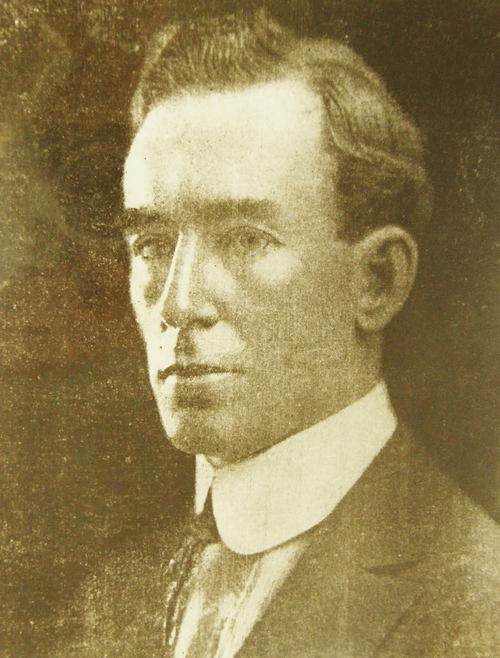
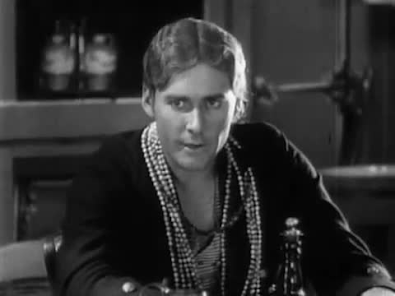
His mother was born Lily Mary Young, but immediately after marrying Theodore, she changed her first name to Marelle. Erroll would always claim that both of his parents were descended from the “Mutineers of the Bounty”, a lie that takes me to his first motion picture, “In the Wake of the Bounty”, portraying Fletcher Christian, below. I look at that 1933, Australian feature film in my article, “The Mutiny on the ‘HMSV (His Majesty’s Armed Vessel Bounty’ in Motion Pictures” for reading of the actual events and the film versions at:
https://www.bewaretheblog.com/2021/02/the-mutiny-on-hmav-his-majestys-armed.html
This article looks at only Errol Flynn’s “Swashbuckling” motion pictures out of a combination career of 66 motion picture and television appearances.
Technically, Errol Flynn’s first pirate film was with the actor as one of the guests on Catalina Island, for a pirate charity show put on by other actors, the 1935 short subject from “Metro-Goldwyn-Mayer”, “Pirate Party on Catalina Isle”.
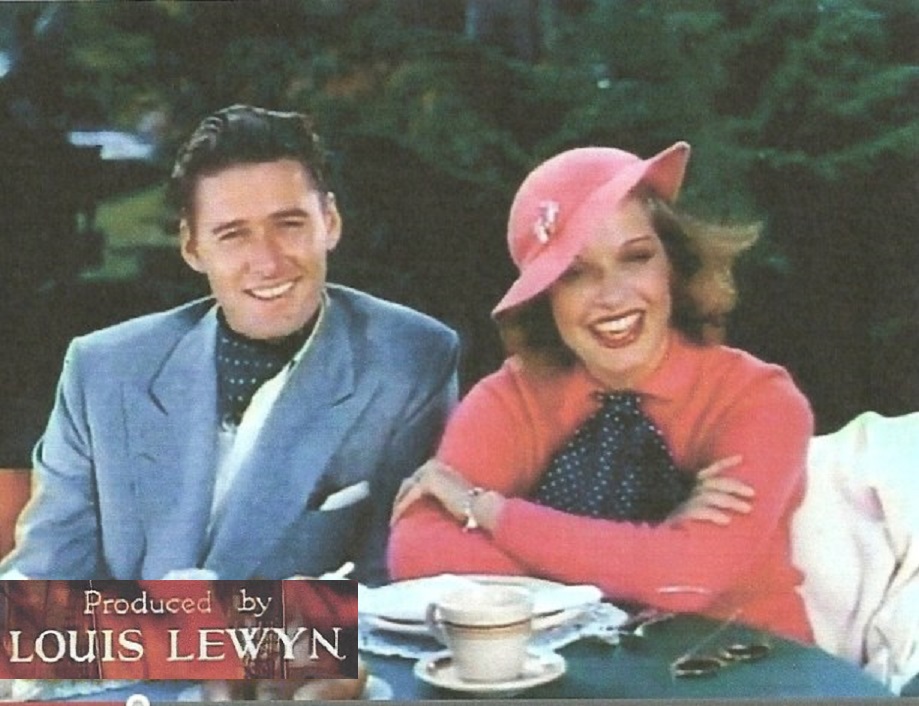
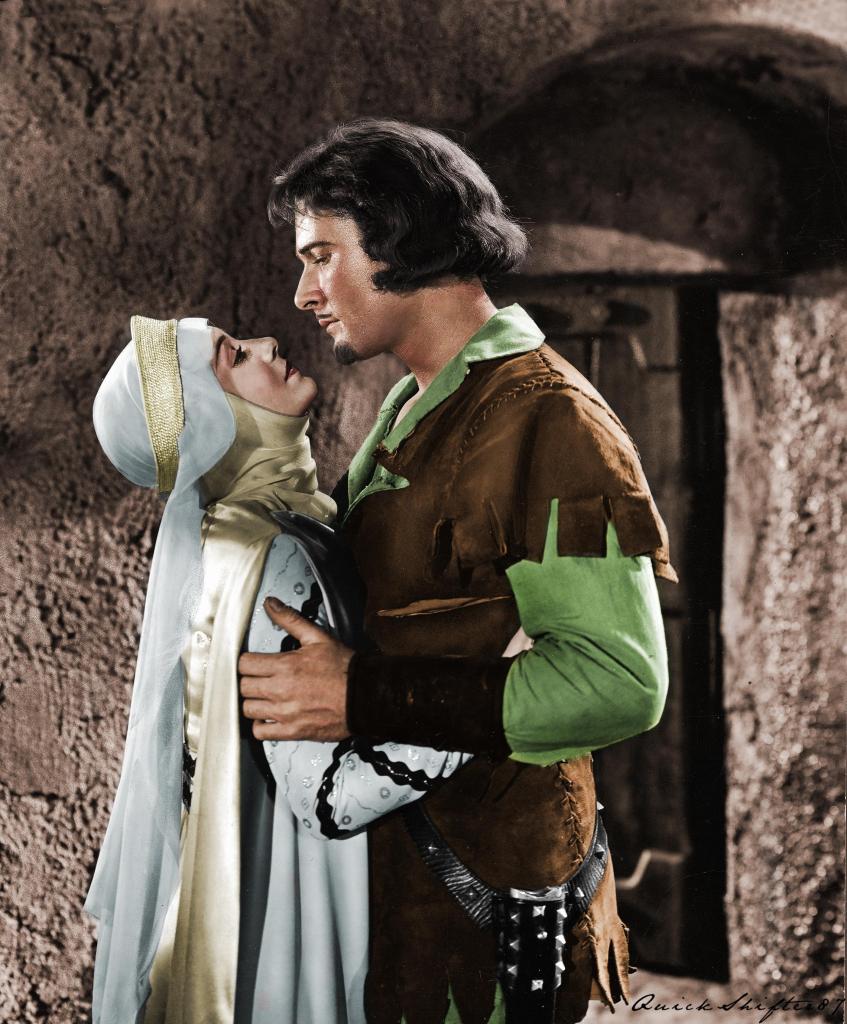
Above, Errol Flynn and his first wife, actress Lili Damita. They had only married that year and would divorce in 1942. At the end of the year, Errol Flynn appeared in probably his first, or second best character, depended upon the reviewer , or the viewer.
CAPTAIN BLOOD released December 28, 1935

The motion picture was directed by Michael Curtiz, who followed this movie with 1936’s, “The Walking Dead”, starring Boris Karloff. Most fans of Michael Curtiz think of this movie, another I will mention with Errol Flynn, and both 1942’s, “Yankee Doodle Dandy”, starring James Cagney, as composer “George M. Cohan”, and “Casablanca”, co-starring Humphrey Bogart, Ingrid Bergman, and Paul Henreid. These fans seem to have no knowledge that Michael Curtiz made some classic horror movies. Yet, his resume includes the first two technicolor horror movies, both co-starring Lionel Atwill, and Fay Wray, 1932’s, “Dr. X”, and 1933’s, “The Mystery of the Wax Museum”,
The screenplay was by Casey Robinson, based upon the best selling novel by Rafael Sabatini. Among his other works, Robinson wrote the screenplay for 1939’s “Dark Victory”, starring Bette Davis, and was the uncredited co-writer on 1942’s “Casablanca”.
The Swashbucklers and a Few Others:
Errol Flynn portrayed “Doctor/Captain Peter Blood”. Flynn followed this feature film with Michael Curtiz’s, 1936’s, “The Charge of the Light Brigade”, co-starring Olivia de Havilland, and Patrick Knowles. This was actually the actor’s second feature film for Curtiz. Two motion pictures, and the above mentioned short subject earlier. Had found Flynn with 13th billing in the director’s 1935 “Perry Mason” mystery, “The Case of the Curious Bride”.

Olivia de Havilland portrayed “Arabella Bishop”. This was de Havilland’s fourth motion picture. She had just been in the 1935 version of English playwright William Shakespeare’s, “A Midsummer Night’s Dream”, with James Cagney, Mickey Rooney, Dick Powell, Joe E. Brown and others. Olivia de Havilland’s next motion picture would have her co-starring with Fredric March and Donald Woods, in 1936’s, “Anthony Adverse”.

Lionel Atwill portrayed “Colonel Bishop”. Atwill had just been in director Tod Browning’s, 1935, “Mark of the Vampire”, the remake of Browning’s silent, 1927, “London After Midnight”, starring Lon Chaney. Lionel Atwill would follow this feature with 1936’s, “Lady of Secrets”. My article is “Lionel Atwill: The Legitimate Stage, Classic and Not So Classic Horror, and ‘Sherlock Holmes” found at:
https://www.bewaretheblog.com/2024/04/lionel-atwill-legitimate-stage-classic.html

Basil Rathbone portrayed French pirate “Levasseur”. Rathbone followed this feature with the comedy drama, 1936’s, “Private Numbers”, co-starring with Robert Taylor and Loretta Young. That film would be followed with the role of “Tybalt – Nephew to Lady Capulet”, in the 1936 film version, of William Shakespeare’s, “Romeo and Juliet”. My article is “Basil Rathbone: From the Boer War to ‘The Ghost in the Invisible Bikini” to read at:
https://www.bewaretheblog.com/2023/05/basil-rathbone-from-boer-war-to-ghost.html

Above, J. Carrol Nash portraying “Cahusac” and Basil Rathbone.
Ross Alexander portrayed “Jeremy Pitt, Blood’s friend and navigator”. This was only Alexander’s tenth of seventeen film roles. Ross Alexander died on January 2, 1937, at the age of twenty-nine.

Guy Kibbee portrayed “Henry Hagthrope, Master Gunner”. Character actor Kibbee started on-screen in 1929. In 1936, he was in Freddie Bartholomew’s, “Little Lord Fauntleroy”, and had the title role in Shirley Temple’s, “Captain January”. Back in 1933, he was in the James Cagney, Joan Blondell, Ruby Keeler, and Dick Powell , musical., “Footlight Parade”, and in 1934, Guy Kibbee was in the cast of Al Jolson’s, “Wonder Bar”.

The Basic Story:
In 1685 England, physician “Dr. Peter Blood” is summoned to the house of “Lord Gildoy”, portrayed by David Cavendish, billed as Dennis D. Auburn. Who is in need of medical treatment from being wounded as a participant in the “Monmouth Rebellion”. Where a group of Protestants, led by James Scott, 1st Duke of Monmouth, the eldest illegitimate son of the late King Charles II, King of Scotland and England, was attempting to overthrow the newly crowned King James II. The reason for the rebellion was that James was Catholic.
“Peter Blood” does not finish his treatment, before he is arrested. “Blood” and others are charged for treason against “King James II” and convicted in the court of “George Jeffreys, 1st Baron Jeffrey, known as “The Hanging Judge”, portrayed in this picture by Leonard Mudie, and sentenced to death.

However, “Robert Spencer, 2nd Earl of Sunderland”, portrayed by Haliwell Hobbes, who represents the king, has “Peter Blood’ and others transported to the West Indies to be sold into slavery.
In Port Royal, “Dr. Peter Blood’s” rebellious nature attracts “Arabella Bishop”, the niece of the local military commander, “Colonel Bishop”. She suggests “Blood” become the colony’s needed doctor, and he can treat the colony’s “Governor Steed”, portrayed by George Hassell. This gives “Dr. Blood”, except at night, almost complete freedom of movement on Jamaica.
“Blood” develops an escape plan for his fellow prisoners and himself. While he is developing an interest in “Arabella Bishop”. “Colonel Bishop” becomes suspicious of “Blood” and has “Jeremy Pitt” flogged and left without food or water tied to a pole. “Dr. Blood” is about to meet a similar fate, when a Spanish galleon arrives, and starts shelling Port Royal. “Peter Blood” leads his fellow prisoners onto the galleon, and they sail away into a life of piracy, under “Captain Blood”. At sea, he dictates to “Jeremy” a set of rules for his crew, which covers the division of the spoils the ship wins.

“Peter Blood” teams up with another pirate, the French “Captain Levasseur”. “Governor Steed” is unable to control the pirate situation around Jamaica, and “Colonel Bishop” is appointed the new governor. Next, “Bishop” sends his niece “Arabella” back to England, three-years-later, she is returning. Her ship is attacked by “Levasseur” and “Arabella Bishop” is taken prisoner along with royal emissary “Lord Willoughby”, portrayed by Henry Stephenson, seen below left.
“Captain Blood” and his crew meet “Captain Levasseur” on an island. “Blood’s” crew and the Frenchman want to hold “Arabella” and “Lord Willoughby” for ransom. In a conning move, “Peter” convinces “Levasseur” to sell the two to him. Even after accepting “Blood’s” payment for his two prisoners, the Frenchman still objects to not holding them for ransom. One thing leads to another, and Basil Rathbone finally is able to show off his military trained swordsmanship in a duel with Errol Flynn, that choreographed.


“Blood” now orders his ship and crew to sail to Port Royal, with his them still believing their two prisoners will be ransomed. “Blood” knows the real danger to all of them, but they are stopped within the sight of Port Royal. In the distance, French ships are attacking the port without any defense coming from the shore. It is apparent to “Peter Blood” that “Colonel Bishop’s” obsession with capturing him has left the port undefended.
“Lord Willoughby” asks “Blood” to fight the French, but receives a reply from the crew and their captain that they will not fight for “King James II”. At which point, “Lord Willoughby” informs them that “James” is no longer on the throne. He was kicked out of England and fled to France, and good “King William Henry”, now “William III”, aka: “William of Orange”, rules.
Having “Arabella” and “Lord Willoughby” taken to a safe place on shore undetected by the French ships. “Captain Peter Blood” has the French flag raised to confuse the enemy, and attacks the French ships. “Blood’s” ship moves between the unsuspecting French, then, lowering the French flag, he orders that the Union Jack be raised. “Peter Blood” wins the battle and the day. “Colonel Bishop” finally returns after searching the waters for “Blood”, is arrested for deserting his post during a time of war, and meets the new governor of Jamaica, “Doctor Peter Blood”. ho also gets “Arabella Bishop” to admit that she has always been in love with him.
The question now raised, could you call a motion picture that takes place during the reign of King Richard, Coeur de Lion (The Lion Heart)? The answer is yes, because of the way it is presented.
THE ADVENTURES OF ROBIN HOOD released May 12, 1938 as a “Limited Engagement”
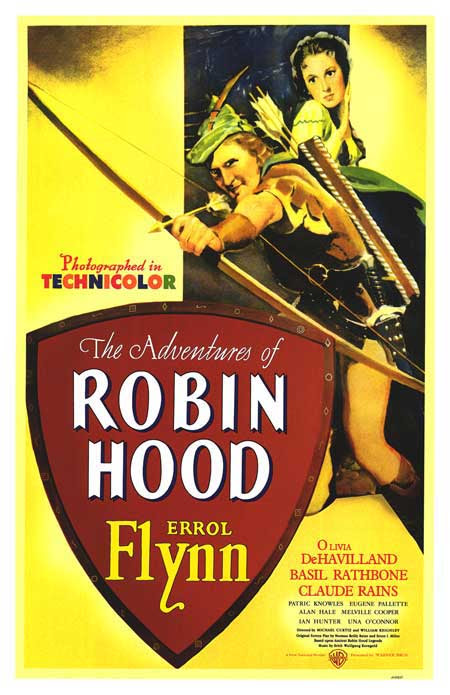
The screenplay was based upon the “Robin Hood Legends”, by three writers. Norman Reilly Raine had previously co-written 1937’s, “Life of Emile Zola”. He would go on to co-write the 1951, American version of director Fritz Lang’s,1931, classic “M”, that starred an unknown Peter Lorre.
Seton I. Miller would co-write the Errol Flynn, Basil Rathbone, and David Niven, First World War British aviation, 1938’s, “The Dawn Patrol”.
The uncredited third writer was Rowland Leigh, he co-wrote the Errol Flynn and Olivia de Havilland’s, 1936, “The Charge of the Light Brigade”.
First Trivia: The film was originally written for James Cagney to portray the title character back in 1935, but Cagney walked out on his “Warner Brothers” contract.
The motion picture started as being directed by William Keighley, who directed the Errol Flynn and Claude Rains, 1937, version of Mark Twain’s, “The Prince and the Pauper”. However, Jack L. Warner replaced Keighley with Michael Curtiz, because of the lack of fast paced action.
Errol Flynn now had the title character “Sir Robin of Locksley” aka: “Robin Hood”. He was just seen in the comedy romance, 1937’s, “Perfect Specimen”, co-starring Joan Blondell, and directed by Michael Curtiz.
Olivia DeHavilland was “Lady Marian Fitzwalter” aka: “Maid Marian”. She had just appeared in 1938’s, “Gold is Where You Find It”, co-starring with George Brent and Claude Rains. She followed this feature film with 1938’s, “Four’s a Crowd”, co-starring with Errol Flynn, and Rosalind Russell.
Basil Rathbone was “Sir Guy of Gisbourne”. He had just co-starred with Gary Cooper in 1938’s, “Marco Polo”, and followed this feature, co-starring with Ronald Colman in 1938’s, “If I Were King”.
Alan Hale, Sr. was “John Little” aka: “Little John”. Second Trivia:
Alan Hale, Sr. had originally portrayed “Little John” in the 1922 silent version of “Robin Hood”, starring Douglas Fairbanks, Sr. Hale would play the role a third time, in 1950’s, “Rogues of Sherwood Forest”, starring John Derek as “Robin Hood”.

Above left to right:
Alan Hale, Sr., Basil Rathbone, Olivia DeHavilland and Errol Flynn.
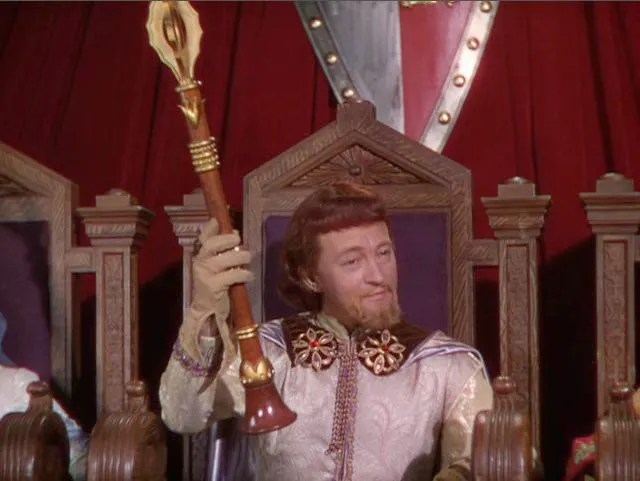
This brings me to Claude Rains as “Prince John”. While Michael Curtiz kept the pace at a fast marathon run and Flynn, Rathbone and others were acting over the top. Claude Rains would steal the picture from them. Portraying “Prince John” a delicious, wickedly evil, underplayed villain. My article, fans of the “Rocky Horror Picture Show”, is “- – – -CLAUDE RAINS WAS THE INVISIBLE MAN – – – -“ at:
https://www.bewaretheblog.com/2019/05/claude-rains-was-invisible-man.html
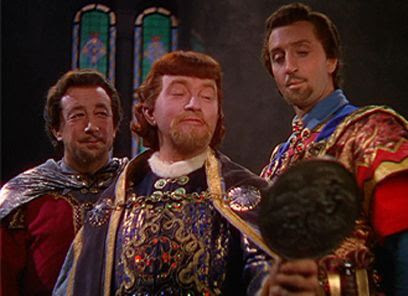
Above, look at the expression on Rains’s face. As the actor stands between Melville Cooper, as the “High Sheriff of Nottingham”, and Basil Rathbone.
The Screenplay:
The “Robin Hood Legend”, as used in motion pictures going back to the silents, was created by an American. He was author and illustrator Howard Pyle in his, “The Merry Adventures of Robin Hood of Great Renown in Nottinghamshire” published in 1883. The basic story line turned into a screenplay, has remained unchanged over decades in feature films.
Howard Pyle’s tale is set in 1191. The fictional Saxon nobleman, “Robin of Locksley”, returns from the crusades to find his home and lands taken by the Norman’s under “Prince John”.
With his brother imprisoned by “Leopold V. Duke of Austria”, and a ransom demanded to release him. “Prince John” now rules England, and is in no hurry to help “Richard”. John” has two main Norman allies. One is the aforementioned “Guy of Gisbourne”, and the other is his appointed, “Sheriff of Nottingham”.
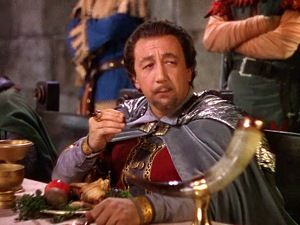
“Robin” still loves his childhood sweetheart, “Marian Fitzwalter”, but because of his situation caused by loosing his home, land, and title, is forced to become an outlaw. “Robin” meets others in “Sherwood Forest”, becomes their leader, and famously, “robs from the rich and gives to the poor”.
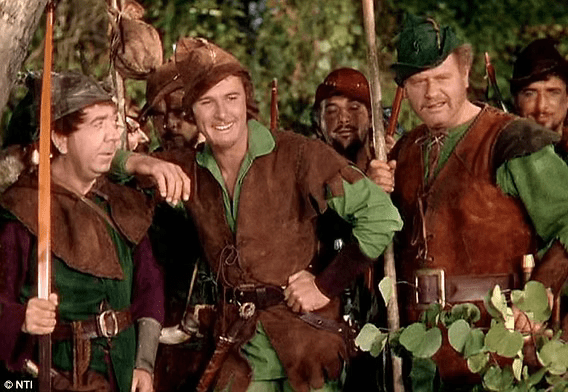
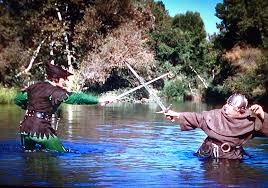
The “Outlaws” stop rich Norman land owners coming through Sherwood and rob them of their money and riches. Then distributes the wealth through to the poor, through “Friar Tuck”, portrayed by Eugene Pallete. Whom he met in the classic scene attempting to cross the same river.
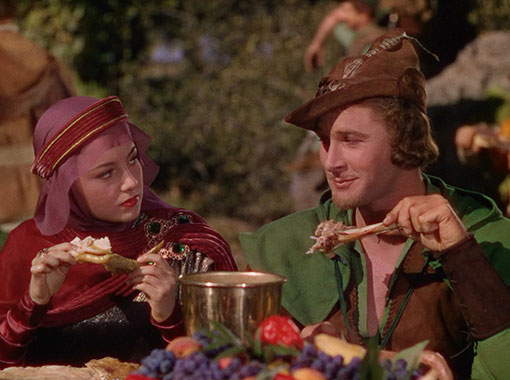
One day, “Maid Marian”, escorted by “Sir Guy of Gisbourne”, and the “Sheriff of Nottingham” enter “Sherwood”, and are attacked by outlaws swinging from trees. “Robin” lets the guards go and invites his three guests to dine on the “King’s Deer”.
While “Gisbourne” and the “Sheriff” are forced to ride wearing only their undergarments to “Prince John”. While the two sit backwards on their horses. “Robin” is given the opportunity to make amends with “Marian”, and show her the truth of what is happening to the poor.
“Prince John” rules by cunning. Setting one person against another, and playing both “Locksley” and “Grisbourne” as fools, if it suits him. His only fear is the release and return of “Richard”.

“Prince John” calls for an archery tournament with a golden arrow as the prize, and a new entry appears with his faced hard to see clearly from the stands. It is obvious to “Prince John” that he is “Robin Hood”
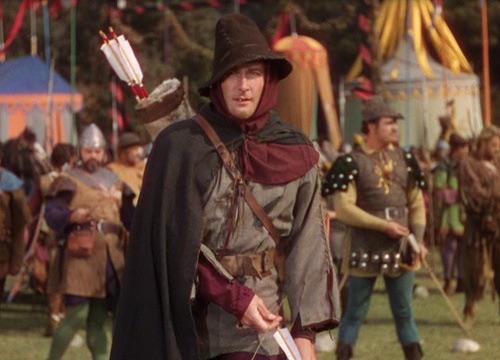
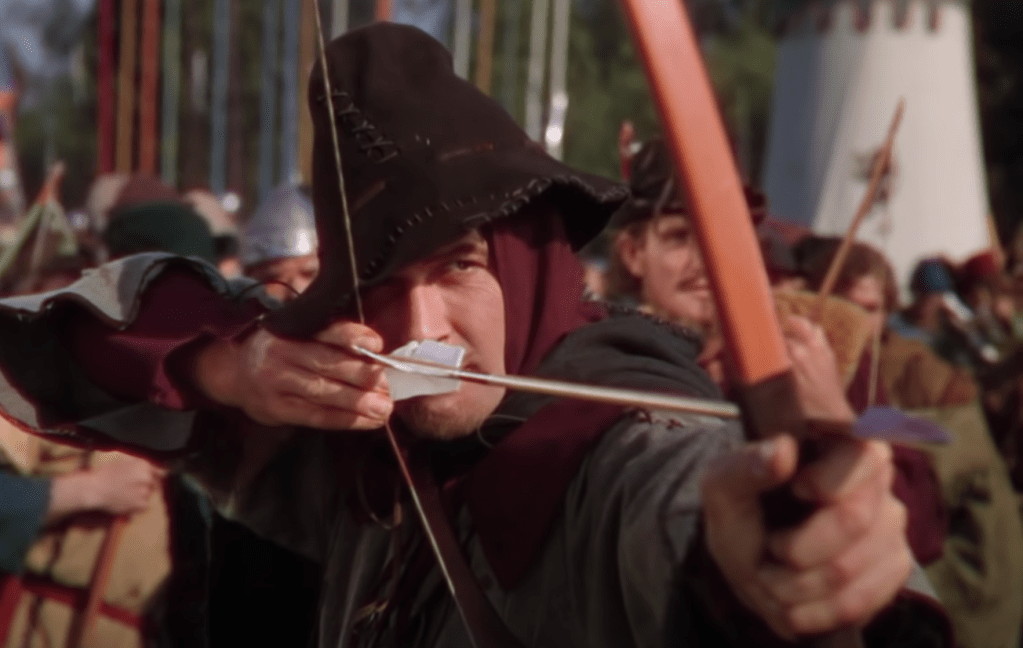
Below, note Claude Rains’s smirk, as he awards “Robin of Locksley” the prize at the archery contest and lets loose his not so hidden men. Who meet “Robin’s” not so hidden men. Of course “Robin” gets away to “Maran’s” joy.
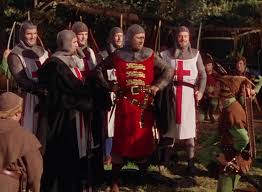
Next, several men covered in long riding coats enter “Sherwood Forest” and are caught and invited to enjoy the “King Richard’s” diner and donate to the poor. However, after eating and learning what they believes, that the “Outlaws” are loyal to the King fighting in the “Holy Land”. The coats are dropped and “King Richard the Lion Hearted” is revealed.
Now, the loyal Saxon Outlaws of “Sherwood Forest” join with the true King of England and go to confront his bother.
Below, the freed “King Richard” brings “John’s” rule to an end, but not without a final battle to keep the power that his brother brought to the Prince who would be King.


Throughout the story, “Robin” has one major enemy and it is not “Prince John”, but “Guy of Gisbourne”. At the climax, they have an often copied sword fight, in which “Locksley” kills “Gisbourne”. In fact, the June 21, 1991, Walt Disney Pictures, “The Rocketeer”, not only recreates the scene, but has actor Timothy Dalton portraying actor “Neville Sinclair”, a parody of Errol Flynn, but ads the rumor that the real Flynn was a spy for the Nazi’s. Found in biographer Charles Higham’s, 1980, “Errol Flynn: The Untold Story”.
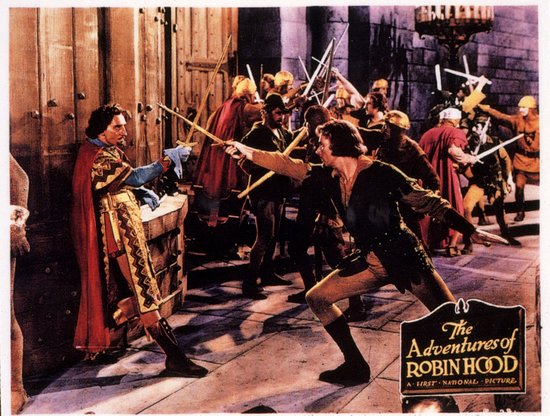
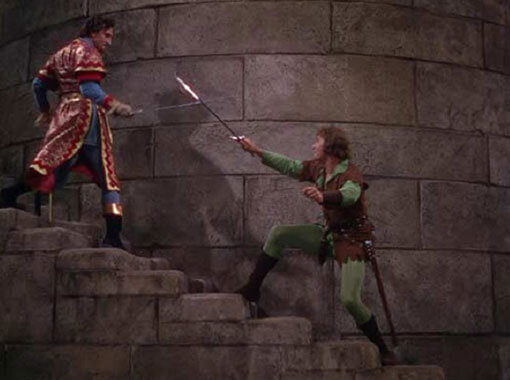
In the end, “Richard” restores the title, the land, and the wealth of “Sir Robin of Locksley” and of course he marries “Marian”.
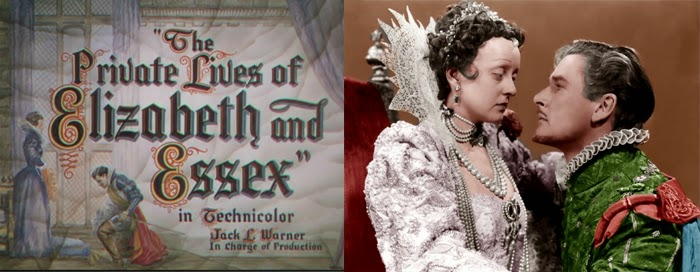
On November 11, 1939, Errol Flynn was seen by movie goers portraying Robert Devereux, 2nd Earl of Essex and Bette Davis portraying Queen Elizabeth the First, in the “Private Lives of Elizabeth and Essex”. The motion picture was directed by Michael Curtiz, and opens with the “Earl of Essex” returning to court after a major defeat of the Spanish at Cadiz. With the three principles, my reader might think this was a “Swashbuckler” set against the war between theSpanish Empire by England and its allies. However, the screenplay is rather a historical political drama that revolves around the affairs between “Lord Essex” and the English “Queen”.
Two motion pictures later, and the actor was back fighting “Philip II of Spain” against the First “Spanish Armada” in a period film, that in actuality, was a piece of pro-British Second World War propaganda.
THE SEA HAWK premiered in New York City on August 10, 1940
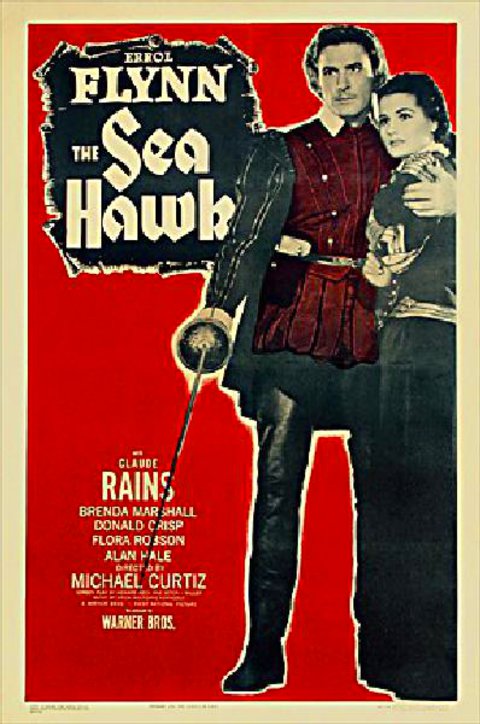
Initially the screenplay was to have been based upon Rafael Sabatini’s 1915 novel, “The Sea Hawk”. An adaption and screenplay was written by Richard Neville and Delmer Davies, then tossed out. It was decided to base the screenplay on the exploits of Sir Walter Drake, and the screenplay duties were turned over to Howard Koch, he wrote the Errol Flynn western, 1940 “Virginia City”, and Seton I. Miller, who would co-write, 1940’s, “Here Comes Mr. Jordan”, that starred Robert Montgomery, Claude Rains, and Evelyn Keyes.
No real surprise, the director was Michael Curtiz. He had just directed Errol Flynn’s, 1940, “Virginia City”. Curtiz followed this motion picture by directing Errol Flynn in the historical western, 1940’a “Santa Fe Trail”, co-starring Olivia de Havilland, and Raymond Massey.
Errol Flynn portrayed “Geoffrey Thorpe”, and would be seen before and after this role in the two Michael Curtiz directed westerns I just mentioned.
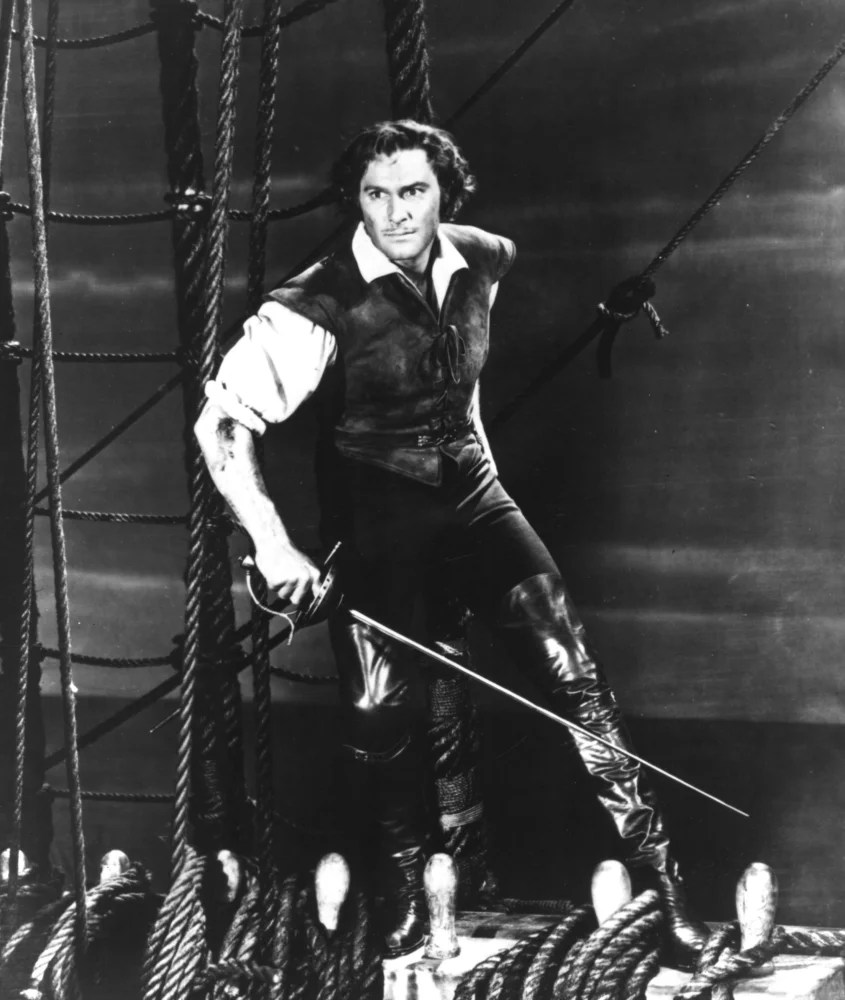
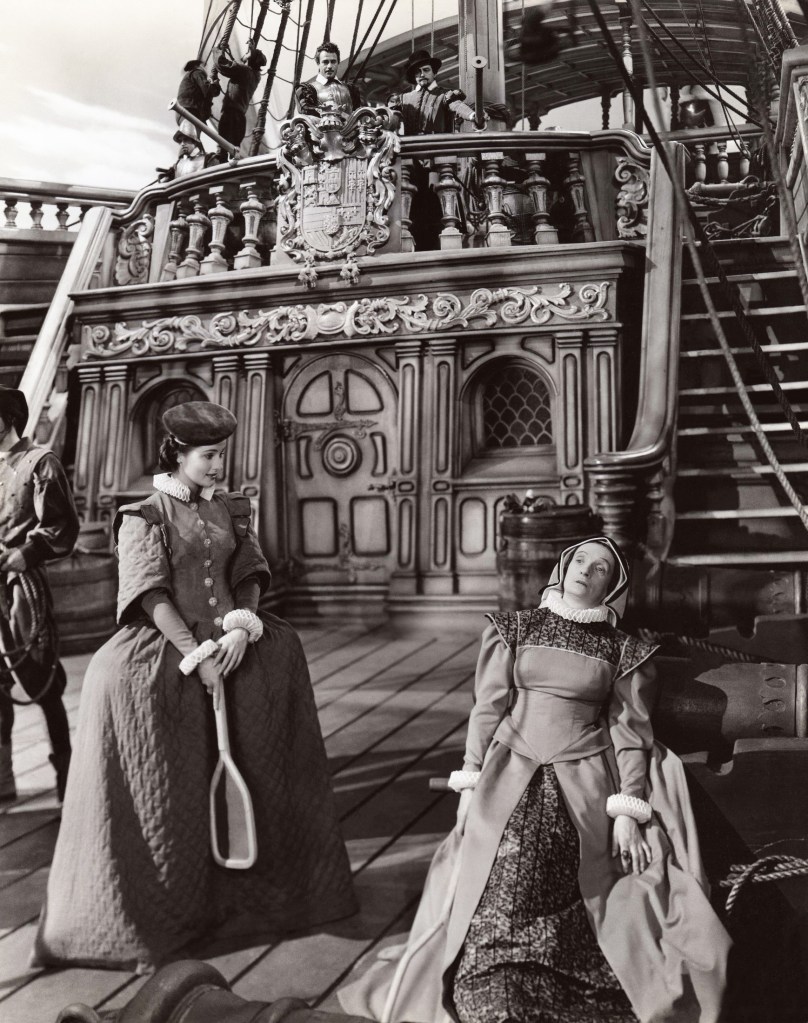
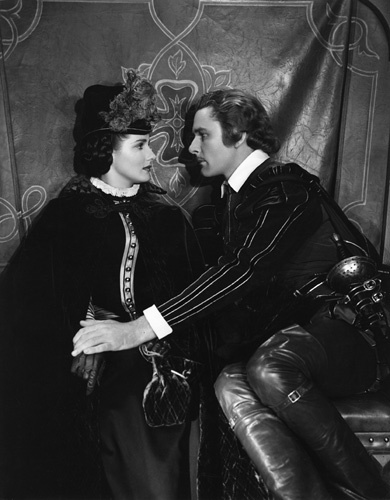
Brenda Marshall portrayed “Dona Maria”. Marshall had been born Ardis Anderson in the Philippines. Her career of 21-roles ended in a 1955 episode of “I Love Lucy”, billed under her married name as “Mrs. William Holden”. She had married the actor in 1941.
Below, Claude Rains, top deck left, looks down on Brenda Marshall, who in turn, is looking at actress Una O’Connor as “Miss Latham, Donna Maria’s English Duenna (Lady in waiting).
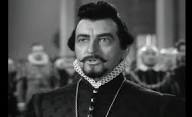
Claude Rains portrayed “Don Jose Alvarez de Cordoba”. Just prior to this film, Rains had 3rd-billing in 1940’s, “Saturday’s Children”, that starred John Garfield and Anne Shirley. His next film was the overlooked and forgotten 1940 “Lady with Red Hair”, a biography of stage and silent screen actress Caroline Louise Dudley aka: “Mrs. Leslie Carter”, portrayed by Miriam Hopkins, branded an “Adulteress” in a child custody divorce case.
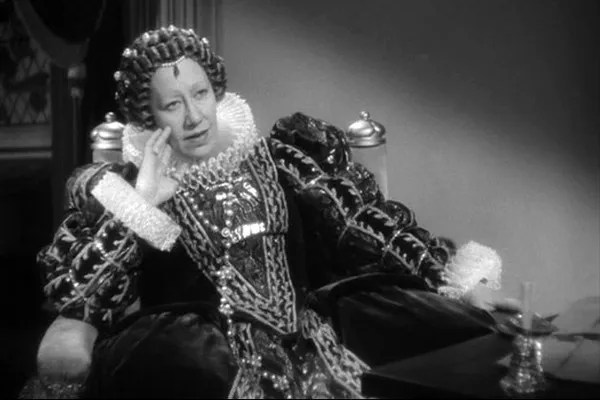
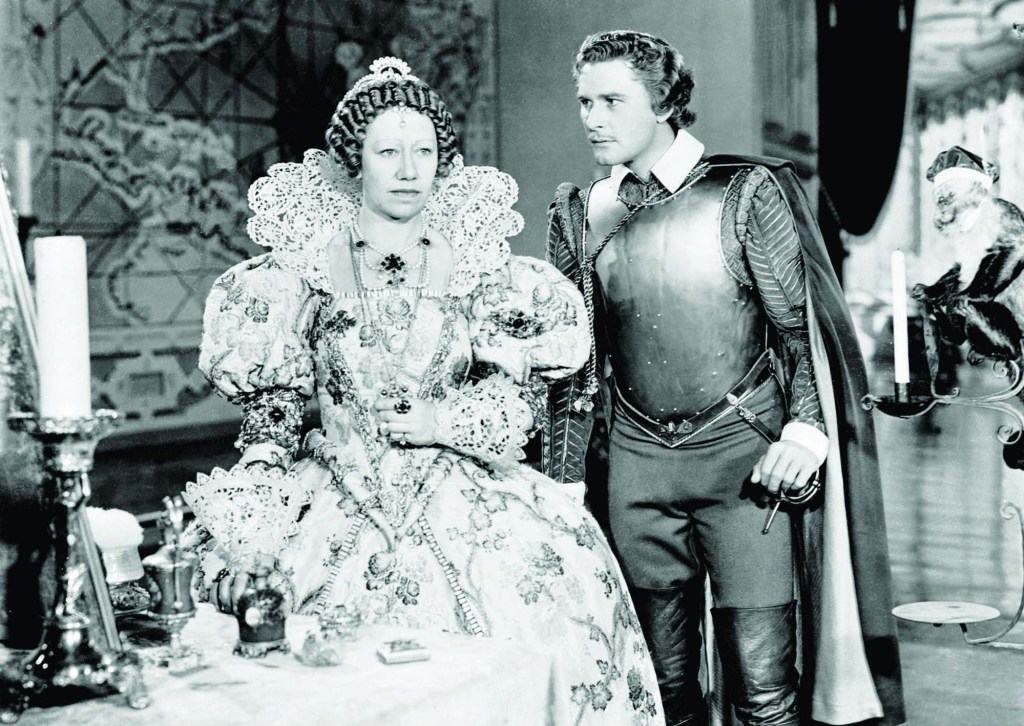
Flora Robson portrayed “Queen Elizabeth the First”. Robson had just been seen in the film-noir heist drama, 1939’s “Invisible Stripes”, starring George Raft, Jane Bryan, and William Holden.
The Story:
“King Philip II”, portrayed by Montague Love, announces to his court his intentions to destroy England and its Queen This is to be the Spanish King’s first step toward world domination and he orders the building of a great armada to lead his conquest.
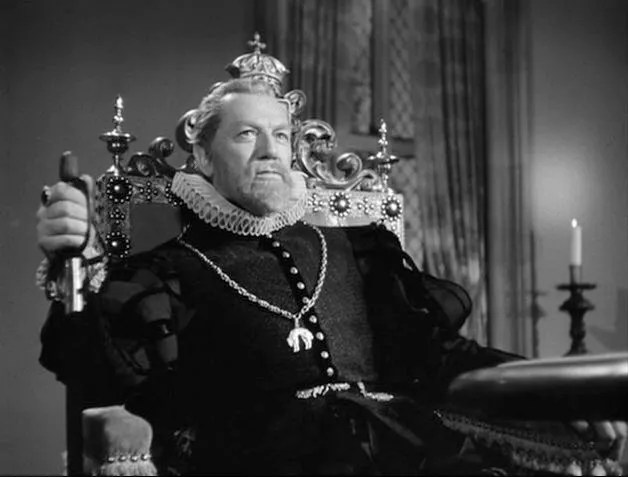
“Philip” sends “Don Alvarez” to England as Spain’s ambassador to “Queen Elizabeth”. It is up to “Alvarez” allay any suspicions she may have about “Philip”. Accompanied by his niece “Donna Maria”, the two leave Spain for England. However, in-route , the Spanish ship is met by the English privateer ship, the “ALBATROSS”, under the command of “Geoffrey Thorpe”, and “Don Alvarez” and his niece are taken on-board the privateer and will be taken to England. An English crew is placed on-board the Spanish galleon to have it escort the “Albatross”.
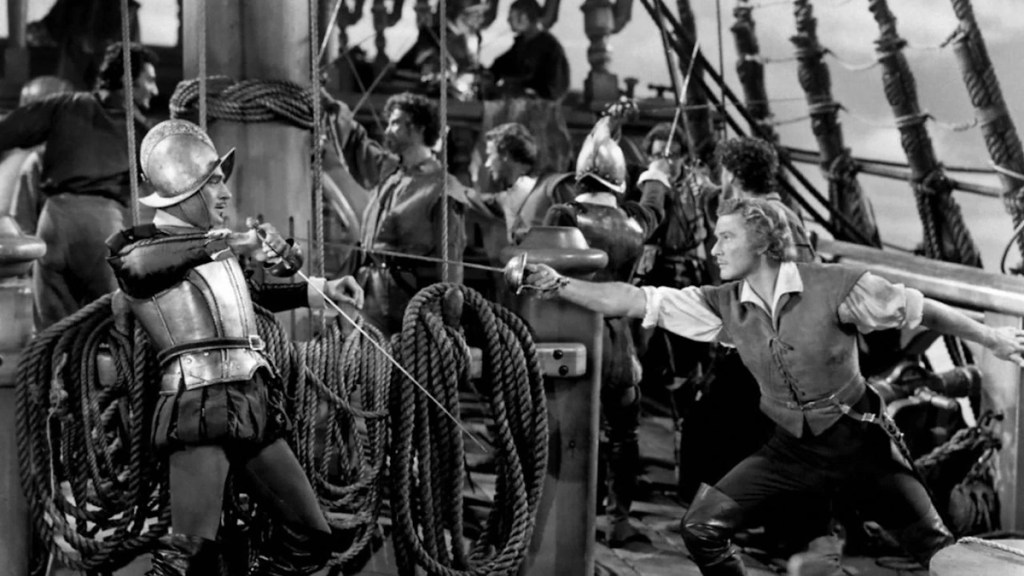
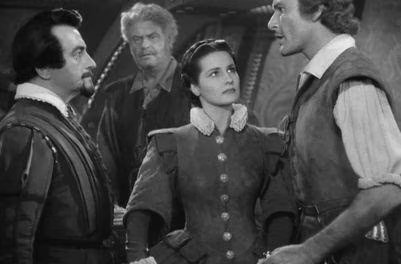
During the short voyage, “Thorpe” has become infatuated with “Donna Maria”. In a gesture, he returns to her, all the jewelry the English crew had removed from their Spanish galleon. “Dona Maria” is also starting to fall in love with the British privateer.
Back in England, “Don Alvarez” complains about his ship being attack by “Geoffrey Thorpe” and the “treatment” he and his niece were forced to endure. “Elizabeth” calls before her and the court all of the British privateers in port and scolds them for attacking Spanish merchant ships. All for public show, but in reality, “Queen Elizabeth” not only supports their actions, but finances them.
In private, “Captain Thorpe” proposes a plan to capture the Spanish treasure ships returning from the America’s. “Elizabeth” is wary of “Geoffrey’s” plan, but in the end endorses it.
Within the English court is “Lord Wolfingham”, portrayed by Henry Daniell, hears of the plan, but is also a Spanish spy.
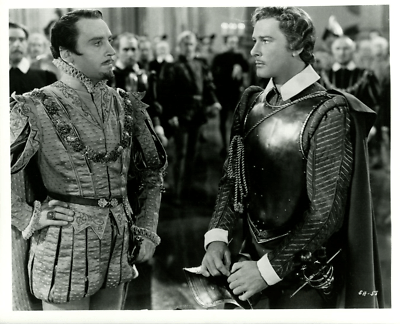
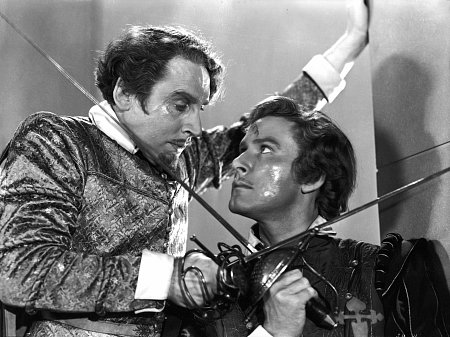
Above left, Henry Daniell confronting Erroll Flynn in the English court.
“Wolfingham” sends a spy to find out where the “Albatross” is really going.
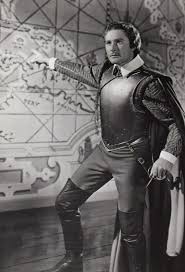
After getting information, both “Lord Wolfingham” and “Don Alvarez” visit the chart maker than “Captain Thorpe” visited several times. There they learn that he plans to sail to the “Isthmus of Panama”. The two conspirators now order the captain of “Don Alvarez’s” ship, which “Queen Elizabeth” returned as a sign of good faith on her part, to sail and set up an ambush of the “Albatross”.
When the “Albatross” reaches its destination, they are spotted a head of the ship’s arrival, and “Captain Geoffrey Thorpe” and his crew fall into a well laid out trap. However, before they’re captured, members of the British privateer go ashore and capture the Spanish caravan loaded with spoils. The trap is sprung and the Englishmen are driven into the Panamanian swamps. “Geoffrey Thorpe” and some of his crew escape back out of the swamps, but are captured and taken as prisoners about a Spanish galleon.
In Spain, “Captain Thorpe” and his crew are put on trial by the “Tribunal of the Holy Office of the Inquisition” and condemned to be a galley slave.
On the Spanish galleon, “Thorpe” meets “Abbott”, portrayed by James Stephenson, a British spy attempting to uncover what the Spanish armada is really for, and during the night. The prisoners are able to take over the ship and board a second one, carrying secret Spanish plans.
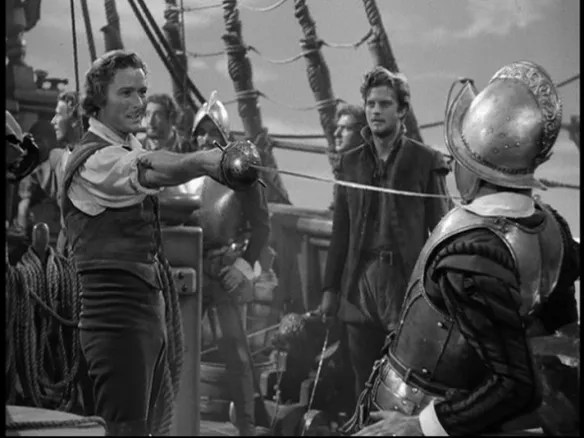
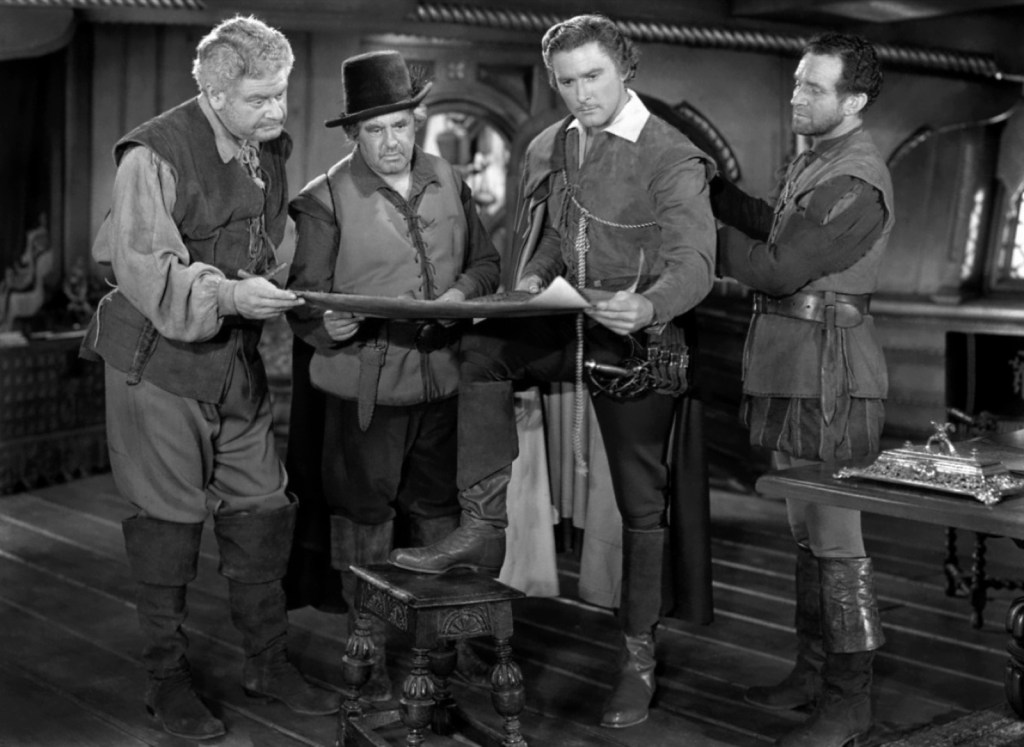
“Captain Thorpe” and the escaped prisoners will sail both ships back to England. “Geoffrey” wants to get the secret plans to “Queen Elizabeth”, but arriving in port. A carriage pulls up to the ship “Captain Thrope” is on, and out comes “Don Alvarez” and he boards the Spanish ship “Alvarez” believed was sent to take him back to Spain. He is captured, and “Trope” now enters the carriage to find “Donna Maria”, who wanted to stay in England.
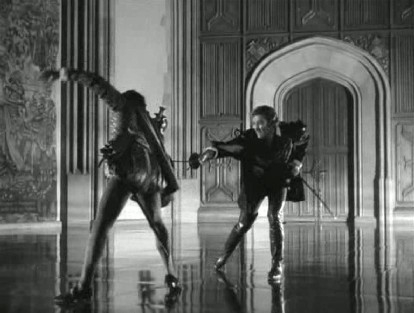
However, “Lord Wolfingham’s” spy spots “Thrope” and alerts the palace guard’s, on the Lord’s authority, to take him prisoner. “Geoffrey Thorpe” escapes and fending off palace guards is able to enter “Queen Elizabeth’s” residence. He is confronted by “Wolfingham” and a sword fight follows ending with the death of the traitor.
With the help of “Donna Maria”, “Captain Geoffrey Thorpe” reaches “Queen Elizabeth the First”, and hands her the proof of “King Philip’s” true intentions.
The “Queen” knights “Sir Geoffrey Thorpe” and announces her intention to build a great Navy to fight the “SPANISH ARAMDA”.
Either reading the above, or seeing “THE SEA HAWK” today. My reader might think this was just another “CAPTAIN BLOOD” for Errol Flynn. In actuality this was a “British Second World War Propaganda Motion Picture”.
The purpose of the story was to build up British morale and influence the United States. “King Philip II” was written, and portrayed, as an allegorical ADOLF HITLER!
At the film’s end, “Queen Elizabeth” gives her subjects a speech against the danger coming from “King Philip” . However, as written and spoken by Flora Robson, was really meant to inspire the current British population. Who was already fighting the German’s in the Second World War, but also to build support for England in America.
In her speech were direct words that it is the duty of all free men to defend liberty, and that the world did not belong to any one man.
It would be eight-years before Errol Flynn made another swashbuckler of sorts. A film known for the intensity of its sword fights, and amount of such fights. This motion pictures has beat out any other such sword fighting films during this eight year period. While many film historians compare the next feature to only one other movie, 1940’s “The Sea Hawk”!
ADVENTURES OF DON JUAN premiered in New York City on December 28, 1948
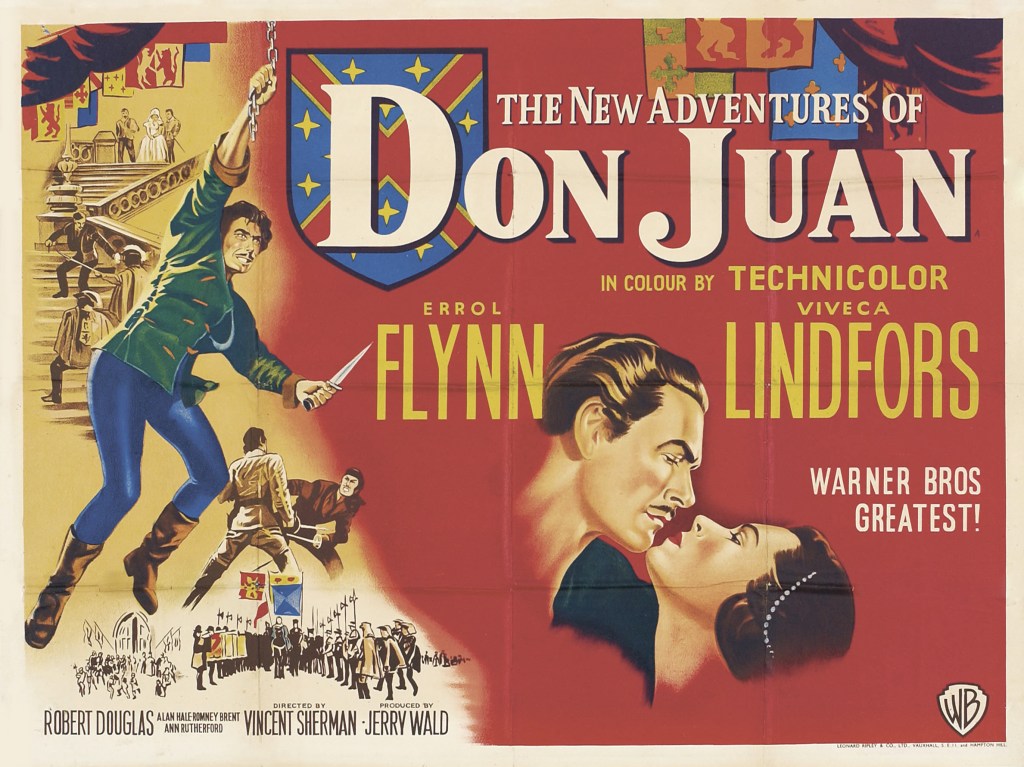
I picked this poster because of the title change. In South Africa the word “New” has been added. There are at least 25-countries that initially showed this feature, and with the exception of South Africa. The translations of the above title became “Adventures of Don Juan”.
The story is credited to Herbert Dalmas, who started as one of four screenplay writers for “Universal Pictures” on the Chapter Serial, 1938’s, “Flash Gordon’s Trip to Mars”. Just prior to this feature, Dalmas co-wrote the 1947 western, “Last of the Redmen”, starring Jon Hall and Evelyn Ankers. The screenplay had two credited and two uncredited writers. The credited two writers were George Oppenheimer, who had just turned Mickey Rooney into a professional boxer, in 1947’s “Killer McCoy”. Harry Kurnitz had just co-wrote the Ava Gardner and Robert Walker, 1948, fantasy, “One touch of Venus”. While the two uncredited writers were extremely interesting. The first was novelist William Faulkner, and the second was Robert Florey, whose screenplays included Bela Lugosi’s, Edgar Allan Poe’s, 1932, “Murders in the Rue Morgue”, and both director James Whale’s, 1931, “Frankenstein”, and 1935’s, “Bride of Frankenstein”.
Vincent Sherman was the director and had just directed Ann Sheridan and Kent Smith in 1947’s, “Nora Prentiss”. He followed this picture with 1949’s, “The Hasty Heart”, starring Ronald Reagan, Patricia Neal, and Richard Todd.
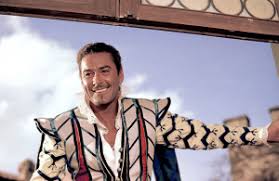
Errol Flynn portrayed “Don Juan de Maraña”. Flynn had just been in a western directed by “One-Eyed” Raul Walsh,1948’s, “Silver River”, co-starring with Ann Sheridan and Thomas Mitchell. Errol Flynn followed this film co-starring with Greer Garson, Walter Pidgeon, and Robert Young in 1949’s, “That Forsyte Woman”.
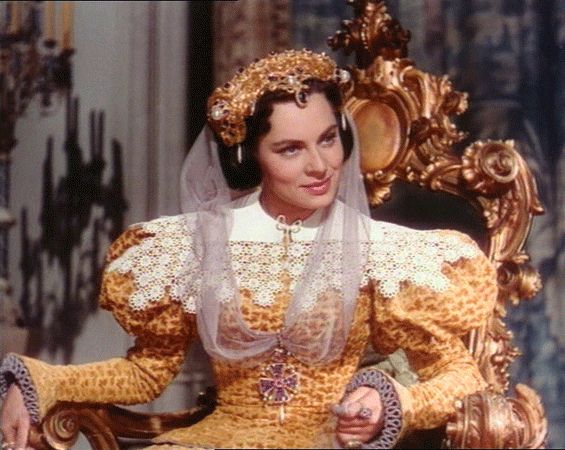
Viveca Lindfors portrayed “Queen Margaret”. Lindfors had just been seen in the post Second World War drama, 1948’s, “To the Victor”, co-starring with Dennis Morgan. The motion picture was written by future director Richard Brooks.
Robert Douglas portrayed “Duke de Lorca”. Douglas just co-starred with Alexis Smith in 1948, “The Decision of Christopher Blake”, about a young boy would must decided which parent he will live with after their divorce.
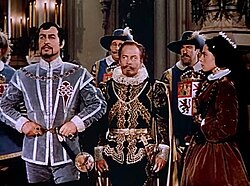
Above, Robert Douglas is on the right, Viveca Lindfors is on the right, and in the middle is Rommey Brent portraying “King Philip III”.
The Basic Story:
Errol Flynn was still in England during the reign of “Queen Elizabeth the First”, the story opens with “Don Juan de Maraña” in London, being informed that he is to be repatriated to Spain, after being involved with the English wife of a Spanish nobleman. The Spanish ambassador in London, “Don Jose, Count de Polan”, is an old family friend, and he is portrayed by Robert Warwick, who sends a letter of recommendation to Spanish “Queen Margaret”.
The “Count de Polan” has requested that the Queen provide an opportunity in her court for this rehabilitation of “Don Juan” over the gossip and scandal that has followed him all over Europe concerning his many illicit relationships, love affairs with married and unmarried women. Accepting her old friend’s recommendation, “Queen Margaret” appoints “Don Juan de Maraña” the fencing instructor to the “Royal Spanish Academy”.
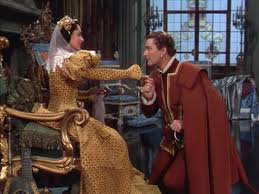
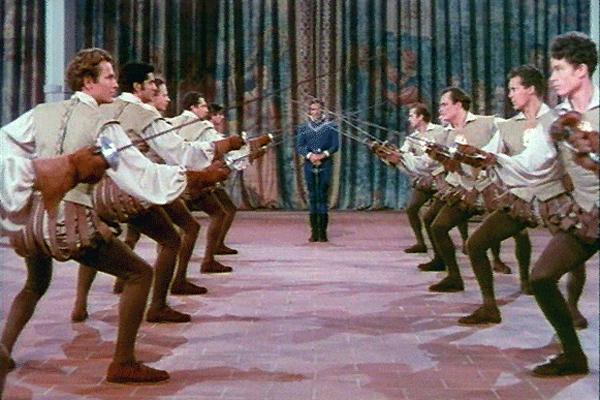
During his time at court, “Don Juan” secretly falls in love with the Queen, but remains a faithfully loyal subject to both the Queen and her weak husband, “King Philip III”.
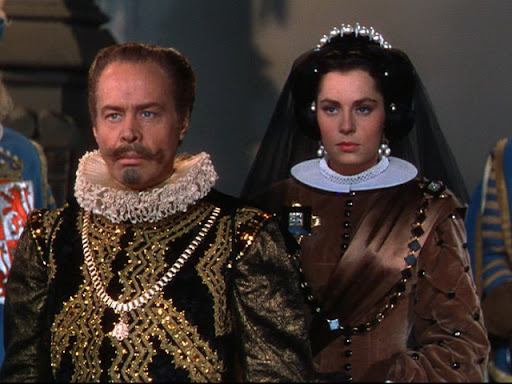
“Don Juan” discovers a treacherous plan by the “Machiavellian”, evil and conniving “Duke de Lorca”, who has “Don Jose, Count de Polan”, as his prisoner.
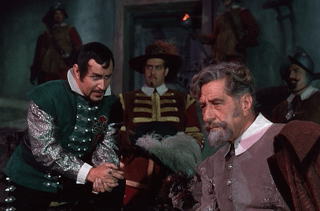
Above, left Robert Douglas, center and below, Raymond Burr as his henchman, “Captain Alvarez”, and Robert Warwick, being tortured.
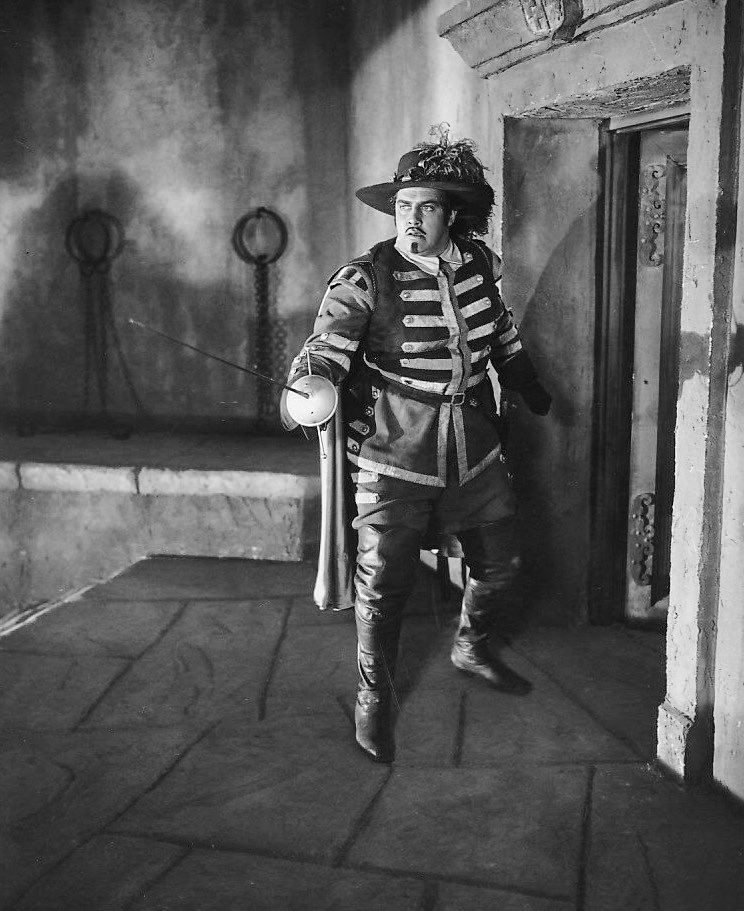
Sound familiar? The Duke is plotting to dispose the “King” and “Queen” usurp their power, and declare war on England. With the help of “Don Juan’s” many friends at the Spanish court, he is able to stop the “Duke” and fight a duel to the death.
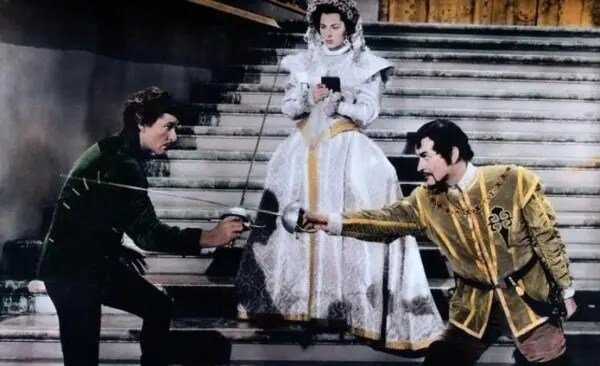
After the “Duke de Lorca” is dead and his power grab defeated by “Don Juan”, “Queen Margaret” finally reveals her love for him. However, he knows such a scandal would bring down the Spanish crown and asks to be freed of the court. Tearfully, the “Queen” agrees, and “Don Juan” leaves.
Although Errol Flynn appeared in adventurer films such as Bombay, India, born British writer, Rudyard Kipling’s “Kim” in 1950, or 1953’s, “Adventures of Captain Fabian”. It wasn’t until 1952 that he took up the sword once more.
AGAINST ALL FLAGS premiered in New York City on December 24, 1952
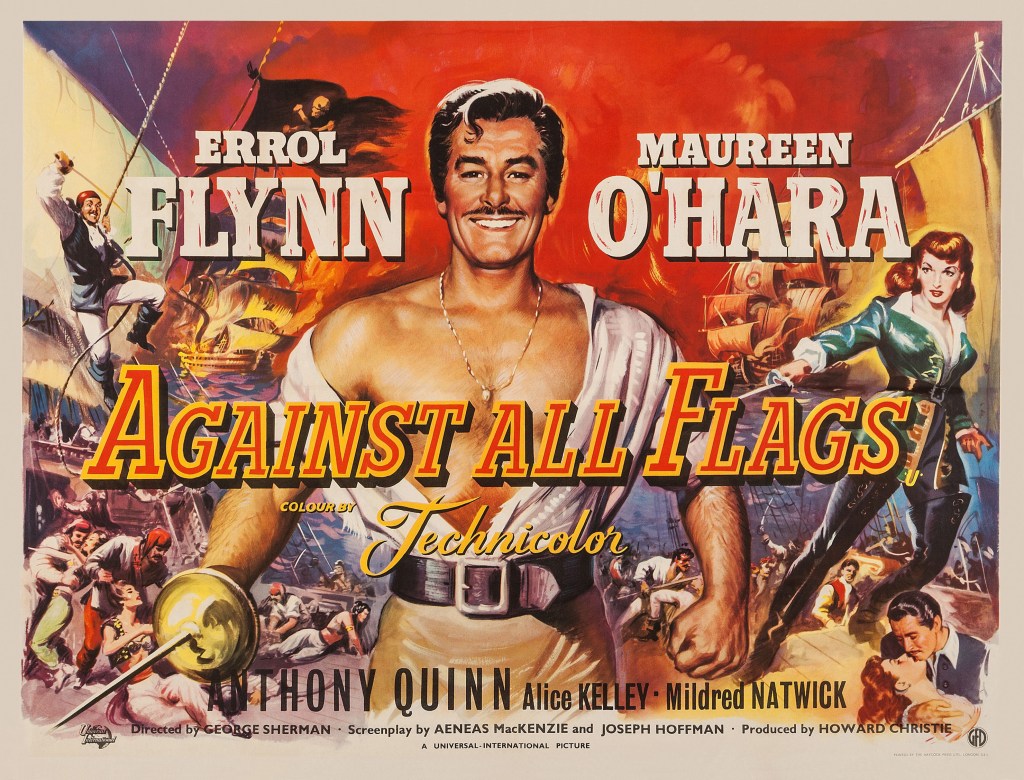
The original story writer and primary screenplay writer was Aeneas MacKenzie. He had co-written 1941’s, “They Died with Their Boots On”, starring Errol Flynn as “General George Armstrong Custer”, and Olivia de Havilland as his wife. In 1956, he was the primary screenplay writer on producer/director Cecil B. DeMille’s, “The Ten Commandments”.
Joseph Hoffman co-wrote the screenplay. He had just co-wrote, director Don Siegel’s western, 1952, “The Dual at Silver Creek”, starring Audie Murphy and Faith Domergue. Hoffman followed this motion picture with director George Sherman’s 1953 western, “The Lone Hand“, starring Joel McCrea and Barbara Hale.
This motion picture had two directors, one credited, one uncredited. The credited director was George Stevens (From January-February 1952). The uncredited director was Douglas Sirk (April 1952-additional swordplay sequences).
Errol Flynn portrayed “Brian Hawke”. Flynn had just been seen with co-stars Ruth Roman and Raymond Burr, in the film-noir adventure crime film, 1952’s “Mara Maru”. He would follow this feature film with Scottish author, Robert Louis Stevenson’s, 1953 non-swashbuckler, “The Master of Ballantrae”.
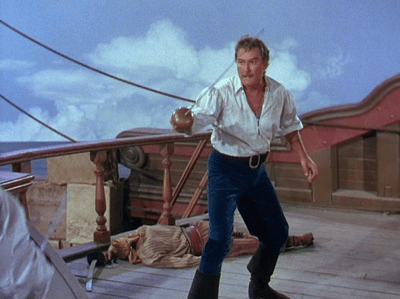
Maureen O’Hara portrayed “Prudence ‘Spirtfire’ Stevens”. This pirate feature followed director John Ford’s classic 1952, “The Quiet Man”, co-starring with John Wayne.O’Hara followed this film with the 1953 western, “The Redhead from Wyoming”, co-starring Alex Nichol.
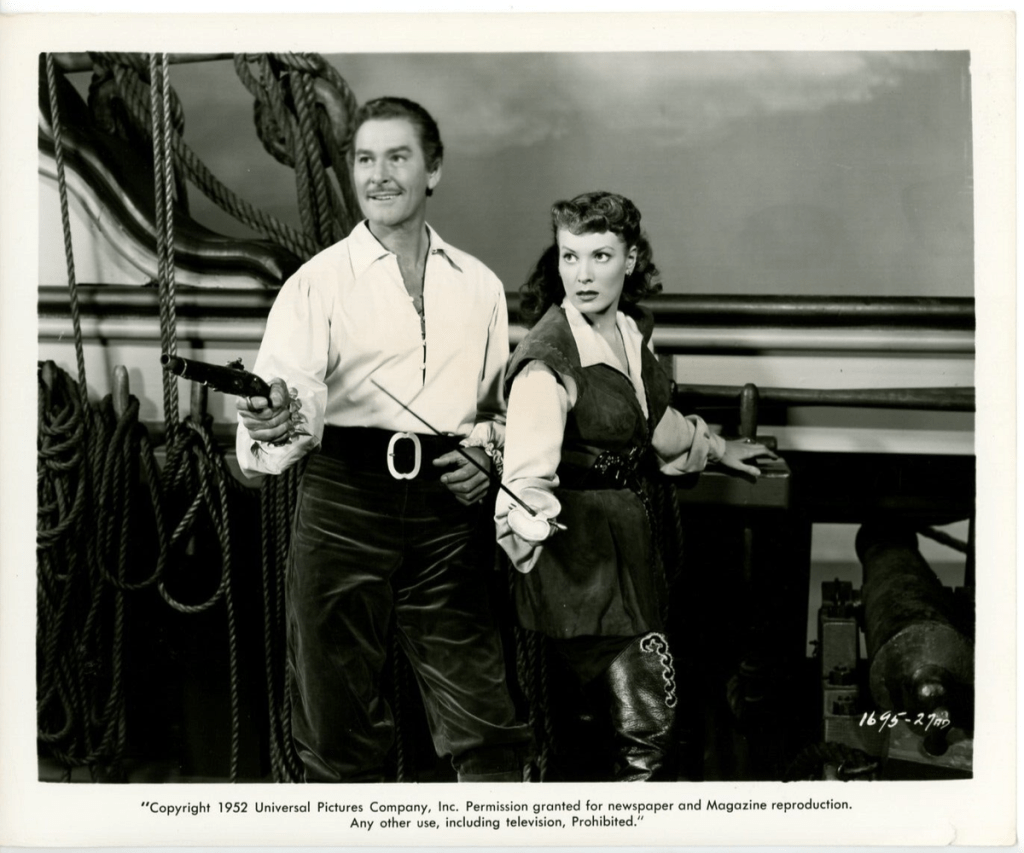
Anthony Quinn portrayed “Captain Roc Brasiliano”. Quinn had just starred in the swashbuckler, 1952’s, “The Brigand”. He followed this motion picture with 1953’s, “Seminole” co-starring with Rock Hudson and Barbara Hale.
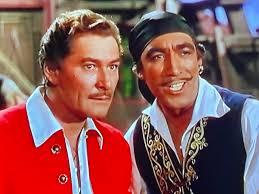
The year is 1700, the location off the coast of Madagascar, three men appear at the major pirate controlled city and arouse the suspicions of “Captain Roc Brasiliano”. One of the three, is “Brian Hawke”, actually a British Naval Officer sent to bring the pirate’s down. Along with the other two men, “Hawke” is brought in front of the “Pirate Tribunal”, but proves who he is not, by defeating another man is a sword fight. His case is dismissed and the British officer’s cover is protected and he joins “Brasiliano’s” crew.
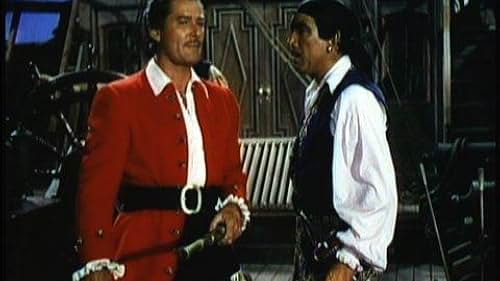
While causing the shipping lanes, “Roc Brasiliano’s” crew captures a Mughal ship. The Mughal’s were an early modern empire that rules the Indian subcontinent. The ship is loaded with a large amount of wealth, but unknown to the pirate’s is something much more valuable to them. That is “Princess Patma”, portrayed by Alice Kelley, daughter of the “Mughal Emperor”, disguised as an ordinary woman by her fast thinking chaperon. Both are left behind on “Patma’s” burning ship, but they are rescued by”Brian Hawke”, and the “Princess” falls in love, with only the third man she has ever seen, “Hawke”. However, back in Madagascar,, she finds herself being sold at auction as a slave. “Hawke” wants to protect her, but is out bid by “Captain Prudence ‘Spitfire’ Stevens”. The daughter of an honored pirate leader, and a pirate captain you do not cross. “Roc” also wants to marry her, but she will not have him.
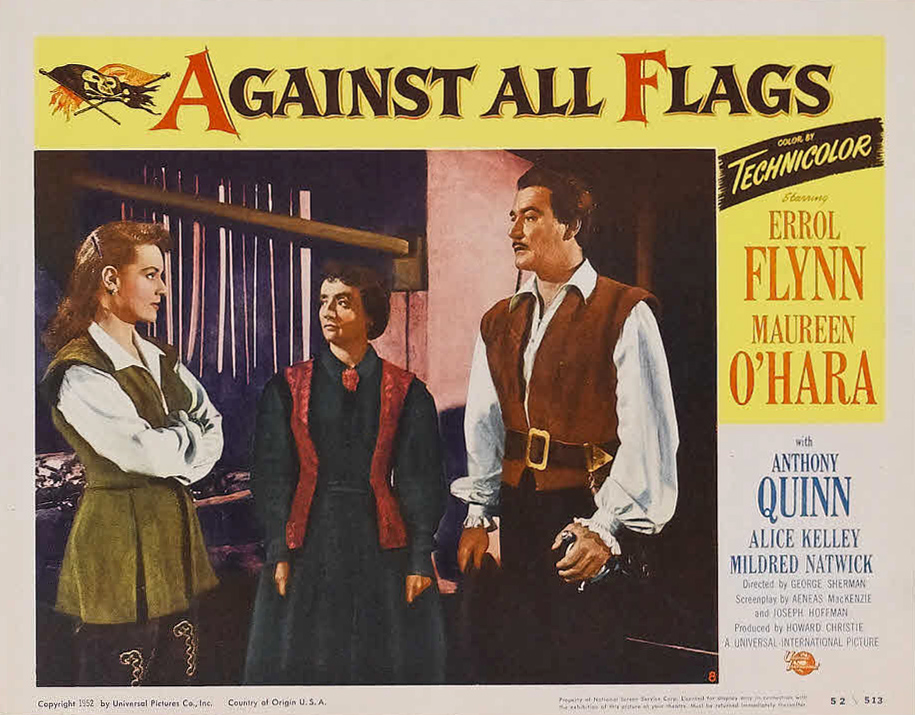
Above, Maureen O’Hara, Alice Kelley, and Errol Flynn
Later, “Prudence” tells “Brian” that she is leaving her criminal life behind and would like him to come with her to Britain vis Brazil. At the same time, “Roc” had developed a hatred for the British pirate and it growing. Neither prospect interests “Brian Hawke”, whose mind set is to complete his mission. He is able to steal a map of the pirate defenses. The plan is for a Royal Naval ship to sail into the harbor to pick up “Patma” and the map of the defenses. “Brian Hawke” is to have disabled the cannons. “Hawke” uses a flare gun to signal the British man of war that the “Princess” is ready to be picked up.
Unfortunately, the best laid plans, “Roc Brasiliano” discovered “Hawke” and the two British sailors attempt to disable the guns.
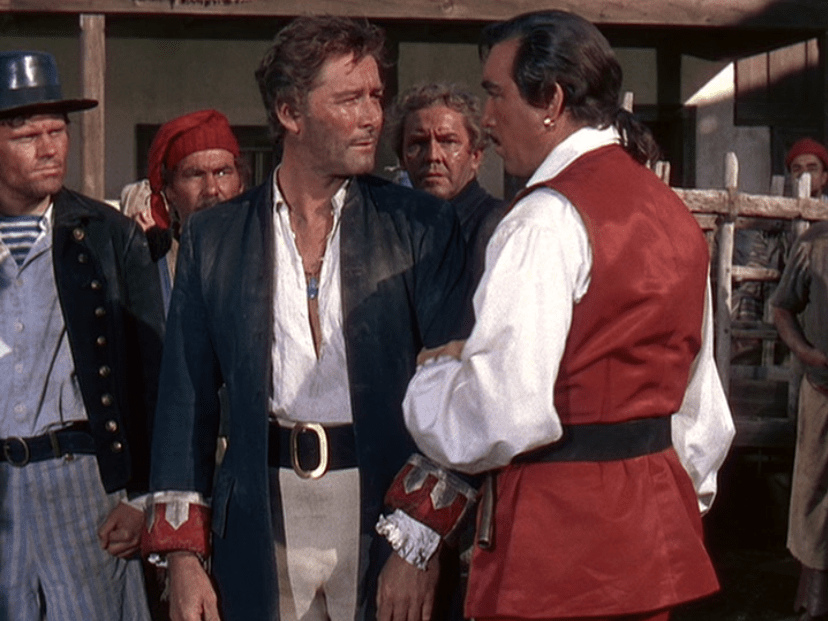
The three men are taken to the beach and buried up to their necks in the sand, awaiting both the tide coming in, and the crabs to attack their faces. However, “Spitfire” rescues the three.
At that same moment the British ship enters the harbor, followed by the pirates shooting the cannons, but surprise, “Hawke” and his team had already double-shotted them, and they explode.
Faced with defeat and execution, using “Princess Patma” as a shield, “Roc” gets aboard his ship and starts to sail away. The three British sailors have slipped on board “Brasiliano’s” ship and fight off the crew with “Spitfire’s” help, and rescue the “Princess”.
Now it is time for “Brian Hawke” to duel to the death with “Captain Roc Brasiliano”, and “Roc” is killed.
On board the British Man of War, “Brian Hawke” requests the “Prudence ‘Spirtfire’ Stevens” be granted freedom, because of all her help. His request is honored, and “Brian” and “Prudence” kiss.
By 1954, many American actors started to appear in Italian motion pictures. In that year Kirk Douglas appeared in the Italian production of Homer’s “The Odyssey” under the title, “Ulisse (Ulysses)”, Ingrid Bergman and George Sanders starred in “Viaggio in Italia (Journey in Italy)”, and Anthony Quinn and the basically unknown Sofia Lorean co-starred in “Atilia, il flagella di Dio (Attila, the Scourge of God)”. So is wasn’t out of place for Errol Flynn to star in:
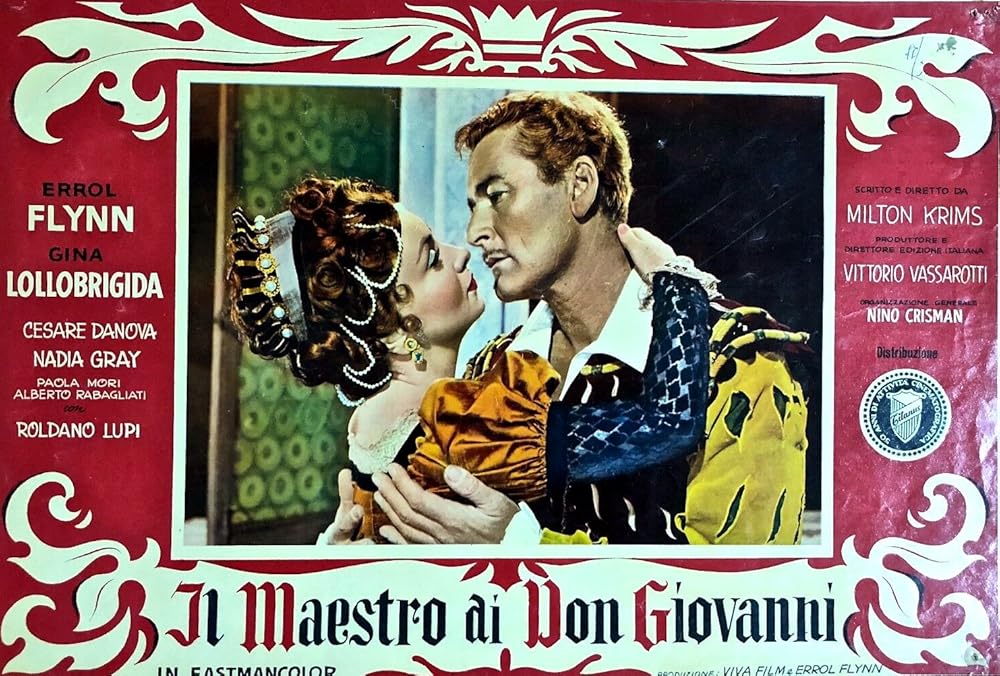
“ll Maestro di Don Giovanni (The Master of Don Giovanni)” aka: “Crossed Swords” aka: “The Teacher of Don Juan” premiered in the United States on July 28, 1954
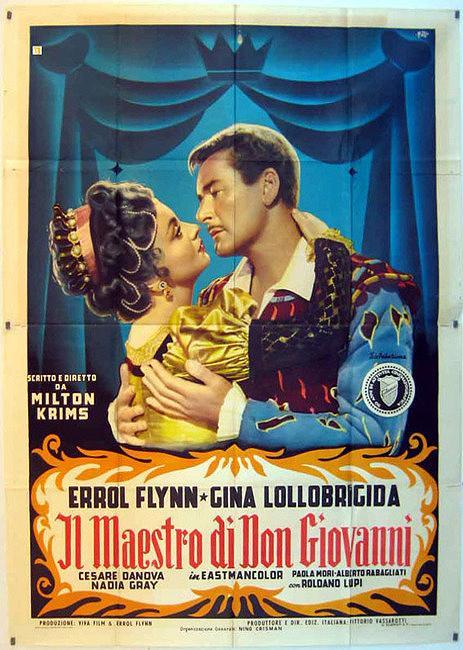
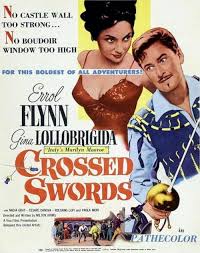
This Italian Swashbuckler was co-written, and co-directed, by New York City born, Milton Krims. Krims co-wrote the seldom seen Korean War movie, 1952’s “One Minute to Zero”, starring Robert Mitchum and Ann Blyth.
His co-writer was the uncredited, co-producer, and co-director. Italian, Vittorio Vassarotti.
Errol Flynn portrayed “Renzo”. Flynn was last seen in movie short, 1953’s, “The Story of William Tell”. The actor followed this picture with, 1954’s, “Lilacs in the Spring”, aka: “Let’s Make Up”, co-starring Ann Neagle and David Farrar.
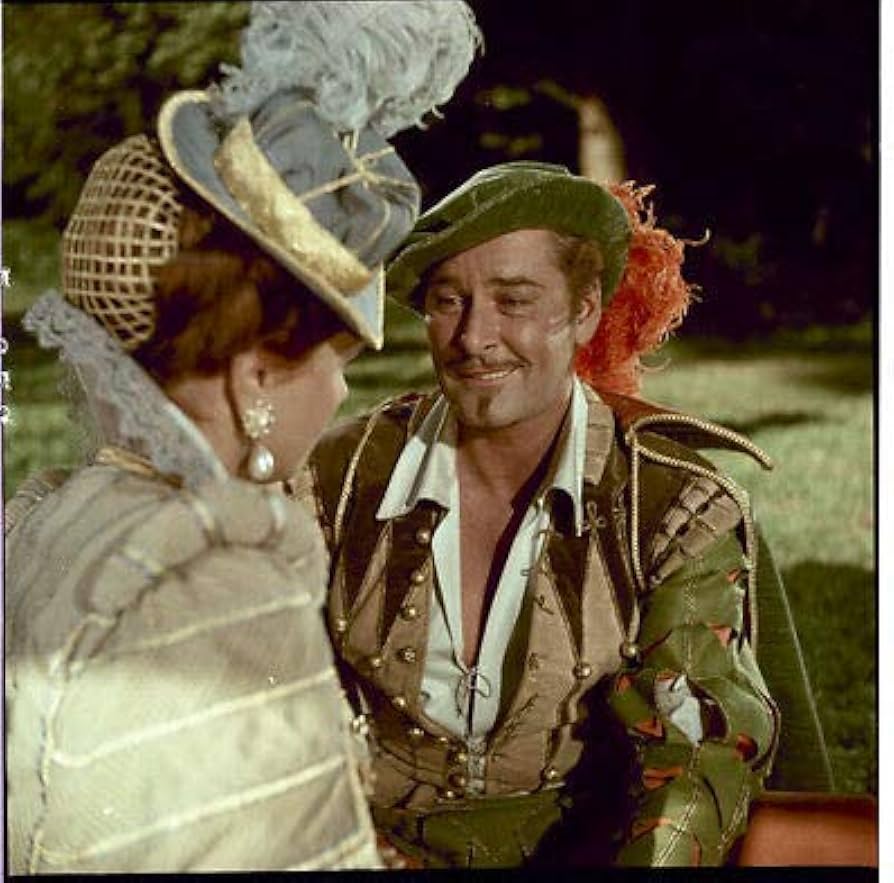
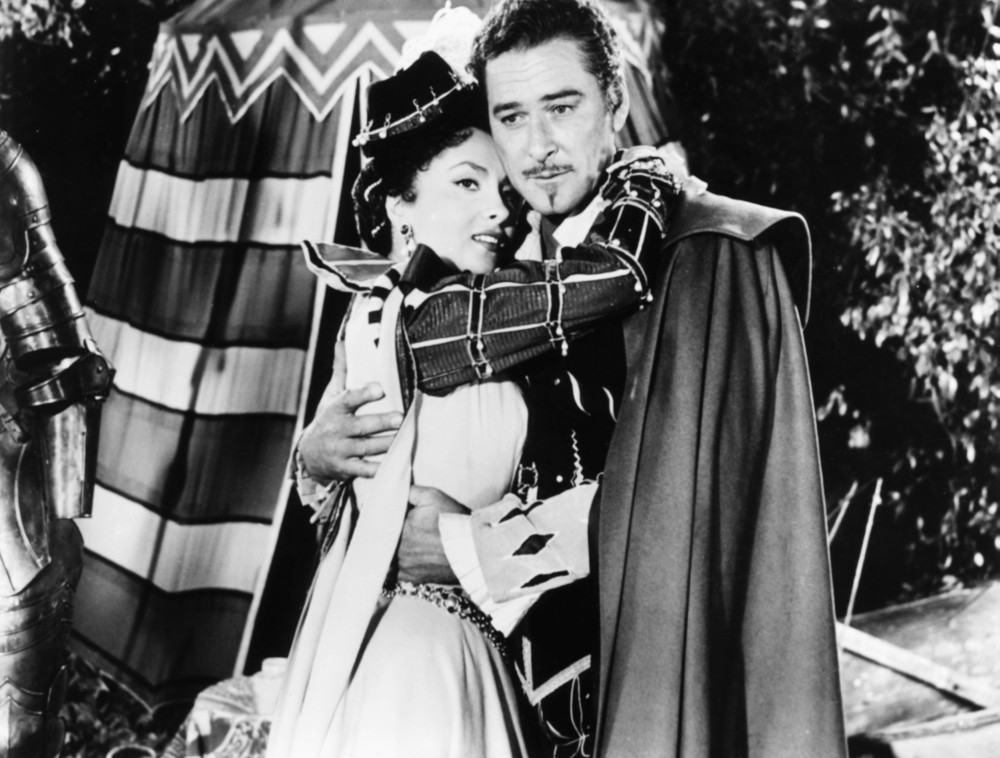
Gina Lollobrigida portrayed “Francesca”. Lollobrigida’s last movie appearance was in American film-noir director Robert Siodmak’s, 1954, Italian motion picture, “Le Gran Jeu (The Great Game)” aka: “Flesh and the Woman”. In, 1956, Gina Lollobrigida, co-starred with Burt Lancaster and Tony Curtis in the European circus drama, “Trapeze”. The actress immediately followed that feature film, with a French/Italian co-production, of French author Victor Hugo’s, “The Hunchback of Notre Dame”, with Anthony Quinn in the title role. Below,. she is with Errol Flynn.
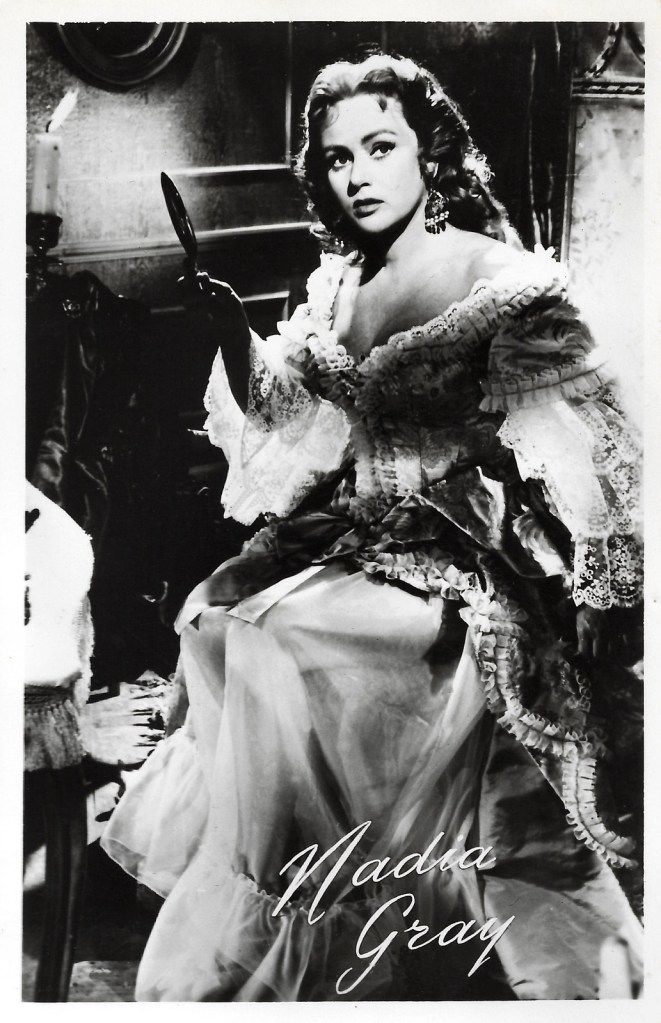
Nadia Gray portrayed “Fulvia”. Gray is actually Romanian born Nadia Kujnir-Herescu. She met her husband, a Romanian aviator during the Second World War, and the two fled their home country in 1946. When the Communists started to take it over. In France, her new country, she became an film actress in 1949. The following picture is not from this movie. I was unable to locate a still with Gray in it.
Cesare Danova portrayed “Rainero”. Danova started appearing in American productions with 1959’s, “The Man Who Understood Women”, co-starring with Henry Fonda and Leslie Caron. Among his American films, besides becoming a regular guest of many television programs are, 1963’s, “Cleopatra”, the same year’s, “Gidget Goes to Rome”, 1964’s, “Viva Las Vegas”, competing with Elvis Presley for Ann-Margaret, and the 1966, gimmick movie., “Chamber of Horrors”
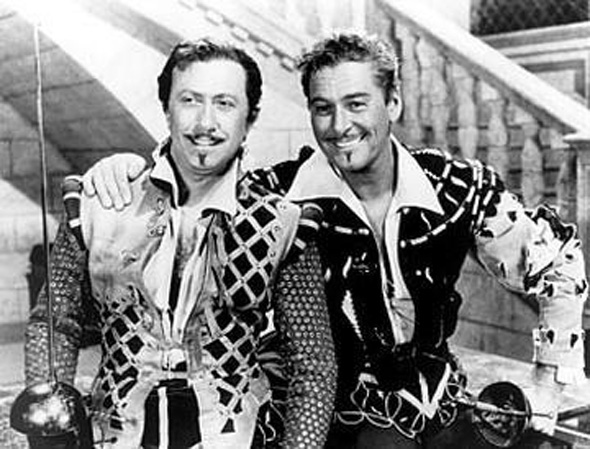
The Very Basic Storyline:
We meet two friends that have been traveling together, womanizing, and having adventures over the last two-years, they are “Rainero” and his “Don Juan Like Mentor”, “Renzo”. The setting is the “Duchy of Sidona”, where “Rainero’s” father is the “Duke of Sidona”, portrayed by Pietro Tordi.
On their way back to Sidona, the two meet “Fulvia”, a former, and now scornful lover of “Renzo”. Who attacks “Renzo” both verbally and physically, her anger run its course, now invites them to her estate.
There they meet “Fulvia’s” very rich husband, “Gennarelli”, portrayed by Alberto Rabagliati. There they meet the future looking counselor to the “Duke”, “Pavoncello”, portrayed by Rondalo Lupi. He wants a new law that men under 20-years of age, must marry and produce children as a means of creating future manpower for the defense of the Duchy. The “Duke” is not sure he likes the idea, but will think about it.
After being away, “Gennarelli”, returns to his estate to find “Renzo” and “Fulvia” in bed together, leading to a duel between the two men that “Renzo” easily wins and leaves “Fulvia” and “Gennarelli” fighting over her love affair.
Next, “Renzo” and “Rainero” now go to the “Duke’s” castle. There, “Renzo” meets “Rainero’s” sister, “Francesca”, who considers “Renzo” a bad influence on her brother. However, she is also attracted to him.
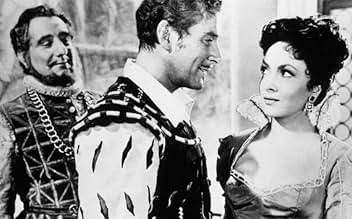
“Fulvia” arranges a joust between “Renzo” and “Pavoncello”, who wants to marry “Francesca”. Both men become injured and the “Duke” stops the joust.
Next, “Gennarelli” proposes to “Pavoncello” that the two join forces to drive “Renzo” out of Sidona, by getting the “Duke” to sign the proposed law. “Renzo” flees Sidona accompanied by “Rainero”. Meanwhile, to be sure to take care of “Renzo”, “Pavoncello” hires an assassin named “Lenzi”, portrayed by Ricardo Riloi. He is given money to hire two-hundred men, because “Pavoncello” really wants to take over Sidona and the surrounding area and “Renzo” has given him the perfect distraction to put his plan into effect.
However, our heroes are eating at a tavern when they’re attacked by some of “Lenzi’s” men, but defeat them. They return to the castle and overhear “Fuvia” talking with “Gennarelli” about “Pavoncello’s” plan. “Renzo” and “Raniero” are captured and “Lenzi’s” army enter Sidona, capture the “Duke” and “Francesca” and imprison the two. “Fulvia” helps “Renzo” and “Raniero” to escape, and they free the “Duke” and “Francesca” leading an uprising against “Pavoncello” and “Gennarelli”. This is followed by “Renzo” dueling and killing “Lenzi”, and “Raniero” getting the “Duke’s” loyal supporters to fight “Lenzi’s” army. Along with “Francesca” getting the women of Sidona to seduce the men of “Lenzi’s” army. All leading to a sword duel to the death between “Renzo” and “Pavoncello”.
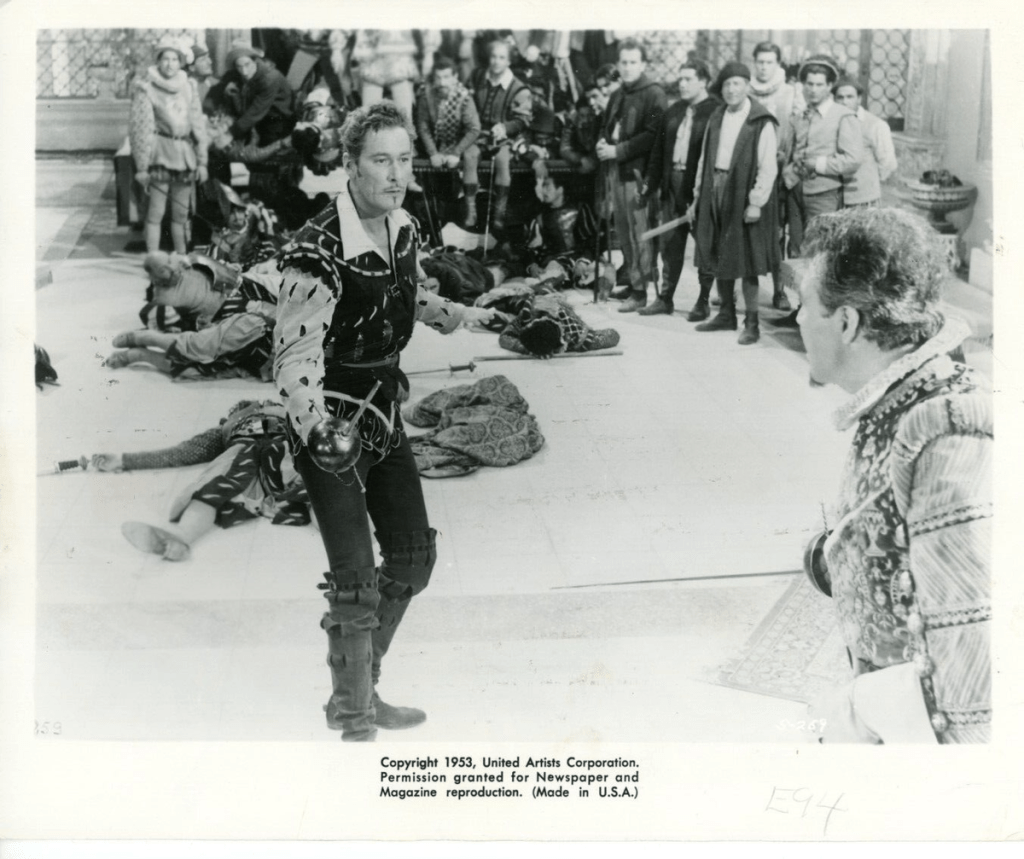
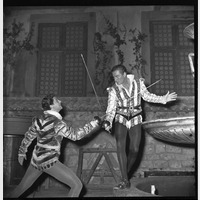
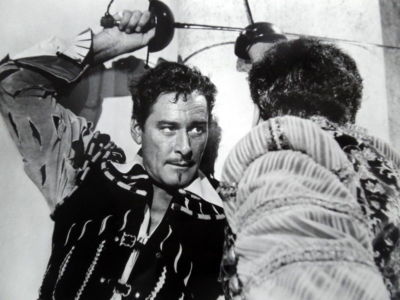
Of course after things settle down, “Francesca” is able to get “Renzo” to settle down and marry her.
Errol Flynn had 9 more movies and 5 television appearances left in his career. Of these, only one was considered a swashbuckler.
Edward of Woodstock Palace , Oxfordshire, England, was known as the “Black Prince”. He was the oldest son of “King Edward III” and heir to the throne.
The Dark Avenger aka: The Warriors premiered in London, on April 15, 1955
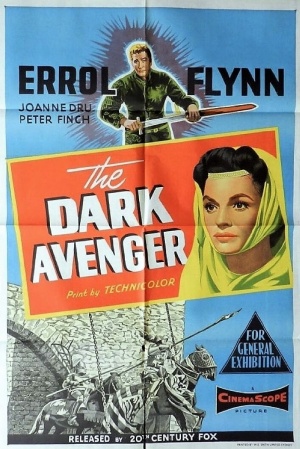
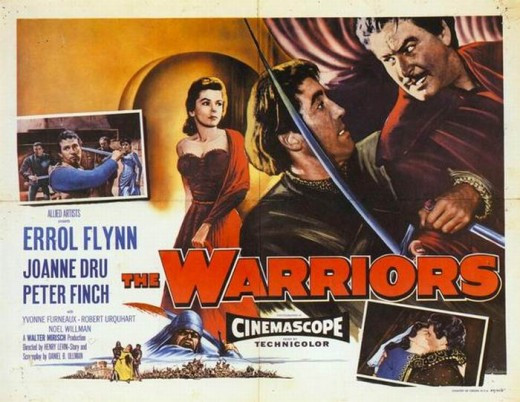
Daniel B. Ullman wrote the story and was the main screenplay writer. In 1953, as Dan Ullman, he co-wrote director William Cameron Menzies, 3-D feature, “The Maze”, starring Richard Carlson. Prior to this screenplay, he came up with the story and wrote the screenplay for 1955’s, “Seven Angry Men”, the story of Abolitionist John Brown, starring Raymond Massey.
The other screenplay writer was Phil Park, and this was his second of only three screenplays. Otherwise his writing career consisted of seven television scripts.
Henry Levin directed “The Dark Avenger”. Levin’s first movie as a director was the overlooked and very interesting horror film, 1944’s, “Cry of the Werewolf”. Among his other work, my reader will find, Pat Boone’s, both 1957’s, “Bernardine”, co-starring Terry Moore, and “April Love”, co-starring Shirley Jones. The 1959 production of Jules Verne’s “Journey to the Center of the Earth”, starring James Mason and Pat Boone, and producer George Pal’s 1962, Cinema, “The Wonderful World of the Brothers Grimm”.
Errol Flynn portrayed “Edward, the Black Prince”. Flynn followed this feature with the musical drama, 1955’s, “King’s Rhapsody”, co-starring Ann Neagle and Patrick Wymore.
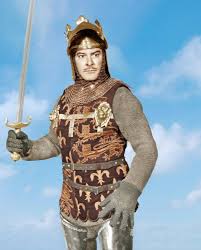
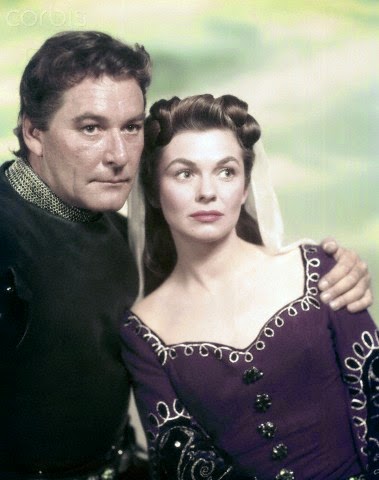
Joanne Dru portrayed “Lady Joan Holland”. Dru was just seen in “Brief Affair”, February 12, 1955, an episode of the forgotten television anthology series, “The Star and the Story”. Dru’s co-stars were Henry Fonda and Craig Stevens.
Peter Finch portrayed “Comte de Ville”. Finch had just co-starred with Sir Alec Gunness in 1954’s, “Father Brown, Detective”.
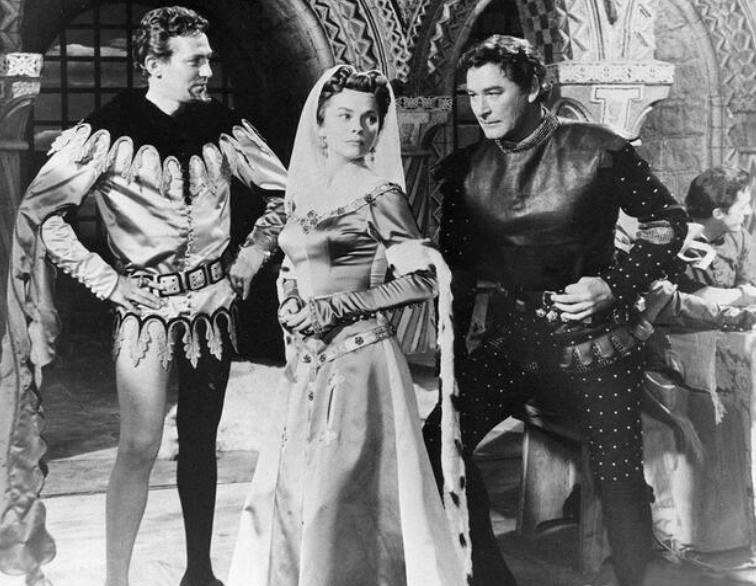
Above left to right, Peter Finch, Joanne Dru, and Errol Flynn.
Yvonne Furneaux portrayed “Marie”. Furneaux started her film career as “Jenny Diver” in 1953’s, “Beggar’s Opera“, starring Sir Laurence Oliver as “Captain MacHeath”. She had roles in both Errol Flynn’s, 1953’s, “Master of Ballantine”, and 1954’s, “Crossed Swords”. She is known to fans of the “House of Hammer” for 1959’s, “The Mummy”, and had major roles in Italian director Federico Fellini’s, 1960, “La Dolce Vita”, and Roman Polanski’s, 1965, “Repulsion”.
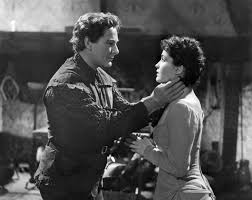
The Extremely Basic Adventure Story:
The film opens with the “Prince Edward”, leading an army to protect the English and French citizens of “English Aquitaine”. Originally French land that became an English possession with the marriage of Eleanor of Aquitaine to King Henry II in 1154.
“Edward” defeats the French nobles and their knights attempting to reclaim the land for France and forces them to sign terms of surrender.
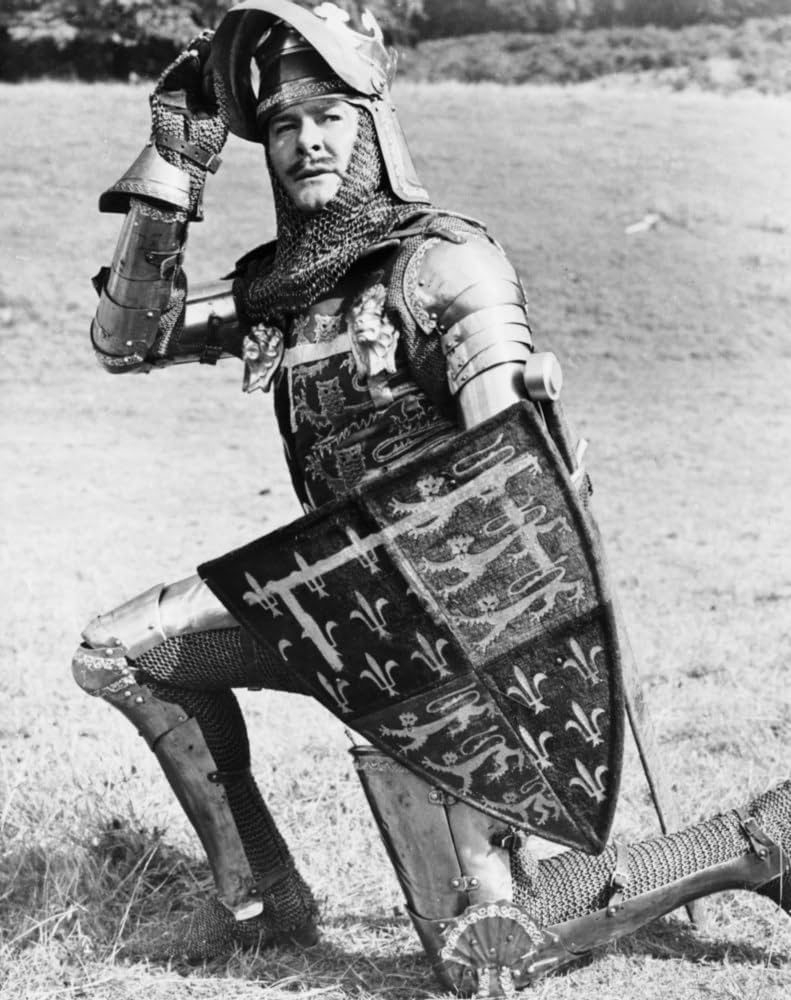
However, the French nobles do not plan to honor the surrender and plan in secret to kill “Edward”. Their first move is to kidnap “Lady Joan Holland” and her children and hold them as hostages against English rule of France.
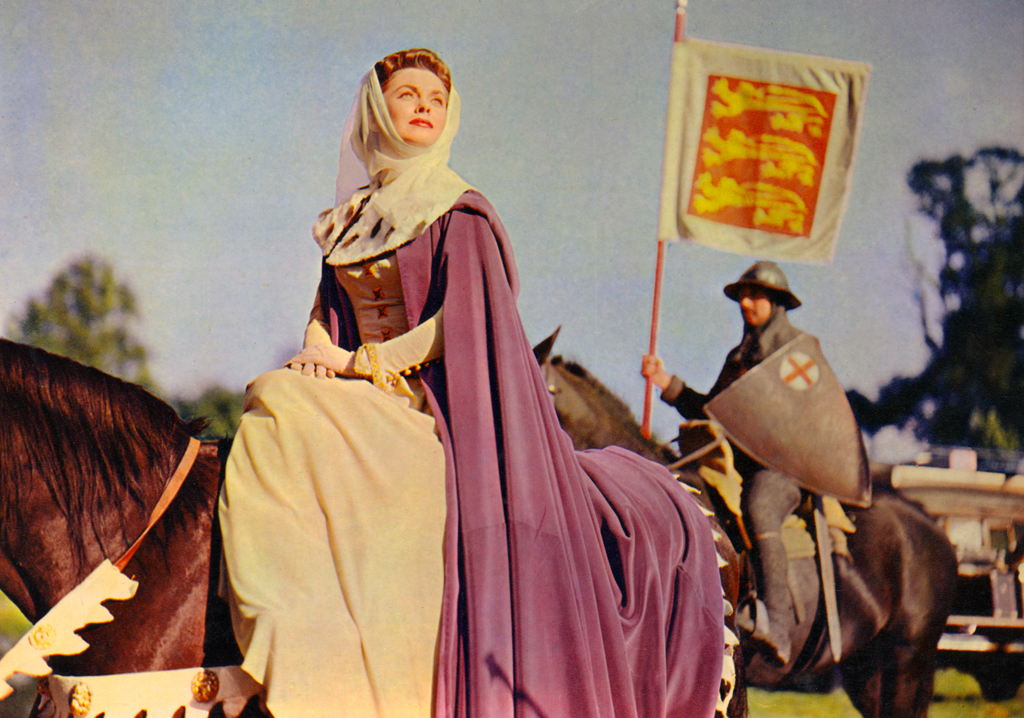
This of course forces “Prince Edward’s” hand, as he must rescue the lady and her children. He barely survives an ambush and needs to be in disguise among the French peasantry to move freely to ascertain the force guarding “Lady Holland”. To get even closer to his enemies, he now adopts a final disguise and becomes “THE BLACK KNIGHT”.
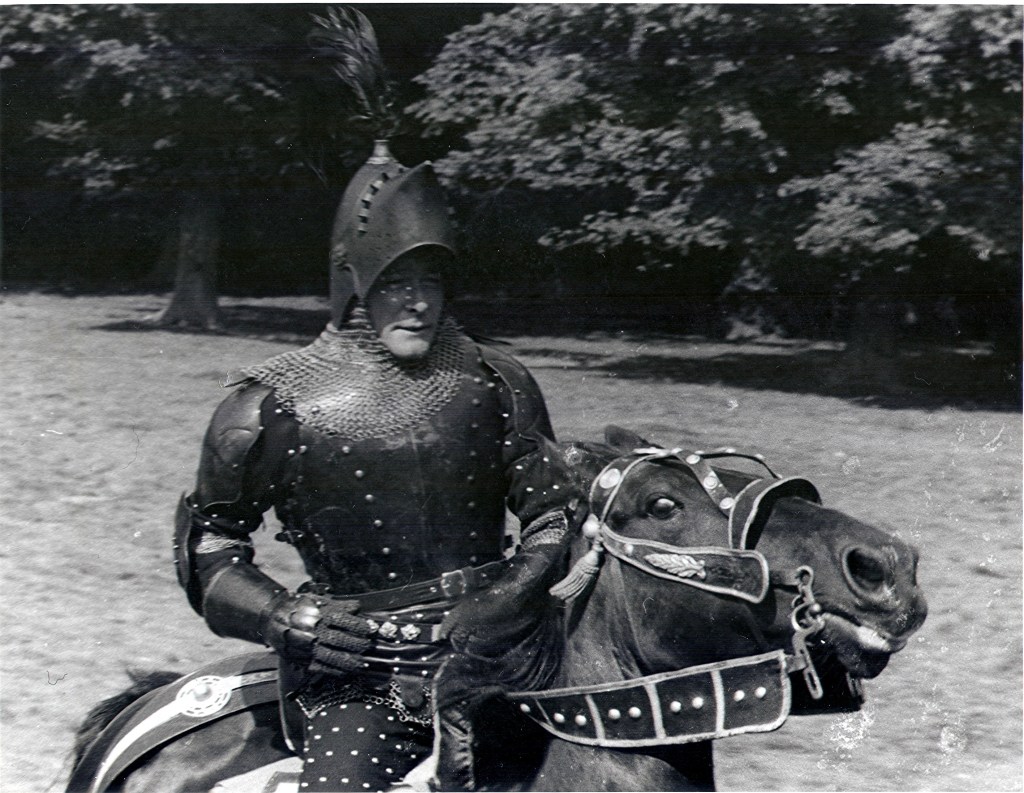
“Edward” learns the French plans, rescues “Lady Joan Holland” and her children, and escapes to safety. Now, from the Castle of Aquitaine, “EDWARD, THE DARK AVENGER”, leads the English knights and the men-at-arms, against the vastly superior French force, led by his one time friend, the “Comte de Ville”, that is storming the castle, and wins this climatic battle.
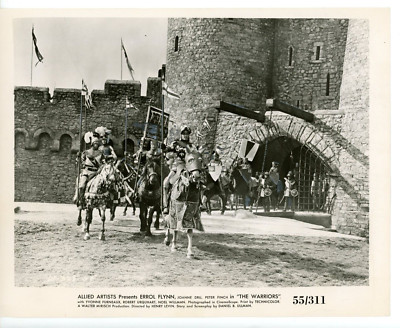
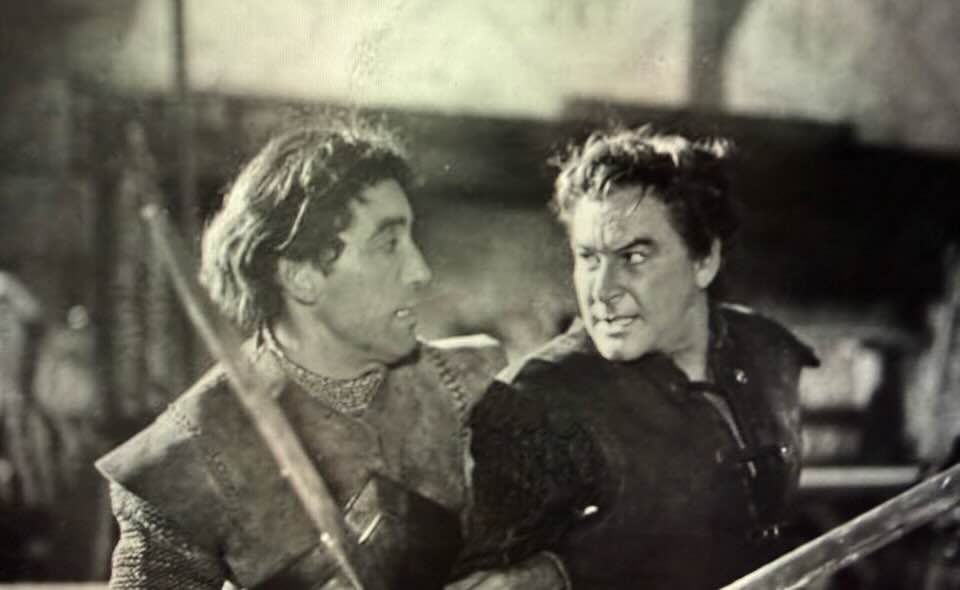
Above the uncredited Christopher Lee, staring in 1957’s “Curse of Frankenstein” becoming another “Hammer Film’s” star, portrayed the “French Patrol Leader” at a tavern and one of the French soldiers that attacked the castle at the film’s climax. Only to be killed by Errol Flynn’s “Prince Edward”.
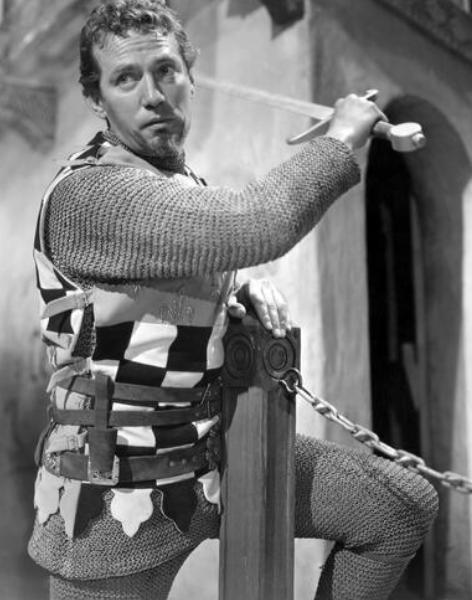
Above Peter Finch’s “Comte de Ville” fights and dies by the hand of Errol Flynn’s “Edward”.
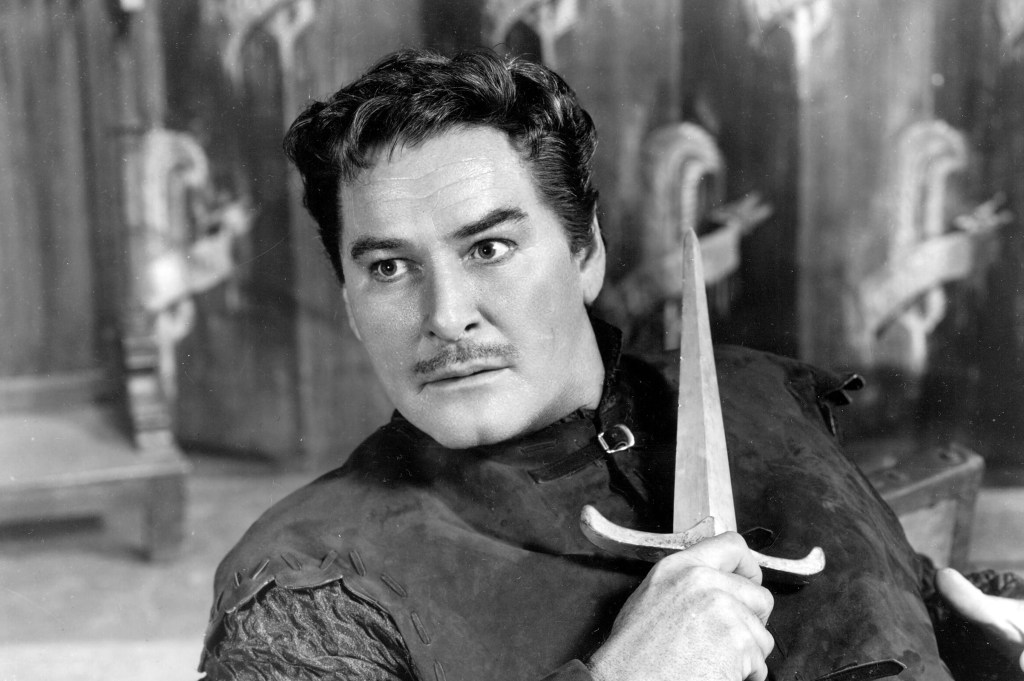
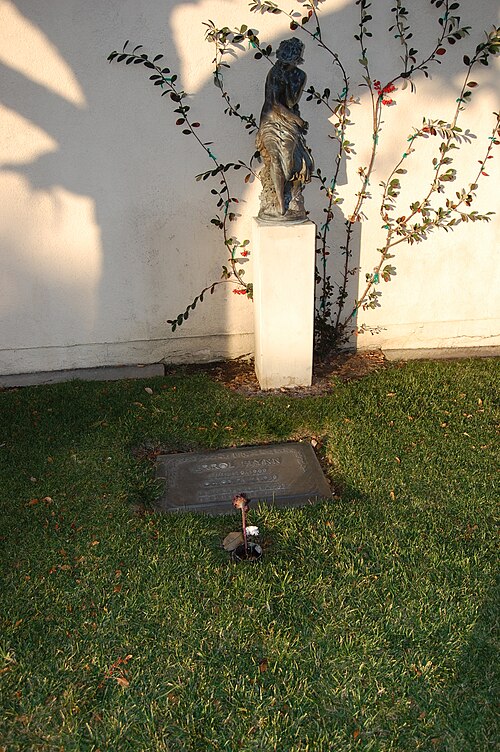
On October 14, 1959, Errol Leslie Thompson Flynn lost his last duel with life. He is buried at Forest Lawn Cemetery in the Hollywood Hills.
 THE FILM MADNESS OF FRADKIN-STEIN
Leave a comment