Don’t recognize his name? Should my reader be a fan of “Universal Horror”, George Pal Science Fiction, even a little Cecil B. DeMile, or John Ford? You have either seen, or heard IRVING PICHEL. So, lets go into his story – – – –
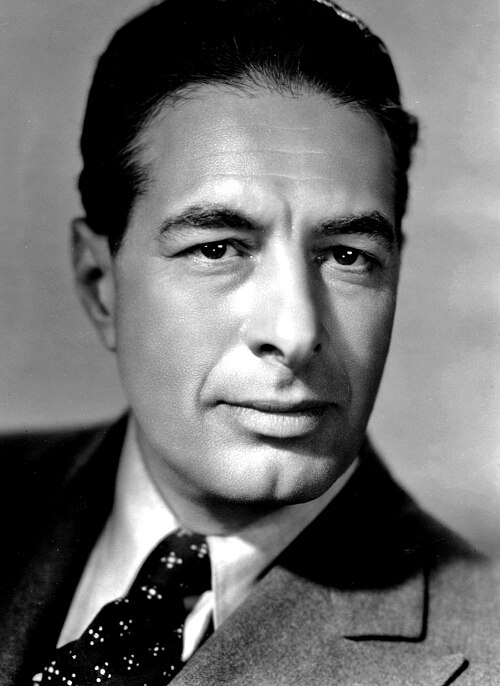
His father, Julius Pichel, worked, 47-years, for the “Pittsburgh Gazette-Times”, his mother was Rachel Stadtfield Pichel, a homemaker, and according to Irving, the heart of his Jewish family.
Irving attended “Pittsburgh Central High School”, one of his classmates, and life long friend, was future playwright George S. Kaufman, 1925’s, “The Coconuts”, 1928’s, “Animal Crackers”, 1936’s, “Stage Door”, and, 1939’s, “The Man Who Came to Dinner”.
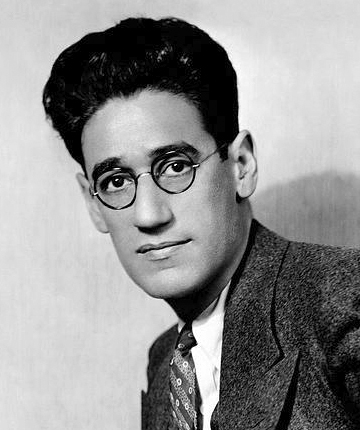
In 1903, 14-years-old, Kaufman, and 12-years-old, Pichel, collaborated on what would be George’s first play, “The Failure”. Which, of course, was a “failure”. The two boys wrote the play while attending Hebrew School, at the “Rodef Sholom Community House Synagogue”. Located were both boys lived, in Shadyside, an east Pittsburgh community.

Irving graduated from “Harvard University” in 1914, and immediately went into acting. From January 7th through May 8, 1915, in Boston, Massachusetts, he porrtrayed the role of “Edwards”, in the stage play, “Common Clay”, by Cleves Kinkead. Irving Pichel was also the “Stage Manager” for the Boston production, which was also the play’s premier run.
On December 31, 1916, Irving Pichel married Violette Willson, the daughter of Jackson Stitt Wilson, a Methodist Minister, and a Socialist Mayor of Berkeley, California. They had three children and stayed married through his death.
His first work in musical theatre, was as a ‘technical director”, at the “Bohemian Club”, a very private San Francisco club for the very wealthy of California. Irving also helped with the club’s, invite only, popular summer production at their “Bohemian Grove”, a private retreat north of San Francisco, in Sonoma.
In 1923, Irving Ptchel founded the original “Berkeley Playhouse”, located in “Wheeler Hall”, on the “University of California, at Berkeley. He served as the playhouse’s director until 1926, when he moved to Los Angeles. His next move was to become a student at the famed “Pasadena Playhouse”.

On April 10, 1927, George C. Warren, in the “New York Times“, reviewed the world premiere of playwright Eugene O’Neil’s, “Lazarus Laughed”. Which took place at the “Pasadena Playhouse”. In his positive review of the O’Neil play is the following:
“More than twenty of the characters in the play speak, but there are only five that stand out. Lazarus was played superbly by Irving Pichel – – – -“
The major motion picture studios were taken back, some stopped, or cancelled productions that were in progress. All because of one event!
On October 6, 1927, “Warner Brothers” released a musical motion picture with a synchronized sound system, “THE JAZZ SINGER”. It wasn’t the synchronized musical numbers that caused the other studios to react. It was, that between some of those songs, the voice of Al Jolson was heard, speaking dialogue. The “Warner Brothers” publicity department went to work advertising the motion picture with just two words: “JOLSON TALKS”.
Every studio wanted to make “TALKIES”, but that meant many of the leading stars of the silent era were out. Their voices, which hadn’t been needed for a “Silent Movie”, sounded terrible. The studio’s turned to stage actors, at least, until they could build up a group of their own sound movie actors.
Two years after “Lazarus Laughed”, “Paramount Pictures” signed Irving Pichel.
On December 27, 1930, “Paramount Pictures” released “The Right to Love”.
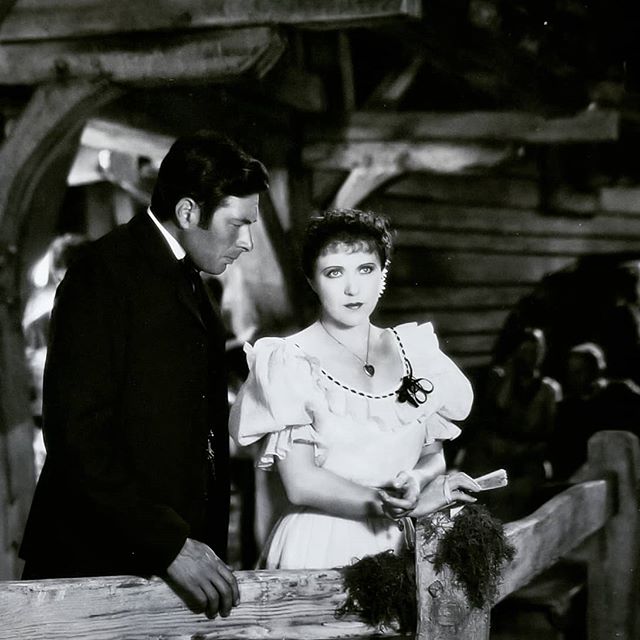
Above, are 4th-billed Irving Pichel portraying “Caleb Evans”, and 1st-billed, Ruth Chatterton portraying “Brooks Evans/Naomi Kellogg”, in Pichel’s first motion picture appearance.
Because of his technical skills, Irving Pichel was both, an actor, and a director. The following motion pictures are a variety, by year, of Pichel’s work in the industry, and includes the one feature film he also produced.
I move forward to October 10, 1931, and the first feature film Irving Pichel co-directed. The producer’s name, who was a one-time spy for the “Office of Strategic Services”, later changed to the “Central Intelligence Agency”, was “Merian C. Cooper”. My article is “Merian C, Cooper: Before ‘King Kong’ to ‘Cinerama”, found at:
https://www.bewaretheblog.com/2015/10/merian-c-cooper-before-king-kong-to.html
The motion was:
THE MOST DANGEROUS GAME released September 16, 1932
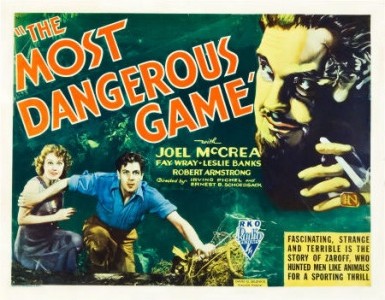
Producer Cooper was a cost conscious man, and this picture was shot at night, while on most of the same sets, “King Kong”, was shot during the day.
In 1924, writer Richard Connell published in “Collier’s Magazine” his short story, “The Most Dangerous Game”.
The screenplay was written by James Ashmore Creelman. He had started writing screenplay’s during the silent era in 1920. He co-wrote the screenplay for 1933’s, “King Kong”.
Irving Pichel was the primary director of the feature, and the co-director was Merian C. Cooper’s partner for years, the uncredited Ernest B. Schoedsack, the main director of “King Kong”.
Three members of the cast had double duty, appearing in both “The Most Dangerous Game”, and “King Kong”.
Joel McCrea portrayed “Robert ‘Bob’ Rainsford”, a major big game haunter. His stunt man was Buster Crabbe, two-years, before he filmed his first “Tarzan” feature, and five-years before he filmed, “Flash Gordon”. Joel McCrea had been seen on-screen since 1927, and he just been seen as Dolores Del Rio’s co-star in 1932’s, “Bird of Paradise”, and followed this movie with the forgotten sports drama, 1932’s, “Sport Parade”.
Fay Wray portrayed “Eve Trowbridge”, “Martin’s” sister. As shooting of “King Kong” began. The role of “Ann Darrow” was yet to be cast. When Cooper made the decision to use Wray in that movie also. The actress was saying lines in the other during daylight, and for this picture, during night. My article is “FAY WRAY BEFORE KING KONG”, found at:
https://www.bewaretheblog.com/2015/11/fay-wray-before-king-kong.html
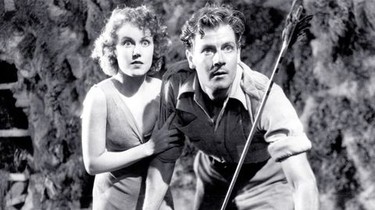
Robert Armstrong portrayed “Martin Trowbridge”, “Eve’s” alcoholic brother. Armstrong was also doing double duty for Merian C. Cooper. My article is “ROBERT ARMSTRONG: It Wasn’t All ‘The Eighth Wonder of the World’, His Brat, or Joe” found at:
https://www.bewaretheblog.com/2020/08/robert-armstrong-it-wasnt-all-eighth.html
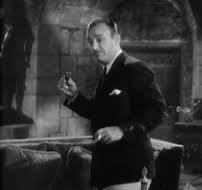
Leslie Banks portrayed the evil, “Count Zaroff”. This was only the actor’s second motion picture and his first was 11-years earlier. Banks was an English stage actor, more at home with Shakespeare than Irving Pichel. He took a break from stage acting to service in the First World War, after which, he became a member of the “Birmingham Repertory Theatre”. He was brought to the United States for this one role, but would later appear in Alfred Hitchcock’s, 1934, original, “The Man Who Knew Too Much”, and 1939’s, “Jamaica Inn”, starring Charles Laughton.

Nobel Johnson portrayed “Ivan”. Don’t recognize the actor? He’s probably best known for portraying the “Chief of Skull Island”, but Nobel Johnson and his brother had their own African-American film company during the silent era, appeared in films with Bob Hope and Bela Lugosi, and was directed in “She Wore a Yellow Ribbon” by John Ford. My article “Nobel Johnson African-American Pioneer Actor” may be read at:
http://www.bewaretheblog.com/2015/06/noble-johnson-african-american-pioneer.html

The story opens on board a luxury yacht and a conversation is going on with big game hunter “Bob Rainford”. He’s asked how he would feel to switch places with the animals he hunts? Just then, the yacht runs a ground in a channel by an island, and starts to sink. “Bob” swims to shore, becoming the yacht’s only survivor.


On the island, “Bob” comes upon a chateau owned by an expatriate Russian Count, named “Zaroff”. There he meets the Count’s other guests, including brother, and sister, “Martin” and “Eve Trowbridge”, along with “Zaroff’s” servant, “Ivan”.

“Zaroff” knows of “Rainsford” fame as a big game hunter. in their conversation, “Count Zaroff” reveals he is a game hunter, himself, of what he calls ,“The Most Dangerous Game”, but leaves his statement there.
“Eve” tells “Bob”, about the two sailors that came ashore with her and her brother, but have disappeared. This happened right after the two sailors entered the Count’s trophy room. Which, he had told everyone, that they were not permitted to enter, but anywhere else in the chateau was open to them.
During the night, “Martin” disappears, and “Bob Rainsford” decides to see what is in the trophy room. With “Eve”, they enter it, and discover that “Zaroff’s” hunting trophies, are the heads of the people he haunted and killed.

Next, “Zaroff” enters the trophy room holding “Martin’s”. Now, realizing what “Zaroff’s” “Most Dangerous Game” is to haunt, “Bob” calls him a madman. However, the “Madman” invites him to join the thrill of his haunt, as the Count’s partner, but is refused.
“Rainsford” is told, that like the other’s before him. He now has all day to roam the island and decide on a place to hide, but at MIDNIGHT, the haunt begins. Should he survive to 4 A.M., he is free to go, and will be given the keys to the boat house. “Eve” decides to go with “Bob”, although “Count Zaroff” had personal plans for her.


Eventually, “Eve” and “Bob”, become trapped at a waterfall by one of the Count’s starved hunting dogs. That is looking upon the two as food. “Count Zaroff” appears and shoots with his rife, and he watches as “Bob Rainsford” falls off the cliff and into the raging waterfall. Knowing his shot was a kill shot, “Zaroff” grabs “Eve”, and takes her back to the chateau.
“Bob” has survived, and appears at the chateau. He explains, it was the dog, not himself, that was shot. The Count admits defeat, and presents the other with the boathouse keys. However, “Bob” sees that one of the Count’s hands is behind his back with a pistol, and this leads to a fight between the two. “Zaroff” is mortally wounded with his own gun, but “Bob” is now attacked by “Ivan”. Which leads to the servants death. “Eve” and “Bob” make it to the boathouse. As the hungry hounds have marked him as their prey.
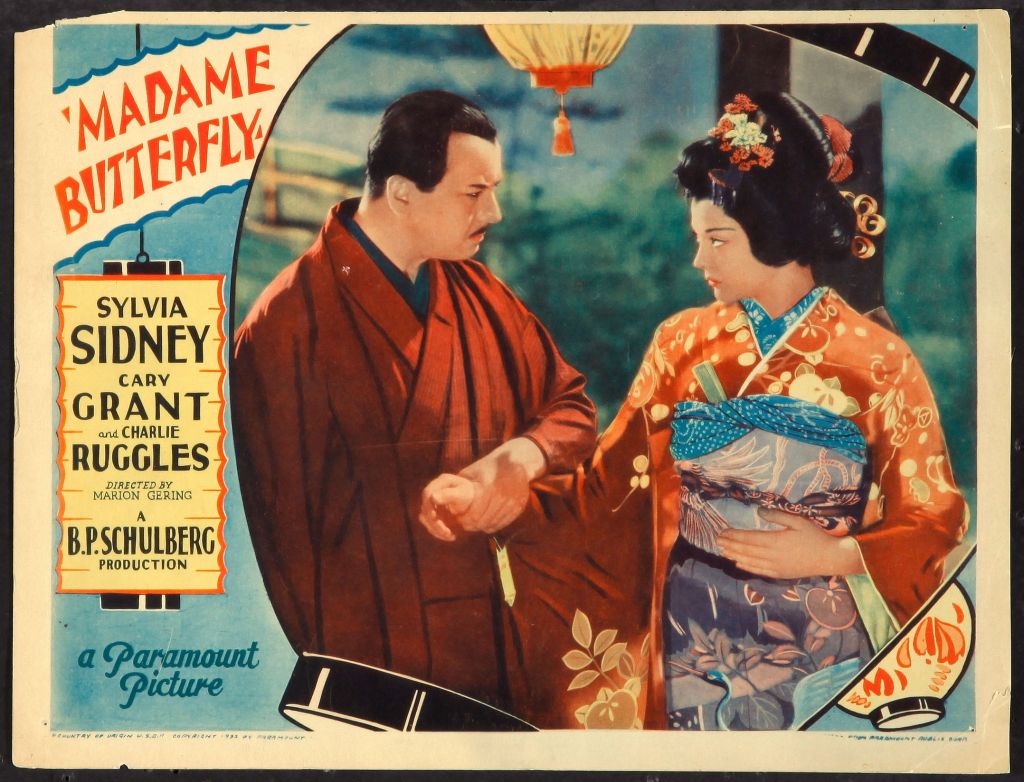
On December 30, 1932, Irving Pichel was seen in “Paramount’s” version of the David Belasco play, “Madame Butterfly”. Although, the 1904 opera by Giagomo Puccini has remains the most known version of the story. Portraying the title role, actually, “Cho-Cho San”, was Bronx, New York, born Caucasian actress, Sylvia Sydney, and in his only 8th-motion picture was a British-American actor named Cary Grant, portraying “United States Naval Lieutenant B. F. Pinkerton” in this tragic love story of a Japanese geisha, and an American in Japan. Irving Pichel portrayed Japanese “Prince Yamadori”, and like Sylvia, Sydney in Japanese make-up.
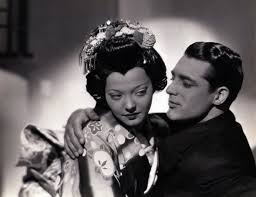
Above Sylvia Sydney and Cary Grant, below Irving Pichel and Sylvia Sydney
On February 28, 1933, Irving Pichel was in a very low budget production of Charles Dickens’s, “Oliver Twist”. Made by “Poverty Row Studio”, “Monogram Pictures”. “Poverty Row” referred to any movie company that didn’t have a physical studio, but rented office space on Gower Street in Hollywood and then rented a sound stage from the major studios.
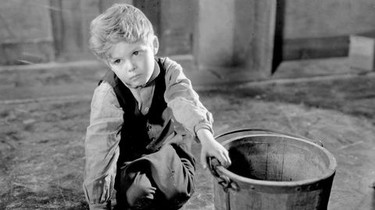
Pichel portrayed “Fagin”, child actor, Dickie Moore (John Richard Moore, Jr.) had the title role. At one time, he was in the cast of Hal Roach’s, “Our Gang”. William “Stage” Boyd portrayed “Bill Stikes”. “Stage” Boyd was a legitimate stage actor and used that middle name to stop being confused with William Boyd the actor who was now portraying “Hop-a-long Cassidy”. Doris Lloyd portrayed “Nancy Sikes” and her career of, 204, supporting roles would last into 1967.
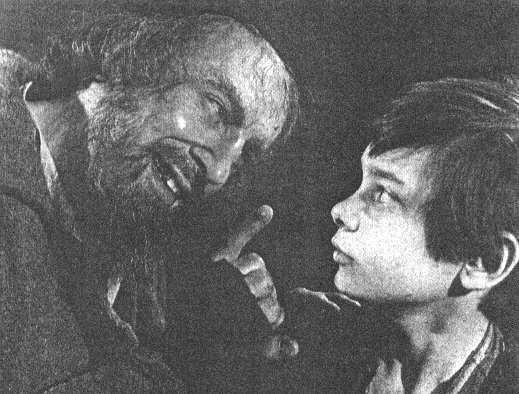
Above, Irving Pichel as “Fagin”, and Sonny Ray as “The Artful Dodger”. Below, Dickie Moore as “Oliver Twist”.
His name was Cecil B. DeMille and created “Biblical Sex” with his 1923, “The Ten Commandments”. That story is part of my article, “Cecil B. DeMille: December 1913 to December 1923”, found at:
https://www.bewaretheblog.com/2024/07/cecil-b-demille-december-1913-to.html
However, he also created historical epics such at:
CLEOPATRA released October 5, 1934

The motion picture was produced and directed by Cecil B. DeMille. Two years earlier, DeMille had produced and directed 1932’s “Sign of the Cross”, starring Fredric March and Claudette Colbert. That screenplay was a story about the Christian persecutions under Roman Empire “Nero Claudius Caesar”, portrayed by Charles Laughton.
ThIS motion picture’S writing credits are very interesting.
First, there is credit given to the Greek Middle Platonist philosopher, historian, biographer, and essayist, Lucius Mestrius Plutarchus, more simply known as Plutarch, for his biography, “Life of Caesar”.
Bartlett Cormack wrote the initial story for the motion picture. He is credited with using “historical material”, but what that “historical material” is, other than Plutarch’s book, I could not locate.
The actual screenplay was written by two writers:
Waldemar Young started screenplay writing in 1917. Among his work are four silent films by director Tod Browning, starring Lon Chaney, Sr., 1925’s “The Unholy Three”, 1927’s “The Unknown” co-starring Joan Crawford, 1927’s “London After Midnight”, and 1928’s “West of Zanzibar” co-starring Lionel Barrymore. For Cecil B. DeMille, Young co-wrote, 1932’s “The Sign of the Cross”, and 1935’s “The Crusades”. Also in 1932, for another director, was the “Island of Lost Souls”, starring Charles Laughton as H.G. Wells’s, “Dr. Moreau” and with Bela Lugosi as “The Law Giver”.
Vincent Lawrence started his screenplay writing career in 1924. Most of his work before “Cleopatra”, were musicals for Maurice Chevalier. However, in 1938, Lawrence co-wrote the screenplay for “Test Pilot” starring Clark Gable, Myrna Loy, and Spencer Tracy. The following year he was an uncredited contributor to the screenplay for 1939’s “Gunga Din”, starring Cary Grant, Victor McLagen, and Douglas Fairbanks, Jr.
The Three Leads and Two Main Supporting Players:
Claudette Colbert portrayed “Cleopatra”. Colbert bookended this motion picture with the release of director Frank Capra’s, 1934, “It Happened One Night”, co-starring with Clark Gable, and followed this feature with the 1934 version of authoress Fannie Hurst’s, “Imitation of Life”, with her “Cleopatra” co-star Warren William.

Warren William portrayed “Gaius Julius Caesar”. William was appearing in two film series, he was both Erle Stanley Gardner’s lawyer, “Perry Mason”, and, S.S. Van Dine’s detective, “Philo Vance”. Warren William had bookended this feature first as “Perry Mason”, in 1934’s “The Case of the Howling Dog”, and followed with the previously mention 1934 “Imitation of Life”.

Henry Wilcoxon portrayed “Marcus Antonius aka:Marc Anthony”. Wilcoxon started on-screen acting in 1931, and besides this picture. The actor, a favorite and friend of Cecil B. DeMille’s, was also in 1935;s, “The Crusades”, 1947’s “Unconquered”, 1949’s “Samson and Delilah”, 1952’s “The Greatest Show on Earth”, and 1956’s “The Ten Commandments”.

Joseph Schildkraut portrayed “King Herod”. Schildkraut started acting in the Austrian-Hungary film industry in 1915. Over his career the actor would portray “Judas Iscariot” in Cecil B. DeMille’s, 1927 silent classic, “King of Kings”, that starred H.B. Warner as “Jesus”. In 1929, he portrayed “Gaylord Ravenal”, in the hybrid part silent, part talkie, version of Jerome Kern and Oscar Hammerstein II’s “Show Boat”, and he also appeared in DeMille’s, 1935, “The Crusades”. In 1959, Joseph Schildkraut portrayed “Otto Frank” in director ‘George Stevens‘s production of “The Diary of Anne Frank”.

Above, Henry Wilcoxon with Joseph Schildkraut.
Ian Keith portrayed “Octavian aka: Caesar Augustus”. Keith started his on-screen work in 1924. In 1930, he portrayed “John Wilkes Booth” in director D.W. Griffith’s, “Abraham Lincoln” starring Walter Huston. The same year, Ian Keith was in director Raul Walsh’s, “The Big Trail”, the first movie with an actor now named John Wayne. For DeMille, Keith was in 1932’s “Sign of the Cross”, 1935’s “The Crusades”, 1938’s “The Buccaneer”, and 1956’s “The Ten Commandments”.

An Overview of the Screenplay:
It is 48 BC and “Cleopatra” and her brother “Ptolemy XIII Theos Philopator”, there is no actor listed in this role, are politically battling for control of Egypt. “Pothinos, Ptolemy’s Regent”, played by Leonard Mudie, kidnaps “Cleopatra“. However, her loyal follower, “Apollodorus the Sicilian, the Queen’s Political Advisor”, portrayed by Irving Pichel, chases after “Pothinos”.


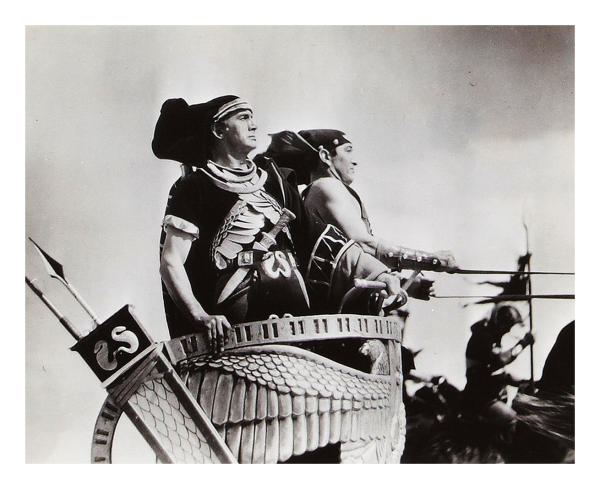

Above, Leonard Mudie prepares to leave Claudette Colbert’s “Cleopatra” to die in the desert, he will leave her tied to a post, unaware that Irving Pichel is coming.
“Pothinos”, next informs “Julius Caesar” that “Queen Cleopatra” has fled Egypt. He convinces the Roman General to sign an agreement with “Ptolemy” for joint control of the country, but in walks “Apollodorus” with a rug as a gift for “Caesar”. When the rug is unrolled, there is “Cleopatra”, forcing “Pothinos” to try and explain his false words, by denying that the woman in the rug is “Cleopatra”. Irving Pichel is seen on the far right holding part of the rug.


However, “Caesar” sees through the deception and rips up the agreement. Next, apparently alone in “Caesar’s” quarters, “Cleopatra” continues to entice him with plans of jointly conquering India for that country’s riches. Continuing to use her charms upon the married Roman, as they talk, “Cleopatra” spots a pair of sandals from behind a curtain. She slowly moves into position, picking up a spear during the conversation, and kills the man holding a knife, “Pothinos”.

“Gaius Julius Caesar” banishes “Ptolemy”, makes “Queen Cleopatra” the sole ruler of Egypt and begins an affair with her.


Next, “Julius Caesar” returns to Rome with “Queen Cleopatra”. She rides into the city upon a golden throne lifted by slaves and the citizens cheer her.


There is concern from members of the Roman Senate that “Caesar” may be planning to declare himself Emperor and make “Cleopatra” his Empress. “Julius Caesar” has divorced his wife, “Calpurnia”, played by Gertrude Michael, seen below speaking to “Marc Anthony” about her concerns.

“Marc Anthony”, after speaking with “Calpurnia”, is now worried about what the Senate might do, and speaks to his friend “Julius Caesar”. Portraying “Anthony’s” close friend, General “Gnaeus Domitius Ahentobarbus aka: Enobarbus” in the following still is C. Aubrey Smith.


Ignoring “Calpurnia’s” fears and a warning from a soothsayer, on the steps to the Senate, to “beware the Idea of March”, the Roman General enters the Senate chambers.


Informing the Senators of his plans, “Gaius Julius Caesar” is assassinated.


Hearing the news, “Cleopatra” wants to go to “Caesar”, but “Apollodorus” tells his Queen that her lover’s only love was power, and what she could bring of it to him. Fearing Roman reprisals, “Cleopatra” and her court return to Egypt.
Next the Senate makes “Marc Anthony” and “Octavian” co-rulers of Rome, but the two remain bitter rivals for power.

“Anthony”, as a means to capture “Cleopatra”, and bring her back to Rome, invites her to meet him at Tarsus in South Central Turkey. However, “Enobarbus” warns him against the plan and the Queen, but “Anthony” goes anyway.
When “Marc Anthony” arrives at Tarsus, “Cleopatra” awaits him on her royal barge and the Roman co-ruler finds himself invited to a banquet in his honor.


Instead of bringing “Queen Cleopatra” back to Rome as his prisoner, she seduces “Marc Anthony” and they sail for Egypt.

“King Herod” who is secretly aligned with “Octavian” now visits the lovers. “Herod” in a private audience with “Cleopatra” reveals that both Rome and “Octavian” would be pleased, if she were to poison “Anthony”.

In a drinking match with “Anthony”, “Herod” reverses the names.

“Apollodorus” reminds his Queen of her duty to Egypt over her love for any man. On a condemned murderer, she tests the poison wine to see how well it works. While drinking with “Anthony” he holds the poisoned wine class in his hand

Just then, word is received that “Octavian” has declared war on Egypt. “Anthony” orders his Generals and Legions to gather, but “Enobarbus” tells him that all the troops have deserted out of loyalty to Rome and he leaves him also.

Roman General and co-ruler of Rome, “Marcus Antonius”, is now faced with commanding the untested Egyptian army and navy at the critical sea “Battle of Actium”, on September 2, 31 BC. Which willend in an Egyptian defeat.

/
“Octavian” and his soldiers surround and besiege “Anthony” and “Cleopatra” within Alexandria. “Cleopatra” leaves its protection accompanied by “Apollodorus” to meet with “Octavian” in an attempt to save “Anthony”, but the bitter “Octavian” refuses.

Meanwhile, “Anthony” believes “Cleopatra” is trying to save herself and not him. Taking his sword in despair, “Anthony” stabs himself in the stomach. Just as “Cleopatra” returns to find her love now dying, but the two are able to reconcile their love before he dies.

“Octavian’s” army finally breaches the gates of Alexandria, only to discover that “Cleopatra” has taken her own life by the bite of an asp.


Irving Pichel was back to directing for Merian C. Cooper. Whose next feature film, as a producer, was 1935’s, “The Last Days of Pompeii”. This directing assignment was for a classic adventure story by British author, H. Rider Haggard.
SHE released on July 12, 1935

The adaptation for a screenplay of H. Rider Haggard’s, “She: A History of Adventure”, published in book form in 1887, was from Ruth Rose. Rose was the wife of Cooper’s partner, Ernest B. Schedsack. My article is, “RUTH ROSE: The Real ‘Ann Darrow’, the 1933 ‘King Kong’ Screenplay and More” at:
https://www.bewaretheblog.com/2021/09/ruth-rose-real-ann-darrow-1933-king.html
The actual screenplay was written by Dudley Nichols, the “Academy of Motion Picture Arts and Sciences, Best Screenplay Oscar” winner, for director John Ford’s, 1935, “The Informer”. Among his screenplays, just for John Ford, are 1934’s, “The Lost Patrol”, 1936’s, “Mary of Scotland”, 1937’s, “The Hurricane”, 1939’s, “Stagecoach”, and the wrote the narration for John Ford’s, filmed while Ford was under actual Japanese air attack, 1942’s, “The Battle of Midway”.
There were two co-directors on this feature film:
The main director, was Irving Pichel. He had just portrayed a “District Attorney” in the Bette Davis and George Brent, 1935, “Secret Agent”. As a director, Pichel had last directed the 1933 horror mystery crime drama, “Before Dawn”, starring Stuart Edwin, Dorothy Wilson, and Warner Oland.
This was Lansing C. Holden’s first of only two directing assignments and the other was a 1938 short subject. For, “SHE”, Holden was also an uncredited production illustrator, and he was the production designer for 1937’s, “A Star is Born”.
The Main Cast of “She”:
Helen Gahagan portrayed “She, Who Must Be Obeyed”. Not mentioned in this screenplay is that H. Rider Haggard’s character has an actual name of “Ayesha, she would must be obeyed”.
Gahagan is an interesting person in her own right. She was a major Broadway stage actress and this was her only motion picture. She toured Europe as a successful opera singer. In 1931, Helen Gahagan married actor Melvyn Douglas, and they stayed married until her death in 1980. Helen Gahagan Douglas became a politician and was the protege of Eleanor Roosevelt. In 1945, she became only the third woman, and first woman, from the Democratic Party, to be elected to Congress. She was a member of the “House of Representatives” from California, and decided to run for the open 1950 Senate seat.
Her Senate race is famous, as Gahagan Douglas’s Republican opposition was also a member of the “House of Representatives”, Richard Milhous Nixon. This was a dirty fight, and Nixon and the “Republican Party” knew she was very anti-Communist, but this was during “The Second Red Scare” and they wanted to make the voters think she had Communist sympathies. Afraid to call her either a “Commie”, or a “Red”, Nixon started to refer to Helen Gahagan Douglas as “Wearing PINK Underwear”. She became known as “THE PINK LADY”, and that was as good as telling the voters she was a “Red Communist”.
Gahagan Douglas fought back by calling Richard Milhous Nixon, “TRICKY DICKY!”, but she lost the Senate race.
Randolph Scott portrayed “Leo Vincey”. Scott’s film career started in 1928, with the silent motion picture “Sharp Shooters”. He had the “Uncredited” role of the“Foreign Serviceman in Moroccan cafe”. Of Scott’s, next eleven movie appearances, only one was fully credited, and that was with sixteenth-billing. In 1931, Randolph Scott had third-billing in the forgotten drama, “Women Men Marry”. From that movie forward, the actor was getting full credit, if not the leading roles. For the record, one of those uncredited roles, was in the genre Scott is most identified with, his first western was 1929’s, “The Virginian”, starring Gary Cooper and Walter Huston. His first starring western, was 1932’s, “Heritage of the Desert”, based upon a Zane Grey novel, and directed by Henry Hathaway.
In 1933, Randolph Scott co-starred with Carole Lombard in the horror-mystery, “Supernatural”. By 1935, the actor was a confirmed “B” western star.

Above, Helen Gahagan and Randoph Scott in a scene from the colorized version of “She”, supervised by stop-motion-animator Ray Harryhausen. Note, the color of her gown, Walter Elias Disney saw and fell in love with the motion picture and the look of “She, who must be obeyed”. He used that look for his evil queen in the 1939 animated, “Snow White and the Seven Dwarfs”, and Ray used Disney’s colors for his colorization.

Helen Mack portrayed “Tanya Dugmore”. She had just been in a forgotten 1935 crime drama entitled, “Four Hours to Kill”. The title is misleading, as it does not refer to a killer, but the time a police officer with a fugitive killer in custody, has to wait for transportation to take him the two-thousand-miles to prison. So, having “to kill” four-hours, the police officer takes his prisoner to a legitimate theater to watch a show. There, it turns out the theater’s hostess is the wife of the man that informed on the killer the police officer has in custody. As a secondary love story involving Helen Mack’s character and her boyfriend, believed to have stolen an expensive piece of jewelry, enfolds. Their love story ties the informers wife, the killer in custody, and an adulterous couple into the love story. All leading to a climatic shoot-out in the theater.

Nigel Bruce portrayed “Horace Holly”. Four-years after this motion picture, character actor Nigel Bruce first portrayed “Dr. John H. Watson, M.D.” to Basil Rathbone’s, “Sherlock Holmes”, in the 1939 version of British author Sir Arthur Conan Doyle’s, “The Hound of the Baskervilles”. I bring that fact up, because in “SHE”, the actor plays “Horace Holly”, EXACTLY like he would play, “Dr. Watson, except to Randolph Scott’s, “Leo Vincey”, and not Rathbone’s, “Holmes”.

In her screenplay, Ruth Rose moved the location of the “City of Kor”, from Africa to the Serbian Arctic. As this motion picture was being filmed in 1935, “Art Director”, Van Nest Polglase, turned “Kor” into “Art Deco” gone wild.
“Leo Vincey” has been called back to England, from Canada, to his families ancestral estate by his dying uncle, “John Vincey”, portrayed by Samuel Hinds. There he meets his uncle’s best friend, “Horace Holly”. The two other men tell “Leo” a fantastic story about his ancestor, also named “Leo Vincey”. Who led an expedition, accompanied by his wife, into the Siberian Arctic, and discovered the “Fountain of Youth”. “Leo’s” ancestor’s expedition took place 500-years ago, and only that “Leo Vincey’s” wife returned, but with his journal. After which she never told anyone what had happened to her husband.
This “Leo” is shown a portrait of the other “Leo”, and is amazed at the resemblance. Before his uncle dies, that same night, his ancestors journal is given to this “Leo”. Accompanied by “Holly”, the two set out to find the “Fountain of Youth” and what happened to his ancestor.


.jpg)
Following the directions in his ancestor’s journal, “Leo” and “Holly” travel to the Serbian Arctic in search of the truth, if any, in the journals strange tale. There they meet a guide named, “Dugmore”, played by Lumsden Hare, who believes they have a map to a legendary treasure. “Leo” and “Holly” also meet “Dugmore’s” mistreated, almost as a slave, daughter, “Tanya”.
With porters, at the start of their journey, the four set out to climb the mountain that is alleged to contain “The Fountain of Youth”.

The porters desert, and the four come across a prehistoric saber tooth tiger frozen in the ice.


“Dugmore” will be killed, when he falls off an ice shelf, leaving “Leo”, “Holly” and “Tanya” to go on. As they progress up the mountain, “Leo” becomes deathly ill. With “Leo” seemingly close to death, the three come across a strange ancient race, the “Amahaggar”, and are taken into the outer part of the “Legendary City of Kor”.

The “Amahaggar” were once cannibals, but have been forced to stop the practice by order of “Ayesha, She Who Must Be Obeyed”. However, they revert back to the practice upon finding the three “White” travelers.
On the order of the “Amahaggar Chief”, portrayed by Noble Johnson. “Holly” is about to have a red hot headpiece placed over his head and onto his shoulders.


Suddenly, horns blare, and every action of the “Amahaggar” seems to freeze in place. “Holly” and “Tanya” stare in amazement at “Ayesha”, who upon seeing “Leo”, lets out a scream. She is looking upon her lover, “Kallikrates”, and instructs her high priest,“Billali”, portrayed by Gustav von Seyffertitz, to give the three strangers quarters, and medical care for her “Kallikrates – Leo Vincey”, who has returned to her.


“Tanya” begs “Ayesha” to let her nurse “Leo” back to health, and she is permitted. However, the ruler of “Kor” recognizes a modern rival that must be taken care of.
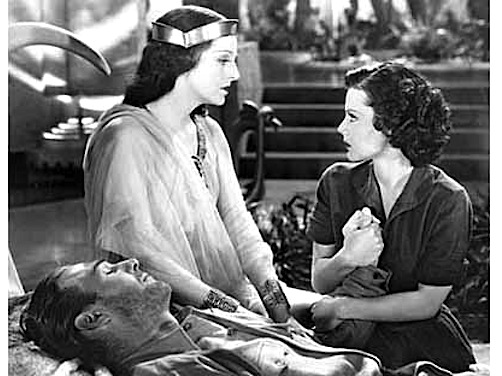


After “Leo” recovers, along with “Holly”, and “Tanya”, the three are called to witness the wrath of “SHE Who Must Be Obeyed!”.

“SHE” orders the executions, including their chief, of several of the “Amahaggar” men, for reverting back to cannibalism. These executions are over “Leo’s” objections, but “SHE” says this is necessary for “Ayesha”to remain in power by causing fear in her subjects.


Later, after the executions, “Ayesha” shows this “Leo” the body of “Kallikrates”. Which she has kept preserved until his return to her once more. “Leo” stares at his own face in disbelief.

“Ayesha” claims she murdered his ancestor in a fit of jealous rage over his wife. “Leo” says that’s impossible, because it would have to have happened 500-years ago. “Ayesha” takes him to where the “Pillar of Fire” is, and explains that when it turns “Blue and Cold”, you enter and never age. “Leo Vincey” realizes he’s staring at the mythical, “Fountain of Youth”, that his ancestor was searching for.


“Ayesha” now moves on “Tanya”, who is obviously in love with “Leo”. “Ayesha” arranges to have “Tanya” sacrificed, as both”Leo” and “Holly” unknowingly watch. Initially, the gagged and veiled “Tanya” is brought to the same place the “Amahaggar” were executed.


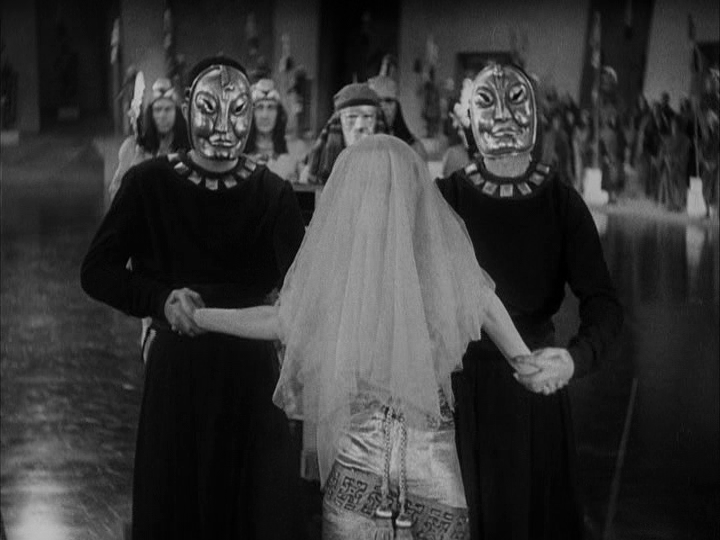
_11.jpg)
_08.jpg)

“Ayesha’s” plan of course does not work, and “Leo” rescues “Tanya”.
_07.jpg)
“Leo” takes “Holly” to see the “Pillar of Fire”, “Ayesha” arrives, and attempts to have her reborn “Kallikrates”, join her in eternal life. By entering the flame when it turns cold, but “Leo” is reluctant.

To prove entering is safe, “Ayesha” enters the flame, and but ages 2,000 years, because you can only enter the flame once!
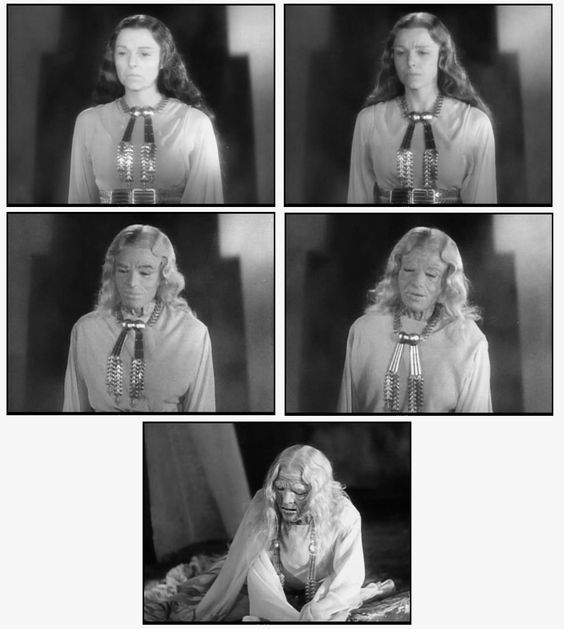
At that exact moment, the “Amahaggar” feel the time to break free from the rule of “SHE” is at hand, and attack her soldiers and followers. While this is happening, “Leo”, “Tanya”, and “Holly” use the confusion to leave “Lost” the “City of KOR” and return to the civilized world.
From “Directing”, a motion picture about “ETERNAL LOVE”. Irving Pichel moved to “Acting”, in a motion picture about “ETERNAL LOVE”.
The following is modified from my in-depth article, “Dracula X 2 (1931), Dracula’s Daughter (1936), Son of Dracula (1943): ‘Universal Pictures’ Living Dead Family”, looking for a bite to eat, at:
https://www.bewaretheblog.com/2024/10/dracula-x-2-1931-draculas-daughter-1936.html
Bram Stoker’s, “Dracula”, may be the widest known vampire story that was turned into motion picture’s, but he wasn’t the first Irish author to tell a classic vampire tale. The other Irish author was Sheridan Le Fanu, below, and his Gothic tale was about a female vampire named “Carmilla”, published in 1872, twenty-five-years before “Stoker”.

DRACULA’S DAUGHTER released on May 11, 1936
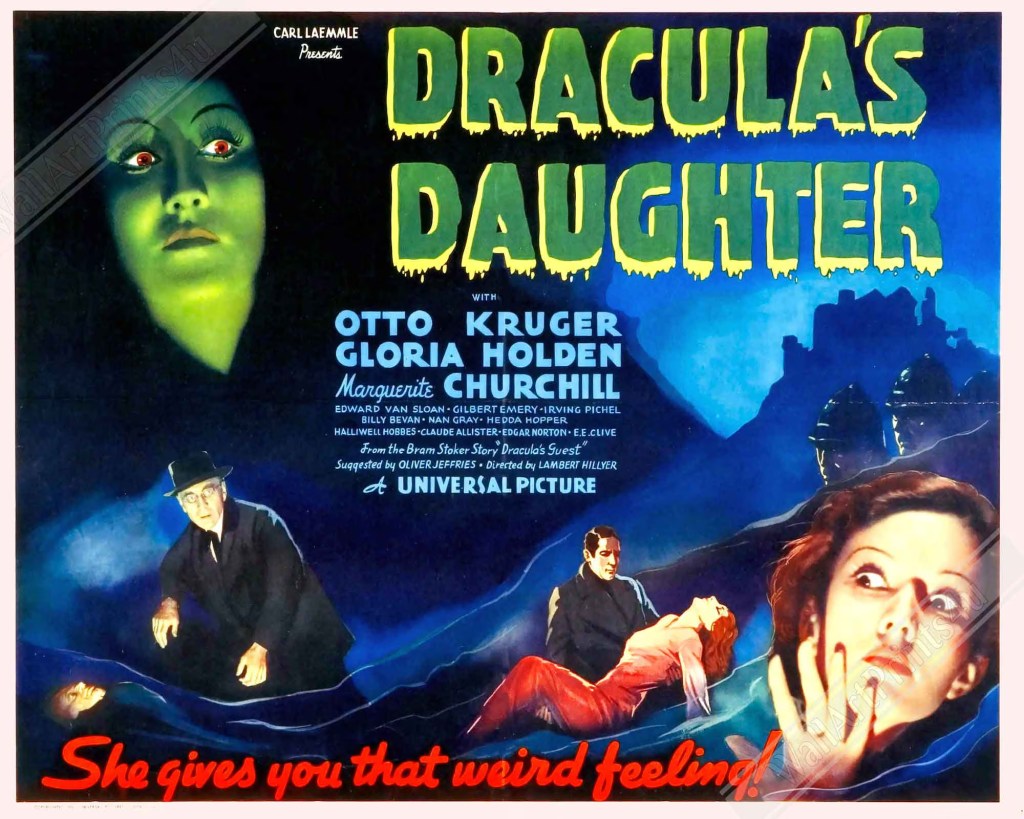
The story behind the filming of “Dracula’s Daughter” is a little convoluted, and starts at “Metro-Goldwyn-Mayer”, with the purchase of a missing Chapter from Bram Stoker’s novel, entitled
“Dracula’s Guest”, first published in a 1914 collection entitled, “Dracula’s Guest and Other Weird Stories”.
.jpg)
Producer, David O. Selznick hired John L. Balderston to write a story treatment based upon “Dracula’s Guest”. Which in Selznick’s contract with Florence Stoker, the authors wife, had an approved alternate title of “Dracula’s Daughter”.
John L. Balderston’s name does appear in the final film credits for writing the story. The following comes from the website for the “American Film Institutes Catalogue” at: https://catalog.afi.com/Catalog/moviedetails/6644
– – -According to modern sources, the film Dracula’s Daughter was also loosely based on the 1872 British novel Carmilla by Sheridan Le Fanu, – – –
Balderston’s treatment expanded upon the Bram Stoker short story and definitely added much of Le Fanu’s novel to his created character. Who became the motion picture’s title, “Dracula’s Daughter”.
Continuing from my above linked article:
John Lloyd Balderston’s treatment made it very clear that “Dracula’s Daughter” was a lesbian. Who enjoyed torturing male victims and they in turn, under her control, enjoyed being tortured. There was a scene of the “Countess’s” chambers with the whips and straps she might be using on her male victims, although they would not be shown in use.
———-
David O. Selznick, depending upon the source you read, either sold John Lloyd Balderston’s treatment to the Laemmle’s in October 1934, or September 1935. Which ever date you choose, those Horror film historians agree that Selznick knew Universal Pictures wanted to make a sequel to 1931’s, “Dracula”, and he held the means for a tidy profit on his investment.
At Universal Pictures, Carl Laemmle, Jr. assigned the other playwright who had worked on the 1931 feature, Garrett Fort, to rewrite Balderston’s treatment into a screenplay that would pass the “Hays Censorship Office”.
Garrett Fort’s name appeared in the final credits for writing that revised screenplay.
For my reader unfamiliar with John L. Balderston, who was at the opening of “King Tut’s” tomb and wrote “Universal Pictures”, 1932, “The Mummy”, my article is “John L. Balderston: Writing Classic Fantasy, Horror, and Science Fiction Screenplays” at:
https://www.bewaretheblog.com/2022/08/john-l-balderston-writing-classic.html
Also credited with writing the screenplay is the name Oliver Jeffries. This was Carl Laemmle, Jr. giving an inside the industry credit to his studio’s competitor, David O. Selznick, below, in a fictitious name for acquiring the original story and hiring Balderston.

The motion picture was directed by journalist turned movie director, Lambert Hillyer. Who is credited with taking silent movie cowboy actor William S. Hart, and turning him into a very rich western movie star. Hillyer had just directed Boris Karloff, Bela Lugosi and Francis Drake in 1936’s, “The Invisible Ray”, and followed this motion picture with the auto racing movie, 1937’s, “Speed to Spare”.
.jpg)
The Main Cast:
Otto Kruger portrayed “Dr. Jeffrey Garth”. Kruger’s film career. included the Wallace Beery and Jackie Cooper, 1934 version of Scottish writer Robert Louis Stevenson’s, “Treasure Island”, portraying “Dr. Livesey”, Edward G. Robinson’s, 1940, “Dr. Ehrlich’s Magic Bullet”, director Alfred Hitchcock’s, 1942, “Saboteur”, and detective writer, Raymond Chandler’s, 1944, “Murder My Sweet”.
Gloria Holden portrayed “Countess Marya Zaleska (Dracula’s daughter)”. It has been said that Holden’s “exotic” role influenced vampire writer Anne Rice, and the feature film is directly mentioned in Rice’s, 1988, “Queen of the Damn”. Among her other roles, saw Holden portraying “Alexandrine Zola”, in 1937’s, “The Life of Emile Zola”, starring Paul Muni, in 1939, she was in director Tod Browning’s, “Miracles for Sale”, starring Robert Young, and Douglas Fairbanks Jr’s, and the, 1941, version of French author Alexander Dumas’s, “The Corsican Brothers”.
Irving Pichel portrayed “Sandor”, dominating the left of the following photo of Gloria Holden and Otto Kruger.

Marguerite Churchill portrayed “Janet Blake”. Churchill has the distinction of being the first actress to play opposite Marion Mitchell Morrison, under his new name ofJohn Wayne, that was created by director Raul Walsh, for the 70mm “Grandeur” western, 1930’s, “The Big Trail”. The story of that motion picture makes up my article, “JOHN WAYNE, WILLIAM FOX: Grandeur and ‘The Big Trail” found at:
http://www.bewaretheblog.com/2015/10/john-wayne-william-fox-grandeur-and-big.html
However, Churchill’s total film roles through 1952, was only twenty-eight feature films.

Above Marguerite Churchill and Gloria Holden.
Edward Van Sloan returned in his role as “Professor Van Helsing”. Van Sloan had just appeared in the drama, 1936’s, “Road Gang”, starring Donald Woods, 1953’s, “The Beast from 20,000 Fathoms, and followed this motion picture with 1936’s, “Sins of Man”, starring Jean Hersholt and Don Ameche.

Nan Grey, billed as Nan Gray, portrayed “Lili”. Grey was a contract player for “Universal Pictures” and found herself in several Deanna Durbin musical comedies, but also, besides this film, in a couple more horror entries. She was “Lady Alice Barton” in the 1939, “Tower of London”, and, “Helen Manson” in 1940’s, “The Invisible Man Returns”.

Gilbert Emery portrayed “Sir Basil Humphrey”. Emery had been, on-screen, acting since 1921, and among his other notable films is the classic 1932 version of author Ernest Hemingway’s, “A Farewell to Arms”, starring Helen Hayes and Gary Cooper, the classic 1935 version of “Magnificent Obsession”, starring Irene Dunne and Robert Taylor, 1937’s, “The Life of Emile Zola”, and producer and director Cecil B. DeMille’s, 1938, “The Buccaneer”.

The Screenplay:
This motion picture was released five-years after “Dracula”. However, it opens with “Professor Van Helsing” driving the stake into the count’s body and was made as a direct sequel to the earlier motion picture. “Universal Pictures” wanted Bela Lugosi to be in the coffin for the scene, but he refused and a terrible looking wax dummy was used. However, that was the only thing wrong with the picture.

After having destroyed “Dracula”, while standing by the coffin in Carfax Abbey, two Whitby Police Officers, “Sergeant Wilkes”, portrayed by E. E. Clive, and “Constable Albert”, portrayed by Billy Bevan, stumble upon the scene and arrest the professor for murder. The police officers have also found the broken-neck body of “Renfield” and believe “Van Helsing” was responsible for that murder too.


Unseen by the three, is a woman, “Dracula’s Daughter”, implied as apparently having observed the ending to the 1931, “Dracula”, and was never seen by “Van Helsing”, “Harker”, or “Mina”.
“Van Helsing” finds himself in Scotland Yard, and in front of “Sir Basil Humphrey”, explaining that he indeed destroyed “Dracula”, but that as the vampire had been dead for over 500-years. He cannot be charged, in 1936, with murder.

Instead of hiring a lawyer, “Professor Van Helsing” contacts one of his star students. Who is now a prominent London psychiatrist, “Dr. Jeffery Garth”. Who just, also, happens to be a close friend of “Sir Basil”.
The bodies of “Count Dracula” and “Renfield” are at the Whitby police station awaiting transfer to London. “Sergeant Wilkes” leaves the station to meet an officer from Scotland Yard at the train station, and “Constable Albert” is left in charge of the bodies. Enter a woman dressed in black, and with a scarf covering the lower half of her face.

The mysterious woman shows “Constable Albert” her ring, and he sits down in a chair in a trance.

“Sergeant Wilkes” and “Scotland Yard Detective Hawkes”, portrayed by Halliwell Hobbes, find “Constable Albert” in his trance, they touch him, and he falls over to the floor. They also find that the box which contained “Dracula’s” body is now empty.


The mysterious woman is the tormented “Countess Marya Zaleska”. Who is trying to rid herself of the vampire curse, that her father, “Count Dracula”, placed upon her.
As portrayed by Gloria Holden, the “Countess” is a sympathetic character, and the Carl Laemmle, Jr requested revised screenplay, of John L. Balderston’s somewhat sadistic and overly sexual original by Garrett Fort, plays to that end. While holding just a hint of Sheridan Le Fanu’s, “Carmilla”.
This feature film was made just two-years into the new, and harder, “Motion Picture Production Code”, being enforced by Joseph Breen of the “Hayes Office”. For my reader interested in the history of motion picture censorship. I give examples in my article “CENSORSHIP Protecting (?) America’s Morality in Motion Pictures 1923 to 1971” found uncensored at:
http://www.bewaretheblog.com/2017/06/censorship-protecting-americas-morality.html
It was the “Countess” and her manservant “Sandor” that removed her father’s body. Now, the audience watches the “Countess” burn it, in her hope that his total destruction will release the curse place upon her. “Countess Zaleska” ritually tosses salt on to the pyre, as the old texts mention, and watches her father’s body burn to ash.


However, “Sandor” knows better, and starts to discourage “Marya’s” thoughts of freedom from vampirism. “Sandor”says that even now, when he looks into her eyes, he still sees only “DEATH”!


The “Countess” soon gives in to her thirst for blood, and seeks victims in the London fog.


Next, she attends a society party attended by “Janet Blake”, the secretary of psychiatrist “Dr. Jeffrey Garth”, also in attendance. “Garth” is always, playfully, antagonistic towards “Janet”, not realizing she loves him. Speaking with “Dr. Garth”, “Countess Zaleska”, is told offhandedly, that he believes any person can defeat their cravings by confronting them. The “Countess” believes this may be the answer she’s been looking for to overcome her father, along with “Dr. Garth’s” modern science.

Above right, is Marguerite Churchill, quietly steaming over Otto Kruger’s obvious fascination with Gloria Holden. On her left, portraying “Lady Esme Hammond”, is Hedda Hopper. Whose career started to drastically change the year before this motion picture. When Hopper agreed to start writing a “Gossip Column” for “The Washington Herald”, for $50 dollars a week, equal to $1,134 dollars as of this writing.
After the party, the “Countess” asks “Sandor” to find a model for her painting. This is where that small influence from Sheridan Le Fanu is still found, but in a means of getting around the “Hays Office”.
“Sandor” finds “Lili” at a bridge contemplating suicide and asks her to come with him. She is standoffish, but he explains it not for him but his mistress. “Sandor” promises the young woman food, warmth, and money, “Lili” agrees and goes with the servant to the “Countess”.

“Countess Marya Zaleska” has been fighting off her urges as instructed by “Dr. Garth”, and it seems to be working. She explains to her model that she wants her naked for the painting, and “Sandor” will not be present. “Lili” starts to undress, but, “Countess Marya Zaleska” cannot resist her vampire urge anymore, and attacks “Lili”.


“Lili” has survived the attack, was found on a London street, and taken to the hospital. “Dr. Garth” is called in, because the patient is non-responsive. He now uses hypnosis to force “Lili” to remember what happened to her.

“Lili” does remember, and “Dr. Garth” receives enough information pointing at “Countess Zaleska”. However, being forced to remember the evenings events through hypnosis, has caused “Lili” to suffer a heart attack, and she dies as “Garth” looks on. While, in her London home, “Countess Zaleska” now realizes there is no cure for her vampirism and orders “Sandor” to kidnap “Janet Blake” and take her to Castle Dracula in Transylvania.
In Transylvania, “Sandor”, who is in love with the Countess, reminds her of the promise to make him a vampire to live eternally at her side, but is coldly told she will not transform him. She plans to turn “Dr. Garth” and make him her vampire partner.
“Sandor”, NOW, wants to get even with “Countess Zaleska”, and approaches “Janet Blake”, who is on a couch in a trance. In his hand, “Sandor” holds one of his wooden arrows, and contemplates plunging it into the young woman. As a means of eliminating the “Countess’s” hold on “Dr. Garth”, but turns away.


“Dr. Garth” arrives at Castle Dracula, and is met by “Sandor”, who guides him to the “Countess”.
_01.jpg)

“Dr. Garth” is next taken to “Janet”, whom he now realizes he loves, but “Countess Marya Zaleska” makes her desires known.


“Dr. Garth” volunteers to be turned into “Zaleska’s” partner, IF she releases “Janet.
It is agreed too, but suddenly, a wooden arrow from “Sandor’s” bow penetrates “Countess Zaleska’s” heart.“Sandor” is shot dead by “Scotland Yard Detective Hawkes”, who with “Professor Van Helsing”, followed “Dr. Garth” to Transylvania. “Countess Marya Zaleska” dies in “Dr. Jeffrey Garth’s” arms, finally at peace, as “Janet Blake” comes out of her trance.

Among Irving Pichel’s acting film roles, that followed “Dracula’s Daughter”, where in two Bette Davis starring vehicles. He was seen as “Huger”, in 1938’s, “Jezebel”, and he was “General Carbajal” in the Bette Davis and Paul Muni, 1939, “Juarez”,
While, among his films during the same period, but as a director, were the forgotten film-noirs, 1936’s, “The Gentleman from Louisiana”, and, 1937’s, “Larceny on the Air“.
I now turn to a piece of HORROR-SCIENCE FICTION from “PRC (Producers Releasing Corporation)”. They are on record as the least successful “Poverty Row” motion picture studio. As this time “PRC” was llocated at 1440 North Gower Street, in Hollywood. The following film’s estimated final budget, was around $40,000, which at this writing, would be $958,330.94
TORTURE SHIP was released on October 28, 1939
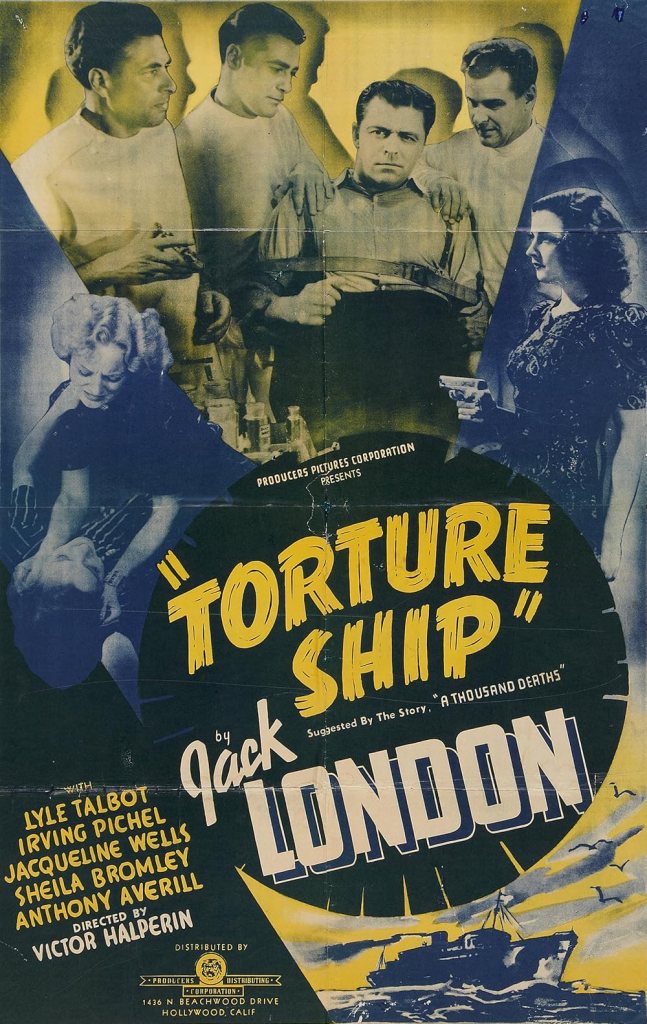
The screenplay was based upon an obscure Jack London story, “A Thousand Deaths”, from 1899. It was turned into a screenplay by two uncredited writers. The first was Harvey Huntley, who apparently only co-wrote this one screenplay, and nothing else is apparently known about Huntley. The second writer was George Wallace Sayre, who had 45 either screenplays, or television scripts to his name, between 1933 and 1954.
The motion picture was directed by Victor Halperin. This was his 15th of 17 directed movies, between 1924 to 1942..These included the very first Zombie movie, 1932’s, “White Zombie”, starring Bela Lugos, 1933’s, “Supernatural” starring Carole Lombard and Randolph Scott, and, 1936’s, “Revolt of the Zombie”, starring Dean Jagger.
Lyle Talbot portrayed “Navy Lieutenant Bob Bennett”. For fans of 1950’s television. Talbot co-starred in 98-episodes of “The Adventures of Ozzie and Harriet”, and 24-episodes of “The Bob Cummings Show”. Then there were one, or two episodes of “The Gene Autry Show”, “Topper”, “Hopalong Cassidy”, “My Little Marge”, “The Abbott and Costello Show”, “The Range Rider”, and “Death Valley Days” for starters.
Julie Bishop, billed as Jacqueline Wells, portrayed “Joan Martel”. Bishop/Wells had just been seen in the latest “The 3 Mesquiteers” western, 1939’s, “The Kansas Terrors”. That had starred, for this entry in series, as “The Three Mesquite’s”, Robert Livingston, Raymond Hatton, and Duncan Renaldo.
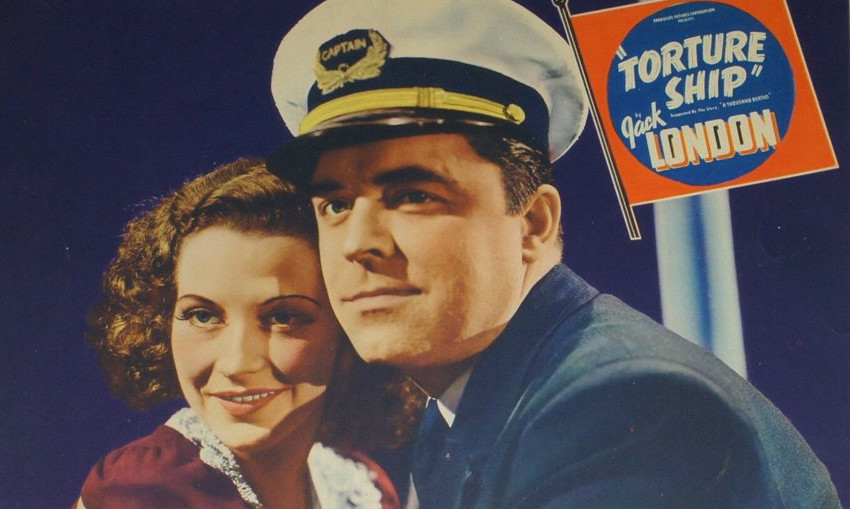
Above, “Jacqueline Wells” (Julie Bishop) and Lyle Talbot
Irving Pichel portrayed “Dr. Herbert Stander”. He followed this picture with a Technicolor short, 1939’s, “Old Hickory”, about “President Andrew Jackson”.
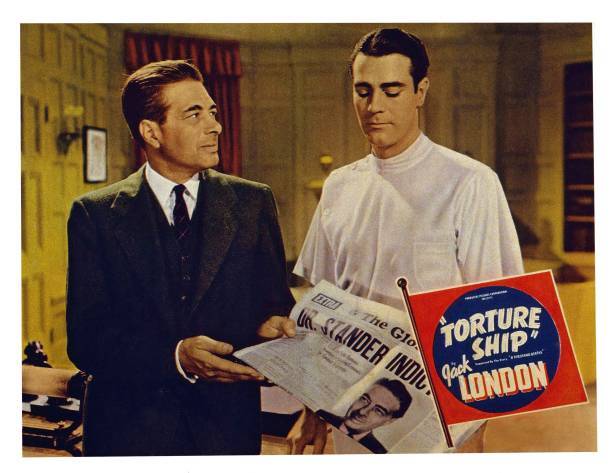
Above left, is Irving Pichel speaking to Julian Madison portraying “Paul”.
The story is basically one you’ve seen before, many times. A mad scientist, “Dr. Herbert Stander”, arranges for the escapes of a specific group of criminals. Each, next, finds themselves on his yacht as the subjects of “Dr. Stander’s” brain experiments. The object of which is to eliminate their criminal tendencies.
Then, there’s is “Dr. Herbert Stander’s“kind hearted nephew, “Bob Bennett”. Who just graduated from the Annapolis Naval Academy, and somehow is permitted to be the “Captain” of his”Uncle’s” yacht for as long as wants. Don’t over think that point. Add in “Joan Martel”, the secretary to “Mary Slavish” aka: “Poison Mary”, portrayed by Shelia Bromley.
“Joan” is trying to prove she is innocent of any knowledge of what her employer,”Poison Mary”, did, by killing people with poison for their insurance money. Although, “Mary”, claims “Joan” knew about everything. Of course, “Joan” and “Bob” fall in love.
What makes all of this work, is that the portrayals are all over the top. Whether, or not, this was what director Halperin was planning all along, or everyone was just turned loose. Due to the time and budget restrictions placed on him, by “PRC”, to make this quickie movie. This movie is very camp, and parodies all such straight (?), “Mad Scientist” movies of the 1930’s and 1940’s. The released cut, including the opening credits, runs just 64-minutes. So, just go with it.
Then, there was a very good “B” movie directed by Irving Pichel. Which was a reflection of America, before directly becoming involved in the Second World War. Released 16-months before “Pearl Harbor”, was 1940’s, “The Man I Married”, starring Joan Bennett, Francis Lederer, and Lloyd Nolan. The screenplay is about a woman who discovers her husband is a Nazi. It is worth a look!
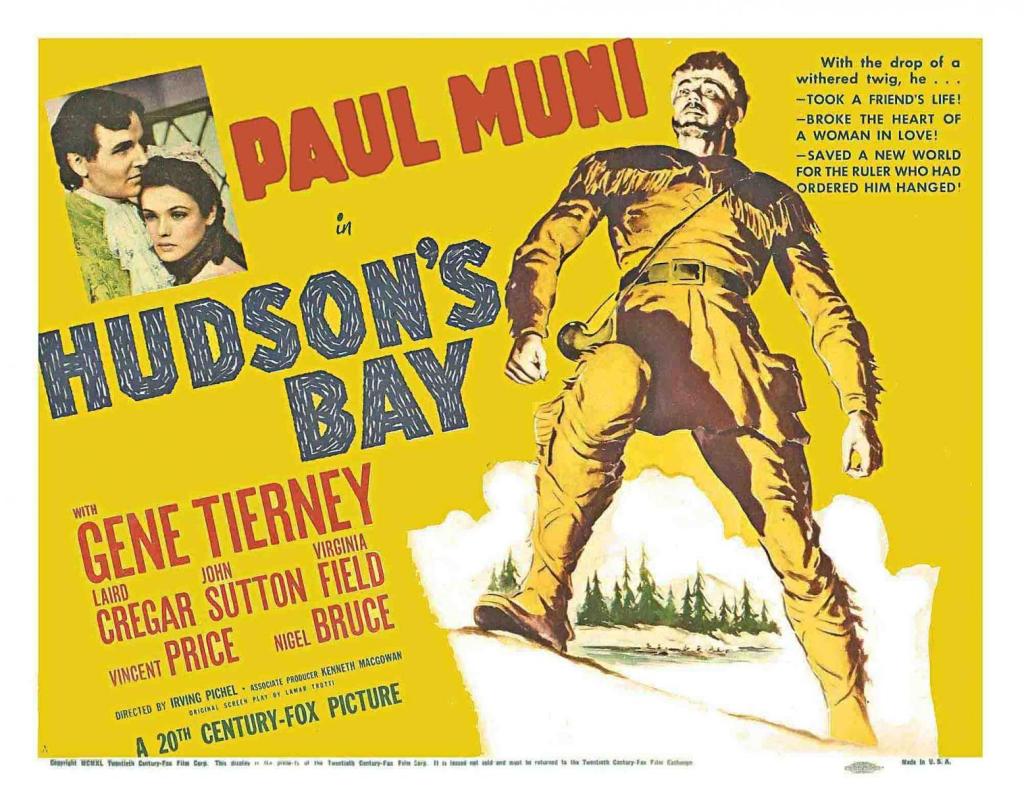
HUDSON BAY premiered in Kansas City, Missouri, December 24, 1940
Irving Pichel had earlier directed, for the Christian film group, “Cathedral Films Incorporated”, “The Great Commandment”, released only to Churches on October 2, 1939. Although, an unnamed actor portrayed “Jesus”.
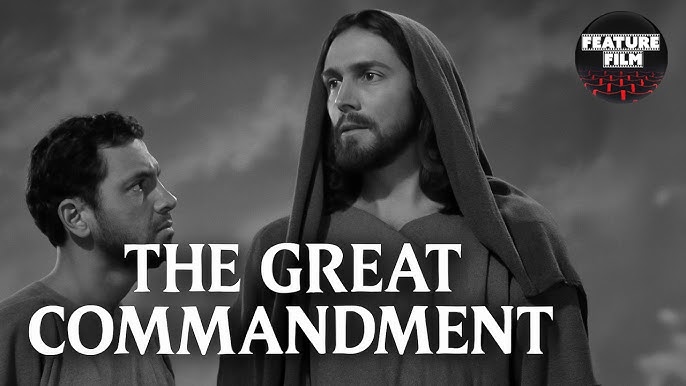
It was Irving Pichel who provided “The Voice of Jesus”. The movie starred John Beal, and was sold to “20th Century Fox”. That studio released a theatrical version across the United States, on June 13. 1941. Pichel would follow “Hudson Bay” with the comedy musical romance, 1941’s, “Dance Hall”, starring Carole Landis, and Cesar Romero.
The screenplay was by Lamar Trotti, who wrote Will Rodger’s, 1934, “Judge Priest”, and his 1935, “Steamboat Round the Bend”. Trotti also wrote the screenplay for the Loretta Young and Don Ameche, 1936, “Ramona”, the Tyrone Power, Alice Faye, and Don Ameche story of the great Chicago fire, 1938’s, “In Old Chicago”, and the Don Ameche, Loretta Young, and Henry Fonda, 1939, “The Story of Alexander Graham Bell”.
Paul Muni portrayed the real life, “Pierre Esprit Radisson”. Muni had just starred in the historical crime drama, 1939’s, “We Are Not Alone”, and would follow this motion picture with 1942’s, “Commandos Strike at Dawn”.

Gene Tierney portrayed the fictional “Barbara Hall”. This was the actresse’s second motion picture, and her first was 1940’s, “The Return of Frank James”, starring Henry Fonda. She would follow this feature, with the 1941 motion picture version of author Erskine Caldwell’s “Tobacco Road”, directed by John Ford.

Laird Cregar portrayed the real life “Medard Chouart de Groseilliers” aka: “Gooseberry”. Cregar is known for his portray of “Jack the Ripper” in 1944’s, “The Lodger”. My article is “Laird Cregar: An Excellent Character Actors Life Cut Short” at:
https://www.bewaretheblog.com/2022/10/laird-cregar-excellent-character-actors.html

John Sutton portrayed the fictional, “Lord Edward Crewe”. Sutton had just appeared in actor Sydney Toler’s, “Charlie Chan” mystery, 1940’s, “Murder Over New York”, and would follow this picture with the 1941, Jane Withers comedy, “A Very Young Lady”.

Above, Paul Muni and John Sutton.
Virginia Field portrayed the real life, “Eleanor ‘Nell’ Gwyn”. Field had just appeared in the Maureen O’Hara, Louis Hayward, and Lucille Ball, 1940, “Dance, Girl, Dance”, and would follow this movie with the sports romance, 1941’s, “Knockout”, co-starring with Arthur Kennedy.

Vincent Price portrayed the real life, “King Charles II”. Price had just portrayed “Joseph Smith”, in director Henry Hathaway’s, 1940, “Brigham Young”, and followed this feature with 1943’s, “Song of Bernadette”, starring Jennifer Jones.

Nigel Bruce portrayed the real life, “Prince Rupert”. Character actor Bruce had just appeared with Edward G. Robinson in the biography of the founding of the “Reuters” news organization, 1940, “A Dispatch from Reuters”, and followed this picture with the 1941, comedy, “Play Girl”.

Above, Nigel Bruce, Vincent Price, and Paul Muni.
The screenplay is based upon actual events in 1667 Canada, about the founding of the “Hudson Bay Company”, but with a fictious love story intertwined.
Basically, French trapper “Pierre Esprit Radisson” and his friend “Gooseberry” want to open a trading post in the Hudson Bay region of northeastern Canada. They go to the English governor at Albany for funding, but the governor believes the two are rogues and has them jailed. In jail, they meet jailed English Lord, “Edward Crewe”, manage to get him and themselves out.
According to the screenplay, the fictional “Lord Crewe”, was banished from England by “King Charles II” as a means of acquiring his land to rebuild London after the fire of 1666.
The screenplay moves forward as a noble adventure film, with the three arriving in Montreal, and “Pierre” and “Gooseberry” convincing “Lord Edward” to finance their expedition to establish free trade with the native Indian tribes. The three spend the next six-months guided by “Pierre’s” Indian foster father, “Orimha”, portrayed by Chief Thundercloud, trapping and trading with the Indians.


Finally arriving with their pelts at a French settlement, the governor of “New France”, the real life, “Pierre de Voyer d’Argenson, Vicomte de Mouzay”, portrayed by Montagu Love, takes all the furs as payment for fines, only created upon their arrival. Not to worry, the three steal back their furs and head for England.

The three men meet “Prince Rupert”, who gets “King Charles II” to stop his attacks on “Lord Crewe” and finance the three. The King agrees, but for 400,000 pelts in return for that help. At the court, “Edward’s” sweetheart, “Barbara”, is happy to be with him once more.

Financed by “King Charles II” the three head for Canada, but they have picked-up “Barbara’s” brother, “Gerald Hall”, portrayed by Morton Lowry, and he will become trouble. The first trading post is established at “Fort Charles”, but “Gerald” complains about the hard work, he is left to run the trading post, and the others push on.

A wounded Indian finds their camp, informs the three that “Gerald” paid a band of local “Indian” fur trappers with brandy, and they went wild. Rushing back to “Fort Charles”, “Pierre” finds a drunken “Gerald”, and “Orimha” tells him that there will be an Indian war, if “Gerald” doesn’t pay for the crime of inciting violence. “Pierre” permits “Gerald” to be shot by a firing squad for his crime.
The three, with their furs, return to England, but the King having heard of “Pierre Radisson’s” execution of “Gerald Hall”, has him arrested. “King Charles II” is forced to reconsider his action, when he learns that “Orimha”, was instructed to have the tribes stop trading with the English unless “Pierre” can return to Hudson Bay.
At the films end, “Lord Edward” and “Barbara Hall” are to be married. while “Pierre” and “Gooseberry” head back to Canada singing.

Next, I am looking at the one feature film “Produced By Irving Pichel“. In which, he had assembled a cast of known, and future major stars.
SWAMP WATER premiered in Waycross, Georgia, on October 23, 1941
Note: The motion picture was shot in Waycross’s, “Okefenokee Swamp”
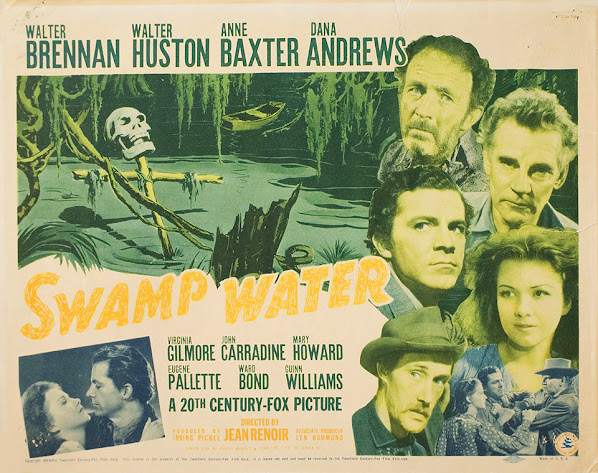
Producer Irving Pichel, worked with French director Jean Renoir, in explaining American film production, and assisted him in adapting his techniques to American film styles and other production details. On this, the French Director’s First American Motion Picture. Renoir’s previous films included, the internationally acclaimed, using the English translations, 1936 “The Lower Depths”, 1937’s “Grand Illusion” and 1939’s, “The Rules of the Game”,
The story is based upon the 1940 novel, “Swamp Water”, originally published in serial form in the “Saturday Evening Post”, by Vereen Bell. During the Second World War, Bell served as a Navy Lieutenant in Intelligence. On October 25, 1944, his ship, the escort carrier, “USS Gambier Bay”, was sunk in “The battle off Samar”, a part of the “Battle of Leyte Gulf”. Lieutenant Vereen Bell died the following day from wounds suffered during the Japanese attack on his ship.
The screenplay was written by Dudley Nichols. Nichol’s writing is mostly associated with director John Ford. These include both, 1934’s, “The Lost Patrol”, and “Judge Priest”. The 1935, “Oscar Winning”, “The Informer”, 1936’s, “Mary of Scotland”, 1937’s, “The Hurricane”, 1939’s, “Stagecoach”, and 1940’s, “The Long Voyage Home”. However, Dudley Nichols’s immediate prior screenplay was for German-American director, Fritz Lang’s, 1941, “Man Hunt”, and he would follow this screenplay with director Howard Hawks’s, 1943, “Air Force”.
The Cast:
Walter Brennan portrayed “Tom Keefer”. Brennan had just been seen in 1941’s, “This Woman Is Mine”, and followed this feature with the musical comedy, 1941’s, “Rise and Shine”.

Walter Huston portrayed “Thursday Ragan”. Huston had just portrayed “Mr. Scratch”, in 1941’s, “The Devil and Daniel Webster”, and followed this feature with 1941’s, “The Shanghai Gesture”. My article is “Walter Huston – Singer, Actor, Father of John” found at:
https://www.bewaretheblog.com/2026/02/walter-huston-singer-actor-father-of.html

Anne Baxter portrayed “Annie”. Baxter was just in the Jack Benny, 1941 comedy, “Charlie’s Aunt”. She followed this motion picture with Orson Welles’s, 1942, “The Magnificent Ambersons”. The role was original cast with Linda Darnell, but she was fired for misconduct by Darryl F. Zanuck, and Baxter’s career was really launched.

Dana Andrews portrayed “Ben”. Andrews had just co-starred with Randolph Scott and Gene Tierney in 1941’s, “Belle Star”. He followed this feature film with the Gary Cooper and Barbara Stanwyk’s, 1941, “Ball of Fire”.

Virginia Gilmore portrayed “Mabel MacKenzie”. Gilmore co-starred in director Fritz Lang’s, 1941, “Western Union”. She would follow this film with “Mr. District Attorney in the Carter Case”, starring “B” Cowboy actor, James Ellision, the first side-kick for William Boyd’s “Hopalong Cassidy”.

John Carradine portrayed “Jesse Wick”. Carradine had just been in Fritz Lang’s, 1941, “Man Hunt”, and followed this feature film with the Tyrone Power starring vehicle, 1942’s, “Son of Fury: The Story of Benjamin Blake”.

Ward Bond portrayed “Tim Dorson”. Bond had just appeared in 1941’s, “The Maltese Falcon”, and followed this movie with 1942’s, “Wild Bill Hickok Rides”. My article is “Ward Bond of Director John Ford’s Stock Company” at:
https://www.bewaretheblog.com/2025/01/ward-bond-of-director-john-fords-stock.html

Jean Renoir brought to the American motion picture screen, a film, that was more European in Construction, and is considered by film-historians to be the FIRST ACTUAL AMERICAN FILM-NOIR.
Renoir concentrated on characters over expected action, and worked closely with the two cinematographers, Peverell Marley and Lucien Ballard, on the black and white imagery he wanted. Probably, only Orson Welles, might have understood what Jean Renoir wanted his audience to see on-screen.
The Very Basic Plot:
“Thursday Ragan” is a Georgia farmer living on the edge of the Okefenokee Swamp. He is very harsh to people, and seeks complete control of his son “Ben”. Yet, in his own way, he loves his son. Then there is his young wife, “Hannah”, (portrayed by 27-years-old, Mary Howard, Walter Huston was 57, 30-years her elder). “Thursday” would rather spend his time with her than anyone else, including “Ben”.


“Ben’s” girlfriend is “Mabel MacKenzie”, but she is a jealous, conniving, and very shallow person. Who uses her sexual charms to manipulate “Ben”, and the other men of the small community, including “Thursday”.


The real story starts when “Ben’s” dog disappears into the swamp and he goes after it.

“Ben” enters the swamp looking for his dog, but finds more than he bargained for.


During his search, “Ben” is attacked for no apparent reason. The man doing this attack, turns out to be the murderer, “Tom Keefer”. Who thought “Ben” was among the men. he believed, were still hunting him. However, “Ben’s” quick reaction turns into a short fight and it is “Keefer” who is actually knocked unconscious.


When “Tom” regains consciousness, and realizes that “Ben” is not a threat to him. “Tom” tells “Ben” that he was framed for the murder of “Sheriff Deputy Shep Collins”, and “Ben” after hearing the tale, “Ben” accepts it as truth. but who did the actual killing?

Next, the two form a partnership to protect “Tom Keefer”, but also protect his daughter.
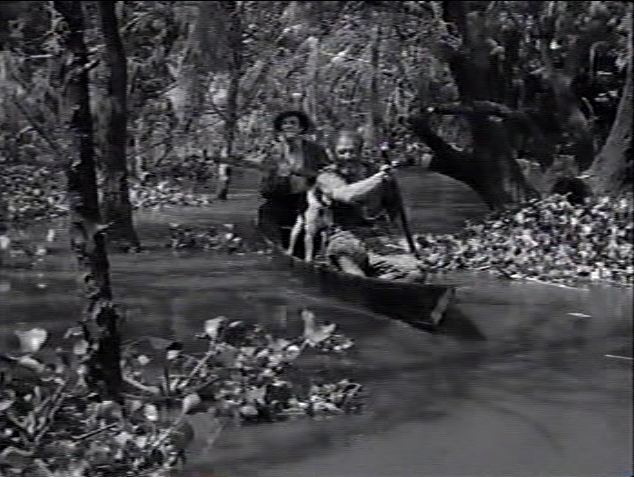
“Ben” will sell the animals trapped by both men, thereby, hiding the existence of “Tom”. Adding to their partnership, is “Ben’s” new responsibility, “Julie Keefer”, a true girl of the “Okefenokee Swamp”.

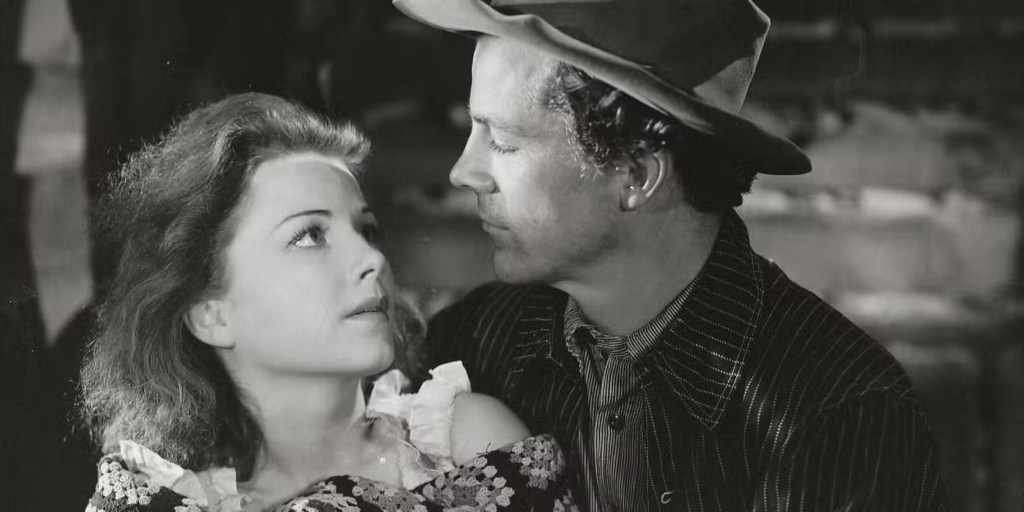
After interdictions, and explanations, “Ben” will take “Julie” to “Hannah” to turn the swamp girl into the strong woman she really is, and don’t even thing “Cinderella”. Slowly, in Renoir fashion, a love will start to bloom between “Ben” and “Julie”. With what has transpired, so far, it gives”Ben” the strength to finally stand up to his father.


Meanwhile, “Ben” starts to believe that “Jesse Wicks” is involved in the “Deputy Sheriff’s” murder. He goes to him, forcing “Wicks” to confess, and the confession is told to the towns people.


“Ben” next goes to the swamp to tell “Tom” he’s a free man, but the real killers, named by “Jesse Wicks”, the “Dorson Brothers”, “Tim”, and “Bud”, portrayed by Guinn “Big Boy” Williams, have followed “Ben”, and the two start shooting at “Ben” and “Tom” in an attempt to kill both.

Meanwhile, several men from the town, are now, also chasing the brothers for the murder, and enter the Okefenokee Swamp with “Julie Keefer”.

“Ben” is able to double back, and confronts “Bud Dorson”.
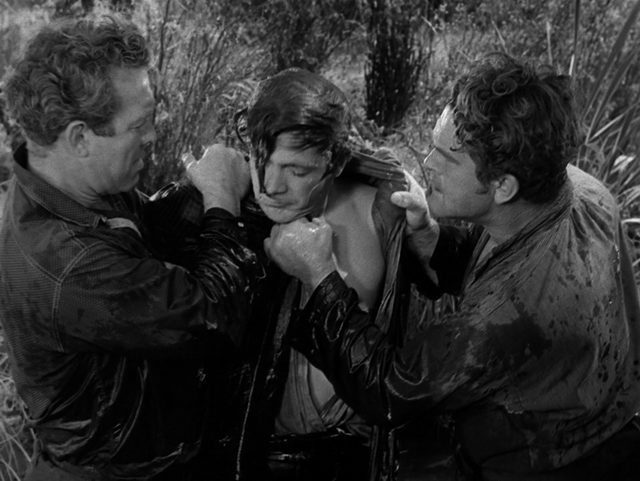
The two start to fight, but not being able to watch the ground they’re fighting on, “Bud” steps into quick sand, and the fight ends with his screams.


“Tom Keefer” next confronts “Tim Dorson”. “Tom” tells the other, that all he ever wanted was a normal life. A moment later, “Tim Dorson”, who had the upper hand, just turns away from “Tom”, and walks into the swamp, never to be seen again.
The townspeople find “Tom” and “Ben”, and the movie cuts to a dance. Where “Thursday” and “Hannah” are one dancing couple, “Ben” and “Julie” are another, and a clean cut “Tom Keefer” smiles and looks on
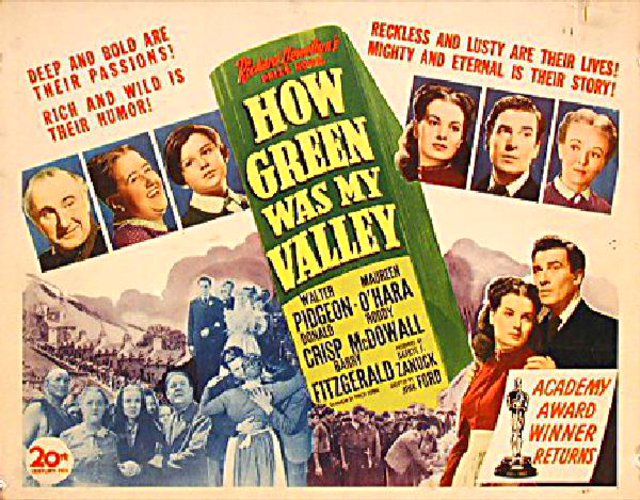
Irving Pichel worked for director John Ford in three major motion pictures, but you might never have known this fact. That was because, he provided only voice over narration. The first of the three motion picture’s, was Ford’s, “How Green Was My Valley”. Which premiered on October 28, 1941, in New York City.
The story is told by the character of “Huw Morgan”, portrayed by Roddy McDowall.
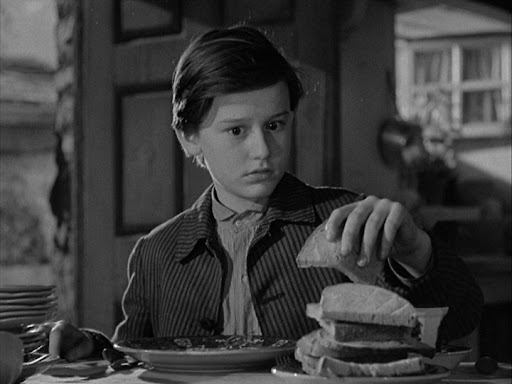
However, this is “Huw” remembering the coal mining town and its people he grew up among many years ago. At the beginning, and at the ending, the voice of the adult “Huw”, setting up the story, and ending it, was provided by Irving Pichel‘s narration.
It would be two-more years before Irving Pichel was seen, or heard, on the motion picture screen. However, before that return, had been, December 7, 1941, and the United States entering the Second World War.
During those two-years, IRVING PICHEL DIRECTED 3 MOTION PICTURES.
He first, followed “Swamp Water”, with a low-budget espionage entry. It is remembered not because of the film’s director, or two stars, but because it was the First Anti-Japanese motion picture from a major studio, in this instance, “20th Century Fox”.
SECRET AGENT OF JAPAN premiering on March 16, 1942 in New York City
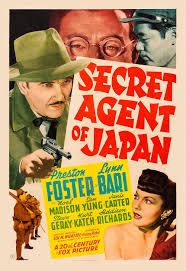
The anti-Japanese piece of propaganda was by John Francis Larkin, set prior to Pearl Harbor, around a bar in Shanghai, China. Larkin had been writing “B’ screenplays for the studio, mostly the “Charlie Chan” mystery series.
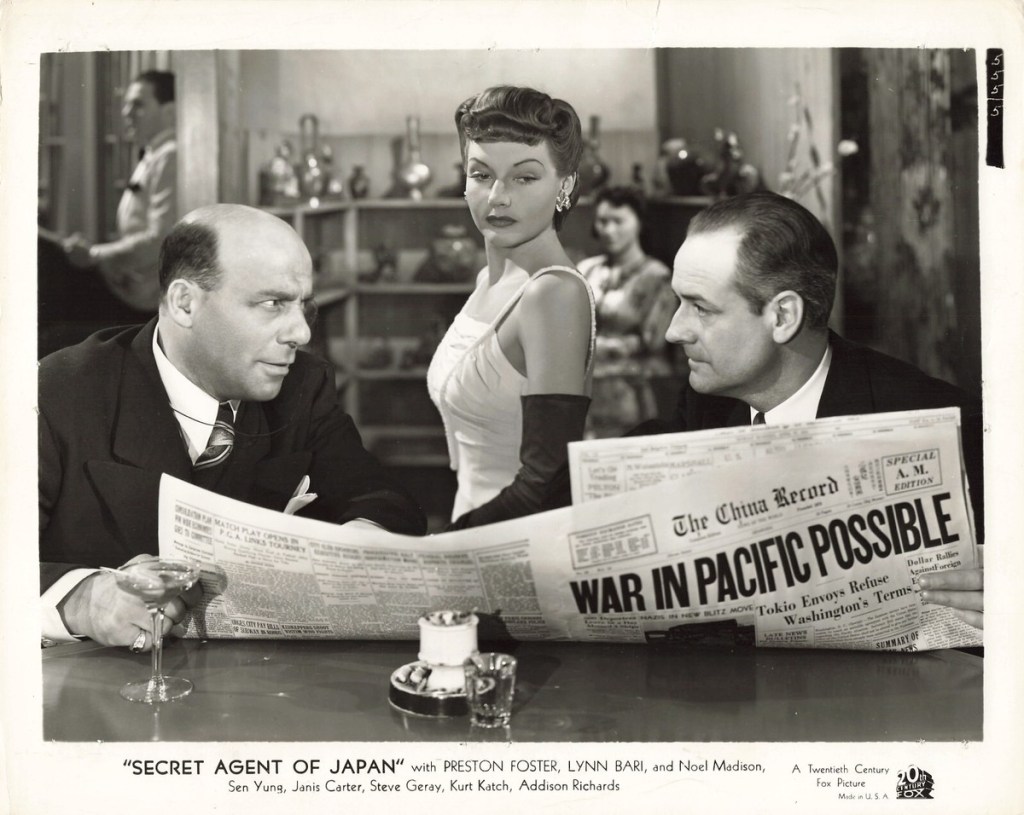
Above, Lynn Bari as British Secret Service agent “Kay Murdock”, looking for Japanese secret codes and plan prior to Peal Harbor. Below, she is with Preston Foster portraying nightclub owner, “James Carmichael”, actually American fugitive “Roy Bonnell”. As the two come together to stop a Japanese espionage ring.
The second feature Irving Pichel’s directed, before his voice returned to the motion picture screen, was a classic, charming story, set in war torn, 1942, France.
THE PIED PIPER premiered on July 8, 1942
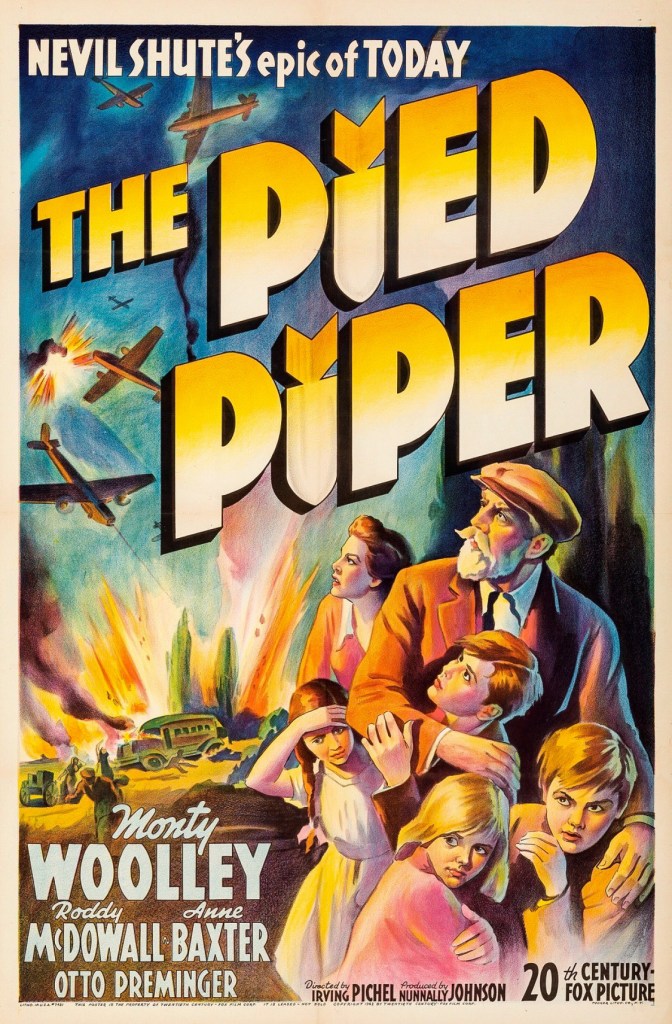
Today, as I write this article, English novelist, Nevil Shute (Norway), is still mainly remembered for one novel, 1957’s, “On the Beach”. That story is about survival after a nuclear Third World War. Shute’s, earlier, 1942 novel, “The Pied Piper”, is also about survival, and a World War. However, the survival was not after, but during the the start of the Second World War caused by Nazi Germany.
Shute’s novel was turned into a screenplay by Nunnally Johnson. Johnson’s previous screenplay was for 1942’s, “Roxie Hart“, starring Ginger Rodgers. My reader may not recognize that movie title, but instead, may know, the 1975, musical version, “Chicago”, and “All That Jazz”. Nunnally Johnson followed this screenplay with the 1942, comedy, “Life Begins at Eight-Thirty“, starring Monty Woolley.
Director Irving Pichel would follow “Pied Piper” with the third feature film that he directed before his return to the motion picture screen. This was the just mentioned, 1942, “Life Begins at Eight-Thirty”. Which he had co-starring with Monty Woolley, Ida Lupino, and Cornel Wilde.
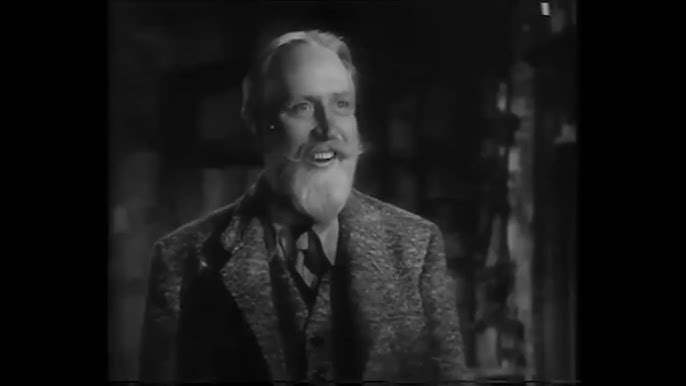
Monty Woolley portrayed “John Sidney Howard”. On the Broadway stage, he had portrayed the title character of “Sheridan Whitside”, in Nunnally Johnson’s play, “The Man Who Came to Dinner”. Just prior to this motion picture, Woolley had reprised the role in the 1941, motion picture. He followed this picture, with yes, 1942’s,”Life Begins at Eight-Thirty”.
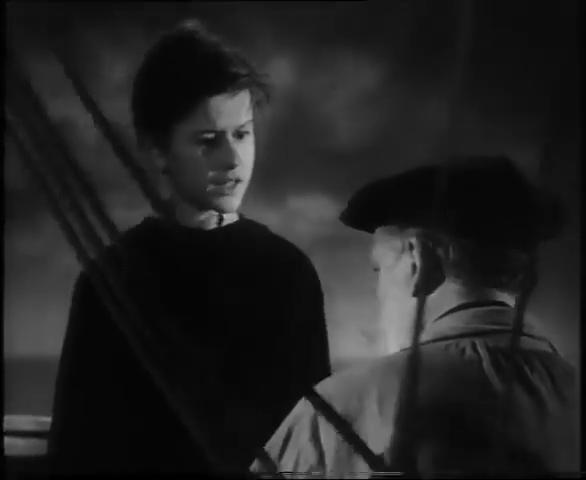
Roddy McDowall portrayed “Ronnie Cavanaugh”. McDowall had just starred in 1942’s,”On the Sunny Side”, a drama about a young boy in England during the Second World War. He would follow this film, by co-starring with Preston Foster, in 1943’s, “My Friend Flicka”.
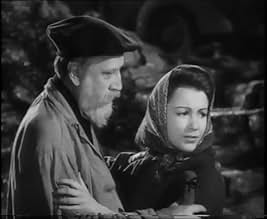
Anne Baxter portrayed “Nicole Rougerson”. Baxter has just co-starred in twin director’s, Orson Welles and Robert Wise’s, 1942, “The Magnificent Ambersons”, film-edited by Wise, and a product of Welles’s “Mercury Theater”. She followed this movie, by co-starring with Tyrone Power and Dana Andrews, in the Second World War submarine feature, 1943’s, “Crash Dive”.
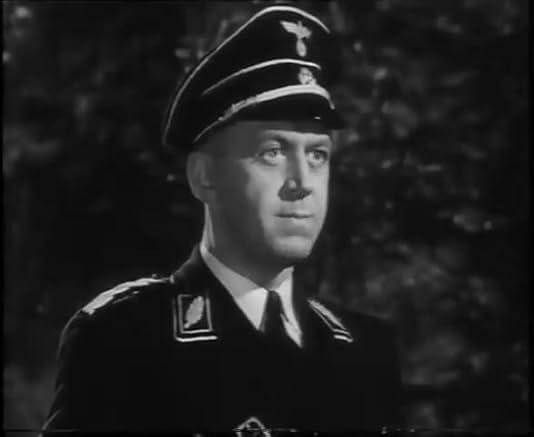
Otto Preminger portrayed “Major Diessen”. This was Otto Preminger’s first on-screen acting role. As a director, his last released motion picture was the anti-Nazi comedy, 1943’s, “Margin for Error”, that co-starred with Joan Bennett and Milton Berle. The future director of films like 1944’s, “Laura”, 1953’s, “The Moon is Blue”, 1955’s, “The Man with the Golden Arm”, and 1960’s, “EXODUS“, had next directed the war comedy, 1944’s, “In the Meantime, Darling”, co-starring Jeanne Crain, and Frank Latimore.
The Very Basic Plot:
On September 3, 1939, the “United Kingdom” officially entered the Second World War. The screenplay’s setting is in June 1940, 78-years-old, “John Sidney Howard” goes to the North of France, near the border with Switzerland to sulk, over being turned down for military service. His son, a Royal Air Force (RAF) Pilot was shot down and killed by the Germans. At this time, France is not involved in the war, until Germany invades, May 10, 1940. “Howard” decides to return to England to do what he can for the war effort.
Next, a British friend in Switzerland, “Mrs. Cavanaugh”, portrayed by Jill Esmond, is afraid that Germany will next invade Switzerland. Her husband, “Mr. Cavanugh”, portrayed by Lester Matthews, is a British official to the “League of Nations”. His wife is to accompany him to Geneva for a major meeting about stopping Germany. She’s worried about the safety of her two children, “Ronnie”, and “Sheila”, portrayed by Peggy Ann Gardner. “Mrs. Cavanaugh” asks Howard”, who she knows is returning to England, to take her children with him and to her sister in Plymouth.
At first, “Howard” refuses, but changes his mind, and the three leave on the train going north to the town of “Chartres”. However, the German’s invade France, the train is forced to stop at the town of “Joigny”, and “Howard”, “Ronnie”, and “Sheila” are told, no other trains are running north. When the three, next, board a bus for “Chartres”. “Ronnie” quietly adds a French girl to their group. She is “Rose”, portrayed by Fleurette Zama, who needs to get to her father in London. Just when “Howard” realizes he has a new addition to his group. The bus is attacked by German planes and those passengers, not killed, are forced to start walking.
The now four, join the stream of refugees that are walking down the road toward the next town.
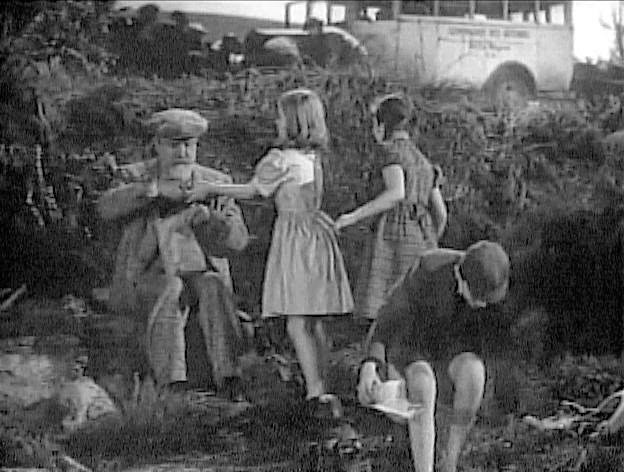
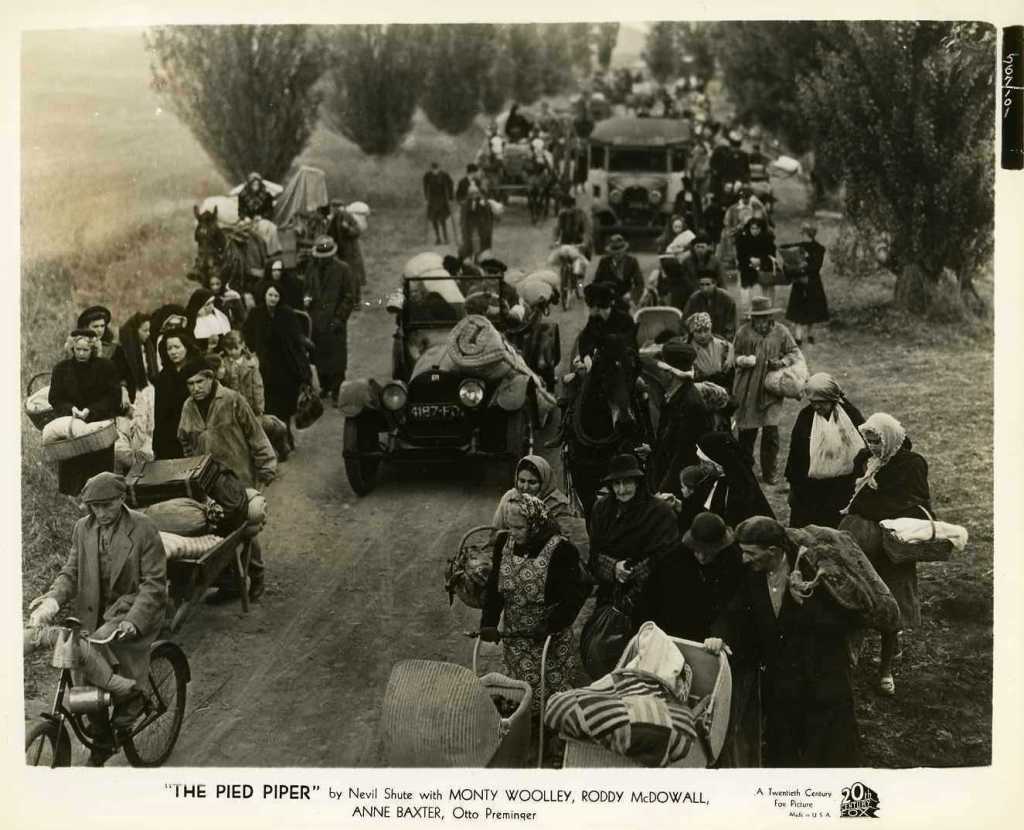
Next, German flyers shoot at the refugees, and kill a large amount of them. When “Howard’s” group stops for the night, he discovers they have picked up a young boy named “Pierre”, portrayed by Maurice Tauzin, whose parents were killed back on the bus.
Very tired, “Howard” and the five children arrive in “Chartres”, to find an acquaintance of “Howard’s” son, “Nicole Rougerson”.
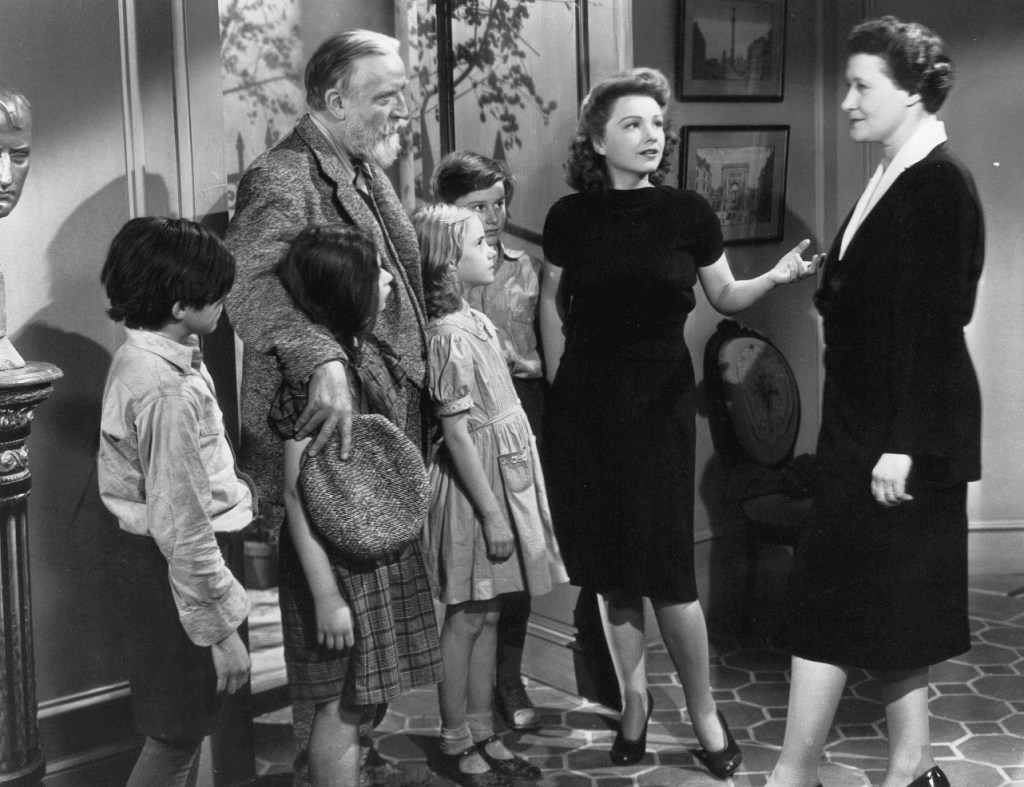
Above, left to right, are Merrill Rodin, Fleurette Zama, Monty Wooley, Peggy Ann Gardner, Roddy McDowall, Anne Baxter, and Odette Myrtil portraying “Madame Rogerson”.
“Howard” now discovers a fifth child, the Dutch boy, “Wilhelm”, portrayed by Merrill Rodin. “Howard” has become Nevlle Shute’s allegorical “Pied Piper of Hamlin”.
“Nicole” takes the six away from her home, after learning the German’s have heard there might be an Englishman there.
The seven, now board a train heading for Brittany, a Celtic cultural peninsula on the Northern French coast. On the train, “Nicole” reveals having had three “Blissful” days with “Howard’s” son.
In “Landerneau”, “Nicole” appeals to her “Uncle Aristide”, portrayed by J. Carrol Nash, who owns fishing boats. At first, “Aristide” is suspicious of the Englishman seeming to use children as cover. However, “Uncle Aristide” finds a man named “Focquet”, portrayed by Marcel Dalio, who will take the group to England. However, going through a German occupied town, “Sheila” makes the mistake of speaking English and is overheard by a German Soldier. The mistake leads to the group being captured at “Focquet’s” boat. They are all taken to German “Major Diessen”.
“Major Diessen” is convinced that, “John Sidney Howard”, is a BRITISH SPY using the children as his cover. To get “Howard” to reveal himself, “Diessen” has him watch the execution of a spy. “Howard” offers to confess to anything the German Major wants, even though it’s untrue, IF he lets the others go.
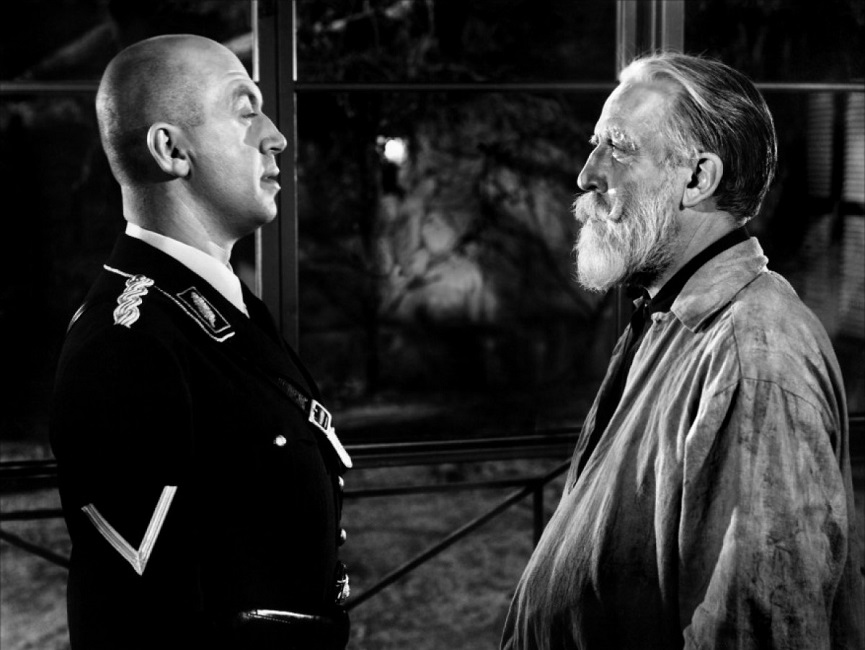
Next, with everyone else out of his office, “Major Diessen” makes a very unexpected proposa. He will let the others and “Howard” go, IF he will take another child with him to England?
The child in question is “German Army Major Diessen’s” niece, who is seven-years-old, and the daughter of his brother. The Major’s younger brother was killed in Belgium, and the Nazi’s have discovered his wife was Jewish. The woman was “taken care of”, but the Major wants to save his niece. He wants “Howard” to take his niece to his older brother, a naturalized American citizen. As, should it be discovered that the little girl is half-Jewish, she will end up like her mother. Just in case “Howard” fails to help his niece, “Diessen” will keep an eye on “Nicole”, who is refusing to leave France. “Howard” counters, by threatening to reveal all of “Major Diessen’s” dealings, IF any harm comes to “Nicole Rougerson”.
Later, back in England, at his club, “Howard” is asked:
“If he had any difficulties” getting back from France?
He replies:
“No, —-not too much!”
“The Pied Piper” was nominated by the “Academy of Motion Picture Arts and Sciences” for the “Best Picture Oscar”.
Monty Woolley was nominated by the “Academy of Motion Picture Arts and Sciences” for the “Best Actor, Oscar”.
Edward Cronjager was nominated by the “Academy of Motion Picture Arts and Sciences” for the “Best Cinematography, Black and White, Oscar”.
Director Irving Pichel was not nominated for “Best Director”. Which to this film historian, seems strange, for a motion picture that was nominated for the “Best Picture Oscar”.
On March 6, 1942, John Steinbeck published his novel, “The Moon Is Down“. He wrote this specific piece of propaganda, to illustrate to his readers. the vital need for supporting resistance groups in Europe against Nazi Germany. However, who the enemy is, and in what country his story is set in, are never mentioned by John Steinbeck.
The novel was first turned into a Broadway play by playwright, Chester Erskine. Howard Bay’s designed set’s, suggested to the audience, that the country Erskine’s play was taking place in, was Norway. Which had been invaded by Nazi Germany back on April 9, 1940, but who the enemy was, and what country the play actually takes place in. Is never mentioned by Chester Erskine, like John Steinbeck.
However, “20th Century Fox”, obtained the motion picture rights to the original novel and slight changes occurred.
THE MOON IS DOWN was first released on March 13, 1943, in Toronto, Canada, but had it’s “World Premiere”, the following day, in New York City
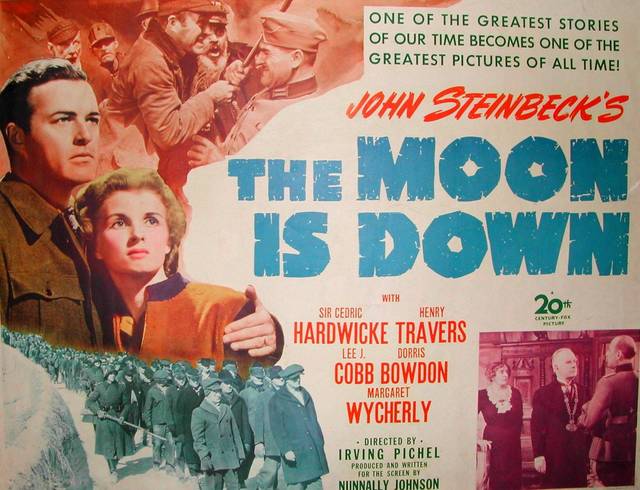
The motion picture was directed by Irving Pichel and produced by the screenplay writer, Nunnally Johnson. The two decided to use the same location as “How Green Was My Valley”, was mainly filmed in the town of, “Brents Cragg”, located between Malibu Beach, in the Santa Monica Mountains, and the town of Calabasas, in the San Fernando Valley, in what is now, “Malibu Creek Park”.
Producer/screenplay writer Johnson, made it clear that the action was set in a sea port town in Norway. Which was located near a major coal mine, both taken over by the German army.
The Cast:
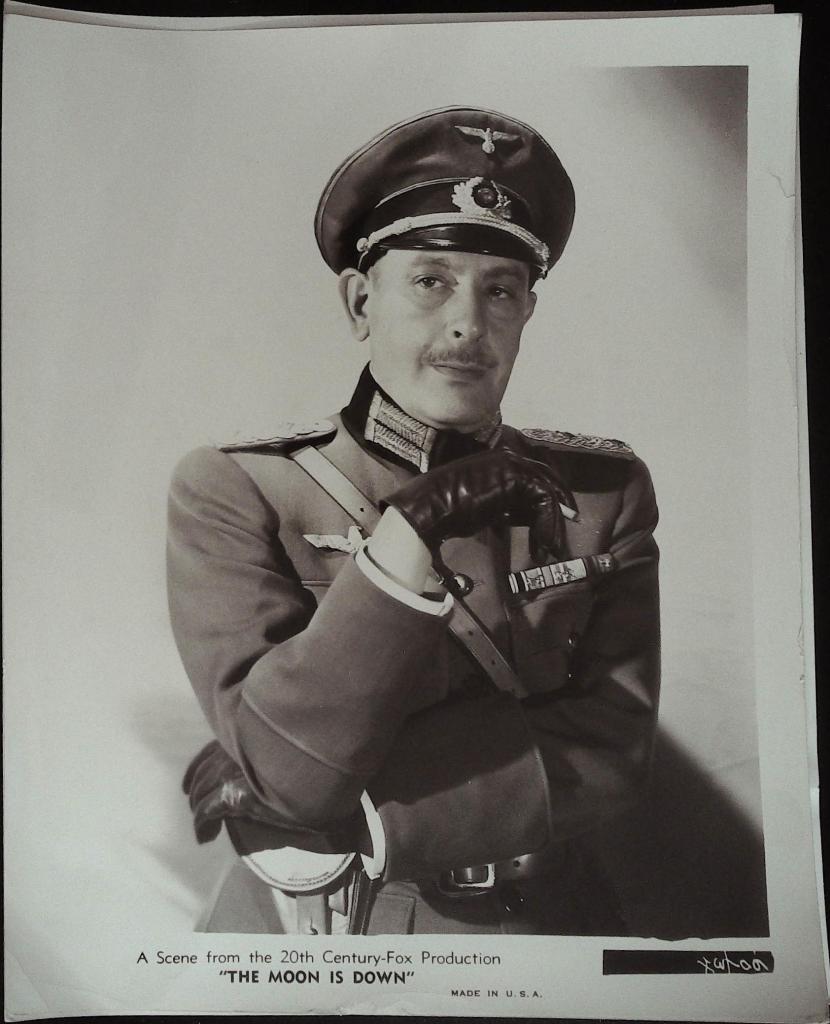
Sir Cedric Hardwicke portrayed “German Colonel Lanser”. Hardwicke was one of 8-directors on segments of 1943’s, “Forever and a Day”. Which was about the history of a house in London during the blitz, and played “Mr. Dabb” in that film, also. He followed this movie with another World War 2 feature, 1943’s, “The Cross of Lorraine”, about French soldiers attempting to survive in a German POW camp.
Henry Travers portrayed “Mayor Orden”. Character actor, Travers, had just been seen in director Alfred Hitchcock’s, 1943, “Shadow of a Doubt”. He followed this feature film with 1943’s, “Madame Curie”, starring Greer Garson and Walter Pidgeon.
Lee J. Cobb portrayed “Dr. Albert Winter”. Cobb had just been seen in the Second World War thriller, 1941’s, “Paris Calling”, starring Randolph Scott and Basil Rathbone. He followed this picture with the Second World War action romance, 1943’s, “Tonight We Raid Calais”, co-starring with Annabella and John Sutton.
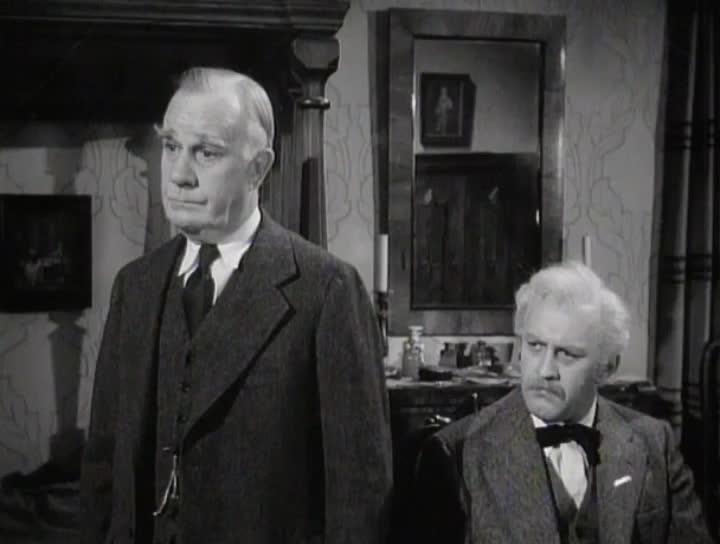
Standing above, Henry Travers and sitting Lee J. Cobb
Dorris Boden portrayed “Molly Morden”. This was Boden’s last motion picture appearance, but her seven movies included, 1939’s, “Young Mr. Lincoln”, 1939’s, “Drums Along the Mohawk”, and 1940’s, John Steinbeck’s, “The Grapes of Wrath”, all starring Henry Fonda and directed by John Ford. She was also Mrs. Nunnally Johnson until his death in 1977.
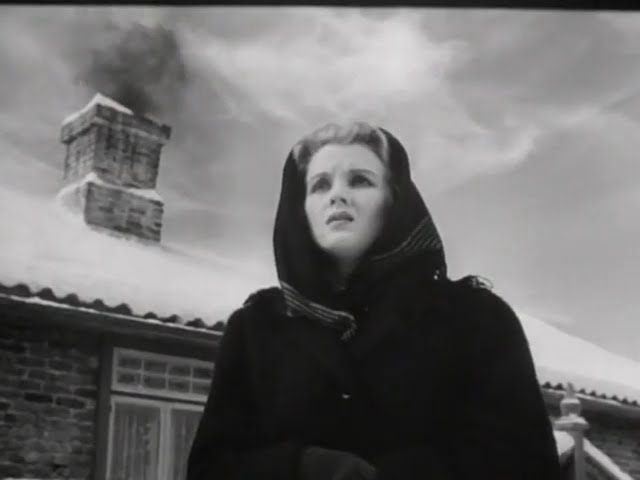
Margaret De Wolfe Wycherly portrayed “Madame Sarah Orden”. In 1929, she was the star of director Tod Browning’s, “The Thirteenth Chair”, in 1941, she was Gary Cooper’s mother in “Sergeant York”, and in 1949, Margaret Wycherly was nominated by the “Academy of Motion Pictures Arts and Sciences, Best Supporting Actress, Oscar”, for portraying James Cagney’s mother in “White Heat”.
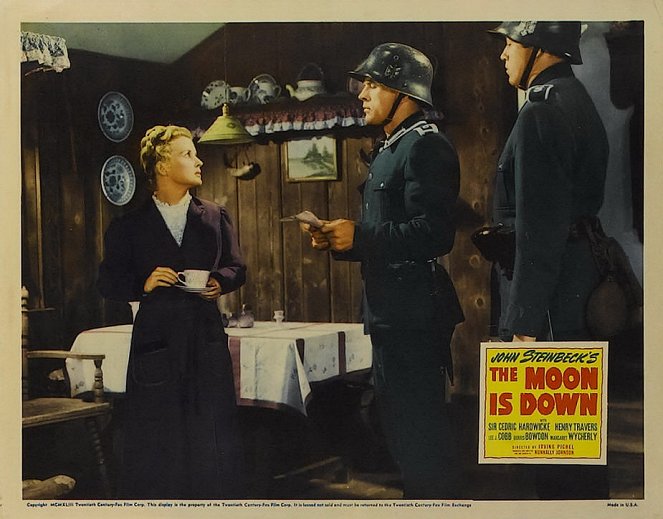
The Basic Screenplay:
As I mentioned above, a small Norwegian port town is taken over by German troops. Initially, the German commander, “Colonel Lanser”, wants the townspeople to co-operate with him. However, it is the soft spoken “Mayor Orden“, that becomes “Lander’s” opposite and the secret leader of the resistance. There is a traitor in their mists, “George Corel”, the store keeper, portrayed by E. J. Ballantine.
The sabotage for “Lanser” starts as subtile annoyances, but after “German Captain Loft”, portrayed Henry Rowland, starts demanding brutal and violation retaliation for even small acts of resistance. Followed by widow “Molly Morden” killing a young German love sick solders and “Loft” retaliates. The allies are contacted and arms are dropped to the Mayor and the fight escalates into controlled chaos for the Germans by “Orden”. Ending with the elimination of the townspeople by order of “Colonel Lanser”.
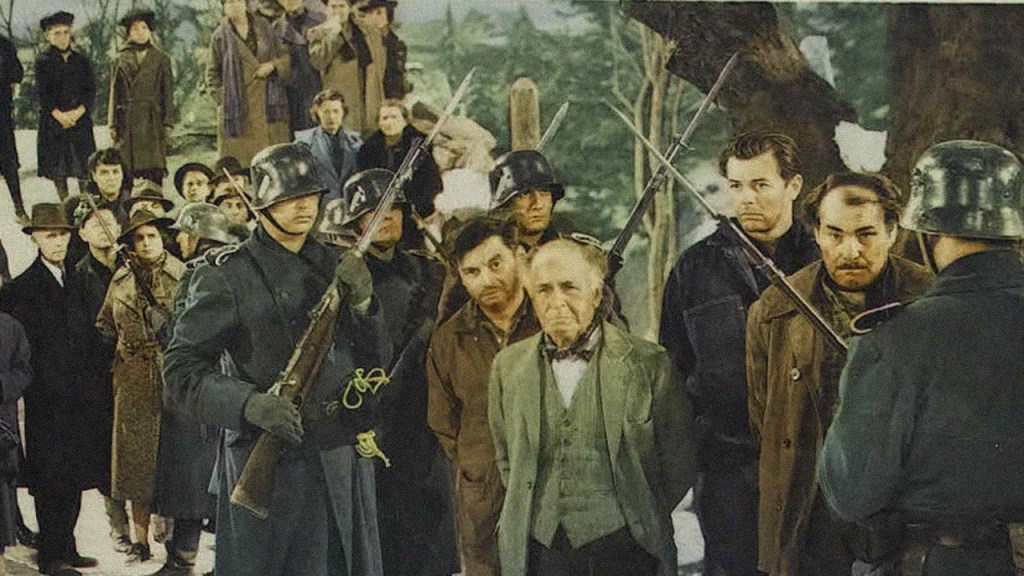
TRIVIA:
One of the actresses that Irving Pichel directed was appearing on-screen for her first time. She was 4-years-old, NATALIE WOOD.
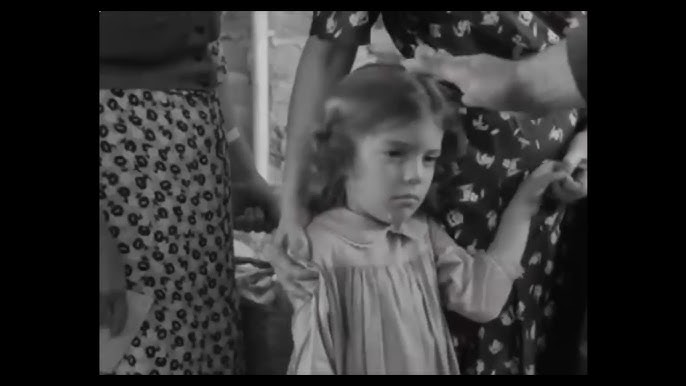
The following has been modified by the combining of two of my articles:
“I BOMBED PEARL HARBOR: December 7, 1941 in Motion Pictures” found at:
https://www.bewaretheblog.com/2016/12/i-bombed-pearl-harbor-december-7-1941.html
“GREGG TOLAND: Painting Pictures with a Cinematographer’s Movie Camera” found at:
https://www.bewaretheblog.com/2023/01/gregg-toland-painting-pictures-with.html
December 7th released in 1943

Propaganda film making can work from both sides of a war. Director and Naval Commander John Ford, working with the Department of the Navy, and co-Director/Cinematographer Gregg Toland created “December 7th” from a screenplay by Bud Schulberg.
The Ford/Toland/Schulberg film won the “Academy Award for Best Documentary Short Subject”, at a running time of 32 minutes,. narrated by Irving Pichel.
The problem here:
The film that Ford and Toland had originally made, from a script by Budd Schulberg, with detailed narration by Irving Pichel, edited, ran 82 minutes in length.
Commander John Ford, as a civilian movie director, by this date, had made such films as the 1936, controversial picture about the doctor who treated John Wilkes Booth,“The Prisoner of Shark Island”. While, 1939, saw three Ford classics “Stagecoach”, “Drums Along the Mohawk” and “Young Mr. Lincoln”. “The Grapes of Wrath” came out in 1940. and, mentioned above, three months prior to the Pearl Harbor attack, was the release of “How Green Was My Valley”.
Now, John Ford, was in charge of one of the main “Office of Strategic Services (OSS)”, Photographic Intelligence Units, and would be wounded filming remarkable footage of the Japanese attack on Midway Island.

Navy Lieutenant Gregg Toland was assigned to film a documentary style propaganda motion picture about the Japanese attack on Pearl Harbor. It was Toland, who recreated scenes of the attack that he blended seamlessly with actual footage. The motion picture audience, and the “Office of the Coordinator of Information”, could not tell which film was real footage, and which was recreated.
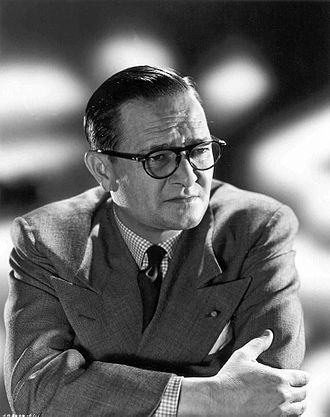
Novelist, Playwright, and Screenplay writer, Navy Lieutenant Bud Schulberg, would reach his peak during the 1950’s, but right after “Victory in Europe (VE) Day”. He would be part of the first American troops to liberate Nazi concentration camps and write about the horrors he saw. Schulberg was also part of the team that arrested German film maker Leni Riefensthal. Riefensthal filmed the 1932 Berlin Olympics and made the propaganda film “Triumph of the Will”. You can read her story as well as that of German film maker Fritz Lang in my blog article, “Fritz Lang and Leni Riefensthal: Their Films” at:
http://www.bewaretheblog.com/2015/03/fritz-lang-and-leni-riefensthal-their.html
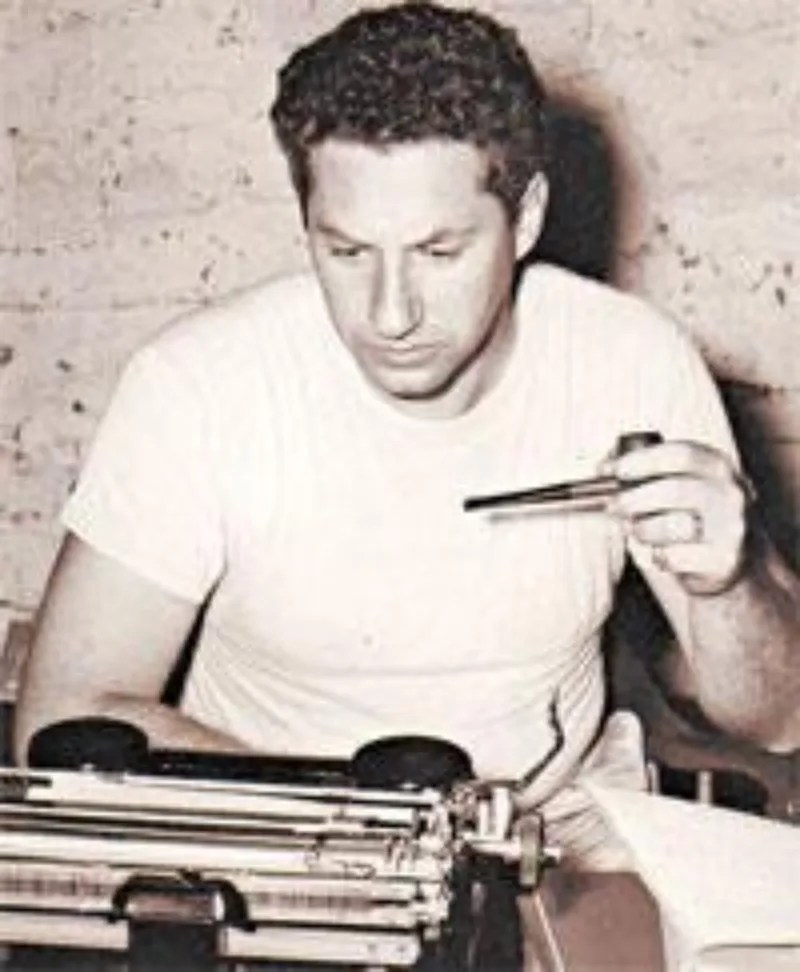
So, why would an American propaganda film, made by so distinguished a group of film makers, be cut by 50 minutes? The answer was one word, “Censorship”, from the “Department of the Navy”, and the “Administration of President Franklin Delano Roosevelt”≥ Claiming this action was to keep the home front morale high, and remove any footage that might support the Japanese living on Hawaii.
This censorship was based upon questions posed by Ford, Toland and Schulberg in their film. Questions that are still being asked today. Such as, why the warnings sent just days prior to the attack, to both Army Lieutenant General Walter Campbell Short, in charge of the defense of all military installations in Hawaii, and Four Star Admiral Husband Edward Kimmel, the Commander-in-chief of the U.S. Pacific Fleet. Where apparently ignored?
Two of the major questions posed in the 82-minute original version were:
Why wasn’t there long range Navy patrols, and short range Army Air Corps patrols on the days prior to the attack? Why were the Army aircraft arranged in tight groups? Making them easy targets for total destruction by the Japanese pilots? Noting, to that last question, Short had a fear of local sabotage.
Another problem with the original cut of the film, concerned the amount of interviews with some of the 160,000 Japanese-American’s living in Hawaii prior to, and after December 7th. As a result of these interviews, John Ford made the decision to recreate events the could be considered pro-Japanese Hawaiians. This “Fictional” aspect of the depiction of Japanese life on the Islands was thought misleading.
A further problem, not for the Naval Censors, but the filmmakers. There was only approximately four minutes of actual film footage of the Pearl Harbor air attack. So, Ford had to recreate it with miniature battleships on the 20th Century Fox back lot. Passing off his recreations as actual captured combat footage. Problem here were among other things, was the very visible wires on the miniature Japanese aircraft, and the fact that John Ford was using recognizable American planes for Japanese Zero’s.
The complete uncut version of “John Ford’s December 7th” was kept from view for decades, and only released in 1991.
Six uncredited “VOICE” roles followed for Irving Pichel. The 6th being the narrator for director John Ford’s 1949, “She Wore a Yellow Ribbon”, the second feature of Ford’s “Cavalry Trilogy”. The first was 1948’s, “Fort Apache”, and the third was 1950’s, “Rio Grande”.
Between 1943’s, “The Moon is Down” and 1948’s, “Mr. Peabody and the Mermaid”, Irving Pichel directed Thirteen motion pictures. I am not going to mention all 13 films, but start with:
And Now Tomorrow premiered in New York City on November 22, 1944
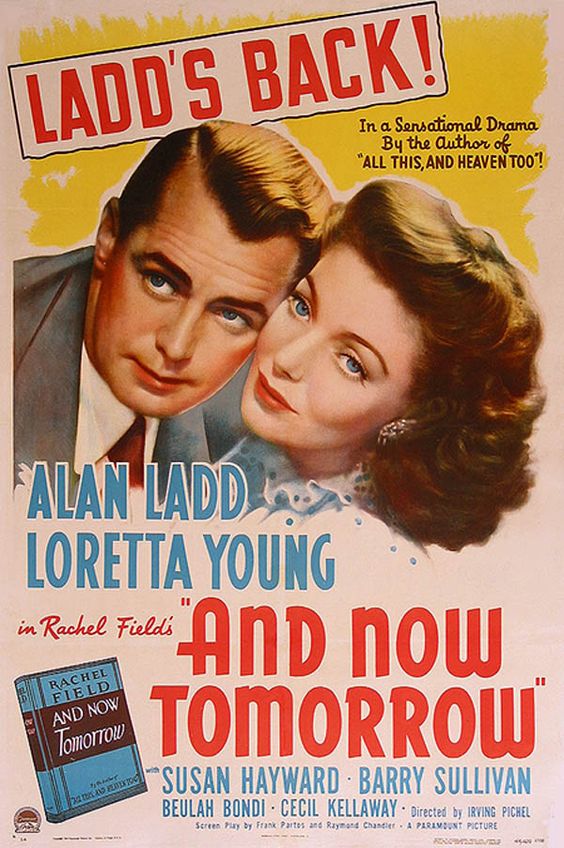
This above cast and director was the result of the Second World War and actor availability.
Originally, George Stevens was announced to direct, that changed, after he was sent by the “Army Signal Corps” to Persia (Iran) to film footage of refugees from Poland. Irving Pichel was assigned to direct the motion picture. Pichel had just directed without credit, added scenes to 1944’s, “The Eve of St. Mark”, for credited director, John M. Stahl.
The originally announced leads were Joel McCrea and Loretta Young. McCrea had to drop out to do war related work, and was replaced by Franchot Tone. Tone would be replaced by Alan Ladd, “Ladd’s Back”, after he had invalided out of the army due to combat injuries.
Young’s sister was to have been portrayed by Veronica Lake, but she had become a popular “Pin-Up” with the “GI’s”, and a “USO” tour took priority and Susan Hayward got the role she had wanted.
The screenplay was based upon novelist, poet, and children’s fiction writer, Rachel Field’s, 1942 novel, “And Now Tomorrow”. Field died on March 15, 1942, she was only 47-years-old.
The screenplay was by two writers, the primary was Frank Partos. He had been writing screenplays since 1932. He had just co-written the horror ghost story, 1944’s, “The Uninvited”, starring Ray Milland and Ruth Hussey. However, the more interesting screenplay writer was detective novelist, Raymond Chandler. This was his second screenplay and two of his novels, “Farewell My Lovely”, and “The High Window” had already been turned into feature films, but Chandler was not involved with the screenplays.
The Final Leading Cast:
Alan Ladd portrayed “Doctor Merek Vance”. Ladd had just been seen in a Government short, “Skirmish on the Home Front”, with Betty Hudson, and William Bendix. The 1944, 13-minute short, shown in movie theaters before the first picture was promoting the United States Government’s, “War Time Economic Stabilization Plan”. He followed this picture with the 1945, crime drama,”Salty O’Rourke”.
Loretta Young portrayed “Emily Blair”. Young started on-screen in 1917, with the 4-year-old portraying a “Fairy” in “The Primrose Ring”, and ended in 1989, with “Lady in the Corner”. Although, in 2018, 18-years after her death, released to “Youtube”, was the never before seen, unsold pilot, for a proposed television show, “The Spark”.
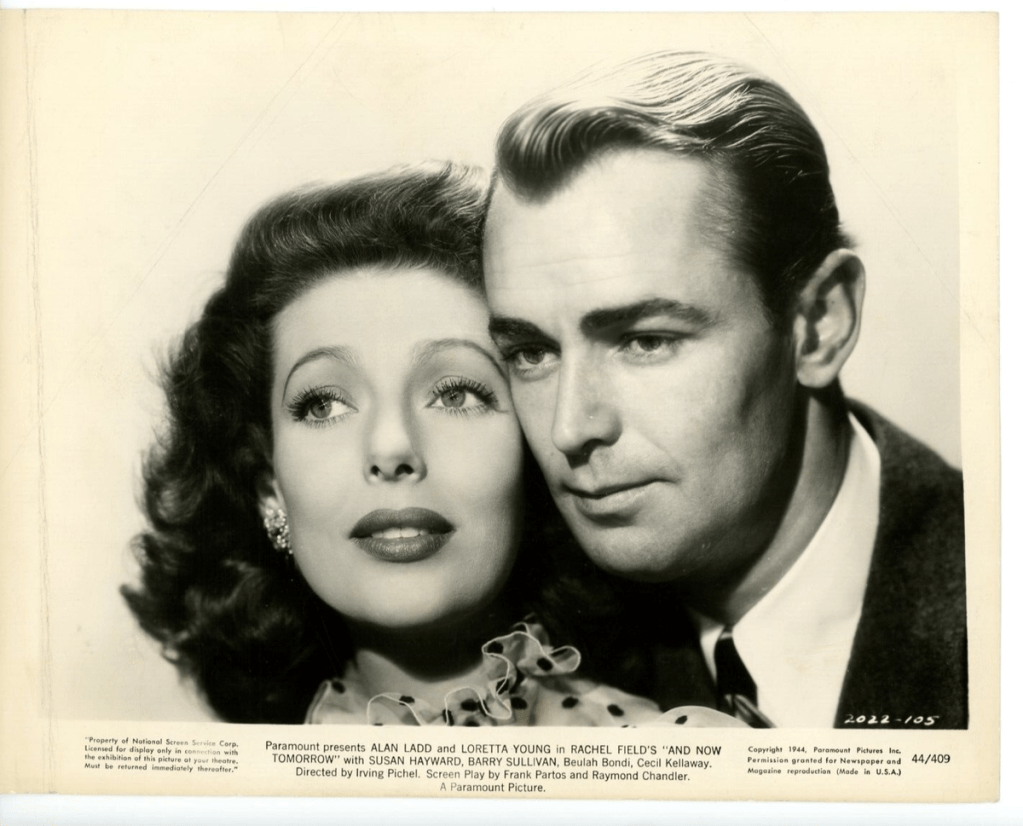
Susan Hayward portrayed “Janice Blair”. Of Hayward’s first six motion pictures, one had all her scenes deleted, four were uncredited roles, and for 1938’s, “Girls Probation”, she had 9th credited billing as “Gloria Adams”, in the film starring Jane Bryan and Ronald Reagan. Just prior to this feature, Susan Hayward co-starred with William Bendix in the 1944 film-noir, “The Hairy Ape”, and followed this film with 1st-billing in the 1946 film-noir, “Deadline at Dawn”, her co-stars were Paul Lukas and Bill Williams.
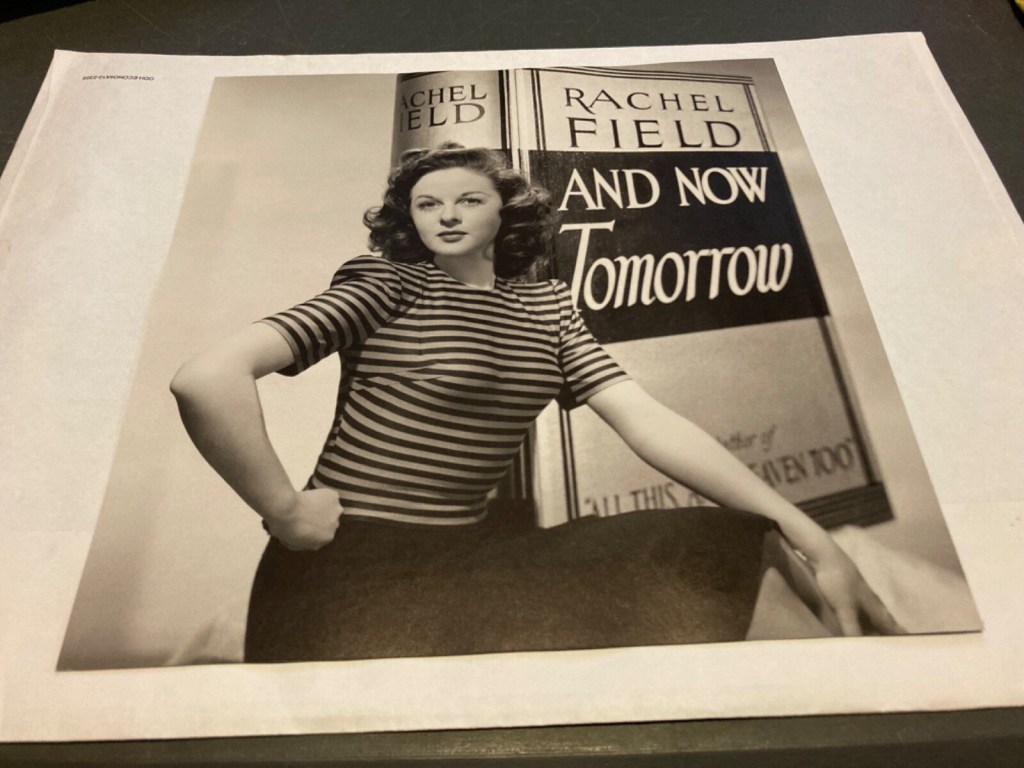
Barry Sullivan portrayed “Jeff Stoddard”. The solid, best word description, supporting actor had some memorable movies in his career, this was not one for any of the actors. Three of those memorable roles were in 1949’s, not really, version of F. Scott Fitzgerald’s, “The Great Gatsby”, that starred Alan Ladd, Sullivan portrayed “Tom Buchanan”. In the 1952 expose of “Hollywood”, “The Bad and the Beautiful”, he was “Fred Amiel”, and in 1957’s “Forty Guns”, Barry Sullivan stood up,. scene by scene, with Barbara Stanwyck. In director Sam Fuller’s Forty-Guns”, with Sullivan’s “Griff Bonell”, a very obvious, “Wyatt Earp”.
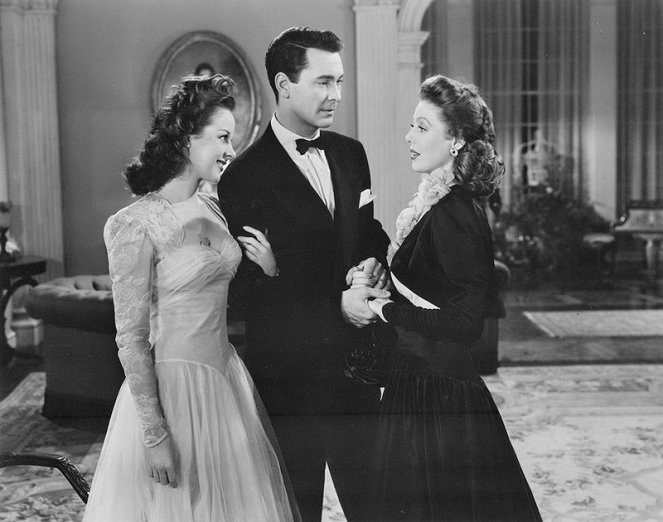
Above left to right, Susan Hayward, Barry Sullivan, and Loretta Young.
Rachel Field’s best selling “Women’s” novel had a controversial plot for the time. Her story was about a very wealthy woman, “Emily Blair”, who is loosing her hearing from meningitis. Enter young “Dr. Merek Vance”, who has developed a serum that may correct her hearing loss, and possibly fight meningitis. “Emily” goes to “Vance”, and during her treatment, the two fall in love.
Meanwhile, “Emily’s” younger sister, “Janice”, has fallen in love with “Jeff Stoddard”. Who just happens to be her sister’s ex-fiancé. “Emily” had left “Jeff” after getting the prognosis about her hearing, and didn’t want him feeling sorry for her. She feared that her hearing loss would become the real reason for “Jeff” going through with their marriage, not real love.
Now, “Jeff” is reluctant to inform “Emily” about his falling in love with “Janice”, because he does feel sorry for her hearing loss.
The motion picture was a worldwide box office hit with credit to Irving Pichel’s directing. Critics talked about the great chemistry between Alan Ladd and Loretta Young, if they only knew at the time.
I quote Edward Funks, 2015, “Easedropping: Loretta Young Talks About Her Movie Years”. In this interview, Young stated about Ladd that:
He wouldn’t look at me. He’d say, “I love you…” he’d be looking out there some place. Finally, I said, “Alan, I’m he-ere!!”… I think he was very conscious of his looks. Alan would not look beyond a certain point in the camera because he didn’t think he looked good… Jimmy Cagney was not tall but somehow Jimmy was at terms with himself, always. I don’t think Alan Ladd ever came to terms with himself.
Moving forward, Irving Pichel had narrated one movie, been the voice of a radio announcer, and been the announcer of a steeplechase in three movies, and directed four feature films and then came a motion picture based upon the files of the:
O. S. S. limitedly released in the United States on May 26, 1946
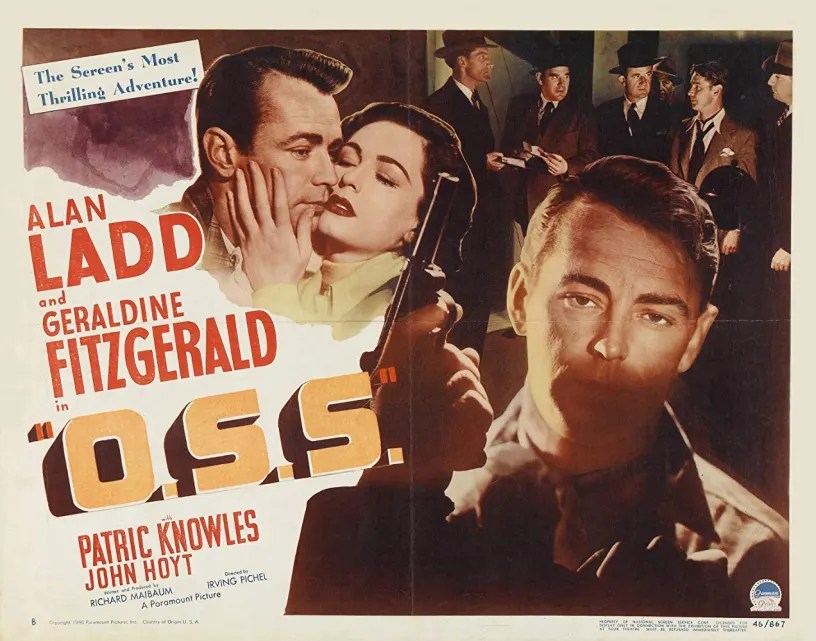
Irving Pichel had just directed Barbara Stanwyck, Robert Cummings, and Diana Lynn in the 1946 comedy, “The Bride Wore Boots”. He would follow this feature with the 1946, film-noir romance, “Temptation”, co-starring Merle Oberon, George Brent, and Carl Korvin.
The screenplay was written solely by ex-Office of Strategic Services, Army Captain Richard Maibaum. Among his screenplay credits, were all the “James Bond” movies from 1962’s, “Dr. No” through 1989’s, “License to Kill”.
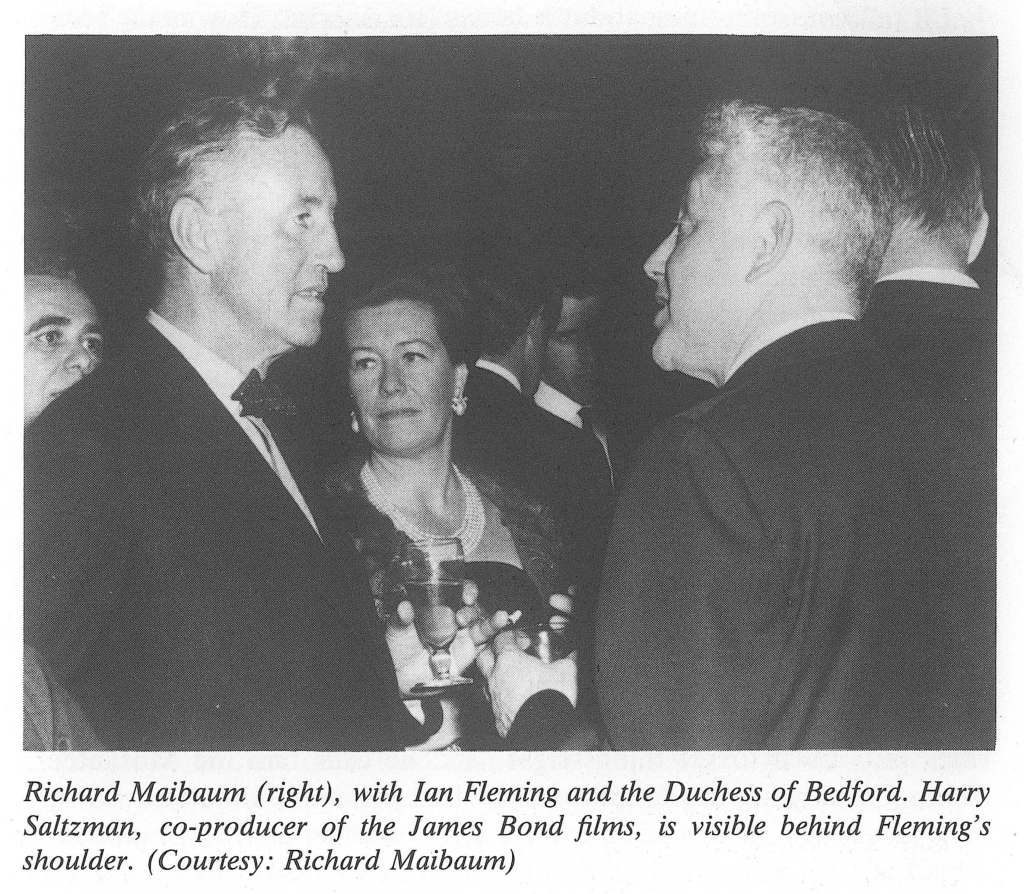
The Main Cast:
Alan Ladd portrayed “Philip Masson/John Martin”. Ladd had just starred in 1946’s, film-noir crime drama, “The Blue Dahlia”, written for the screen by Raymond Chandler, and directed by George Marshall, and co-starring Veronica Lake and William Bendix.
Geraldine Fitzgerald portrayed “Ellen Rodgers/Elaine Duprez (Dupree)”. Irish-American actress Fitzgerald had just appeared with Sydney Greenstreet and Peter Lorre in the 1946, film-noir crime drama, “Three Strangers”. She followed this motion picture with the 1946, film-noir crime drama, “Nobody Lives Forever”, co-starring with John Garfield.
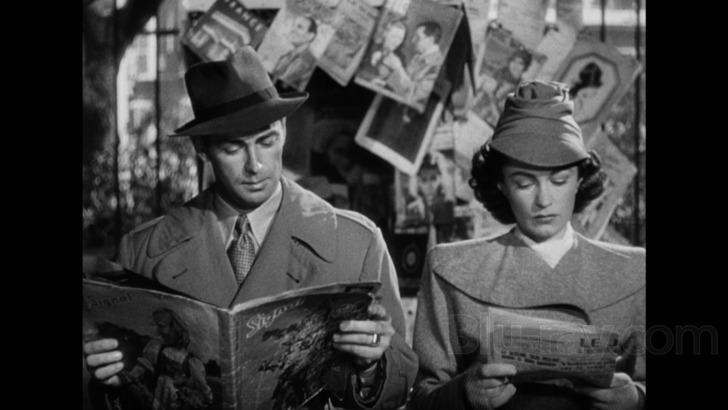
Patric Knowles portrayed “Commander Brady”. Knowles was just seen in 1946’s, “The Bride Wore Boots”, and followed this picture with the latest version of W. Somerset Maugham’s, “Of Human Bondage”. That, 1946 version, starred Paul Henreid and Eleanor Parker.
Above left to right, Alan Ladd, Patric Knowles and Geraldine Fitzgerald.
John Hoyt portrayed “Colonel Paul Meister”. This was the actor’s first on-screen appearance. Fans of cult science fiction know John Hoyt for his portrayals in 1951’s, “The Lost Continent”, 1951’s, “When World’sCollide”, 1958, “Attack of the Puppet People”, and, 1959’s, “Curse of the Undead”. Some of the other work by this character actor include 1951’s, “The Desert Fox: The Story of Rommel”, 1952’s, “The Black Castle”, starring Boris Karloff and Richard Greene, the 1953 film version of William Shakespeare’s “Julius Caesar”, 1955’s, “Blackboard Jungle”, and the Howard Hughes produced, 1956, “The Conqueror”, starring John Wayne and Susan Hayward. Where many actors and crews developed cancer from being exposed to lingering radiation from the “White Sands Proving Grounds”.
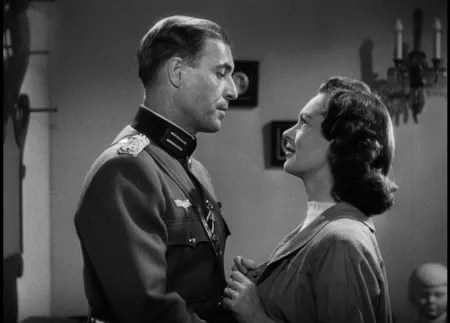
Above, John Hoyt and Geraldine Fitzgerald
Under the skilled hands of Director Irving Pichel, and the excellent cast assembled by Producer Richard Maibum, this is a very tense and exciting motion picture.
The story opens with “Philip Masson” attempting to steal the plans for an electric circuit from a plant in Baltimore, Maryland. “Masson” is captured in the act and arrested, but instead of being sent to prison for “Espionage”. He finds himself given a chance to use “his skills”, after intense training, for the “Office of Strategic Service”, as an American spy in Europe, named “John Martin”.
Along with three other men, “Parker”, portrayed by Richard Webb, “Gates”, portrayed by Don Beddoe, and “Bernay”, portrayed by Richard Benedict, and a woman, “Elaine Duprez”, the five are parachuted into France.
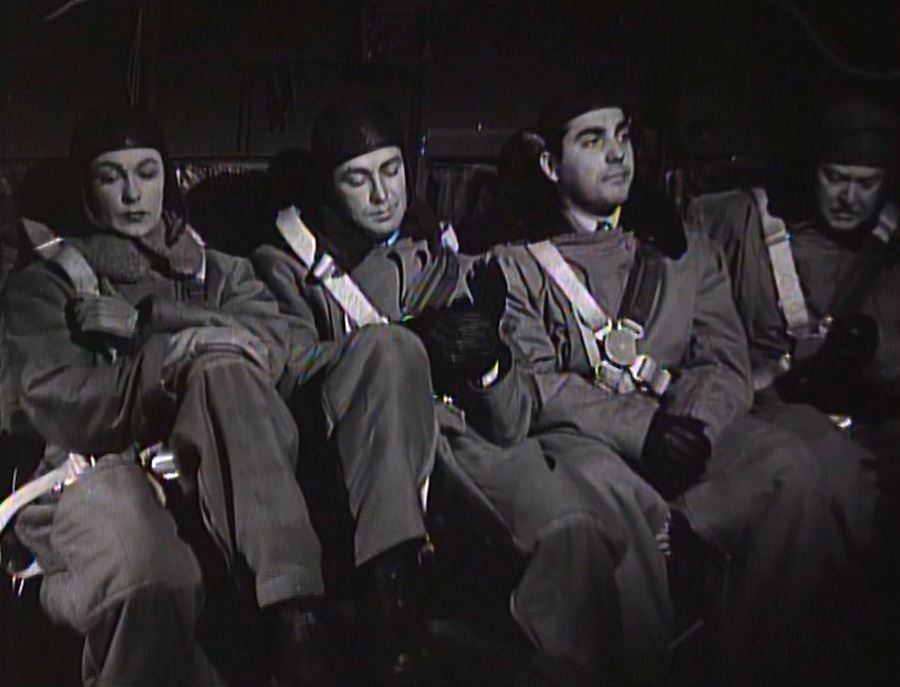
Above left to right, Geraldine Fitzgerald, Alan Ladd, Richard Benedict, and Don Beddoe.
Once, within France, “Gates”, is killed by a German Agent at an inn. The group splits up, but “Elaine” and “Martin” stay together. Next, comes a meeting with a French Maquis (Guerrilla fighters) Group. However, the meeting is interrupted by the arrival of “German Colonel Paul Meister”, looking for allied saboteurs. Instead, he finds, and become infatuated with, French sculptress, “Elaine Duprez”. Who offers to make a sculpture of his head.
Later, “Meister” announces his departure on a troop train to Normandy, and “Elaine” begs to accompany him. A new bust of the German Colonel is made, but “Martin” and “Elaine” fill it with plastic explosives and it gets placed on the troops train. The bust explodes, bringing down and sealing off a tunnel the train was passing through. “Elaine” was able to get off the train and out of the tunnel before the explosion, but she came under heavy German fire. While, “Martin” moves to save her and gets his partner to safety. However, she makes him promise never to do such a thing again and endanger himself and their overall missions.
On foot, “Martin” and “Elaine” now meet “Bernay”, the groups radio operator, and brings them word of “D-Day, June 6th, the Normandy Invasion”, placing this story in 1944, and are met by an officer of the Gestapo, “Amadeus Brink”, portrayed by Harold Vermilyea. “Brink” hopes to secure his safety and a small fortune from the allies by helping the espionage mission.
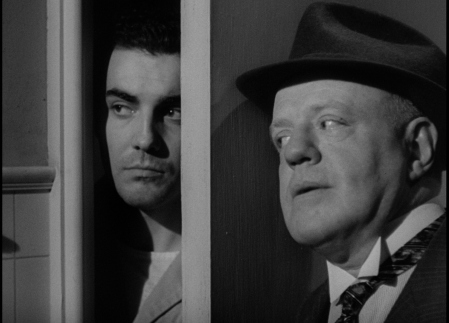
Above left, Robert Benedict, right is Harold Vermilyea.
“Brink” first removes the Gestapo wanted files on both “Martin” and “Elaine”. Next, he arranges for his cousin, as a courier, to turn over a diplomatic pouch to “Bernay” containing papers for photo-coping. The coping is completed and “Bernay” places the negative photo strip in the lining of “Martin’s” hat. Next, AGAINST THE ADVISE OF “BRINK”! “Bernay” sends a final radio message that the Nazi’s have broken the “O. S. S.” secret code. He is shot and killed by another Gestapo agent,. but just prior had finished sending. Both “Martin” and “Elaine” are arrested by the Gestapo, questioned, and set free.
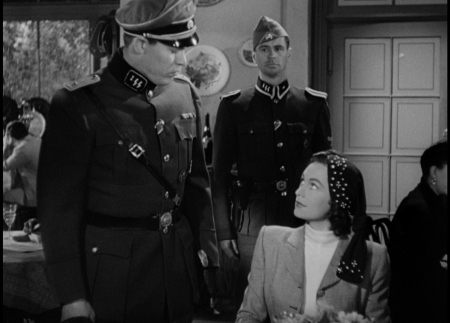
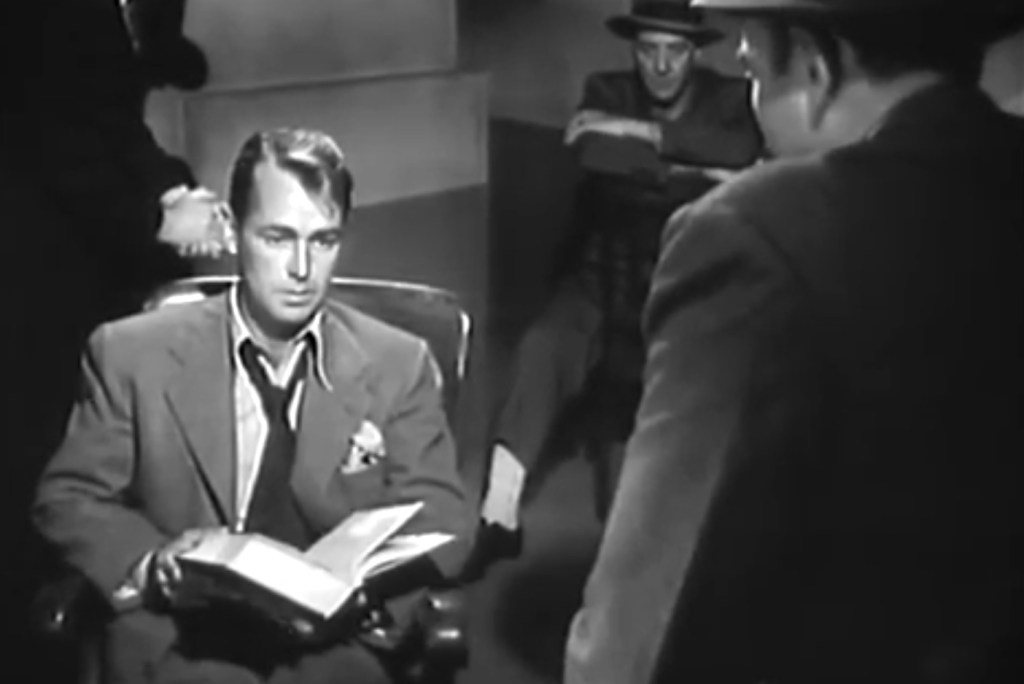
Just after the two are released, “Colonel Meister” catches “Brink” with their file papers.
“John Martin” and “Elaine Duprez” are about to board a plane to take both of them to safety. However, “Commander Brady” stops them, for one last mission.
lThey must contact “Parker”, who is on a mission near the Rhine River, and “Martin” is the only person he would recognize. The meeting of the three takes place, but at a farmhouse with a group of drunken German soldiers. Who accost “Elaine”, “Martin” arrives and is able to get the German’s under control.
“Parker” has been hiding among that group as another German soldier, and is able to give “Elaine” the German troop dispositions, which she passes on to “Martin”. Who is now the radio contact, and he leaves the farmhouse to send out the information. However, “Colonel Meister” arrives and arrests “Elaine Duprez”.
Cut to American troops advancing through France, and “Commander Brady” speaking to “Philip Masson/John Martin” about the completed mission and “Elaine Duprez”. The question posed by “John”, is who really was “Elaine Duprez”? The answer:
“Ellen Rodgers”, who could have been anyone’s “Girl Next Door”.
He was a “MALE VOCALIST” with the Tommy Dorsey Band. In fact his first on-screen appearance was in, 1941’s, “Las Vegas Nights”, without credit, or his name on any of the posters for the film, like the following. where “Red Donahue and His Mule Uno” got billing.
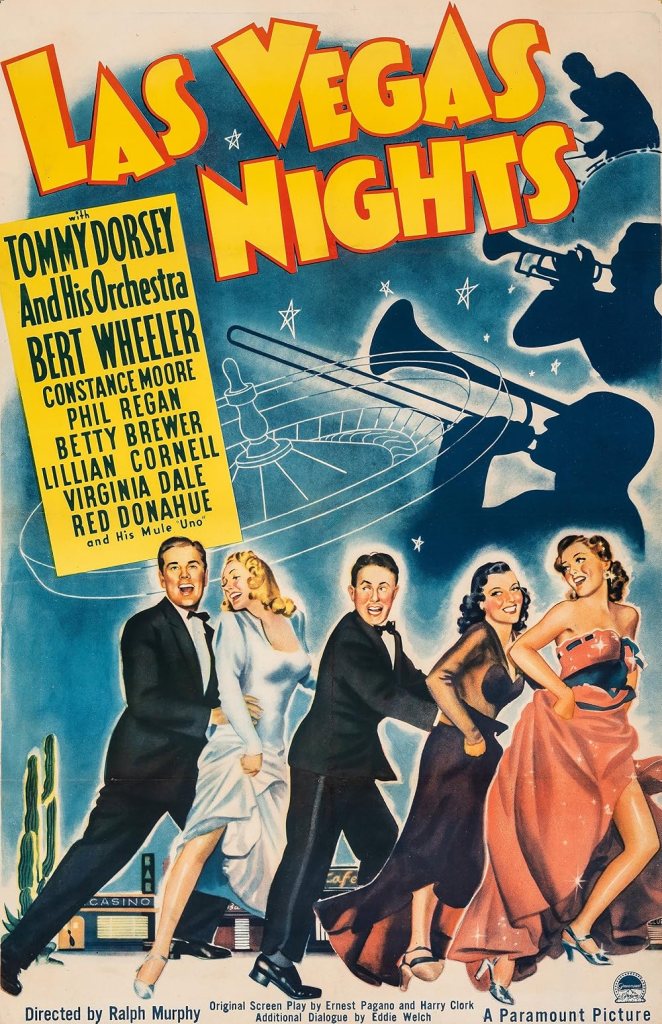
Three movies later, in 1943’s, “Higher and Higher, now the “Male Singer” for Harry James and his Band, did he finally get co-star billing, but it was still a musical. It wouldn’t be until after another 10-musicals, that with the following feature, Francis Albert Sinatra, known to “Bobby Soxers”, like my mother, as “The Voice”, tried a dramatic role. However, he still had to sing, cappella, the English verses of an old Polish folksong, “Ever Homeward”.
MIRACLE OF THE BELLS premiered on March 16, 1948 in New York City
The motion picture was based on Russell Janney’s, 1946 best selling novel, “Miracle of the Bells”.
The screenplay was by two writers. The first was playwright, Ben Hecht. Among his screenplays were 1931’s, “The Front Page”, 1932’s, “Scarface”, director William Wyler’s ,1939, version of Emily Bronte’s, “Wuthering Heights”, Afred Hitchcock’s, 1946, “Notorious”, and 1954’s, “Ulysses”.
The second writer was, Quentin Reynolds, had just written director Henry Hathaway’s, 1948, “Call Northside 777”, staring James Stewart. He followed this picture, as producer, writer, and narrator, of the 1950 documentary, one of the first to warn of the perils of Communism and nuclear war.
Irving Pichel had just directed the comedy musical, 1947’s, “Something in the Wind”, co-starring Deanna Durbin, and Donald O’Connor. In that feature, Pichel, voiced the character of “Dynamo Joe”. Just prior to that comedy musical, Irving Pichel directed, and was seen as a member of the jury, in the Robert Young and Susan Hayward, film-noir romance, 1947’s, “They Won’t Believe Me”.
The Three Leading Actors:
Fred MacMurray portrayed “Hollywood Press Agent Bill Dunnigan”. MacMurray was in 1948’s, slapstick work place comedy, “On Our Merry Way”. He followed this picture with a comedy, 1948’s,”An Innocent Affair”.
Alida Valli, stage name “Valli”, aka: Baroness Alida Maria Laura Altenburger von Marckenstein-Frauenberg, portrayed “Olga Trekovna”. The Italian born actress had just been seen in the Gregory Peck, 1947, “The Paradine Case“. She followed this picture by co-starring with Orson Welles and Joseph Cotton, in director Carol Reed’s, 1949, “The Third Man”.
Frank Sinatra portrayed “Father Paul”. Sinatra had 1st-billing in musical comedy romance, 1947’s, “It Happened in Brooklyn”, co-starring Kathryn Grayson, Peter Lawford, and Jimmy Durante. He followed this drama, with the musical comedy western, 1948’s, “The Kissing Bandit”, co-starring Kathryn Grayson.
Sinatra’s dramatic performance was panned by all the film critics and reviewers. That all seemed to agree that Francis Albert Sinatra was no a dramatic actor. The would change when he won the “Academy of Motion Picture Arts and Sciences, Best Supporting Actor”, for 1953’s, “From Here to Eternity”. Back in 2015, I wrote my first article on Frank Sinatra, “FRANK SINATRA: Three Dramatic Motion Picture Roles” at:
https://www.bewaretheblog.com/2015/11/frank-sinatra-three-dramatic-motion.html
The screenplay opens as “Hollywood Press Agent Bill Dunnigan” arrives by train to Coaltown, Pennsylvania. On the train is the body of the woman he loved, but never made it known to her. She is movie actress “Olga Trekovna”, and “Bill” is honoring her dying request to be buried in her hometown.
However, “Bill” encounters some hostility from the local funeral director, “Harold Vermilyea”, portrayed by Nick Oloff, because “Olga” never finished paying for her father’s funeral. “Bill” says he will take care of the missing payment. This is followed by “Vermilyea” making a phone call to the largest of the five churches in “Coaltown”, “St. Leo’s Catholic Church”. Immediately, after answering that call, and before “Bill’ could leave the funeral home, arrives “Saint Leo’s”, “Father Spinsky”, portrayed by Charles Meredith. Who starts speaking of funeral arrangements and the costs. “Harold Vermilyea”, who will get a kickback from the funeral costs, adds his input that a funeral at “Saint Leo’s” is a sign of status in Coaltown and the surrounding coal mining towns. When “Bill” will not immediately commit to a service being performed by “Father Spinsky”, the two try putting pressure on him
What “Father Spinsky”, and “Harold Vermilyea”, do not know, is that “Olga Trekovna” had a second part of her wish to be buried in Coaltown. That, second part, is for her service to be at the “Polish Saint Michael’s Church”, in the poorer part of “Coaltown”.
“Bill” goes to “Saint Michael’s” and meets “Father Paul”.
“Father Paul” takes “Bill Dunnigan” to the burial spot of “Olga’s” parents, on a hillside away from the coal dust of the mines. There “Father Paul”, sings a hymnal, as the two watch the sunset, and decide to bury “Olga” next to her parents.
The screenplay switches to a flashback, and the audience learns how “Olga Trekovna” was taken from a chorus line to become a stand-in for a very temperamental actress, and is spotted by “Bill Dunnigan”. Who believes she could be a talented actress, even though she has no real training.
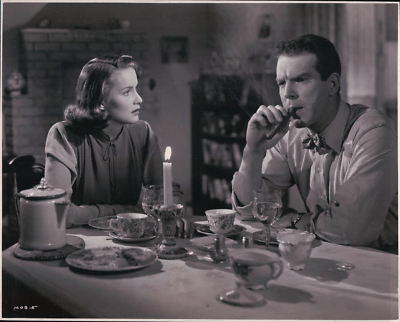
When the actress throws a tantrum and walks off the set. “Bill” approaches the movie’s producer, “Marcus Harris”, portrayed by Lee J. Cobb, but billed as Lee Cobb, to give her a tryout. As a result, “Olga” replaces the actress as the star in a picture about “Joan of Arc”.
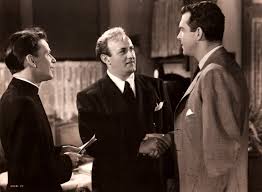
Above left to right, Frank Sinatra, Lee J. Cobb, and Fred MacMurray
Film Break: This movie was made by “RKO Pictures”, and was shot from July to September 1947. The Ingrid Bergman, “Joan of Arc”, also by “RKO Pictures”, started shooting in September 1947. The sets for the “Joan of Arc” sequences in “The Miracle of the Bells”, were the same one’s that had just been completed for the “Bergman” feature, as were the costumes.
Note: the pattern of Ingrid Bergman’s costume, below, from her technicolor motion picture, as compared to Valli’s, above.
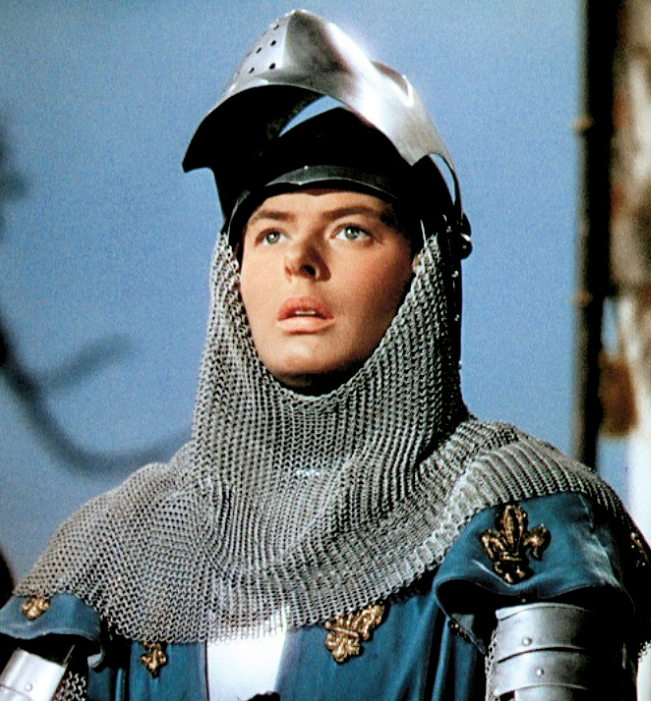
As filming continues, “Bill” finds out, from “Olga’s” doctor, that she has severe tuberculosis, from living in a coal mining town, she is dying!
“Olga Trekovna” finishes filming the religious epic, collapses on the set, and is rushed to the hospital.
As “Bill” was told to expect, “Olga” dies in her hospital room with him by her side.
Next Comes the Miracle of the Bells:
“Marcus Harris” makes the decision not to release “Olga’s” picture, because he tells “Bill”, that no one wants to see a movie starring a person who just died.
“Bill Dunnigan” comes up with an idea to promote the movie. He will donate to all five church’s in “Coaltown”, to sound their bells, TOGETHER, for a three-day tribute to “Olga Trekovna”. However, the money for the donations (bribes), to ring the bells, he can’t cover, but “Harris” comes through and covers them.
On the day of “Olga’s” funeral, there’s an overflow crowd at “St. Michael’s”. Any animosity has been forgotten and “Father Paul” starts the service, but, suddenly, a creaking noise is heard, and “THE MIRACLE OF THE BELLS” takes place. As the statues of the “Virgin Mary” and “Saint Michael”, turn on their pedestals, until BOTH FACE “Olga”, in her coffin.
To those assembled, this was a miracle, but “Father Paul” had determined, that the ground had shifted, because of the extra weight in “Saint Michael’s” from the overflow attendance, upon the already weaken ground from the coal mining. That extra weight caused the two standing pillars, that the two statues were on, to move. However, “Bill Dunnigan” convinces “Father Paul”, not to reveal what he’s learned to those in attendance, and harm their faith in miracles.
As a further result, “Marcus Harris” decides to release the film, because of the interest the potential viewing audience has for the story of the miracle, and the life and death of the film’s star. The movie becomes a major box office hit. Donations from around the world come to the “Saint Michaels”, overwhelming “Father Paul”, and “Harris” decides to build a research hospital to fight tuberculosis from the profits..
From what was called a “TEAR JERKER” movie, at the time of its release. Irving Pichel moved to directing a fantasy romance:
MR. PEABODY AND THE MERMAID premiered in New York City on August 11, 1948
Briefly, this was a Nunnally Johnson written and produced fantasy about a middle aged man on a Caribbean vacation with his wife. Who finds, and falls in love with a mermaid, but no one will believe him and even his wife thinks he’s crazy.
William Powell had recently been seen in 1947’s, “Song of the Thin Man”, the 6th and final film, with his co-star, Myrna Loy, as Dashiell Hammett’s mystery solving couple, “Nick and Nora Charles”. “Mr. Peabody and the Mermaid”, put him seven movies away from his final on-screen appearance in 1955’s, “Mr. Roberts”, starring Henry Fonda and James Cagney. In this motion picture, William Powell portrayed, “Mr. Arthur Peabody”.
Ann Blyth portrayed “Lenore – the Mermaid”. It was Blyth’s 5th motion picture, Joan Crawford’s, 1945, “Mildred Pierce” that raised her out of a “B” feature actress to an “A” List. She was a singer, and would appear in several “MGM” remakes of their 1930’s and 1940’s musicals. In 1954, it was “Rose Marie”, and “The Student Prince”, in 1955, it was “Kismet”, and then in 1957’s, she co-starred with Donald O’Connor, in “The Buster Keaton Story”, and starred in “The Helen Morgan Story”.
Three directing assignments later, brought Irving Pichel to a classic 1950 Science Fiction motion picture.
DESTINATION MOON premiered in New York City on June 27, 1950
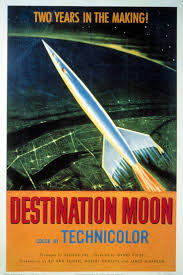
At the time, during the “Second Red Scare of Communism”, producer George Pal brought together the right elements to make this classic. My article is “A FAN REMEMBERS GEORGE PAL: From ‘Puppetoons’ to ‘Doc Savage, Man of Bronze” an overview of his career, found at:
https://www.bewaretheblog.com/2017/07/a-fan-remembers-george-pal-from.html
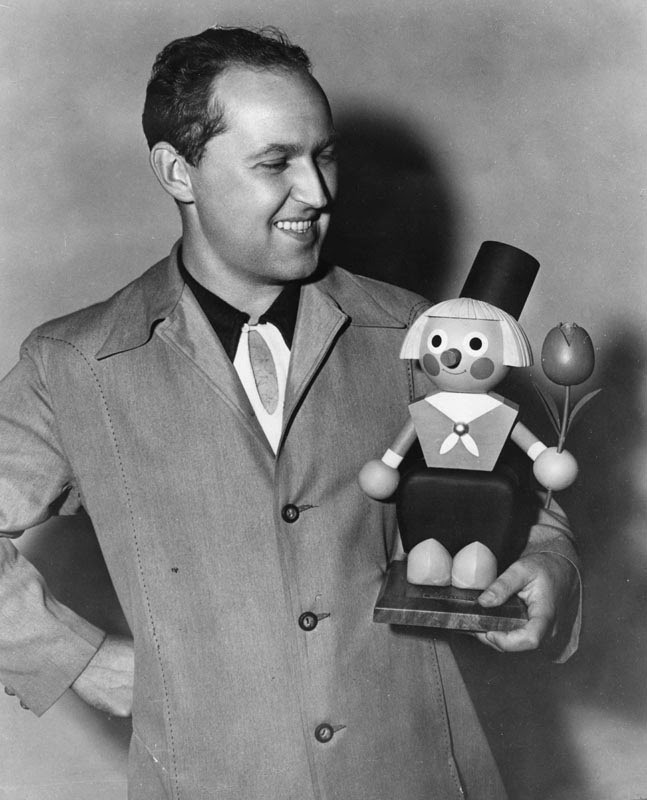
The screenplay was by three writers, based upon an idea in a novel, 1947’s, “Rocketship Galilieo”, by Robert A. Heinlein, seen below in 1950, who wrote the final screenplay draft.
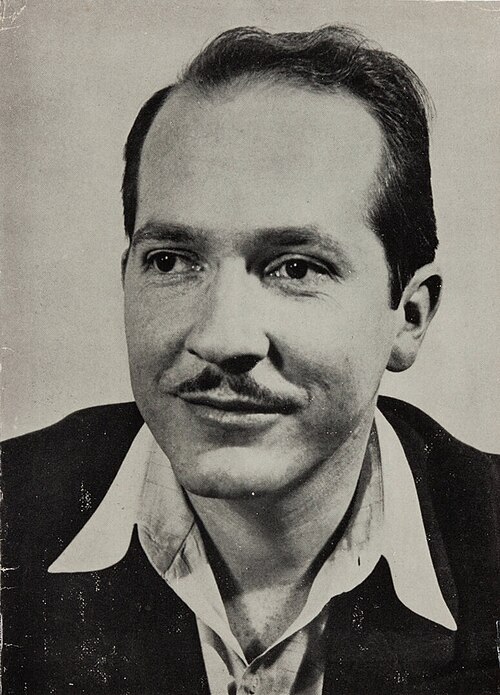
This is an excellent read for any fan of this motion picture.

This was the first screenplay by actor Alford Van Ronkel using the pen name of Rip Van Ronkel. The third screenplay writer was James O’Hanlon, who started writing in 1942, and among his work are the Humphrey Bogart, 1943, “Sahara”, the Judy Garland musical, 1946’s, “The Harvey Girls”, and 1947’s, “Song of the Thin Man”.
Director Irving Pichel had just directed the 1950 film-noir crime drama, starring a dramatic Mickey Rooney, “Quicksand”, with Pichel’s voice heard as a radio announcer. He followed this feature film by directing, the Randolph Scott, 1951, western, “Santa Fe”.
The Solid Main Cast of “B” Actors:
John Archer portrayed “Jim Barnes”. Archer’s first on-screen appearance with co-starring with Johnny Mack Brown, in the 4-hour-and-58-minute, 1938 western serial, “Flaming Frontiers”. In 1941, he had 5th-billing in “King of the Zombies”, followed later, with 6th-billing, in 1942’s “Sherlock Holmes in Washington”, starring Basil Rathbone and Nigel Bruce. While, 1949, found John Archer with another 6th-billing, in James Cagney’s, 1949, “White Heat”. Among his films following this picture, before he went into television, was Randolph Scott’s, 1952, western, “Santa Fe” at 5th-billing.
Warner Anderson portrayed “Dr. Charles Chargraves”. Anderson’s 1st-on-screen appearance was in 1916’s, “The Sunbeam”, he was 5-years-old. His next appearance was in the Irving Berlin’s, 1943, morale boosting musical, “This Is the Army”, as Kate Smith’s, known for singing “God Bless America”, announcer. Next, he had small role’s in Cary Grant’s, 1943, “Destination Tokyo”, and Errol Flynn’s, “Objective Burma”, and was 6th-billed in, 1945’s, “Bud Abbott and Lou Costello in Hollywood”. He was buried with 15th-billings in the 1947, “The Beginning or the End”, “Hollywood’s” version of the creation, and dropping, the Hiroshima atomic bomb. Before turning to television roles, Warner Anderson was in the 1952 western, “Santa Fe”.
Tom Powers portrayed “General Thayer”. 21-years-old, Powers, also started in the silent era, in the 1911 short, “The Sheriff’s Friend, as “Sheriff Joe Copper”. In 1914, he was “The Clumsy Copy Boy” in the animated classic, “Gertie the Dinosaur”. In 1917, Tom Powers, switched to the Broadway stage and musicals, and only returned to films in 1944, with 6th-billing, in director Billy Wilder’s, “Double Indemnity”, starring Barbara Stanwyck, Fred MacMurray, and Edward G. Robinson., with the screenplay by Raymond Chandler. Just prior to “Destination Moon”, he was seen in a different Randolph Scott wester, 1950’s, “The Nevadan”.
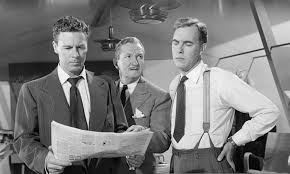
Above left to right, John Archer, Tom Powers, and Warner Anderson.
Dick Wesson portrayed “Joe Sweeney”. Wesson was a comedian, singer, and a producer. His television writing included 51-episodes of “The Bob Cuummings Show”, 61-episodes of “The Beverly Hillbillies”, and 9-episodes of “Petticoat Junction”. His movies, other than this film, included 1951’s, “Jim Thorpe – All American”, starring Burt Lancaster, the Randolph Scott, 1953, “The Man Behind the Gun”, and the Guy Madison, 3-D western, 1953’s, “The Charge at Feather River”.
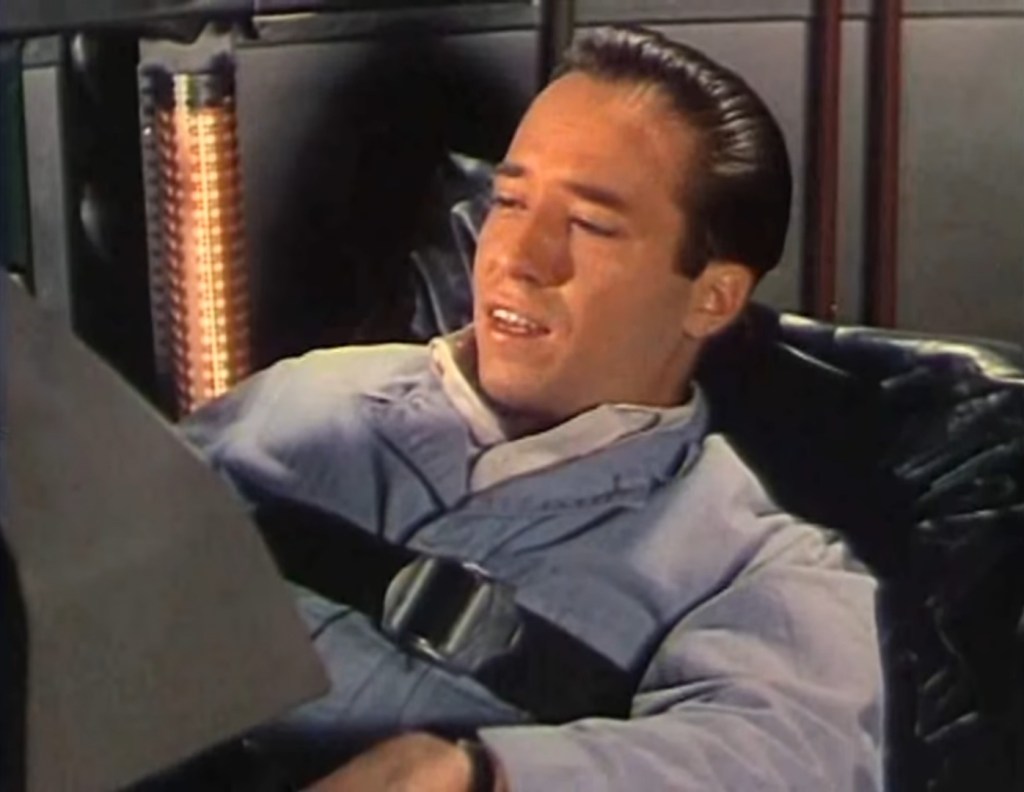
The Perfect “Second Red Scare” Screenplay
For those unfamiliar with what the “Second Red Scare” was, my article is, “MCCARTHYISM: LIGHTS, CAMERA, COMMUNISTS IN THE MOTION PICTURE INDUSTRY” found at:
https://www.bewaretheblog.com/2025/08/mccarthyism-lights-camera-communists-in.html
The movie opens with “Dr. Charles Cargraves” watching the launch of his latest rocket, but as he watches, it explodes on the launch pad. He is joined by “General Thayer”, who asks “Cargraves” what went wrong? The General is told that nothing should have gone wrong, this was Foreign Sabotage. The country is unnamed, but in 1950, “Second Red Scare America”, it was starting to be obvious to many adult Americans. That the unnamed country was the “Soviet Union”, see my “McCarthy Article”.
“Thayer” and “Cargeraves” have a discussion, which brings up the question of what’s next? “Charles Cargraves” surprises “General Thayer”, by telling him there will be no more rocket tests. He wants to build a rocket ship and go to the Moon. The two decide to go to Aircraft Building Magnate, “Jim Barnes”, and bypass the government. A majority of Robert A. Heinlein’s stories, reflect his belief of “American Business” over “American Government”, to get things done.
The three men discuss “Dr. Cargraves’s” idea of designing and building a space craft to go to the moon. “Jim Barnes” is cautious at first, but “General Thayer” brings up Robert A. Heinlein’s 1947 view about reaching the Moon, and “Barnes” decides to go along with the project. He will next contact all the industrial business leaders he knows, to come to a meeting at his headquarters.
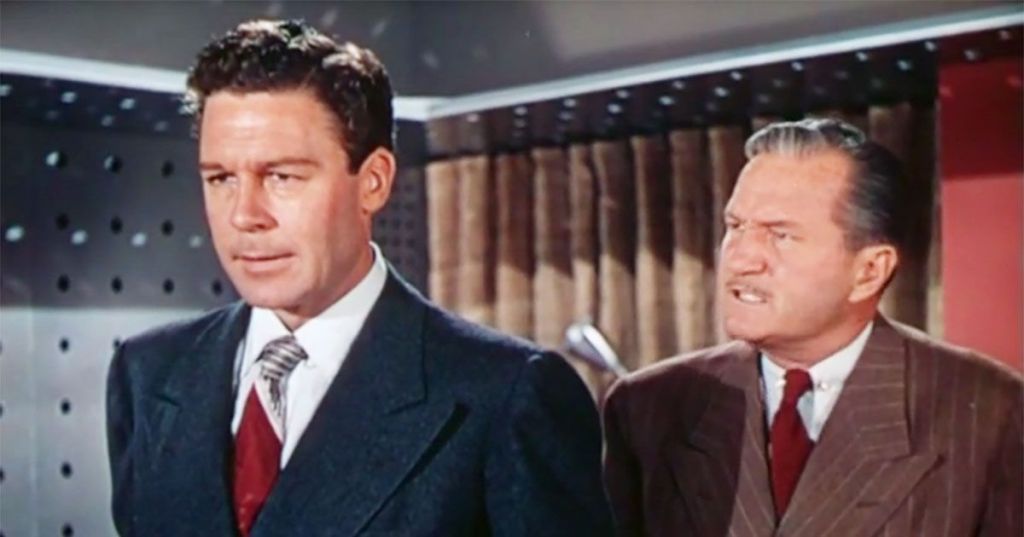
The meeting is held, and questions, after questions, come from the industrial heads that “Barnes” has brought together.
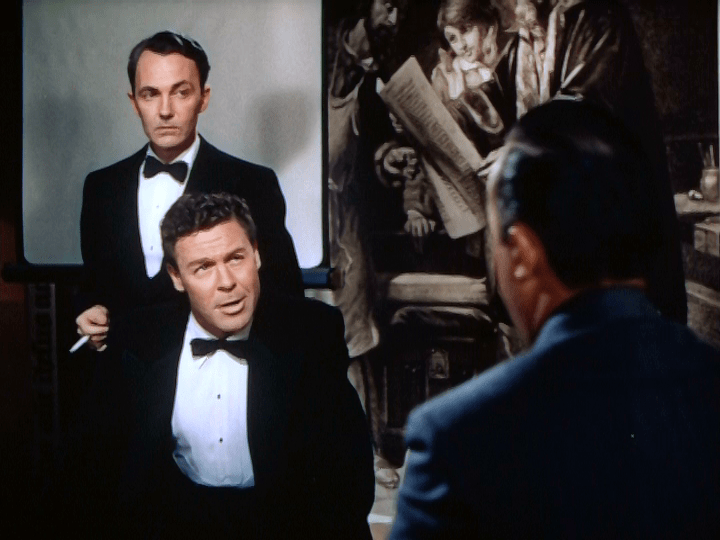
“Barnes”, “Cargraves”, and “Thayer” have models and other aids to help explain their moon project to these potential backers.
Many of those in attendance, are still not convinced of the project. Both those attending the meeting, and, at the same time, the movie theater audience, meet, in an animated segment, presented by “Jim Barnes”, a “Hollywood Star“, “Woody Woodpecker”. He is voiced by Grace Stafford, except his trademark laugh, that is from archival footage of Mel Blanc. The voice “Woody” is speaking too, belongs to director Irving Pichel.

The segment ends, with a convinced on space travel “Woody”, giving his money for the space ship.

There are several of the industrialists, who are still skeptical about the proposed project. It is now, that Robert A. Heinlein’s, real reason for going to the Moon, comes out.
THE FIRST COUNTRY TO REACH THE MOON, CONTROLS THE EARTH!
“General Thayer” mentions that an “Unnamed” foreign country has their own Moon rocket program, and the business men gathered, MUST FUND the rocket, code name “LUNA”, to beat that other country, from:
CLAIMING THE MOON FOR THEIR OWN, and having the military capability of launching an attack anywhere on Earth without fear of retaliation.
First Intermission:
The “Woody Woodpecker” section, might have been a “Walter Lantz Cartoon”, but the information, Irving Pichel, gave “Woody”, is scientific fact for 1950. Those facts came from Robert A. Heinlein’s friend, ex-Nazi German Rocket Pioneer, Herman Oberth. Who, like, Wernher von Braun, came to the United States through “Project Paperclip”.
Back in 1923, Oberth published his scientific work, “Die Rakete in die planetaren Räume (The Rocket to the Planetary Spaces)”. The book is considered the “spark” for interest in German rocketry, and creating space travel enthusiasm in Germany. Below, Hermann Oberth’s, “Model B” design, for a two-stage rocket. The “Luna” is a single stage rocket, popular at the time, and used in another 1950 science fiction motion picture, “Rocketship X-M: Expedition Moon”.
In 1929, Oberth was the technical advisor to German film director Fritz Lang, and his wife, Thea von Harbou’s, on “Frau im Mond (Woman in the Moon)”. In which Lang and his wife created the “Rocket Count Down“, so familiar today. As a means of creating audience tension for their silent movie moon rocket’s take-off.
Robert A. Heinlein’s Screenplay Continues:
American Business agrees to fund “Luna”, and the construction of a “Single-Stage to Orbit, Atomic Powered Spaceship”, begins at a desert location.


The crew of four, “Dr. Charles Cargraves”, “Jim Barnes”, “General Thayer”, and radio operator, “Brown”, portrayed by the uncredited Ted Warde. There is no apparent information on him, or what he was doing, before he was cast for the couple of minutes of screen time.
Word comes., that locals, and those living on the path the “Luna”, will take to break free of the Earth’s gravitation, are afraid of “RADIATION from the “Luna’s”, “Atomic Powered Engines”. Large groups of American’s are heading toward the launch area, and the three believe that “Foreign Country” has spies spreading misinformation.
Second Intermission:
A Small Reality Check, about the American’s in “Destination Moon”, who are Frightened of Radioactive Leakage from the “LUNA’s” Atomic Engine. I had addressed one aspect of the “Second Red Scare”, on American’s, in my article about “Joseph McCarthy”. Another aspect, a “Fear President Dwight David Eisenhower” had, is addressed in my article, “ATOMIC WARFARE: The Fear of President Eisenhower Realized in 1950’s Science Fiction Movies” at:
https://www.bewaretheblog.com/2025/12/the-atomic-warfare-fear-of-president.html
On August 29, 1949, the Soviet Union had tested, “Joe-1”, their first atomic bomb. Production on “Destination Moon”, started on November 14, 1949. While, in the United States there were no Atomic Bomb Tests in either 1949, or 1950.
A Small Reality Check, about the American’s in “Destination Moon”, who are Frightened of Radioactive Leakage from the “LUNA’s” Atomic Engine. I addressed one aspect of the “Second Red Scare” on American’s, in my article about “Joseph McCarthy”. Another aspect, a “Fear President Dwight David Eisenhower” had, is addressed in my article, “ATOMIC WARFARE: The Fear of President Eisenhower Realized in 1950’s Science Fiction Movies” at:
https://www.bewaretheblog.com/2025/12/the-atomic-warfare-fear-of-president.html
On August 29, 1949, the Soviet Union had tested, “Joe-1”, their first atomic bomb. Production on “Destination Moon”, started three-months later, on November 14, 1949. While, in the United States there were no Atomic Bomb Tests, in either 1949, or 1950.
However, there is no doubt that Robert A. Heinlein, when finishing the movie’s final screenplay, was not aware of “Joe-1”≥ The “Soviet Union” test was front page in American newspapers, and American homes on the nightly television news. Adding mention of the unseen, panicked American’s wanting to stop the launch of a one-stage, atomic powered space ship, did same as seeing them.

Robert A. Heinlein’s Screenplay Continues:
The “Luna” is ready for launching, “Cargraves”, “Barnes”, and “Thayer”, make a decision to launch that night, before the “MOB” reaches them. Then, in walks “Joe Sweeney”, with the news that “Brown” is on his way to the hospital with an appendicitis. The three men have been blindsided, until they remember that “Sweeny worked alongside “Brown”, and knows the entire radio position.
“Joe” is asked, if he would replace “Brown”? “Sweeney” doesn’t want anything to do with the space ship, and believes the whole idea of a trip to the moon is silly. Adding, he believes that the “Luna” won’t even launch. HIS MISTAKE, because the other’s use that last statement to get “Joe” to agree to come onboard the “Luna”, which won’t even launch, as radio operator.
To “Joe Sweeney’s” surprise, the “Luna” does blast off and the four men feel the “G-Force’s” of breaking out of the Earth’s gravity.
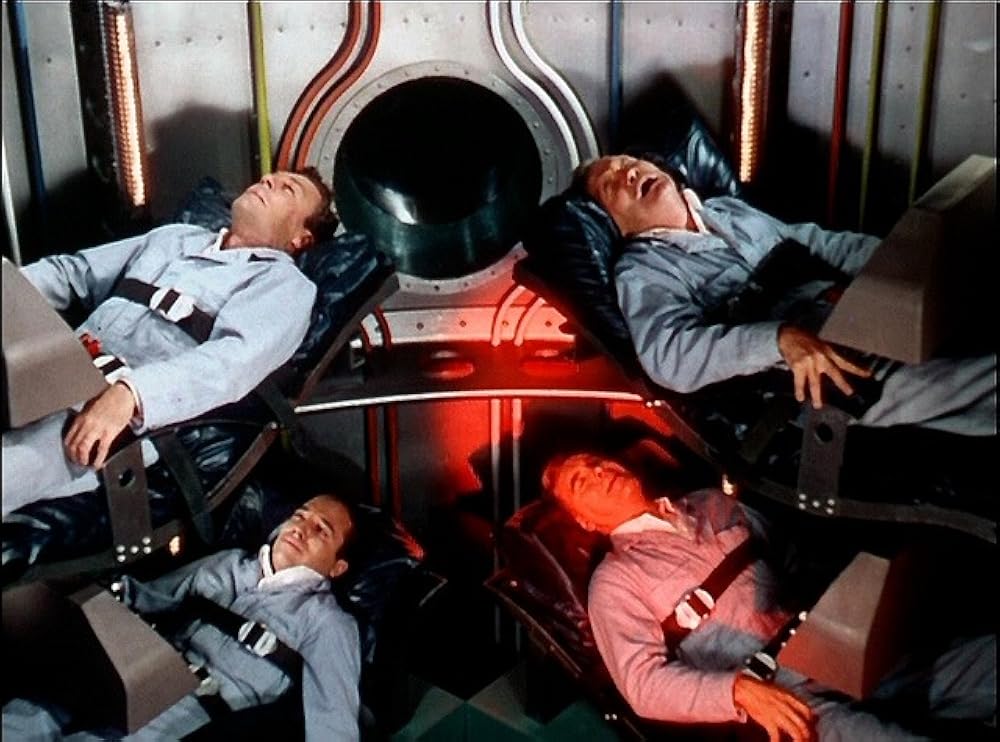

“Joe” contacts Earth base that all is well, but it is discovered that piloting antenna is frozen. “Joe” says he greased it before take-off., and is told the vacuum of space and grease don’t mix. This turns into a space walk to free the antenna. Each of the four men have a different colored space suit for easy identification of who they are.
However, “Dr. Cargraves” becomes untethered and goes into free fall away from the ship.
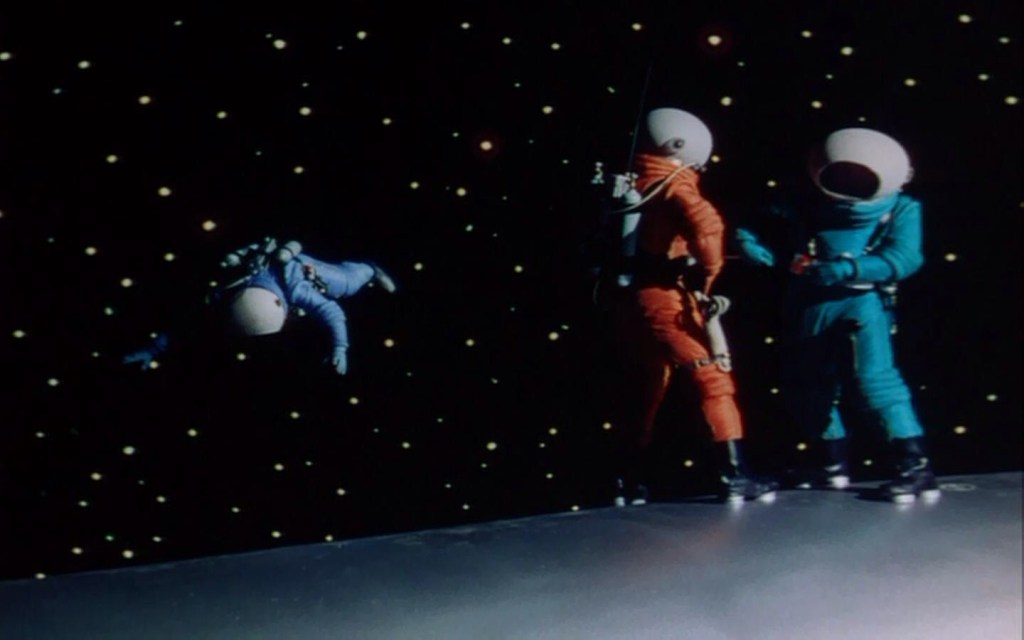
From inside “Luna”, “General Thayer” brings an oxygen cylinder, and “Jim Barnes” uses it as a propulsion unit, reaches “Dr. Cargraves”, and gets him back to the “Luna”, but almost loose “Joe Sweeney” in the process.

The “Luna” achieves lunar orbit, but the expedition leader, “Jim Barnes”, uses a larger amount of fuel than planned to land on the moon.
Third Intermission:
Let’s speak to what the moon look like. Producer George Pal went to the best to design the lunar surface, American painter, illustrator, designer, but forever known for his “Space Exploration Paintings”. Chesley Knight Bonestell, Jr.
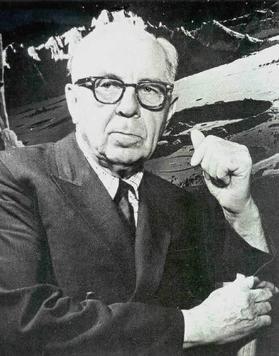
My reader must remember that in 1950, no one actually knew what the moon’s surface really looked like. It would be 19-years after the release of “Destination Moon”, before “Apollo 11” landed a man on the surface, July 20, 1969.
The following painting by Chesley Bonestell is from the table top book of his “Space Exploration” work, 1949’s, “The Conquest of Space”, with descriptions by German American science writer and proponent of space exploration, Willy Otto Oskar Ley, aka: Willy Ley., below left, with Wernher Von Braun.
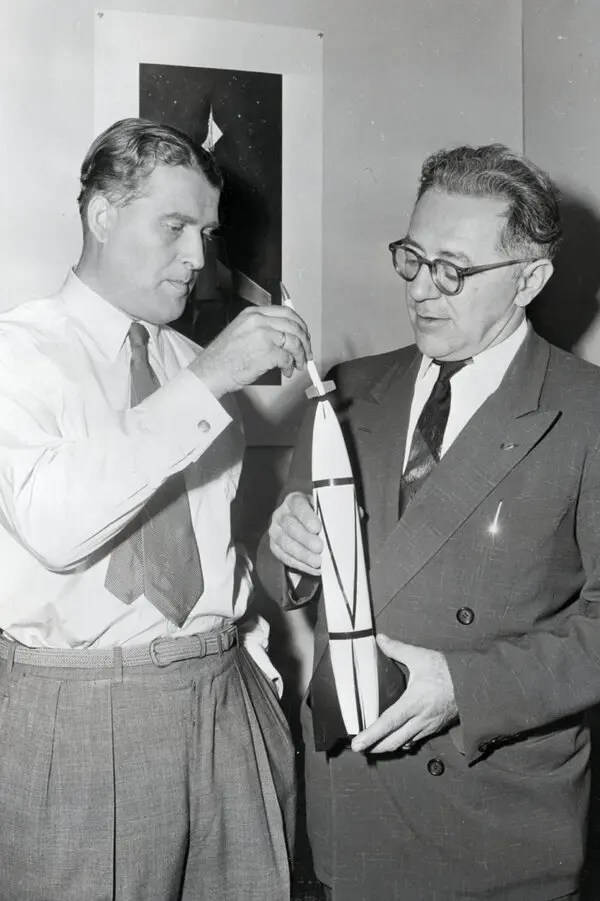

Above, the 1949, “Conquest of Space”, painting by Chesley Bonestell, entitled “Exploring the Moon”. Below, “The Luna“, on the moon in 1950’s, “Destination Moon”.

And yes, the Bonestell and Ley table top book, became George Pal’s, 1955, “Conquest of Space”.
Robert A. Heinlein’s Screenplay Continues:
Safely on the moon, “Jim Barnes” and “Dr. Cargraves” put on their space suits and leave the”Luna” to become the first men on the moon.
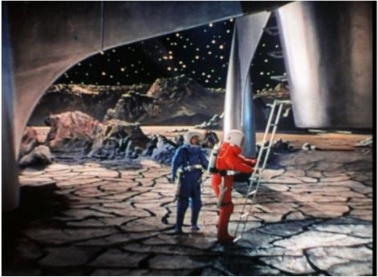

“Barnes” urges “Cargraves”, in Robert A. Heinlein’s “Second Red Scare” dialogue, to claim:
BY THE GRACE OF GOD, AND IN THE NAME OF THE UNITED STATES OF AMERICA, I TAKE POSSESSION OF THIS PLANET ON BEHALF OF, AND FOR THE BENEFIT OF, ALL MANKIND.
Followed by planting the American Flag on the moon.
The group now makes contact with Earth, and “Dr. Cargraves” describes the barren landscape of the moon.

Next, all four men set out to explore the lunar surface. “General Thayer” is walking around with a gieger counter, “Dr. Cargraves” is taking photos of the surface and stars. For fun, “Joe Sweeney” asks”Cargraves” to take a picture of himself. Noting the background, “Dr. Cargraves” positions “Joe”, so the photo has him holding up the Earth.
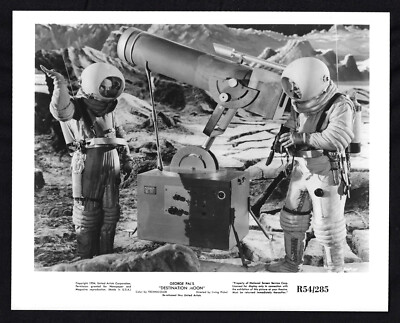
“Thayer” returns to say he’s picked up signs of what might be uranium in an entire Moon mountain range. A couple of words for the “Second Red Scare” audience to think about, tied to the idea of “Who Controls the Moon”.
While this is all going on, “Jim Barnes” is at the “Luna’s” radio with their Earth base, about the “Luna’s” take-off from the moon.
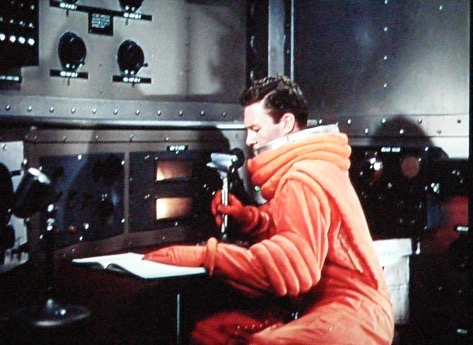
He’s told that extra amount of fuel the burnt getting the “Luna” on the surface has a direct impact on reaching take-off velocity. In short, the ship and crew weigh too much to make it back to Earth, and they’re running out of time within their launch window. “Jim” informs the others, and they start to strip the space craft of anything nonessential for the home flight.
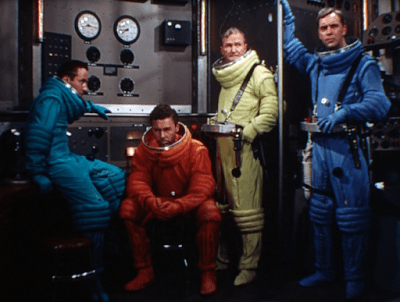
Checking once again with the Earth base, the four are told they need to drop another 110 pounds. This starts the four considering the possibly of having to leave one of them behind to certain death. As “Barnes”, “Cargraves”, and “Thayer” continue to discuss their situation, they find “Joe Sweeney” missing. “Joe” is standing outside of the “Luna”, telling the other three men, that his weight is the necessary pounds, so the other three can make it home. They need to return, because of their knowledge and expertise. He considers himself, just along for the ride. Suddenly, “Jim Barnes” realizes were that extra 110 pounds is, the radio! “Barnes” calls the base, informs them that there will be no more contact until they land, shuts the radio off, almost in mid sentence, and tells “Cargraves” and “Thayer” to rip out the radio. He, tells “Joe”, he’s going home with them, but to take the torn up radio away from the hatch as fast as possible. Then, giving “Joe” instructions on what to do with his spacesuit. He’s to take a spent oxygen cylinder, tether the cylinder to his space suit, have it hanging just outside the open airlock. Then enter the “Luna”, and push the air lock close switch. The cylinder’s weight will pulls the space suit out, and the air lock will finish closing. Minutes later, the “Luna” lifts off for Earth.
As the “Luna” is seen approaching the Earth, instead of THE END, the audience sees:
This is THE END….of the Beginning
I would be amiss, after speaking to “McCarthyism” above, if I didn’t mention the fact that in October 1947, Irving Pichel was subpoenaed by the “House Committee on Un-American Activities”. As a result, he was “Blacklisted”, even though he never appeared in front of the committee, but the major United States Film Makers refused to give him new work. He went overseas, but was cleared of all charges, and returned to the United States to work in low budget productions, such as 1950’s, “Destination Moon”.
Irving Pichel’s final film work was directing the docudrama, about the German Priest, “Martin Luther”, starring Irish actor Niall MacGinnis. and premiering in Milwaukee, Wisconsin, on May 4, 1953.
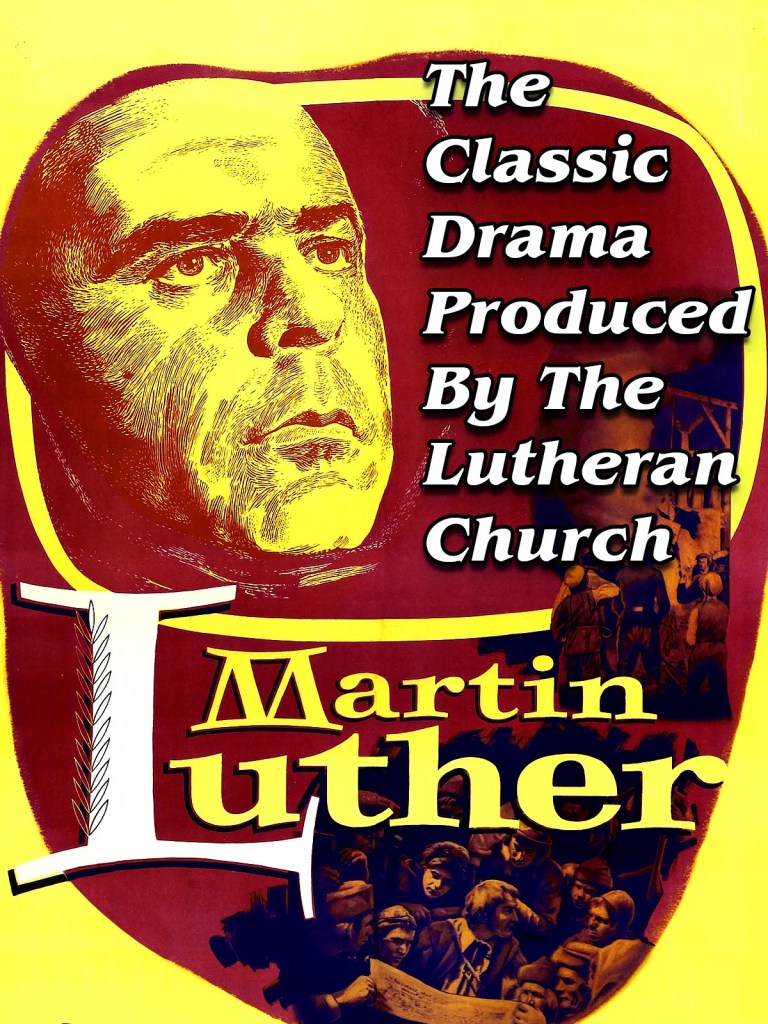
On July 13, 1954, 63-years old Irving Pichel passed away, and yes, he apparently was a Communist.
 THE FILM MADNESS OF FRADKIN-STEIN
Leave a comment