“Olsen and Johnson” became a vaudeville team, the year before, “The Five Marx Brother’s, Chico, Harpo, Groucho, Gummo, and Zeppo, had their only professional performance together, in 1915. Both groups would be followed by “The Three Stooges”, originally, Moe and Shemp Howard, and Larry Fine in 1925. Stan Laurel and Oliver Hardy in 1927, Bud Abbott and Lou Costello, in 1935, and it wasn’t until 1946, that the teaming of singer Dean Martin, and comedian, Jerry Lewis, took place.
This is the story of two classically trained musicians, who discovered the “Vaudeville Stage”, instead of the “Concert Hall”.
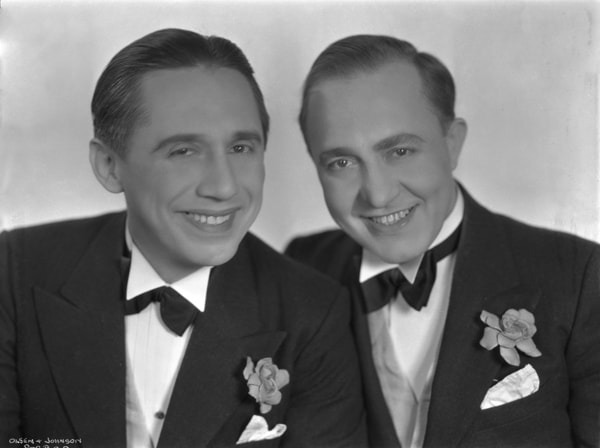
John Sigvard “Ole” Olsen, below on the left, was born on November 6, 1892, in Peru, Indiana.
Harold Ogden “Chic” Johnson, below on the right, was born on April 15, 1891, in Chicago, Illinois.
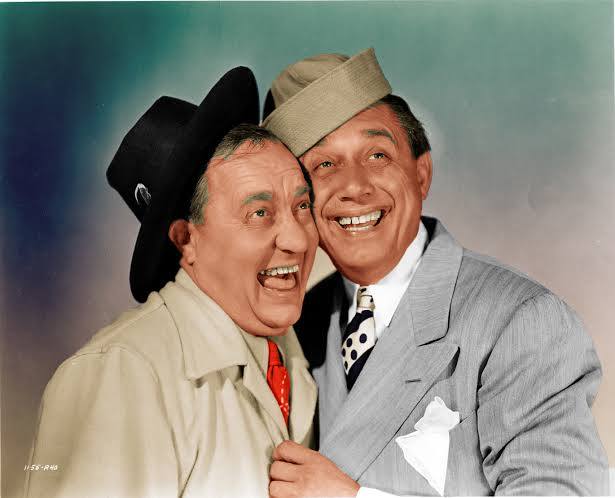
“Ole Olsen” was a musical student at “Northwestern University”, in Evansville, Illinois. He graduated in 1911, with a degree in music. In 1912, with three other college music graduates. “Ole”, formed the Chicago based, “The College Four” band. “Olsen”, was a trained concert violinist, and using “College” in the band’s name. Seemed to catch the eye of the family friendly vaudeville venues. Along with small music halls and beer halls, that parent’s could safely take their children. The “College Four” played violin solos by “Ole”, accompanied the illustrated sing along slide shows, and even performed ventriloquism routines with music. However, “Ole’s” pianist left the group, and he needed a replacement.
Things radically changed for the “College Four”, when “Ole” hired rag-time pianist, “Chic” Johnson. Who had been playing piano in saloons, and cabarets. “Chic” had studied and played classical piano at the “Chicago Music College”, but dropped out without getting his music degree.
However, “Chic” Johnson, brought to the band, a faster pace to the music, comedy routines, that usually required a straight man, but instead of a designated straight man, “Ole” and “Chic”, depending upon the routine, or joke, became the other’s straight man. These changes were too much for the other two musicians and they left, but a bond had formed between “Olsen and Johnson”.
Shortly, after he band’s final break-up, “Ole” Olsen and “Chic” Johnson, moved to the two major vaudeville circuits. “The Orpheum”, which in 1929, would merge with two others to become “Radio-Keith-Orpheum (RKO Pictures)”, and the “Pantages”, owned by Alexander Pantages, out of Canada. His empire would have 84-vaudeville and movie theaters, between Canada and the United States.
At this point in their career, the comedy duo had become a vaudeville starring act, but not yet involved with motion pictures. As this is a motion picture and television history blog, I will switch to films shortly.
During the first half of, 1927, “Ole” and “Chic” took a cruise to Australia, and started to appear on Australia’s, “Tivoli Vaudeville Circuit”. Which included, Sydney, Melbourne, Brisbane, and Adelaide. While in Australia, the American duo, also recorded a record for “Columbia”.
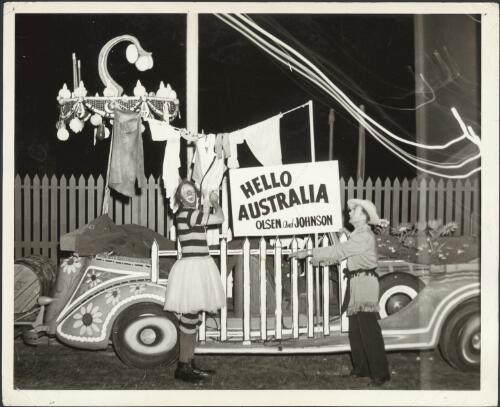
On the vaudeville stage, “Olsen and Johnson”, had, what some vaudeville historians described as “CONTROLLED CHAOS!” Which became their trademark, drawing audiences into the theatre.
Audiences at any “Olsen and Johnson” performance could expect, and came to see, their “Controlled Chaos”. When, suddenly, someone would break the “4th Wall of the Theatre”, leap off the stage, and sit down in an audience member’s lap. In that same audience, “Ole” and “Chic” had planted members of their cast, who might start shouting insults at those on stage, or start a planned fight between two of their cast members.
The two vaudevillians used props, such as exploding cigars, collapsing chairs, live animals, and blank cartridge gun fire. The two were masters of physical comedy. At intermission, when the audience normally gets a chance to breathe, and buy snacks. That audience at the snack bar, or outside the theatre for fresh air, was still not safe from “Ole” and “Chic’s” planned “Chaos”.
The first motion picture starring (?) “Olsen and Johnson”, has an interesting, not motion picture storyline, revolving around their vaudeville popularity across the United States and Canada.
OH SAILOR, BEHAVE! released August 16, 1930
On September 24, 1929, at the “Vanderbilt Theatre”, on Broadway, the comedy “See Naples, and Die”, written and directed by Elmer Rice, opened. It ran only for 62-performances.
The rights to the play were acquired by “Warner Brothers“, and they assigned Joseph Jackson to adapt the play for a screenplay. He had started for the studio with the 1927 silent, “Afraid to Love”. Sid Silvers added more dialogue to the Jackson screenplay. Actor Silvers, had written two short films and one feature, all in 1930.
The motion picture was directed by Archie Mayo, who had been directing since 1917. Over his 88-films, Mayo would direct the Marx Brothers, and Jack Benny in comedies, Gary Cooper, George Raft, Joan Bennett, Lloyd Nolan, and Ida Lupino, among other major and minor stars in dramas.
The two leads were supposed to be Irene Delroy, portraying “Nannette Dodge”, and Charles King, portraying “Charlie Carroll’. Both were Broadway musical stars at the time this film was released. HOWEVER, thank you “Warner Brothers”, for giving the world, 1927’s, “The Jazz Singer”, and the singing voice of Al Jolson; Which ushered in sound movies, and when, “The Talkies“, completely took over film production. The major studios started to turn out more musicals. Between April 8, 1929’s, “The Desert Song”, starring John Boles, Carlotta King, Louise Fazenda, and Myrna Loy, and this motion picture. Over 100, motion picture musicals had been released, but by mid-1930, the public had grown tired of musicals.
That situation worried the “Warner Brothers” executives, but a solution appeared to them.
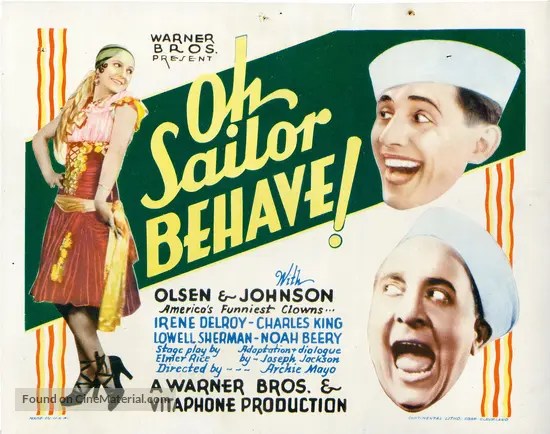
Note, the poster for 1930’s, “Oh, Sailor Behave”, placed above Delroy and King’s name’s, the poster reads:
WITH OLSEN & JOHSON AMERICA’S FUNNIEST CLOWNS
The use of the word “With”, normally implied an added interesting actor, but not a starring actor.
“Ole”, portrayed “Simon”, and “Chic”, portrayed “Peter”. They are two bungling members of the “United States Navy Shore Patrol“, initially stationed in Naples, Italy. They are in Venice, searching for a man with a wooden leg, who robbed the Naples, United States Navy, Base Bank.
The original motion picture screenplay was exactly like Elmer Rice’s, 1929 play.Which had been about an American newspaper reporter sent to Venice to interview a Romanian general, and falls in love with a young and beautiful heiress, who is being blackmailed.
When the shooting with “Ole” and “Chic” had been completed. Their entire added second storyline, without any connection to the original storyline, took up one-third of a motion picture with a running time of 68-minutes. For comparison, the original play ran 90 to 100-minutes.
The movie had been planned to be filmed in “Technicolor”, but was lowered to straight black and white. Any previously shot color footage was reprocessed into black and white.
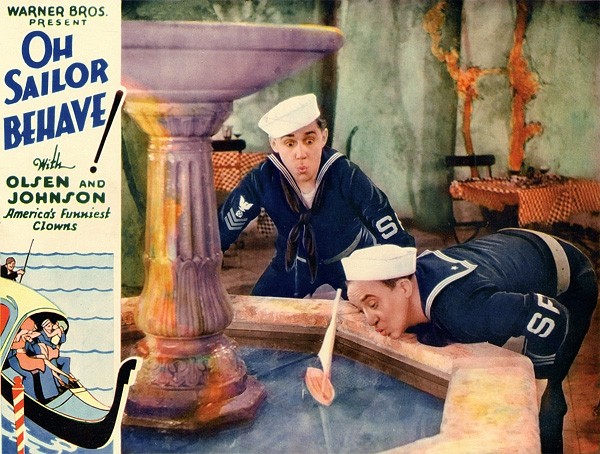
“Olsen and Johnson” were now advertised, by the “Warner Brothers” publicity department, as the main stars, not Delroy and King. Although King recorded three of the five song numbers in the finished cut. Had, Delroy and King, remained in the first and second cast positions, as originally planned. The finished movie would have had a prestigious preview, and then released in top theater markets. Instead, with “Olsen and Johnson” in the leads, to avoid audience apathy toward musicals. The “Comedy” was just released to “General Audience Theaters”, instead of “First Run Theaters”.
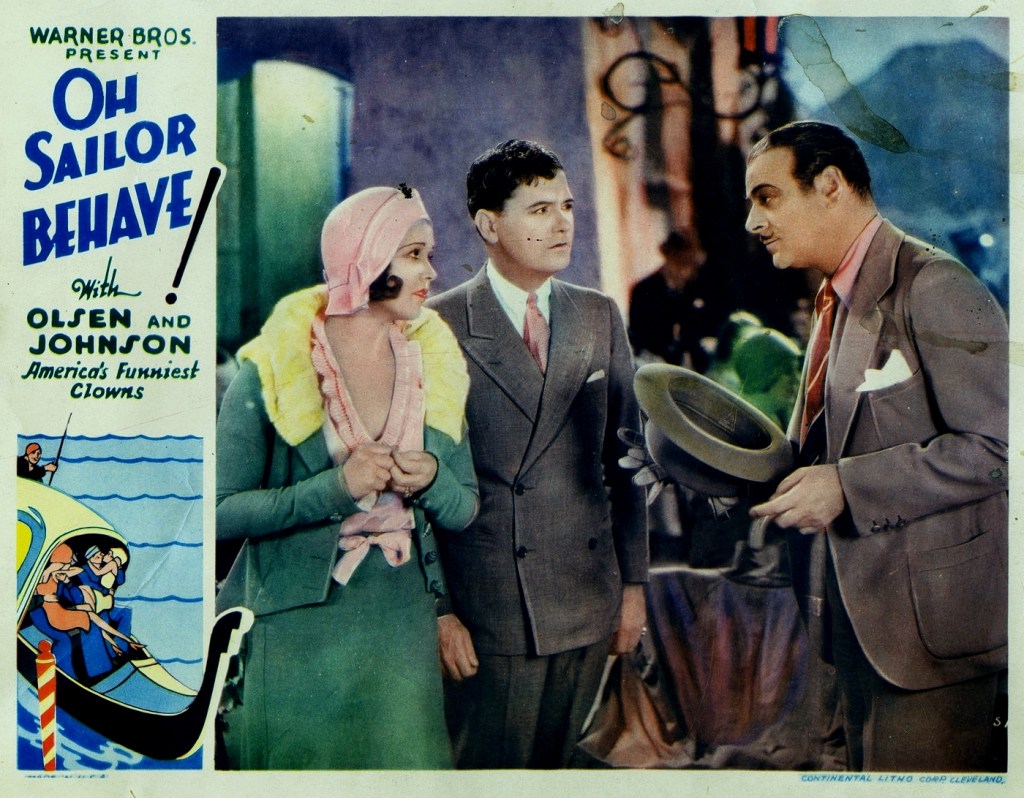
Above, left to right, Irene Deloy, Charles King, and Lowell Sherman portraying “Prince Kosloff”
Which brings me to “Olsen and Johnson’s” second feature film. On November 27, 1929, at the “Lyric Theater”, on Broadway, the Cole Porter‘s musical, “Fifty Million Frenchmen”, premiered, with 18 Cole Porter songs, and the book by Herbert Fields. The motion picture rights were obtained by “Warner Brothers”.
50 MILLION FRENCHMEN premiered in the United States on February 14, 1931. It next premiered in London, England, on June 16, 1931
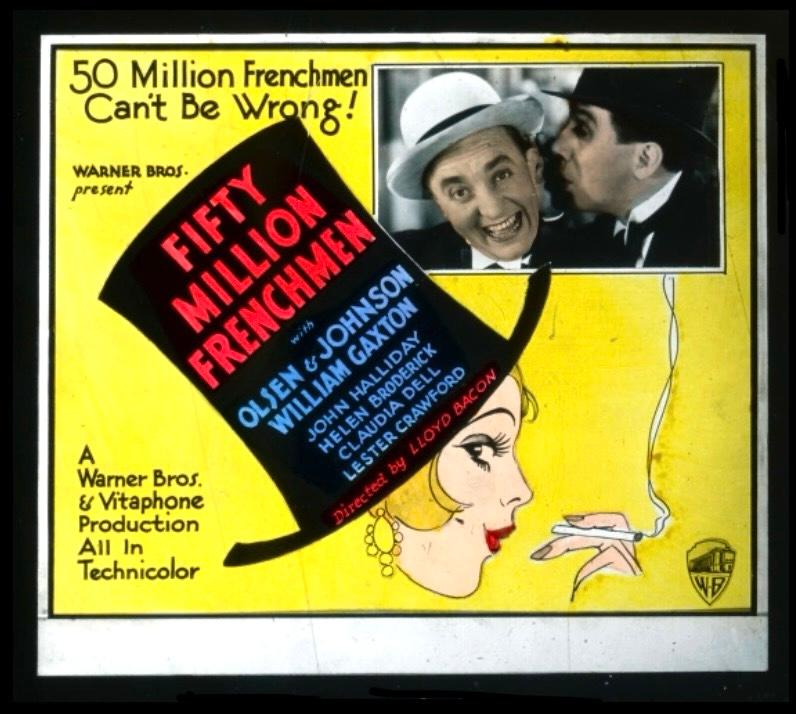
My reader will note the above two “Premier Dates”. “Warner Brothers” was still in panic mode, dealing with the declining “Box Office Receipts” in the United States. So, they removed all 18 Cole Porter songs from the American/Canadian release, but varied them for Foreign release. Which depended on the censorship of the country the film would be seen in.
The feature film was directed by Lloyd Bacon, who started acting in 1915, in the western, “Bronco Billy’s Greaser Deputy”. When Bacon stopped acting in 1935, he had appeared in 79 movies. His first directing assignment was the 1922, comedy short, “The Speeder”. Lloyd Bacon stopped directing in 1953, with the Jane Russell, 3-D musical, “The French Line”, he had directed 131 pictures.
“Warner Brothers”, once again, assigned Joseph Jackson to adapt the play for the motion picture screen. For the actual screenplay writing, he was assisted by comedy writer, Eddie Welch, on his first screenplay.
The storyline is pretty much Herbert Fields’s Broadway play book. It is set in Paris, France, and Wealthy American “Jack Forbes”, who is played by William Gaxton, bets his friend, “Michael Cummins”, played by John Halliday, that he can “woo and win”, “Lu Lu Carrol”, portrayed by Claudia Dell, without revealing his wealth, or using his connections. To be sure that “Jack” has no chance of winning the bet, “Michael” hires two “bumbling” detectives, “Simon” and “Peter” to follow him.
The following is from the “Berkley Gazette”, dated April 25, 1931:
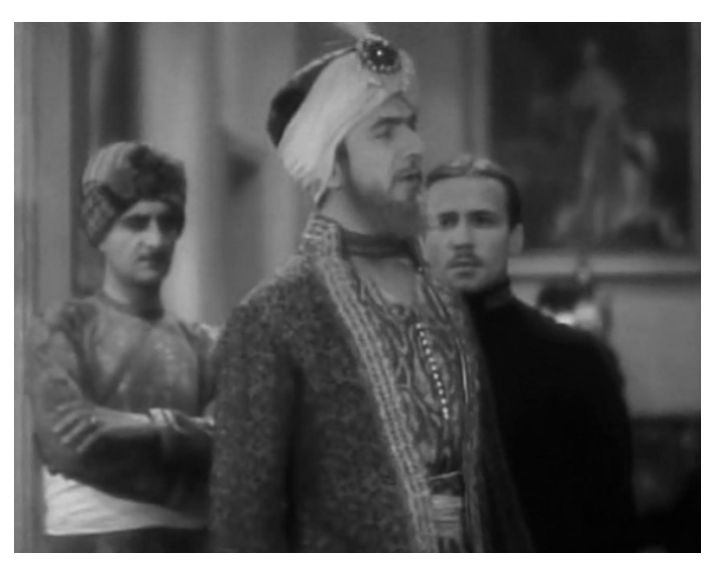
The movie was filmed in August 1930, and then all the songs were removed, and it was finally released in February 1931. I bring this up, because from September 29th through November 15, 1930, “Universal Pictures” filmed “Dracula”. In, what is described as a “Two-Minute-Role”, was Bela Lugosi, portraying the uncredited role of “Orizon the Magician”. “Dracula” wouldn’t be released until February 16, 1931, two-days after this movie.
The next film production for “Olsen and Johnson” was based upon a never produced play by playwright Len D. Hollister, entitled “The Wife of the Party”. The rights to it were purchased by “Warner Brothers”.
GOLD DUST GERTIE released in the United States on June 27, 1931, and then released in London, England, on July 1, 1931, under the title: WHY CHANGE YOUR HUSBAND
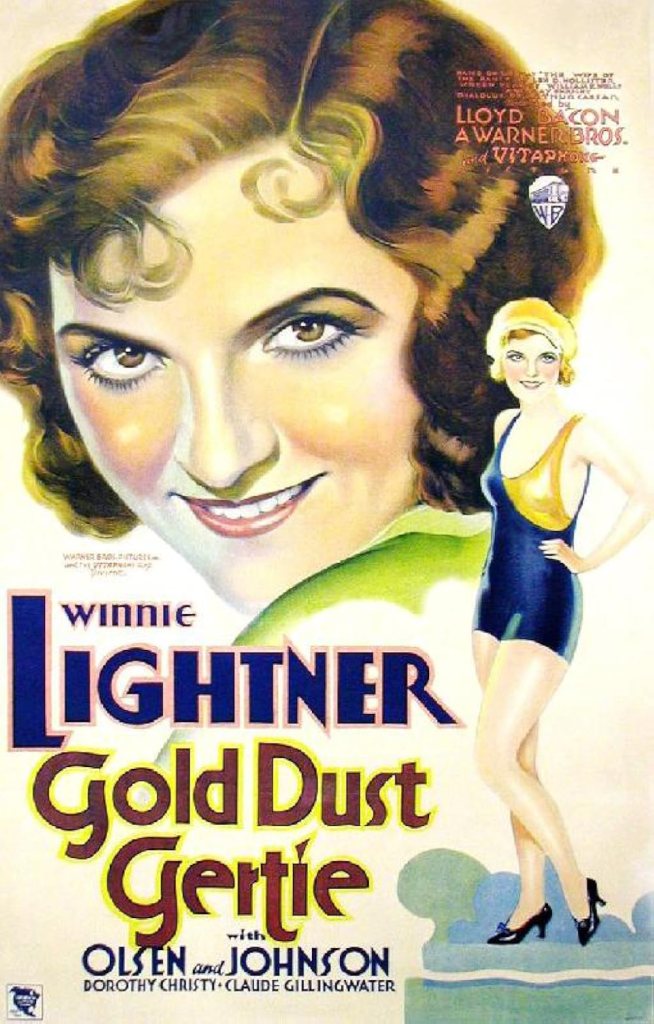
The original title for the motion picture, as filmed, was “RED HOT SINNERS”, but once again, for the United States and Canadian releases, “Warner Brothers” edited out all the songs, but one. That was “She Came from a South Sea Island”, song by leading lady, Winnie Lightner. The total number of songs remains unknown as of this writing, and the only known print in existence, is the United States edit.
Lloyd Bacon directed the picture. Among Bacon’s films at this time, was the 1930 version of Herman Melville’s, “Moby Dick”, starring John Barrymore, the 1932 Joe E. Brown comedy, “Fireman, Save My Child”, the classic Busby Berkeley musical, 1933’s, “42nd Street”, and the Al Jolson, musical, “Wonder Bar”.
The screenplay was by two writers, the first was W. K. Wells aka: Billy Wells aka: WM Wells, and William K. Wells for this feature film. Wells was a legitimate stage comedy writer, who started writing screenplays in 1929. He was known for his dialogue for the “Fox Movie Tone Follies” of 1929, and 1930. In 1930, he wrote all the dialogue for the adventure, musical, romance, “Captain Thunder”, starring an unknown Fay Wray.
The second screenplay writer was Ray Enright, this was the first of only four comedy screenplays. He had been directing since 1921 and had 77 credits by 1956. When Enright ended his career with an episode of television’s “Ethel Barrymore Theatre”, “The is Villa”, starring Akim Tamiroff as “Pancho Villa”, on September 21st.
The Three Leading Actors:
Winnie Lightner portrayed “Gertrude ‘Gertie’ Dale”. Lightner was a Broadway singer, who earned the nickname of “Song a Minute”, because she could “belt out” any known song, completely, in 60-seconds. He first on-screen appearance was co-starring in the 1929 musical, “Gold Diggers of Broadway”.
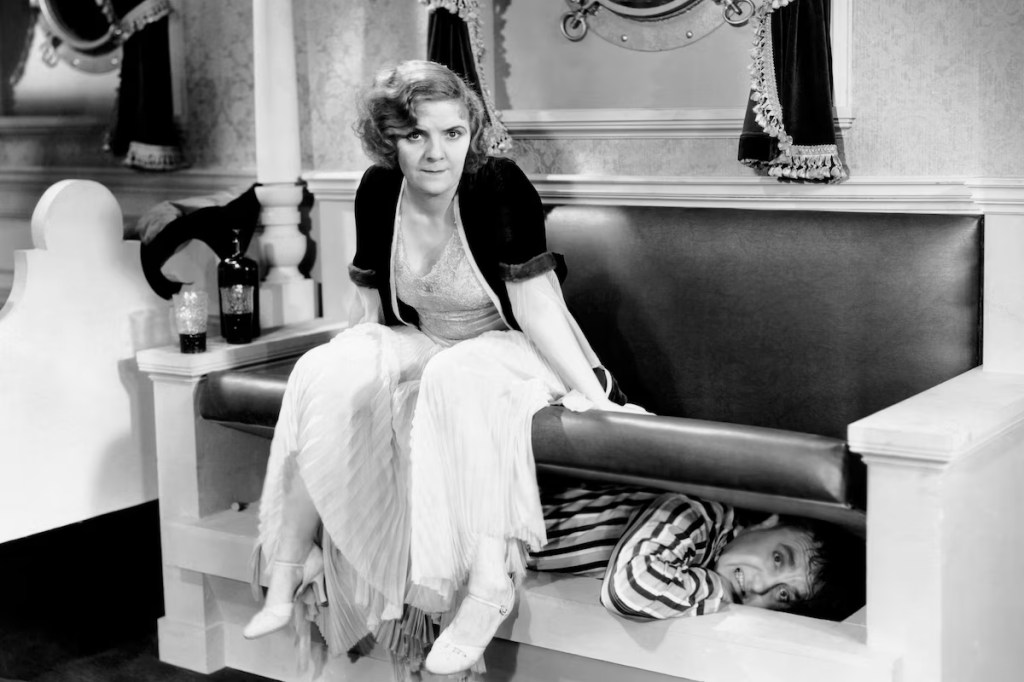
Above Winnie Lightner and “Ole” Olsen portraying “George Harlan”.
“Chic” Johnson portrayed “Elmer Guthrie”.
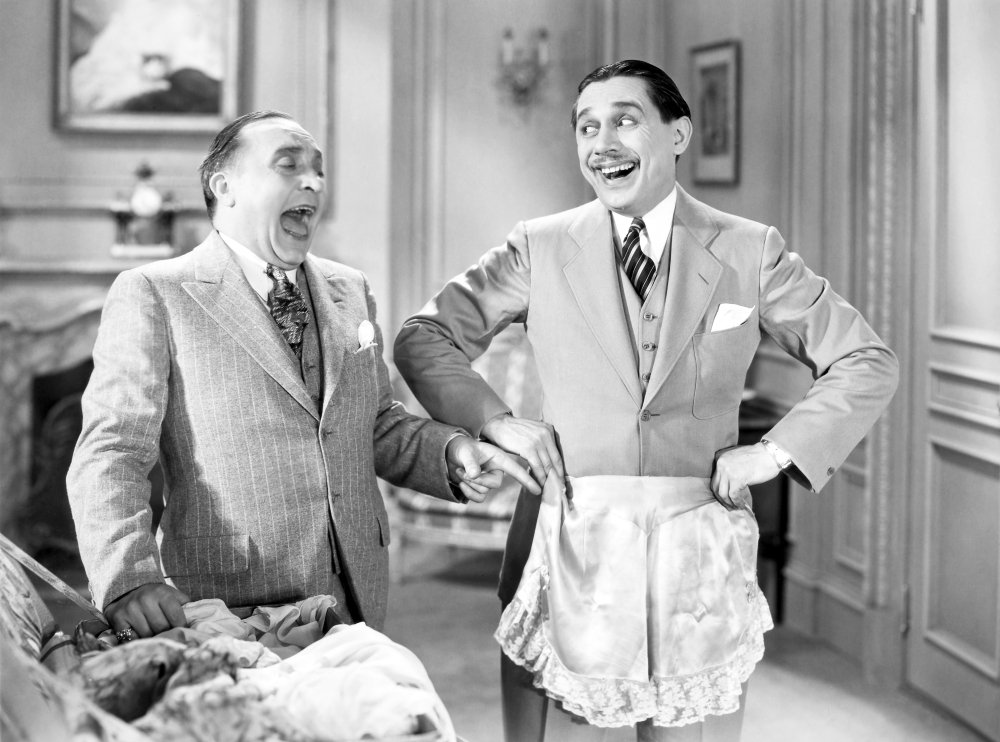
Above left is “Chic”, and holding the ladies underwear, is “Ole”.
The Basic Plot Line:
“Gertrude Dale” is a “Gold Digger”, who marries men, only to divorce them, so she can collect alimony. In 1927, she marries a salesman from a woman’s lingerie company named “George Harlan”. She next divorces “George”, but marries his friend and co-worker, “Elmer Guthrie”. By 1930, she has also divorced “Elmer” and is collecting alimony from both friends. Both men are remarried, but have not told their current wives about “Gertie”. Whom both have stopped paying her alimony.
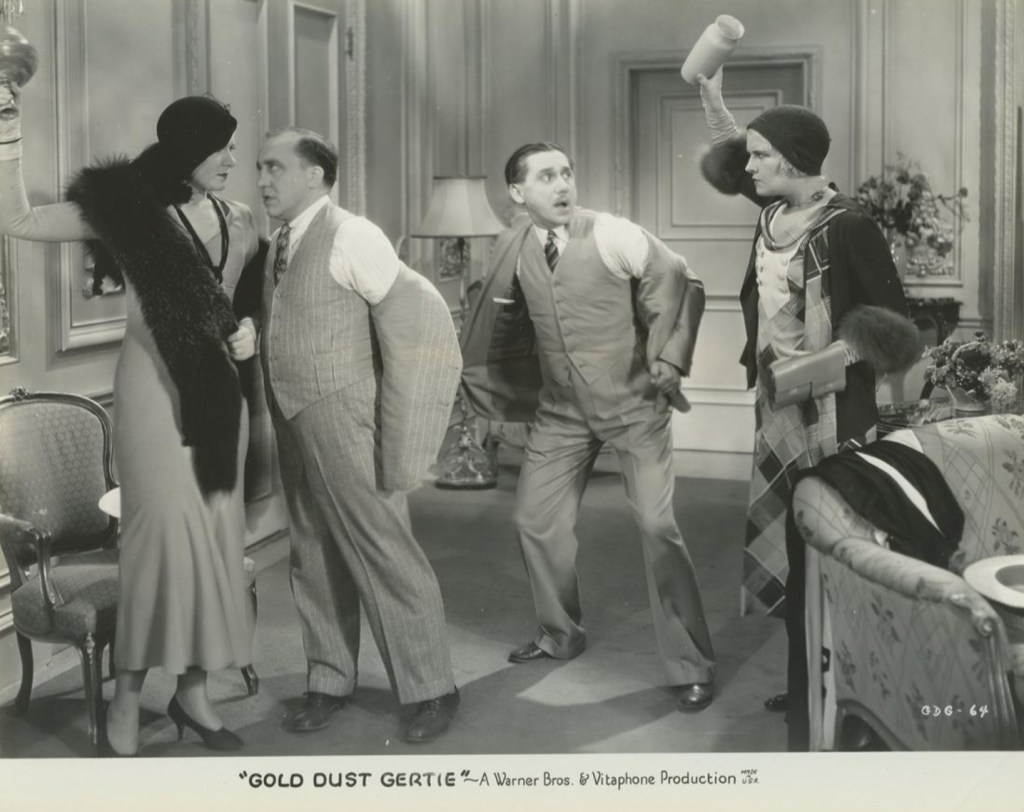
Above left to right, Dorthy Christie as “Mrs. Mabel Guthrie”, “Chic” Johnson, “Ole” Olsen, and Vivien Oakland billed as Vivienne Oaklland as “Mrs. Lucille Harlan”.
The company that “George” and “Elmer” work for is known for designing women’s swim wear. It is owned by “John Aberdeen Arnold”, portrayed by Claude Gillingwater, who is very, very, old fashion. One of the gags revolves around the fact that “Arnold” is still designing swimwear for 1911, not 1931.
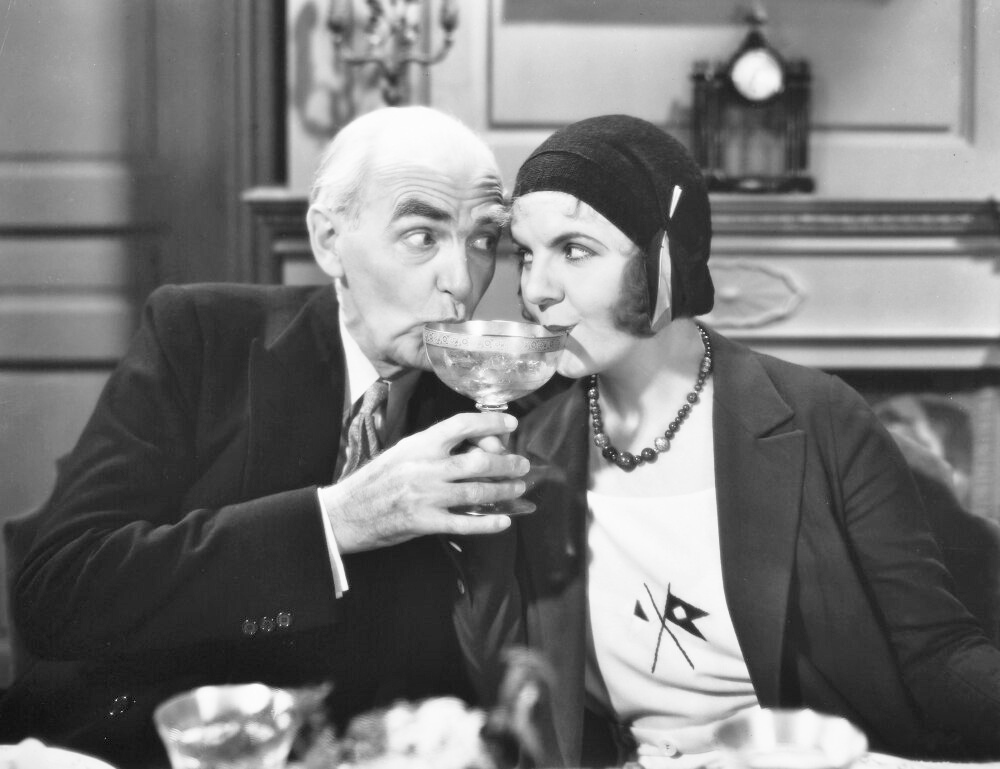
Above, Claude Gillingwater, and Winnie Lightner.
“Gertie” has set her sights on “Arnold”, and convinces him to update his clothing line. In fact, “Gold Dust Gertie” designs a new updated bathing suit for his new line. She gives up seeking the back alimony from both “George” and “Elmer”, and will discover that she is falling in real love with “Arnold”.
Meanwhile, “George” and “Elmer’s” wives, Mabel” and “Lucile”, who are sisters, find out about their husband’s previous marriage’s to a “Gertrude Dale”, and the alimony they were paying.
Throughout the film, there is a slapstick comedy running gag about hiding “Gertie“. Every time one, or both wives appear, and “Gertie” is there also.
Finally, “Mabel” and “Lucille” confront their husband’s over “Gertrude Dale”.
Which leads to another typical slapstick comic sequence. The audience never sees “Elmer” and “George”, as their wives toss things at them, and off screen, beat the crap out their husband’s. After their wives leave, the audience now sees the battered “Elmer” and “George”.
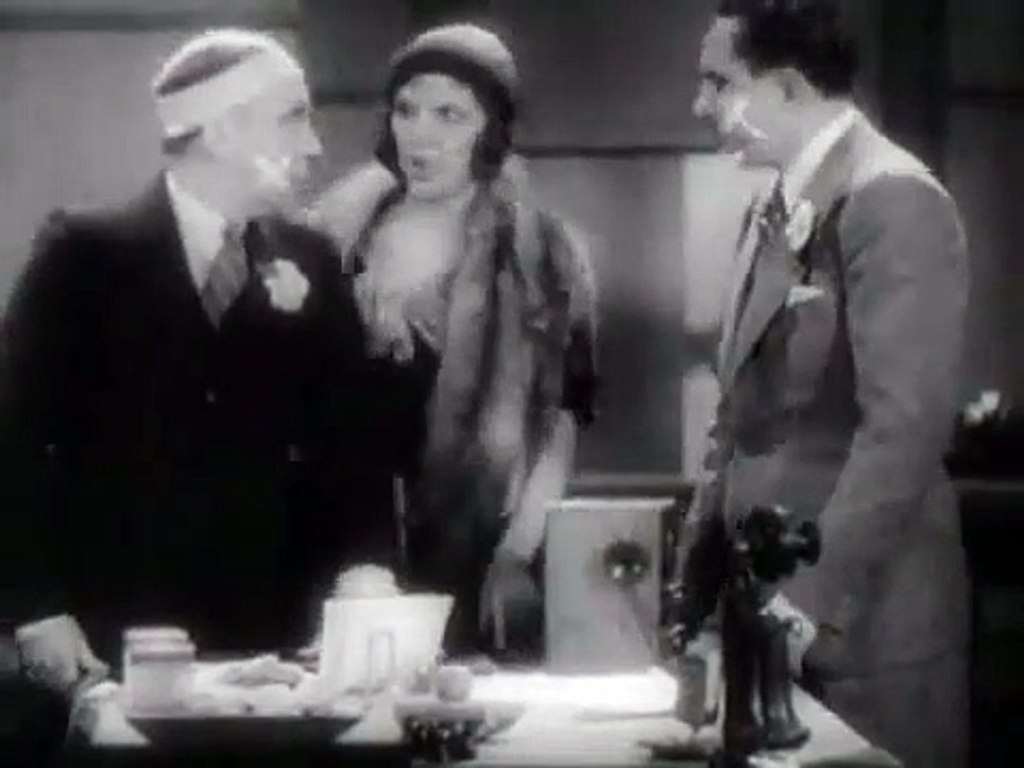
However, things between the four are not over, and they meet, again, the following day to continue the battle.
This is were “Olsen” and “Johnson’s” chaotic style kicks in to a classic sequence their other films never had.The sequence starts with “Mabel” and “Lucille” chasing “George” and “Elmer,” with “Gertie”, in motor boats on a lake.
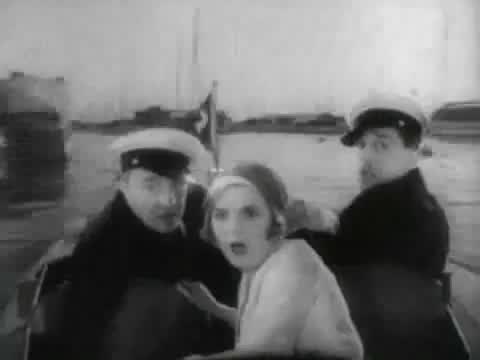
At one point is the chase, “Elmer” and “George”, have gotten rid of the motor boat, but find a rowboat. The sequence continues, as it turns into a rowboat chase, with the wives using the oars as weapons. The whole sequence seems to have come from a “Looney Toons” cartoon. The furious wives now close-in on their husbands≥ This is on the beach where their rowboat ended up, with “Gertie” still with them. As their wives close in, “Gertie” advises “Elmer” and “George” to start swimming to China. Her ex-husband’s jump into the lake water, as their wives keep hitting them with rowboat oars. They’re hit so hard, that both”George” and “Elmer” sink out of sight in the lake. When “George” and “Elmer” pop up in the water, it’s not the lake, but the Pacific Ocean, and the two start swimming to China\
“Arnold” has found out about “Gertie’s” alimony schemes and husbands. Surprisingly, he is amused by all of this, and says he feels younger. As their wedding commences, it become obvious that the minister also knows who “Gertrude Dale”.
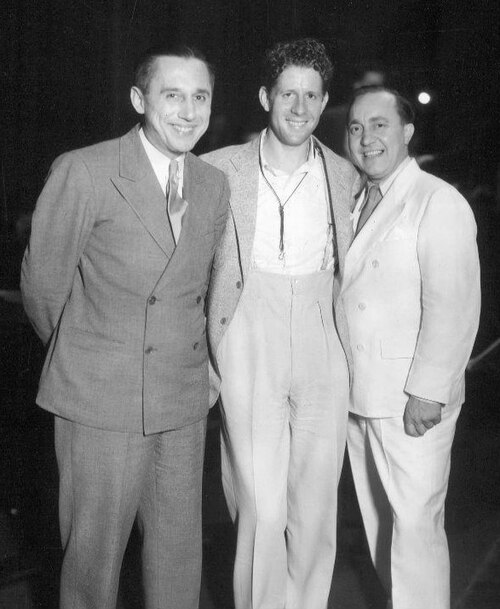
On radio, was a popular music and variety program, “The Fleischman Yeast Hour”, hosted, since 1929, by singer Rudy Vallee. During the “Summer of 1932”, “Chic” and “Ole”, became regulars on the program, much to Vallee’s dislike. Even over the airwaves, the “Chaotic Vaudeville” of the two, disrupted the formal format of the program, in segments “Olson and Johnson” called “The Padded Cell of the Air”. 1932 was an election year, and during that segment, “Ole” and “Chic” nominated “MICKEY MOUSE FOR PRESIDENT”, and kept it going through the Summer.
Below, left to right, “Ole” Olsen, Rudy Vallee, considered one of the first teen-heart throbs. and “Chic” Johnson.
Ethel Merman opened, on Broadway, at the “Apollo Theatre”, 253 West 125th Street, November 1932, in the musical “Take a Chance”. Merman’s supporting roles of “Duke Stanley” was played by Jack Haley, and “Louie Webb” was played by Sid Silvers. However, on June 5, 1933, “Ole” took over as “Duke”, and “Chic” as “Louie”. The change came, because the musical was about to go on tour, and it was felt that “Olsen and Johnson’s” vaudeville and radio exposure, would ad more life to the road show engagement. Below, is the cast page from the show’s program for the “Erlanger Theater”, 127 N. Clark Street, Chicago.
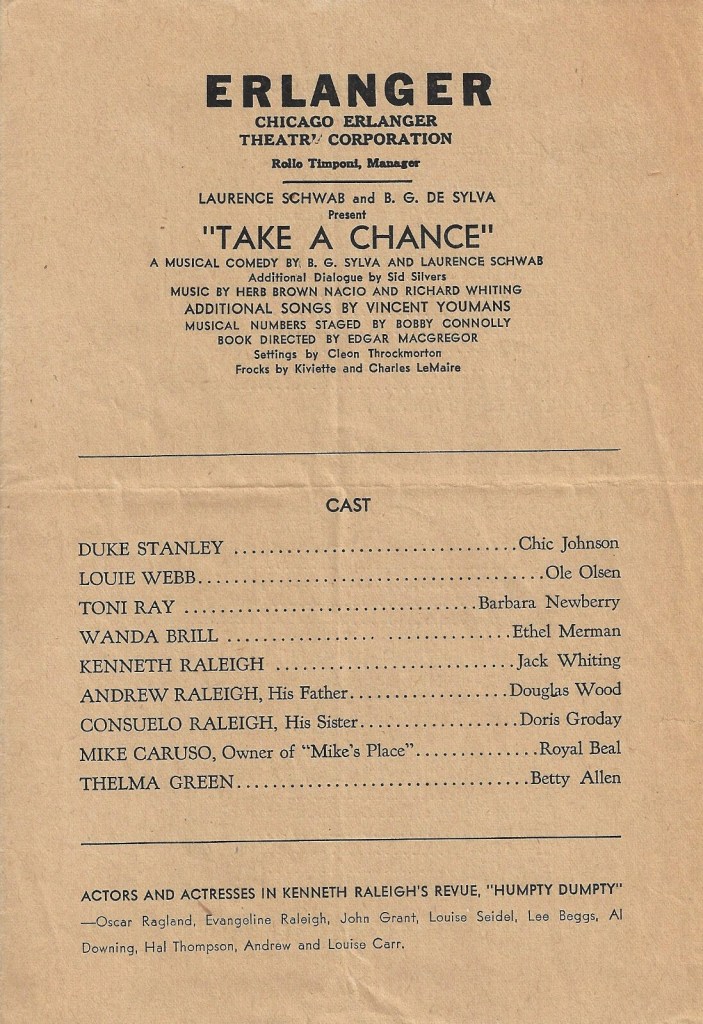
On July 1, 1933, “Take a Chance” closed on Broadway, and the duo took their own chaotic vaudeville style show on the road. Although at times, they called their show, “Take a Chance”. On October 27, 1933, a motion picture version of the Broadway musical was released, but it had a changed plot. Also, “Paramount Pictures” dropped all the Broadway songs, but one. That song was Ethel Merman’s, she was also dropped from the movie, standard, “Eadie was a Lady”. However, the picture introduced the song, “It’s Only a Paper Moon”. The only original cast member was June Knight portraying her Broadway role of “Toni Ray”, but in the changed plot.
Starting on Friday, September 22, 1933, through March 30, 1934, “CBS Radio” had the 30-minute, “The Olsen and Johnson Show”. The duo had a live studio audience, that they incorporated into their act. The two comics still used “Vaudeville Blackout Jokes”. Which were built around a single joke, that normally ran 15-seconds to the punch line. The term, “Blackout”, came from when the lights were dimmed low, on stage and in the audience, as the joke is set up. The moment the punchline was given, the stage and audience lights went off, or to “BLACK”, as it was called. However, for a “Blackout Joke” to work on radio, the joke relied entirely on an audio trick to mimic the abrupt drop to darkness. Those two mimic’s, were either “Sudden Silence”, all sounds completely stop, or “A Zany Sound Effect”, which was right up “Olsen and Johnson’s” alley, as the saying goes, of a “Chaotic Sound”, such as a comic “Bonk”, or the overly used by others, “Scratch across a record”.
After “The Olsen and Johnson Show” went off the air, the duo took “THEIR SHTICK” on the road until September 1936. When the two signed a two picture contract with “Republic Pictures”.
COUNTRY GENTLEMEN released on November 9, 1936
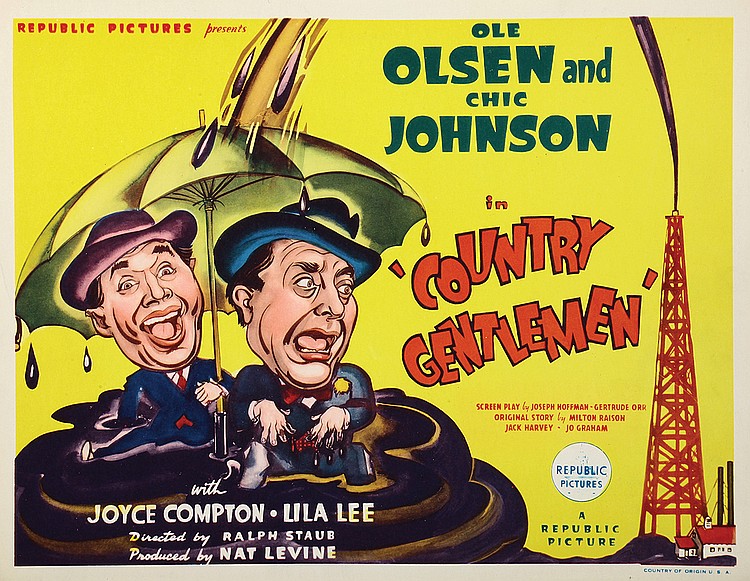
To write this screenplay, it took 6-Republic Picture writers. The original story took 4 of the 6 writers. The main story writer was, Milton Raison, who began as was one of the uncredited writers on 1932’s, “Rasputin and the Empress”, the only motion picture to star Ethel, John, and Lionel Barrymore together. In 1951, he switched to television writing and turned out 74-television scripts to his career end in 1960.
Jack Harvey only wrote 10-screenplays, but he was also an actor, and director. Jo Graham was a“Dialogue Director” from 1939 through 1948. She only wrote 5 actual screenplays. John P. Medbury was a straight comedy writer and started in 1922.
The actual screenplay was written by Joseph Hoffman. This was his 5th-screenplay that started with co-writing 1935’s, “Charlie Chan’s Secret”, starring Warner Oland. He switched to television writing in 1961, and even wrote for the cartoon series, “The Jetson’s”. In 1972, Hoffman’s last script was for the an episode of “Love, American Style”.
Gertrude Orr was the second actual screenplay writer. Her first screenplay was for 1925’s, “Smilin’ at Trouble”, her final of 23, was 1938’s, “Slander House”.
Which brings me to the picture’s director, Ralph Staub. This was his first feature length motion picture. Between his start in 1930, and 1960, 30-full years. Of Staub’s 313 directing assignments, only 15, including this feature, are not short subjects.
The Two Leading Actors, Plus Two:
“Ole” Olsen portrayed “J. D. McAllister aka: Jerome D. Hamilton”.
“Chic” Johnson portrayed “Charles Watson aka: Charlie ‘Chubby’ Williams”.
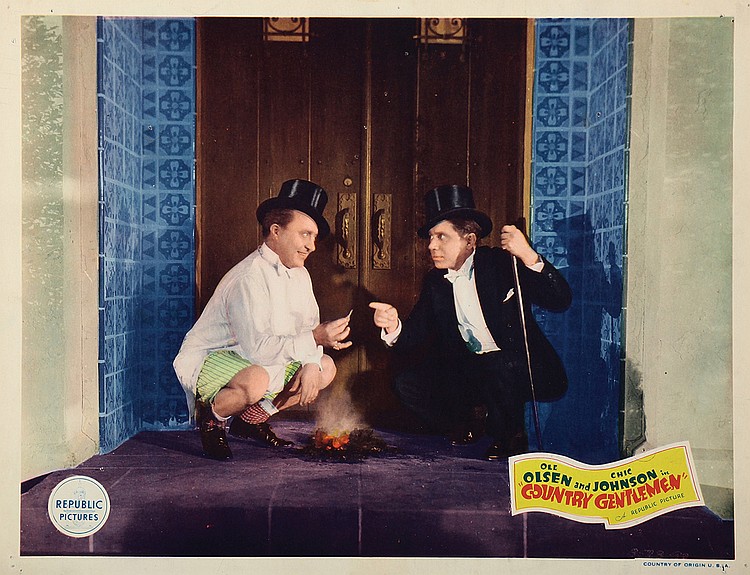
Above left,”Chic” Johnson, above right, “Ole” Olsen
Joyce Compton portrayed “Gertie”. Compton’s 1st on-screen role is unidentified, but is listed for the 1925, drama, “The Golden Bed”. In all, at the end of her career, mostly in “B” films, she appeared on-screen 161-times, that included 37 uncredited roles.
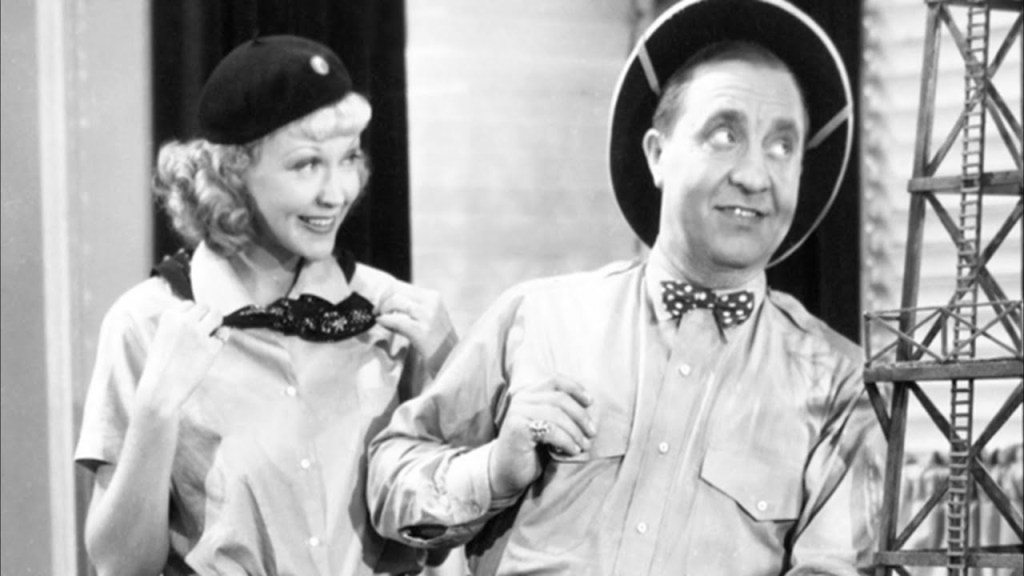
Above Joyce Compton with “Chic” Johnson. A compliment to Joyce Compton is the way she played her character. Her performance was compared to popular comedian Gracie Allen. Who, with her straight man husband, George Burns, were both a popular vaudeville team, and had their own radio show. On television, “The George Burns and Gracie Allen Show”, ran for 292-episodes, 1950 through 1958. Below, Gracie Allen in 1938.
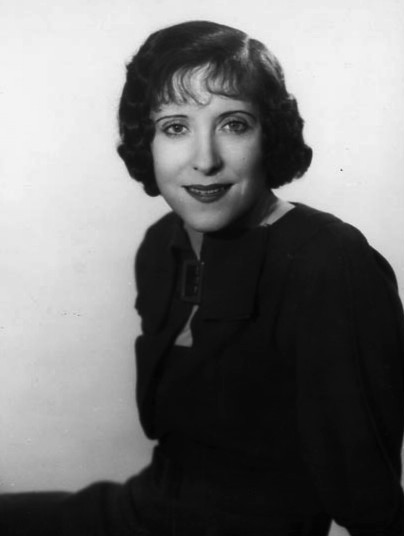
Lila Lee portrayed “Mrs. Louise Heath”, talk about needing a stage name. Lee was born Augusta Wilhelmena Fredericka Appel. Between 1918 and the 1930’s, Lee Lee was a major leading lady. In 1920, she was magician and escape artist, Harry Houdini’s co-star in “Terror Island”. She was Lon Chaney, Seniors, co-star in 1930’s, sound version of “The Unholy Three”.
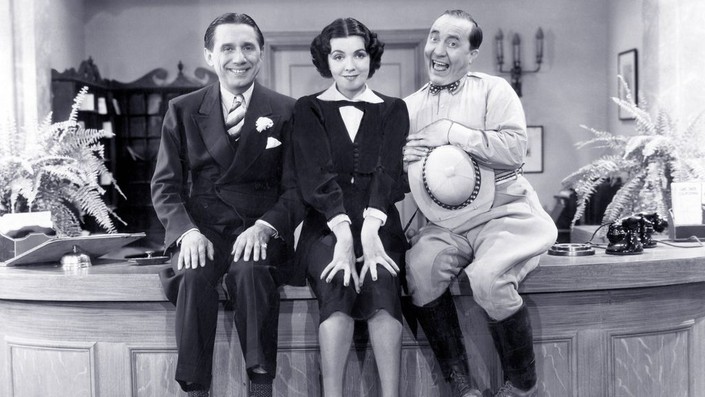
Above left to right, “Ole” Olsen, Lila Lee, and “Chic” Olsen.
The screenplay is typical slapstick comedy about two swindlers. “J. D. McAllister”, and his partner, “Charles Watson” are on the run once again. They have attempted to sell worthless stock at different small towns and end up being run out of town in each. Accompanying them, is their faithful secretary, “Gertie”, and he Great Dane, “Fluffy”, portrayed by Prince.
The three human’s and one dog, end up in the small town of Chesterville. “Jerome D. Hamilton” has met hotel owner, widow, “Mrs. Louise Heath”, and her son, “Billy”, portrayed by Sammy McKim, and wants to give up his life of crime and marry her.
However, plans will change as a “Veteran’s Home” is to be built in Chesterville. The two con-men smell a money making scheme. The movie is pure vaudeville shtick, dated, and leads to a predictable ending.
However, the next motion picture the duo appeared in, is a pure on-screen example of their “Chaotic Vaudeville Style”, full of fast paced jokes, and has been described as a “frantic back stage farce”.
ALL OVER TOWN released on September 8, 1937
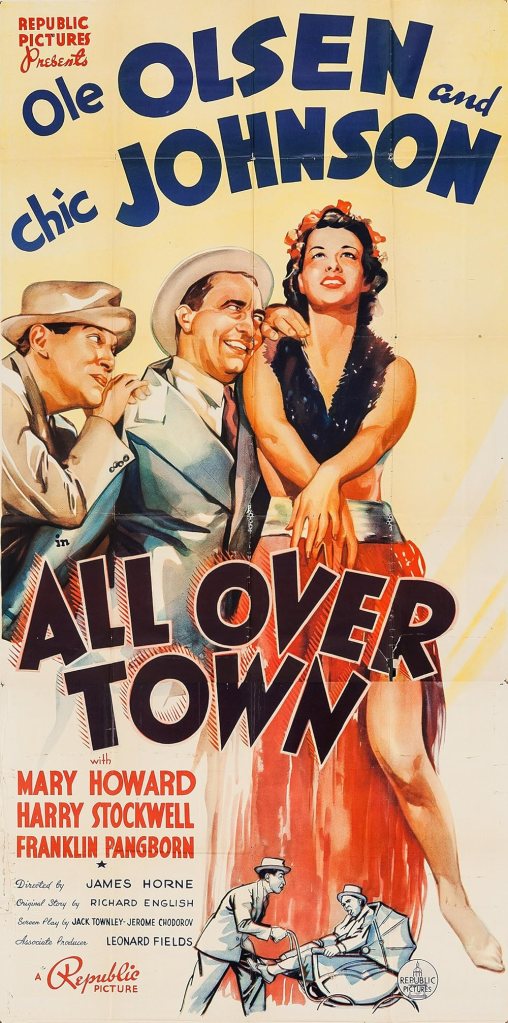
This was the “Ole” and ““Chic’s” last motion picture made for “Republic Pictures”, and the studio seemed to turn them loose. It a mixed bag to reviewers, but it was also a final test for the duo’s Broadway classic production I will speak to next.
The following four writers were assigned the screenplay by “Republic Pictures” executives:
The story came from Richard English, this was only the fourth screenplay from the West Newton, Pennsylvania, writer. By 1956, he had worked on a total of 28 screenplays. Among them, is the excellent 1949, “Lust for Gold”, starring Glenn Ford and Ida Lupino in the story of the “Lost Dutchman Mine”, and another for Glenn Ford, 1950’s, “The Flying Missile”, a fictional story of the development of the Navy’s “Cruise Missile”. All documents related to its development was still classified when Richard English came up with his story.
The screenplay was by two writers, Jack Townley, had started in 1926, with a western drama, “Twin Triggers”, in 1936, he wrote for the comedy duo of Bert Wheeler and Robert Woolsey, “Mummy’s Boys”, and in 1957, the Paul Burke and Allison Hayes, horror thriller, “Disembodied”.
Jerome Chodorov, started writing screenplays in 1935. Among his work is the musical mystery, 1940’s, “Two Girls on Broadway”, starring Lana Turner and Joan Blondell, the Bob Hope comedy, 1941, “Louisiana Purchase”, and the Janet Leigh, Jack Lemmon, and Betty Garrett, 1955, screwball comedy, “My Sister Eileen”.
James Parrott provided comedy construction. Among his work is the 1926, Stan Laurel short, “On the Front Page”, the 1929 comedy short, “Double Whoopee”, starring Stan Laurel, Oliver Hardy, and Jean Harlow, and right before this feature film was 1937’s, “Way Out West”, starring Stan Laurel and Oliver Hardy. Parrott followed this feature film with 1938’s, “Swiss Miss”, starring Stan Laurel and Oliver Hardy.
The two stars roles:
Ole Olsen portraying the very originally named “Olsen”.
Chic Johnson portrayed the very originally named “Johnson”.
The Plot, of Sorts:
Here goes, two vaudeville performers, who just happen to be named “Olson” and “Johnson”, want to help a young women named “Joan Eldridge”, portrayed by Mary Howard. Some reviewers have called “Joan”, “Sally”, although there is no character named “Sally”, in the story. To help “Joan”, the two vaudevillians want to open her closed theatrical boarding house to put on a show to raise money. The two are accompanied by their pet, a trained seal, named “Daisy”.
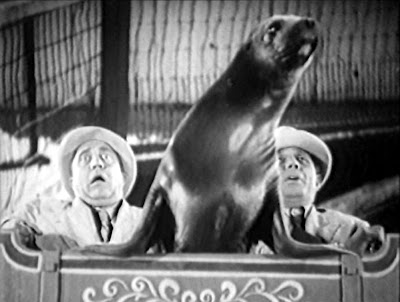
The reason the boarding house is closed, is that in its past, there was a murder, and the boarding house is supposed to be haunted. However, the fictional “Olsen” and “Johnson”, also get mixed up with some low level thugs. Who may be tied to that murder, or not. Then the show’s sponsor is murdered, and it’s up to “Olsen” and “Johnson” to find the killer. This chaotic screenplay all leads the duo to doing a radio program to reveal the murderer. The two are on “Joan’s” theater’s stage with a live audience. During the broadcast a shoot out with the killer takes place. As both “Olsen” and “Johnson” narrate for the radio audience, in the style of a movie-shoot out, and the killer is arrested.
Next, the boys are holding the prop gun used in the shoot-out, to demonstrate to the audience how it works. One of them fires the gun to show its not loaded and sound-effects are used for the sound of the gun going off. However, there is an immediate second shot heard, and one of the two reacts, by saying that the rehearsal is over!
Has the entire movie been nothing more than a play in rehearsal? That’s left to the audience in one version of the ending.
The motion picture was released at 63-minutes by “Republic Pictures”, but there are edited cuts that are lower and some showing higher run times. One company lists the film at 94-minutes. There has been confusion since 1949, with a British comedy, “All Over the Town”, that runs 83-minutes.
Next, “Ole” Olsen and “Chic” Johnson decided to write a Broadway musical and created one of the all-time comedy shows.
HELLIZAPOPPIN opened in the test marker of Boston, Massachusetts, at the Schubert Theatre, September 10, 1938
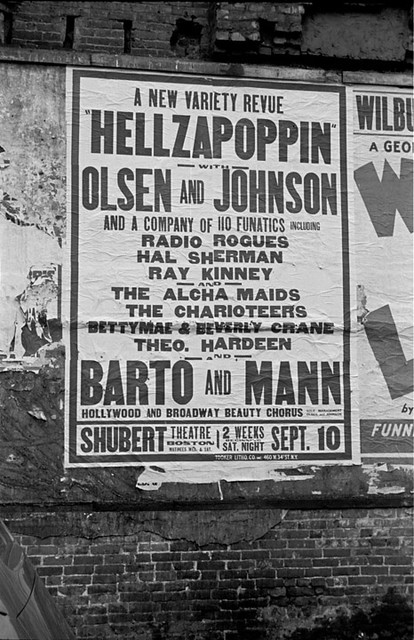
On the above ad for the musical, note the tag line:
AND A COMPANY OF 110 FUNATICS
“Hellzapoppin” was “Ole” and “Chic” completely turned loose.
The book, aka: the spoken script, character dialogue, and the dramatic structure (storyline), of even a musical, think “Rodgers and Hammerstein’s, 1943, “Oklahoma”, is what the theatrical director follows. However, when “The Book”, comes from Harold “Chic” Johnson, and John “Ole” Olsen. There is no actual storyline for the audience to follow. Some reviewers, at the time, used the word, “ANARCHIC”, to describe what is seen on stage, and within the walls of the theater. “Hellzapoppin” is simply, “Olsen and Johnson’s” “CONTROLLED CHAOS”.
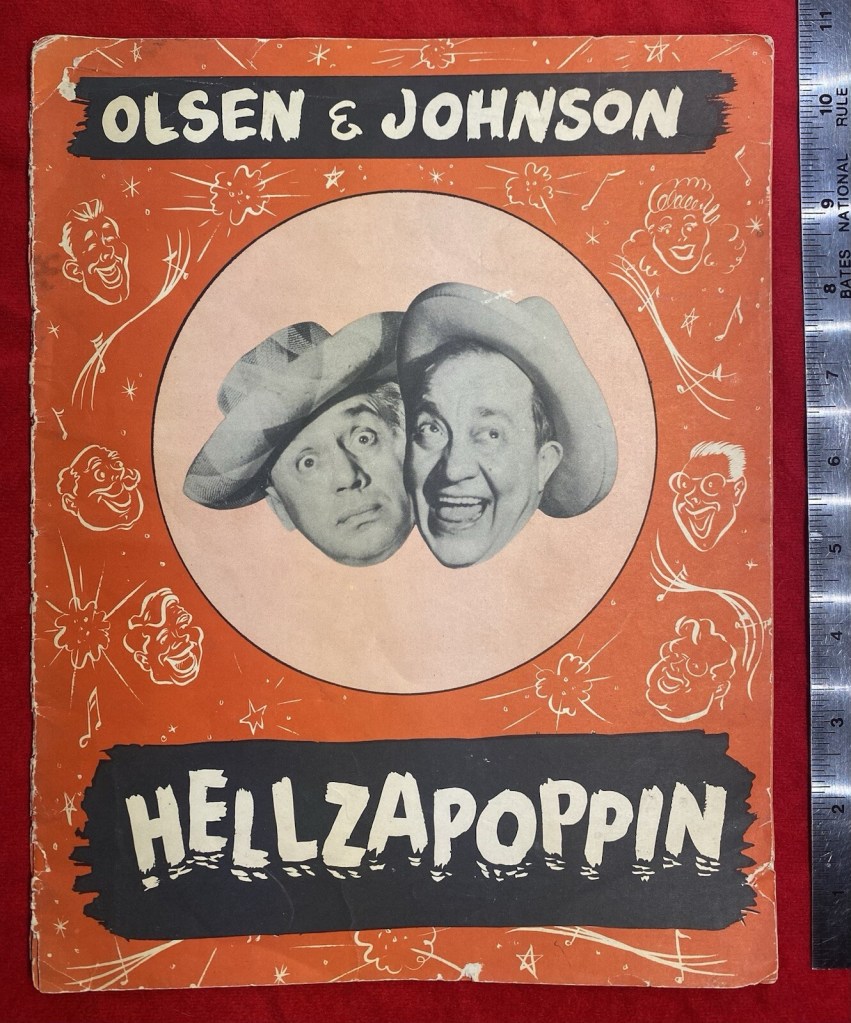
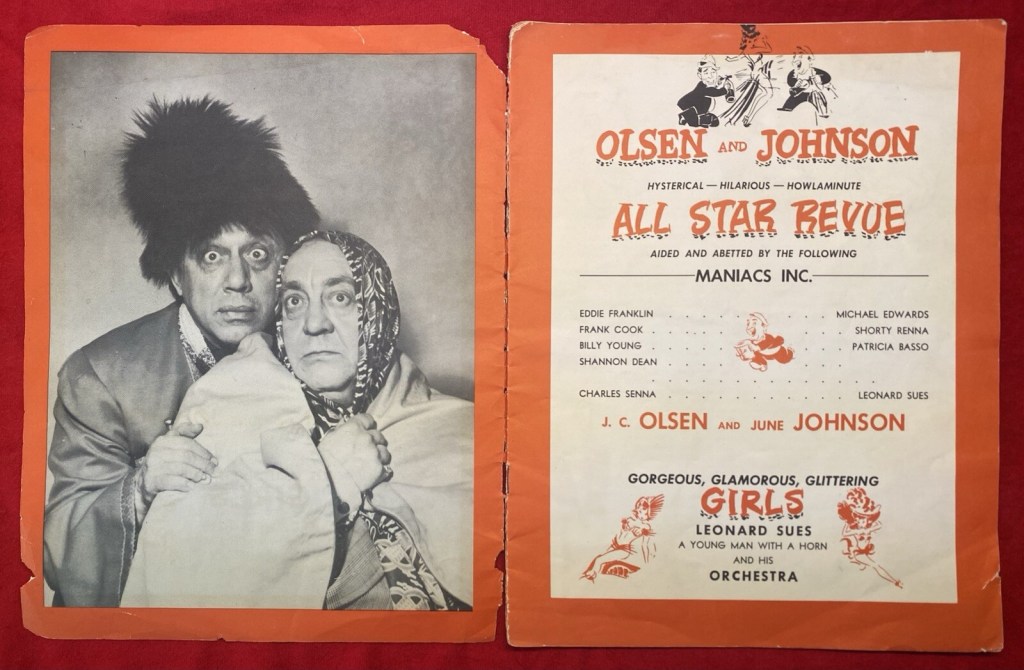
The music’s lyrics were written by two composters. Sammy Fain would be nominated 10-Times for the “Academy of Motion Picture Arts and Sciences, Best Song, Oscar”. In 1953, he won for “Secret Love”, from the Doris Day, Howard Keel, musical western, “Calamity Jane”. In 1955, for “Love is a Many Splendored Thing”, for the William Holden and Jennifer Jones, Korean War love story of the same name.
The other lyricist was Charles Tobias. A piece of music I am sure my reader, at same time in their life, is familiar with, is entitled “Merrily We Roll Along”. Which was written in 1935. WHAT YOU DON’T RECOGNIZE THE TITLE? Every time you watch a “Warner Brother’s, Looney Tunes Cartoon”, and hear the opening music, thank Charles Tobias.
Two other of his songs my reader may be familiar with, are Tobias’s English language translation of a German song for Nat King Cole, becoming, 1963’s, “Those Lazy-Hazy-Crazy Days of Summer”, and during the Second World War, for the Andrew SIster’s and Glenn Miller’s band, “Don’t Sit Under the Apple Tree (With Anyone Else, But Me)”.
The book was pushing the Vaudeville style sketched to its limits, even with racial stereotypes.
When the audience entered the main theater, over their heads was hanging dirty laundry. I mean DIRTY LAUNDRY! Some of the audience’s seats were wired wth buzzers, when set off, sent a very mild electric shock to the audience member.
“Hellzapoppin” starts with newsreel footage of Adolph Hitler, BUT instead of speaking German. He is dubbed into speaking with a YIDDISH (code, at the time for derogatory Jewish) ACCENT. Next, the audience sees Italy’s dictator Benito Mussolini speaking with a BLACKFACE MINSTREL SHOW ACCENT. Followed by United States President Franklin Delano Roosevelt speaking gibberish. WHEN, Olsen and Johnson seem to break through Roosevelt’s face, actually a transparent sheet in front of the screen the images are being projected onto.
That was only the opening, highlights of the show, have chorus girl’s leaving the stage to dance with audience members, or sit on men’s laps. In one gag, both “Chic” and “Ole” are shooting at a picture of a warship, and it finally sinks. Moments later, a man dressed as a Naval officer, soaking wet, walks on stage and the two shoot him dead. Why? Because the Captain always goes down with the ship. I another running gag, a matron walks up and down the rows of seats on all levels calling for “Oscar”, she was played by “Chic’s” wife, Katherine.
The very short, normal, run at the Boston, “Schubert Theatre”, ended. On September 22, 1938, “Hellzapoppin”, opened on Broadway at the “46th Street Theater (aka: “Chanin’s 46th Street Theatre”, and now “The Richard Rodger’s Theatre”), on November 26, 1938, “Hellzapoppin” moved again to the “Winter Garden Theatre”, then on November 25, 1941, the show moved to “The Majestic Theatre”, The continuous run of the Olsen and Johnson musical show, “HELLZAPOPPIN” finally closed on December 17, 1941, for a total of 1,404 continuous performances.
I’ve spoken to the original Broadway Production of “Hellzapoppin”, next directly came the motion picture.
HELLZAPOPPIN premiered in New York City, Christmas Day, December 25, 1941
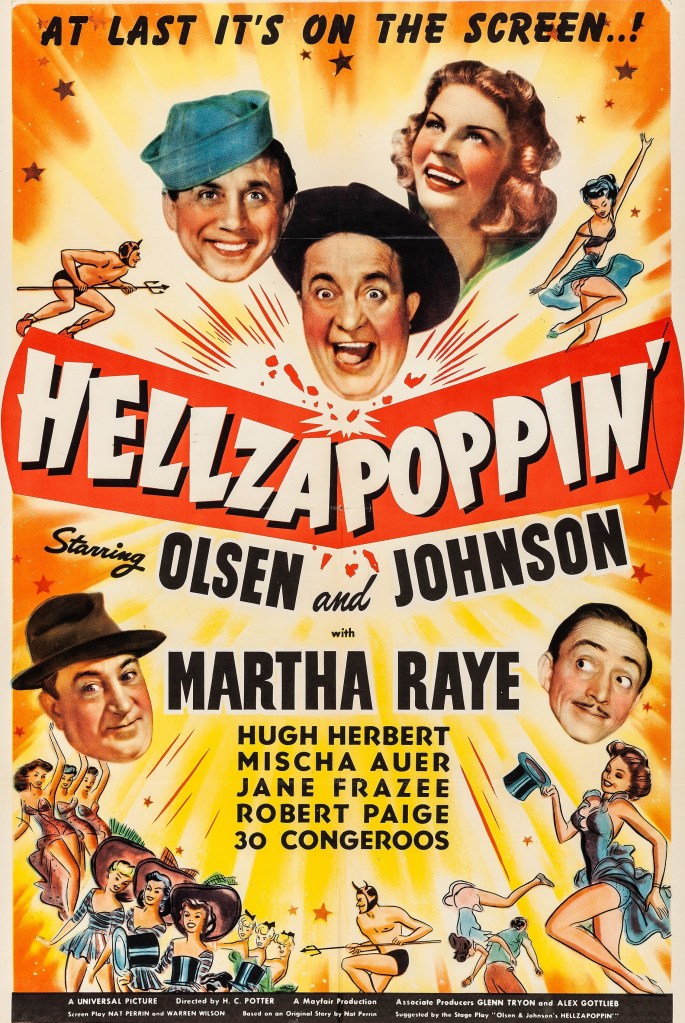
THERE IS NO WAY I CAN EVEN ATTEMPT TO COVER, THE ONE-HOUR-TWENTY-MINUTES-AND SEVENTEEN SECONDS, OF THIS CLASSIC OF VAUDEVILLE CHAOS, but here’s an overview.
This was a “Universal Picture”, but not the same studio that brought the audience all those black and white, classic, horror films, that the world still loves, but a studio still being advertised, at the end of 1941, as “The New Universal”. The founder of “Universal Picture’s”, in 1912, Carl Laemmle, and his son, known as “Junior” on the lot, were out. Their last true release, is considered to be director James Whale’s version, of the “Jerome Kern and Oscar Hammerstein II’s”, musical, “Show Boat”, in 1936.
The new owners, a corporation, were still in flux five years after “Show Boat”. This was over how to maintain the quality of the film’s, “The Old Universal”, maintained. Which, proudly put, on each movie poster, for each released motion picture, along with each film’s opening title card, three simple words, “Carl Laemmle presents”.
The studio had purchased the rights to the “Olsen and Johnson” Broadway hit, but “Ole” and “Chic”, were cut out of writing the screenplay. However, the opening credits would read that the motion picture was “Based upon Hellzapoppin” by Olsen and Johnson”.
Writing the motion picture screenplay was turned over to three writers.
Nat Perrin, created the original, new, storyline. Perrin had just been one of the three writers on the “Abbott and Costello” comedy, 1941’s, “Keep ‘Em Flying”. “Bud” and “Lou” were the #1 comic duo on the lot. Perrin, would followed this picture, with “Abbott and Costello’s”, 1942, “Pardon My Sarong”.
Warren Wilson had just worked on the 1941, slapstick movie, “Tanks a Million”, and followed this movie with a comedy, based upon a popular, Sunday newspaper comic strip, entitled, “Blondie Goes to College”, that would be released in 1942.
Alex Gottlieb had worked on the war thriller, 1941’s, “Mystery Ship”, and followed this feature film with the low-budget, horror entry, 1942’s, “The Strange Case of Dr. Rx”, starring Lionel Atwill.
H. C. Potter was assigned to direct the motion picture. Potter had started directing with 1936’s, “Beloved Enemy”, starring Merle Oberon and Brian Aherne. Just before this feature film, he directed the musical comedy, 1940’s, “Second Chorus”, starring Fred Astaire and Paulette Goddard. He followed this feature film with the romantic comedy, 1943, “Mr. Lucky”, starring Cary Grant and Laraine Day. H. C. Potter’s credits up to this film, were mostly, “A” List features.
However, the “New Universal Pictures” executives, thought some of Potter’s scenes were too confusing for the picture’s audience. So, they brought in, director Edward “Eddie” F. Cline, who would receive no on-screen credit for his work on the motion picture. Cline was known for directing silent and sound comedies starring comedians Buster Keaton, “Fatty” Arbuckle, W. C. Fields, and Charlie Chaplin.
Here are two related examples of the changes to the already shot scenes made by Eddie Cline to H. C. Potter’s work. Throughout the film, like in their original stage production, “Ole” and “Chic”, would break the fourth wall of the theatre. In this instance, the two were speaking to an unseen movie theater projectionist, and not the seated Broadway audience of their stage production.
However, the studio executive’s considered this classic vaudeville routine, as causing confusion to their paid ticket audience, viewing the motion picture. So, Eddie Cline was given instructions to remove the confusion in H. C. Potter’s scenes of the duo breaking the fourth wall.
I can only guess that Cline thought the studio executives had no clue about the vaudeville routine “Ole” and “Chic” were using. So, he made two changes, first, the duo was no longer breaking the fourth wall to speak to an unseen projectionist. They were now speaking directly to the paid studio audience. Which seemed to pass inspection.

Next, seemingly again playing games with his orders from the “New Universal Pictures” executives. Director, Eddie Cline made a change to the entire screenplay, and with writer Alex Gottlieb. The two created, and added the projectionist, “Louie”, portrayed by Shemp Howard, to the screenplay, opening up some more vaudeville gags. My article is “SHEMP HOWARD: The 2nd and 5th Stooge of THREE”, at:
https://www.bewaretheblog.com/2025/08/shemp-howard-2nd-and-5th-stooge-of-three.html

Even though the names of “Olsen and Johnson”, were in first position on the above poster for the movie.To the studio executives, and the movie viewing audience. It was the third name under the film’s title, that was the big money making draw. That name belonged to comedian Martha Raye, portraying “Betty Johnson”. Raye was known both by her energetic comedian nickname, “Big Mouth”, and as the female “Bob Hope”. She first appeared on-screen in Bing Crosby’s, 1936, musical, “Rhythm of the Range”, and was just seen portraying twins, and co-starring, in “Abbott and Costello’s”, 1941, “Keep ‘Em Flying”. Raye followed this feature film, by co-starring with Kay Francis and Carole Landis, in 1944’s, “Four Jills in a Jeep”.
Originally, part of the sale of the rights to the Broadway play was to bring the entire main cast into the filmed production. The studio executives changed that, and only “Olsen and Johnson” were kept. However, instead of “Chic Johnson’s wife”, Katherine Johnson, looking for someone named “Oscar”, up and down, the theatre’s audience. The screenplay created Martha Raye’s, “Betty Johnson”, “Chic Olson’s” fictional sister. Which allowed the “Big Mouth” comedian to be heavily involved in physical slapstick, enduring comedic gags, like being blown up with dynamite, thrown on a conveyor belt, and hurled through the air by the Frankenstein monster.
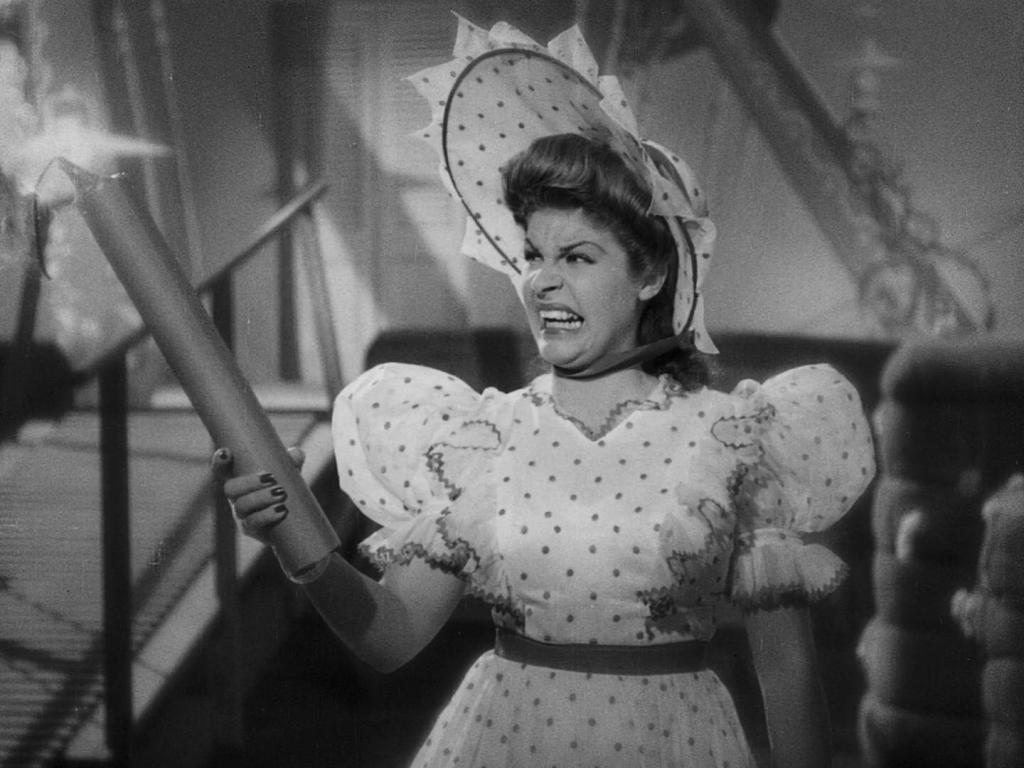
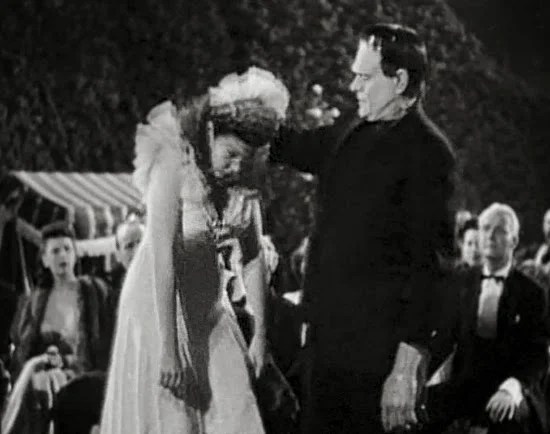
Above, Martha Raye in the hands of stunt man, Dale Van Sickel. As another character in the film, Van Sickel, is a man who is thrown into a swimming pool. Below, the stunt man unmasked.
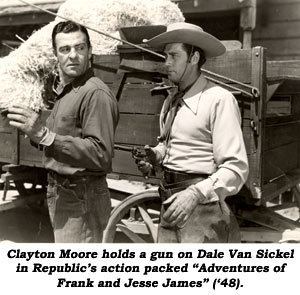
Robert Paige portrayed “Jeff Hunter”, the producer and composer of the never named musical play, that is being rehearsed throughout the movie. In two-years, Paige would be seen as “Frank Stanley”, in the “Son of Dracula”. In 1953, Robert Paige was a scientist in “Abbott and Costello Go to Mars”, even though it was Venus their space ship went too. However, Robert Paige was also, one of the cast in the outstanding, overlooked and forgotten, 1953, “Split Second”. Which is about a group of people being held captive by gangsters in a house about to be blown away in a Atomic Bomb Test.
Jane Frazee portrayed “Kitty Rand”, the wealthy female lead of “Jeff’s” musical. Who, of course, he is in love with, and won’t agree to marry until he’s a success.
Singer Frazee was in several “B”, “Universal Musicals”, opposite Robert Paige. She came to the studio’s executives attention, with her role in 1941’s, “Buck Privates”, starring Bud Abbott, Lou Costello, and the “Andrew Sisters”.
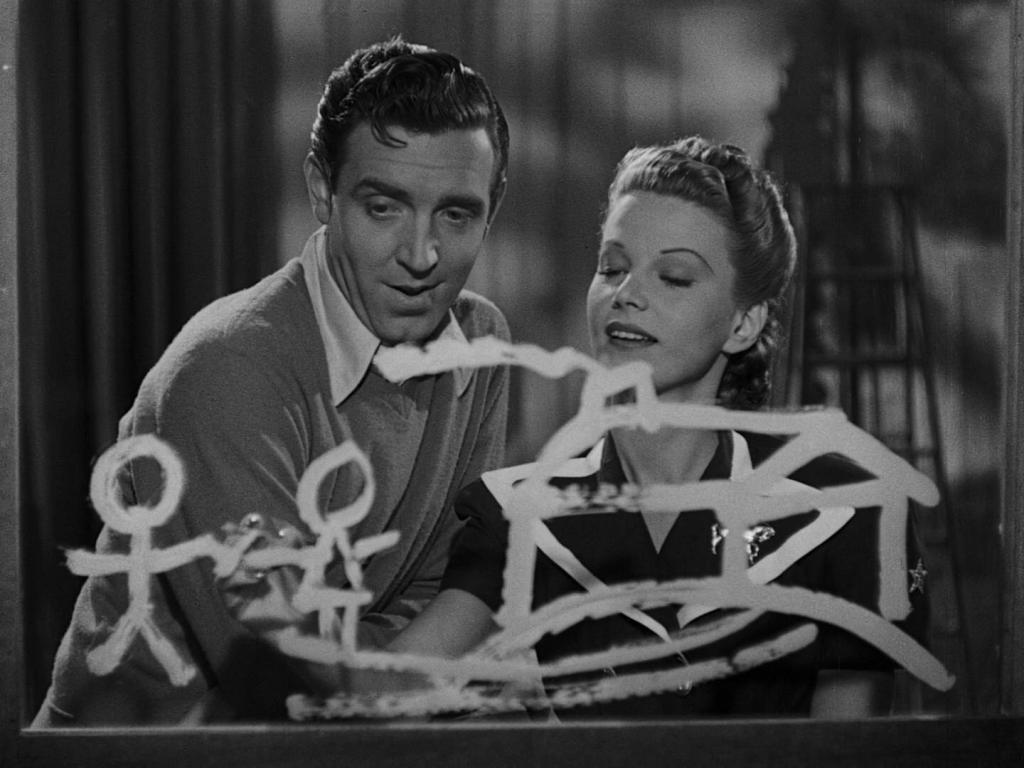
Lewis Howard portrayed “Kitty’s” parent’s, approved fiancé, “Woody Taylor”. Howard was a “B” actor, signed in 1939 by “Universal Pictures”. He left the studio for the army during the Second World War, 1942-1946. Howard appeared in only 20-low-budget motion pictures, before his death on September 29, 1951.
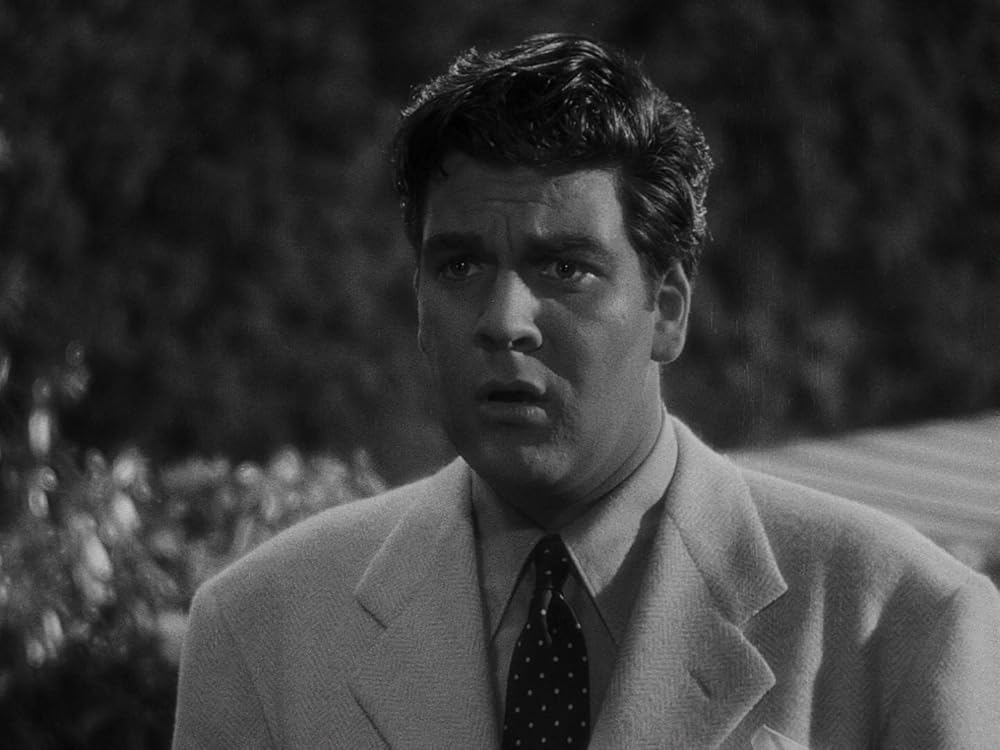
I’m not going into detail on the love story, but it is played almost completely straight with “Jeff Hunter” trying to keep the production on track and win “Kitty”. Faced with the problem that “Woody” is his best friend. Which, of course, makes the love story, an on going target, for all that comes, in and out, from the “Chaos”, that is “Hellzapoppin”.
While, man hungry, “Betty Johnson”, is pursuing one time Russian Nobleman, “Pepi”, portrayed by Mischa Auer. Who is the male lead opposite, Jane Frazee’s, “Kitty Rand”, in the musical being produced and directed by “Jeff Hunter”. Auer had just been in one of Jane Frazee’s non-Robert Paige movies, 1941’s, “Moonlight in Hawaii”. He followed this feature, with a second, non-Paige, Frazee movie, 1942’s, “Don’t Get Personal”.
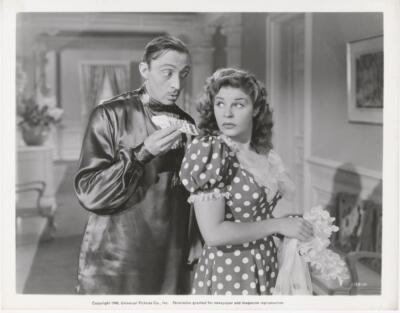
The Story., if There is a Story:
It is hard to explain this motion picture, even compared to the others with “Olsen and Johnson” I’ve mentioned.
The comic skits are all tied around “Ole” and “Chic”. The movie opens with projectionist, Shemp Howard, showing a pageant of chorus girls coming down a staircase. The staircase suddenly collapses into a slide, and the chorus girls slide into hell and meet comic demons.
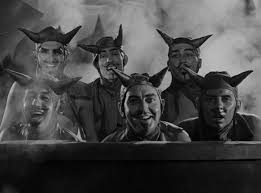
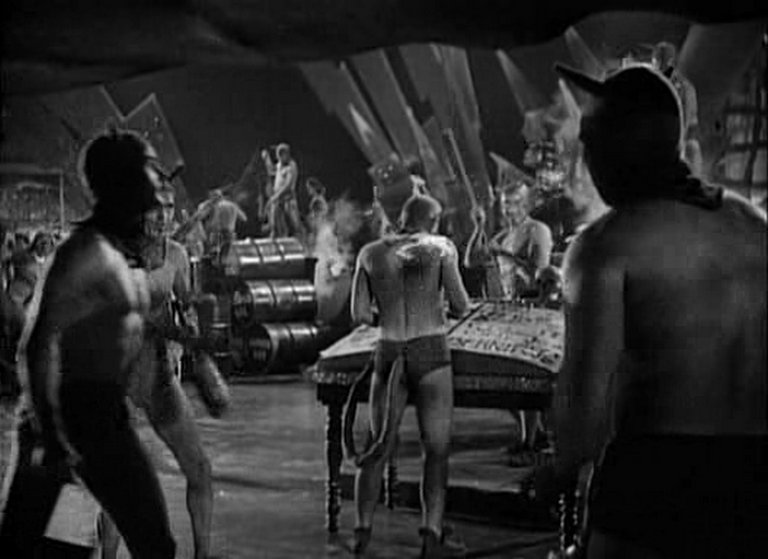

Next, the picture cuts to “Ole” and “Chic”, arriving in hell by a taxi cab in the midst of the chorus girl sequence.
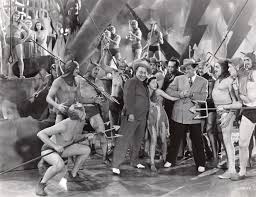
Which is followed by a series of vaudeville style pranks, and then, the audience discovers, this is all part of shooting a movie on a sound stage.
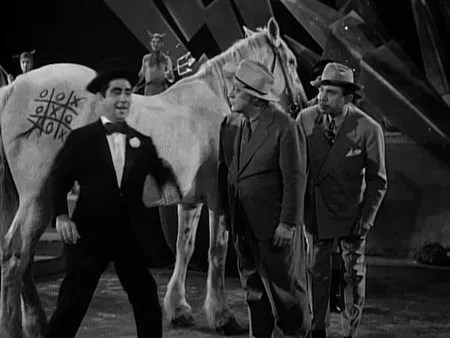
“Ole” and “Chic” are now hounded by the film’s “Director”, portrayed by Richard Lane. Who as announcer, “Dick Lane”, did the wrestling and boxing matches on Los Angeles television’s, “KTLA-TV”, from the “Olympic Auditorium”, and also the “Roller Derby”, from 1946 through 1972.


Enter the writer of the motion picture being filmed, and directed, by Richard Lane, “Mousy screenplay writer, Harry Selby”, portrayed by Elisha Cook, Jr. Who had just been seen in two classic 1941 crime movies, “The Maltese Falcon”, and, “I Wake Up Screaming”. My article is “Elisha Cook, Jr: Film-Noir’s, Westerns, Horror, Science Fiction, and a Judy Garland Musical” at:
https://www.bewaretheblog.com/2025/05/elisha-cook-jr-film-noirs-westerns.html

“Selby” now, starts to explain his screenplay, as the motion picture now morphs into what is supposed to be his musical comedy.
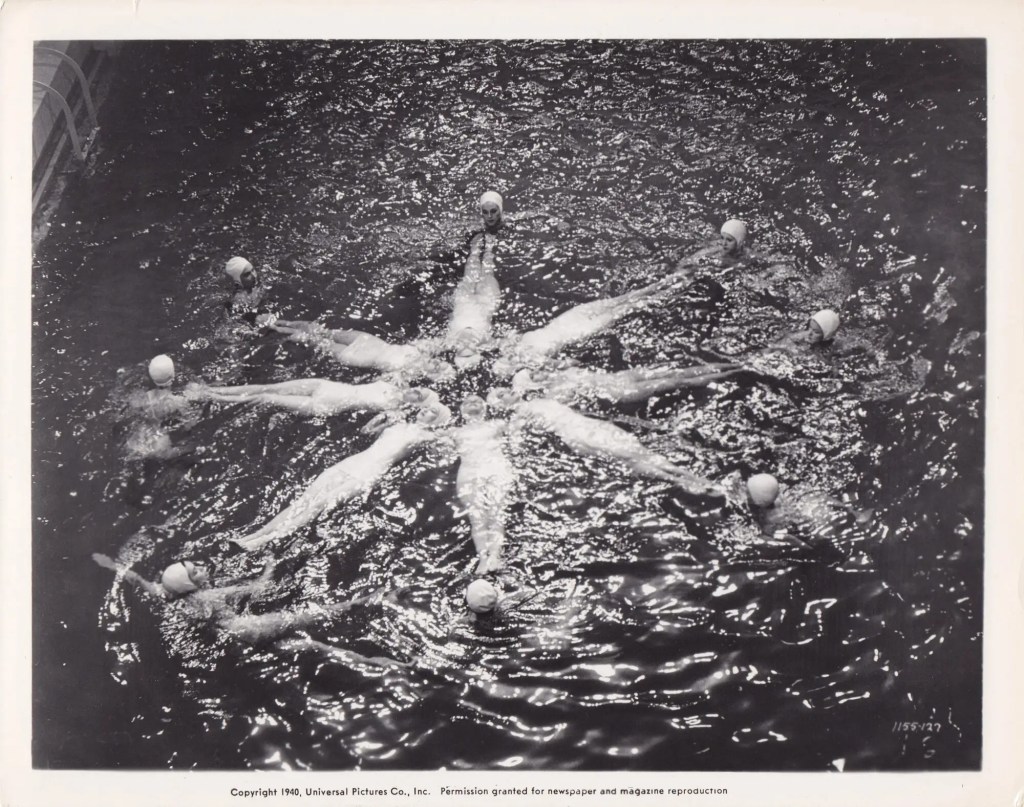
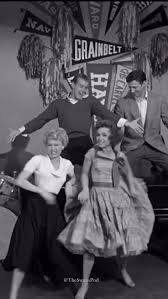
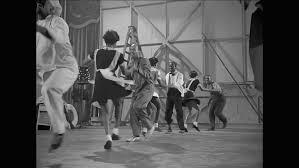
Moving to the end of “Hellzapoppin”, Olsen and Johnson leave the sound stage. After which, the audience finds the director frustrated by what “Harry Selby” has written. The director pulls out a gun, and Elisha Cook, Jr., now finds his Film-Noir crime roles, have become the butt of a vaudeville sight joke. After the director shoots Cook, Jr. multiple times, the director seems not to not have killed him.
To which the character of “Selby” replies:
I always wear a bulletproof vest around the studio.
Followed by, “Harry Selby” taking a drink of water and – – –

THE END!
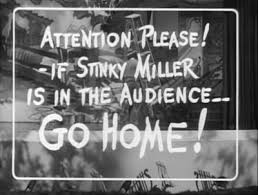
If you love movies and are a movie buff, this slapstick, musical attack, on the motion picture industry is a must see.
As of this writing, the following link takes my reader to the “Internet Archive”, and 1941’s, “HELLZAPOPPIN”:
https://archive.org/details/hellzapoppin-1941-
After filming on “Hellzapoppin” was completed on November 3, 1941, it was back to Broadway for “Ole” and “Chic”.
On December 1, 1941, at the “Winter Garden Theatre”, “Sons of Fun”, a vaudeville review, opened, starring “Olsen and Johnson”. It would run for 742-performances, and close on August 29, 1943.
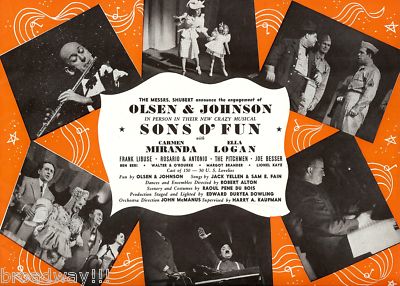
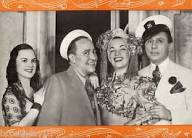
Above left to right, Ella Logan, Chic Johnson, Carmen Miranda, and Ole Olsen. Below left to right is Ole Olson, Carmen Miranda, and Chic Johnson
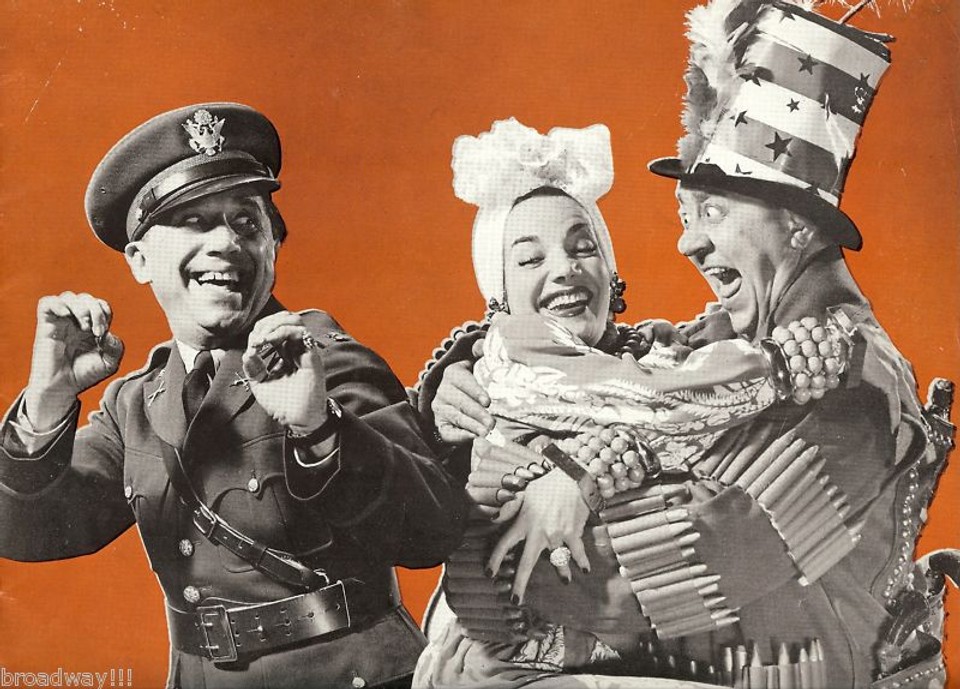
Above left to right, Ole, Carmen, and Chic
The popularity of the Broadway production of “Hellzapoppin” carried on in 1942, in a “Winter Garden” production. That starred comedian’s Jay C. Flippen and Francis J. “Happy” Felton in the “Olsen and Johnson” roles.
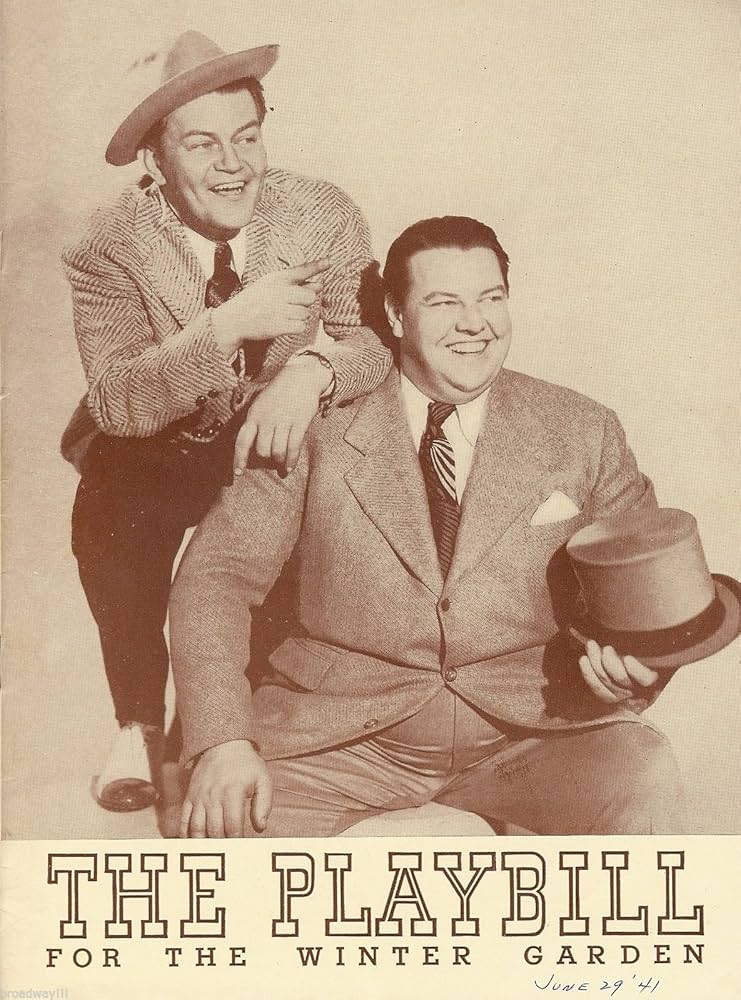
On June 14, 1943, filming began on:
CRAZY HOUSE released on October 8, 1943
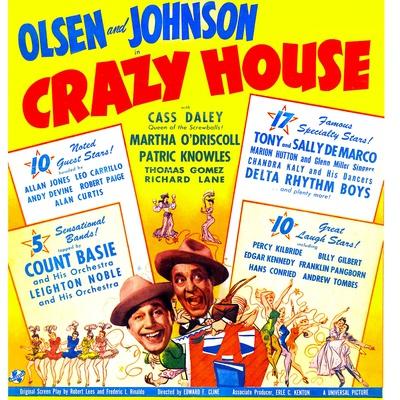
The screenplay was by two writers, Robert Lees and Fredric I. Rinaldo. Both writers had started out in 1935, co-writing the same 25-short subjects for “Universal Pictures”. They both followed by turning Curt Siodmak’s, 1940 story, into a screenplay for the comedy, “The Invisible Woman”. Next, Lees and Rinaldo were made a team, and among their films, were the following for the comedy duo of “Abbott and Costello”, 1941’s, “Hold That Ghost”, 1947’s, “Buck Privates Come Home”, 1947’s, “The Wistful Widow of Wagon Gap”, 1949’s, “Abbott and Costello Meet Frankenstein”, and 1951’s, “Bud Abbott and Lou Costello Meet the Invisible Man”.
However, both “Ole” and “Chic” found themselves, reduced to writing, UNCREDITED dialogue for their motion picture.
While “Crazy House” was the next motion picture for “Olsen and Johnson”. It wasn’t for the now, fully credited, director, Edward “Eddie” F. Cline. He had just filmed comedian, Joan Davis’s, 1943, “He’s My Guy”, and would follow this production with the Andrew Sisters, musical comedy, 1943, “Swingtime Johnny”.
The idea for “Crazy House”, almost sounds like a sequel to “Hellzapoppin”, mixed with actual events.
The set up:
In the screenplay, “Olsen and Johnson”, portray “Olsen and Johnson”. Who made a comedy motion picture for “Universal Pictures”, followed by a very successful Broadway musical. The two are now returning to “Universal Pictures”, to get them to make another motion picture.
Overview of the Screenplay:
The movie opens with “Ole” and “Chic” staging an elaborate parade that moves from “Hollywood” to North Hollywood and “Universal Pictures. The parade’s purpose is to announce their return to movies.
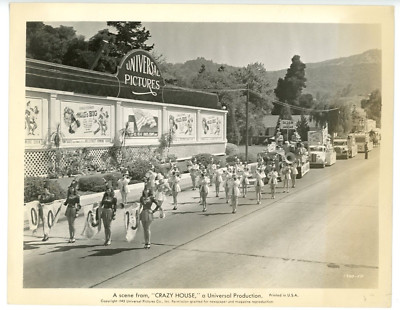
The studio executives and everyone else on the lot, are terrified that the two are coming. The studio hasn’t recovered from the chaos and destruction of the movie sets and props. That “Ole” and “Chic” destroyed on their previous, unnamed, motion picture. At the studio’s gate, armed security guards even shoot at the two to scare them away.
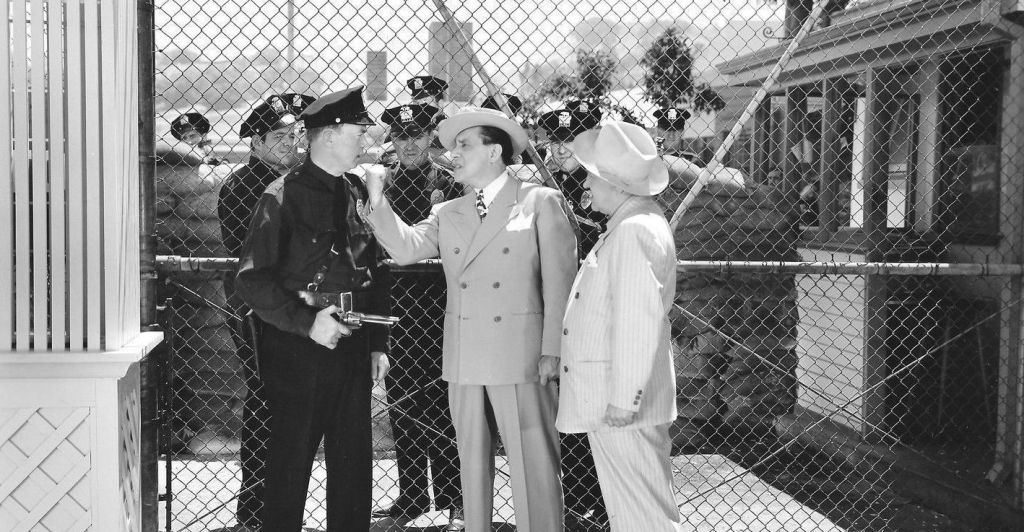
Inside, one of the first cameo’s take place, as “B” Cowboy star, Johnny Mack Brown and Andy Devine, are riding horses to warn the panic stricken studio staff and actors that “Olsen and Johnson” are coming.
To get into the studio, the two load themselves into canons and are shot onto the studio grounds. As even more commotion is caused by the duo. Dressed as “Sherlock Holmes” and “Dr. Watson”, Basil Rathbone and Nigel Bruce discuss the disruption around them:
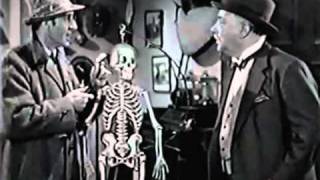
| Watson: | I say, Holmes! There’s a lot of excitement in the studio. Everybody’s running for the air raid shelters. Do you know what’s happening? |
| Holmes: | Olsen and Johnson have arrived. |
| Watson: | Huh? How do you know? |
| Holmes: | I’m Sherlock Holmes. I know everything. |
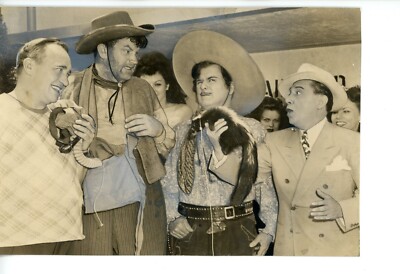
Above left to right, “Chic” Johnson, Andy Devine, Leo Carrillo, and “Ole” Olsen. Other cameo’s include singer Alan Jones of 1936’s “Show Boat”, Robert Paige, Evelyn Ankers of 1941’s, “The Wolf Man”, Louise Allbritton of 1943’s, “Son of Dracula”, Turhan Bey of 1942’s, “The MummyTomb”, Gale Sondergaard of 1943’s,”Sherlock Holmes and the Spider Woman”.
The two are next seen entering the office of the head of the studio, and asking his secretary to tell the studio head that:
“Universal’s most sensational comedy team is outside!”
On hearing those exact words, the head of “Universal Pictures”, immediately replies:
“Oh, ABBOTT AND COSTELLO. Send them right in!”
A sad prediction of the future of the vaudeville team in the changing comedy world.
The studio head refuses to help the comic duo make a motion picture and they now looksfor outside help. They find it in millionaire, “Colonel Cornelius Merriweather”, portrayed by Percy Kilbride. Of course, “Colonel Merriweather” is a penniless kook, who believes he rich.
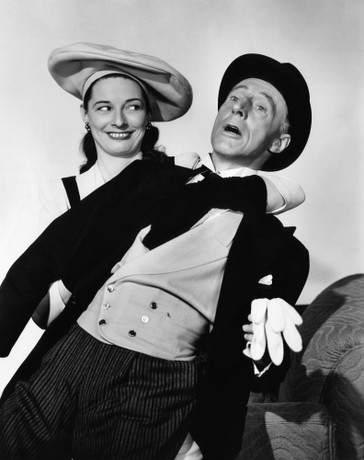
Above, Percy Kilbride with comedian and singer, Cass Daley, portraying both herself, and her fictional cousin, “Sadie Silverfish”. Whom “Ole” and “Chic” hire, thinking she’s Cass.
Below is Hans Conried, as “Rocco”, the movie set designer for the “Olsen” and “Johnson” picture. Conreid, had just been seen in 1943’s, “A Lady Takes A Chance”, starring Jean Arthur and second billed, John Wayne.
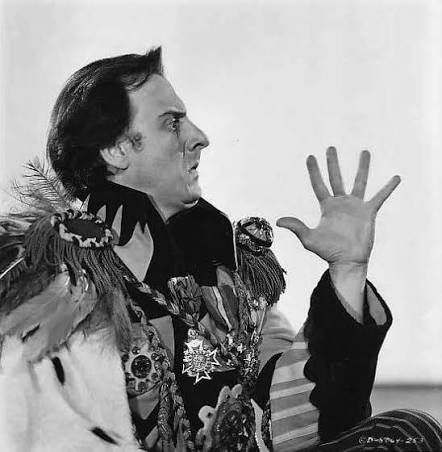
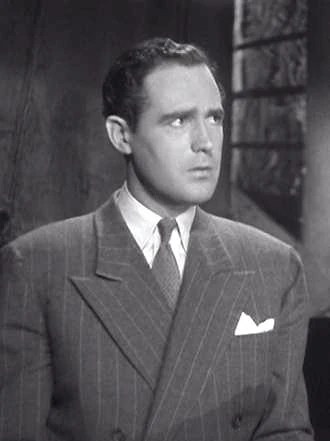
To direct their film, they get a former “Assistant Director” of theirs, “Edward ‘Mac’ MacLean”, portrayed by Patric Knowles. By this time, Knowles had portrayed “Will Scarlet”, in 1939’s, “Adventures of Robin Hood”, “Frank Andrews” in 1941’s, “The Wolf Man”, and “Dr. Frank Manning”, in 1943’s, “Frankenstein Meets the Wolf Man”.
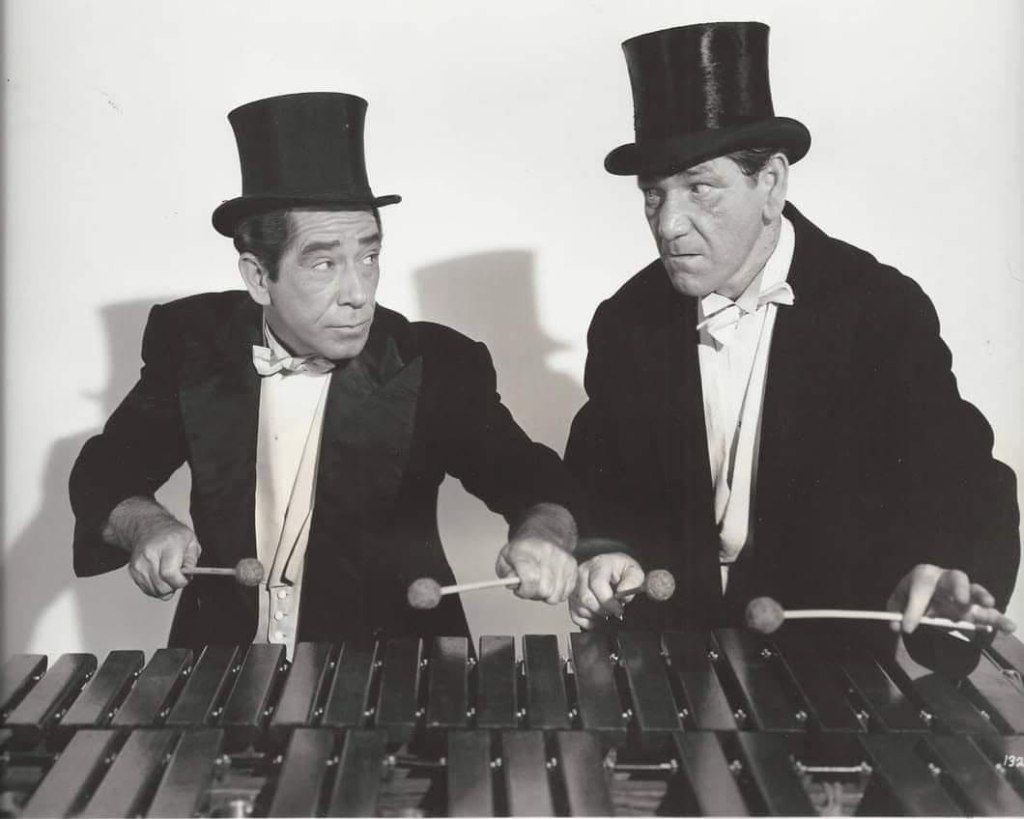
Playing “Ole” and “Chic’s” two stooges, aka: lackey’s, are Shemp Howard as “Mumbo” and vaudeville comedian Fred Sanborn as “Jumbo”. They played a similar team in 1941’s, “Hellzapoppin”.
After filming is finally completed and the film edited , “Ole and “Chic’s” creditors are demanding their overdue payments. “Olsen and Johnson” now find themselves in front of a “Judge”, portrayed by Edgar Kennedy. Whom they are driving nuts, and to get them out of his court. Rules to permit the duo to put their finished film up for bidding at the upcoming “Motion Picture Industry’s” annual screening of independently made features for purchase. Selling their picture, should cover “Ole” and “Chic’s” debts, and maybe even give the duo a small profit.
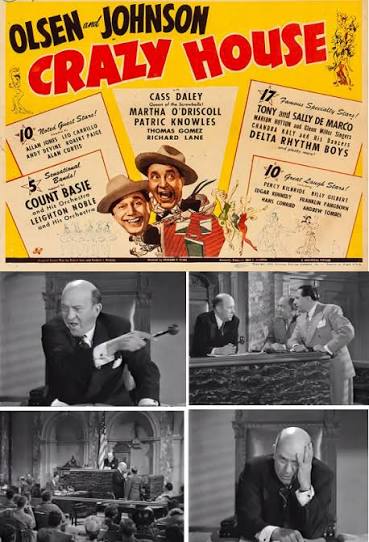
In the end, the movie is sold, and everything ends well.
HOWEVER:
“Olsen and Johnson’s” vaudeville comedy was becoming stale with the Second World War audiences, but the musical numbers “Olsen and Johnson” had in the movie were outstanding.
However, the film received mix reviews with the film critics, and not the box office profit size, that the “Universal Pictures” executives had envisioned.
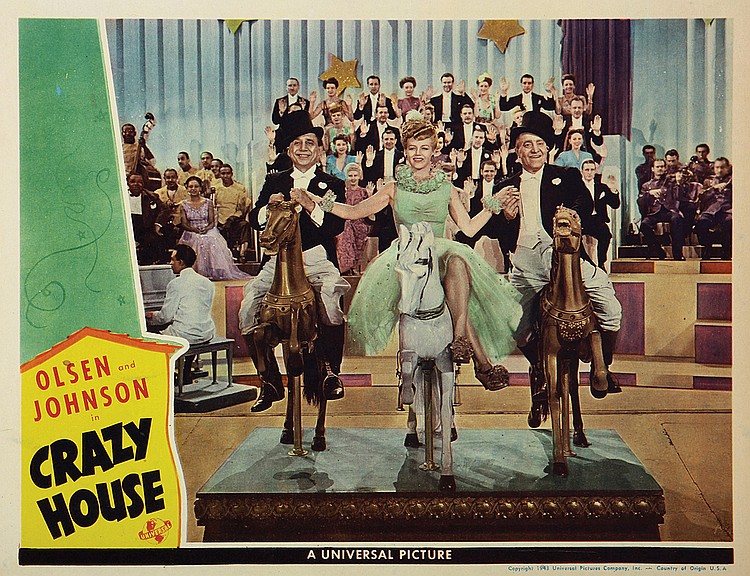
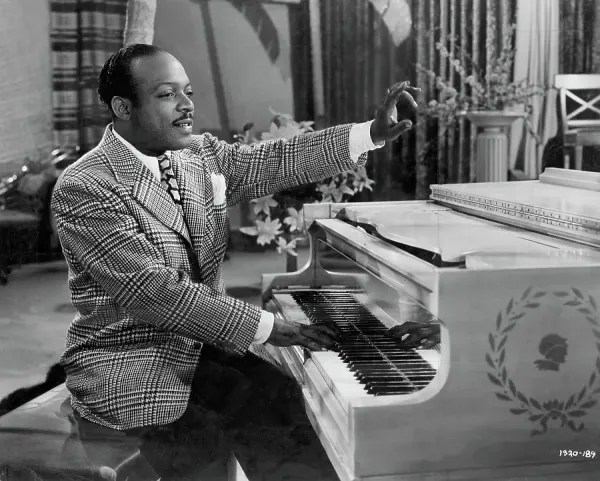
Above in this one still from the 1943 motion picture, are Count Basie and His Jazz Orchestra, dancers Sally and Tony De Marco, singer Marion Hutton, and the group “The Modernizes, the last two from the Glenn Miller Orchestra. Along with singer, dancer, and choreographer Paula Kelly, singer and actress Martha O’Driscoll, and of course, “Ole” Olsen and “Chic” Johnson. Below is Count Basie in the picture.
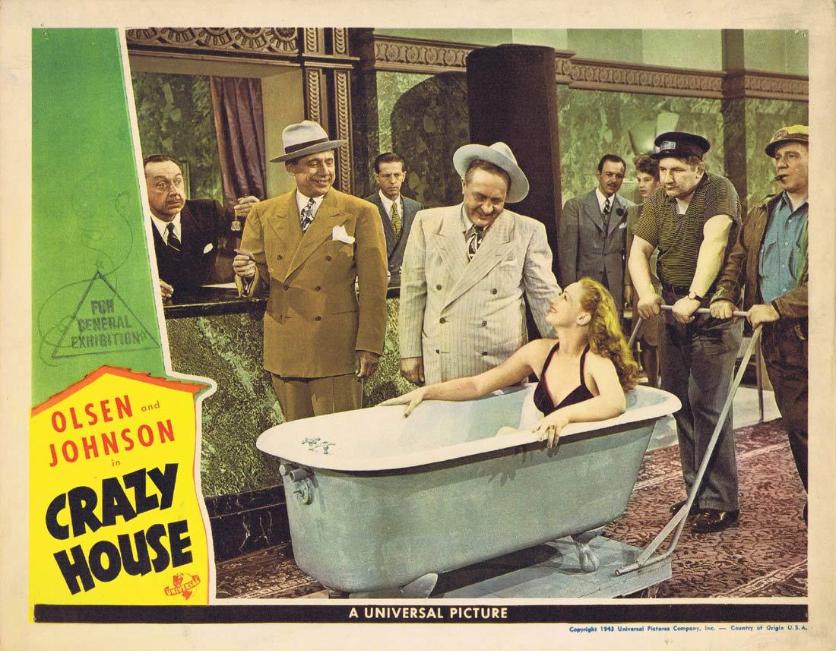
Speaking about Martha O’Driscoll, here’s one way to arrive at your hotel. Pushing Martha’s bathtub is Mack Sennett and Hal Roach, comic, Franklin Pangborn.
The following link, at the time of this writing, from the “Internet Achieve” will take my reader to “Olsen and Johson’s Crazy House”:
https://archive.org/details/CrazyHouse1943
The executives at the studio decided to reduce the funding for the two remaining motion pictures on their contract with “Olsen and Johnson”. The next motion picture made with the two stars was “GHOST CATCHERS”, that premiered in New York City on May 30, 1944.
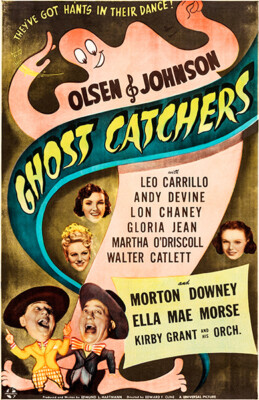
This was a troubled film from the start, Diana Barrymore, the actress daughter of John Barrymore, was under contract and was assigned the role of the older daughter, “Susanna Marshall”. According to actress, Gloria Jean, mentioned in Jan and Scott MacGillivary’s “Gloria Jean: A Little Bit of Heaven”, who portrayed the younger daughter, “Melinda Marshall”.
“Diana Barrymore was supposed to do Ghost Catchers but she didn’t like the idea of working with Olsen & Johnson. So they replaced her with Martha O’Driscoll.”
The story has the youngest “Marshall” daughter, “Melinda”, about to have her singing debut at New York’s, “Carnegie Hall”. Her out of state family, rent an old house to live in until after her performance.
However, the family starts hearing strange noises, and seeing visions. Their oldest daughter, “Susana”, runs next door for help, but it’s actually a nightclub that, “Ole” and “Chic” perform their original vaudeville acts, with gun shots, airborne props, and trap doors.
What happens next is a murder, a gang attempting to scare the “Marshall” family out of the house, and a real ghost, “Wilbur Duffington”, portrayed by Jack Norton. Who will help the “Marshall’s” and “Ole” and “Chic”.
We don’t know the original running time. However, by all accounts, after filming was finished, they mention that the running time was “DRASTICALLY REDUCED” to 68-minutes. So, that “Universal” could move “Ghost Catchers” to either the top, or botton of a double bill, depending upon the area of the United States it played in.
“Abbott” and “Costello” had been off-screen for a year-and-a-half, due to Lou having rheumatic fever. It was at this time that a sneak preview of “Ghost Catchers” took place. The theater were the preview was to take place was packed to overflowing, but with the rumors mills working. The audience expected it to be an “Abbott and Costello” new movie. When the opening title card came on and the names of “Ole Olsen” and “Chic Johnson” were shown. According to the MacGillivary’s biography of Gloria Jean, half the audience, got up and walked out!
According to a review in the Hollywood trade paper “Variety”, May 31, 1944:
In the best Olsen & Johnson tradition, Ghost Catchers is a tuneful, screwy concoction, brief and zippy. Grooved for the top rung on duals [meaning the main attraction on double-feature programs], it is money in the bank.
On August 16, 1944, premiering in New York City, was the new “Abbott and Costello” feature film, “In Society”.
The final “Olsen and Johnson” motion picture for “Universal Pictures” and the LAST THE TWO EVER MADE, was “SEE MY LAWYER”, released on March 9, 1945.
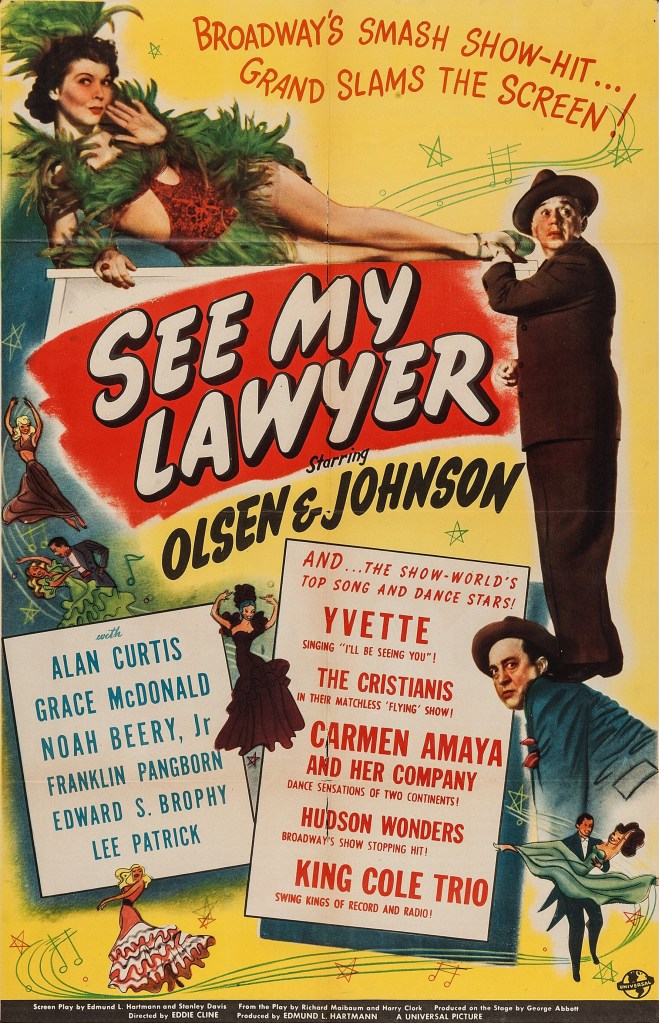
As I said this was the final “Olsen and Johnson” motion picture. I direct my reader not to their names, but the list of performers on the lower right side. I would add that the bulk of the 67-minutes were old vaudeville acts, not necessary by the two stars, and even contained an edited out Ritz Brothers performance from their 1943 movie, “Never A Dull Moment”. Many reviews were glad to see that “Ole” and “Chic” did not dominate the film and the many other performers in the feature film.
The basic story has the duo attempting to get out of their contract with a nightclub owner. They decide to start insulting the audiences hopefully to get the owner to fire them. However, this all leads to law suits and counter lawsuits.
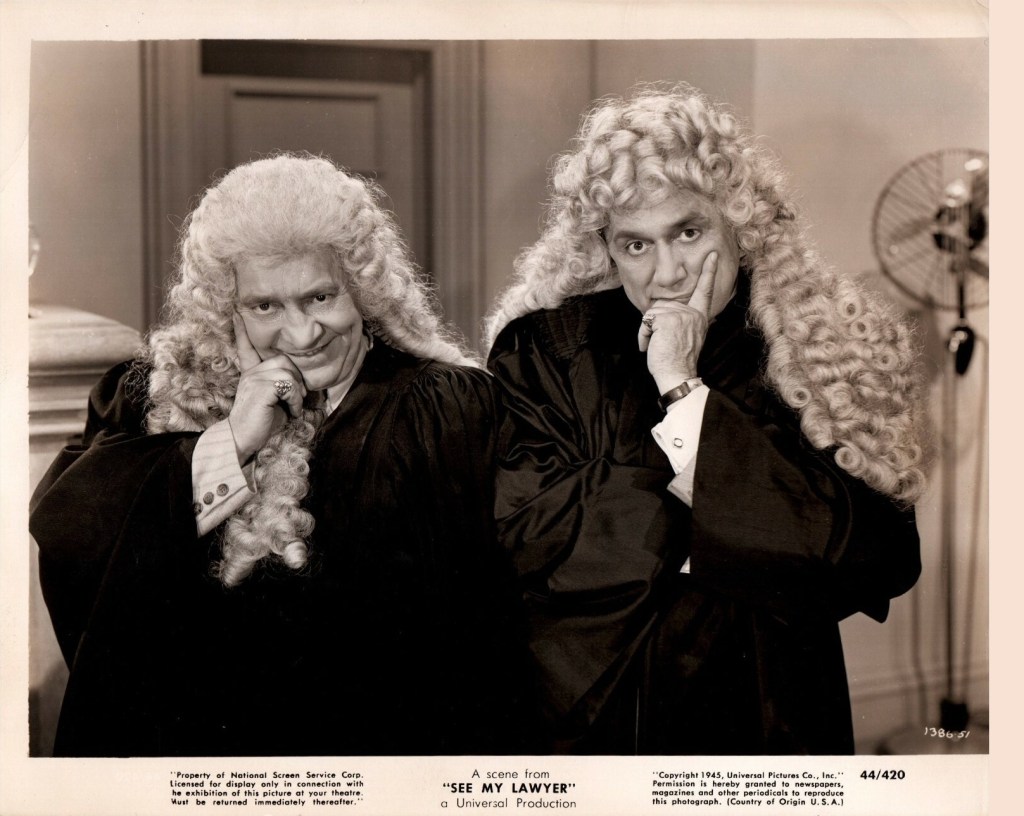
The “Independent Film Bulletin” for July 9, 1945, contained this nice review:
As always, the middle-aged comics fall back on the corniest gags — mud or custard pies thrown in the face, seltzer water squirted on indignant folk, dresses ripped off lovely girls, and plenty of screaming and shooting of cap pistols — a brand of humor which many patrons abhor but plenty of others delight in. The film starts out with a semblance of plot, based on the well-known stage play, but this is later forgotten for long stretches… Laughter was plentiful in a New York naborhood [sic] house where this was billed above the main feature, Guest in the House.
However, writer Sara Hamilton, in “Photoplay”, May, 1945, had a different view:
It was a long, dry spell between laughs, believe us. Too bad, too, because no one can be funnier than Ole Olsen and Chic Johnson with the right material. Another like this and they’ll see mylawyer.
Their movie career was over, but from December 23, 1944 through July 14, 1945, “Olsen and Johnson”, starred on Broadway at the “Winter Garden” in “Laffing Room Only”, a condensed version of “Hellzapoppin”.
In 1947, the duo appeased as themselves in the 8-minute short, “Johnny at the Fair”. The only information I can find, is the short was narrated by Lorne Green, and a Charlie Pachter, portrayed “Johnny”. Who meets different people while walking around a fair.
The “National Broadcast Company (NBC)” hired “Ole” and “Chic” to host a program titled promote, “Buick Cars”, entitled “Fireball Fun for All”. The comedy/variety show was summer replacement for the “Texaco Star Theater”. It ran from June 28, 1949 through October 27, 1949/
Mention the names of William Alexander “Budd” Abbott, or the name of Louis Francis Cristillo aka: Lou Costello, today, and many people can tell you the title of one of their motion pictures.
The same could be said for either the Marx Brothers, or the ever changing Three Stooges. In fact you can find all three groups movies on television and there are fan pages on the internet.
Ask anyone you meet, who is “Olsen and Johnson”? Don’t get upset, because that person has no idea whom you speaking about.
Harold Ogden “Chic” Johnson, died on February 26, 1962.
John Sigvard “Ole” Olsen, died on January 26, 1963.
Unlike the others, they have moved not into comic history, but comic obscurity.


Leave a comment