Ever think of FBI Director, John Edgar Hoover as the UNCREDITED and INVISIBLE Co-Screenplay Writer for 7-motion picture‘s, or as a CREDITED Actor in 2–motion pictures, and one by stock footage.
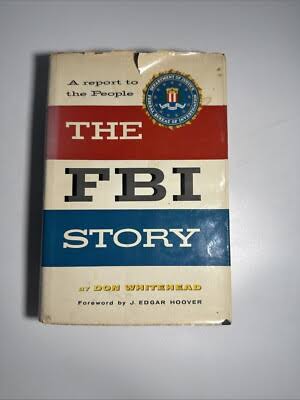
I start with a look at a popular 1950’s, nonfiction book, about the “Federal Bureau of Investigation”, and a motion picture made from it. Over which, “J. Edgar”, kind of produced through “His Power”, of being the head of the “FBI”.
According to the website, “Good Reads”, the nonfiction 1956 book, “THE FBI STORY: A REPORT TO THE PEOPLE”, answered American’s questions about:
https://www.goodreads.com/en/book/show/1590354.The_FBI_Story
“What is the FBI? How did it come into being? What has it accomplished? What are its powers? Above all, what does the mere fact of its existence mean to every citizen of the United States? This book, written with the cooperation of J. Edgar Hoover and FBI personnel, will answer these questions once and for all. The FBI Story, written by one of America’s top reporters, Don Whitehead, and with a Foreword by J. Edgar Hoover, takes you behind the scenes to reveal the record of America’s crusade against crime and subversion. The FBI Story names names, places and events. You’ll read about cases which have made today’s headlines as well as about the celebrated cases and notorious events which made yesterday’s.”
The nonfiction work was written, as mentioned in the above paragraph, by American Journalist, Don Whitehead. Who had been awarded “The Medal of Freedom”, by President Harry S. Truman, the 1951, “Pulitzer Prize for International Journalism”, and, the 1953, “Pulitzer Prize for National Reporting”.
Whitehead’s nonfiction work would be turned into a motion picture of the same title, released on September 24, 1959.
Given the task of turning the non-fiction work into a workable motion picture screenplay were two-writers:
The first was Richard L. Breen, who had been nominated for the “Academy of Motion Picture Arts and Sciences, Best Screenplay Oscar”, for 1948’s, “Foreign Affair”, lost in 1948, but won the “Oscar”, for 1953’s, “Titanic”.
The second screenplay writer was John Twist. Although he wrote, or co-wrote 67-screenplays between 1927 and 1965. Twist is best known for three motion picture screenplays, 1948’s, “Sinbad the Sailor”, starring Maureen O’Hara and Douglas Fairbanks, Jr., and the Westerns,1949, “Colorado Territory”, starring Joel McCrea and Virginia Mayo, and 1950’s, “Dallas”, starring Gary Cooper and Ruth Roman.
The problem for Breen and Twist was to turn a 368-page nonfiction work into an exciting screenplay for the worldwide audience. As a result, actual events were shorten from the time they might have actually take to track a criminal down, some criminal relationships were either combined, or eliminated, and a factious “FBI” family man, “John Michael “Chip” Hardesty”, was added, portrayed by James Stewart, with a wife, “Lucy Ann Hardesty”, portrayed by Vera Miles. Factiously, added, to have someone the viewing audience could be sympathetic with, while “PLUGGING THE FBI” and its work, thank you Mr. Hoover.
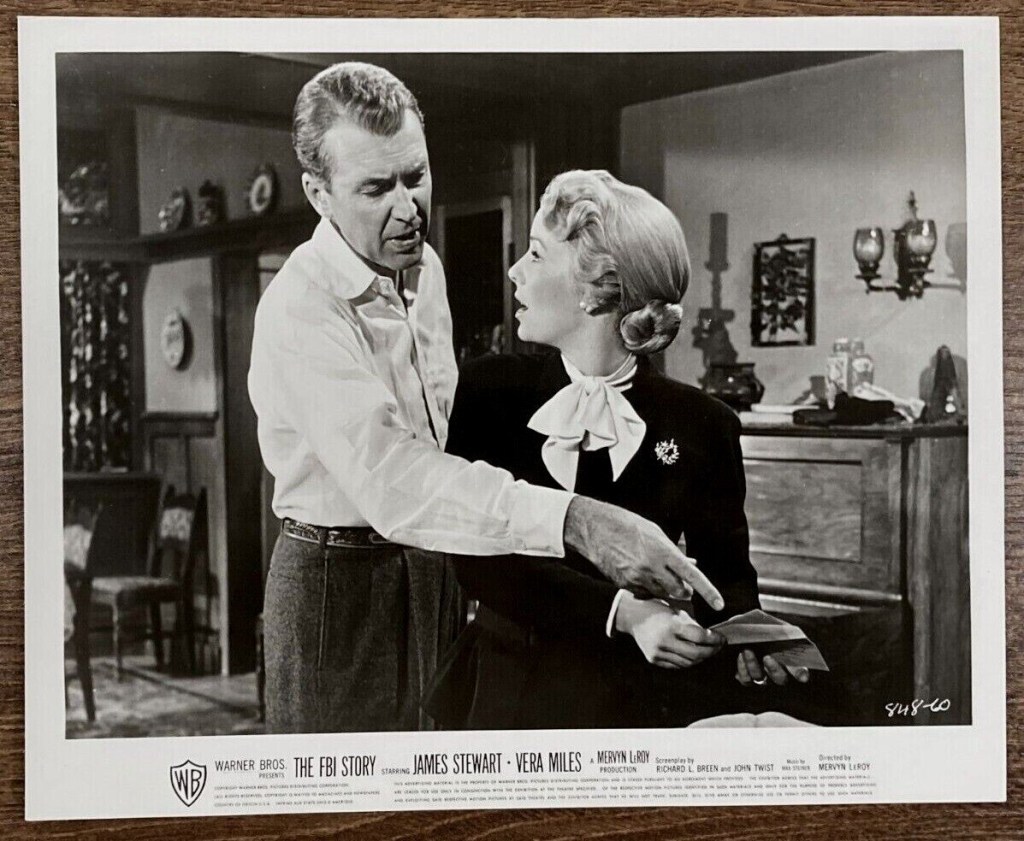
The screenplay writers created the character of “FBI Agent Hardesty”, now came into contact with all of the history of the “Federal Bureau of Investigation”, that the audience was seeing on-screen. The movie was
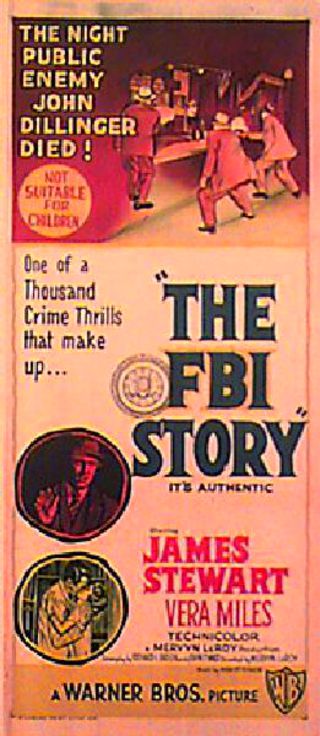
On the “Official Cast and Crew Listing”, for “The FBI Story”, the name of Mervyn LeRoy, 1931’s “Little Caesar”, 1944’s “Thirty Seconds Over Tokyo”, and 1951’s, “Quo Vadis”, shows, as both the picture’s sole producer, and its director.
HOWEVER:
From script approval, “Suggesting” rewrites to entire scenes he had watched the rushes on. The hand of “PHANTOM PRODUCER”, J. Edgar Hoover, pressed down upon actual producer Mervyn Leroy, and let’s not forget. That Hoover had cast approval, and is shown with his back to the camera, speaking to new “FBI Agents”, in a cameo sequence.
Prior to the writing of his autobiography, J. Edgar Hoover was at WAR WITH THE HOLLYWOOD STUDIOS. The studios, especially “Warner Brothers”, were turning out motion pictures that, in Hoover’s mind, glorified gangsters. Examples were 1929’s, “Chinatown Nights”, 1930’s, “Doorway to Hell”, 1930’s “The Pay Off”, 1931’s, “Public Enemy” 1931’s, “Little Caesar”, and 1932’s, “Scarface”.
J. Edgar Hoover, with his political clout, as the “Head” of the, “Federal Bureau of Investigation”, pressured the studios. IF they wanted to make gangster movies, fine, BUT, the law enforcement agents had to be the heroes,
The first such movie, in response to Hoover’s demand, was “G-MEN”, released on April 18, 1935, and starring “Public Enemy’s”, James Gagney as a lawyer, who joins the “FBI”.
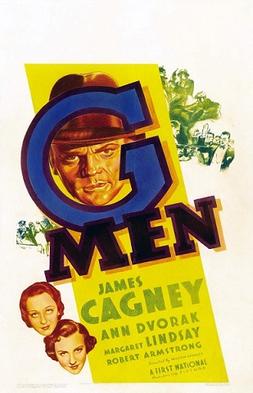
Technically, this was the movie that started what became known in Hollywood, as “The G-Men Genre“, but in reality. The heads of the major “Hollywood Studios”, were FRIGHTENED of the power of the man sitting at the head of the table in the “FBI Dining Room”.
THIS “FBI Director”, knew that to make a crime drama. The studio’s would, now, need access to certain “FBI” logos, real equipment, technical jargon, and case files, IF a studio wanted “FBI” assistance, the screenplay MUST BE APPROVED BY HIM.
In February of 1938, the “Autobiography” of J. Edgar Hoover, “PERSONS IN HIDING”, was published in both the United States and the United Kingdom. Below is from the London publication.
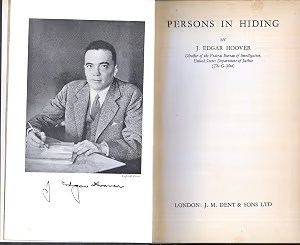
Just like “The FBI Story”, Hoover’s, non-fiction, “Autobiography” was the source for a small series of four-motion pictures “Paramount Pictures”, 4-versions, of the criminal tales of the “FBI” he told. “Paramount’s” first movie kept the title of the autobiography:
PERSONS IN HIDING released February 10, 1939
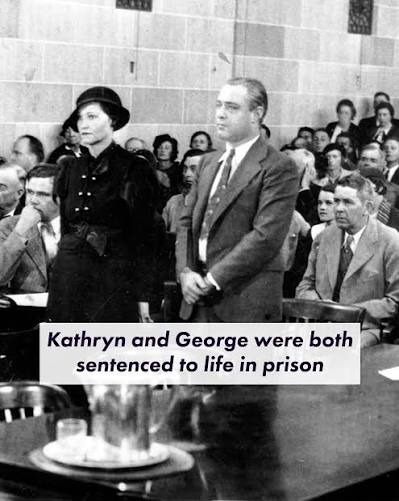
Taken from J. Edgar Hoover’s autobiography, the screenplay was based upon George “Machine Gun” Kelly, but the facts the public had read about in their newspapers were different from what the “FBI Director” had written.
To Hoover, it was George’s wife, Kathryn, that was the more dangerous of the pair. She bought and gave George his first “Machine Gun”, actually, managed his public image, and masterminded his major crimes. However, according to the newspapers, she wasn’t shown that way, and it was a frightened George. When cornered by “FBI Agents”, that said the legendary line:
“DON’T SHOOT G-MAN”
Giving the “Federal Bureau of Investigation” agent’s, the nickname of, “G-Man (Government Man)”
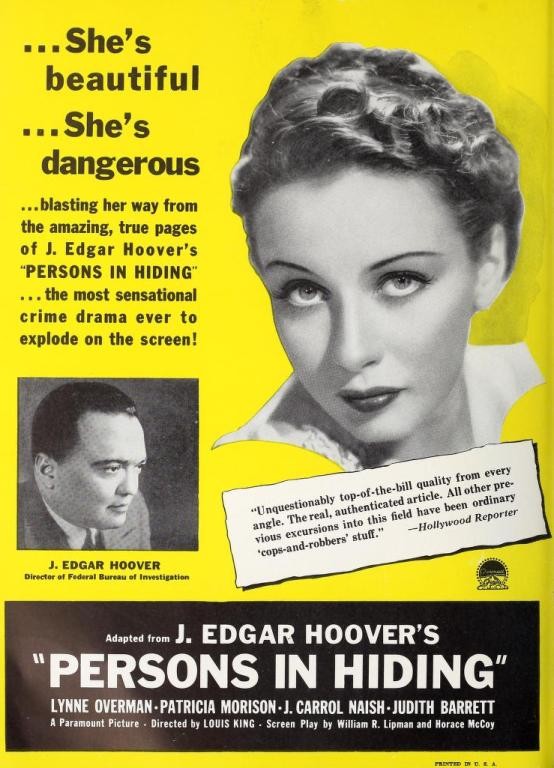
J. Edgar Hoover, depending upon the reviewer, is listed as either the source of the story, or a screenplay writer, or both. Below, the film’s opening title card:
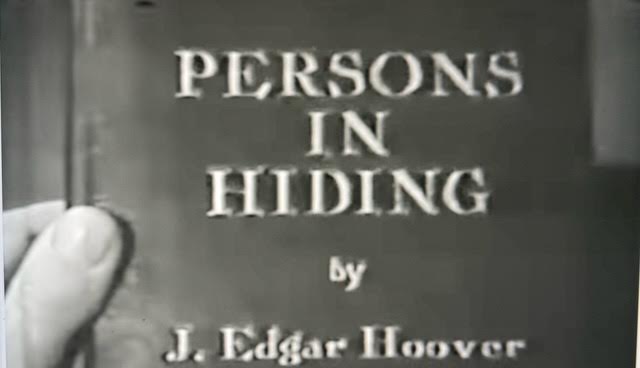
The two credited screenplay writers were, William R. Lipman, the Lloyd Nolan, Mary Carlisle, and Lynne Overman, crime drama, 1938, “Hunted Men”, and the next movie I will be mentioning.
The other writer was Horace McCoy, who co-wrote both of the screenplays mentioned with Lipman. However, back in 1935, novelist McCoy, wrote the classic depression era novel, “THEY SHOOT HORSES, DON’T THEY?”
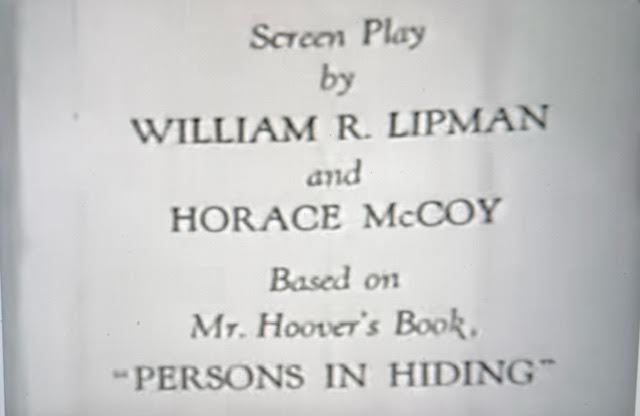
Louis King was the director, he had just directed Mark Twain’s, 1938, “Tom Sawyer, Detective”, starring Billy Cook as “Tom“, and Donald O’Connor as “Huckleberry Finn”. He would direct the next movie I will mention.
The Cast:
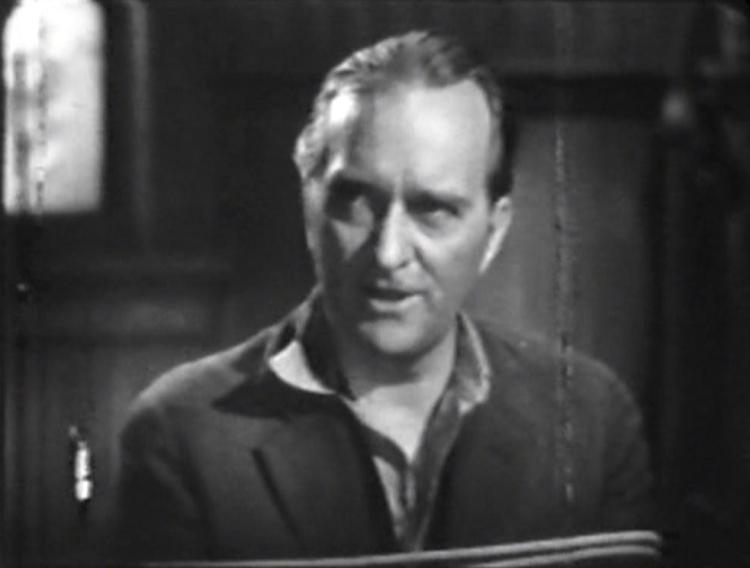
Lynne Overman portrayed “FBI Agent Pete Griswald”. Overman was just seen in the Akim Tamiroff, 1938, crime movie, “Ride a Crooked Mile”. He followed this film with Cecil B. DeMiles, 1939, “Union Pacific”.
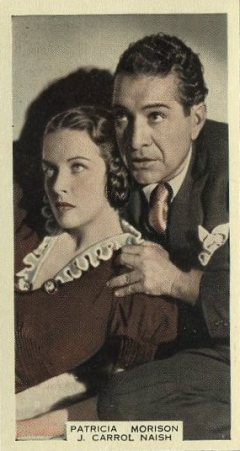
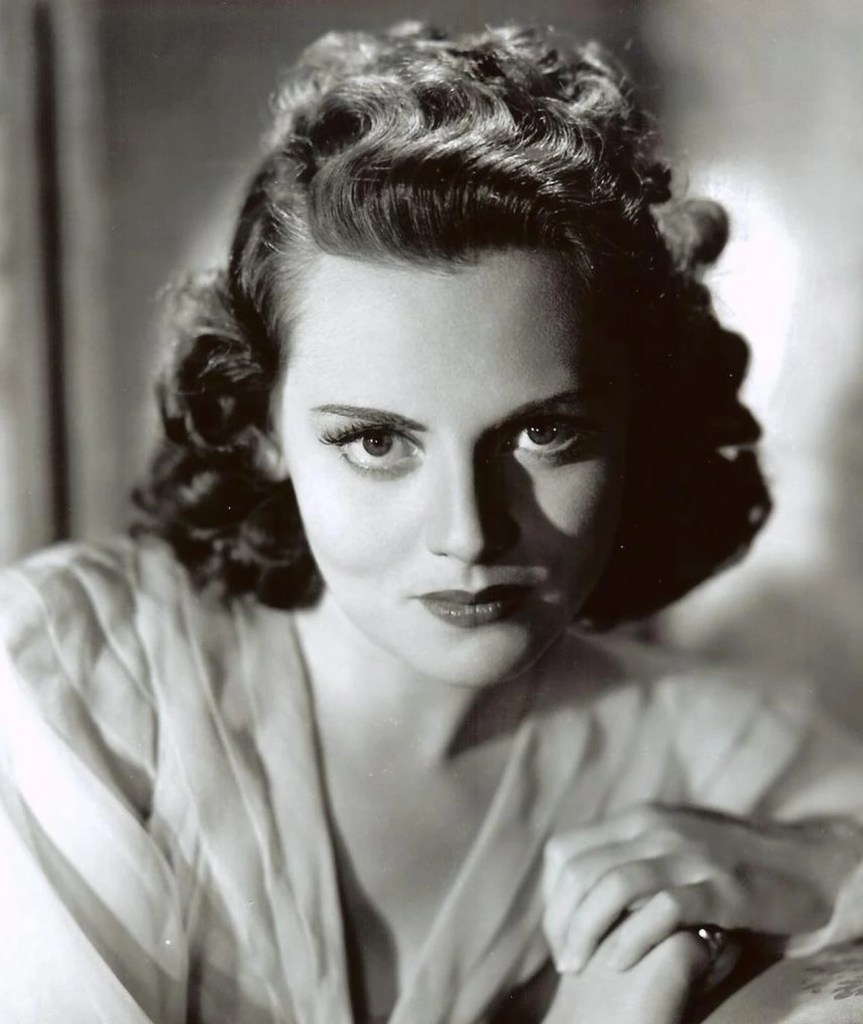
Patricia Morison portrayed “Dorothy Bronson (the fictional Kathryn Kelly)”. Morison had just been in a short subject, 1935’s, “Wreckless”. Eileen Patricia Augusta Fraser Morison was a legitimate stage actress, a mezzo-soprano, and movie and television actress.
J. Carrol Naish portrayed “Freddie ‘Gunner’ Martin (George Kelly)”. He had just co-starred with Mary Carlisle, and Robert Preston, in 1938’s, “Illegal Traffic”. Naish followed this movie by co-starring with Anna May Wrong in 1939’s, “King of Chinatown”.
Helen Twelvetrees portrayed “Helen Griswald”. Twelvetrees., who had starred in the horror mystery, 1930’s, “The Cat Creeps”. Had just co-starred with Buck Jones in the 1937, Western, “Hollywood Round-Up”. She only had one more movie released, before would retire from motion pictures.
Dennis Morgan portrayed “Mike Flager”. Morgan was billed as Richard Stanley, but was born, Earl Stanley Morner. Billed as Richard Stanley, he had just been in 1938’s, “Illegal Traffic”, and followed this picture with 1939’s, “Waterfront”, apparently now as Dennis Morgan.
Richard Denning portrayed “Powder – henchman”. Denning had just been in the film-noir crime film, 1939’s, “Ambush”, starring Gladys Swarthout and Lloyd Nolan. He followed this movie with 1939’s, “King of Chinatown”. My article is “RICHARD DENNING: HIS SCIENCE FICTION AND HORROR FILMS” at:
https://www.bewaretheblog.com/2020/08/richard-denning-his-science-fiction-and.html
Leona Roberts was “Ma Bronson”. Roberts had just appeared in 1939’s, “Boy Slaves”, and followed this picture with 1939’s, “The Made Her a Spy”.
Below, a staged photo with J. Carrol Naish and some of the supporting actors and actresses.
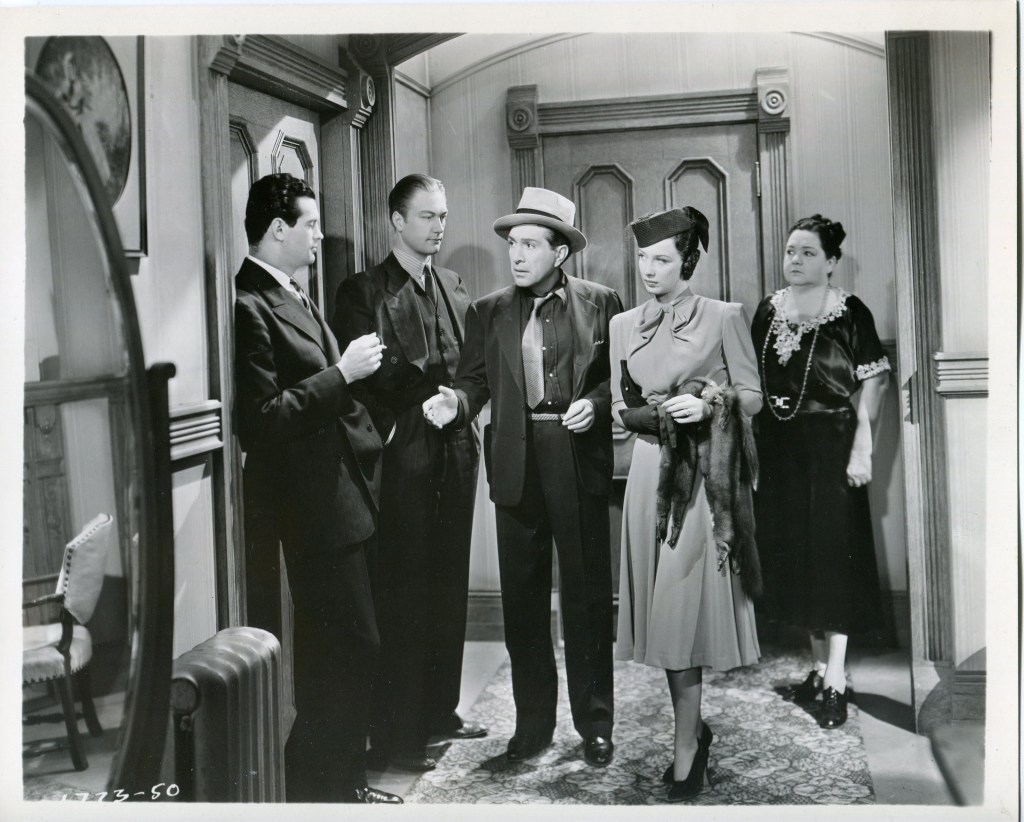
Left to right, Richard Stanley (Dennis Morgan), Richard Denning, J. Carrol Naish. Helen Twelvetrees, and Leona Roberts.
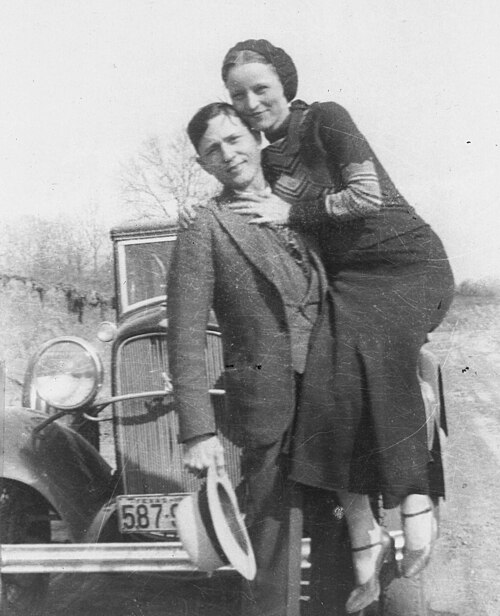
The screenplay was a mixture of the chase to capture “George ‘Machine Gun’ Kelly. However, the two writers slipped in a little of Bonnie Parker and Clyde Barrow, below, into their versions of George and Kathryn Kelly. Especially patterning Kathryn Kelly after Bonnie Parker to fit Hoover’s description and make her the real center of the screenplay.
What would happen in 1956, first took place in this screenplay. We meet the main “FBI Agent”, “Pete Griswald”, and his wife, “Helen Griswald”. The purpose, Herbert Hoover wanted to show that his “FBI Agents” were normal people with a normal family life. Who made up the decision to enter law enforcement and made up his agency.
“Ma Bronson” was based upon Kathryn Kelly’s real mother, Ora Shannon, and represents the poor depression era Texas farm life “Kathryn” dreamed of escaping.
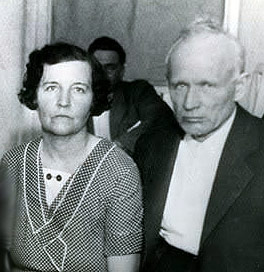
Above, Ora Shannon and husband James Emory Brooks
In the screenplay “Dorothy Bronson” has similar dreams of becoming wealthy, and meets petty crook “Freddie Martin“. She will mold him into “Gunner”, aka: “Machine Gun”, “Freddie ‘Gunner’ Martin”.
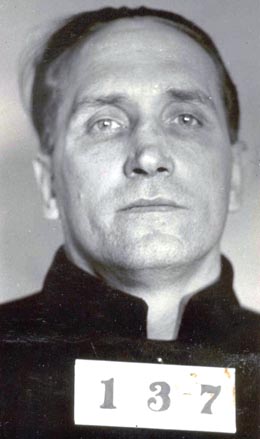
The screenplay reworks the July 1933 kidnapping of tycoon Charles F. Urschel. The character of “Mike Flager” was based upon the long time friend of “George Kelly”, Albert L. Bates, below, who before George meet Kathryn, were wanted for multiple bank robberies across the American Northwest and Southwest.
“Mike Flager” comes to “Freddie” and “Dorothy” with the kidnapping scheme. In the movie, they kidnap wealthy “Burt Nest”, portrayed by William Collier, Sr. True to the real kidnapping, “Nest”, like “Urschel”, the victim of the plot is unusually perceptive, although blind folded, he is able to memorize the specific flight paths of plane flying over the gang’s hideout, “The Bronson Family Ranch”, and other small details. Once released, he is able to locate the ranch for “FBI Agent Pete Griswald”. This leads the “FBI” to the ranch
In the Screenplay:
There is a dramatic separation capture of “Freddie” and “Dorothy”. The “FBI” arrived at the “Bronson Ranch” and a chaotic shootout takes place. The two criminals are able to escape and split up. The “FBI” pursue “Freddie”, and he is cornered and captured in a high stakes confrontation.
While, “Dorothy Bronson”, remains at large, but her obsession with high society comes into play. “Griswald” is able to track her down by “Dorothy’s” use of a specific perfume called “Tantalizing”. This is an unique scent, and using the lab technicians of the “FBI”, and other “FBI” specific resources, she is tracked down and arrested.
In Real Life:
The real life George “Machine Gun” Kelly, and Kathryn Kelly, are captured, on the morning of September 26, 1933, in a bungalow located at 1408 Rayner Street, in Memphis, Tennessee. During their flight from the “FBI” after the kidnapping, the two traveled approximately 2,000 miles, before capture. The residence was small, in a quiet neighborhood, and surprisingly, the neighbors slept through the capture.
The next motion picture based upon a story in the J. Edgar Hoover’s autobiography was:
UNDERCOVER DOCTOR premiering in New York City on May 31, 1939
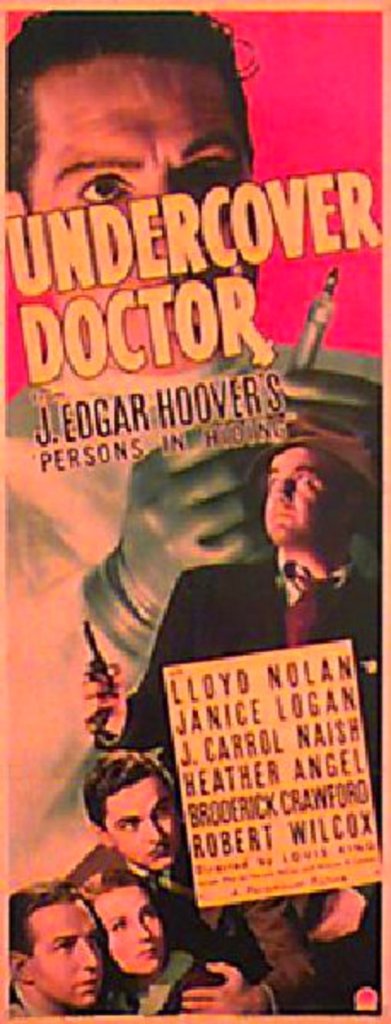
Looking at the above poster, it has the actual on-screen title of the picture, “UNDERCOVER DOCTOR From J. Edgar Hoover’s Persons in Hiding”. Hoover is credited, for writing the book this screenplay is based upon.
The working title was “Federal Offense”.
The two screenplay writer’s are the same as for 1939, “Persons in Hiding”. William P. Lipman had not written anything after that film, but would follow this film with the Anna May Wong, J. Carrol Naish, and Anthony Quinn, 1930, “Island of Lost Men”. Screenplay writer Horace McCoy, also didn’t write anything between the two films, and co-wrote the same Anna May Wong starring vehicle as this picture.
“Paramount Pictures” kept the team together, by using Louis King as director. He would follow this picture with the Jackie Cooper and Betty Field coming of age, 1940’s, “Seventeen.
The screenplay is directing related to the criminal activities of the under world doctor, Dr. Joseph P. Moran and his direct connections with the “Ma” Barker gang. Actually, “Chapter Five” of “Persons in Hiding” is titled, “The Infamous Doc Moran”.
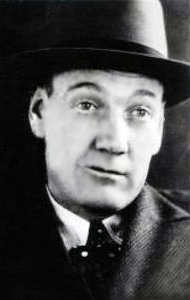
Above Dr. Joseph P. Moran, below Kate Barker aka: “Ma” Barker.
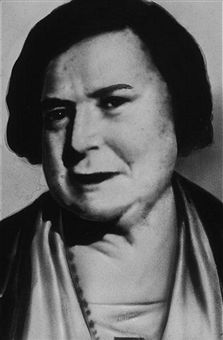
However, “Ma” Barker is not in the screenplay, see 1940’s “Queen of the Mob”, and some characters are composites.
Lloyd Nolan portrayed the composite, “FBI Agent Robert Anders”. In J. Edgar Hoover’s book, there is a list of several agents, across the United States, who were attempting to catch “Ma” Barker’s gang. To cut down the story for a film screenplay, several other characters are also composites. However, the main, actual FBI Agent, was from the “Chicago Field Office”, Melvin Purvis, who tracked down both John Dillinger and “Baby Face” Nelson. Also, his composite includes E.J. Connelley, the “FBI Agent” actually tracking down the “Barker Gang.
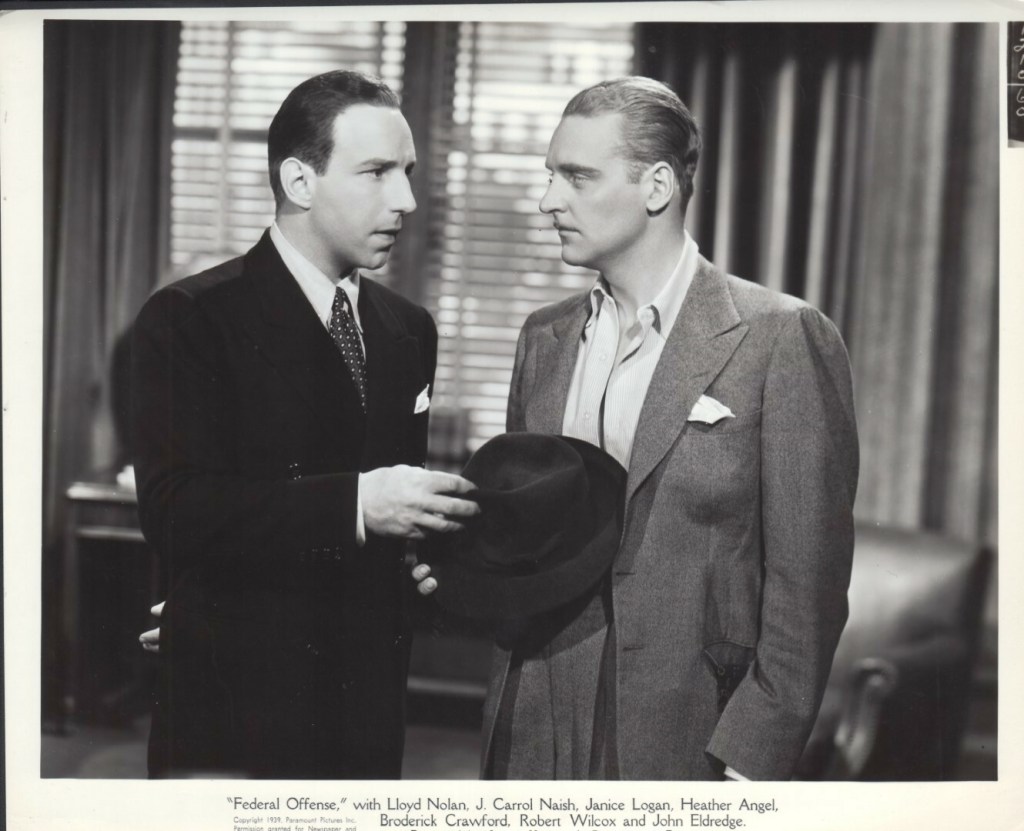
Above left, Lloyd Nolan, and George Meeker portraying “Dapper Dan Bar”. “Dan” is based upon Arthur “Doc” Barker, the more refined, sometimes elegant, but very calculating son of “Ma” Baker, seen below.
Janice Logan portrayed fictional, “Margaret Hopkins – Dr. Morgan’s Nurse”. She is loyal to the doctor and in love with him. However, the real “Dr. Moran’s” post-op work was usually handled by “Ma” Barker, herself. This was the first of only six-films for actress Logan, but her third was the classic science fiction, 1940’s, “Dr. Cyclops”.
Above, Janice Logan and character actor Raymond Hatton portraying “Dizzy Warner”. Speaking to classic science fiction, Hatton was the old prospector “Pete”, in director Rodger Corman’s, 1955, “The Day the World Ended”, not to forget the Western sidekicks he played in the 1930’s and 1940’s.
J. Carrol Naish portrayed “Dr. Morgan”, as implied above, based upon the real “Dr. Joseph P. Moran”. Naish had just been seen in the World War One love story, 1939’s, “Hotel Imperial”, and followed this picture with 1939’s, “Island of Lost Men”.
Heather Angel portrayed fictional, “Cynthia Weld”. “Weld” is “Dr. Morgan’s” high-society fiancée to demonstrate the doctor’s desperate desire for wealth and social standing.
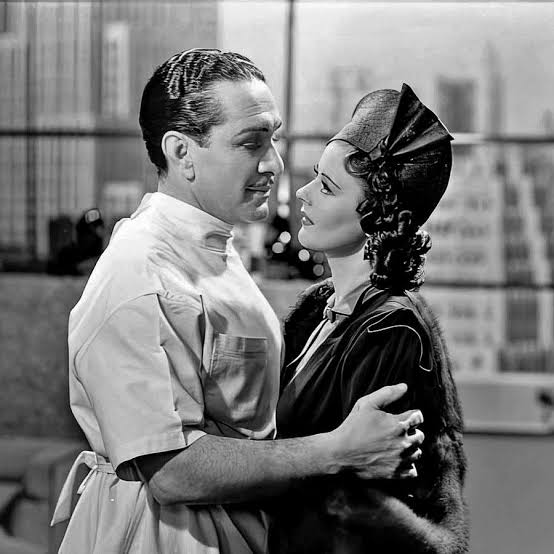
Above, J. Carol Naish and Heather Angel.
Broderick Crawford portrayed “Eddie Krator”. “Krator” is a composite of both Frederic “Fred” George Barker, and Albin Francis Karpavičius aka: Alvin “Creepy” Karpis. Crawford had just been seen in the Charlie Ruggles, 1939, comedy, “Sudden Money”, and followed this feature with 1939’s, “Island of Lost Men”.
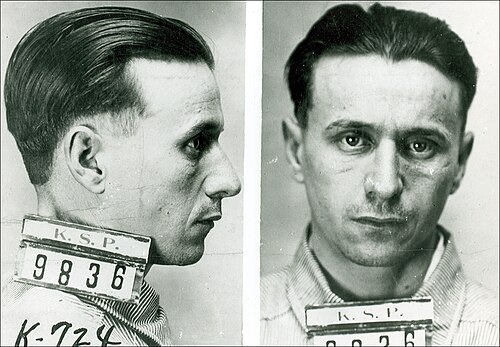
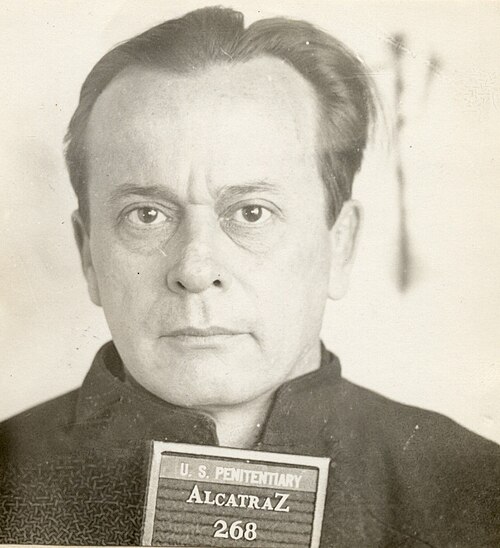
Above, Fred Barker, below, Alvin “Creepy” Karpis.
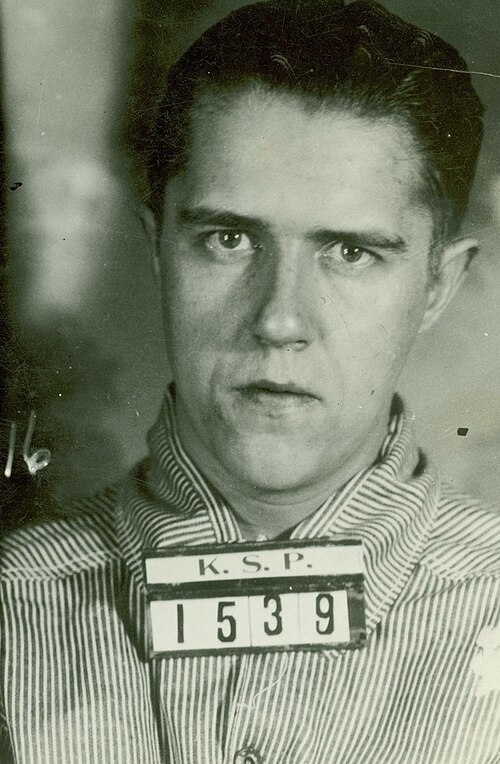
Paul Fix portrayed “Monk Jackson”, the uncredited actor’s character was based upon Volney Everett “Curley” Davis. Who arranged the logistics between the “Barker Gang” and their safe houses. Most fans of 1950’s television Westerns, know Fix as “Marshall Micah Torrance”, on “The Rifleman”. My article is “PAUL FIX: The Character Actor Who Taught John Wayne To Walk”, found at:
https://www.bewaretheblog.com/2018/02/paul-fix-character-actor-who-taught.html
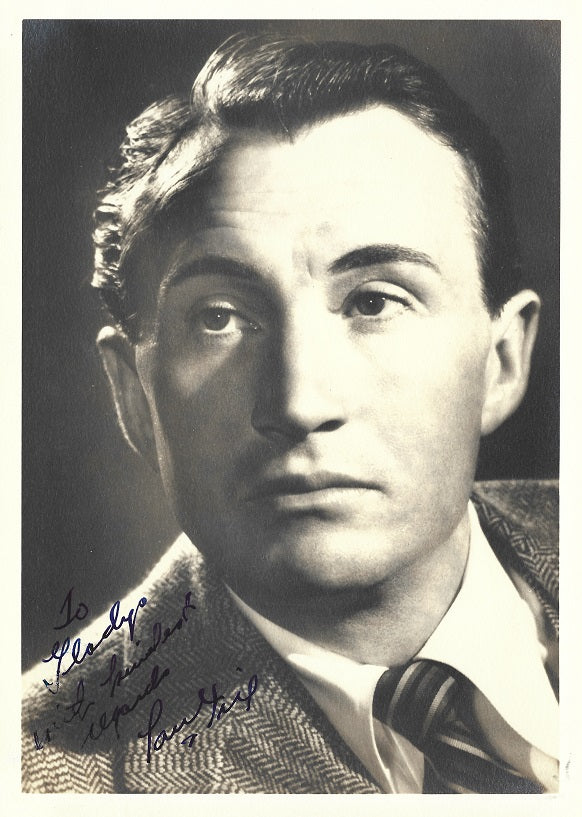
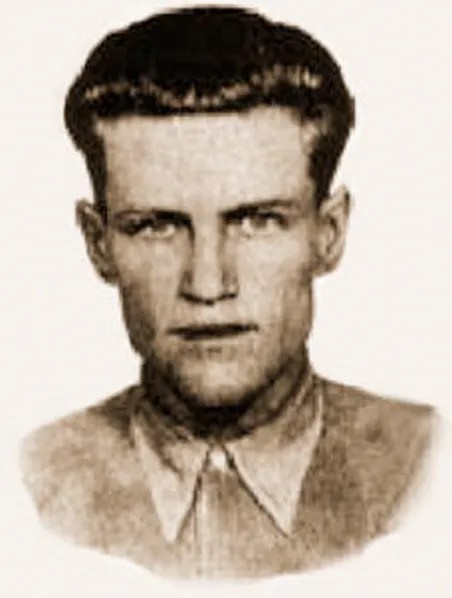
Above Paul Fix, below, Volney Everett “Curley” Davis.
Fact:
The Barker-Karpis Gang, as Hoover’s book referred to them, had pulled off the kidnappings of two millionaires, William Hamm, Jr., and Edward Bremer. Two events took place as a result. The first was the start of copycat kidnappings for ransom. This is included the one by the Kelly’s, and that led, in 1934, to Fred Barker and Alvin Karpis going into hiding, but they visited Dr. Joseph Moran for plastic surgery on their faces and the burning off of their fingerprints. That surgeries went wrong, as the doctor was a drunk, and left both gangsters in pain. “Ma” Barker became their nurse. After the surgery was performed, Dr. Moran started bragging about it, and Fred and Alvin murdered him, dumped his body in Lake Erie, all leading to the “FBI” catching up to the Barker-Karpis Gang, and a four-hour shoot out in Florida, resulting in the deaths of “Ma” and Fred Barker.
Screenplay:
The details of the kidnappings are left out, and the screenplay concentrates on “Dr. Morgan”, J. Carrol Naish, a respected doctor by day, and criminal doctor by night. Who is seen fixing multiple gun shot wounds for the gang led by Broderick Crawford.
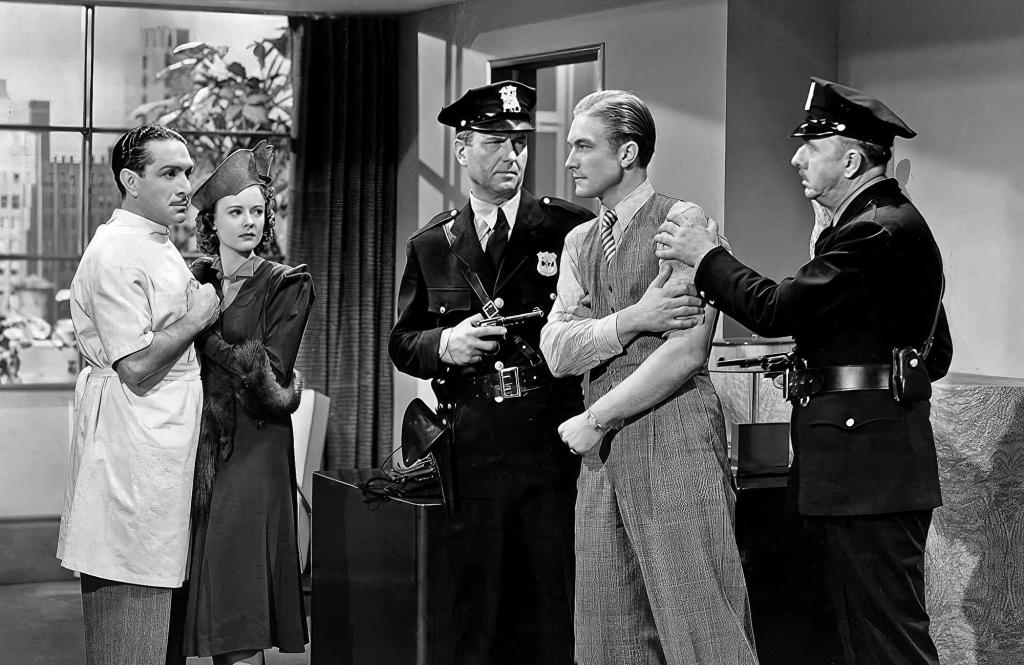
Above, “Dr. Morgan” and his fiancée, “Cynthia Weld”, have been confronted by Richard Denning’s “Frank Oliver”. A minor “Establishing Character”. Who was attempting to expose the doctor’s use of “Cynthia”, as a means to enter the”High Society” of New York, that “Cynthia” and “Frank” live in, and the doctor dreams of entering.
The main sequence of the entire movie, is a recreation of the “Underworld Surgery Plot”.
I mentioned the control J. Edgar Hoover had over crime movies, but there was something else that even the “FBI Director” had to comply with:
“A Code to Govern The Making “Motion Picture Production Code”, enforced by the “Hayes Office’s”, Joseph Ignatius Breen, for Will Hayes.
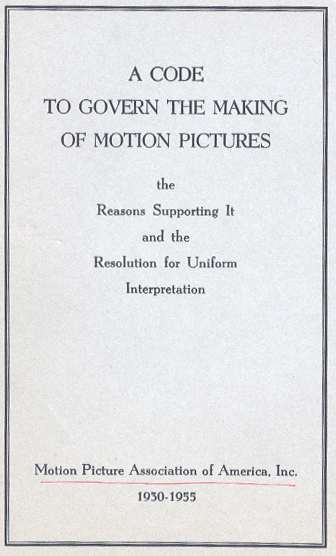
According to the code, medical procedures could not be shown with graphic or explicit realism.
So, what was shown, on-screen, to the theatre audience, was the work of Cinematographer William C. Mellor. Who had just filmed 1939’s, “Hotel Imperial”, but whose later work would include director George Steven’s, 1951, “A Place in the Sun”, starring Elizabeth Taylor, Montgomery Clift, and Shelley Winters, George Stevens’s, 1956, “Giant”, starring Elizabeth Taylor, Rock Hudson, and James Dean, and director Richard Fleischer’s, 1959 version of Truman Capote’s, “Compulsion”, starring Orson Welles.
The audience sees harsh lighting, in a room full of dark shadows, as “Dr. Morgan” enters, and washes his hands at a sink. He next prepares his surgical tools on a darkened table, and the audience is aware of members of “Eddie Krator‘s” gang in the shadowed corners of the room watching the doctor. “Krator” lies on the operating table with curtains surrounding the audience’s view, so, even lite only shadows show them what is about to take place. “Dr. Morgan” approaches “Eddie Krator”- – – –WHEN, the “FBI”, led by “Robert Anders”, raid the operating room. Instead of being killed, as in real life. This version of “Chapter Five” from “Persons in Hiding “, ends with the arrest of “Dr. Morgan” for performing an illegal operation. While, “Eddie Krator”, and his entire gang are arrested by J. Edgar Hoover’s approved heroes, “HIS FBI AGENTS”.
In “Paramount Picture’s”, 3rd movie, based upon “Persons in Hiding”. There are no real people being fictionalized.
PAROLE FIXER released on February 2, 1940
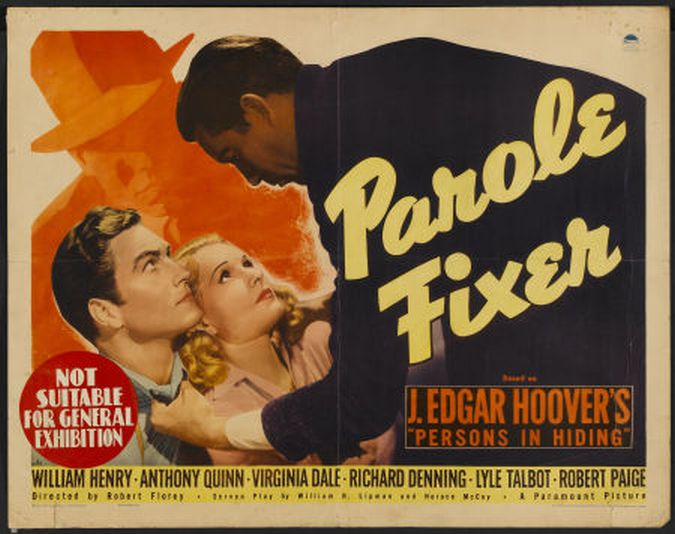
THE BACK STORY:
This screenplay reflects the Chapter in “Persons in Hiding”, that truly underscores FBI Director J. Edgar Hoover’s “Poker Play” to keep “HIS FBI” going.
The “FBI” had been too successful on their war on crime. On September 26, 1933, George “Machine Gun” Kelly and his wife Kathryn were captured, on May 23, 1934, Bonnie Parker and Clyde Barrow were dead, on July 22, 1934, John Dillinger was dead, on October 22, 1934 Charles Arthur Floyd aka: “Pretty Boy Floyd” was dead, on November 27, 1934, Lester Gillis aka: “Baby Face Nelson” was dead, on October 24, 1935 Arthur Simon Flegenheimer aka: “Dutch Shultz” was dead, on May 2, 1936, “Creepy” Alvin Karpis was captured.
In short, to the government, and the public, the “FBI” had completed its mission.
Funding was proposed to be cut, and downsizing was being spoken as a possibility. J. Edgar Hoover needed a reason, or more to the immediate point, a “VILLAIN”, for his organization to exist, and be funded.
The following is the front page for the “The Seattle Star”, dated May 25, 1935. The kidnapping took place in Tacoma, Washington. $200,000 1935 dollars is equal, as of this writing to, $4,890,218.98.
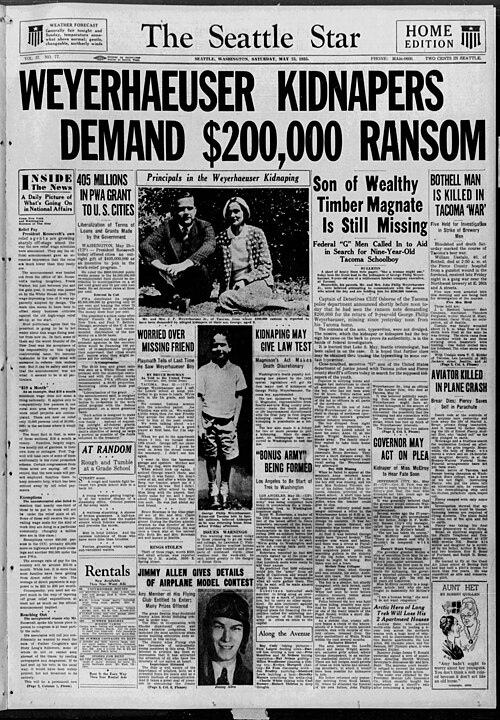
“Persons in Hiding”, tells a story about that 9-year old boy, George Weyerhaeuser.
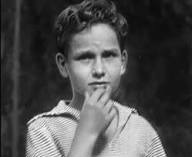
His story, in “Chapter Ten”, would bring J. Edgar Hoover’s, “SAVIOR VILLAIN” into fruition. As, in the United States, and the United Kingdom, readers discovered J. Edgar Hoover’s NEW VILLAIN. The CORRUPT, American Penal, and, Parole Systems. As illustrated in the tale of William “Bill” Dainard, the “MASTERMIND” of the George Weyerhaeuser kidnapping.
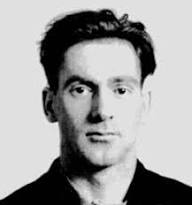
As planned, there were three kidnappers, William “Bill” Dainard, Harmon Metz Waley, and his wife, Margaret E. Waley, below.
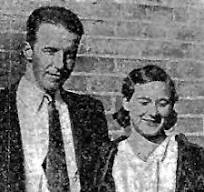
However, the were only the catalyst for the point Hoover wanted to make.
The following article is from Melbourne, Australia’s, “Herald Gazette”, for September 22, 1938, and is part of a series based upon J. Edgar Hoover’s “Person’s in Hiding”, and speaks to the point the FBI Director wanted to make to gain public support for funding the “Federal Bureau of Investigation”, and KEEPING HIS JOB.
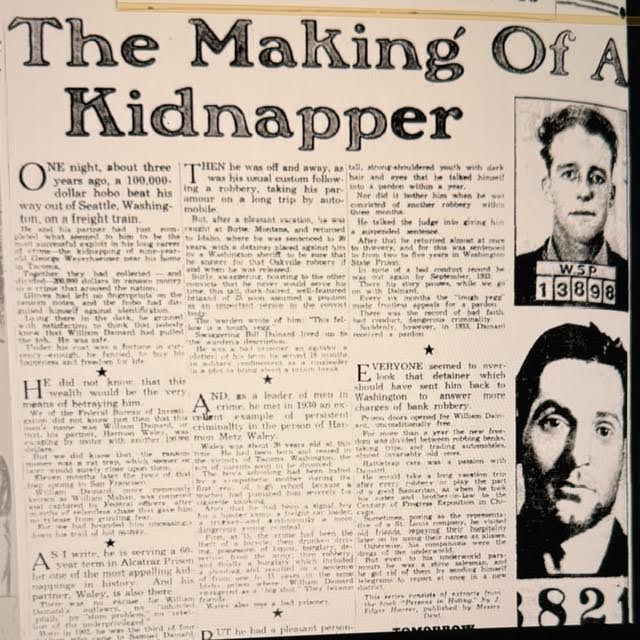
William “Bill” Dainard had a past criminal record and had used aliases. According to the “FBI” investigation of the kidnapping. Dainard had been sent to prison in two different States.
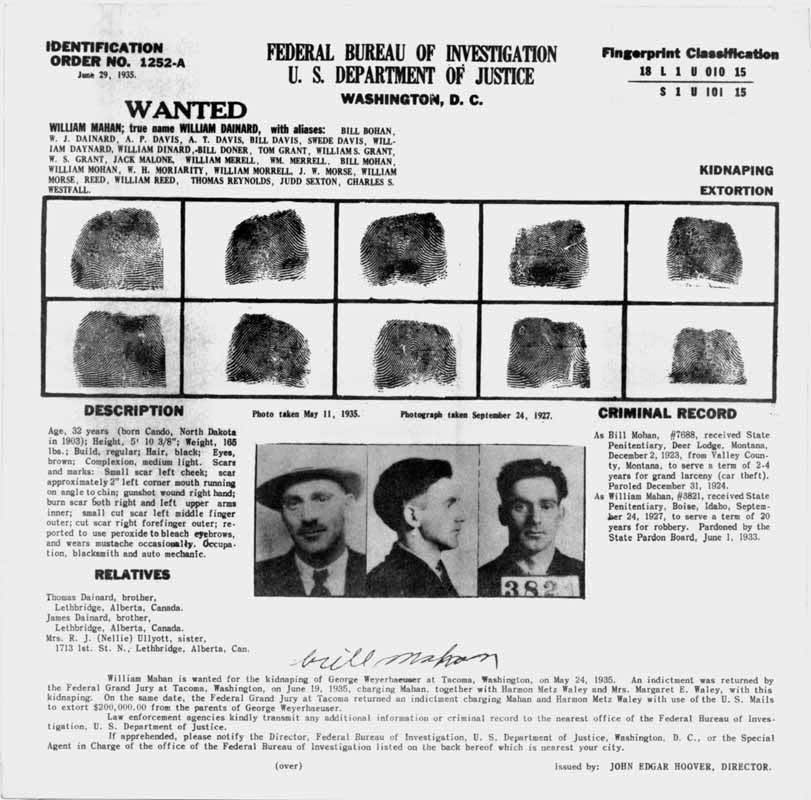
Prior to the kidnapping, William “Bill” Dainard was serving a prison sentence for a bank robbery in Idaho. He had previously served a sentence in Montana for a 1922 Car Theft. Where doctors certified that he was mentally “INSANE”. After being released on an “Early Parole”. William “Bill’ Dainard switched to bank robbery, and with another man, on January 31, 1927, robbed the “Oakville State Bank”, in Oakville, Washington. Roughly, six months later, Dainard robbed the “Rathdrum State Bank“, in Rathdrum, Idaho. An accomplice from the Montana car theft, but not the bank robbery, was arrested. This forgotten accomplice, under police interrogation, “Ratted” Dainard out for the bank robbery. Bill Dainard was captured, and sentenced to 20-years, in the “Idaho State Prison”.
However, he was able to convince the warden, and other prison authorities, that he was now a “Model Prisoner”, and had “Reformed” from his criminal past. William “Bill” Dainard went before the Idaho State Board of Prisons. Whose decision was to release him on an “EARLY PAROLE”.
Within days of that release, Dainard, was planning the George Weyerhaeuser kidnapping.
My reader must understand how J. Edgar Hoover’s thought process worked at the time of writing “Persons in Hiding”. Hoover is on record arguing, that parole boards were filled with, “Sentimental Tommys”. That he considered were: “Naive, bleeding-heart do-gooders”. Who let a twice imprisoned, William “Bill” Dainard, manipulate them. A manipulation that led the “Idaho State Parole Board”, into giving this criminal an “EARLY PAROLE”, resulting in the Weyerhaeuser Kidnapping.
J. Edgar Hoover used Dinard’s, “Early Parole”, and the kidnapping’s aftermath. To make his point against the Corrupt, American Penal, and, Parole System to the readers of his autobiography. Illustrating to those readers, around the world, how easy it was for Dainard to convince the board members that he had reformed. Pointing out that after consulting with each other, their action had let loose a hardened criminal to pick-up his criminal career, as if he had never been arrested, or imprisoned, twice.
After the ransom was paid, George Weyerhaeuser was released unharmed. However, the “Serial Numbers” of a large amount of the high denomination bills were placed upon a list by the “FBI Agents”, and the list distributed. On June 8, 1935, a clerk at a Salt Lake City, Utah, “Woolworth Store”, notified a police detective stationed there, and Margaret Waley was arrested. In her possession were other ransom bills, and this led to the capture of her husband.
Next, came a small piece of irony, Dainard attempted to hide out in Butte, Montana. He was walking on a street in Butte, when he was spotted by Butte Police Officer James Moonewy. The exact same Montana Police Officer, who had arrested him for the 1927 bank robbery.
THE 3RD PARAMOUNT PICTURE:
For the third time, the screenplay writing team of William R. Lapman and Horace McCoy went to work. However, this time, they were turned loose to create a screenplay that fit “Chapter 10”, BUT, were told, not to specifically touch the George Weyerhaeuser kidnapping.
The 3rd-film was directed by Robert Florey. Among his films as a co-screenplay writer were 1931’s, “Frankenstein”, and 1935’s, “Bride of Frankenstein”. However, as a director, his work includes Bela Lugosi’s, 1932, Edgar Allan Poe, “Murders in the Rue Morgue”, Anna May Wong’s, 1937, “Daughter of Shanghai”, and Peter Lorre’s, 1941, “The Face Behind the Mask”.
The Cast and Their Created Characters:
The Good-Guys:
William Henry portrayed “FBI Agent Scott Britton”. He had just been seen in the Preston Foster, Ellen Drew, and Andy Devine, Western, 1939’s, “Geronimo”, and followed this film by co-starring with Akim Tamiroff in 1940’s, “The Way of All Flesh”.
Virginia Dale portrayed “Enid Casserly”. Dale had just co-starred with Jeanne Cagney, James’s sister, in 1939’s, “All Women Have Secrets”, and followed this feature film with the Jack Benny, Ellen Drew, and Andy Devine, 1940’s, “Buck Benny Rides Again”.
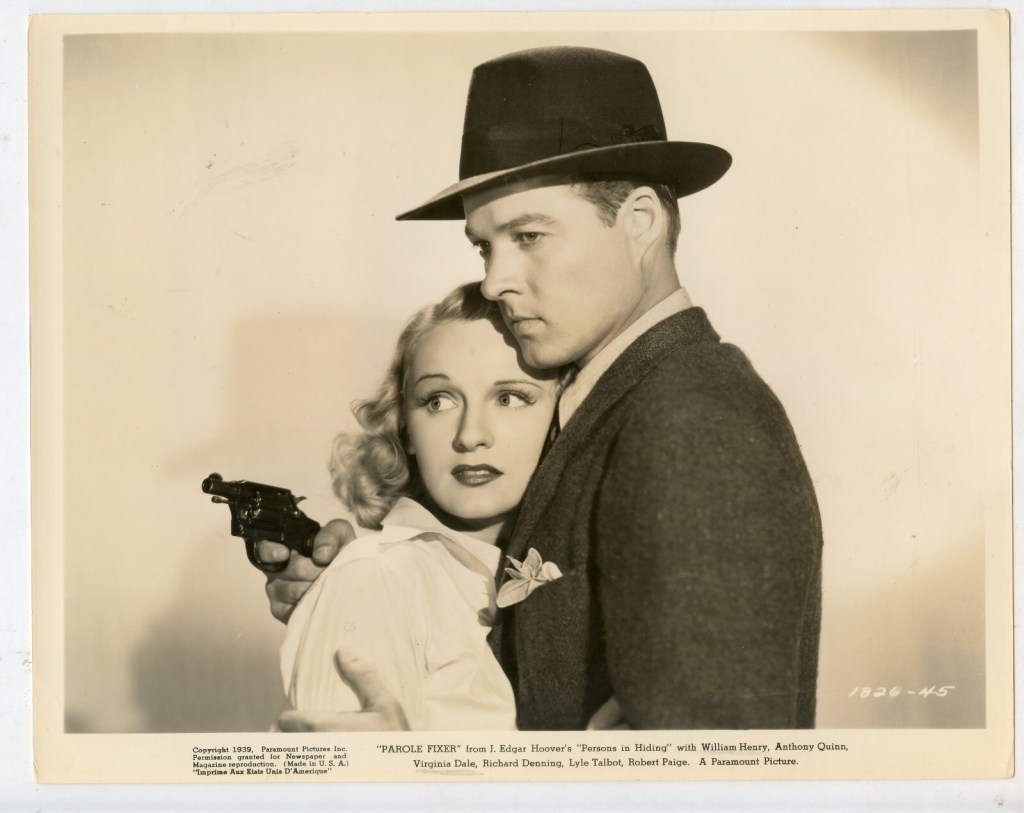
Above, a publicity photo of William Henry and Virginia Dale.
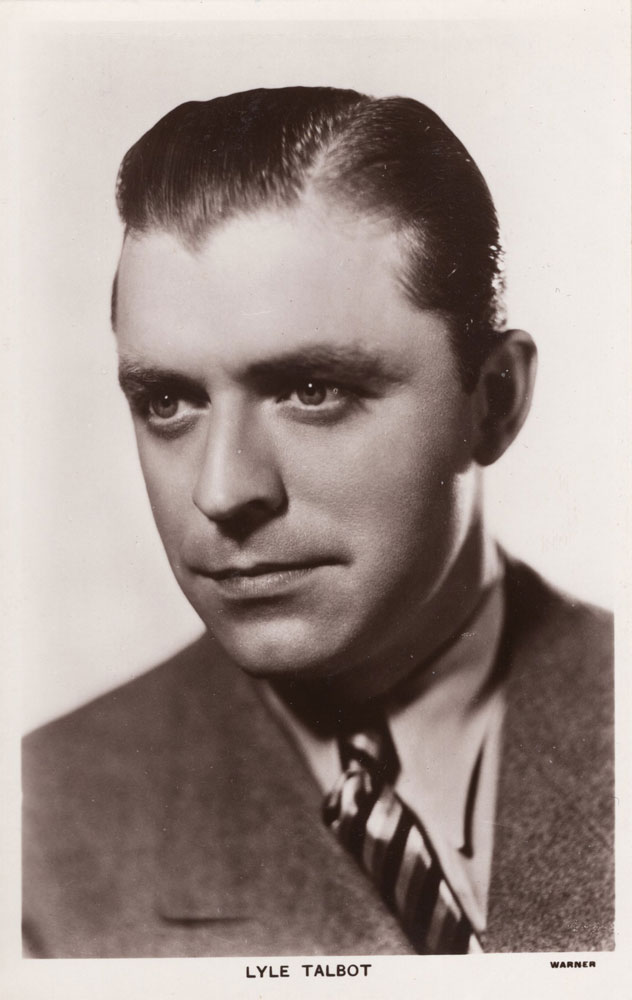
Lyle Talbot portrayed “FBI Agent Ross Waring”. Talbot who would appear for 98-episodes of the television series, “The Adventures of Ozzie and Harriet”, had appeared in the Spencer Tracy and Bette Davis, 1932 “20,000 Years in Sing Sing”, was “Commissioner Gordon” in the 1949 Cliff-Hanger, “Batman and Robin”, and portrayed “Lex Luther”, in the 1950 Cliff-Hanger, “Atom Man vs Superman”.
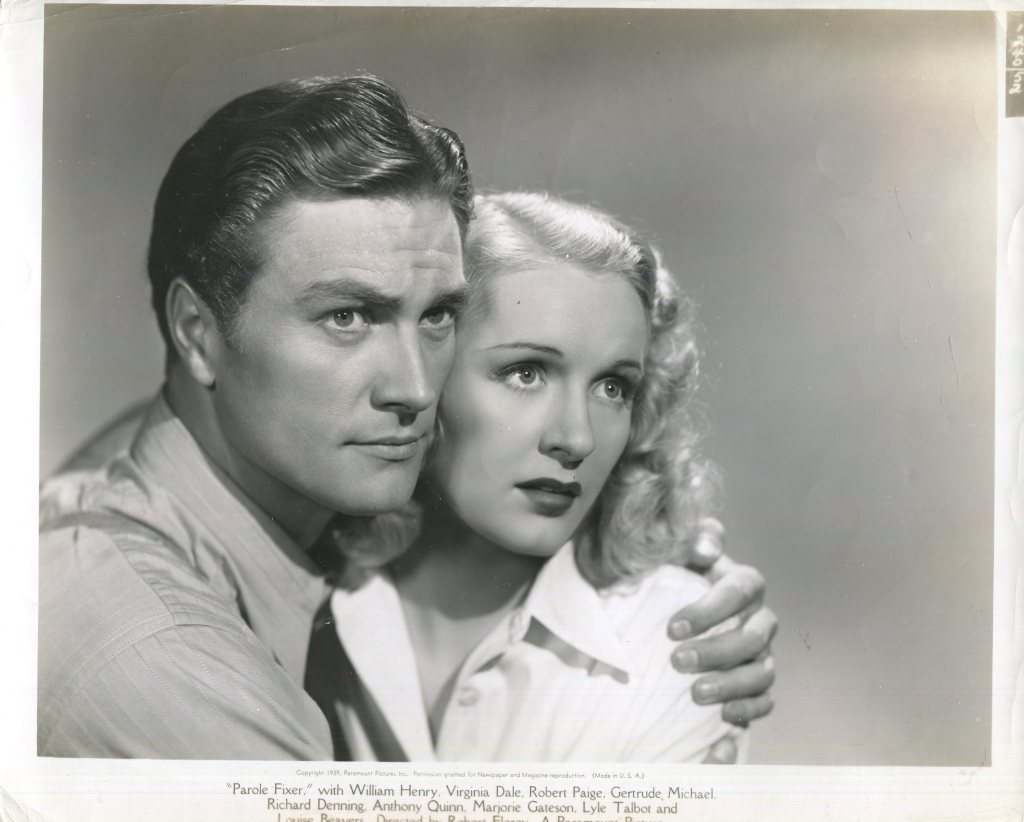
Richard Denning portrayed “Bruce Eaton”, seen below with Virginia Dale. Denning would follow this movie by co-starring with Martha Raye, and Charles “Charlie” Ruggles in the 1940 musical based upon the Broadway hit, “The Farmer’s Daughter”.
Jack Carson portrayed “FBI Agent George Mattison”. Carson who had been in the classic Marlene Dietrich and James Stewart, 1939 Western, “Destry Rides Again”. He followed this feature with the Spencer Tracy and Hedy Lamarr Mystery, 1940’s, “Take This Woman”.
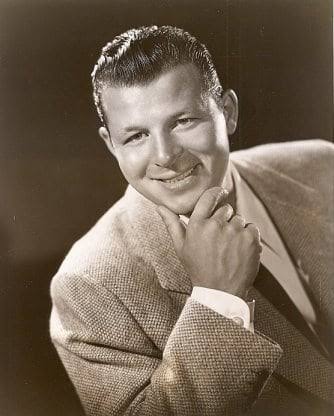
Harvey Stephens portrayed “Parole Board” member “Bartley Hanford”. Stephens had just been in the James Cagney and Pat O’Brien, 1940, “The Fighting 69th”, and followed this feature film with the “Hopalong Cassidy” Western, 1940, “Stagecoach War”.
The Bad-Guys:
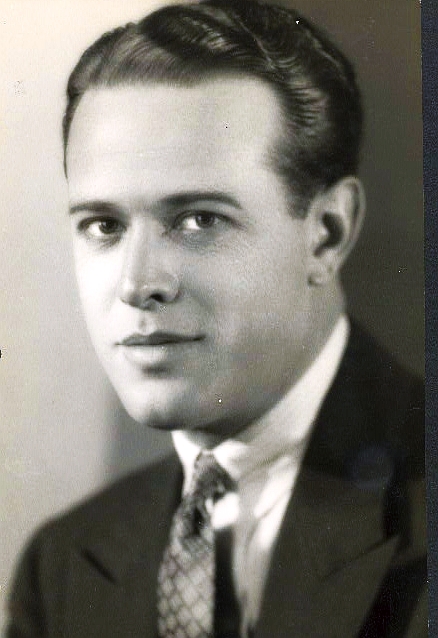
Anthony Quinn portrayed “Francis ‘Big Boy’ Bradmore”. This was Quinn’s 23rd movie, and he was nowhere near stardom, but appearing mostly in small roles. For Cecil B. DeMille, he was a “Cheyenne Indian” in 1936’s, “The Plainsman”, “Beluche” in 1938’s, “The Buccaneer”, and in DeMille’s 1939, “Union Pacific”, “Cordray”. Anthony Quinn was “Chang Tai”, in 1939’s, “Island of Lost Men”, and “Forbes” in 1939’s, “Television Spy”, starring William Henry.
Paul McGrath portrayed “Lawyer Tyler Craden, the title character”. McGrath just had been seen in the made-for-television movie, 1938’s, “Susan and God”, based upon the Broadway Play, as “Barrie Trexel”. The title character was portrayed by English actress Gertrude Lawrence, find the uncut motion picture version of director Robert Wise’s, 1968, “STAR”, starring Julie Andrews as Lawrence. McGarth followed this feature film with Fay Wray’s, 1940, “Wildcat Bus”.
Gertrude Michael portrayed “Collette Menthe”. Michael had just been in the crime drama, 1939’s, “Hidden Power”, starring Jack Holt. She followed this feature with 1940’s, “The Farmer’s Daughter”. She also starred as “Sophie Lang” in a three movie series about a female version of Arsene Lupin and Michael Lanyard aka: “The Lone Wolf”.
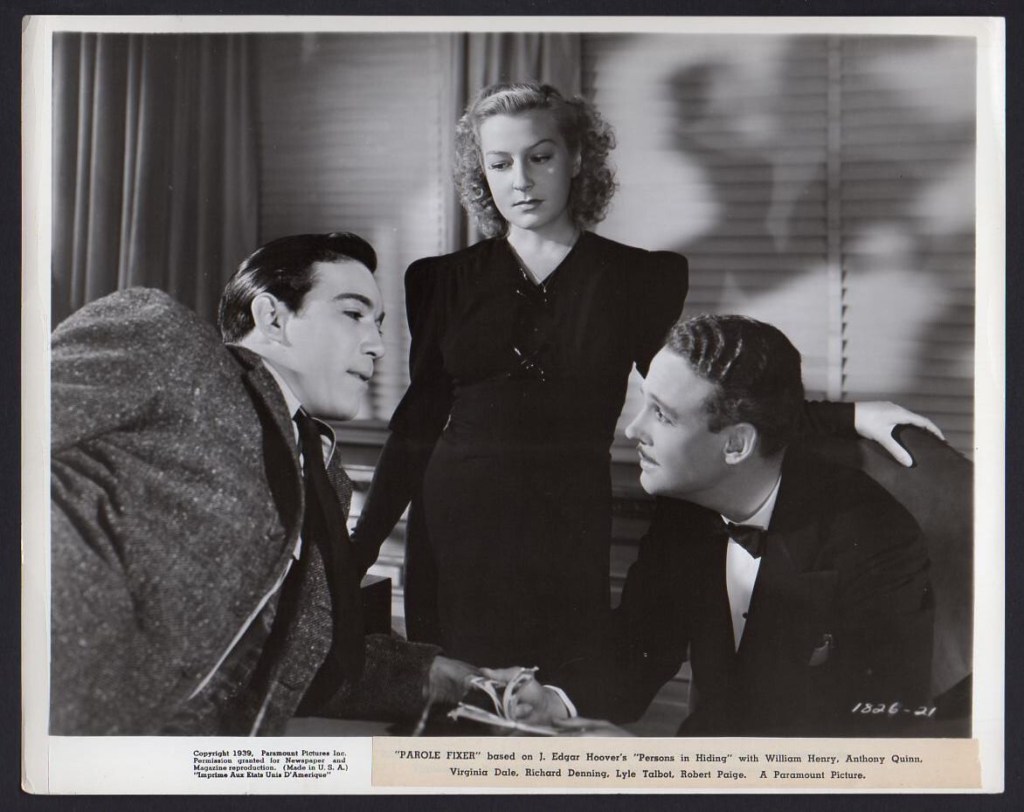
Above left to right, Anthony Quinn, Gertrude Michael and Paul McGarth.
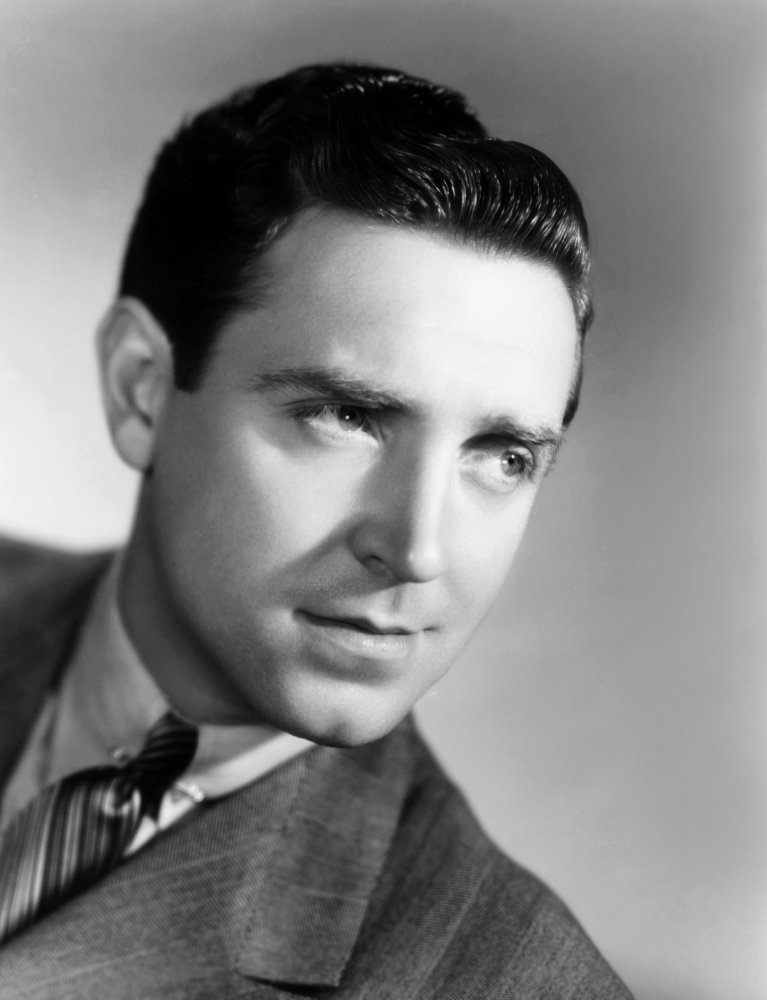
Robert Paige portrayed “Steve Eddson”. Among his film work is the 1941, horror entry, “The Monster and the Girl”, co-starring with Ellen Drew and Paul Lukas. The Olson and Johnson, 1941, “Hellzapoppin”, see my article, the two comedian’s, 1943, “Crazy House”. Also, co-starring with Lon Chaney and Louise Allbriton, in 1943’s, “Son of Dracula”, and 1953’s, “Abbott and Costello Go to Mars”.
The Story:
Attorney “Tyler Crane” is a “Fixer” for the “Crime Industry”. He “Arranges aka: Fixes” parole’s for the proper price for him, plus bribes for his marks on the “Parole Boards”. In this case, the recemipacant is a notorious and violent convict named “Francis ‘Big Boy’ Bradmore”. The “Fixer” makes the necessary arrangements for “Big Boy” to receive an early parole. A short time after “Big Boy” is released on that “Early Parole”, he guns down an “FBI Agent”.
While the “G-MEN” are organizing their hunt for “Bradmore”. “Tyler Crane” is attempting to bribe the “Board Members” into not giving out any real information about “Big Boy”, However, honest board member, “Bartley Hanford”, now finds himself in the middle of a triangle. “Lawyer Crane”, the dishonest board members, and the “G-Men”. Who want to track down the killer of one of their own. The leading “G-Man” is “Scott Britton”, who has both his normal partner, “Ross Waring”, assigned to him, plus a second “G-Man”, “George Mattison”.
While “Hanford” is deciding what to do, “Big Boy’, and a hardened ex-con named “Steve Eddson”, pull off a society kidnapping of “Enid Casserly”, and her fiancé, “Bruce Eaton”.
The kidnapping could be argued as against J. Edgar Hoover’s instruction, but the victim is an adult and not a nine-year-old child. Remember, that Hoover had final approval on all screenplays using HIS “FBI Agents”.
“Bartley Hanford” now turns over copies of the “Parole Board” hearing for “Francis ‘Big Boy’ Bradmore” to the “G-Men”. As “Branford” becomes the “G-Men’s” inside bridge to the crooked board members. After “Scott Britton” and his team review the documents, it is decided to follow “Collette Menthe”, the film’s glamorous socialite “Femme Fatale”, and close associate of the “Fixer”, “Tyler Crane”.
Meanwhile, at the direction of J. Edgar Hoover, the audience is seeing how the “FBI Lab” works to help solve cases. Part of the “FBI Director’s” education program of the American public to further get them behind his call for more funding.
This all leads to a raid by the “FBI”, on the location that “Enid Casserly”, and “Bruce Eaton” are being held. The rescue is successful, but this leads to a shoot out with “Big Boy”, and his partner “Eddson”. The two attempt to escape in a car, being pursued by “Branford” and “Waring”. “Big Boy” is driving and at the same time is shooting at the “FBI” in the followingcar with a pistol. However, you can’t out shoot a machine gun, as “Waring” fires back and “Big Boy’s” car skids off the road. Cut to a newspaper headline:
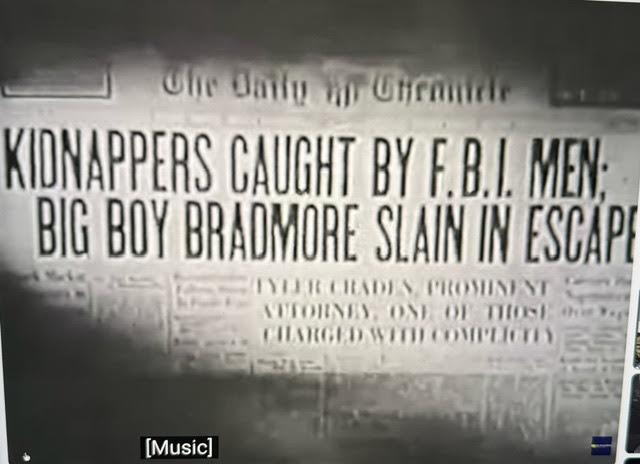
However, once again, J. Edgar Hoover’s control over the screenplay came into view. As the story switches to the court room and “Tyler Craden”, “Collette Menthe”, and the “Chairman of the Parole Board”, stand. before a judge who sentences them within a speech how crime doesn’t pay and the “FBI” will track down all criminals.
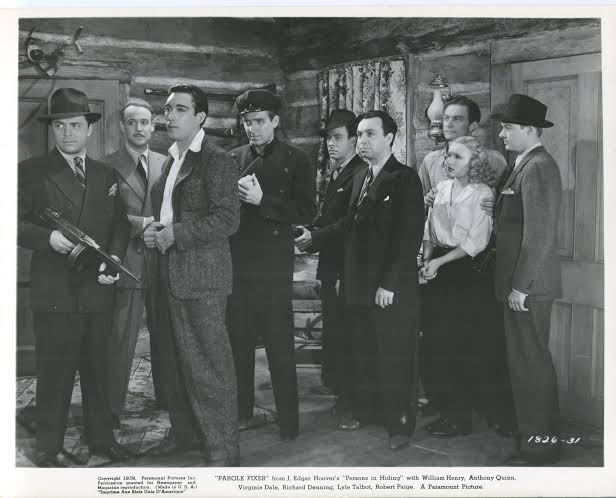
Above front on the left, Lyle Talbot, Anthony Quinn, and Robert Paige, behind them Paul McGrath. Above front on the left by the door, Harvey Stephens, Virginia Gale, William Henry, and Richard Denning, behind them Jack Carson.
The 4th and Final “Paramount Pictures” screenplay based upon “Persons in Hiding” was:
QUEEN OF THE MOB aka: WOMEN FROM HELL premiered on June 17, 1940, in Saskatoon, Saskatchewan, Canada
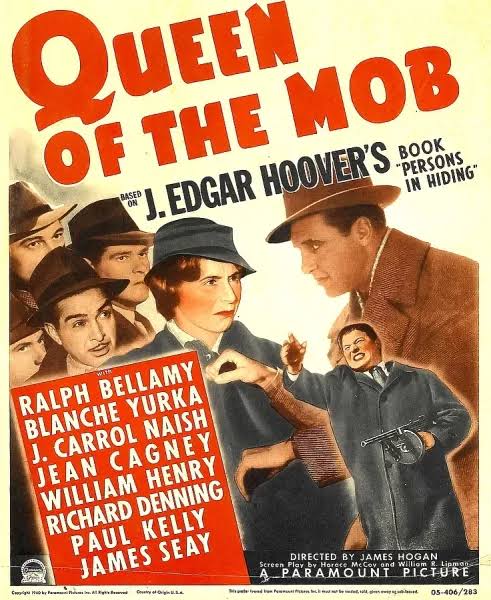
Now “Paramount Pictures” returned to the story of “Ma’ Barker”, perhaps.
The Actual Facts:
In 1927, Fred Barker was imprisoned in the “Kansas State Prison”, in Lansing, for a string of burglaries. “Fred” was a member of what the newspapers called “The Bloody Barkers”, with his brother’s, Herrman, Lloyd, Arthur aka: Doc. In prison, Fred met Alvin “Creepy” Karpis. Barker was released from prison in 1930, and reunited with Karpis to form the “Barker-Karpis Gang”. The gang started with small burglaries, but escalated to major bank robberies across the entire Midwest of the United States.
Above, Herman Baker.
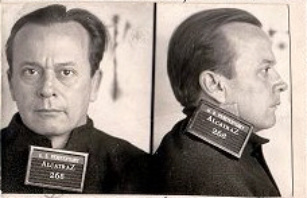
Above, Arthur “Doc” Baker.
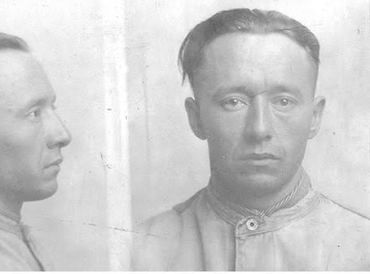
Above, Lloyd Barker.
December 19, 1931 – After robbing a store in West Plains, Missouri, at point blank range during their getaway. Sheriff Calvin Roy Kelly was shot to death at point blank range. While he was investigating a suspicious car near the “Davidson Motor Company Garage”.
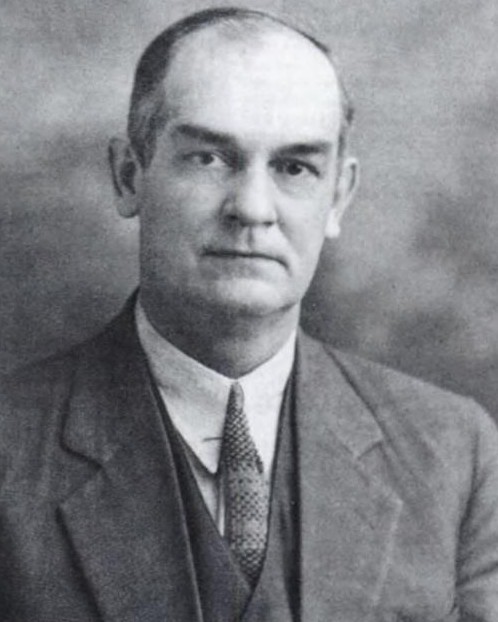
This murder brought in the “Federal Bureau of Investigation” down on the “Barker-Karpis Gang”. The gang relocated to St. Paul, Minnesota, and the protection of the corrupt Police Chief, Thomas Archibald “Big Tom” Brown.
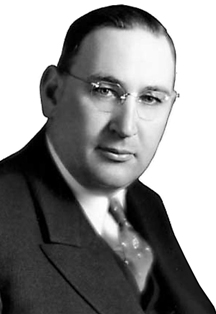
Under the protection of “Big Tom”, the Barker-Karpis Gang expanded in size and became organized as a multi-state criminals.
June 15, 1933 – “The William Hamm Kidnapping”. William Hamm, Jr. had served in the First World War, and became the President, in 1931, of the family business, “Hamm’s Brewery”, Saint Paul, Minnesota, and was President of the “Emporium Department Store”.
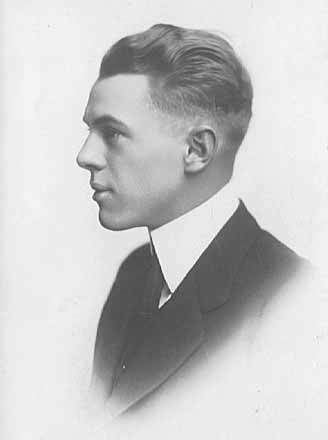
Above, William Hamm, Jr. circa 1915
On June 15th, on his way to lunch after leaving the brewery, four men shoved Hamm into the back seat of a waiting car, placed a pillow case and black out goggle over his dead, and drove away. The car did not stop until they reached the gang’s safe house in Wisconsin. The location has never been revealed by the FBI. There he was forced to write and sign four ransom notes. Next, the kidnappers drove William Hamm to Bensenville, Illinois, a suburb of Chicago, and a secluded house within the area. That night, the family received a phone call informing them of the kidnapping and advised more information would follow.
At 2 A.M, June 16th, a man “believed” to be Verne Sankey, gave a ransom note to a taxi driver, and told him to deliver it to William Dunn, the manager of “Hamms Brewery”.
Note: Verne Sankey has the distinction of being the “First Public Enemy”. He was thought to be the “Kidnapper of the Lindbergh Baby”. He would be cleared of the charge, but use a necktie to hang himself.
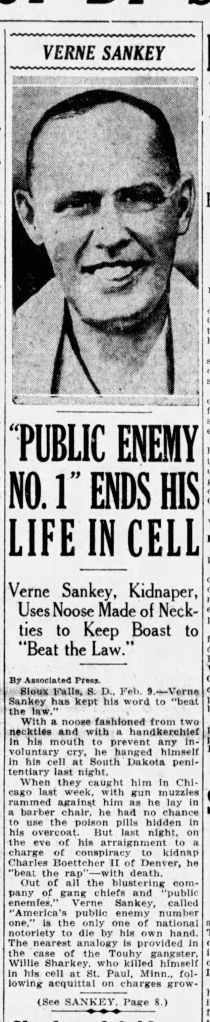
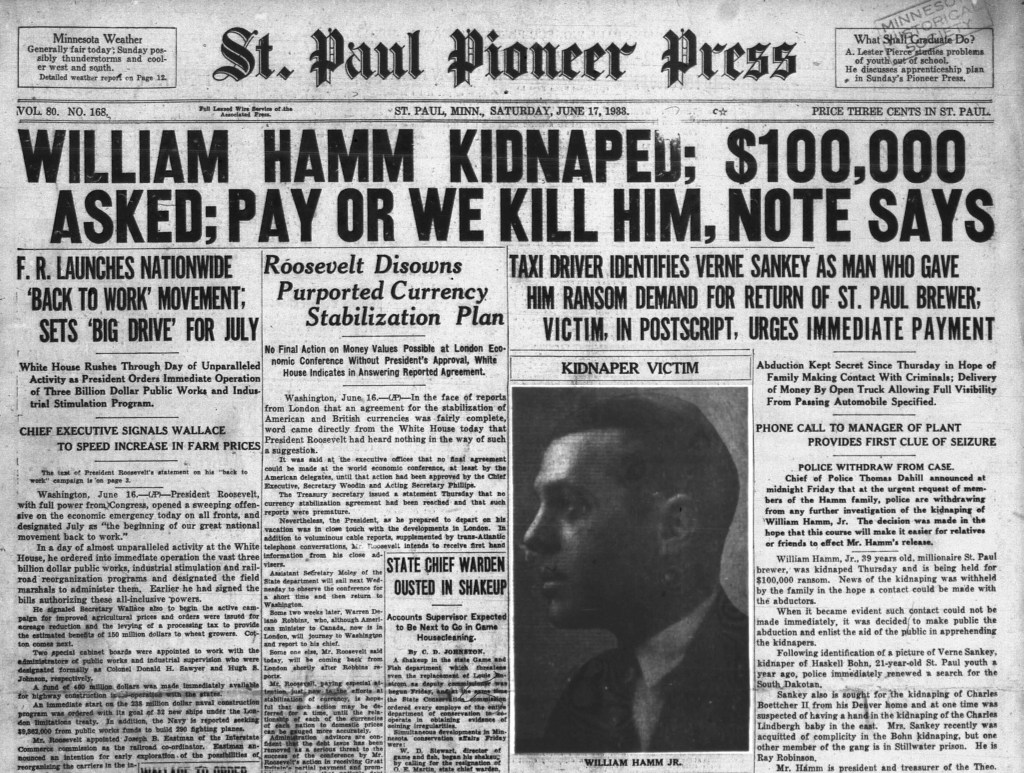
The ransom was paid, and Hamm was driven to Wyoming, and released unharmed. $100,000 1933 dollars is equal as of this writing to $2,576,769.23
This was the first time the “FBI” used the Silver Nitrate (Common Table Salt) to remove fingerprints off the ransom note. Thanks to this scientific breakthrough, the “FBI Lab” was able to get clear identifiable fingerprints for Alvin “Creepy Karpis, Arthur “Doc” Baker, and Charles Fitzgerald, seen below, in a 1971 photo from his release from “Folsom State Prison”.
January 17, 1934 – was the “Kidnapping of Edward George Bremer, Jr”. Edward Bremer, Jr. was a wealthy banker. He had just dropped his daughter off at school, when two men approached him, one of them was Arthur “Doc” Barker. Who pistol whipped and punched the resisting Bremer. While forcing him into the back seat of his own car. “Doc” forcibly got blacken blind glasses over Edward Bremer’s eyes.
Next, the two found they could not start the car, but again forced Bremer to show them how. The two kidnappers drove away, but later left the car and took another one. As a result of the pistol whipping by “Doc”, Edward Bremer’s car had blood stains in the back seat, raising the fear that he had been murdered. Once again, Bremer was held in the safe house is Bensenville, Illinois.
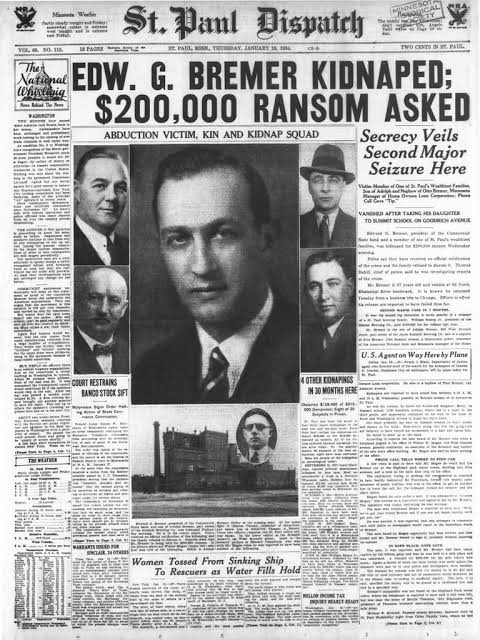
$200,000 1934 dollars as of this writing is equal to $4,999,701.49
Adolph Bremer, Edward’s father demanded proof he was till alive, and his son was forced to write a new letter. Then Adolph tried to reduce rage amount of money, and Fred Barker went ballistic and said they should just kill Edward Bremer, but “Doc” and “Creepy” got him calmed down. Bremer’s family paid, and a bag of cash was picked up by Fred Goetz aka: “Shotgun George Ziegler”. Who next drove Edward to a deserted road on February 7th, and left him there.
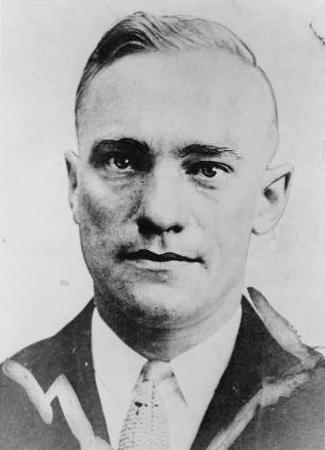
Edward Bremer could not identify his kidnappers. HOWEVER, a key break in the crime came when a police officer found an empty gas can left along the known kidnapping route. On the can was one fingerprint belonging to “Doc” Barker.
On the night of January 8, 1935, FBI agents quietly ambushed Arthur “Doc” Baker while he was taking a casual walk in Chicago. Later that night, the FBI raided the apartment of Russell “Slim Gray” Gibson was shot and killed, even though he was wearing a bullet proof vest. His wife was arrested for harboring a fugitive, and another member of the gang, Byron Bolton was arrested.
However, the find was a notebook with one bullet hole in it. Inside was a map of Ocklawaha, Florida. The end of the Barker Gang was about to take place.
The map led the FBI to a quiet two-story vacation cottage. That was rented under a fake name on the shores of Lake Weir in Ocklawaha, Florida.
On January 16, 1935, one-dozen, heavily armed, FBI agents surrounded the peaceful setting. Unknown to the FBI, “Creepy” Karvis, and the majority of the gang had left days earlier. The only people in the cottage was Fred Baker and his mother Kate Barker. The FBI ordered Fred to surrender, and instead he opened up on them. FOUR-HOURS-LATER, the gun battle ended. When the shooting had ended, the FBI agents sent in a local estate handyman inside wearing a bulletproof vest to check out the house. He found Fred and “Ma” Barker dead in an upstairs bedroom. Between the bodies was a machine gun and Kate Barker had been killed by a single gunshot wound.
It was John Edgar Hoover that built up the story that “Ma” Barker was the:
“most vicious, dangerous, and resourceful criminal brain of the last decade”—
The other side to the story comes from Alvin Karpis and other surviving members of the gang at the time. They all agreed that Kate Barker’s role was an accomplice who traveled with her sons as a front to make them look like an innocent family. Some of the gang members said, Kate Barker:
“couldn’t plan breakfast,” —-let alone a bank robbery.
The Motion Picture:
William R. Lipman had been one of the two screenplay writers for director Jacques Tourneur’s, 1940, “Nick Carter” detective mystery, “Phantom Raiders”, starring Walter Pidgeon, just before this screenplay. He would follow this movie with director Charles B, Seitz’s, 1940, “Nick Carter” mystery starring Walter Pidgeon, “Sky Murder”.
Horce McCoy had just co-written director Robert Florey’s, 1940, “Women Without Names”, and followed this picture with the “B” Western, 1940, “Texas Rangers Ride Again”.
Selected Cast Members:
Ralph Bellamy portrayed “FBI Agent Scott Langham“. Starting later in 1940, Bellamy began a series of “Ellery Queen” mystery movies. In 1941, he was “Colonel Montford” in Lon Chaney, Jr’s, “The Wolf Man”, and the following year he was “Erik Ernst” in “The Ghost of Frankenstein”.
Jack Carson was now “FBI Agent Ross Waring”. Carson had just been in the crime drama, 1940’s, “Girl in 313”, starring Kent Taylor and Lionel Atwill, and followed this picture with the Ronald Coleman and Ginger Rodgers, 1940, “Lucky Partners”.
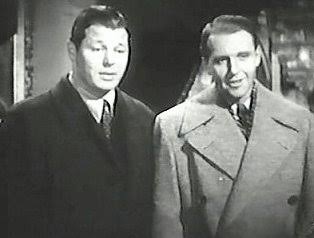
Above left, Jack Carson, with Ralph Bellamy.
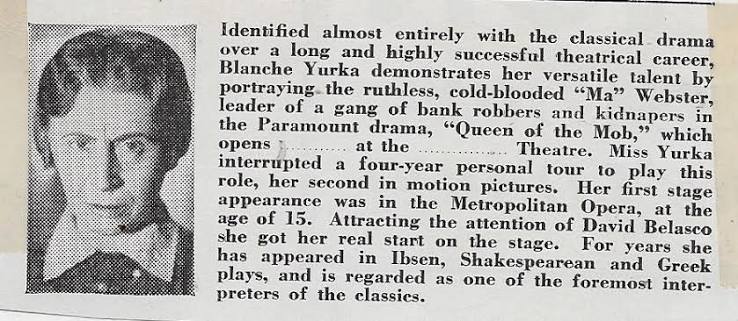
Blanche Yurka portrayed “Ma Webster (Based upon Kate Barker)”. Broadway actress Yurka had last been seen on-screen as “Madame Therese De Farge” in the 1935, Ronald Colman version, of Charles Dickens, “A Tale of Two Cities”. In 1944, she portrayed “Bianca”, in the seldom seen and overlooked, excellent, “Cry of the Werewolf”, starring Nina Foch.
J. Carrol Naish portrayed “George Frost (Partly based upon Alvin Karpis and others of the Barker Gang)”. Naish had just co-starred with Richard Denning, and Jeanne Cagney, in the boxing story, 1940’s, “Golden Gloves”. He followed this feature with the comedy musical, 1940’s, “Down Argentine Way”, starring Don Ameche, Betty Grable, and Carmen Miranda.
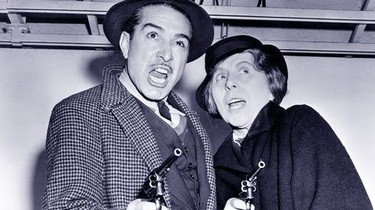
Jeanne Cagney portrayed “Ethel Webster”. As Jean Cagney, she had just portrayed “Mary Parker”, in 1940’s, “Golden Gloves”, and followed this feature with the Bing Crosby, Mary Martin, and Basil Rathbone, 1940, comedy musical, “Rhythm on the River”.
Willam Henry portrayed “Bert ‘Beretie’ Webster the one good son”. Henry had just co-starred with Akim Tamiroff and Gladys George in 1940’s, “The Way of All Flesh”, and followed this picture by co-starring in the Richard Dix Western, 1940’s, “Cherokee Strip”.
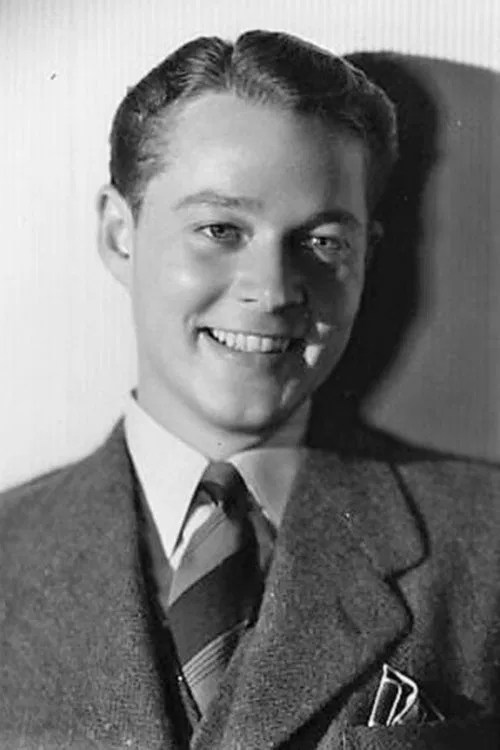
Richard Denning portrayed “Charlie Webster”. Denning had just portrayed “Bill Crane” in 1940’s “Golden Gloves”, and followed this picture with Cecil B. DeMile’s, 1940, “Northwest Mounted Police”.
Paul Kelly portrayed “Tom Webster”. Kelly had just been in the George Raft and William Holden, 1939, “Invisible Stripes”, and followed the movie by portraying “General George Armstrong Custer”, in 1940’s, “Wyoming”.
James Seay portrayed “Eddie Webster”. Seay had portrayed “Jimmy” in 1940’s, “Golden Gloves”, and followed this picture with the Western, 1940’s, “Oklahoma Renegades”.
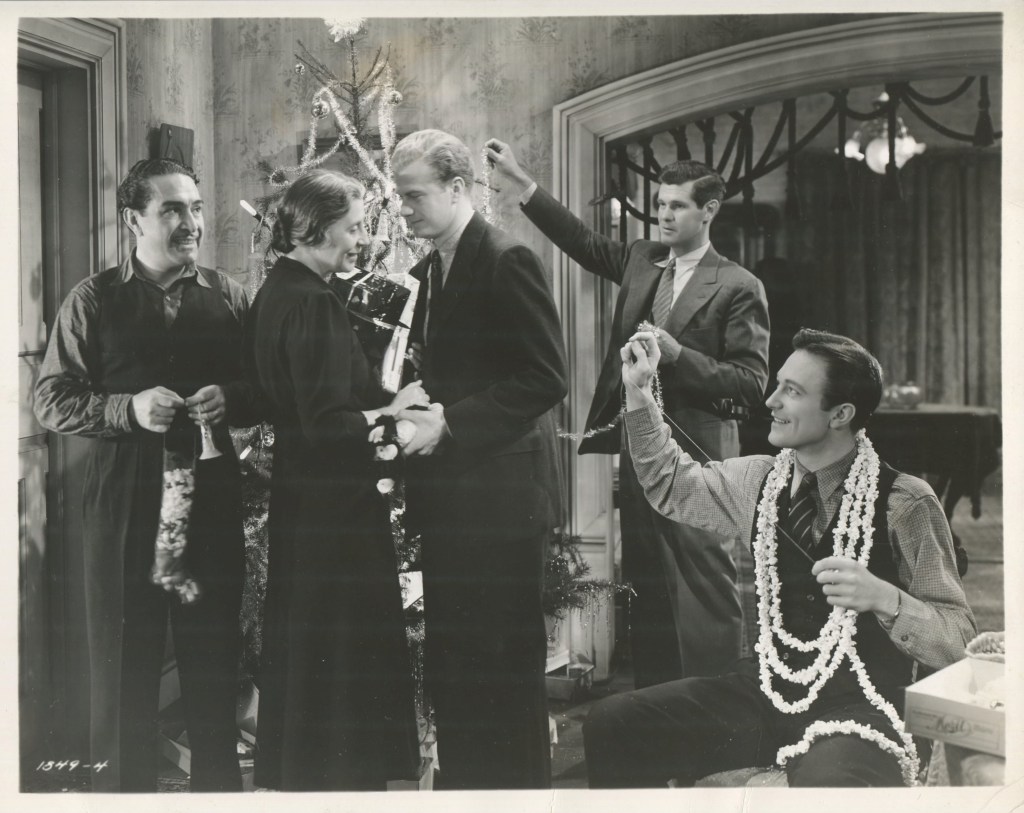
Above left to right, J. Carrol Naish, Blanche Yurka, James Seay, Paul Kelly, and seated Richard Denning.
The Screenplay of “Queen of the Mob”:
The audience meets the “Infamous ‘Ma’ Webster” of “Centre City”, who rules her three of her sons, “Eddie”, “Tom”, and “Charlie”, and her gang with her iron hand and shows no mercy, even to her sons, for anyone who disobeys her orders. This is not to the liking of the gangster “George Frost”, who is not a member of “Ma’s” family, but he adjusts to her rule within his own limits. The opening plan is to rob the “Centre City Bank”, but the one son who stands up to his mother, “Bert”, studying to become a lawyer, and married to “Ethel”, warns the five against the robbery. Adding that the “FBI” and local police have evidence against them. “Ma” surprises the others, by taking “Bert’s” advise and the robbery doesn’t happen, but the gang now starts a cross country crime spree including a kidnapping that they receive a ransom amount of $300,000.
Since “Ma” and her gang know the “FBI” has marked the bills and the serial numbers are on a list sent to many businesses. They meet with a shady character named “Pan”, portrayed by John Miljan.
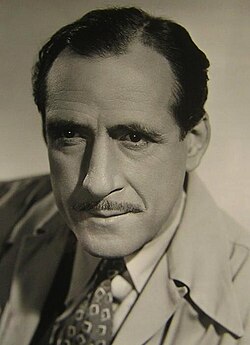
“Pan” exchanges the $300,000 in marked bills for $100,00 unmarked, but the temptation to keep the $400,000 over comes the trade, and “Ma Webster” orders the murder of “Pan”. What the “Webster” gang doesn’t know, is that examining the body of “Pan”, the “FBI” obtains the serial numbers of the unmarked $100,000 from a written list. As a result, the “Federal Bureau of Investigation” is now on the trail of “Ma Webster”, her three sons, and “Frost”.
“G-MEN Scott Langham” and “Ross Waring” are assigned to the “Webster Case” and soon have tracked “Ma Webster’s” gang to a small southern town, in which they seem to have relocated peacefully. “Ma Webster” is actually passing as a socialite to impress the locals.
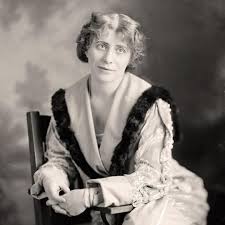
When “Langham” and “Waring” arrive in the community, as fast as they can, the gang disappears and takes up residence in cheap hotels, while moving from State to State.
The following Christmas Holiday, “Ma” decides to return to “Centre City”, and visit her son “Bert”, his wife, “Ethel”, and their new baby. She tells the others to stay where they are, BUT the three boys and “George”, decide to rob a store, but fail in the attempt, and “Charlie” is shot and killed, and “Tom” arrested.
“Bert” will represent his brother, and convinces “Tom” to plead guilty to the robbery. To also agree, that of this own free will, he will return to the city of the kidnapping to face trial there. The “Ma Webster Gang” is split over what “Bert” wants “Tom” to do. When “George Frost” tries to leave and go his own way, he is killed by “Ma” and “Eddie”. Next, the two contact another gang leader, “Stitch Torey”, portrayed by Pierre Watkin, for help getting “Tom” out of jail. “Stitch” and his gang fail at the attempt and most of them are killed. However, “Tom” goes with his mother and brother.
“Eddie” has been working at a cannery and is forming his own gang with their own hideout. He steals some cans of food from the cannery, and gives them to his men. Under pursuit by the “G-Men”, “Eddie’s” men crash their car and the cans are discovered. Sent to the “FBI Lab”, “Eddie’s” fingerprints are found on them. This leads to the captured criminals revealing “Eddie” and “Ma’s” whereabouts. That house is surrounded by the “FBI” and local police, and the “G-Men” ask for their surrender.
“Tom” gives himself up, as he has finally realized what his mother has done to his and his brother’s lives. He can not longer face that life, and will stand trial defended by “Bert”. Next, neither “Eddie”, or “Ma” will surrender, and the gun battle begins.
When it ends, “Eddie” is dead, and “Ma” has been handcuffed and arrested. She will face justice in the court of law. Again, pushing J. Edgar Hoover’s belief that crime doesn’t pay and his “FBI” Agents are heroes.
THUS ENDS “PARAMOUNT PICTURE’S” FOURTH AND FINAL MOTION PICTURE BASED UPON FBI DIRECTOR J. EDGAR HOOVER’S AUTOBIOGRAPHY, “PERSONS IN HIDING”.
HOWEVER, ever hear of one-time circus clown, reporter for the “Kansas City Star”, “New York World”, “Chicago Tribune”, and the “Denver Post”, Marine Corps Lieutenant, 1920’s and 1930’s screenplay writer, was “Annie Oakley’s” first biographer, and authority on the circus and crime, Courtney Ryley Cooper. Oh, and personal friend and confident of John Edgar Hoover?
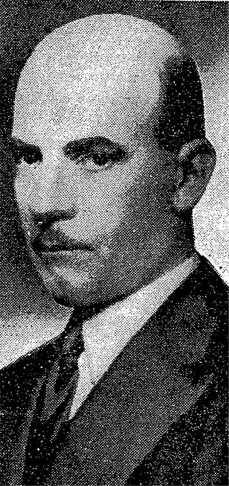
Today, I is believed thar FBI Director, J. Edgar Hoover, DID NOT WRITE “Persons in Hiding”. It is believed that Courtney Ryler Cooper was Hoover GHOST WRITER. Although, Hoover may have had input on the work.
Which brings me to THREE OTHER FILMS the FBI Director was involved with:
WALK EAST ON BEACON premiered on April 29, 1952
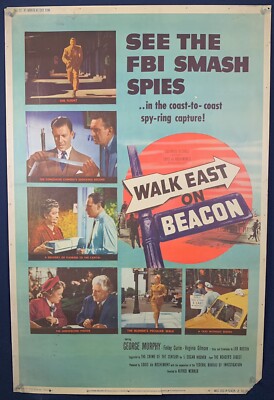
The screenplay was based upon an article entitled, “The Crime of the Century: The Case of the A-Bomb Spies”, published in a 1951 edition of “The Readers Digest Magazine”, under the by-line of J. Edgar Hoover. As my reader has noted, Hoover had others write for him. I could not locate who, but as “FBI Director”, he took the credit.
The primary subjects of Hoover’s article, where Klaus Emil Julius Fuchs, Harry Gold, David Greenglass, and the more remembered, Julius and Ethel “Greenglass” Rosenberg. All worked on “The Manhattan Project”, at the “Los Alamos Laboratory”, and were charged with being part of a Second Red Scare Soviet Spy Ring, by the United States Government. After major investigation by J. Edgar Hoover’s, “FBI”. The specific charges was spying for the Soviet Union, providing “Top Secret” information about American radar, sonar, jet propulsion engines, and the designs for American nuclear weapons.
As J. Edgar Hoover (?) tells it in his article. The “Rosenberg’s” were considered the major target by the United States Government, and Julius was known as the “organizer” of this “American Spy Ring”.
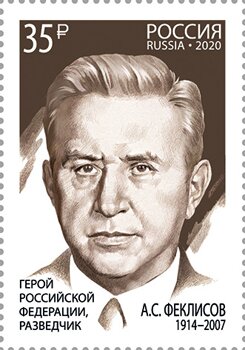
Julius Rosenberg clearly worked for Soviet Spymaster, Aleksandr Semyonovich Feklisov, seen on this Soviet Stamp commemorating him.
HOWEVER, according to the “Venoa Transcripts”, from a major “Cold War” counterintelligence program that intercepted Soviet Spy Traffic and decoded it. Ethel Rosenberg’s participation was either very minor, or may have been non-existent and Hoover’s “FBI” got it wrong.
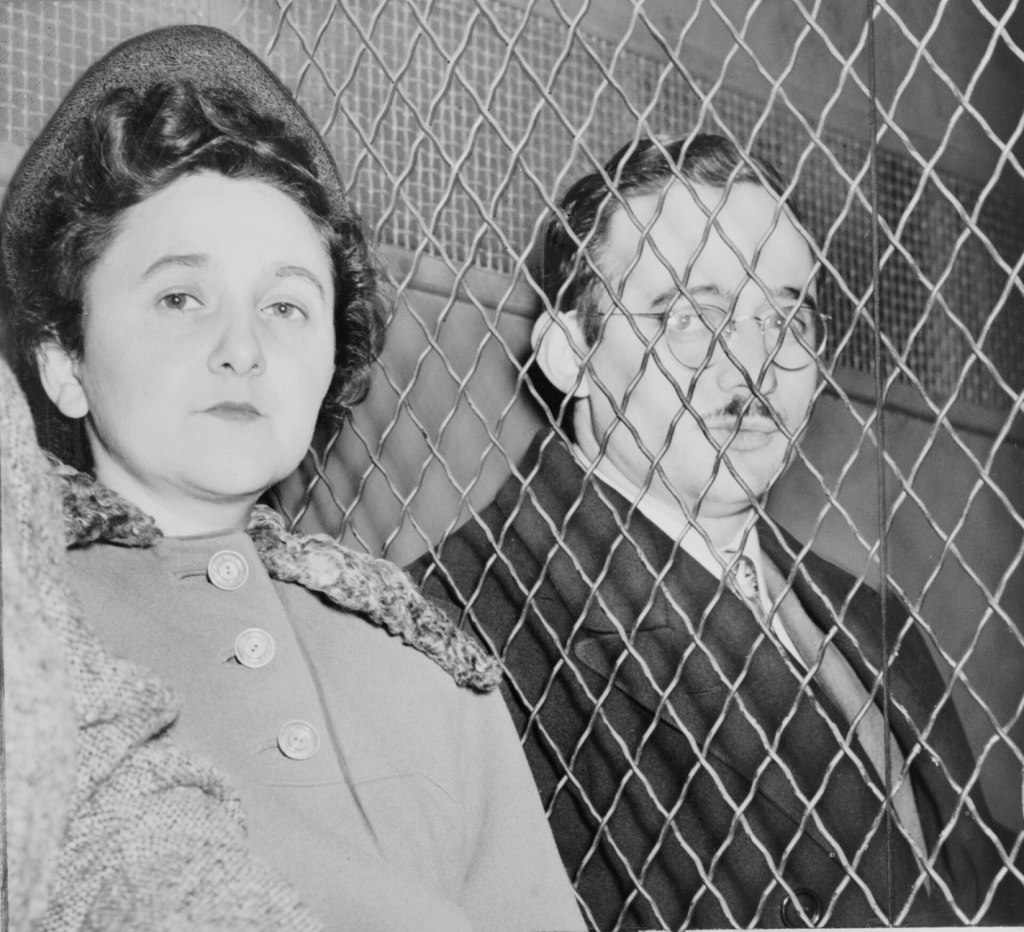
Ethel and Julius Rosenberg were executed in New York’s, “Sing Sing Prison”, on June 19, 1953. The couple are the only members of the Soviet Spy Ring that were executed.
Ethel’s brother, David Greenglass’s testimony, was a major reason that his sister was executed. His viewpoint about Ethel appear to have been based upon written statements from David’s wife. Which may not have been true, because it appears that Ruth Leah “Printz” Greenglass, may have been the real Soviet Spy, not her sister-in-law. Ruth approached David to join her. According to “The Mitrokhin Archive: the KGB in Europe and the West“, by Christopher M. Andrew, and, Vasili Mitrokhin:
David is on record replying to to his wife’s question:
“My darling, I most certainly will be glad to be part of the community project (espionage) that Julius and his friends (the Russians) have in mind.”
Ruth testified at the “Rosenberg’s Trial” as a Government witness, and was never charged in the espionage case.
David served 9-years in prison, and was released. Before his death at 92-years, he admitted questioning some of his wife’s statements, but David never brought that questioning up in court.
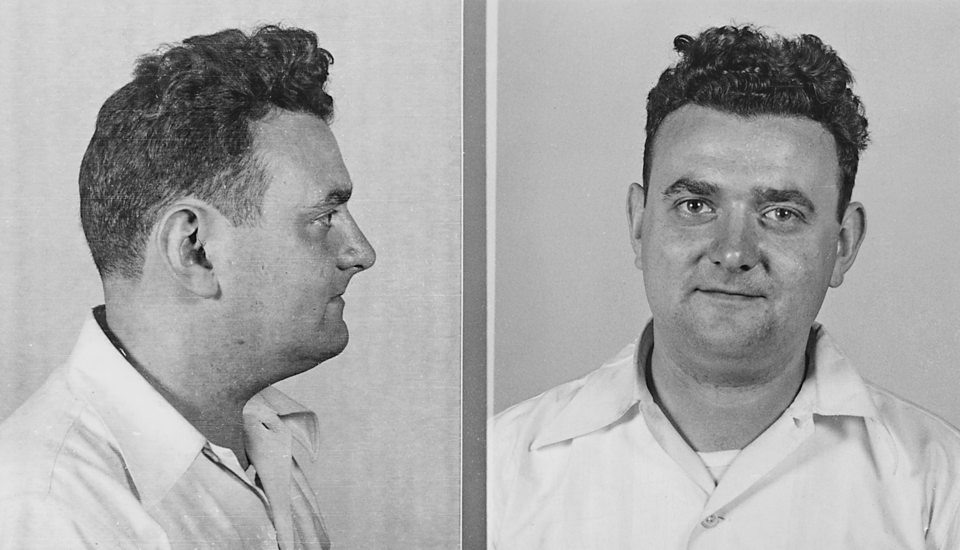
Ruth Greenglass would rejoin her husband after his release from prison. The two lived in New York City under assumed names with their children. Ruth passed away on April 7, 2008.
A few days after her death, Ruth’s Grand Jury testimony was finally unsealed, and released. Much of her answers were different than the testimony she gave in court. It was her court testimony that convinced the jury that Ethel was guilty. From a historical perspective, adding to both, one, that Ruth, not Ethel, was the Soviet Spy, and either, two, J. Edgar Hoover’s “FBI” was protecting itself from wrongful arrest, and the Government Prosecutors knew the truth about Ethel Rosenberg. Either, explaining why Ruth Greenglass’s “Grand Jury Testimony” was placed under seal.
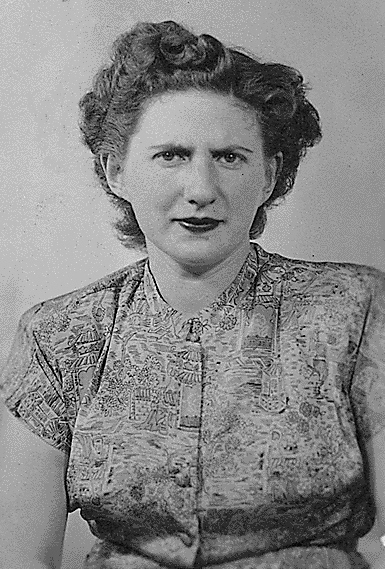
Klaus Emil Julius Fuchs was a German theoretical scientist, with British citizenship, that worked on the “Manhattan Project” at “Los Alamos”. Fuchs was convicted on March 1, 1950, and served 9-years and 4-months in a British prison. On February 21, 1951, he was stripped of his British citizenship.
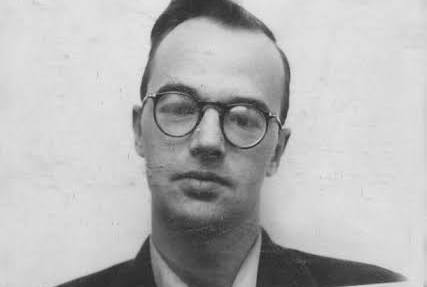
Harry Gold, was born Henrich Golodnitsky, in Switzerland. In 1940, Soviet Union Spymaster Jacob Golos recruited Gold as a Soviet Spy. He was the spy that passed information about the Atomic Bomb from the others to the Soviets. He was the United States Government’s main witness against the Rosenberg’s. In 1951, he was sentenced to 30-years in prison, but in May 1965, we released on parole for his good behavior.
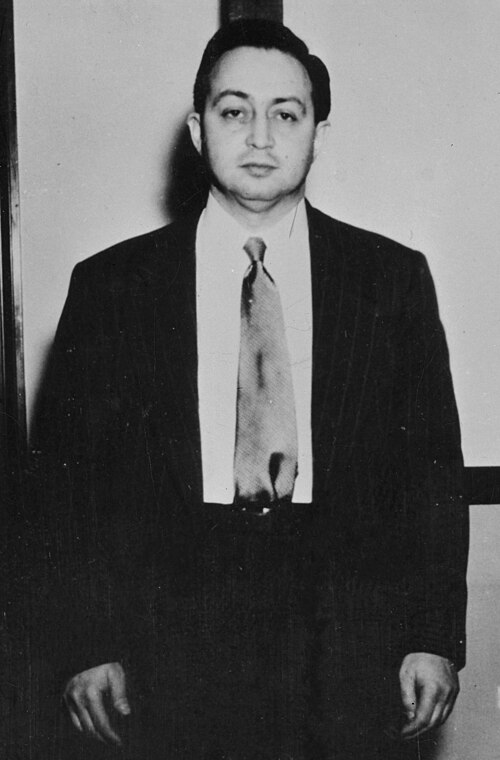
The motion picture version of the “Reader’s Digest” article:
For this “Columbia Picture” motion picture, it took 4-writers to turn J. Edgar Hoover’s magazine article into a screenplay. The main writer was Leo Rosten, who had worked of President Franklin Delano Roosevelt’s, Second World War Administration as the “Deputy Director of the Office of War Information”. Among his stories and screenplays was the 1942, Humphrey Bogart film-noir political drama, “All Through the Night”, in 1946, it was the dramatic actress, Lucille Ball and Clifton Webb’s, film-noir crime thriller, “The Dark Corner”, and on a lighter side. Just before this motion picture, was the Jane Russell, Groucho Marx, and Frank Sinatra, musical comedy, 1951’s, “Double Dynamite”. Rosten would follow this picture by writing the story for the Tony Curtis and Martha Hyer, crime thriller, 1957’s, “Mr. Cory”.
Laurence Heath writing as Leonard Heideman was a television writer and this was his first screenplay. His next feature film would be as an uncredited writer, on the 1954, animated version of George Orwell’s, “Animal Farm”. Otherwise, Heath concentrated on 1950’s television drama’s.
Emmett Murphy was a television writer. Who between this, his first work, and his last in 1972, worked on a total of 12 scripts.
Virginia Shaler was the fourth writer, and since 1949, this was her 3rd of 4 screenplays, the last in 1960.
The motion picture was directed by Alfred Welker. His first feature film was the Fred Thompson, 1925, Silent Western, “Ridin’ the Wind”. Fred’s co-star was his horse, billed as “Silver King the Horse”. Among Welker’s films is 1939’s, “The Adventures of Sherlock Holmes”, starring Basil Rathbone, Nigel Bruce, and Ida Lupino, the psychological film-noir, 1946’s, “SHOCK”, starring Vincent Price and Lynn Bari, and the heist thriller, 1948’s. “He Walked by Night”, starring Richard Basehart and Scott Brady.
The Main Cast:
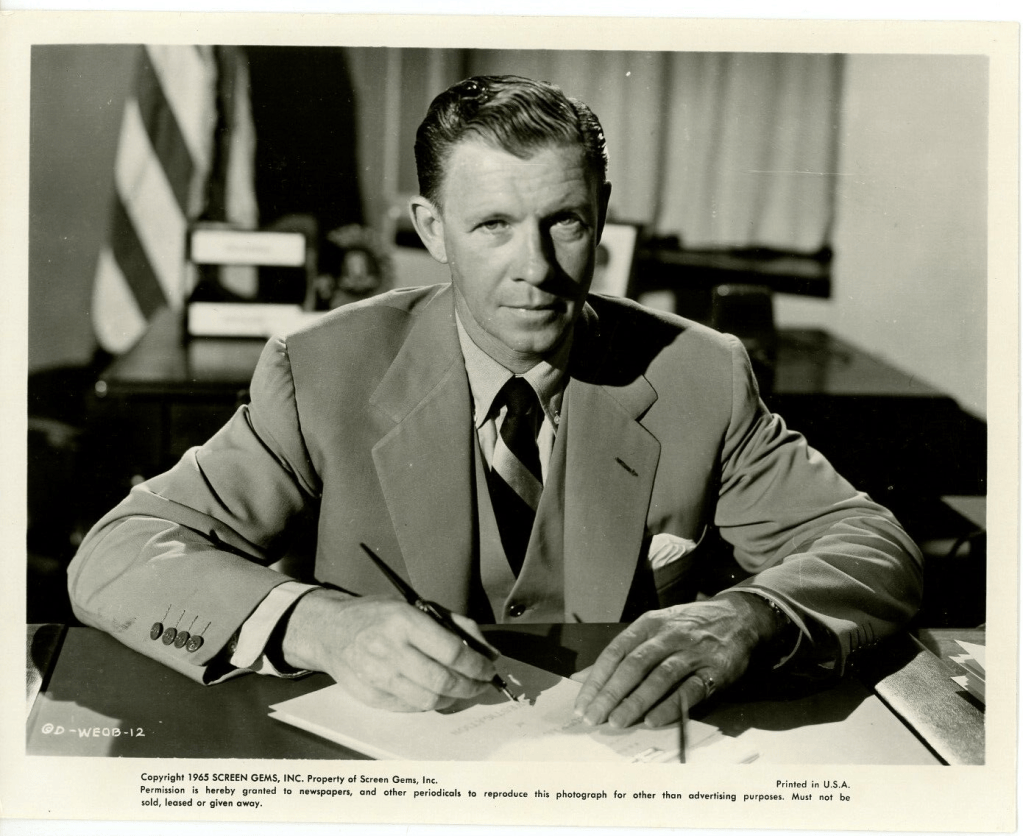
George Murphy portrayed “G-Man, Inspector James ‘Jim’ Belden”. The future California Senator had just been seen in the psychological drama, 1952’s, “Talk About a Stranger”, co-starring with his best friend’s wife, actress, now, Nancy Reagan. Murphy’s next on-screen appearance wasn’t until a 1958 television episode of the comedy-mystery series, “The Thin Man”.
Finlay Currie portrayed “Professor Albert Kafer”. The Scottish born Currie was just in “Metro-Golden-Mayer’s”, all-star, epic 1951 version of Henryk Sienkiewicz’s, “Quo Vadis”. He followed this picture by co-starring with Maureen O’Hara and Peter Lawford, in the Australian adventure, 1952’s, “Kangaroo”.
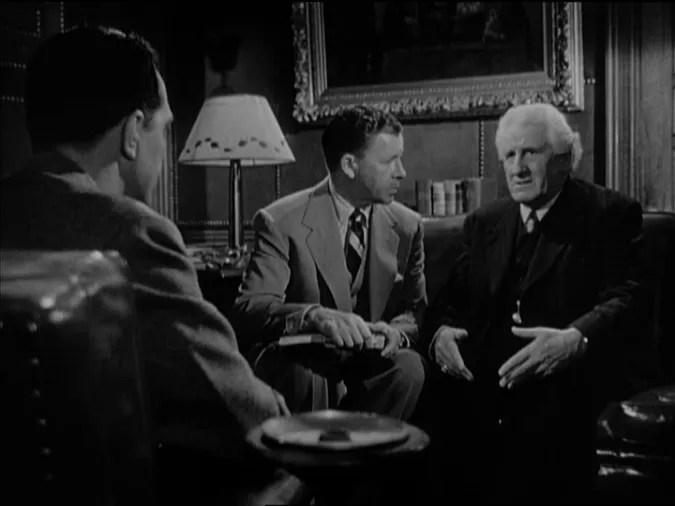
Above, George Murphy is speaking to Finlay Currie.
Virginia Gillmore portrayed “Millie Zalenko”: aka: “Teresa Henning” aka: “Teresa Salinka”. Gilmore was just in “The Dune Roller” the January 4, 1952 episode of television’s “Tales of Tomorrow”. She followed this feature film with the June 16, 1952 episode, “The Barker”, on television’s “Broadway Television Theatre”.
Karel Stepanek portrayed “Alexi Laschenkov” aka “Gregory Anders”. The Czechoslovakia born actor had just been seen in the “BBC Sunday-Night Theatre’s”, June 24, 1951 episode, “Those in Favor- – -“, and followed this movie with 1952’s, “Affair in Trinidad”.
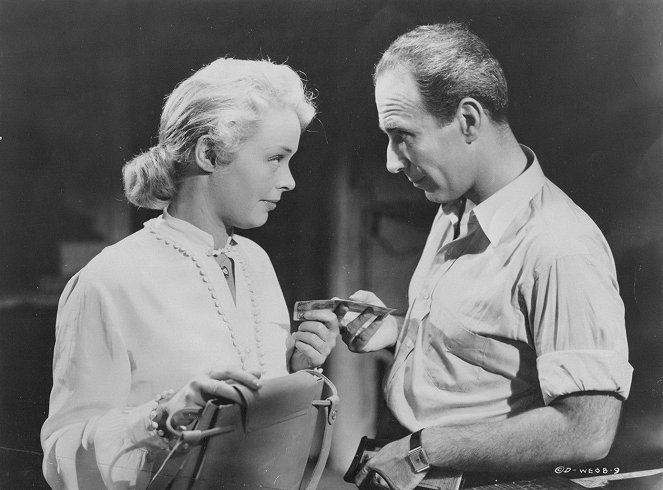
Above, Virginia Gillmore and Karel Stepanek.
Peter Capell portrayed “Chris Zalenko”, aka: “Gino”. Capell was just seen in “The Man with the Astrakhan Hat”, March 5, 1951, on Arch Oboler’s horror television program, “Lights Out”. He followed this movie with “The Puzzle of Pier 90”, on the television crime series, “The Hunter”, July 1,6 1952.
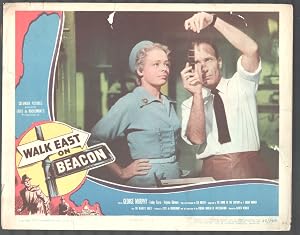
Above, Virginia Gillmore and Peter Capell.
On the “Official Cast Listing” was an uncredited, J. Edgar Hoover. Who is seen on stock footage that “Columbia Pictures” was able to obtain. Hoover was against this motion picture, even though it showed the crime fighting techniques of his agency.
His problem was with the screenplay. That clearly showed how “Communist Agent’s” could gain access to Scientists working on “Top Secret” programs. Who would, also, have access to “Top Secret” documents.
Which makes no since, as the picture was made after the “Rosenberg Trial” had been covered worldwide, and “HE” (?), had written the “Readers Digest” article.
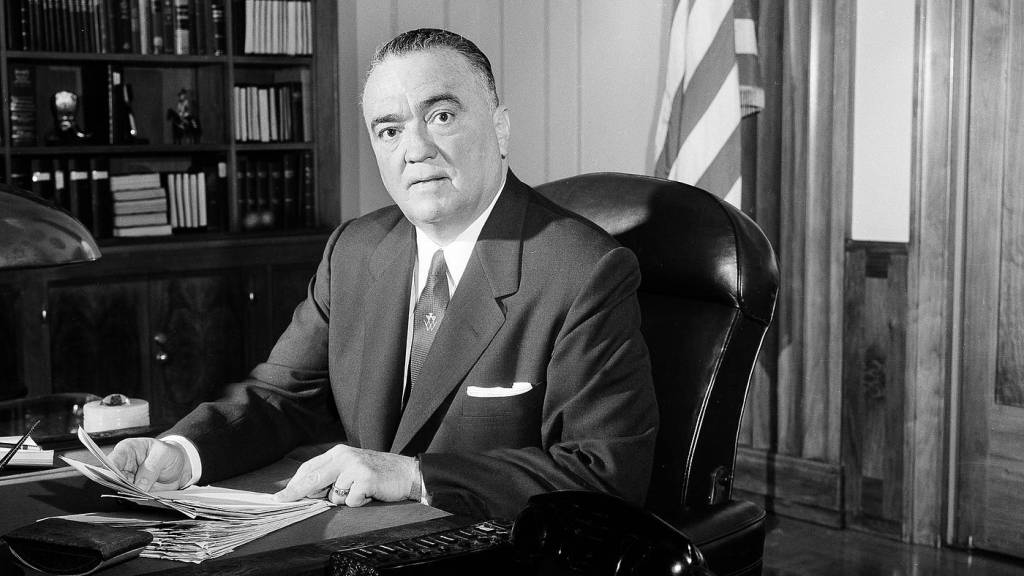
The Screenplay:
Although the “source” is claimed to be the “Reader’s Digest” article. This screenplay has nothing to do with what I mentioned above. Instead, we have a standard, 1950’s, “Red Scare” plot, BUT with an excellent cast. All acting in a screenplay which should have been under J. Edgar Hoover’s personal control. That was DESIGNED TO SHOW OFF THE TECHNOLOGY OF THE “FEDERAL BUREAU OF INVESTIGATION”. Against the Soviet Union’s ability to spy on America.
The Soviet Spy Master inside the United States is “Alexi Laschenkov”. The setting for this picture is Boston, Massachusetts, and “Alexi” has arranged for the son of emigre, “Professor Albert Kafer”, to be kidnapped and held hostage. The son, “Samuel”, who is never shown in this motion picture, will be taken to East Berlin under guard at all times. The kidnapping is to be the Soviet Spy’s hold over the professor to get him to obtain “Top Secret” documents. Should the Professor not co-operate, his son will be executed.
Once the professor knows what “Alexi” wants, he contacts the “FBI” with the plot, and is told what he should do. Meanwhile, the “FBI’s” counterintelligence group goes into action with “G-Man, Inspector James ‘Jim’ Belden”put in charge.
Unknown to the “FBI”, the Soviet Spies are using a photo shop run by “Millie Zalenko” and her husband,“Chris Zalenko”, at 26 Locust Street, in Boston. (There is a real Locust Street in Boston, but homes on that block do not get that high. The highest number is “20 Locust Street”.) The photo shop front helps the Spy Ring make copies of documents, and process photographs to be either used in Boston, or by other Spy Rings in the United States and Canada. It is through the photo shop that documents get sent to the Soviet Union.
Director Alfred Welker used a documentary style on the screenplay known as “Doc-Noir”. The audience meets ,sand follows, rather closely, the good guys, and the bad guys. Allowing the audience to be an active part of “G-Man Belden” and his team’s investigation. A number of clues are put together, through interviews, and the following of suspects, which finally lead the “FBI” to the “Zalenko” photo shop.
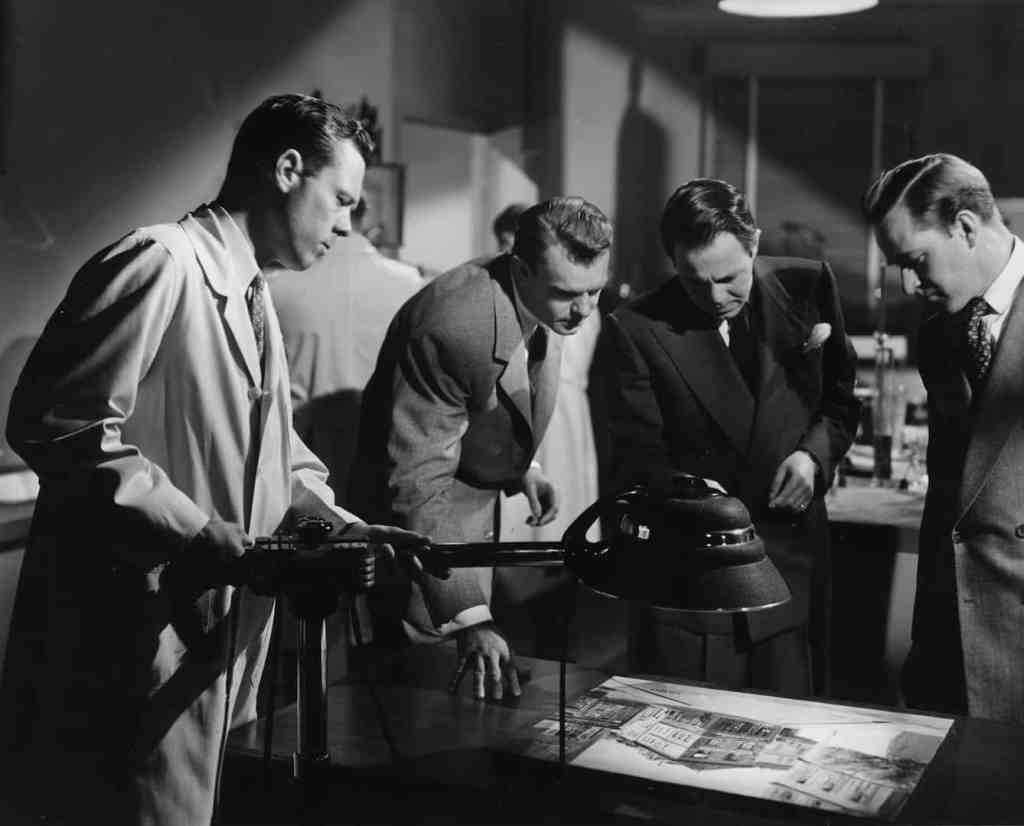
An example of modern, 1952, “FBI Tech” is shown. When a small television camera, with sound capability, is placed inside the photo shop to spy on the spies. The “FBI” learns that the Soviets are after the “Falcon Space Defense System”. (Here, would have been the direct tie in to the Los Alamos Spy Ring. The actual Los Alamos Spy Ring was after the secret of the Atom Bomb, but filmmakers were cautioned, for national security, not to touch the subject matter of the “Rosenberg Trial”. So, one of the writers, came up with a futuristic computerized space defense system with the code name “Falcon”. Nothing like a little improbable Science Fiction in 1951, when the movie was shot.)
Proceeding to the climax, one by one, the “Communist Cell” is broken up.
“Millie Zalenko” is arrested by the “FBI”.
“Chris Zalenko” is arrested by the “FBI”.
Other Characters:
The Florist, “Luther Danzig”, portrayed by Bruno Wick, whose shop is a meeting place for the “Communist Cell”. Centrally located in the Beacon Hill district, is arrested.
Taxi Driver “Melvin Foss” aka: “Vincent”, portrayed by Jack Manning, who met with “Professor Kafer” on Beacon Street at midnight. “Foss” becomes an “FBI Informant”, but is still arrested. His wife “Rita Foss”, portrayed by Vilma Kurer, is innocent. She becomes a shocked symbol of what happens to a family after a one time good American goes over to the Commies.
While this is happening, “Alexi Laschenkov” had succeeded in kidnapping “Professor Albert Kafer”, the scientist behind the “Falcon Project”. “Kafer” is force into a small boat preloaded with stolen material by the Russian spy. Who could care less about the members of the cell, because he, and the professor, will be safely in mother Russia. “Laschenkov” heads the boat for open waters. There he plans to meet a Soviet submarine and the two men will go to the Soviet Union. However, “G-Man, Belden”, has gotten together with the “United States Coast Guard”. There are able to stop the small boat before it can meet the submarine, it leaves without either man, being pursued by the Coast Guard. The Spy Master will join the rest of his Communist Cell, and the Professor will return to his work on the “Falcon Project”.
What is never mentioned is what happened to the Professor’s son in East Germany.
J. Edgar Hoover wrote (?) another short article for “Reader Digest”:
THE TRIGGER FINGER CLUE aired on television’s “Readers Digest”, March 26, 1956
Apparently, no images of the program exist today. It also appears that no video of this program is available either.
The Actual Bank Robbery:
On May 23, 1928, the legendary Colorado bank robbery of the “First National Bank”, in Lamar, Colorado, took place. The robbery had been planned by two brothers, Jake and his older brother Ralph Fleagle. When it was over, three more members of the Fleagle family would be indirectly involved.
However, directly involved were two known criminals, California’s Howard “Heavy” Royston (His last name is often misspelled as “Royton”). Howard’s nickname, “Heavy”, was because he weighed 250 pounds.
George J. Abshier was the gang’s scout and also participated in the actual robbery.
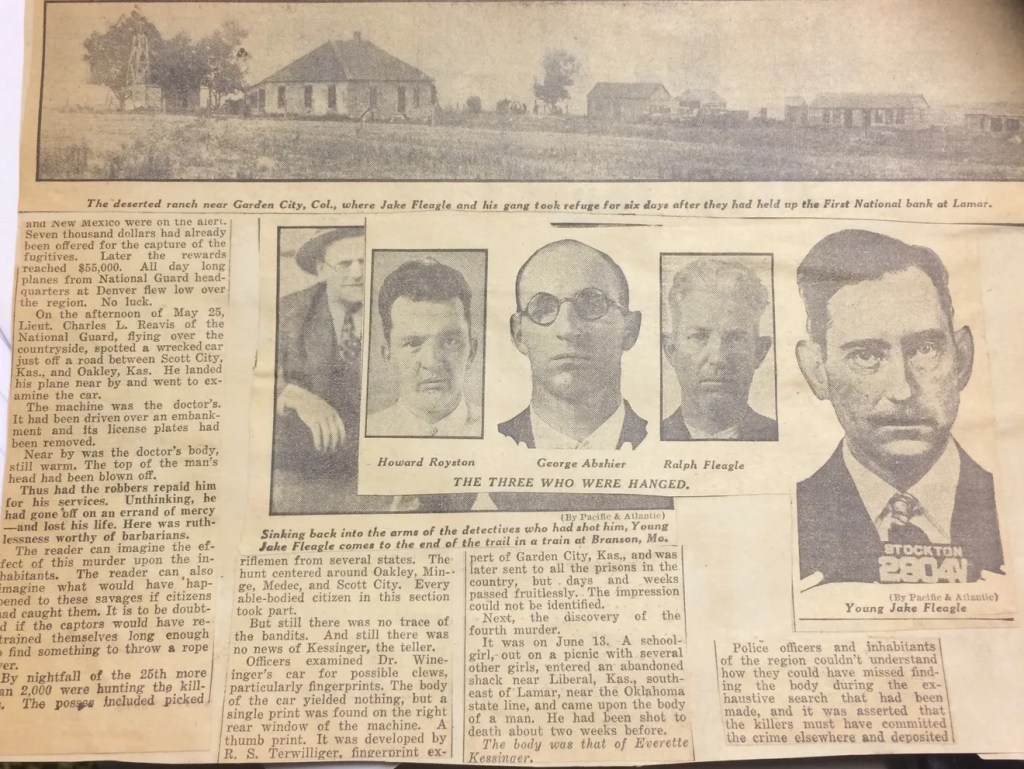
Initially, San Quentin Prison escapee, Corazon Gargullio, was brought in for the robbery. However, he got frustrated with all the delays in carrying out the robbery, and left, before it took place. His involvement with the planning would be discovered, a few days after the robbery took place, Garguillo would be killed by law enforcement.
During the actual robbery, the elderly bank president, A. N. Parrish attempted to fight back, and with his pistol shot Howard Royston in the jaw. In retaliation, Jake Fleagle shot and killed Parrish. A. N’s son, J. F. Parrish rushed into the room to try and save his father, but was killed by Ralph Fleagle.
During the getaway, the gang kidnapped local doctor Dr. William Wesley Wineinger to treat “Heavy”. After he had performed his work, Winesinger was shot and killed, dumped into his car, and the car pushed into a canyon.
What followed was historical for the fledgling law enforcement agency still being called the “Bureau of Investigation”. Agents were called to the wreck of Dr. Wineinger’s car and found a single latent fingerprint on the window glass. The window glass with the finger print was sent to the “Bureau’s” Washington, D. C. office. Where, fingerprint pioneer Albert Parker, was able to match it to a fingerprint card of Jake Fleagle from an earlier arrest. What makes this somewhat amazing, was Parker remembered seeing this same print on a fingerprint card for Jake Fleagle from an earlier arrest.
THIS WAS THE FIRST TIME A SINGLE LATENT PRINT FROM A CRIME SCENE LED TO SOLVING A CASE FOR THE “FBI”.
After Jake Fleagle was identified, a team of Federal Agents went to the “Fleagle Farm in Kansas. There they found a letter written by Ralph Fleagle asking his family members to send his mail to a Post Office Box in Kankakee, Illinois. In July, 1929, a team of Post Office Agents and Local Police ambushed and arrested Ralph.
At the same time, at the “Fleagle Farm”, another team of agents arrested Ralph’s elderly father, and two brothers, Fred and Walter, along with Ralph’s wife, Margaret. All leading to him making a full confession for the release of his innocent family members.
The ending for the “Fleagle Gang” found:
Jake killed in a shoot out in with police in 1930, Branson, Missouri, during a train robbery.
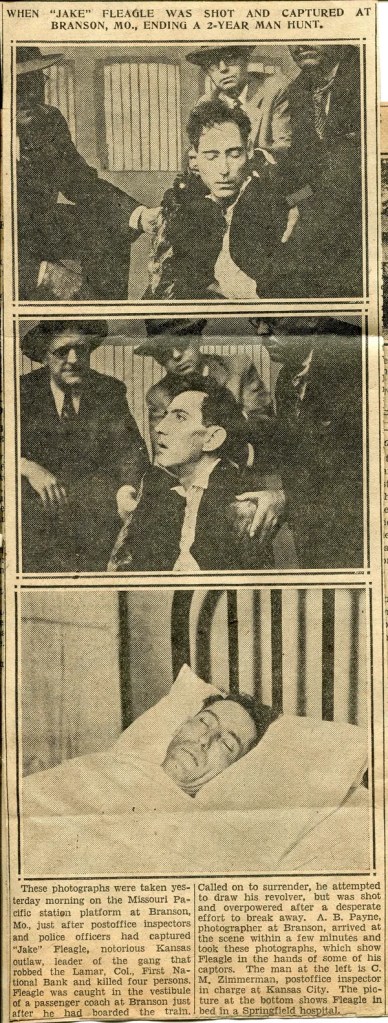
While, Ralph, Howard, and George, all captured, convicted in separate trials, and executed by hanging at the “Colorado State Penitentiary in 1930.
However, even as a write this article, the search for Ralph Fleagle’s buried treasure still goes on. The following comes from the website, “Legends of America” at:
https://www.legendsofamerica.com/fleagle-gang-loot/
“As for the hundreds of thousands of dollars of Ralph Fleagle’s buried booty, one cache was dug up in Nebraska in 1952, another in Kansas in 1961, and another near Murrieta, California.
Many Fleagle bandit caches are still said to be scattered throughout the Inland Empire of Southern California, as well as in the Sacramento, California, and Garden City, Kansas, areas.
One buried cache of $100,000 taken from a bank in Nebraska is said to be buried in one or two places: in the area of Battle Canyon, in the badlands of the Logan-Scott County area, and on Ralph’s Fleagle’s ranch, where he lived before he was captured near Branson, Missouri.”
THE “READERS DIGEST” VERSION:
J. Edger Hoover’s article was given full credit for the source of the story. The teleplay was written by William P. Rousseau. This was his 3rd-episode of the “Readers Digest” television series. Before this episode, Rousseau wrote 7 for the television series, “Public Defender”, starring actor Reed Hadley. At the same time, the writer was also a producer of both “Public Defender”, and “Jane Wyman Presents the Fireside Theatre”, among other programs in both fields.
However, the character’s for this 30-minute program, including commercials, were changed. In fact they where based more on the
Elisha Cook, Jr. portrayed “Big Mike Presser (Ralph Fleagle)”. Cook followed this program with director Stanley Kubrick’s,. 1956, “The Killing”. Horror fans know the actor from William Castle’s, 1959, “House on Haunted Hill”. My article is “Elisha Cook, Jr.: Film-Noirs, Westerns, Horror, Science Fiction and a Judy Garland Musical” to read at:
https://www.bewaretheblog.com/2025/05/elisha-cook-jr-film-noirs-westerns.htm
Joe Turkel portrayed “Eddie Presser (Jake Fleagle)”. He next appeared in Stanley Kurbrick’s, 1956, “The Killing”.
Paul Dubov portrayed “Morty Boyle (A combination of George J. Abshier and Howard “Heavy” Royston)”. Dubov’s next appearance was in “The Night of January Sixteenth” on television’s “Lux Video Theatre”.
Dabbs Greer portrayed “Dr. Petrie (FBI Albert Parker) . Greer followed this television program with 1956’s.”Hot Rod Girl”.
Ray Walker, uncredited, portrayed William Wesley Wineinger. I could only locate his name, but not his other film and television work. He was truly “Uncredited”, as the IMDb website shows at:
https://www.imdb.com/title/tt0715781/?ref_=nm_flmg_job_1_accord_1_cdt_epp_sm_1
All the events of the robbery and its aftermath were shown, but compressed into a 30-minute format. The television viewer saw the bank robbery, the murder of the bank’s president, and his son. The murder of the doctor, and his car being pushed over a cliff. ALL A SECONDARY BUILD-UP TO THE ALBERT PARKER, I mean “Dr. Petrie” sequence, and the discovery of the owner of the “Trigger Finger” print on the windshield. Illustrating, as required by J. Edgar Hoover, the demonstration of a “FBI Heroe” protecting American’s. Followed by a very time compressed capture and trail of the entire gang.
According to the website “IMDb”:
https://www.imdb.com/title/tt0269666/?ref_=ttrel_ov_bk
J. EDGAR HOOVER WROTE THE NARRATION FOR:
OPERATION ABOLITION released in New York City on January 29, 1962
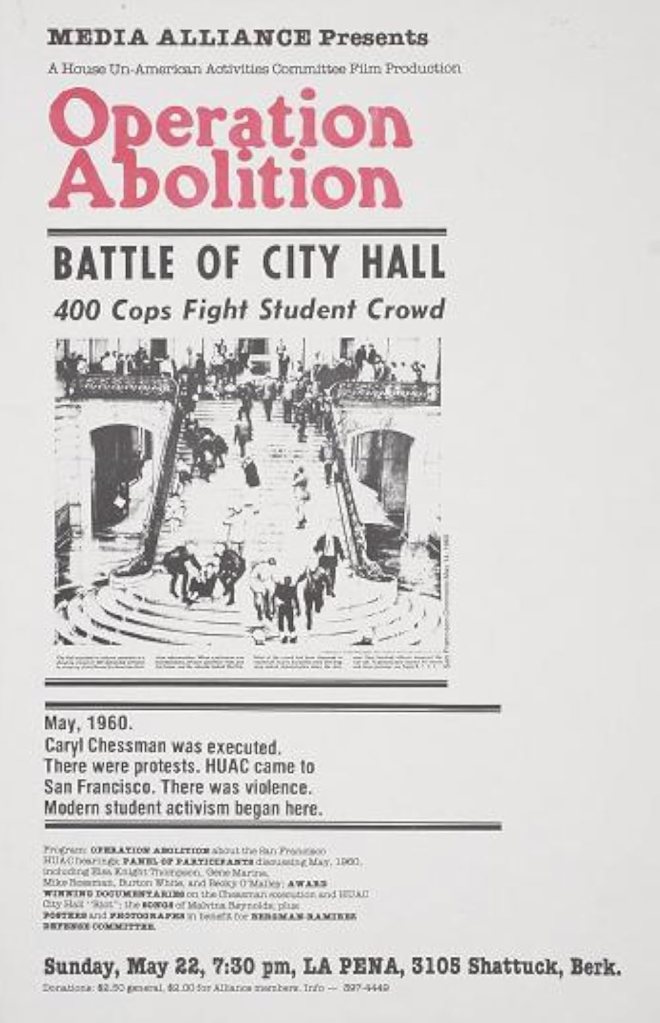
Before I explain the title of J. Edgar Hoover’s short subject. I suggest my reader read my article about the “House Committee on Un-American Activities (HUAC)”, to get a feel for what the committee was like.
“MCCARTHYISM: LIGHTS, CAMERA, COMMUNISTS IN THE MATION PICTURE INDUSTRY” found at:
https://www.bewaretheblog.com/2025/08/mccarthyism-lights-camera-communists-in.html
From May 12th through May 14, 1960, the “HUAC” had scheduled hearings at the San Francisco City Hall. They were looking for evidence to support their claim, that a widespread Communist Conspiracy was infiltrating Northern California’s core institutions. Specially, the very liberal, University of California, Berkeley, and Stanford University.
What the committee members were expecting, was the normal cooperation of the city and country officials. Who were afraid of the “HUAC’s” POWER!
INSTEAD, what they met were up to 500 students forming both a picket line around City Hall and taking up some space inside the galleries. These students were protesting the “HUAC’s” actions across the country. Which seemed to include the apparent exclusion of the general public from their “Secret Hearings”. In short ,violating the “FIRST AMENDMENT“.
On that first day, there would be 64 student arrests, and the “HUAC” members demanded that the students being expelled from City Hall. From that moment on, the students were “LOCKED OUT” of City Hall. Special Passes were put into effect! Needed, to get into the building itself, and police guards were put on all doors.
To clear the protesting students on the first day. The fire department started using water hoses to clear City Hall. They even washed some of students down the outside hard stone steps with their hoses, 64 students were arrested.
The protesters ended their day singing “The Star Spangled Banner”.
THE FOLLOWING DAY THE “HUAC” COMMITTEE MET OVER 1,000 PROTESTORS.
While, J. Edgar Hoover, did not write the narration, for the 45-minute piece of propaganda, that the “HUAC” made. The staffers from the committee, edited clips of “News Footage” from the protests, and titled the sort film, “Operation Abolition”. With the written narration read by the producer, Fulton Lewis III, the protests now showed that the students were either led by, or where Communists. Hoover turned the full power of the “FBI” on the protestors, and.
HE DID PERSONALLY AUTHOR an “FBI Report” to back-up and support the “HUAC” short subject, entitled:
COMMUNIST TARGET -YOUTH: COMMUNIST INFILTRATION AND AGITATION TACTICS
This was a report on the findings of the San Francisco FBI Field Office, ordered by Hoover, to investigate the student protests. The document stated that “The Students were dupes of RED Agitators.” For justification to back his report, J. Edgar Hoover, referenced the same justification for the “HUAC’s” findings for their short film, “Operation Abolition.
However, declassified “FBI Documents”, reveal that Hoover was furious with the San Francisco Office. Apparently, they criticized the “HUAC” film’s conclusions, and disagreed with what their boss had written in his report. Stating that they found no real evidence of Communist plants within the student protestors.
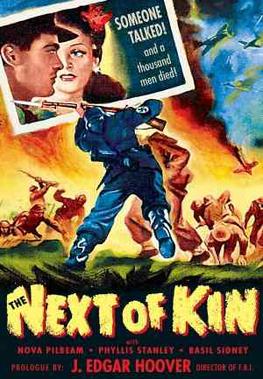
The 3rd on-screen appearance by J. Edgar Hoover was as the narrator of a British made motion picture.
In 1942, a British propaganda film came out, entitled “Next of Kin”. The movie was released in the United Kingdom on May 15th. The picture was made by the “British War Office”, and designed to warn British soldiers of the danger that “Carless Talk Causes Lives”. Initially, it ran 102-minutes. However, when it came to the United States, one-year later on May 5, 1943, David O’Selznick was concerned that the story might give American’s the image that Great Britain was overrun by spies. So, he had a prologue and an epilogue written to explain the film. Selznick got J. Edgar Hoover to do both, the United States version of the movie only ran 75-minutes with the prologue and epilogue added.
This was just a small look at a side of J. Edgar Hoover most people do not know ever happened. He died, the man who held the secrets, on May 2, 1972.
 THE FILM MADNESS OF FRADKIN-STEIN
Leave a comment