“I was reaching for a gutter Macbeth—a composite figure that would indicate how men could rise to prominence or money under the most hazardous conditions, but not much more hazardous than the men of the Renaissance… if you have this type of society, it will produce such men. That’s what I was looking for, a type. Rico was doomed from the first. If he had a tragic flaw, it was over-impulsive action. But he is the picture of overriding ambition.”
You’re about to meet the man quoted above, in the biography, “W.R. Burnett: The Outsider”, by Patrick McGilligan and Ken Mate, published in 1986.
What follows is a selection of motion pictures. Some titles have multiple versions mentioned and compared. All movie titles are based upon best selling novels, or screenplays, written, or co-written, by the face you see below, William Riley “W. R.” Burnett. Every one contains unflinching characters and story lines.
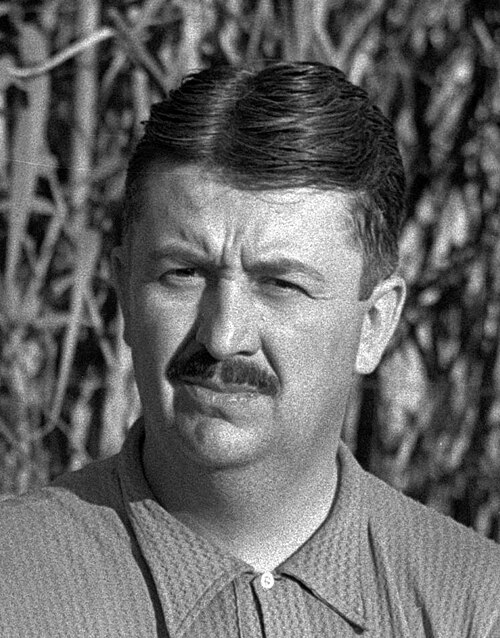
I start with his “MACBETH”!
LITTLE CAESAR released January 9, 1931
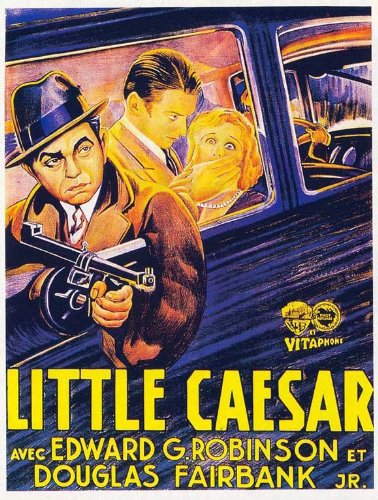
Twenty-eight year old Chicago hotel night clerk, William Riley Burnett, spent his time studying the people that came, and went, during the late night hours. The Springfield, Ohio, native, a graduated of the “Miami Military Institute”, a boarding college, in Germantown, Ohio. At this point in his life, had written a 100, never published short stories, and five unpublished novels, but, he was about to turn those night people into a classic crime novel.
On January 1, 1929, W. R. Burnett’s novel, “LITTLE CAESAR” was published. “First National Pictures”, which would merge, to form “Warner Brothers”, on November 4, 1929, acquired the movie rights.
“First National” initially assigned Francis Edward Faragoh (born Ferenc Eduard Fargo in Budapest, Austria-Hungary) to turned W. R. Burnett’s novel into a screenplay. This was only Faragoh’s 4th-screenplay, but also co-wrote, “Universal Picture’s”, 1931, “Frankenstein”.
Robert N. Lee was also assigned as a writer on “Little Caesar”. Lee’s first screenplay was 1922’s, “Shirley at the Circus”, and he was the primary writer for 1933’s, “The Kennel Murder Case”, starring William Powell and Mary Astor, based upon the S. S. Van Dine, “Philo Vance” mystery novel.
Daryl F. Zanuck, without on-screen credited, contributed to this screenplay.
Robert Lord also, without credit, contributed to the screenplay. His name does not always appear of listings of the motion picture.
Mervyn LeRoy was assigned as director. LeRoy would direct 1932’s, “I Am a Fugitive from a Chain Gang”, starring Paul Muni, 1944’s, “Thirty Second Over Tokyo”, starring Spencer Tracy, and 1951’s, “Quo Vadis”, starring Robert Taylor and Deborah Kerr, among many other feature films.
The Main Cast:
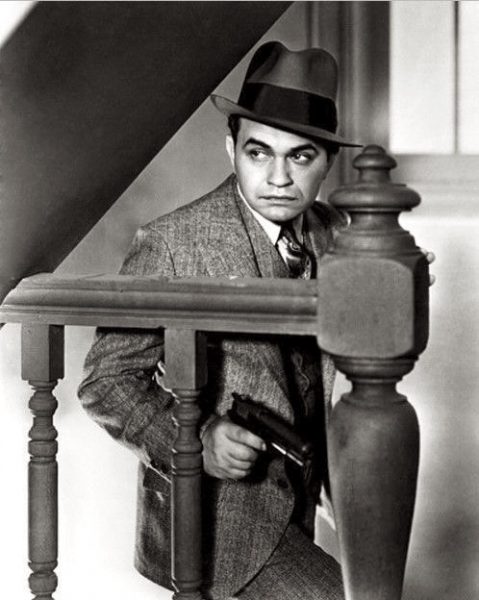
Edward G. Robinson portrayed W. R. Burnett’s “Macbeth”, aka: “Litte Caesar” aka: “Caesar Enrico ‘Rico’ Bandello“. This was Robinson’s 10th-movie since 1916, and he had become a recognized major Broadway actor since 1924. Suddenly, “Edward G.” was discovered in the role. As the “New York Times”, for January 10, 1931, put it:
“Little Caesar becomes at Mr. Robinson’s hands a figure out of Greek epic tragedy”.
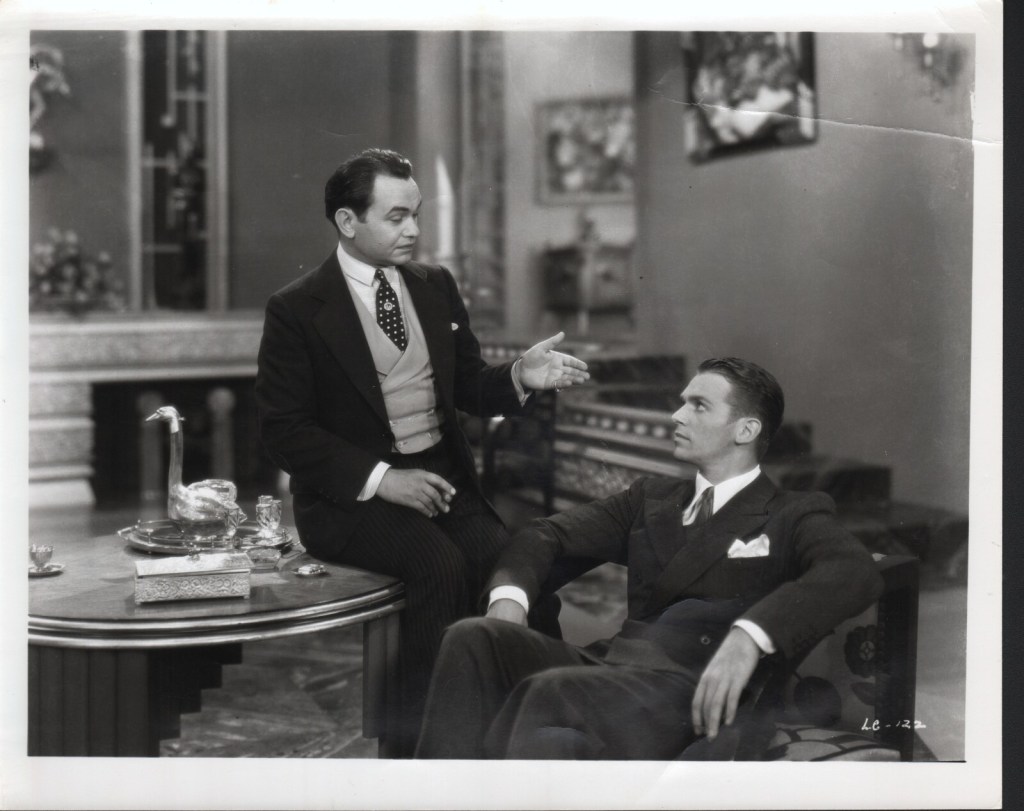
Douglas Fairbanks, Jr. portrayed “Joe Massara”. His father was Douglas Fairbanks, and that fact mainly, got “Junior” a contract with “Paramount Pictures” at the age of 13, this was his 35th feature film. Not to say, he was still only getting films, because of dad and step mom, Mary Pickford. In 1930, he had co-starred with Richard Barthelmess and Neil Hamilton, in director Howard Hawks’s, “Dawn Patrol”. In 1933, he would have the title role in, “The Life of Jimmy Dolan”, with second position, co-star Loretta Young. In 1939, it was “Gunga Din”, co-starring with Cary Grant and Victor McLaughlin, and in 1947, he was “Sinbad the Sailor”, looking for “Alexander the Great’s” lost treasure, with Maureen O’Hara.
Glenda Farrell portrayed “Olga Stassoff”. This was Farrell’s 3rd-film, in 1932, she co-starred in “I Am a Fugitive from a Chain Gang”, in 1933, she co-starred with Lionel Atwilll and Fay Wray in the horror classic, “The Mystery of the Wax Museum”. While in 1937, Glenda Farrell became newspaper reporter “Torchy Blane”, in the first of her 9-comedy/mystery films into 1939.
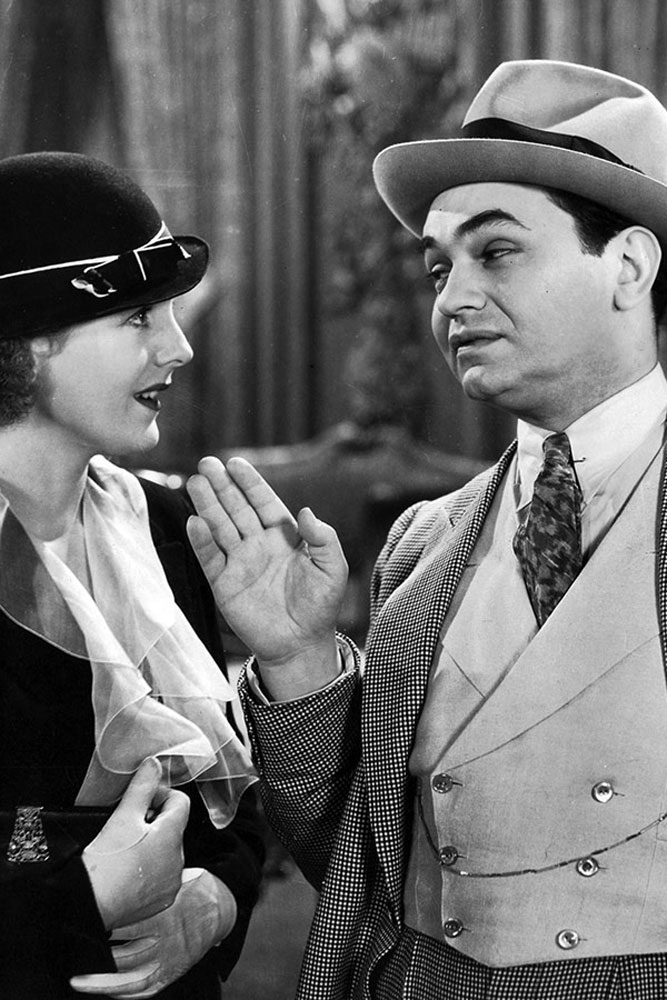
Sidney Blackmer portrayed “Big Boy”. He was a stage actor and a supporting motion picture actor. In 1950, he won a “Tony Award”, for “Best Actor/Drama”, for playwright William Inge’s, “Come Back, Little Sheba“. In 1934, he was in the cast of director Roland V. Lee’s version of French author Alexander Dumas’s, “The Count of Monte Cristo”, in 1935, it was the Shirley Temple film, “The Little Colonel”, and in 1937, he was in both Warner Oland’s, “Charlie Chan at Monte Carlo” followed immediately by the Peter Lorre’s, “Thank You, Mr. Moto”. In 1954, Sidney Blackmer was an airplane passenger in director William Wellman’s, “The High and the Mighty”, piloted by John Wayne and Robert Stack.
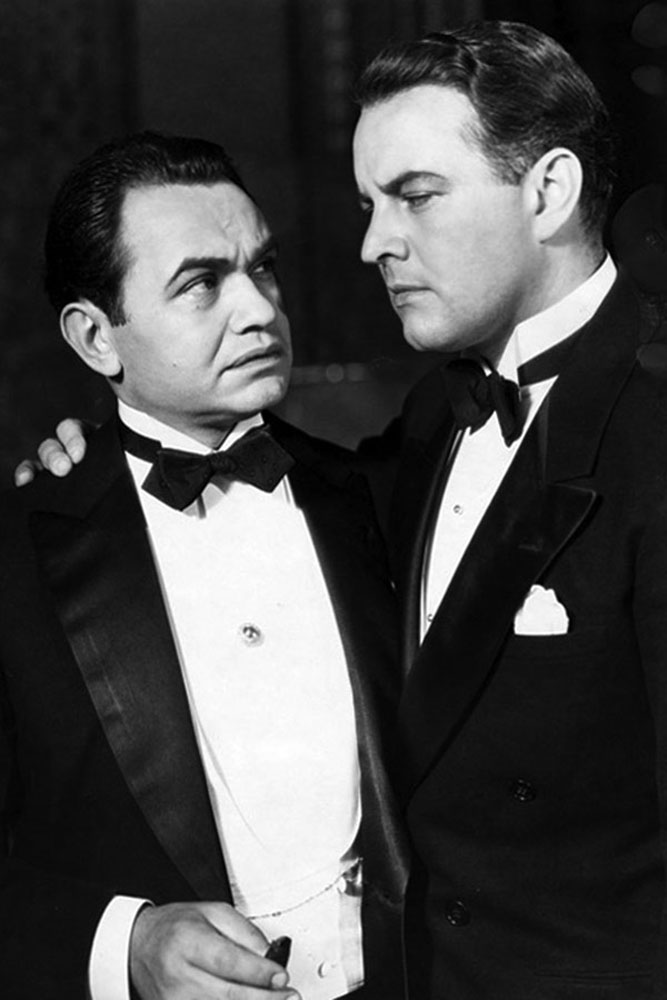
Thomas E. Jackson portrayed “Police Sergeant/Lieutenant Thomas Flaherty”. As with many actors at the time, Jackson, started on stage, but began his 191 roles of film work, with 4th billing in the forgotten 1929 crime drama, “Broadway”. Thomas E. Jackson was also seen in both Technicolor horror movies starring Lionel Atwill and Fay Wray, 1932’s, “Doctor X”, and 1933’s, “The Mystery of the Wax Museum”.
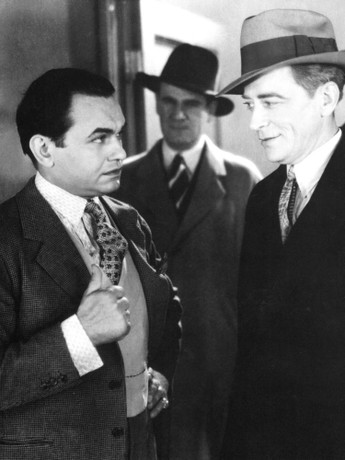
Maurice Black portrayed “Little Arne Lorch”. Maurice would get pneumonia and die in 1938, as the age of 47. Among his roles was portraying “Diamond Louie”, in director Louis Milestone’s version of playwright’s, Ben Hecht, and Charles MacArthur’s, Broadway hit, “The Front Page” in 1931, an uncredited “Gypsy”, in director James Whale’s, 1935, “The Bride of Frankenstein”, the uncredited “Amir”, in director Cecil B. DeMille’s, 1935, “The Crusades”, and the uncredited role of the “Attendant in the Gladiator’s Training Room”, in producers/directors, Merian C. Cooper, and Ernest B. Schoedsack’s, 1935,”The Last Days of Pompeii” (The two made a little 1933 movie, entitled, “King Kong”).
Stanley Fields portrayed “Sam Vettori”. Fields was both a Broadway actor and vaudevillian for 8-years prior to his first motion picture, director Lewis Milestone’s, 1929, “New York Nights”. Stanley Fields followed “Little Caesar” with the Richard Dix and Irene Dunne, 1931, version of Edna Ferber’s, “Cimarron”.
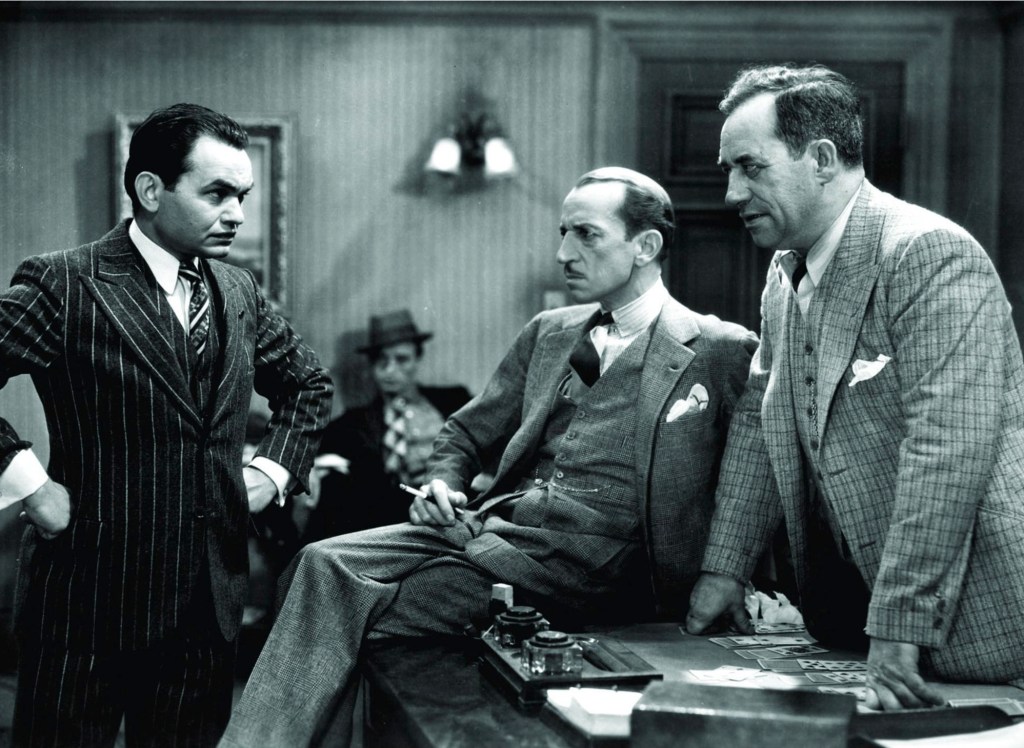
Above in the middle, Maurice Black, and far right, Stanley Fields.
George E. Stone portrayed “Otero”. Gerschon Lichtenstein was born in Poland, inside the Russian Empire. Upon arrival in the United States, and passing through immigration on “Ellis Island”, now George E. Stone, found work in motion pictures, portraying gangsters and hoods. He was “The Rat”, in Janet Gaynor’s, 1927, “7th Heaven”, his first on-screen appearance. Stone had just been seen in the Jack Benny, comedy, 1930’s, “The Medicine Man”, he also followed this feature film with 1931’s, “Cimarron”.
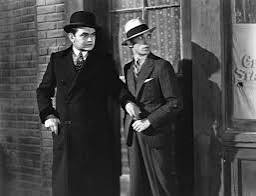
AN OVERVIEW OF THE PRE-MOTION PICTURE CODE SCREENPLAY:
Small-time criminals, “Caesar Enrico ‘Rico’ Bandello“, and “Joe Massara”, rob a gas station, somewhere in the mid-west, and head east to make their fortunes. The two arrive in Chicago, and their goals start to split in the “Windy City”. “Rico”, who refers to himself as a “Youngstown, Ohio, wop”, joins “Sam Vettori‘s” gang and “Joe” follows. However, “Joe”, wants to break away from crime, and become a professional nightclub dancer. He meets “Olga Stassoff”, and she becomes both his dance partner, and girlfriend.
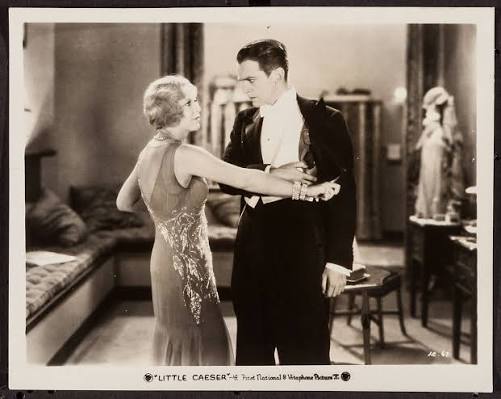
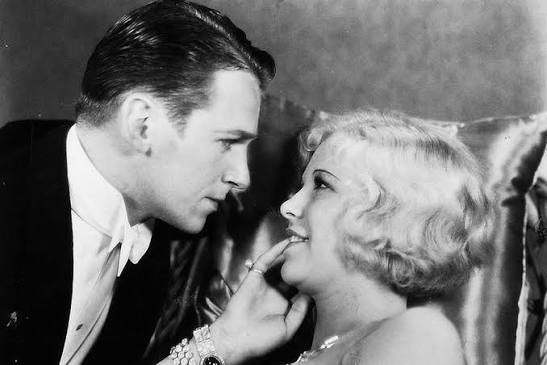
With “Olga” in his life, “Joe” attempts to move away from the gang, but “Rico” needs him for one more robbery. However, orders have come down from “Chicago Crime Lord”, “Big Boy”, to avoid all “Bloodshed”. “Rico” still wants “Joe” to help him rob the nightclub that he and “Olga” perform at, nightly. The robbery goes astray, as “Joe” watches in shock, “Rico” calmly guns down, the crusader again crime, commissioner “Alvin McClure”, portrayed by Landers Stevens, during the robbery.
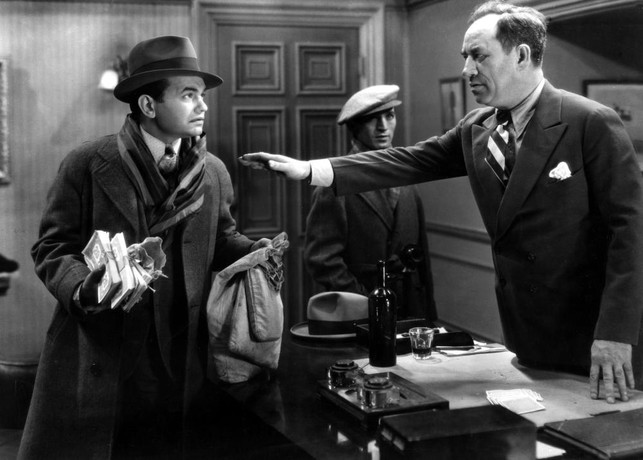
Next, “Rico” accuses “Sam Vettori” of being too soft, and is able to gain the control of “Vettori’s” gang.
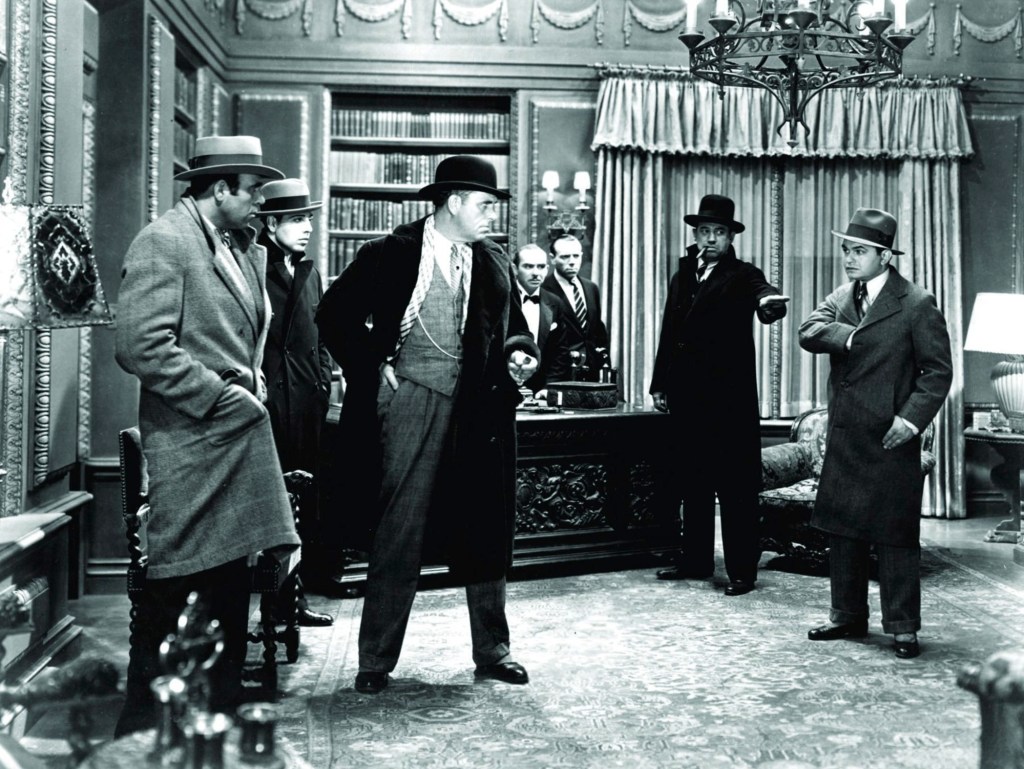
Later, the get away car driver for the robbery gone wrong, “Antonio ‘Tony’ Passa”, portrayed William Collier, Jr, is killed by gang member under orders from “Rico”. Who had found out that “Tony”, in a moment of consciousness, was going to his priest to confess his part in the murder of “Commissioner McClure”.
Rival gang boss, “Little Arne Lorch”, sends some of his men to kill “Rico”, but they fail, as he’s only grazed.
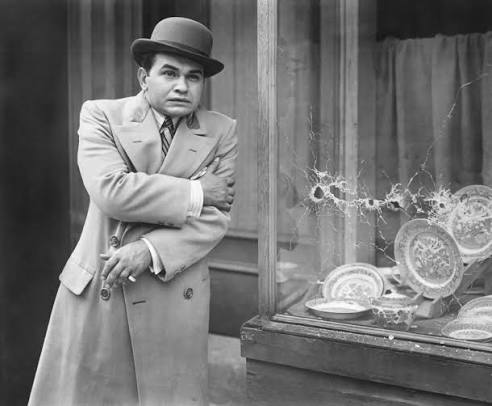
“Rico” and his gunmen visit “Little Arnie” with a proposition, he is either leaves Chicago, or he is killed. “Little Arnie” decides “Detroit, Michigan” has better climate than Chicago, Illinois. “Big Boy”, now gives “Rico” control of Chicago’s Northside.
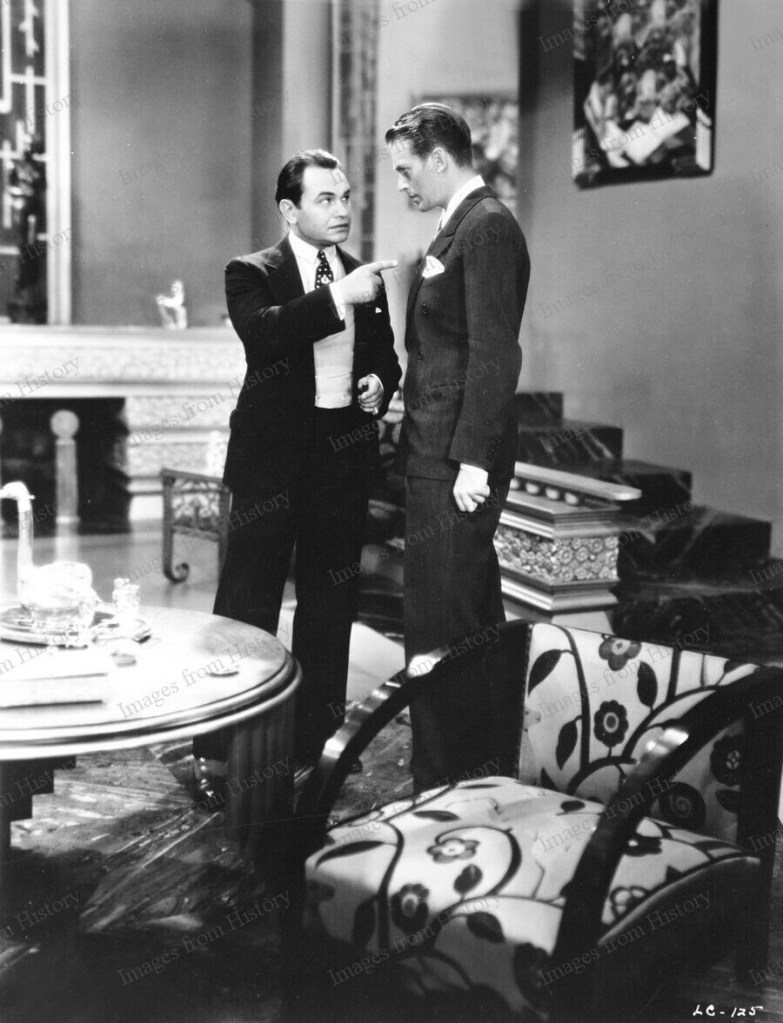
However, as he rising to power, “Rico” worries that “Joe” knows to much about him. “Rico” warns “Joe” that he must give up “Olga”, and join him in a life of crime, or – – –
“Joe” refuses, and “Olga” now calls “ Police Sergeant Thomas Flaherty”, and tells him that “Joe” is ready to talk. This takes place, just before “Rico” and his henchman, “Otero”, arrive at “Joe” and “Olga’s” apartment. “Rico” is there to kill the two, but he discovers he can’t kill “Joe”.
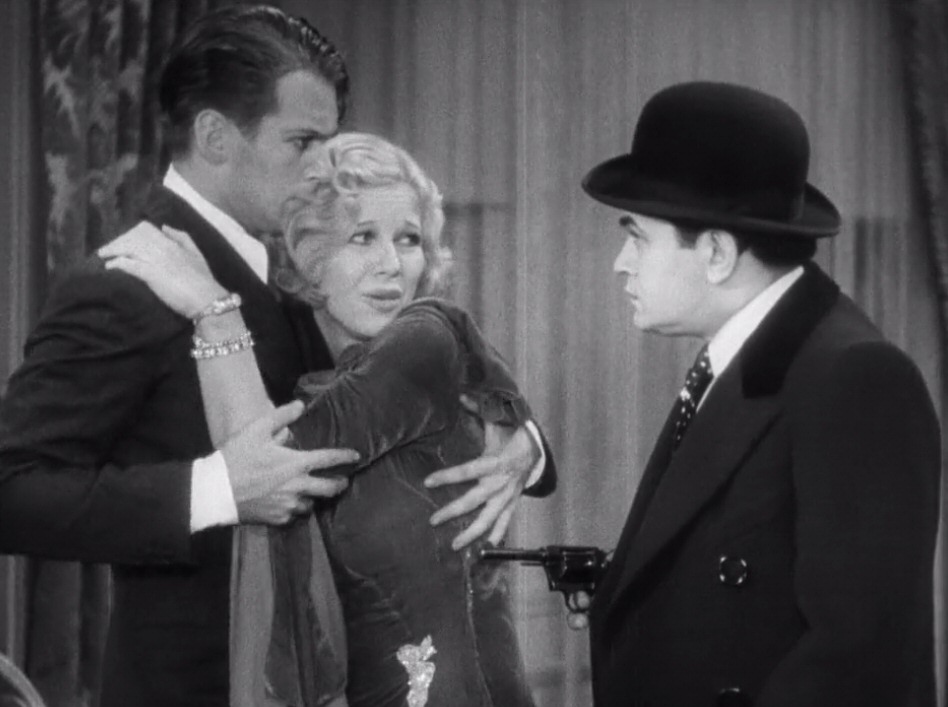
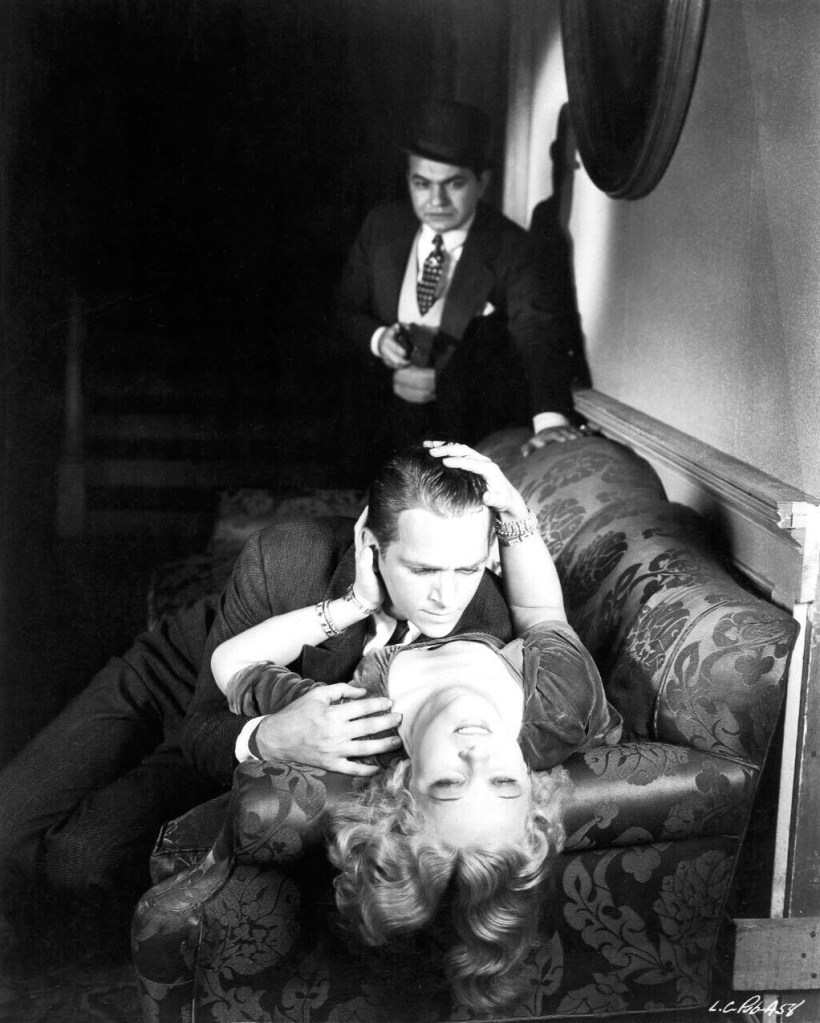
“Otero” attempts to kill “Joe”, but again friendship comes into play and before “Otero” shoots “Joe Massara”, “Rico” actually wrestles the gun from him. A shot is fired, but only wounding “Joe”. Having heard the shot, and seeing “Otero”, “Sergeant Flaherty” and another police officer give chase. They catch up to, and kill “Otero”. With information provided him by “Olga”, “Sergeant Flaherty” proceeds to dismantle, “LiTTLE CAESAR, CAESAR ENRICO RICO BANDELLO’S” organization.
To quote, W. R. Burnett, “Rico”:
“retreats to the gutter from which he sprang.”
Hiding in a flophouse, the once “LITTLE CAESAR”, becomes enraged. When he learns the now, “Lieutenant Flaherty”, has called him a “COWARD”, in a local newspaper.
Foolishly, “Rico” calls the police department to announce he is coming after “Flaherty”. A call that was traced, and “Flaherty”, with other officers confronts “Rico at the flophouse, and asks for his surrender. “Rico” refuses, and behind a billboard, “Little Caesar” dies from “Flaherty’s” bullets saying, again , W. R. Burnett’s words:
“Mother of mercy, is this the end of Rico?”
On the billboard is a picture announcing the dance team of “Joe Massara” and “Olga Stassoff”.
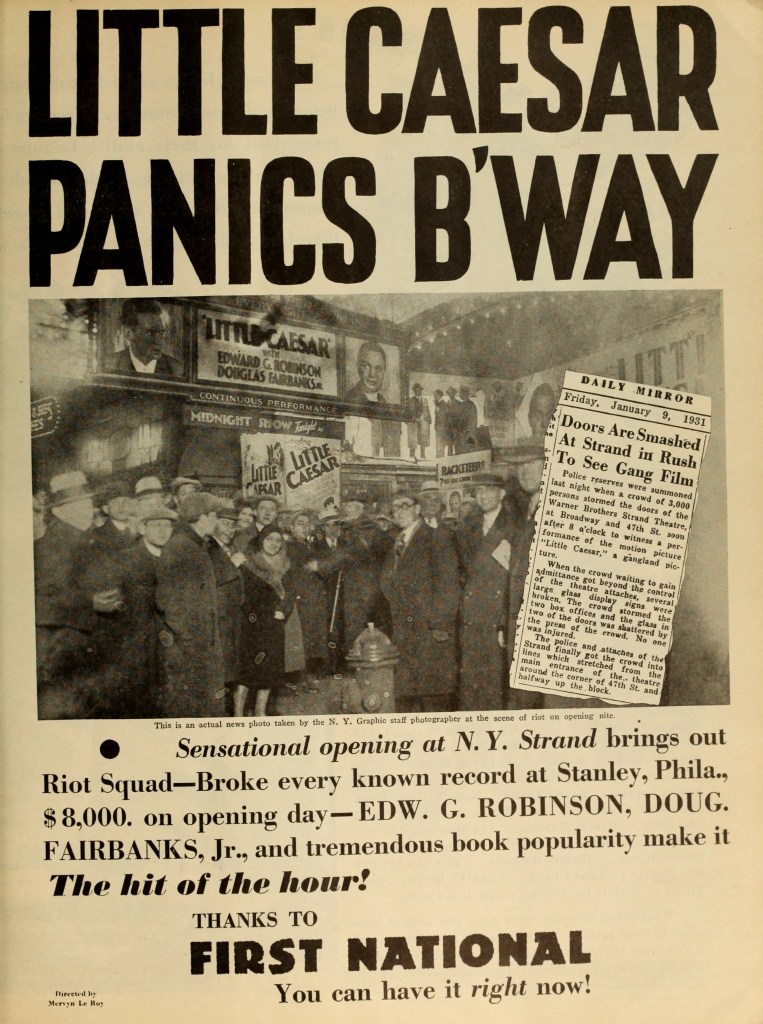
“Little Caesar” started a run of crime movies, such as 1931’s, “Public Enemy” starring song and dance man Jame Cagney, 1932’s “Night World” with Boris Karloff and George Raft, and 1939’s, “The Roaring Twenties” with James Cagney and Humphrey Bogart. This 1930’s gangster run was not equalled until 1957’s, “Baby Face Nelson” was released starring Mickey Rooney and Carolyn Jones. Which started another group of gangster movies. My article is “1957 TO 1961 HOLLYWOOD GANGSTER MOTION PICTURES VS REALITY” found at:
https://www.bewaretheblog.com/2016/01/1957-to-1961-hollywood-gangster-motion.html
The next movie my reader has probably never heard of, but they should be familiar with, at least, the names of four of the five main credited actors.
THE FINGER POINTS released April 11, 1931
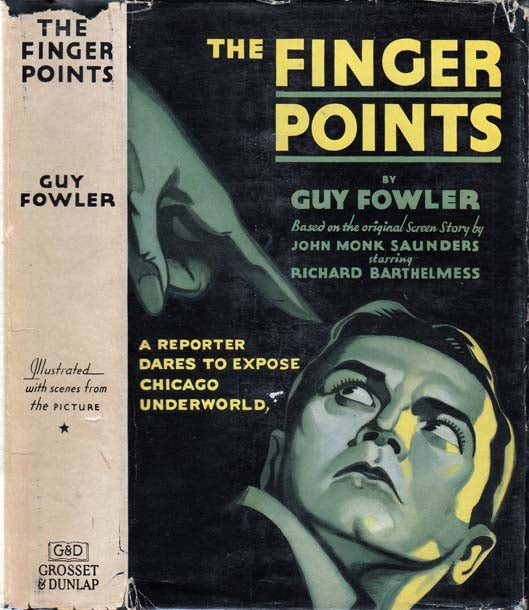
The above is the dust jacket novelization of the screenplay written by Guy Fowler, and published January 1, 1931. Fowler wrote 13-novelizations of screenplays, but I could not locate anything about any other writings, or anything else about him except that the was born in March 4, 1893, in Kentucky, and died on October 20, 1966, in Eureka, California.
The actual story was written by two “Warner Brothers” contract writers. W. R. Burnett and John Monk Sanders. Sanders only wrote 19 screenplays starting in 1925 and ending in 1938. Two of Sanders’s work include, the story for director William A. Wellman’s, 1927, First World War film, “Wings”, and the story for another First World War flying movie, 1938’s, “The Dawn Patrol”.
Robert Lord wrote the actual screenplay, if you don’t count 1931’s, “Little Caesar”. Then Lord, had just written the scenario for the musical comedy, 1930, “Hold Everything”, starring Joe E. Brown. Either way, he followed this motion picture by adapting two college humor stories, by two different writers, Patricia Reilly, and H. N. Swanson, for 1931’s, “Big Business Girl”, starring Loretta Young.
The motion picture was directed by John Francis Dillon. Dillon had been directed feature length movies since 1914. He had just directed a tragic romance, 1931’s, “Millie”, starring Helen Twelvetrees, and followed this picture with 1931’s, “Reckless Hour”. On April 4, 1934, 49-years-old, John Francis Dillon suffered a heart-attack and died.
The Five Leading Cast Members:
Richard Barthelmess portrayed “Breckenridge ‘Breck’ Lee”. Barthelmess was first seen on-screen in 1916. Richard Semler Barthelmess was a founder of the “Academy of Motion Picture Arts Sciences”, and was Lilian Gish’s co-star in two films by director D. W. Griffith. Just before this picture, Barthelmess and co-star Mary Astor were in an early California western, 1930’s, “The Lash”. He followed this movie with 1931’s, “The Last Flight”, with co-stars David Manners and Johnny Mack Brown. In both 1927, and 1928, the actor was nominated for the “Best Actor Academy Award”.
Fay Wray portrayed “Marcia Collins”. Fay Wray was first seen on-screen in a 1923 short subject. In early 1931, Wray co-starred with Jack Holt in director Frank Capra’s, adventure story, “Dirigible”, two other movies and a short subject followed before this feature film for the actress. Fay Wray followed this motion picture co-starring with Clive Brook, Charles “Buddy” Rodgers. Richard Arlen, and Jean Arthur, in 1931’s, “Lawyer’s Secret”. My article is “FAY WRAY BEFORE ‘KING KONG” found at:
https://www.bewaretheblog.com/2015/11/fay-wray-before-king-kong.html
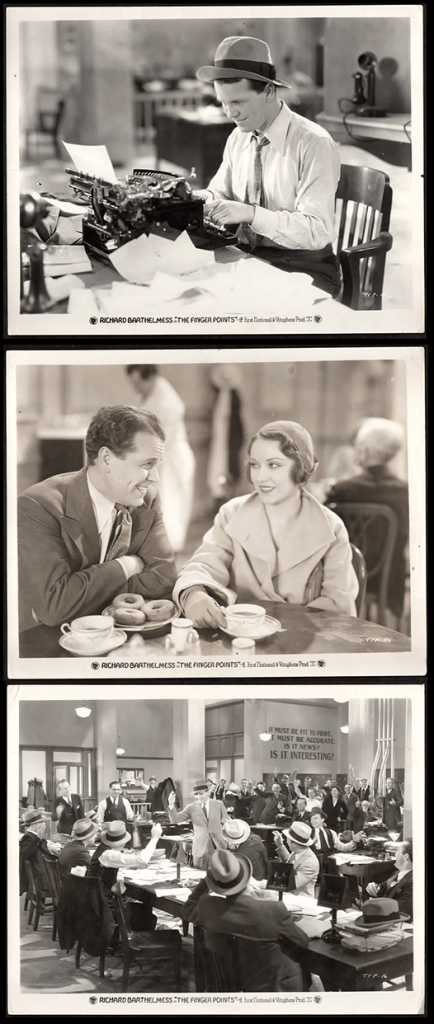
Regis Toomey portrayed “Charlie ‘Breezy’ Russell”. Toomey was a familiar faced supporting character actor, who started on-screen in 1929. His last role was in 1985, and they totaled 275. One of his interesting films, was the military comedy, 1941’s, “You’re in the Army Now”, starring Phil Silvers, Jimmy Durante, and Jane Wyman. Although it was released on December 25th. The motion picture was filmed the previous September, and becomes a look at how American’s felt before December 7th.
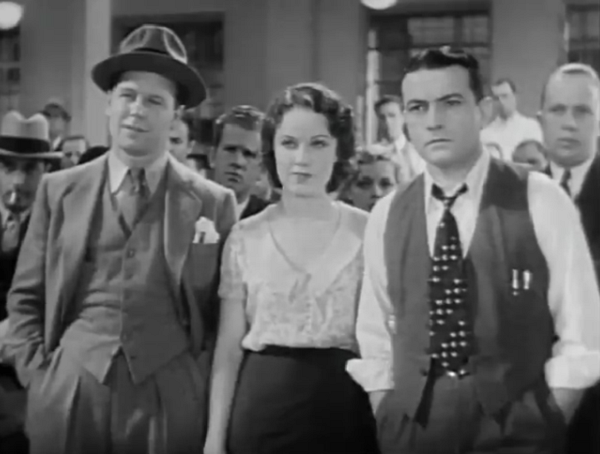
Above left to right, Regis Toomey, Fay Wray, and Richard Barthelmess
Clark Gable portrayed “Louis J. Blanco”. This was Gable’s 20th-motion picture since 1923’s, “Fighting Blood”, his first film with “An Undetermined Secondary Role”. 7th-billed Clark Gable, had just been seen in 1931’s, “The Secret 6”, starring Wallace Beery, Lewis Stone, John Mack Brown, and Jean Harlow. He would follow this feature film with 1931’s, “Laughing Sisters”, co-starring with Joan Crawford. My article is “Red Dust, Mogambo, and Gable”, found at:
http://www.bewaretheblog.com/2022/12/red-dust-mogambo-and-gable.html
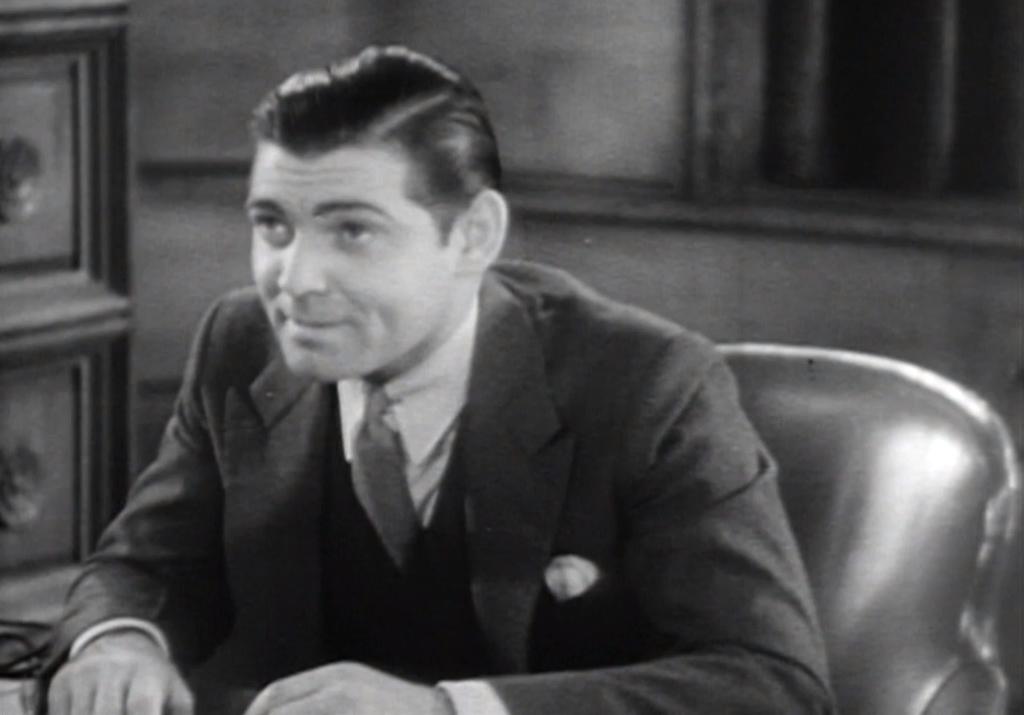
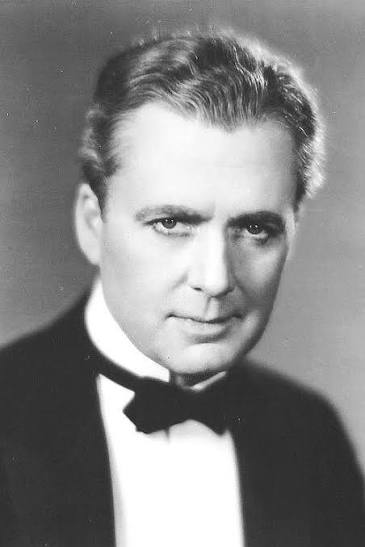
Robert Ellis portrayed “Managing Editor Frank Carter”. Like Regis Toomey, Robert Ellis was a character actor, his first film was 1916’s, “The Kiss of Hate”, co-starring with Ethel Barrymore. In 1931, Robert Ellis portrayed “Police Lieutenant Dundy”, in the original, and considered the closest, version of Dashiell Hammett’s, “The Maltese Falcon”. My article is, “The Stuff That Dreams Are Made Of’: The Maltese Falcon in Writing and on the Motion Picture Screen”, for comparison at:
https://www.bewaretheblog.com/2018/03/the-stuff-that-dreams-are-made-of.html
An Overview of the Screenplay:
One can argue with the description of “Breckenridge ‘Breck’ Lee”, in both the screenplay, and its novelization. As being way off the casting of popular Richard Barthelmess in the role. “Breck” is described as a “young, naive kid, from the Midwest, right out of school”. Who becomes a “Legman” reporter, covering gang-related crime, but Barthelmess was 36-years-old, and, obviously, not just out of school.
HOWEVER, his casting was part of the cover-up, to this thinly veiled true story. A story that no adult in the United States, and probably Canada, in 1931, could not recognize as about Alfred “JAKE” Lingle of the “Chicago Tribune”, and Al Capone.
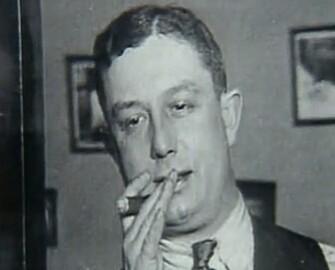
Above, Jake Lingle, below, Al Capone.
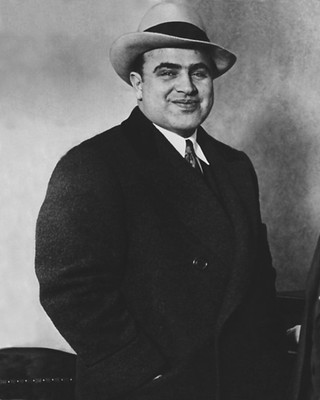
In short, W. R. Burnett needed, even though this was a pre-Motion Picture Code feature, to avoid getting the censors down on the studio, and specially himself.
The “Chicago Tribune” became “The Press”, and “Breck’s” first assignment is to expose the opening of a gambling parlor. Gangster “Louis J. Blanco” attempts to bribe the new reporter, but “Breck” refuses to keep quiet and publishes an article which results in a police raid on “Blanco’s” casino. There in no Al Capone figure in the screenplay, just one of the unseen bosses lieutenant’s, “Blanco”.
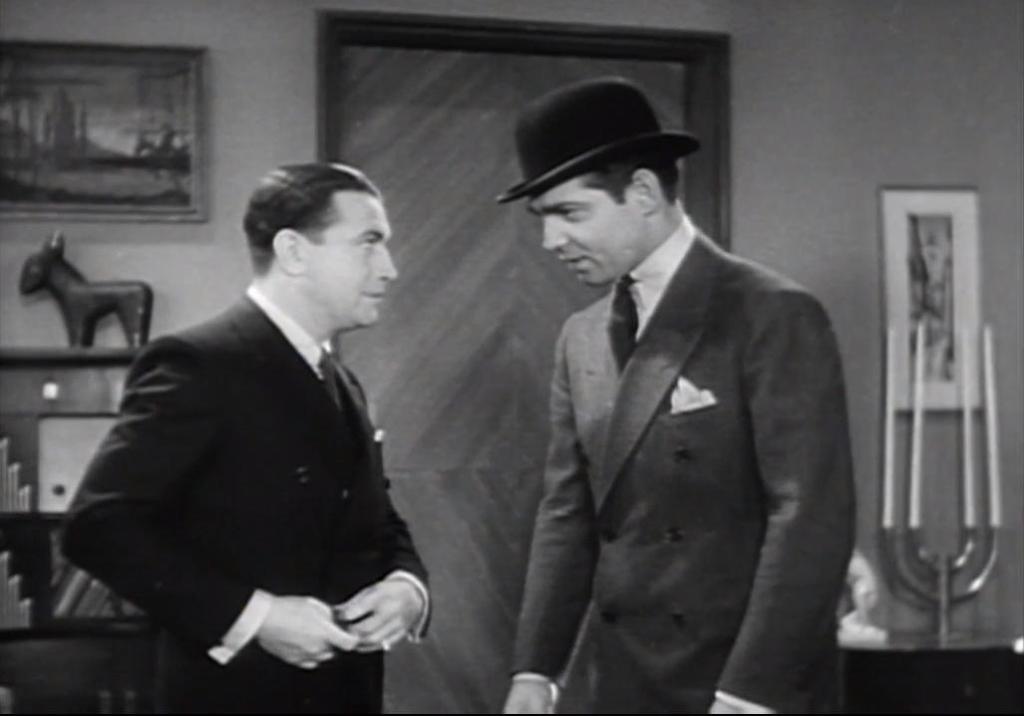
“Breck” is beaten-up by a group of hoods, and ends up in the hospital.
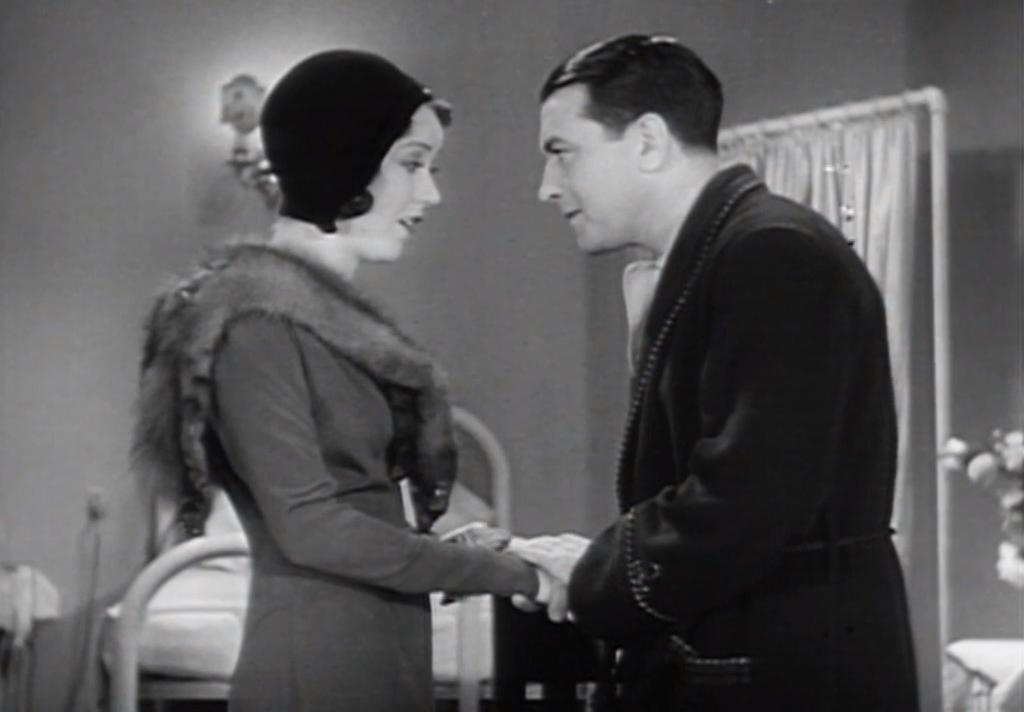
Returning to work, “Breck” is in love with fellow reporter “Marcia Collins”. She is a hard-working reporter, that the fast talking “Breezy”, the source of his nickname, “Charlie ‘Breezy’ Russell”, describes as the
“queen of the sob sisters and the best lookin’ gal in the newspaper business”.
“Marcia” is in love with “Breck”, but now, he is faced with a double money problem. One is that his normal reporter’s pay won’t support two, or a family, and not having insurance, hospital bills. “Breck” goes to “City Editor Frank Carter” for a pay raise, but is denied it. Next, he wishes he had accepted “Blanco’s” offer, and goes to him. His offer is, he will not report “Blanco’s”, or his unseen bosses dealings, for a fee. The gangster agrees and “Crime Reporter”, “Breckenridge Lee”, starts covering for “Louis J. Blanco’s” activity in his news stories. “Breck’s” seemingly suddenly wealth worries “Marcia”, but he assures her its all honestly made.
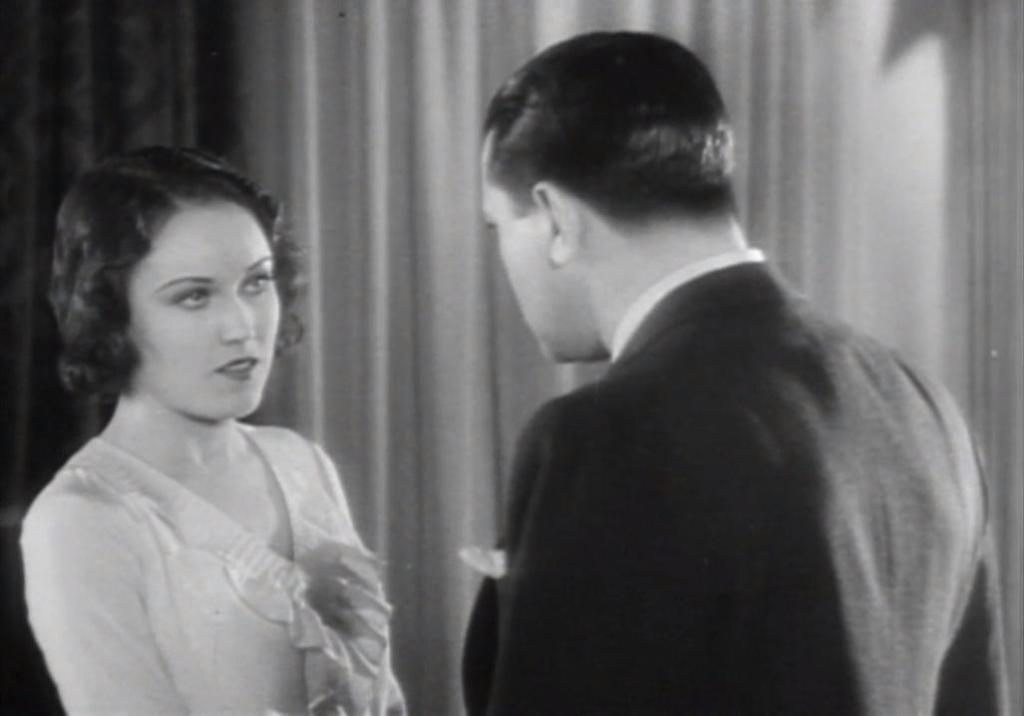
Now, feeling overly confident that he controls every situation. “Breck” decides to increase his income, by shaking down the gangsters, starting with “Blanco”. Whom he threatens, that he will reveal everything, unless he gets a larger share of money. This is followed by learning that “Number One”, is planning another larger gambling house, and an offer to meet the gang lord.
W. R. Burnett found a way around the “Motion Picture Censors”. By having the gangland lord, seen as a shadow in a darken room, and from the back. Actor J. Carrol Nash voiced the unseen gang leader. Thus, leaving the audience thinking he was Al Capone,s in their minds, but never mentioning him.
The would be shake-down artist is told, should anything be printed, he will sufferT
“Marcia” is faced with a decision, “Breezy” has proposed to her, and their to be married. Hearing this, “Breck” offers to go straight, leave the city, and everything he has been doing behind him, IF “Marcia” will agree to leave with, and, marry him.
Events move toward the climax, as “Marcia” agrees to leave with “Breck”, but “Breezy” publishes the gambling story, hoping to impress her. The following morning, “Breezy” shows both “Marcia” and “Breck” the published story. “Breck” leaves the other two and goes to the bank to retrieve all his money. Even though “Marcia” pleads with him not too. On his walk to the bank, two gunmen follow and kill “Breckenridge ‘Breck’ Lee”. At his funeral, he is named a hero, and “Marcia” remains silent knowing the truth.
On June 9, 1930, on a Chicago Street, “Legman Reporter”, Alfred “JAKE” Lingle, left the “Sherman House Hotel”, on his way to the “Randolph Street Terminal”, he was followed by two men. One of them shot “Jake”, directly in the back of his head with a .38-caliber pistol. At first he was thought a hero, but investigation would show his ties to Al Capone.
Less than a month after Lingle’s execution, “Warner Brother’s Production Head”, Darryl F. Zanuck, hired W. R. Burnett, to write a screenplay based upon the murder. Six months after the murder, on December 27, 1930, full production began on 1931’s, “The Finger Points”.
I only have three more films from 1930’s I want to mention in connection to W. R. Burnett, and the next one co-stars “The Platinum Blonde”.
IRON MAN released in London, England on April 28, 1931
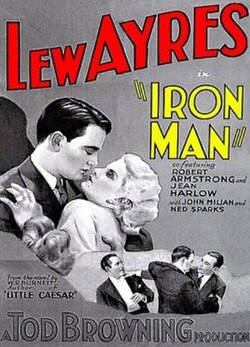
It’s hard to read, but in the lower left of the above poster, the “Universal Pictures”, publicity department were at their best:
“From the novel by W. R. BURNETT author of “LITTLE CAESAR”.
The novel had been published the year before, and Francis Edward Faragoh was hired to turn it into a screenplay. He had just written the screenplay for the 1931, “Too Young to Marry”, starring Loretta Young. Faragoh would follow this feature as one of the two actual screenplay writers for the previously mentioned, director James Whale’s, 1931, “Frankenstein”.
Not only, as the above poster advertises, is this picture a “TOD BROWNING Production”, he was also its director. For “Universal Pictures”, Tod Browning had just directed 1931’s, “Dracula”, and would follow this feature by directing for “Metro-Goldwyn-Mayer”, 1932’s, “Freaks”. My article is, “Tod Browning the Lon Chaney Films” at:
https://www.bewaretheblog.com/2024/02/tod-browning-lon-chaney-films.html
The Three Stars:
Lew Ayers portrayed “Kid Mason”. Ayers gained fame with his leading role in the anti-war, 1930, version of Erich Maria Remarque’s novel, “All Quiet on the Western Front”, he also became a conscientious objector as a result. In the 1940’s, he was “Dr. Kildare” in a successful series of movies.
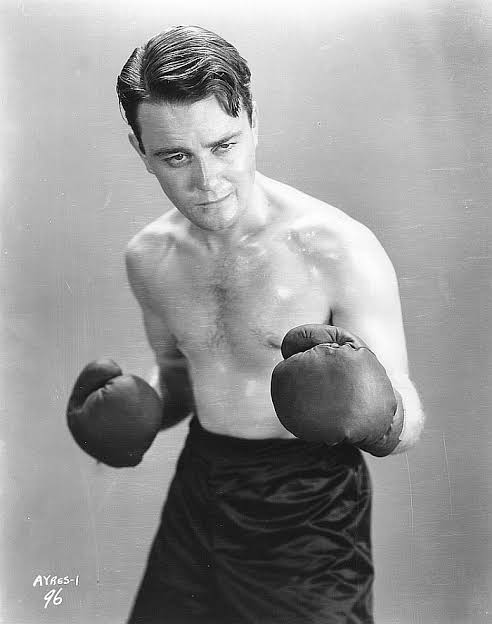
Robert Armstrong portrayed “George Regan”. Armstrong is immediately associated with both 1933’s, “King Kong”, and “Son of Kong”. Not to forget, 1949’s, “Mighty Joe Young”. My article is, “ROBERT ARMSTRONG: It Wasn’t All ‘The Eighth Wonder of the World’, His Brat, or ‘Joe” to read at:
https://www.bewaretheblog.com/2020/08/robert-armstrong-it-wasnt-all-eighth.html
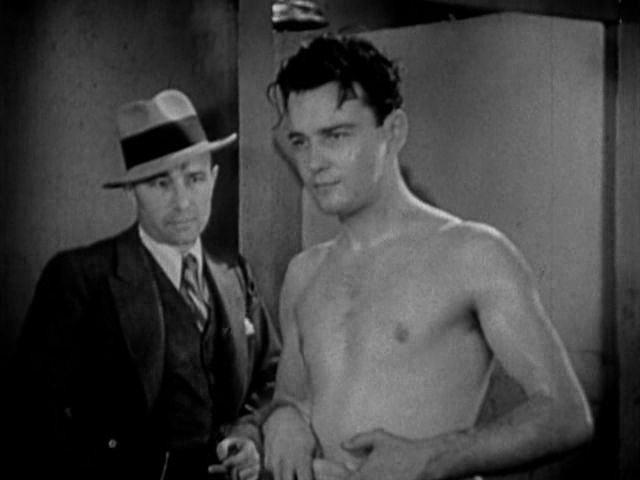
Jean Harlow portrayed “Rose Mason”. Harlow was just seen co-starring with James Cagney in the 1931 crime drama, “Public Enemy”, and would following this movie co-starring with Spencer Tracy in the 1931 comedy, “Goldie”. My article is, “JEAN HARLOW: The 1965 Biological Motion Picture Race” to read at:
https://www.bewaretheblog.com/2021/05/jean-harlow-1965-biographical-motion.html
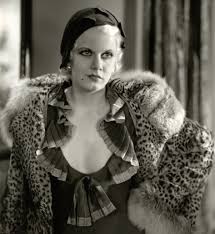
How to Minimize a Very Good Boxing Novel without using W. R. Burton’s words such as:
“- – – -which Coke sat up, pushed back his hat, took his feet off the bed, and, getting up, stood yawning and rubbing his fists in his eyes. Across the room Regan was playing solitaire on a writing-desk, and Coke’s sparring partner, Jeff Davis, was sitting in a big chair by the window turning the pages of a magazine. Coke walked over to Regan and stood looking over his shoulder.”
“Coke” has become “Kid Mason” in the movie, and his first name in never mentioned. Otherwise, the story follows a very compressed concept of the novel, without going into Burnett’s tough, realistic depictions of boxing, and its psychological toil on the fighters.
The movie only runs 73-minutes, so naturally, the story has to fit that running time. The movie opens with – – – -:
– – – – the audience meeting “Kid Mason”, already a boxer, after loosing his first professional fight. While, the novel gave the reader “Coke’s” background as a mechanic’s helper, and how he entered boxing. That backstory has been completely dropped, as has the background of “The Kid’s” marriage to “Rose Mason”.
Instead, the screenplay just gives the viewer the married couple, and the fact that “The Kid” lost his first fight under his manager, and long time friend, “George Regan”.
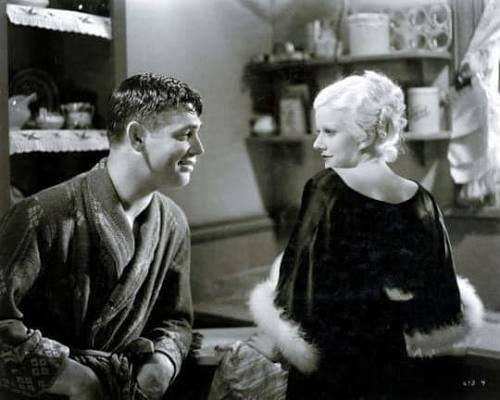
This causes the callus and self-centered “Rose” to abandon “The Kid” for her fantasy of “Hollywood”. “Rose” is revealed to be a gold-digger, who believed “The Kid” would keep winning fights, and, thereby, become her means of becoming wealthy. In the novel, she’s an ex-showgirl to begin with.
In “Hollywood”, “Rose” meets slick, theatrical manager, “Paul H. Lewis”, portrayed by John Miljan. “Lewis” becomes “Rose’s” lover, and her way into the glamour of the “Hollywood” scene. However, suddenly, “The Kid” starts winning fights.
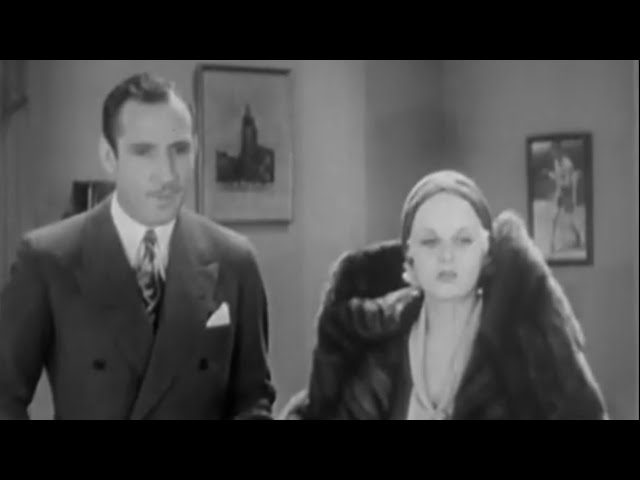
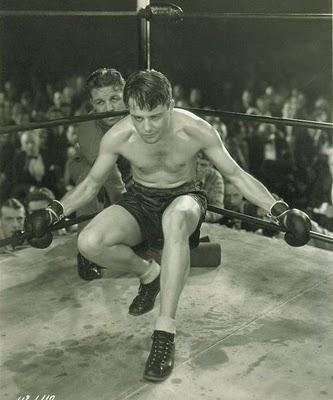
“Paul” realizes the potential of making money through “The Kid”. Who is still blindly in love with “Rose”. After hearing he might win “The Championship”. Thinking only of the status she, not “The Kid”, would have, “Rose” maculates “The Kid” into taking her back, without revealing her “secret lover”, “Paul Lewis”.
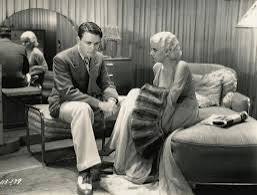
Next, as part of “Rose” and “Paul Lewis’s” plan, she works on the lovesick boxer to fire “George Regan” and make “Lewis” his new manager. Even though the theatrical agent has no knowledge of boxing, or that managing a boxer is not the same as an actor, or actress. What neither “Rose”, or “Paul” seem to realize. Is that the success “The Kid” has been having, is coming directly from how he is being trained, and coached by “George Regan”. Who is now forced to leave.
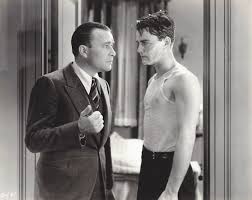
The “Big Championship Fight” takes place, once again there is a variance between W. R. Burnett’s words, and Francis Edward Faragoh’s screenplay for the Tod Browning motion picture.
The First Part of the Ending, is the same in both the novel and screenplay:
Now, untrained by “George”, physically broken, and mentally broken by the discovery of “Rose” and “Paul’s” affair. “Coke/The Kid” is brutally beaten in the championship match. Resulting in his loosing the title, and followed by both “Rose” and “Paul” walking out on him. Next, he finds out that “Rose” has taken all his money, and he doesn’t know what to do next.
The Second Part of the Ending, is not the same in the novel and screenplay:
The Novel:
The realism of W. R. Burnett’s words gives his reader a cynical ending. “Coke” was a good man, trying to have a good marriage, and a good relationship with his best friend, “George Regan”. The moral, if you want to call the ending a moral. Tells how a little bit of fame, a little bit of greed, and a strong amount of misplaced devotion can destroy a naive, but good man.
The Screenplay:
Enter a little “Hollywood Feel Good Ending”. After “The Kid” has lost “Rose”, his fame, the boxing title, and everything he dreamt of having, his faithful friend, “George Regan” returns. The two together will pick-up “The Kid’s” life, proving to him, that there are always “True Friends” for good people.
The following is the first W. R. Burnett novel turned into more than one motion picture. This remake, turns the story completely upside down, from both W. R. Burnett’s novel, and the Tod Browning motion picture.
IRON MAN premiered in New York City on August 17, 1951
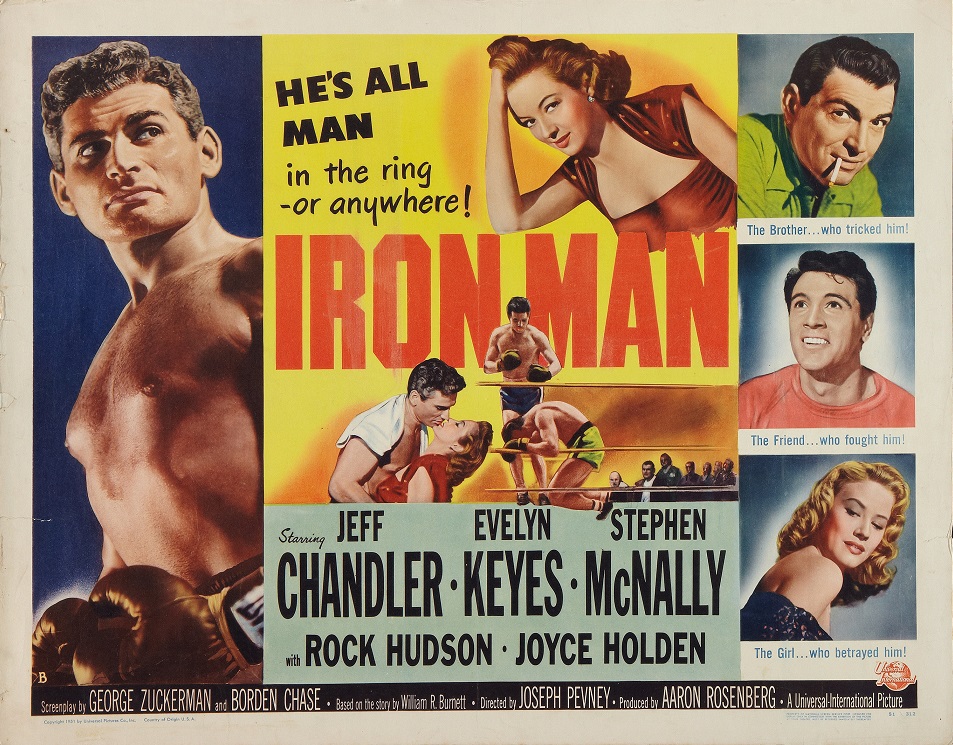
As I just stated, the credited source material is W. R. Burnett’s novel. “Universal Pictures” assigned to two contract writers to create a new screenplay. They were George Zuckerman, who had written the film-noir crime drama, 1951’s, “Under the Gun”, starring Richard Conte. The second writer was Borden Chase, who had been writing “B” Westerns, his latest was James Stewart’s classic, 1950, “Winchester ’73”.
Joseph Pevney was a “Universal Pictures” contract director, this was his 4th motion picture. He would direct the overlooked Robert Louis Stevenson, horror entry, 1951’s, “The Strange Door”, starring Charles Laughton, and Boris Karloff.
The Five Leading Actors:
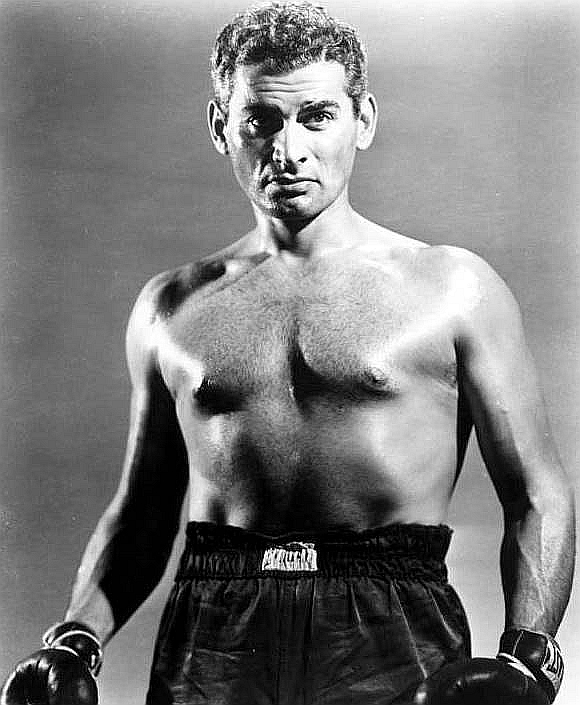
Jeff Chandler portrayed “Coke Mason”. Chandler had just co-starred with Evelyn Keyes in the adventure, 1951’s, “Smuggler’s Island”. He would follow this feature film with 1951’s, “Flame of Araby”, co-starring Maureen O’Hara.
Evelyn Keyes portrayed “Rose Warren Mason”. Keyes had just co-starred with Van Heflin, in the psychological drama, 1951’s, “The Prowler”, and would follow this feature with the 1952 comedy, “One Big Affair”, co-starring Dennis O’Keefe.
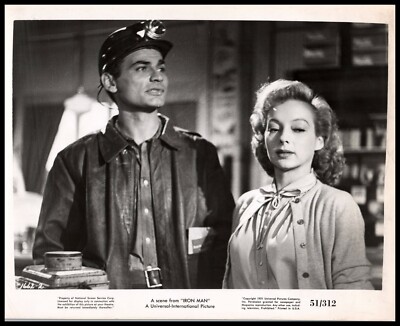
Stephen McNally portrayed “George Mason”. McNally had just co-starred with Coleen Gray in the 1951 western, “Apache Drums“. He followed this feature with the comedy, 1951’s, “The Lady Pays Off”, co-starring Linda Darnell.
Rock Hudson portrayed “Tommy ‘Speed’ O’Keefe aka: Kosco”. Hudson had just been seen in director William Castle’s, film-noir crime drama, 1951’s, “The Fat Man”. He would follow this feature film with 5th-billing, in 1952’s, family film,“Here Come the Nelson’s”, starring Ozzie and Harriet Nelson, David and Ricky Nelson.
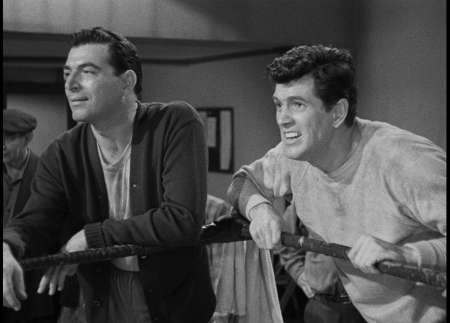
Above left, Stephen McNally, and on the right, Rock Hudson.
Joyce Holden portrayed “Tiny’ Ford – Photographer”. Holden had just been the uncredited “Hospital Receptionist” in 1951’s, “Ma and Pa Kettle Back on the Farm”, and followed this feature with the 1951 comedy, “You Never Can Tell”, starring Dick Powell. In 1956, Joyce Holden co-starred with Don Megowan, and Steven Rich, in the outstanding, but normally overlooked,“The Werewolf”.
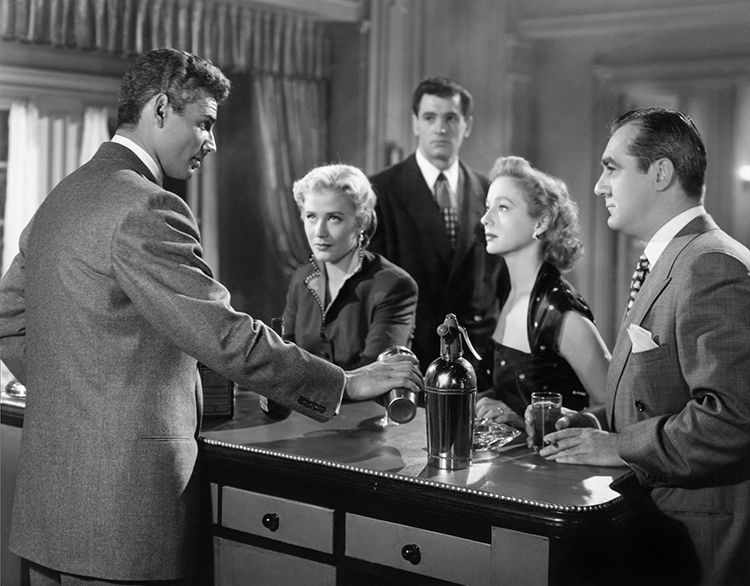
Above back to camera, Jeff Chandler, sitting at bar far left, Joyce Holden, Evelyn Keyes, and Jim Backus portraying “Max Watkins”, standing behind Holden is Rock Hudson.
Some of the changes to the story:
“Coke” and “Tommy” are coal miners and best friends.
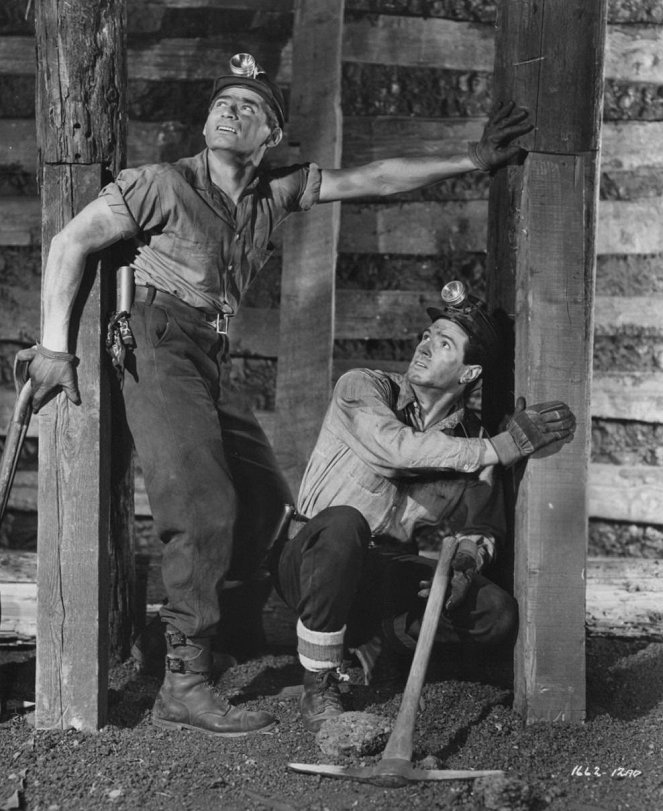
“Coke” dreams of having enough money to open a radio repair shop and marry “Rose Warren”. Keyes’s “Rose”, is the direct opposite of, Harlow’s “Rose”, and is supportive of “Coke” becoming a boxer as a means of getting that money to start his radio shop. This “Rose”, loves “Coke” deeply, and the two marry. Everything seems to be working, until he develops, in the boxing ring, his “KILLER INSTINCT”.
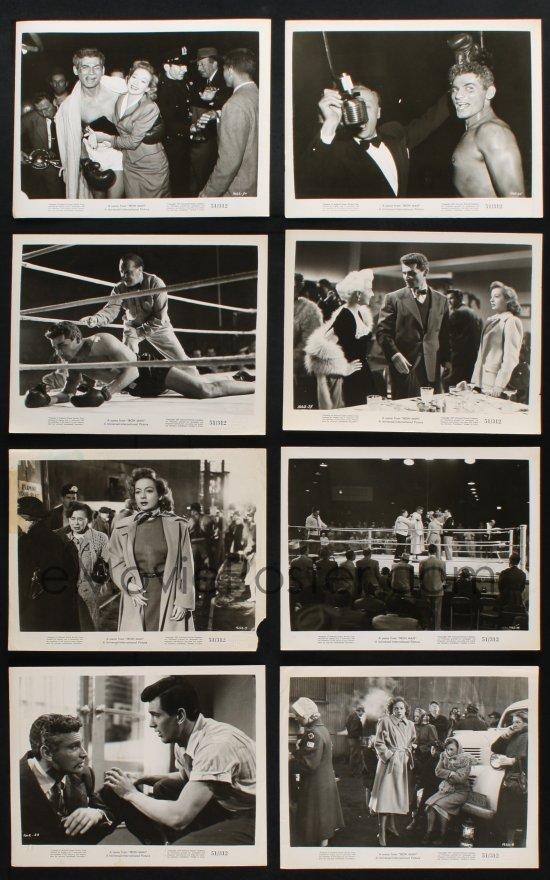
“Coke’s” brother “George”, becomes his manager, but unlike “George” in the W. R. Burnett novel and the Tod Browning movie. This “George”, sees “Coke’s” killer instinct as a cash cow to promote. He promotes his brother to fight dirty and is the catalyst, of “Rose”, and “Coke’s” problems. As the fans turn against “Coke”, and actually hate him.
“Tiny’ Ford” is a newspaper photographer who covers “Coke’s” boxing matches, and it’s her photos that move the storyline along.
We now come to the “Hollywood Ending”:
“George’s”gambling comes to a head over his betting on the climatic fight. “Coke” fights his best friend and training partner, “Tommy”. HOWEVER, “Coke” is seen fighting his demon, his “Killer Instinct”. As his moral self comes out once more, as he sees what he’s doing to his friend, and looses the match.
The audience sees the redemption of the two brothers. For “Coke” he breaks the control of his “Killer Instinct” and realizes what he has married to “Rose”. As for “George”, he also sees his redemption from gambling, as he watched what he was forcing his brother to do for money. The family, including “Tommy” are reunited.
Besides turning his observations of people, and especially the criminal element of the period, into stories. W. R. Burnett, enjoyed tales of the “American Wild West”. In 1930, he took a true incident in Arizona, and turned it into his novel, “Saint Johnson”. Which was his third published novel after “Little Caesar”, and “Iron Man”, all three in 1930 by “Dial Press”.
The following quote from the website, “Davy Crockett’s Almanack of Mystery, Adventure and the Wild West”, tells my reader about this extremely popular novel for that year:
http://davycrockettsalmanack.blogspot.com/2014/01/forgotten-books-saint-johnson-by-wr.html
“Saint Johnson was published in 1930, on the heels of the first two books that introduced Wyatt Earp to the mass public. Those books were Helldorado, written by Billy Breckenridge (a minor member of the anti-Earp faction) and Tombstone: An Iliad of the Southwest by Walter Noble Burns. The book purporting to be Wyatt’s own account, Stuart Lake’s Frontier Marshall, would not appear until 1931.”
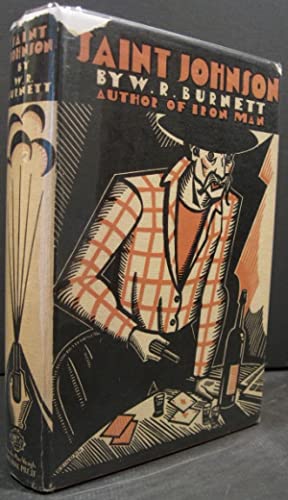
“Saint Johnson” would be turned into four (?) motion pictures, under the same title, from “Universal Pictures”, the first was:
LAW AND ORDER released in Poughkeepsie, New York, on January 22, 1932
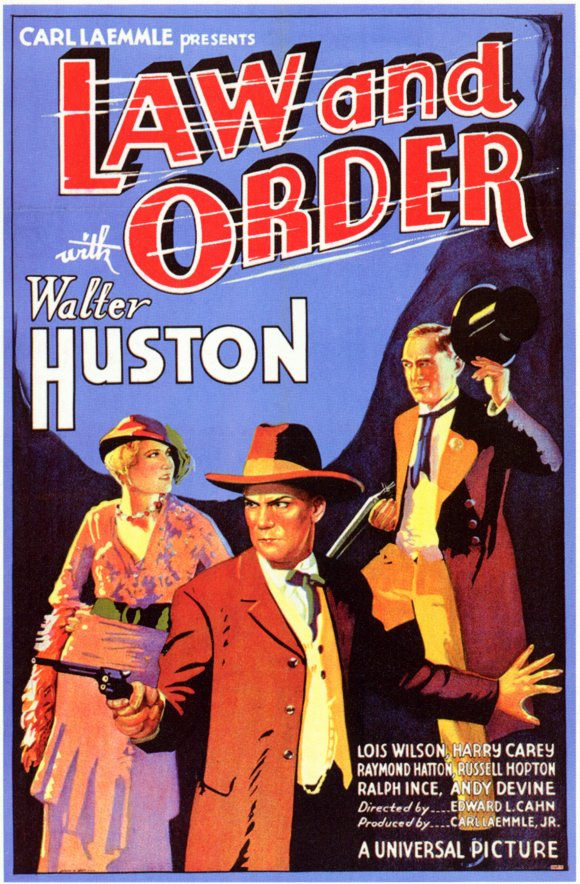
W. R. Burnett’s novel was adapted for the screen by the picture’s star’s son, John Huston, his third screenplay. He would follow this picture by working on the screenplay for Bela Lugosi’s, 1932, “Murders in the Rue Morgue”, with apologies to Edgar Allan Poe. My article is “JOHN HUSTON: “Moby Dick” 1956, “The Barbarian and the Geisha” 1958, “Freud: the Secret Passion” 1962 and “The List of Adrian Messenger” 1963″, to read at:
https://www.bewaretheblog.com/2017/05/john-huston-moby-dick-1956-barbarian.html
The actual screenplay was written by Tom Reed. In 1925, Reed did the title cards for Lon Chaney’s version of Gaston Leroux’s, “The Phantom of the Opera”, In 1929, Tom Reed was both the maker of the title cards for the silent film sections, and dialogue arranger for the singing and sound portion that opened the silent film version of Edna Ferber’s “Show Boat”. This had been shot as a silent film, and because of 1927’s, “The Jazz Singer”. From the original Broadway production of Jerome Kern and Oscar Hammerstein II’s musical. Both Helen Morgan singing “Bill”, and Jule Bledsoe singing “Ole Man River” are added in a sound prologue to the silent film and came under Reed’s direction.
The Cast:
Walter Huston portrayed “Frame ‘Saint’ Johnson”, W. R. Burnett’s substitute for Wyatt Earp. Huston had just co-starred with German major actress, Lil Dagover, who had portrayed“Jane Olsen, in 1920’s, The Cabinet of Dr. Caligari”, in 1932’s, “The Woman from Monte Carlo”. He followed this movie with the film-noir crime drama, based upon another W. R. Burnett story, 1932’s, “The Beast of the City”, co-starring Jean Harlow and Wallace Ford. My article is “Walter Huston: Singer, Actor, and Father of John” at:
https://www.bewaretheblog.com/2026/02/walter-huston-singer-actor-father-of.html

Harry Carey portrayed “Ed Brandt”, the “Doc Holliday Character”. Carey was a major silent and 1930’s Cowboy actor. He was a close friend of director John Ford, the father of actor Harry Carey, Jr., and was one of the mentor’s of an actor now named John Wayne. Harry Carey had just been seen in the 1932 Western, “Without Honor”, and followed this picture with the 1932 Western, “Border Devils”.

Raymond Hattan portrayed “Deadwood”. Hatton started on-screen acting in 1909, but some sites state the year as 1911. In 1939, he joined the “B” Western series “The Three Mesquiteers”, portraying “Rusty Joslin”, into 1940, opposite John Wayne, or Duncan Renaldo, and Bob Livingston. After which he appeared as a side-kick to “B” Cowboys, Johnny Mack Brown and James Ellison, until 1950. When he switched to television in Ralph Byrd’s, “DICK TRACY” series, and in 1955, Hatton portrayed the old miner, “Pete”, in Director Roger Corman’s, “THE DAY THE WORLD ENDED”. He also had a small role in the teenage science fiction film, 1957’s, “INVASION OF THE SAUCER MEN”. In all, between motion pictures and television programs, Raymond Hatton appeared in 442 different roles. My article is “An Overview of ‘THE THREE MESQUITEERS’: A Classic ‘B’ Western Series” to read at:
https://www.bewaretheblog.com/2021/11/an-overview-of-three-mesquiteers.html
Russell Hopton portrayed “Luther Johnson”. Hopton had an uncredited role in the 1932 comedy, “Dance Team”, and followed this feature with another uncredited role ,in 1932’s, “The Man Who Played God”.

Above left, Raymond Hatton, and Russelll Hopton
Andy Devine portrayed “Johnny Kinsman”. Devine had just been seen in the Jean Harlow and Mae Clarke comedy drama, 1931’s, “Three Wise Girls”. He followed this feature with 1932’s, “The Impatient Maiden”, starring Lew Ayres, Mae Clarke, and Una Merkel. My article is “ANDY DEVINE: ‘Hey, Wild Bill, Wait for Me” found at:
https://www.bewaretheblog.com/2019/07/andy-devine-hey-wild-bill-wait-for-me.html

Walter Brennan portrayed the uncredited role of “Lankey Smith, spittoon cleaner”. Brennan just had the uncredited role of a “musician”, in 1931’s, “A House Divided”. He would follow this picture with his 9th credited role, in the “Colonel Tim McCoy” Western, 1932’s, “Texas Cyclone”. The 4th credited role in that same picture, went to an actor named John Wayne, and an uncredited role went to an actor named Glenn Strange. Brennan would return to Wyatt Earp saga, in director John Ford’s, 1946, “My Darling Clementine”.

Based upon this screenplay, I can understand why Wyatt Earp’s widow, Josephine Sarah “Sadie” Marcus Earp, was upset with W. R. Burnett, for his main novel’s character actual first name of “Wyat”, and attempted to stop the publication of his novel in the courts.
After cleaning up and bringing order to Dodge City, Kansas, Wyatt, oops, “Saint Johnson”, and the Earp Brother’s, oops again, “Ed Brandt”, “Deadwood”, and “Luther Johnson”, come to Tombstone, Arizona, and take on the “Clanton’s”, triple oops, the “Northrup Brother’s”:
Ralph Ince portraying “Poe Northrup”, Harry Woods portraying “Walt Northrup”, and Richard Alexander portraying “Kurt Northrup”, seen below:

All leading to a recreation of the “Gunfight at the O. K. Corral”, at least in location. The movie has the gunfight in a narrow lot next to the photography studio. The actual location of the 30-second gunfight was at the “O. K. Corral”, located at the end of an alley next to the Tombstone photography studio.
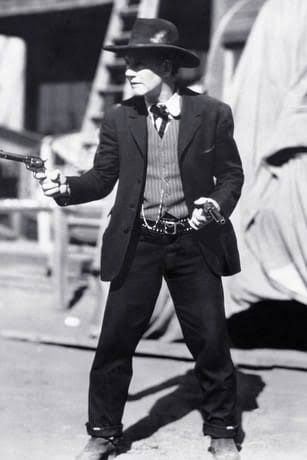
Back in March 2015, I wrote an article that begins:
Hollywood had turned 30 seconds of reality into as much as 30 minutes of gunfighting action. The date was Wednesday, October 26, 1881, the location was Tombstone, Arizona. When at 3 PM local time, Eight Men met in what became the most famous gunfight of the old West.

That article is “The Gunfight at the O.K. Corral’ as Reinvented by Hollywood” and can be read in its entirety at:
https://www.bewaretheblog.com/2015/03/the-gunfight-at-ok-corral-as-reinvented.html
Which leads me to the second film version of William Riley Burnett’s novel, or not.
Using a standard contract for a studio to obtain the rights to film a novel. “Universal Pictures”, purchased them for “Saint Johnson”, in 1931, from William Riley Burnett. Like many authors, what Burnett may not have realized, at the time he signed that contract, was that he gave away to “Universal Pictures”. The right to claim any movie they made was based upon his novel, WITHOUT having to pay him one cent more for its use.
However, W. R. Burnett learned his lesson, as he became a notorious business man for the studio’s. They wanted his work, and his name on their pictures as the following three films illustrated. He had become a major name compared with Dashiell Hammett, and Raymond Chandler for his crime novels alone. His Westerns, thanks to the movie versions was breaking him into comparison with Bret Harte and Louis L’Amour. He used this against the studios adding a clause that said, IF the studio didn’t make the movie within a set time frame, the rights for his work reverted back to him.
The second film:
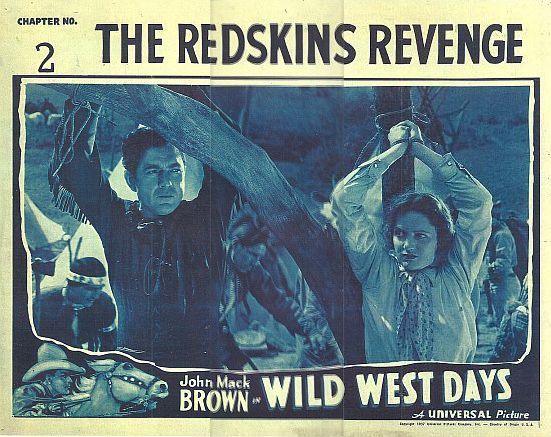
WILD WEST DAYS released on July 5, 1937
Used the tag line:
“Based On W. R. BURNETT’S Famous Novel”
Was, actually a 13-Chapter Serial, starring “B” Cowboy actor, John “Johnny” Mack Brown, portraying “Kentucky Wade”.
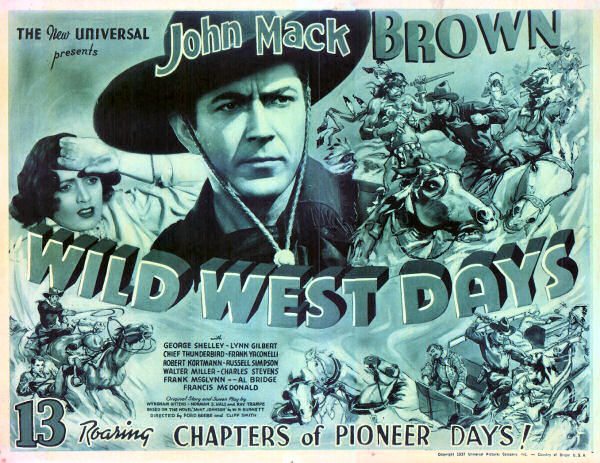
During the 13-exciting chapters, one plot line has “Larry Munro”, portrayed by Frank McGlynn, and “Wade’s” love interest, “Lucy Munro”, portrayed by Lynn Gilbert’s ranch being the target of newspaper editor, “Matt Keeler”, portrayed by Russell Simson and his gang known as “The Secret Seven”. “Keeler” wants the “Munro” ranch, because it has platinum on it. It up to “Kentucky Wade“, and his three friends, “Dude Hanford”, portrayed by George Shelley, “Trigger Benton”, portrayed by Bob Kortman, and “Mike Morales”, portrayed by Frank Yaconelli, to stop them. While, on the second plot line, there is also the recurring problem with “Red Hatchet”, portrayed by Native American Cheyenne, Chief Thunderbird, and his raiding parties.
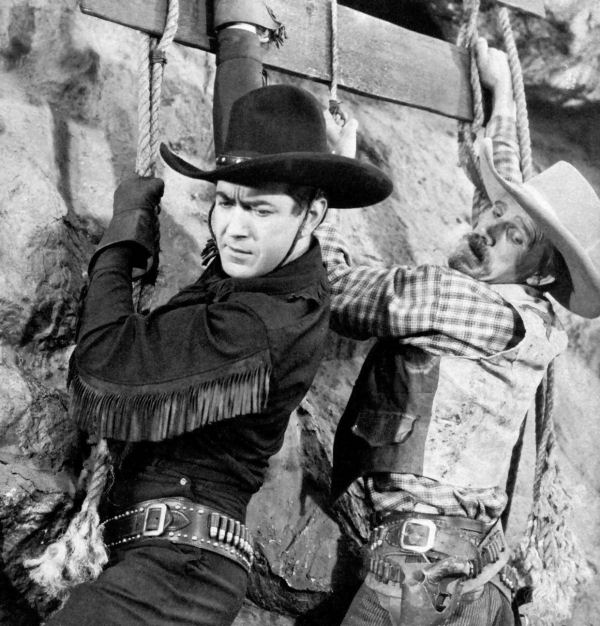
Above, Johnny Mack Brown and Bob Kortman, below, Johnny Mack Brown and Lynn Gilbert
For the 3rd motion picture, “Universal Pictures” returned to the 1932 title, and was closer to W. R. Burnett’s novel in concept, but welcome to the “Singing Cowboys”. My article is “John Wayne Was a Singing Cowboy: Singing Cowboys and Cowgirls in the Movies and on 1950’s Television” to sing along with, at:
https://www.bewaretheblog.com/2022/07/john-wayne-was-singing-cowboy-singing.html
LAW AND ORDER released on November 28, 1940
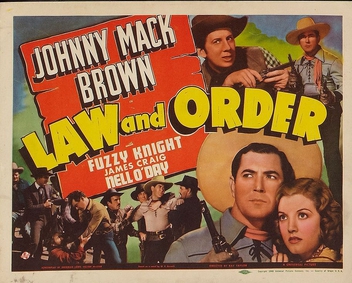
Johnny Mack Brown is back, this time as “Bill Ralston”.
Fuzzy Knight portrayed his normal “B” Cowboy sidekick role of “Deadwood”.
James Craig portrayed “Bill Ralston’s” best friend, “Brandt”.
Next the Singing Cowboy and Cowgirl:
Nell O’Day portrayed “Sally Dixon”.
Jimmy Dodd, billed as James Dodd, in one of his pre-Walt Disney’s “Mickey Mouse Club”, portrayed “Jimmy Dixon”
The duet of Dodd and O’Day sang, breaking the normal “B” cowboy story of getting the bad guy, “Poe Daggat”, portrayed by Harry Cording, the following:
“Oklahoma Oke and Me”, composed and written by Jimmy Dodd.
“Those Happy Old Days”, and, “Ride ‘Em Cowboy”, written and composed by Milton Rosen and Everett Carter.
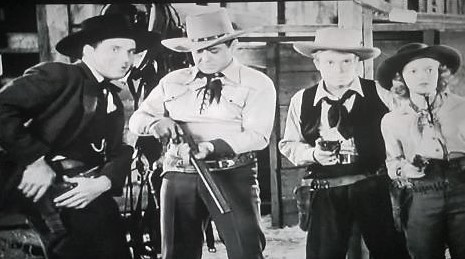
Above left to right, James Craig, Johnny Mack Brown, Jimmy Dodd, and Nell O’Day.
The story has “Bill Ralston” coming to a Western town of “Rhyolite” and planning to settle there. However, he runs up against “Poe Daggart”, who with his brother’s help, runs the town and the countryside. The peace loving “Ralston” sides with the townspeople, by taking the open Marshall position. Marshall Ralston is ambushed by “Poe’s” gang, and kills one of Poe’s two brothers. “Poe” retaliates by riding into “Rhyolite”, killing “Brant”, leading to the showdown. After “Bill Ralston” tares off his Marshall’s badge and states it’s time to “Fight Fire with Fire”. “Bill” and “Deadwood” ride of town. Just outside of “Rhyolite” the two men corner “Poe” and his gang just outside of the “Rhyolite” town limits, and when the gunfire has stopped. “Poe” and the reminder of his gang are dead.
The fourth motion picture now filmed by“Universal International Pictures”
“Based On W. R. BURNETT’S Famous Novel”
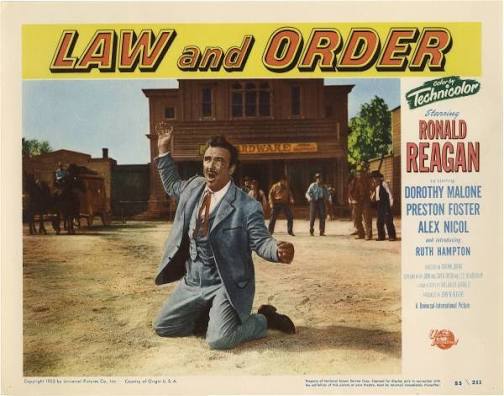
LAW AND ORDER premiered on May 13, 1953 in Los Angles
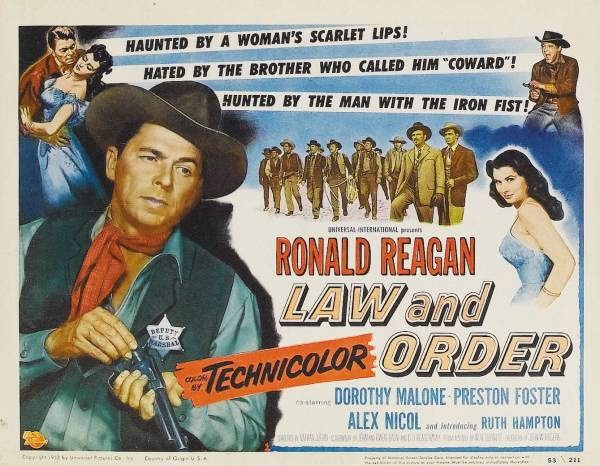
William Riley Burnett got his normal on-screen credit for writing the novel that like the previous two film the screenplay doesn’t follow.
Inez Cocke is credited for adapting W. R. Burnett’s novel for a screenplay. Cocke worked on a total of two movies, this one, plus the June Allyson and Rossano Brazzi 1957, “Interlude”, and one television program. That TV program was the April 10, 1966 episode “Concho the Coyote Who Was Wasn’t”, on “The Magical World of Disney”.
There were three actual screenplay writers, the married couple of John and Gwen Bagni. The couple had just co-wrote the Joseph Cotton and Shelley Winters Western, 1952’s, “Untamed Frontier”. The third screenplay writer was D. D. Beauchamp, who had come up with the story, and co-wrote the screenplay for 1953;s, “Abbott and Costello Go to Mars”, however, they technically end up on Venus.
The motion picture was directed by Nathan Juran, . My article is “Nathan H. Juran: A Look at the Work of the Man Who was Art Director for John Ford, Directed Live Action for Ray Harryhausen and Wrote Screenplays for Fess Parker” at:
https://www.bewaretheblog.com/2017/05/nathan-h-juran-look-at-work-of-man-who.html
The Four Main Roles:
Ronald Reagan portrayed “Frame Johnson”. In May 1952, he married actress Nancy Davis. As president of the “Screen Actors Guild”, he straightened out a mix-up, because the “House Committee on Un-American Activities” was looking for another actress named Nancy Davis, but subpoenaed the wrong actress. He started filming this Western in September 1952. My article is “RONALD REAGAN MOTION PICTURE AND TELEVISION ACTOR” to read at:
https://www.bewaretheblog.com/2016/03/ronald-reagan-motion-picture-and.html
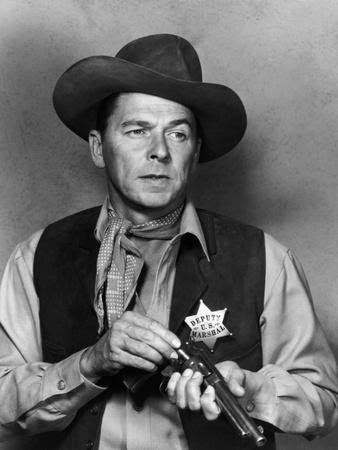
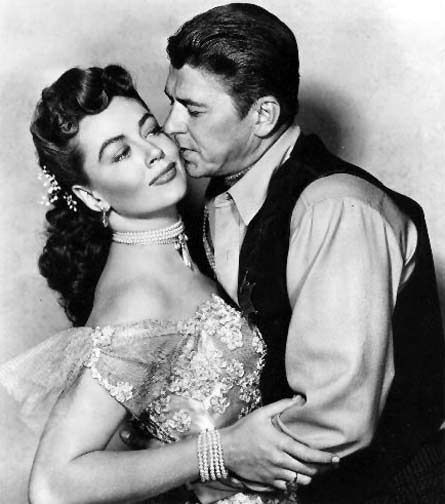
Dorothy Malone portrayed “Jeannie”. Malone had just had 6th billing in the Dean Martin and Jerry Lewis, 1953, “Scared Stiff”, and followed this film with appearances on television.
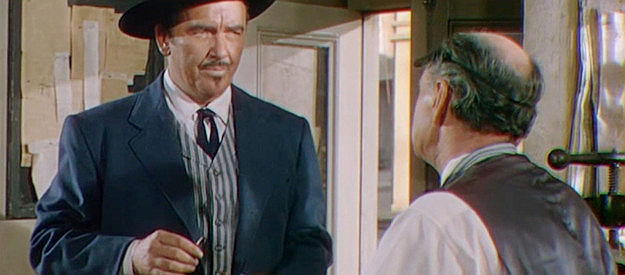
Preston Foster portrayed “Kurt Durling”. Foster was just seen in, 1952’s, “Kansas City Confidential”, a film-noir conspiracy theory heist thriller. He would follow this picture with the 3-D, Mickey Spillane, “Mike Hammer”, film-noir crime mystery, “I, the Jury”, co-starring Peggy Castle.
Alex Nicol portrayed, brother, “Luther ‘Lute’ Johnson”. Nicol had just co-starred with Joel McCrea and Barbara Hale in the 1953, Western, “The Lone Hand”. He followed this film with 1953’s, “Champ for a Day”.
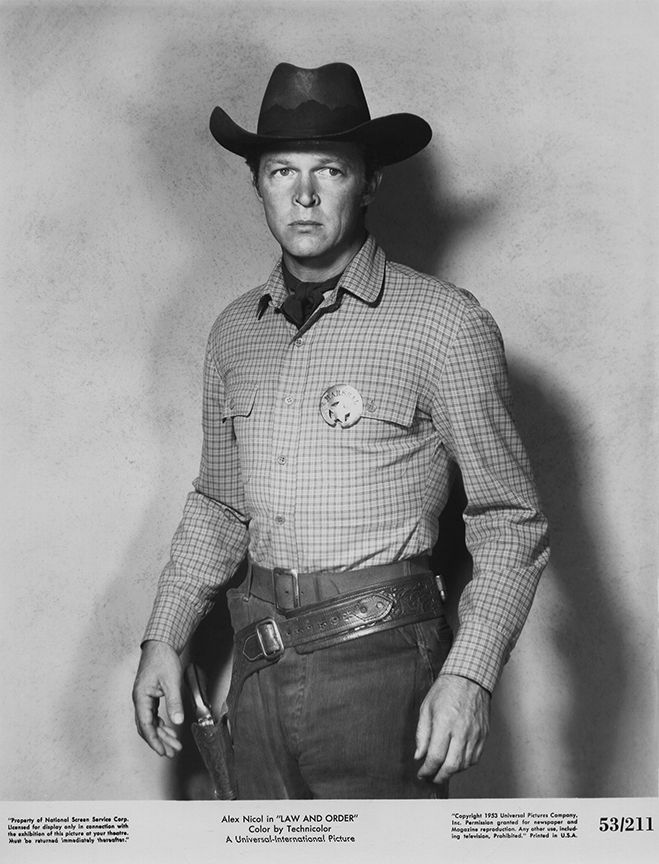
Supporting Characters:
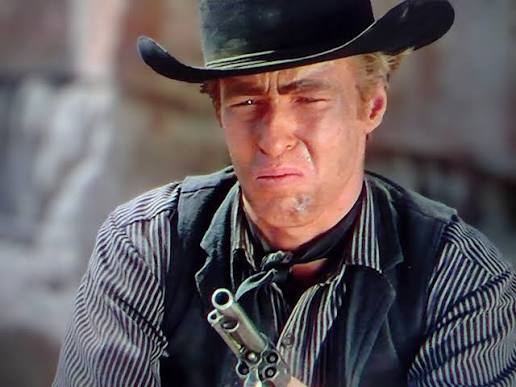
Russel Johnson portrayed, brother, “Jimmy Johnson”. Johnson is known to science fiction fans for 1953’s, “It Came from Outer Space”, 1955’s, “This Island Earth”, and 1957’s, “Attack of the Crab Monsters”. To television. audiences he was the “Professor” on “Gilligan’s Island”.
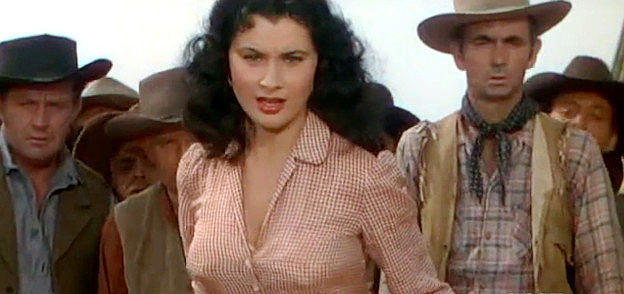
Ruth Hampton portrayed, daughter, “Maria Durling”. Billed as “Miss New Jersey”, Hampton was just in, 1953’s, “Abbott and Costello Go to Mars”. She followed this movie in the uncredited role of a “Dancehall Girl”, in the comedy Western, 1953’s, “Take Me to Town”.
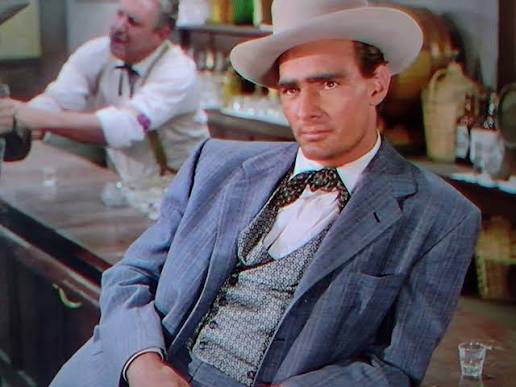
Dennis Weaver portrayed, son, “Frank Durling”. Weaver had just portrayed the uncredited role of “Al”, in the Loretta Young comedy, 1953’s, “It Happens Every Thursday”, and followed this feature film with the Audie Murphy, 1953, “Column South”. Starting in 1955 and through 1964, Dennie Weaver portrayed “Chester Goode” for 290 episodes of television’s “Gunsmoke”.
Don Gordon portrayed, the uncredited son, “Bart Durling”. “Gordon had 7th-billing in 1953’s, “Girls in the Night”, and followed this picture as an uncredited “Soldier”, in 1953’s, “The Beast from 20,000 Fathoms”.
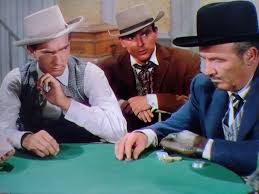
Above left to right, Dennis Weaver as son, “Frank Durling”, Don Gordon as son, “Bart Durling”, and Preston Foster as father, “Kurt Durling”.
Don Garner portrayed the uncredited, “Johnny Benton”. He was a television actor brought in for the role.
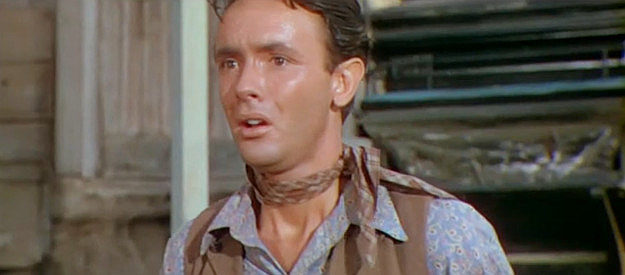
This Film’s Version of W. R. Burnett’s novel:
In 1882, United States Marshall, “Frame Johnson”, apprehends the notorious outlaw, the “Durango Kid”, portrayed by Wally Cassell, and brings him back to Tombstone, Arizona. Where the townspeople and, “Frame’s” brother’s, “Luther” nicknamed, “Lute” and “Jimmy” herald his deed. Later, an angry crowd of townspeople gather in front of the jail demanding “Frame” bring “The Kid” out to be hung. “Frame” goes out, and alone faces the crowd, and threatens to kill anyone who attempts to enter the jail. From the crowd steps “Frame’s” youngest brother, “Jimmy”. However, the crowd disperses and “Frame” tells “Jimmy”, that he wants to leave being a United States Marshall.
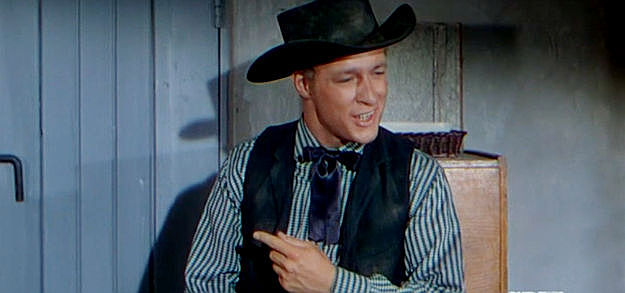
“Frame” next visits his sweetheart, “Jeannie”, owner of a saloon, and tells her of his plans.
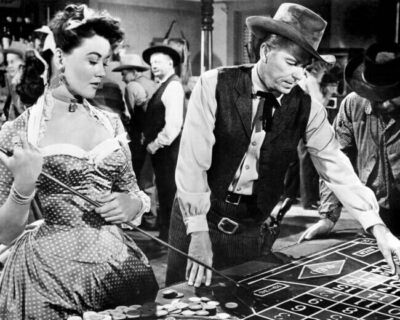
He is giving up being a law man and working a ranch in Cottonwood, Arizona, and she agrees to marry “Frame”.
The “Johnson Brothers” now leave Tombstone, for Cottonwood, and the ranch. Accompanying the three is local coroner, “Denver Cahoon”, portrayed by Chubby Johnson. They plan to send for “Jeannie” as soon as they can.
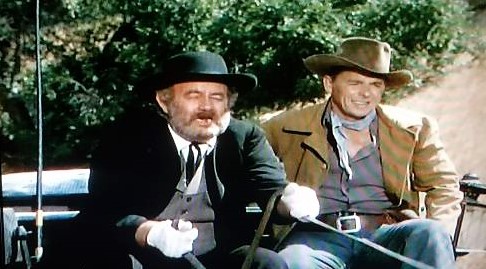
Now comes the set up for the Earps and the Clantons in Tombstone, but not there, but Cottonwood under different names.
They group arrives in Cottonwood, and that night the “Johnson” brothers enter the saloon. There they find “Kurt Durling”, who “Marshall Frame Johnson” shot off his hand during “Durling’s” cattle rustling raid. “Kurt” runs Cottonwood and vows revenge against “Frame” and “Lute (Luther)”, and “Jimmy”. Almost at the same time the three entered the saloon, “Bart Durling” starts to intimidate “Johnny Benton”, “Frame” steps in, and “Bart” backs away. “Kurt” immediately slaps his son across his face and call “Bart’ a coward.
The following morning, “Kurt” puts his revenge into play, by forcing newspaper owner, “Martin”, portrayed James Stone, to run a false article that “Frame Johnson” is a “Cold-Blooded-Murderer”. “Frame” ignores the article, but finds himself falling into his lawman persona. When a mob is taking “Johnny Benton” to be hung for killing “Bart Durling”, in self-defense. After “Frame”, is assured that the crooked “Sheriff Fin Elder”, portrayed by Barry Kelley, will safely take “Johnny” to the next town to be jailed.
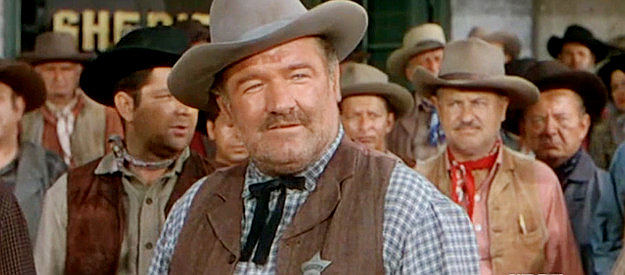
This is followed by a group of town leaders led by “Judge Williams” portrayed by Richard Garrick, ask “Frame Johnson”, the “Cold-Blooded-Murderer”, to become a “United States Marshall”, again, and clean-up Cottonwood, but her refuses.
The brothers ride out to the ranch that “Frame” purchased and realized it needs lots of work, and decide to go back to town and discuss how they want to do it. On their way to Cottonwood, the three come upon “Johnny Benton” hanging from a tree. There the three brothers confront “Sheriff Fin Elder”. “Elder” lies that he tried to defend the innocent “Johnny Benton”, but then ads that “Frame” is a coward for not taking the “Marshall” position. “Jimmy” punches “Elder”, “Lute” says he will take the “Marshall” position. “Frame” congratulates his brother and one-time deputy “Marshall”, as “Lute” heads for town, “Frame” “Jimmy” and “Denver” heard for the ranch.
One day, “Jimmy” is just outside the ranch’s area, and spots a beautiful girl.
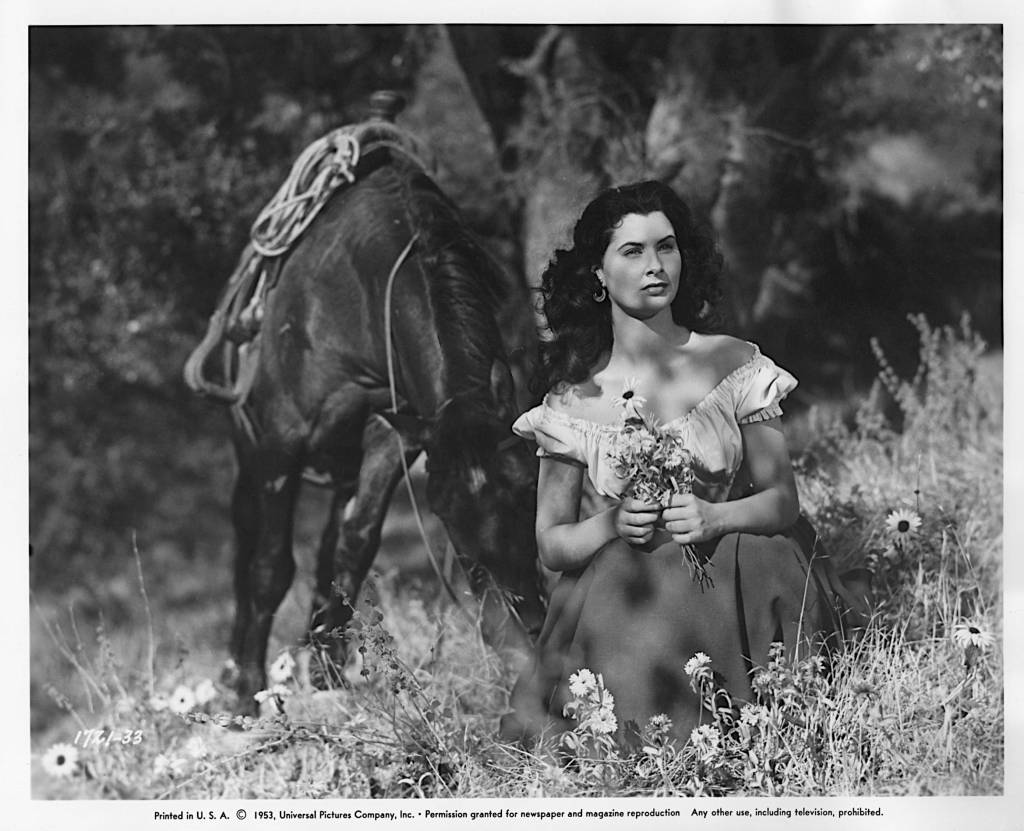
He wants to meet her, and follows her home, only discover she is “Kurt’s” daughter, “Maria”, but that doesn’t stop the young man from declaring his love of her at first sight.
moMeanwhile, “Kurt Durling” and his eldest son, “Frank”, go after the new town Marshall, “Lute Johnson”. The plan starts with “Frank” keeping “Lute” occupied, while his father rustles cattle. When “Lute” finally realizing he can’t do this alone, asks “Frame” for help, the response is that his older brother wants to stay out of the lawman business. That night in the saloon, “Frank Durling” and his henchman, “Jed” portrayed by Jack Kelly, shoot and mortally wounds “Lute”.
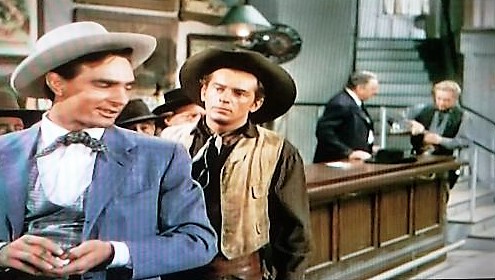
Above left, Dennis Weaver, above right, Jack Kelly 4-years before televisions “Maverick”.
Getting word of the shooting, “Frame” and “Jimmy” rush to town and arrive at the saloon to hear “LUKE” apologize for his failure and dies. Furious at both the “Durling’s” and “Frame”, “Jimmy” goes to the bar and gets drunk. He then starts to stalk off with the intention of killing “Frank”, but “Denver” knocks him out with a bottle, and puts him in a locked jail cell to dry out.
The following day, “Frame Johnson” he is the new “Marshall of Cottonwood, Arizona”. Along with announcing that is against the law to carry a gun within the city limits. Although, several citizens refuse to not carry a gun. After “Frame” arrests a few, and “Judge Williams” backs him, they comply. While, in Tombstone, “Jeannie” hearing about “Lute’s” murder, packs and leaves for Cottonwood. Once there, she tells “Frame” that you does not insist he give up the law as a requirement of their marriage.
Later, that same day, “Denver” agrees to let “Jimmy” out of the cell. As soon as the cell is unlocked, “Jimmy” grabs his guns and heads for “Maria Durling’s”. Before, “Maria” and “Jimmy’ can leave the “Durling” ranch. “Bart” shows up and “Jimmy” kills him, and with “Maria”, the two head for town and “Frame” to tell him about the incident.
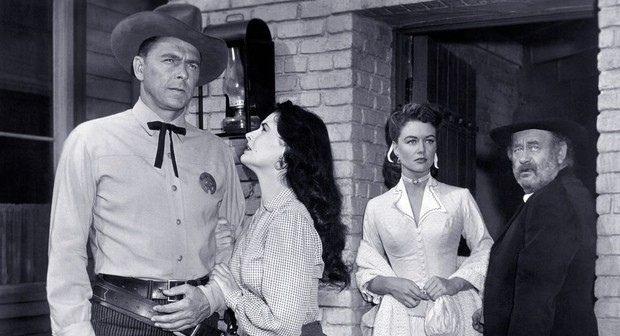
To protect his brother, “Frame” puts “Jimmy” back in a call and promises him a fair trial. However, that night, “Kurt’ sends “Jed” to let “Jimmy” out, and what he expected happens. As the towns people think it was “Frame” who let his brother escape a trial.
“Kurt Durling” assembles a posse to go after “Jimmy Johnson”, but “Frame” demands that he go after his brother. “Durling” pulls a hidden gun on “Frame”, an unarmed “Frame” fights “Kurt” in the street. Suddenly, a stage comes down the street and runs over “Kurt Durling”, killing him.
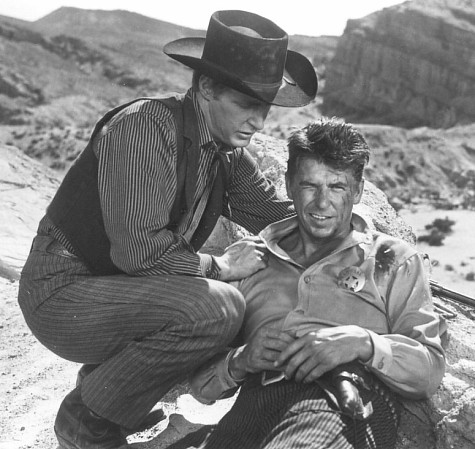
“Frame” gets on a horse and rides after “Jimmy”. Easily following his brother’s drunken trail, “Frame” catches up on him. “Jimmy” is up in some hills, pulls out a gun, as “Frame” gets off his horse and starts to climb, all along urging his brother to turn himself in. At the top, face to face, “Jimmy” shoots his brother in the shoulder, but when he collapses, the younger brother rushes to help the older.
“Judge Williams” is trying to dissuade the posse from going after “Jimmy”. When both brothers ride back into town. Sure that no Western jury will convict a man who has returned of his own accord. “Sheriff Elder” and “Jed” ride out of town, fleeing to the safety of California. “Maria” embraces “Jimmy”, and “Frame” tosses his badge into the ground and tells “Jennie” he will never pick it up again.
Next, the definitive fictional AL CAPONE, 1930’s movie, or maybe not?
SCARFACE premiered in New Orleans, Louisiana, on March 31, 1932.
The motion picture was also known by two other titles, “Scarface: The Shame of a Nation”, or just “The Shame of the Nation”.

This is the original, violent, illicit sex filled, motion picture. It would be remade by Brian De Palma in 1983. Before I tell my reader, who appeared on the screen. There are two stories to tell, the first is about the screenplay, and the second, about that title.
There were two producers, both, technically, without credit, but whose names are on-screen.
The independently made motion picture‘s, opening title card, in the terminology of the 1930’s, reads, “HOWARD HUGHES PRESENTS”. Hughes had just produced 1932’s.”Sky Devils”, starring Spencer Tracy and William “Stage” Boyd. The insert of “Stage”, is a reference to his legitimate stage work, and was to avoid confusion with “B” Cowboy actor, William Boyd, the Western movies, “Hopalong Cassidy”.
The next produced feature film, from Howard Hughes, wasn’t until 11-years later, and was his controversial, 1943, “Billy the Kid”, “The Outlaw”, starring his new find, Jane Russell, and a “Hughes Aircraft” built bra.
My article on the “Presenter” is, “HOWARD ROBARD HUGHES, JR.: The Motion Pictures”, and can be read at:
http://www.bewaretheblog.com/2018/08/howard-robard-hughes-jr-motion-pictures.html
The second producer, was also the motion picture’s director, Howard Hawks. He had just directed Walter Huston, John’s father, and Constance Cummings, in 1931’s, “The Criminal Code”. Hawks would follow this motion picture with the James Cagney, Joan Blondell, and Ann Dvorak, 1932, “The Crowd Roars”.
I wrote an article on one of Howard Hawks’s classic westerns, and the two remakes that Hawks, himself, made. That article is, “Howard Hawks: ‘RIO BRAVO’ Remade (?) as ‘EL DORADO’ and ‘RIO LOBO’ Starring John Wayne”, and riding the trail at:
http://www.bewaretheblog.com/2017/10/howard-hawks-rio-bravo-remade-as-el.html
One: The Story of a Screenplay:
The novel, “Scarface”, was written in 1929, and published in 1930, by the interestingly pennnamed, Armitage Trail, actually Maurice R. Coons.
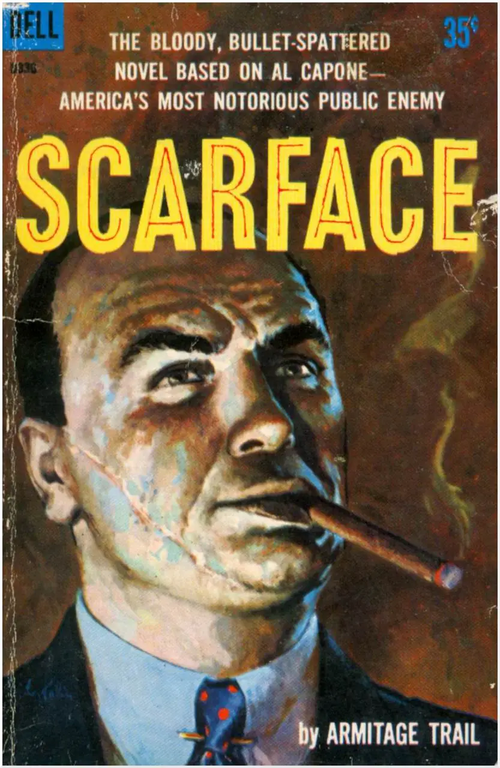
Coon/Trail wrote: “I’m Scarface. I’m just about ten times as hard-boiled as Johnny Lovo ever thought of being. I’ve bumped off six or eight myself and another one – especially a rat like you – wouldn’t mean a thing in my young life. Get me?”
There are six names that worked upon the screenplay according to the website “IMDb” at:
https://www.imdb.com/title/tt0023427/?ref_=nm_flmg_job_1_accord_1_cdt_t_64
However, their information leaves out something important about this article’s subject, as do many others. This is based upon an inaccurate “Official Cast Listing”.
Producer Howard Hughes wanted to make a movie out of Armitage Trail’s novel. He hired W. R. Burnett, because of his novel, “Little Caesar”, to write the screenplay, which he did. HOWEVER, the other “Howard”, “Hawks”, disliked Burnett’s screenplay, because it was too realistic. The “Howard’s” wanted a “tough shoot-’em-up”, as in his “Little Caesar”.
Howard Hughes next offered playwright Ben Hecht, the co-playwright on the award winning 1928 Broadway production, “The Front Page”, what was described as a massive salary. He was to rewrite Burnett’s screenplay, and as fast as possible. Ben Hecht was not dummy, and he demanded $1,000 a day until the screenplay was finished. Which the millionaire producer agreed too, and Hecht would next lock himself up in a hotel room to do the rewrite.
Ben Hecht, delivered the revised screenplay in 11-days. His, $11,000, as of this writing, would be equal to $241,651.
Besides the play, “The Front Page”, Ben Hecht was nominated six-times for the “Academy of Motion Pictures Arts and Sciences, Best Screenplay Oscar”, and won twice. His first win was for 1927’s, “Underworld”, with co-writer Howard Hawks, and his second win was his own directed, 1935, “The Scoundrel”, starring Noel Coward. His other nominations included director William Wyler’s, 1939, “Wuthering Heights”, and director Alfred Hitchcock’s, 1946, “Notorious”.
One actual incident that took place during Hecht’s 11-days. The writer was visited by two men sent to check on what he was writing. They were not from either Howard, but their boss was Al Capone, and their question to him was simple: Ben Hecht started as a crime reporter in Chicago, and had met Capone.
Had he written “Tony Camonte” as a thinly veiled Al Capone?
To which, the writer, who has met “Capone”, famously replied:
“If I was writing about Capone, don’t you think I’d call it Al Capone and get all the free publicity”
Reviewing the screenplay, Howard Hawks added his specific input, and with Ben Hecht, had decided to turn “Tony Camonte” into “Cesare Borgia”, and his sister, “Francesca ‘Cesca’ Camonte”, into “Lucrezia”.
How much of W. R. Burnett’s original screenplay was left by Ben Hecht is not completely clear. Reading Hecht’s screenplay, there was enough, within the dialogue, the underworld details, and Burnett’s known, “hard boiled characters”, to convince the two producer’s that they better give W. R. Burnett some credit, and his name appears under “Continuity” for the final screenplay.
Also working on the features “Continuity”, was Fred Pasley. Who had written the best selling, 1930 biography, “Al CAPONE: The Biography of a SELF-MADE MAN”, that is still available.
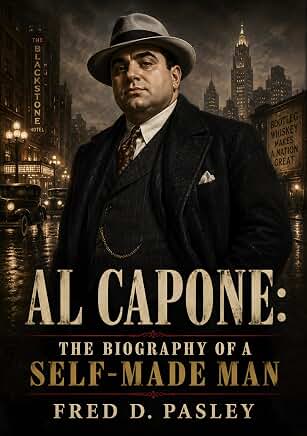
Two more writers, also worked on the “Continuity”, and “Dialogue”.
The first writer was Seton I. Miller, 1930’s, “The Dawn Patrol”, directed by Howard Hawks, 1932’s, “The Last Mile”, 1937’s, “Kid Galahad”, starring Edward G. Robinson and Bette Davis, the 1938, remake of “The Dawn Patrol”, and 1946’s, “Two Years Before the Mast”.
The second writer was John Lee Mahin, 1932’s, “Red Dust”, and its remake, 1953’s, “Mogambo”, both starring Clark Cable, 1934’s, “Treasure Island”, 1941’s, “Dr. Jekyll and Mr. Hyde”, 1956’s, “The Bad Seed”, and 1959’s, “The Horse Soldiers”.
Two: The Question of Censorship and the Alternate Film Titles:
Examples of censorship, as required by the motion picture industry’s own censor, Will Hays, and what was called, at the time, “The Studio Relationship Committee”. Which would become in 1934, with the new “Motion Picture Code”, simply, “The Hays Office”, on “Ben Hecht’s” screenplay included:
At the climax of the screenplay, “Tony Camonte”, dies in a dramatic, somewhat chaotic, shoot out with the police. “The Studio Relationship Committee” objected to this, as giving “Tony”, a glamorous ending to his life, MAKING HIM A HEROIC CRIMINAL.
Instead, Will Hays and “The Studio Relationship Committee”. FORCED the production to shoot an ending in which “Tony” surrenders to the police, goes on trial, and is executed for his crimes. Telling the growing, out of work, looking for any job to feed their families, Depression Era American, THAT CRIME DOESN’T PAY. In 1934, Joseph Breen of the “Hays Office”, would be “Protecting the Morality of the American Movie Goer”.
Howard Hawks refused to shoot that ending, and the studio brought in Richard Rosen to shoot the sequence. I’ll give my reader the actual ending. When I look at the final on-screen story.
Then there was the censoring of scenes of graphic violence, many sequences with machine guns and bombs going off. Basically, what “The Howard’s” complained, needed to be added to W. R. Burnett’s original screenplay. The censor’s complaint was that the two producer’s treated all of the above, like kids playing games with real bullets.
Sexual sequences were removed, especially those showing “Tony’s” incestuous longings for his sister, “Cesca“. I give my reader, “Cesare” and “Lucrezia Borgia”.
The title had to be changed, to again, point out that “Crime Doesn’t Pay”. It now became “Scarface: The Shame of a Nation”, or in different parts of the United States and several Foreign countries, just “The Shame of a Nation”.
The Main Cast of Characters:
Paul Muni portrayed “Antonio ‘Tony’ Camonte”. Muni had been born Frederich Meshilem Meier Weisenfreund and was a major actor in the Yiddish Theater. He had just been seen in his second on-screen appearance, in the early all-talkie, 1929’s, “Seven Faces”, portraying five historical figures and two fictional. Muni would follow this motion picture with another crime classic, 1932’s, “I Am a Fugitive from a Chain Gang”, directed by Mervyn LeRoy.

Ann Dvorak portrayed “Francesca ‘Cesca’ Camonte”. Technically under her birth name of Anna Lehr, at the age of four, Dvorak, the “D” is silent, appeared in her first motion picture, 1916’s, “Ramona”. Two more movies followed as a baby, and then in 1929, at the age of 18. The actress started appearing as Ann Dvorak, in a short subject, “The Doll Shop”, as a doll, the short starred Lionel Barrymore as the “Toymaker”. 33-roles later, of which 29 were uncredited, and one other had her scenes deleted and:
Ann Dvorak, became the interest of Howard Hughes, and he personally “Groomed” the actress for this dramatic role. My reader may take the term “Groomed” to have other meanings. Dvorak followed this motion picture with the previously mentioned, 1932, “The Crowd Roars”.

Osgood Perkins portrayed “John ‘Johnny’ Lovo”. His career consisted of only 21-roles, and had started with 1922’s, “The Cradle Buster”. Perkins had just been seen in 1931’s, “Tarnished Lady”, starring Tallulah Bankhead and Clive Brook, and directed by George Cukor. He would follow this feature with 1934’s, “Madame Du Barry”, starring Dolores del Rio, Reginald Owen, and Victor Jory. On September 21, 1937, James Ridley Osgood Perkins, died from a heart attack.
Karen Morley portrayed “Poppy”. Morley had been considered for the role of “Camonte’s” sister, but suggested to Howard Hughes that her friend Ann Dvorak really looked the part. Just after “Scarface” was released, Morley would make the mistake of arguing with MGM management over her roles for the studio. The word was put out, and Karen Morley’s career with the major studios was finished, and she could only find minor roles from the Independents.
Morley had just co-starred with John Barrymore and his brother, Lionel Barrymore, in a major “MGM” motion picture, 1932’s, “Arsene Lupin”.

Above left to right, Osgood Perkins, Paul Muni, and Karen Morley.
Boris Karloff had the interesting billing as seen on the above poster, of “Boris ‘Frankenstein’ Karloff”. He portrayed “Tom Gaffney”. Karloff had been one of the “Guest Actors as Themselves”in “Universal Pictures”, 1932 comedy, “The Cohens and the Kellys in Hollywood”, the two families mentioned, first appeared in a silent comedy, with different actors, in 1926 at the start of the series. Boris Karloff followed this feature with 9th-billing in the Sylvia Sidney and Chester Morris, gangster romance, 1932’s, “The Miracle Man”. My article is “Boris Karloff: There Were More Than Horror Movies (January 15, 1915 to July 20, 1958)” at:
https://www.bewaretheblog.com/2023/10/boris-karloff-there-was-more-than.html
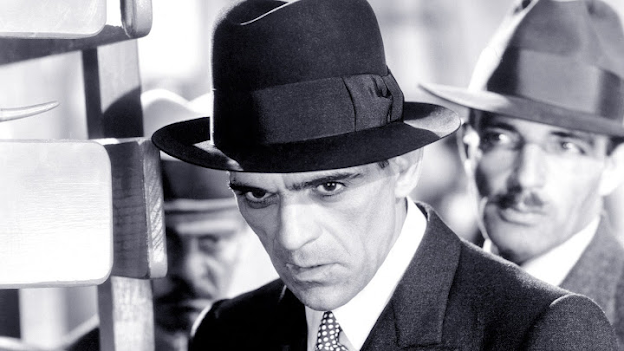
George Raft portrayed “Guino ‘Little Boy’ Rinaldo”. Known mainly as a dancer for the nine pictures that proceeded this one. George Raft raised his “Hollywood” status in this motion picture. As most of his scenes required him to just be seen, he started what became his trademark, flipping a coin in the air over and over again. Raft had just portrayed another dancer in the 1932, drama, “Dancers in the Dark”, starring Miriam Hopkins and Jack Oakie. George Raft followed his film with a comedy crime drama, 1932’s, “Night World”, starring Lew Ayres, Mae Clarke, and Boris Karloff, portraying “Happy’ MacDonald”. My article is “George Raft Beginnings: a Charleston, a Machine Gun, and a Bolero!” found at:
https://motion-picture-history.com/2026/07/24/george-raft-beginnings-a-charleston-a-machine-gun-and-a-bolero/

The Basic Screenplay:
Where Howard Hughes’ 1928 picture “The Racket” might have gotten some viewers, and especially those in Chicago, to think of Alphonse “Al” Gabriel Capone. There was no such ambiguity with his “Scarface”.
“Tony Camonte, is a level one hood, who becomes the enforcer for bootlegger “Johnny Lovo”.

On orders from “Lovo”, “Tony” kills Italian mob boss “Big Louis Costillo”, portrayed by Harry J. Vejar, and sets off a mob war. On “Lovo’s” additional orders, “Tony” and “Guino Rinaldo” start terrorizing bars on the Southside once controlled by “Costillo” to let them know who’s the new boss. “Tony” next, urges “Johnny” to take over the Northside of Chicago controlled by an Irish Mobster named “O’Hara”, never seen on-screen, but “Lovo” says no to the idea. However, power hungry “Tony Camonte” starts attacking the Irish mob’s businesses.
(No matter if it was W. R. Burnett, or Ben Hecht, “Costillo” is an obvious “Big Jim Colosimo”, and “O’Hara” an obvious, “Dean O’Bannon”. Just a “Johnny Lovo”, is a very obvious “John ‘Johnny’ Torrio”)
“Tony” is visited at this apartment by “Johnny’s” girlfriend “Poppy”. He has her look out his window at the neon sign slogan directly across the street for “Cook’s Tours”. Then tells “Poppy” that that slogan on the sign is now his belief:
THE WORLD IS YOURS!
It doesn’t take long for “Tony Camonte” to take over the gang and push “Johnny Lovo” aside.

“Tony” has “Guino” assassinate “O’Hara”, thinking that will give him the Northside, but the Irish mob boss has a successor, “Tom Gaffney” (Based upon a combination of “Hymie Weiss” and “Bugs Moran”),


“Gaffney” sends his men with tommy-guns to the Southside.

“Tony” responds with tommy guns and a mob war is started. On “St. Valentine’s Day” seven Irish gangsters are lined up and killed. The local District Attorney and Police Chief make comments to “Tom Gaffney” at the scene after the massacre, about his lucky he was by not being there. (Bugs Moran was supposed to have been there, but was not),
One by one, “Gaffney’s” men are being killed off and he goes into hiding. A group of prominent citizens including the chief of police vow to bring “Camonte” down. (The citizens meeting was a forced, or else more censorship by Will Hays. One of several small add to the screenplay to offset the violent criminals.)
During a night at the theatre, “Tony” leans that “Gaffney” and his men are at a bowling alley.

He excuses himself, goes over to the alley, and personally murders “Gaffney”.


Later at dinner, “Johnny Lovo’s” anger with “Tony Camonte” comes to a boil, as the other openly flirts with “Poppy” in front of him, and then dances with her.

Later, “Tony” sees “Cesca” dancing with a stranger, takes her by force to their mother’s house, slaps and beats her up, but she appears to enjoy it. Driving home, a car appears behind “Tony’s”, whomever is inside that car is attempting to assassinate him. “Tony” is able to run the gunmen’s car off the road, but his car also crashes destroying it. However, he survives and now has a cut across his left cheek and his face is permanently scarred. (While, Al Capone received his back in 1917, because of an overly forward remark to a girl he was dancing with. This offended her brother, Frank Galluccio, a foot soldier of the “Genovese Family”, who slashed Capone’s face with a knife.)

“Tony” suspects “Johnny” was behind the hit, he forces him to confess and has “Gunio” kill him.
“Tony Camonte” is now the undisputed ruler of Chicago. He takes “Poppy” and goes on vacation in Florida to escape the police and the media for a month. While this is happening, “Cesca” secretly visits “Tony’s” office and meets with “Guino”.
“Tony’s” mother tells him that “Cesca” has moved in with another man. Blindly, “Tony” rushes over to his sister’s apartment to find her with “Guino”. In a jealous rage, “Tony” shoots and kills his friend. “Cesca” with tears coming down her face, tells her bother that she and “Guino” had fallen in love, had just gotten married, and planned to surprise him.

Meanwhile, the police get a warrant for the arrest of “Tony Camonte”. “Cesca” goes to “Tony’s” apartment to kill her brother over “Guino”, but almost as she walks into the room, the police arrive outside the apartment.

As the police shoot at the apartment’s window, “Cesca” admits she’s always loved her brother, and not as a sister.
Next, “Tony”, laughing manically at the police, shoots out of a window. As a stray return bullet from the police hits and kills “Cesca”, this maddens “Tony” even more.

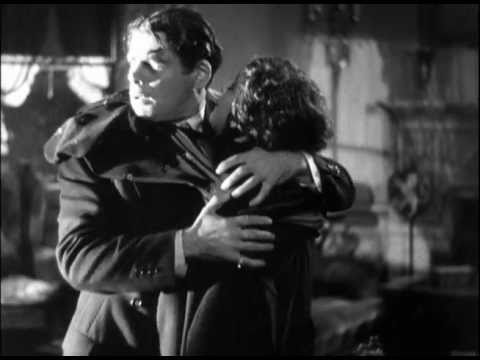

“Tony” decides to make an escape, but will be gunned down by an unknown police officer, and dies on the street.

In “Collier’s Magazine” from March 16 through April 27, 1935, there was a six-part crime story, “Dr. Socrates”, written by W. R. Burnett.
According to the website: “Goodreads” at:
https://www.goodreads.com/book/show/2037592.Dr_Socrates
The basic story, which is also available in book form, tells:
“The story of young Dr. Cardwell who, after being forced at gun point to treat the wounded members of gang of bank robbers, finds himself caught between the threats of gang leader Red Bastian and the suspicion of Federal Agents investigating the wave of bank robberies. Portions of the story suggested by the saga of Public Enemy John Dillinger.”
In 1935, “Warner Brothers” released the FIRST of THREE motion pictures using W. R. Burnett’s “Collier Magazine” story. Here is an overview of all three pictures.
#1: DR. SOCRATES released on October 19, 1935
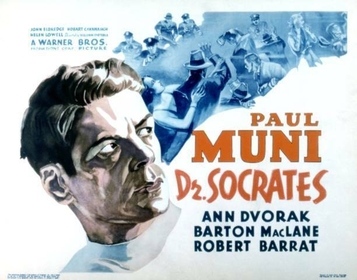
The series was adapted in a screenplay format by Mary C. McCall, Jr. She had arranged for the screen, William Shakespeare’s, “A Midsummer Night’s Dream” for the 1934 feature. She would follow this movie btw contributing to the screwball comedy, 1936, “Snowed Under”.
The actual screenplay was by Robert Lord. He had just co-written the 1935 comedy, “Page Miss Glory”, starring Marion Davies. Whose “Partner” since 1917, was Newspaper Magnet William Randolph Hearst. Lord followed this crime drama with musical comedy, 1936’s, “Colleen”, co-staring Dick Powell and Ruby Keeler.
William Dieterle directed, just prior to this feature he directed the 1934 “A Midsummer Night’s Dream”, and he followed this feature with Paul Muni, in 1936’s, “The Story of Louis Pasteur”.
The Four Actors:
Paul Muni portrayed “Dr. Lee Caldwell”. Muni had just portrayed an immigrant coal miner in 1935’s, “Black Fury”, co-starring Karen Morley. He would follow this film with his “Academy of Motion Picture Arts and Sciences, Best Actor Oscar”, for his starring role in 1935’s, “The Story of Louis Pasteur”.
Ann Dvorak portrayed “Josephine Gray”. Dvorak co-starred with Joe E. Brown, in the musical comedy, 1935, “Bright Lights”, and followed this feature with the comedy musical, 1935, “Thanks a Million”, co-starring with Dick Powell.
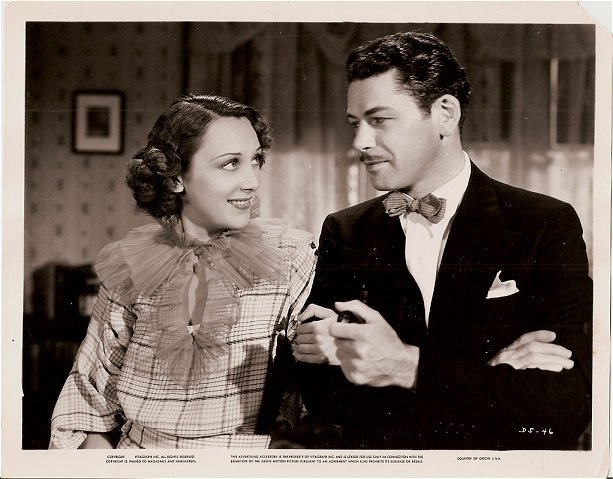
Barton MacLane portrayed “Red Bastian”. MacLane is recognized as the bad guy in crime and western motion pictures. Yet, he was “Detective Steven McBride” in seven of Glenda Farrell’s, “Torchy Blane” films, he worked with director John Huston and actor Humphrey Bogart for both 1941’s, “The Maltese Falcon”, and 1948, get the name right, “The Treasure of the Sierra Madre”, fought dinosaurs in Richard Denning’s, 1948, “Unknown Island”, and was “Air Force General Martin Peterson” in 35-episodes of television’s “I Dream of Jeannie”.
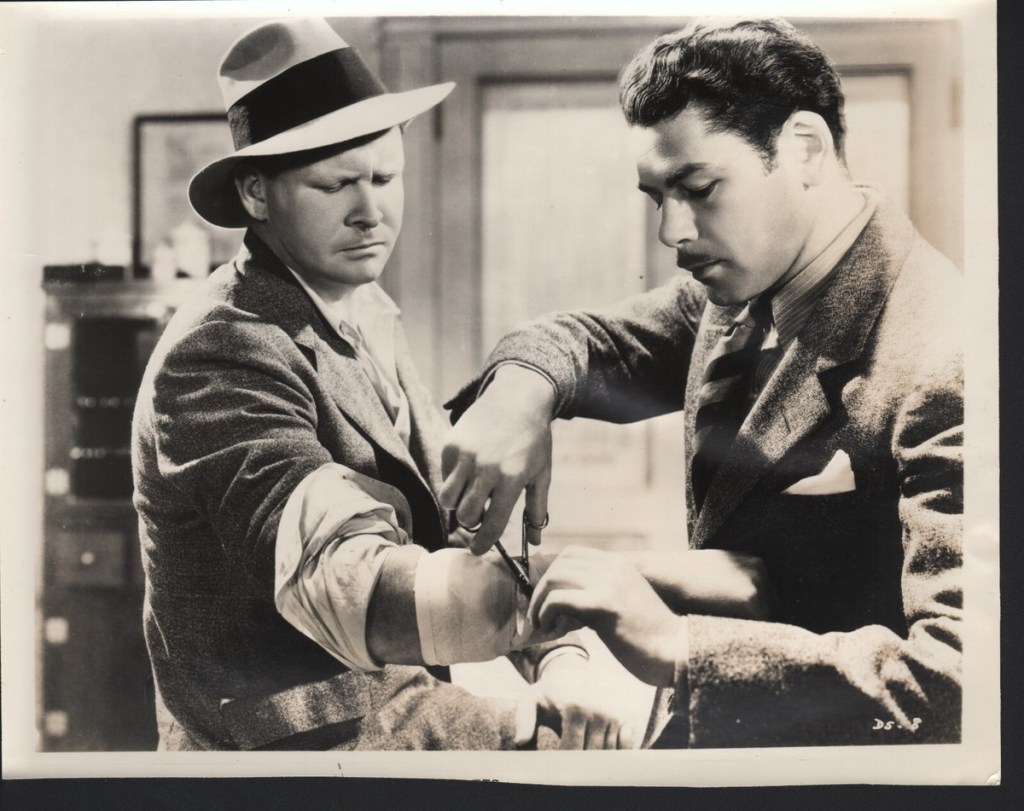
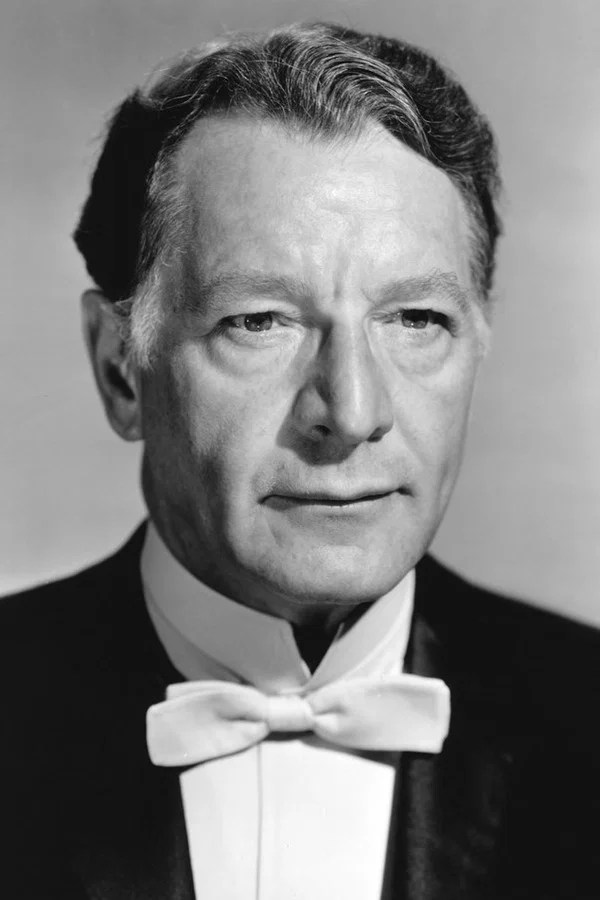
Robert Barrat portrayed “Dr. Ginder”. Barrat was just in the musical romance, 1935’s, “Dressed to Thrill”, and followed the feature with the singing cowboy film, 1935’s, “Moonlight on the Prairie”. The following is Robert Barrat, but I am not sure in which movie, because I cannot locate any photos for this film.
The Plot is Thin and Cleaned UP By the Hays Office:
“Dr. Caldwell” is a major surgeon, but his life goes to pieces after his fiancee dies in a car crash. To deal, or not to deal with the tragedy, he moves to a small out of the way, rural town, named “Big Bend”. There, because the town already has two doctor’s, “Dr. Grinder”, and “Dr. McClintick”, portrayed by Samuel Hinds. “Dr. Caldwell” hardly sees any patients, and turns to reading classic historical books. As a result, “Dr. Grinder”, gives “Dr. Caldwell”, the nickname of “Dr. Socrates”, and becomes his mentor.
Next, “Red Bastian” and his gang pull off a local bank robbery, but during the get-a-way, he is shot be a police officer. Needing medical treatment and unable to go to a hospital. The gang seeks out the town’s most isolated doctor, who happens to be “Lee Caldwell”. During the middle of the night, they break into his office, blindfold, and tie him up. Then drive to local farmer, “Bob Catlett’s”, portrayed by Olin Howland, farm, their hideout.
At gunpoint, “Dr. Lee Caldwell” is forced to treat “Red”. Afterwards, the gangster wants to pay him, but “Caldwell” refuses. “Red” still gives the doctor a one-hundred dollar bill, and blindfolded, he is return to his home.
Later on, while heading to another bank robbery, “Red” spots hitchhiker “Josephine Gray” and offers her a lift, which she accepts. However, the gang now goes to rob the bank, and “Josephine”, realizing the predicament she’s in, attempts to get away. To stop her, “Red” shoots “Josephine”. He puts the wounded hitchhiker in his car and drives away from the scene of the robbery. However, the police now believe “Josephine” is part of “Red Bastian’s” gang, his “Moll”. “Red”, next takes her to “Dr. Caldwell”, so he can treat her gunshot wound. “Red” and his gang will leave “Caldwell’s” for their hideout, leaving “Josephine” to recover at “Caldwell’s”.
This was not a Pre-Motion Picture Production Code film, and under that New Motion Picture Code of 1934, explicit representations of graphic or realistic gunfire, mass shootouts, and brutal killings were severely restricted. As a result, “Warner Brothers”, in 1935, began to switch from “Gangsters”, to Heroic “FBI Agents”.
We’ve reached the point in this screenplay were the influence of what was now being referred to as the “Breen Office”. Referencing Will Hays’s number one enforcer of the new motion picture code, Joseph Breen, vs W. R. Burnett’s original story. I will be giving my reader both versions of certain critical scenes in the movie “VS” the original written story.
The Screenplay Under the New Code:
As “Josephine” starts her recovery in “Lee Caldwell’s” house, the two are starting to get closer. “Red” fearing she know a lot about him and his gang. and could talk to the authorities. “Red” and his gang break into “Dr. Lee Caldwell’s” house, kidnap “Josephine”, and take her back to “Catlett’s” farm. Which sets up the final rescue sequence.
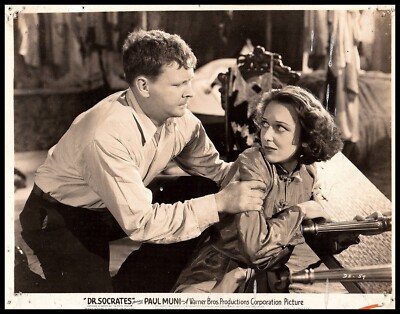
Having been earlier to the hideout, “Dr. Caldwell” informs the police of its location. He then goes there to inform “Red” and his gang that a thyroid epidemic has broken out in the countryside and in town. However, he has brought typhoid vaccine for the group and gives each one a shot, and especially makes sure “Red” gets a full dose. It is actually a powerful sedative, which knocks all of the gang members, and “Red” out, even after the police arrive.
The outsider, “Dr. Lee Caldwell”, is now considered “AN HEROIC HERO”, by the same townspeople that mocked him as weird and called him, “DOCTOR SOCRATES”, in jest, whenever he was around. As for “Josephine”, not only is “Lee” able to clear her name, but it is obvious to the movie viewer that the two are in love and will soon marry and stay together in “Big Bend”.
W. R. Burnett’s Story:
The ending is a standard law-enforcement resolution. “Dr. Caldwell” manages to sneak information about the “Red’s” gangs location to both the local police and the “FBI”. Law enforcement surround the hideout and a major violent and realistic shoot out takes place. The remains gang members surrenders to law enforcement to save their own lives.
As for “Dr. Lee Caldwell”, W. R. Burnett’s written ending is more muted, and realistic. Yes, “Lee” survives, but rather than the glorious public adoration of “Caldwell”. Burnett stays with the man the reader first met after the tragic death of his fiancee. We read of a man trapped by his circumstances, emphasizing the gritty reality of a man who is a reflection of W. R. Burnett’s trademark hardboiled cynicism.
The relationship between “Dr. Caldwell” and “Josephine Gray” is not the happy-ending of “Hollywood”, or the “Breen Office”, but a strained and ambiguous relationship. Overshadowed by psychological trauma of each character in their own beginnings, and suspicion of the “Underworld”.
#2: KING OF THE UNDERWORLD premiered in New York City, on January 7, 1939
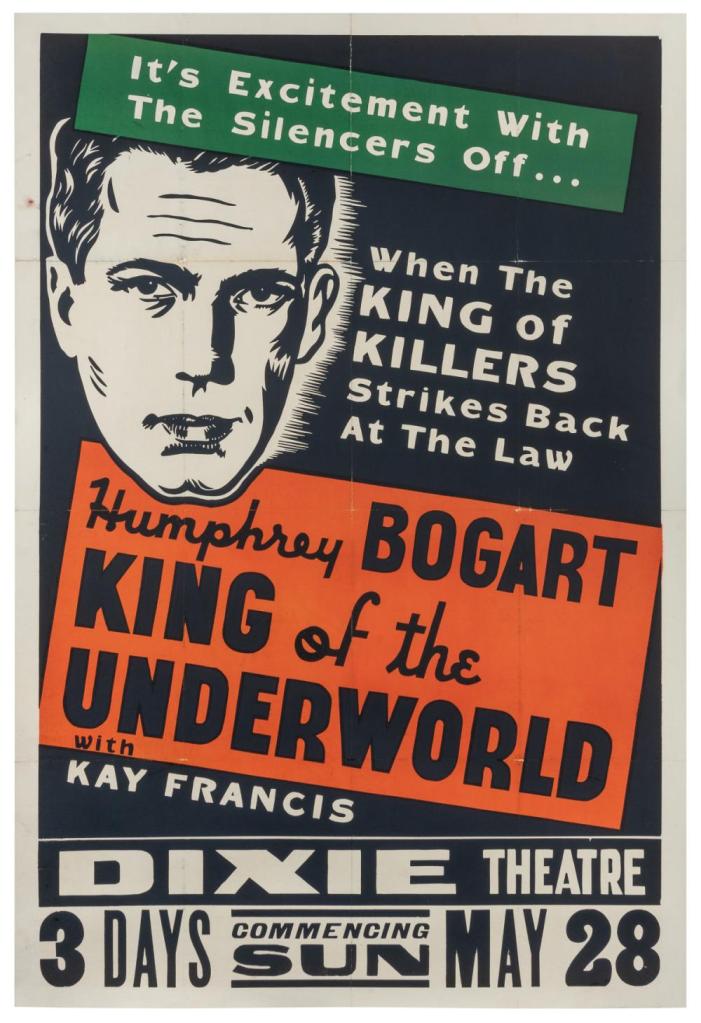
The on-screen credits show that the screenplay was by two writer. George Bricker, had just co-written the comedy, 1938’s, “Mr. Chump”. Vincent Sherman had just co-written the singing cowboy western, 1938’s, “Heart of the West”.
Their screenplay was adapted from a story by W. R. Burnett story.
This motion picture was directed by Lewis Seiler. Seiler had just directed 1938’s, “Heart of the West”.
The FIRST THING my reader, or a viewer of the previous motion picture will notice. Is the large amount of change from either W. R. Burnett’s, “Collier Magazine”, six-part story, or the 1935 motion picture.
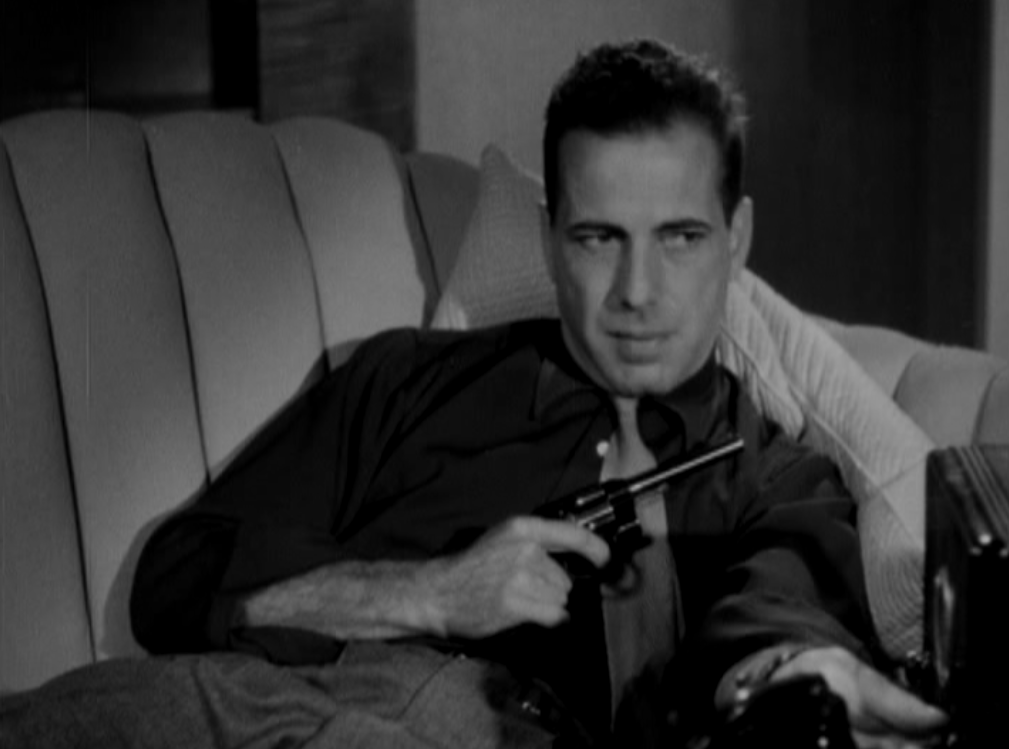
This is a HUMPHREY BOGART motion picture, and he plays, not “Red Bastian”, but “JOE GURNEY”. His previous motion picture was 1938’s, “Angels with Dirty Faces”, starring James Cagney, Pat O’Brien, and the “Dead End Kids”. Bogart was billed 4th. He would follow this picture with a 1939 western, “The Oklahoma Kid”, starring James Cagney in the title role billed over the film’s titles on the posters, and first name below the western’s title was his.
At this time in “Bogie’s” career, you did what the studio told you to do. So, my article is “HUMPHREY BOGART: Horror Movie Actor”, as he is brought back from the dead. Found to read at:
https://www.bewaretheblog.com/2019/08/humphrey-bogart-horror-movie-actor.html
Kay Francis portrayed “Dr. Carole Nelson”. Francis was just seen in 1938’s, “Comet Over Broadway”, and followed this movie with 1939’s, “Women in the Wind”.
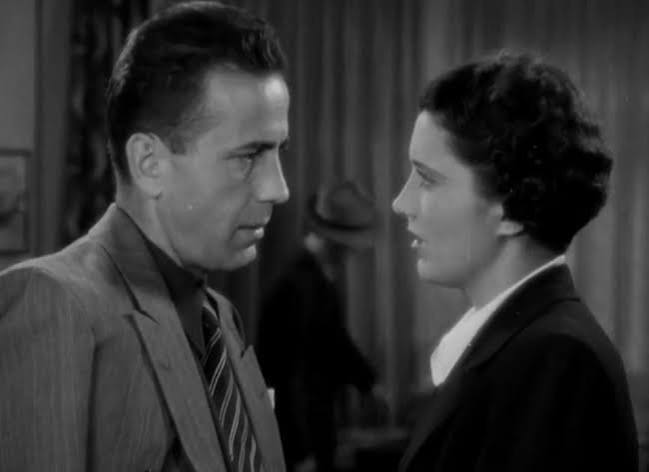
James Stephenson portrayed “Bill Stevens”, below in front seat with Bogart. Stephenson had just co-starred with Boris Karloff in 1938’s, “Devil’s Island’. He would follow this feature with the Glenda Farrell’s, 1939, “Torchy Blane in Chinatown”.
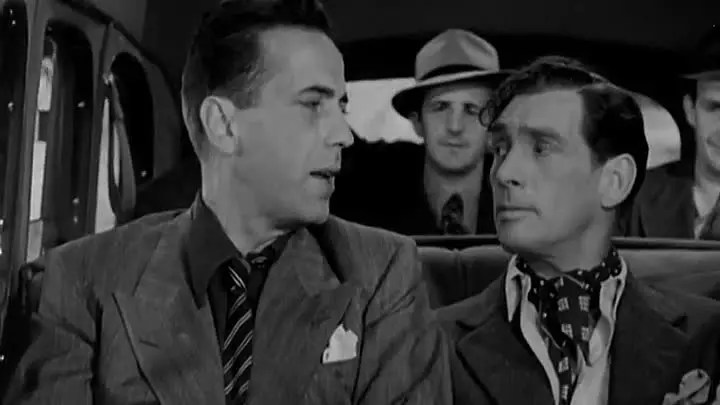
John Eldredge portrayed “Niles Nelson”. Eldredge had just been seen with Kay Francis in 1938’s, “Women Are Like That”. He followed this motion picture with 1939’s, “Persons in Hiding”, co-written by FBI Director, J. Edgar Hoover.
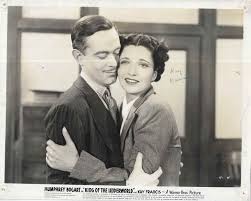
Above John Eldredge with Kay Francis
The Screenplay:
The opening sequences show a shadow of W. R. Burnett’s story and the original screenplay:
An unnamed gangster in the story is treated for a gunshot wound by “Dr. Niles Nelson”, and the gangster’s boss, “Joe Gurney”, suggest that “Niles” should take his practice uptown, as they leave. “Gurney” give “Nelson” $500. “Niles” takes “Joe’s” advise, but his practice starts to be left aside, as he has become addicted to gambling on horse races.
“Niles” starts treating “Joe Gurney’s” gang, which is more profitable for the doctor than regular practice.
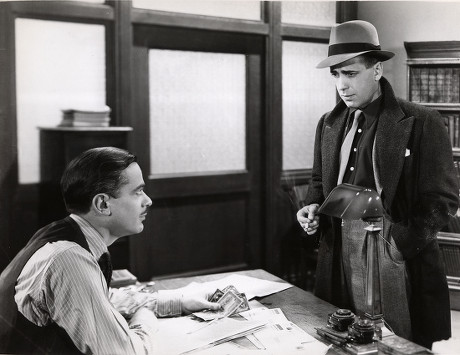
However, as this normally happens during the night, his wife, “Dr. Carole Nelson”, finally decides to follow him. The police raid the hideout and in the process, “Niles Nelson” is killed and “Gurney” and his gang escape.
The corrupt “District Attorney”, portrayed by Pierre Watkin, puts “Carole” on trial, not for being part of “Joe’s” gang, but for being the wife of “Dr. Niles Nelson”, who treated them. The whole point is for a show trial to make himself look good to the public. The trial ends with a hung jury, but “Carole’s” medical license is still at stake. “Carole” is given three-months to prove her innocence, or her license will be revoked. “Dr. Carole Nelson” now relocates to the small town of “Wayne Center”, and moves in with her “Aunt Josephine”, portrayed by Jesse Busley. Two of “Joe Gurney’s” men are jailed in town, and “Carole” hopes he’ll show up and she can speak to him.
Now this screenplay continues to rewrite the events of W. R. Burnett’s story and the original screenplay:
“Joe Gurney” and some of his men are heading for “Wayne Center” to break his other men out of the local jail. Suddenly, his car has a flat tire, and he suspects nearby wanderer, “Bill Stevens”, having shot the tire, but a nail is discovered.
Speaking with “Bill”, “Joe” learns he’s a writer, who wrote a book about “Napoleon”, and the mistakes he made that led to his downfall. It just so happens that “Joe Gurney” is an admirer of the dictator and the two get into a conversation. The tire is fixed, and “Joe” offers “Bill” a ride, and he makes the mistake of accepting “Joe Gurney’s” offer. The car arrives in town, “Joe” and his men rescue the those in jail, but in the shoot out with “The Town’s Sheriff”, portrayed by Raymond Brown. “Bill” is wounded in the shoulder, and arrested, as the others escape, but “Gurney” also sustained a shoulder wound.
Next, local “Dr. Sanders”, portrayed by Arthur Aylesworth, refuses to remove the bullet from “Bill’s” shoulder. “Dr. Carole Nelson” enters the jail house, wanting to question “Bill” about “Gurney”. Her hope is he can provide her with information to use in keeping her medical license. However, he doesn’t know anything, having just met the gangster, but “Carole” removes the bullet. When “Bill’s” claims about how he was with “Gurney” are confirmed, he’s released.
“Bill” goes to “Aunt Josephine’s” home to thank “Carole”, and “Josephine” convince him to stay a week to recuperate.
The road to the revised climax:
During the night, “Joe” has “Bill” kidnapped, so he can “Ghost Write”, the ganger’s autobiography. “Joe” like’s ‘Bill’s” title, “Joe Gurney, the Napoleon of Crime”. However, “Bill”, now, overhears the plan to kill him, once the book is completed.
“Carole, is next kidnapped from her Aunt’s house, blindfolded, and brought to the hideout to treat “Joe’s” wound. He also complains about his eye and she examines it.
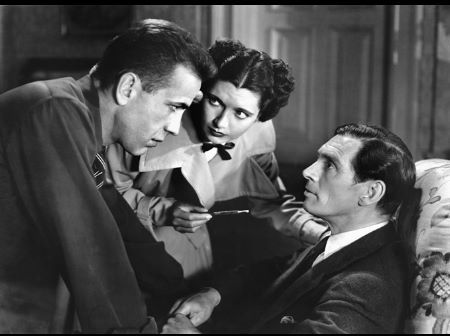
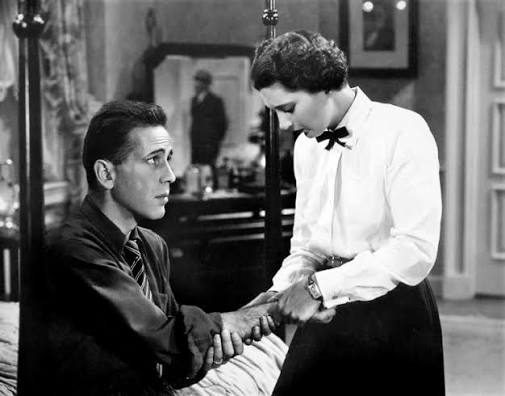
Before being released, “Carole” is told “Bill” will be killed, if she tells the authorities, and gives her a one-hundred dollar bill for her treatment.
“Joe’s” wound is getting worse, and he sends for “Carole” again. However, she has found out that the hundred-dollar-bill he gave her, was traced to a robbery. Both the “Sheriff” and “Government Men (FBI)” are coming to arrest her. At that moment “Dr. Carole Nelson” devices a plan.
At the hideout, she now informs “Joe Gurney” that he has a serious eye infection that will cause him to go blind over the next six-hours. However, there are some eyedrops she has brought that will cure him. She adds, “Gurney’s” infection is contagious, and that everyone present has been exposed to the disease and will also need those eye drops. The suspicious “Joe Gurney” wants her to administer the eye drops to “Bill” first. Which she does, and then turns to “Gurney”.
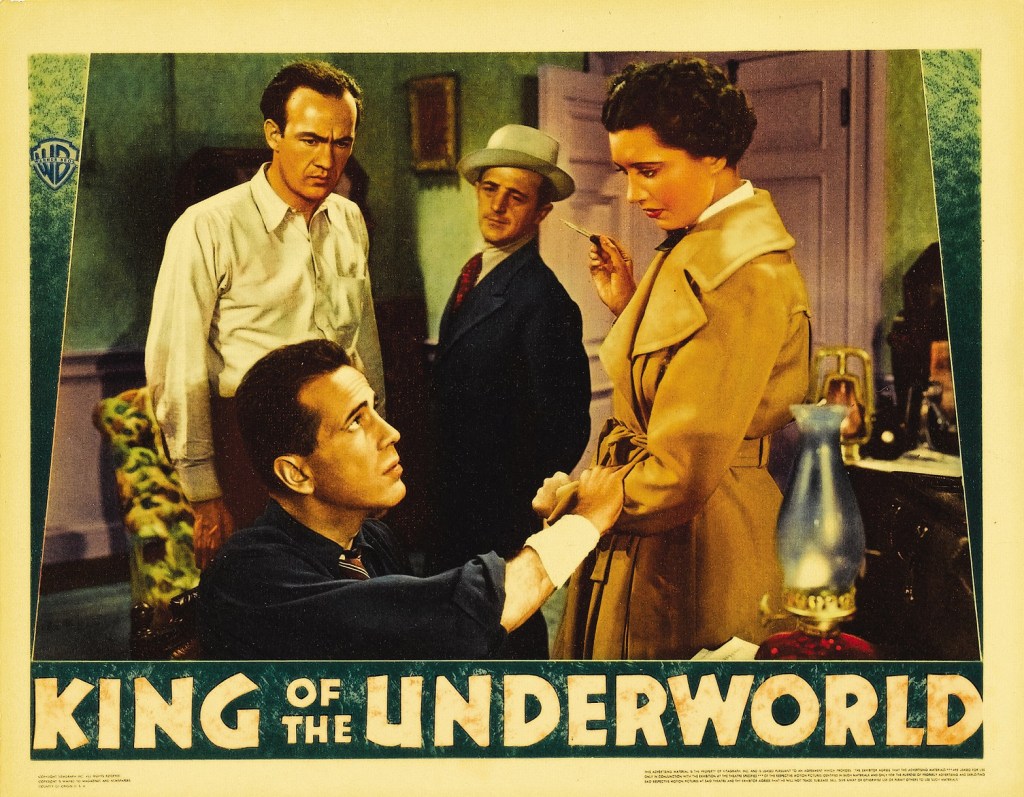
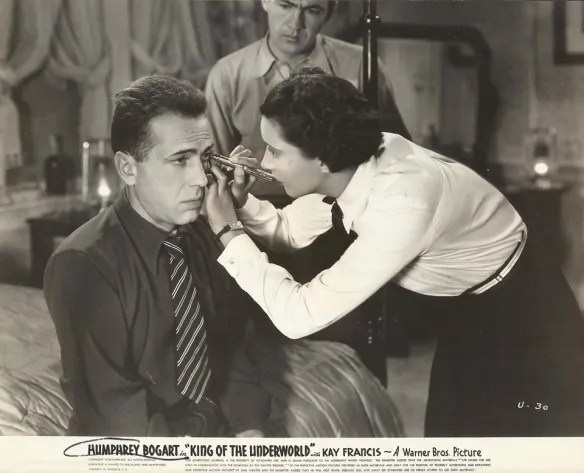
Meanwhile, the second part of “Carole’s” plan is put into effect, as “Aunt Josephine” calls the “Sheriff” with the location of “Gurney’s” gang, BUT informs him that they need to wait until midnight to let “Carole’s” eyedrops temporarily blind the gangsters.
The plan works, and the temporarily blind gangsters tray to fire back at the police, but eventually give themselves up. That is except for “Joe Gurney”, who even blinded attempts to get at the blinded “Bill” and unblinded “Carole”.
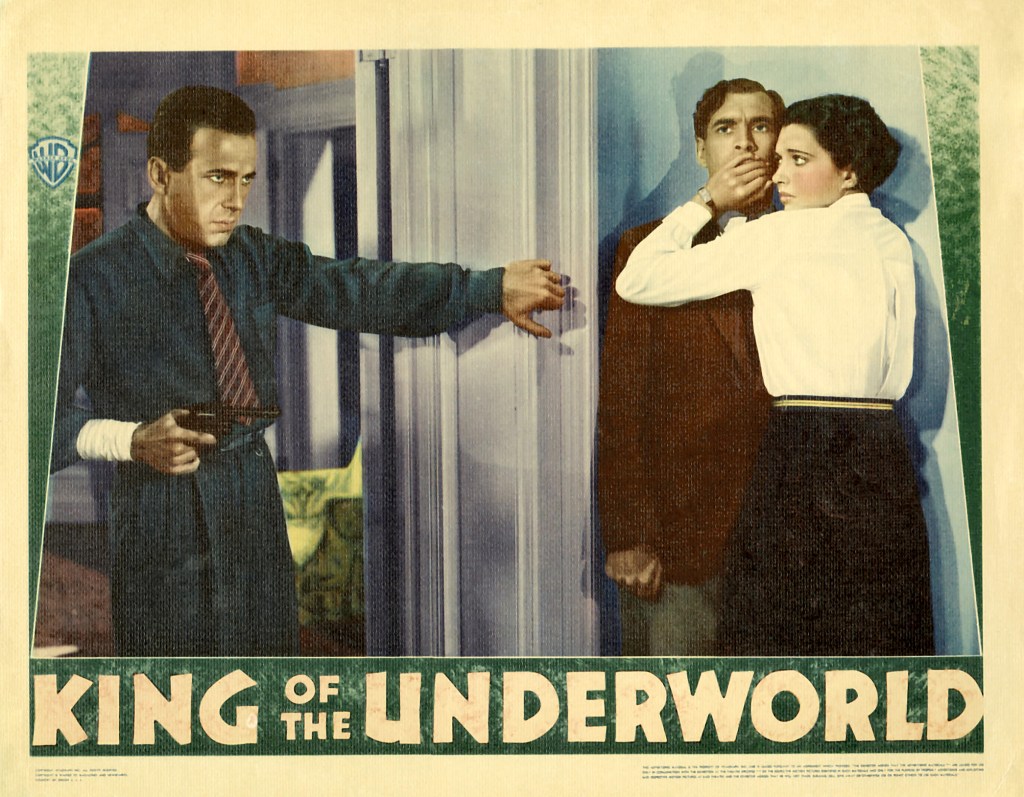
“Joe Gurney”, the “Napoleon of Crime”, thank you “Professor Moriarty” of Sir Arthur Conan Doyle’s “Sherlock Holmes” stories, is gunned down and killed btw the police.
The epilogue tells the audience that “Bill” became a successful writer, married “Carole”, and the two have a son.
Which takes me to the second remake (?) of W. R. Burnett’s story by “Warner Brothers”.
#3: BULLET SCARS released March 7, 1942
I will not be going into the details of the very low budget, quickly made, motion picture, but I will note. That “Warner Brother’s” did not give W. R. Burnett credit, or even list him, as “Uncredited”, for the story idea used in this screenplay. Although, he did get a paycheck for using his “Collier’s Magazine” story, and for the 1935 screenplay of, “Dr. Socrates”.
The story behind that paycheck is a very interesting look at the motion picture industry between 1935 and 1942.
The “Official Cast and Crew Listing”, and the on-screen credits, for “Bullet Scars”, indicate that the idea for this story, came from two writers, Charles Belden, and Sy Bartlett, and not, W. R. Burnett. This can be verified on both the “IMDb” website at:
https://www.imdb.com/title/tt0034555/
or the “Wikipedia” website at:
https://en.wikipedia.org/wiki/Bullet_Scars
Among his work, Charles Belden had written the story, that became 1933’s, “The Mystery of the Wax Museum”. Which, in turn, would become 1953’s, 3-D, “House of Wax”. Three-years-later, Belden, had contributed to the screenplay for 1936’s, “Dracula’s Daughter”.
Among his published writings, Sy Bartlett had written the classic Second World War aviation novel, “Twelve O’Clock High“. Which became a successful motion picture starring Gregory Peck, and also a successful television series. Another of Bartlett’s written stories was about Jim Bowie” at the Alamo. Which became a very successful,“Republic Pictures” motion picture, 1955’s, “The Last Command”.
NOW, WE TRIP BACK TO WRITING THE SCREENPLAY FOR 1935’S, “DR. SOCRATES”:
In January 1935, Charles Belden and Sy Bartlett wrote a motion picture treatment “CRIME DOCTOR”. Basically, a respected doctor gets mixed up with treating criminals. However, “Warner Brother’s”, was not completely sold on the idea, but bought the treatment from the two writers. Next, the production heads decided that the Belden and Bartlett idea needed to be improved upon. Having had great success with 1931’s, “Little Caesar”, and having become a major crime novelist. The studio turned over the Belden and Bartlett treatment to W. R. Burnett to write a screenplay.
What wasn’t expected, was that Burnett wrote a complete narrative property, entitled, “Dr. Socrates”. That property was published, as I earlier mentioned, in six-parts in “Colliers Magazine”. While, the studio turned to Robert Lord, and Mary McCall, Jr. to actually write the screenplay with assistance from Burnett.
In 1933, “The Screen Writers Guild” became a union, but even in 1935, they had not yet secured the right to arbitrate credit. The studio still had complete control over whose name appeared in advertising, on posters, and more importantly on screen. The studio dropped any mention of Charles Belden and Sy Bartlett, having any connection with the real original story idea.
Moving forward, four more years to 1939, and “King of the Underworld”. There was still a pro-studio loop hole, that “Warner Brothers” was using. The loop hole clearly stated, IF the screenplay was shown as being “Adapted” from a specific piece of work, in this case, W. R. Burnett’s “Colliers” story. The studio was only legally obligated to credit Burnett, which emphasized his “Star Power”, over the unknown Belden and Bartlett.
However, “Bullet Scars” was released in 1942, and things had finally changed for the major studios. In May, 1941, “The Writers Guild” signed its first comprehensive contract with the major studios.The “Adapted By” loop hole had been closed. “Warner Brothers” wanted to make a low-budget remake of “Dr. Socrates”. They actually used a lot of footage from the original 1935 motion picture in “Bullet Scars”.
Under the new contract, any writer connected with the original source, or film version, had to be shown with full credit. That meant, both Charles Belden and Sy Bartlett’s names had to be shown as the original film idea. Not, W. R. Burnett’s for the rewrite of their “Crime Doctor” treatment. As of this writing. although “Warner Brothers” followed the contract and gave Belden and Bartlett the credit for the “Original Idea” for “Bullet Scars”. Both film historians and reviewers of the motion picture, mention that the film was actually based upon W. R. Burnett’s “Dr. Socrates”, and not Belden and Bartlett’s “Crime Doctor” treatment. To avoid more union contract problems, Burnett accepted a check, as I mentioned, not to have his name associated with the film credits.
The three main roles were portrayed by:
Regis Toomey as “Dr. Steven Bishop”. Who is preparing to leave on a research assignment.
Adele Longmire as “Nora Madison”. Who is a nurse and the sister of one of the gang members, rather than a hitchhiker.
Howard da Silva as gangster, “Frank Dillon”.
Above left, Howard Da Silva, and what may be John Ridgely portraying “Joe O’Connor”.
The ending has “Dillion” sending two members of the gang to a pharmacist for medicine on a prescription written in latin by “Dr. Bishop”. Which is really telling the pharmacist to call the police with the location of “Dillon’s” gang.
THE DARK COMMAND premiered specially in Lawrence, Kansas, on April 4, 1940
This was “Republic Pictures” fictional story of William Quantrill and his Raiders. That would meet their fate in Lawrence, Kansas. The screenplay was based upon W. R. Burnett’s, 1938 novel ,”The Dark Command”.
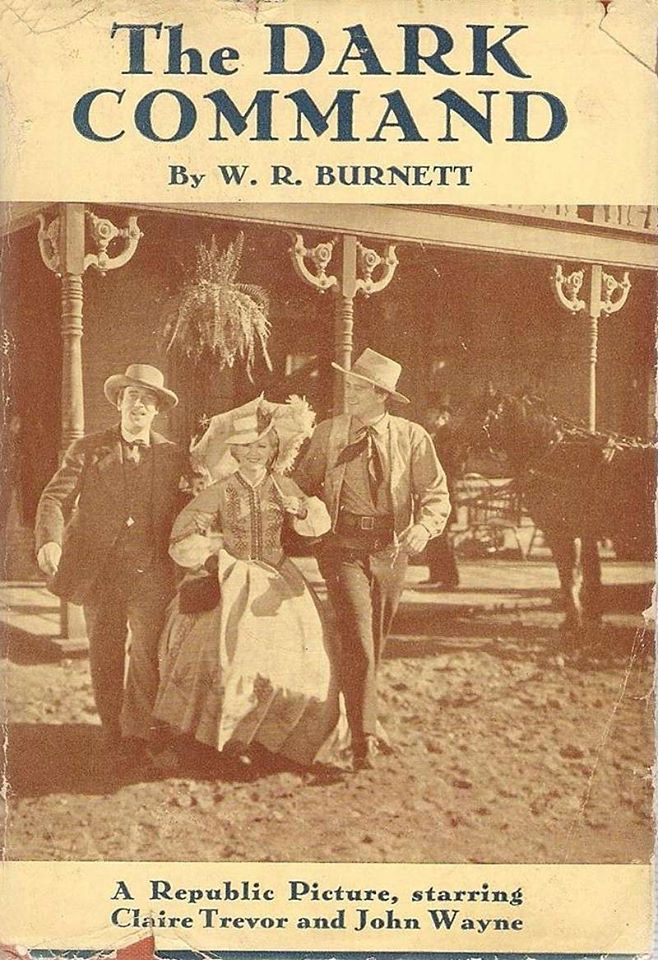
The studio had four writers assigned to turn the novel into a screenplay.
Jan Isabell Fortune was assigned to adapt the novel into a work able story for a screenplay. Her total film work was five films, between 1939 and 1943, and this was her second. According to an interview on May 3, 1943, in the “Detroit Free Press”, Fortune said:
“I landed in Los Angeles with $3.87”, Fortune told reporters. “I read in a paper that Republic studio was going to make a picture based on the life of Sam Houston. So I went after the job.”Upon arriving in Los Angeles, she and her daughter found themselves stealing food to survive. Eventually, she landed a contract with Republic Pictures before starting a career with MGM.”
Grover Jones co-wrote the actual screenplay. He had just adapted Robert E. Sherwood’s, “Pulitzer Prize Winning Play” for 1940’s, “Abe Lincoln in Illinois”. After this screenplay, Jones wrote the descriptive narration for Hal Roach, Jr’s, 1940, “One Million B. C.”
Lionel Houser co-wrote the actual screenplay. He had just co-written the screenplay for the crime story,1940’s, “Wolf of New York”, and followed this feature. As the only writer for the Myrna Loy and Melvyn Douglas screwball comedy, 1940’s, “Third Finger, Left Hand”.
The final screenplay writer that “Republic Pictures” seemed to need to turn the W. R. Burnett novel into a film screenplay was F. Hugh Herbert. Herbert had co-written the Donald Woods crime drama 1940’s, “Forgotten Girls”, before this picture, and followed it, by co-writing the Second World War drama, set in the United Kingdom at the time, 1940’s, “Women in War”.
The motion picture was directed by Raoul Walsh. Walsh had given John Wayne his name. In 1930, he had directed a Western shot both in 35 mm and 78 mm widescreen at the same time. This “Fox Corporation” feature was called “The Big Trail”, but not liking the name of the leading actor. Raoul Walsh got with his drinking buddy John Ford, and then changed the actor’s name to, “John Wayne”. That story is found in my article:
“JOHN WAYNE, WILLIAM FOX: Grandeur and ‘The Big Trail’”
http://www.bewaretheblog.com/2015/10/john-wayne-william-fox-grandeur-and-big.html
The Main Cast for “Dark Command” were:
Claire Trevor portrayed “Mary McCloud”. Trevor had just been seen in 1939’s, “Allegheny Uprising”, co-starring John Wayne. She followed this film with 1941, “Honky Tonk”, starring Clark Gable and Lana Turner.
John Wayne as “Bob Seton”. Wayne had just been seen in 1939’s, “Allegheny Uprising”, and followed this motion picture with 1940’s, “Three Faces West”, co-starring with Sigrid Gurie.
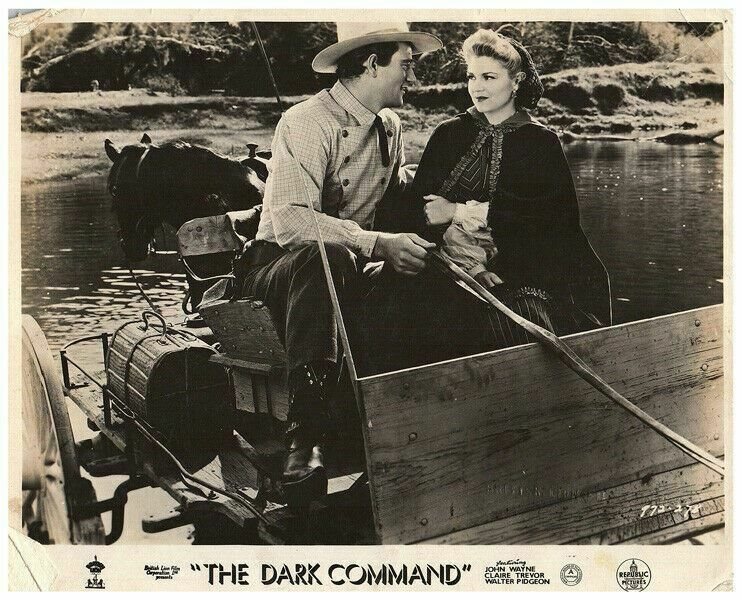
Walter Pidgeon portrayed “William ‘Will’ Cantrell”. Note the slight change in the last name. Pidgeon was last in the Deanna Durbin musical, “It’s a Date“. He followed this feature film with director Jacques Tourneur’s mystery, 1940’s, “Phantom Raiders”.
Roy Rodgers portrayed “Fletcher ‘Fletch’ McCoud”. Rodgers was just seen in 1939’s, “Days of Jesse James”, and followed this non-singing dramatic role with 1940’s, “Young Buffalo Bill”. Roy Rodgers is a part of my article “John Wayne Was a Singing Cowboy: Singing Cowboys and Cowgirls in the Movies and on 1950’s Television” found at:
https://www.bewaretheblog.com/2022/07/john-wayne-was-singing-cowboy-singing.html
_17.jpg)
George “Gabby” Hayes portrayed “Andrew ‘Doc’ Grunch”. Hayes had just been in Roy Rodgers, 1939, “Days of Jesse James”, and followed this in the Roy Rodgers, 1940’s, “Young Buffalo Bill”. M y article is “George ‘Gabby’ Hayes”: Being a ‘B’ Cowboy ‘Sidekick” at
https://www.bewaretheblog.com/2020/03/george-gabby-hayes-being-b-cowboy.html
Porter Hall portrayed “Angus McCloud”. Hall was in 1940’s, “His Girl Friday”, and followed this picture with 1940’s, “Arizona”.
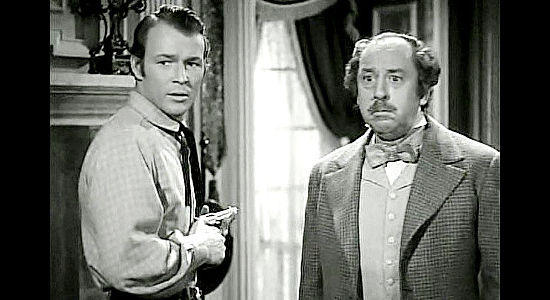
Marjorie Main portrayed “Mrs. Cantrell” aka: “Mrs. Adams”. Main was just in 1940’s, “Women Without Names”, and followed this picture within the Body Swap Comedy, 1940’s, “Turnabout”, about a bickering husband and wife that suddenly find themselves in each others body.
Raymond Walburn portrayed “Judge Buckner”. Walburn was just seen in 1939’s, “Heaven with a Barbed Wire Fence”, and next followed this movie with the crime film, 1940’s, “Millionaires in Prison”.
Republic Pictures Turned W. R. Burnett’s Story into a Typical “B” Western:
Into the town of Lawrence, Kansas, comes “Bob Seton“. Who was picked up on the road by “Doc Grunch”.

“Bob” asks school teacher “Will Cantrell” to help him learn to read, as he plans to become the new Sheriff, and marry “Mary McCloud”. “Will” agrees to help him, but he is also running for Sheriff, and wants to make “Mary” his wife. To the citizens of Lawrence, “Will Cantrell” is an upstanding school teacher and respected leader of the community.
“Bob Seton” becomes a territorial Marshall and is forced to arrest “Mary’s” brother, “Fletcher”, after he kills a man at the Barber Shop badmouthing the Southern cause. This turns “Mary” from “Bob:”, who she has come to really love, and in anger, she accepts “Will’s” proposal of marriage. “Bob” wants a fair trial, but “Fletch” is acquitted of the murder by a jury of “Will Cantrell’s” friends.
Next, “Will’s” maid, “Mrs. Adams”, is frightened about “Seton”, and what it could mean to the school teacher and “Mary”. Her action, lead to two things being revealed, the first, is that “Mrs. Adams” is in reality, “Mrs. Cantrell”, “Will’s” mother. The maid persona is for her protection from the school teacher’s other profession. Second, is that profession, because “Will Cantrell” is the leader of a gang of outlaws raiding both the Northern and Southern States as their Civil War progresses. On one of his raids, “Will” discovers several cases containing uniforms for Confederate States soldiers.
Now things change, as “Will Cantrell”, takes on the persona of an officer in the “Confederate Army”, and his gang, becomes “Confederate Soldiers” in their stolen uniforms. Next, “Fletch”, falls under “Will Cantrell’s” spell, and has become a junior officer in his Army. However, that Army is still nothing more than outlaws in W. R. Burnett’s story, not a real guerrillas in Confederate Army that the real William Clarke Quantrill was a part.
However, “Will’s” mother confronts him over his actions, and initially considers killing him for what he has become, does not, as she still loves her son, but this will lead to a break between the two.
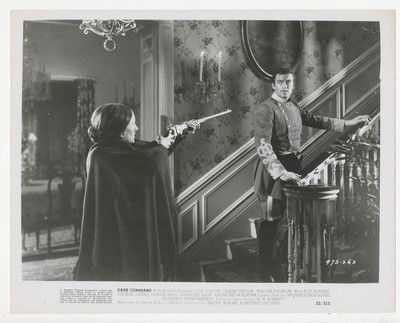
“Bob Seton” is now revealed to be a Union supporter, is captured, and set to be executed under “Will’s” orders. However, ‘Fletch” has come to his senses and helps him escape.
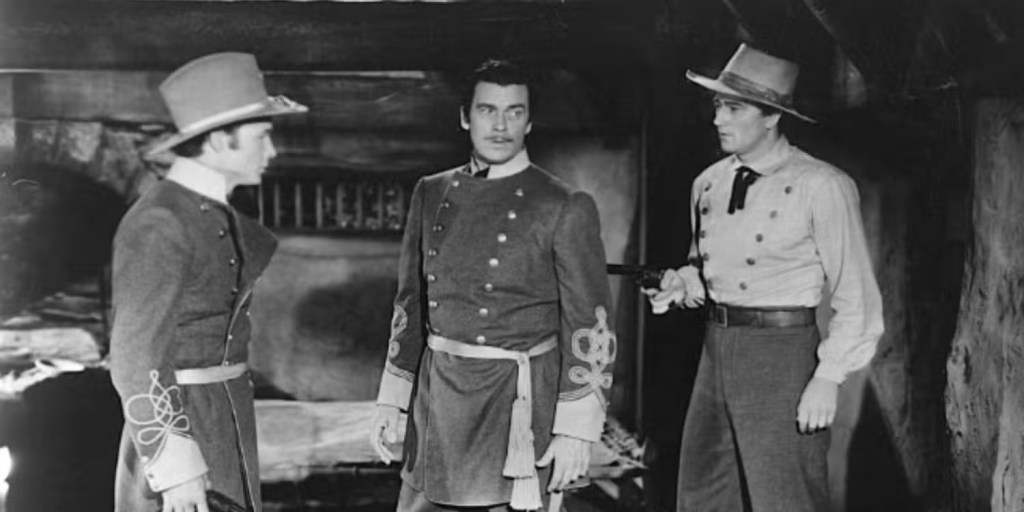
Eventually, everything comes to a climax of events. When “Cantrell’s Raiders” head to Lawrence, Kansas, to burn it down, and “Bob”, “Fletch” and “Mary”, warn the townspeople and set a trap.
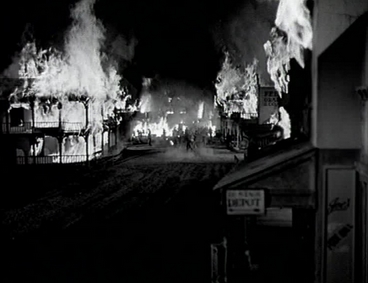
During the panic of the raid, “Mrs. Cantrell” arrives in town to stop her son, but instead is shot and killed. “Bob Seton” and “Will Cantrell” confront each other and “Will” is killed. “Fletch” has been critically shot in stopping the attack by “Will”, and “Doc Grunch” operates on him, saving his life. With “Will” dead, the remaining guerrillas disband to different parts of the county, and “Mary” and “Bob” are back together.
Next, another W. R. Burnett novel brought together an interesting cast, director, and co-writer. Which would lead to two remakes, just as had happened with 1935’s, “Dr. Socrates”.
HIGH SIERRA premiered in Hartford, Connecticut, on January 22, 1941
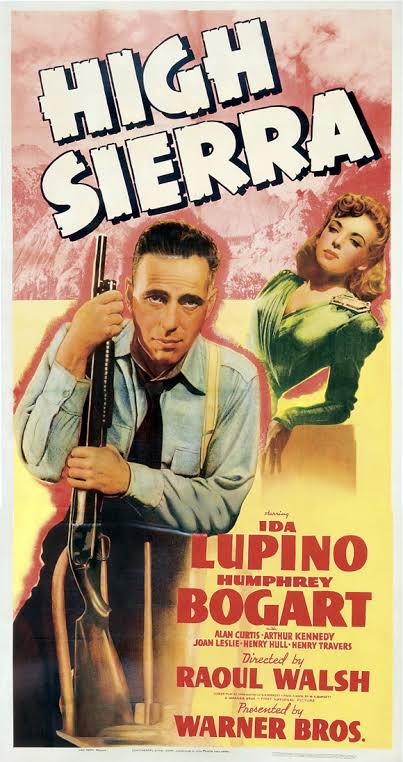
The screenplay was based upon W. R. Burnett’s, 1941 novel, “High Sierra”. Burnett also co-wrote the screenplay.
The main screenplay writer was John Huston. Huston had just written 1940’s, “Dr. Ehrlich’s Magic Bullet”, and followed this motion picture as one of the writers of 1941’s, “Sergeant York”. Also in 1941, John Huston directed his first motion picture, “The Maltese Falcon”, from his own screenplay.
The director was, once again,”One-Eyed” Raoul Walsh, who had just directed George Raft, Ann Sheridan, Ida Lupino, and Humphrey Bogart in 1940’s, “They Drive By Night”. He followed this feature film with 1941’s, “The Strawberry Blonde”, starring James Cagney and Olivia de Havilland, and with Rita Hayworth.
Ida Lupino portrayed “Marie Garson”. Lupino had just been in the above mentioned, 1940, “They Drive By Night”, and would follow this feature film with the 1941 version of Jack London’s, “The Sea Wolf”, co-starring with Edward G. Robinson and John Garfield. My article is “IDA LUPINO: Singer, Actress, Screenplay Writer, and Director” a look at a glass ceiling breaking career at:
https://www.bewaretheblog.com/2021/11/ida-lupino-singer-actress-screenplay.html
Humphrey Bogart portrayed “Roy Earle”. Bogart had just been seen in 1940’s, “They Drive By Night”, and followed this feature film with 1941’s, “The Wagons Roll at Night”. My article is “Bogie’ and Bacall: Their Films Together” found at:
https://motion-picture-history.com/2026/04/24/bogie-and-bacall-their-films-together/
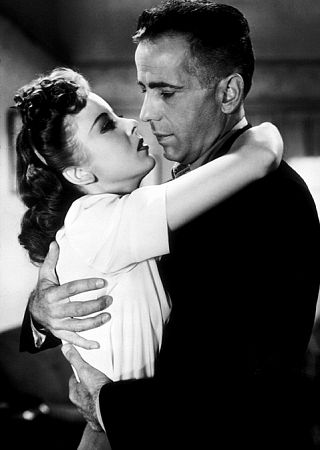
Alan Curtis portrayed “Babe’ Kozak”. Curtis had just been seen in 1940’s, “Four Sons”, and followed this motion picture by having his scenes deleted from 1941’s, “Blood and Sand”. Curtis wasnext seen on-screen in an unidentified “Bit Part”, in the James Stewart and Hedy Lamarr romantic comedy, 1941’s, “Come Live With Me”. Which was followed by playing “Bob Martin” in Abbott and Costello’s, 1941, “Buck Privates”.
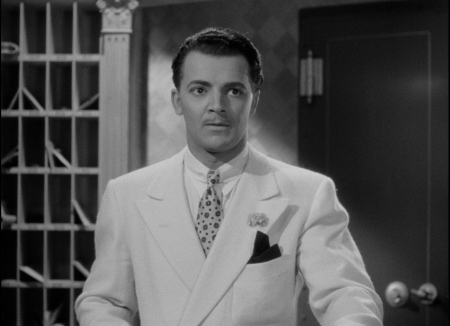
Arthur Kennedy portrayed “Red’ Hattery”. This was Kennedy’s second on-screen appearance. His first was 6th-billed in the James Cagney and Ann Sheridan, 1940, “City for Conquest”. He followed this film with 1941’s, “Knockout” about prize fighting.
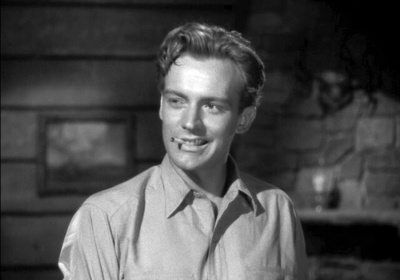
Joan Leslie portrayed “Velma”. Leslie, under her birth name of Joan Agnes Theresa Brodel, had just been seen in Alfred Hitchcock’s, 1940, “Foreign Correspondent” in the “Uncredited Role” of “Jones’s sister”. In 1941, Leslie co-starred with Gary Cooper and Walter Brennan in “Sergeant York”, and in 1942 she co-starred with James Cagney, and Walter Huston, in the musical, “Yankee Doodle Dandy”.
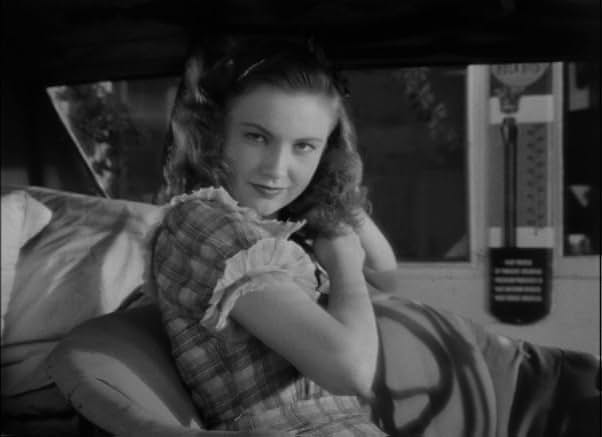
Henry Hull portrayed “Doc’ Banton”. For fans of “Universal Pictures” horror movies, character actor Hull was 1935’s, “The Werewolf of London”. He had just portrayed “Major Rufus Cobb” in director Fritz Lang’s, 1940, “The Return of Frank James”, starring Henry Fonda. In 1944, Henry Hull portrayed “Charles J. Rittenhouse”, one of the passengers on Alfred Hitchcock’s, “Life Boat”, and in 1949, he was “Henry Cameron” in the film version of authoress Ayn Rand’s, “The Fountainhead”, starring Gary Cooper and Patrica Neal.
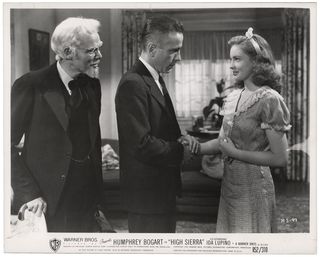
Above left to right, Henry Hull, Humphrey Bogart, and Joan Leslie.
Henry Travers portrayed “Pa Goodhue”. Character actor Travers had just been seen in the 1940 Western, “Wyoming”, starring Wallace Beery, Leo Carrillo, and Ann Rutherford. He followed this feature film with the George Murphy and Lucille Ball comedy, 1941’s, “A Girl, a Guy, and a Gob”.
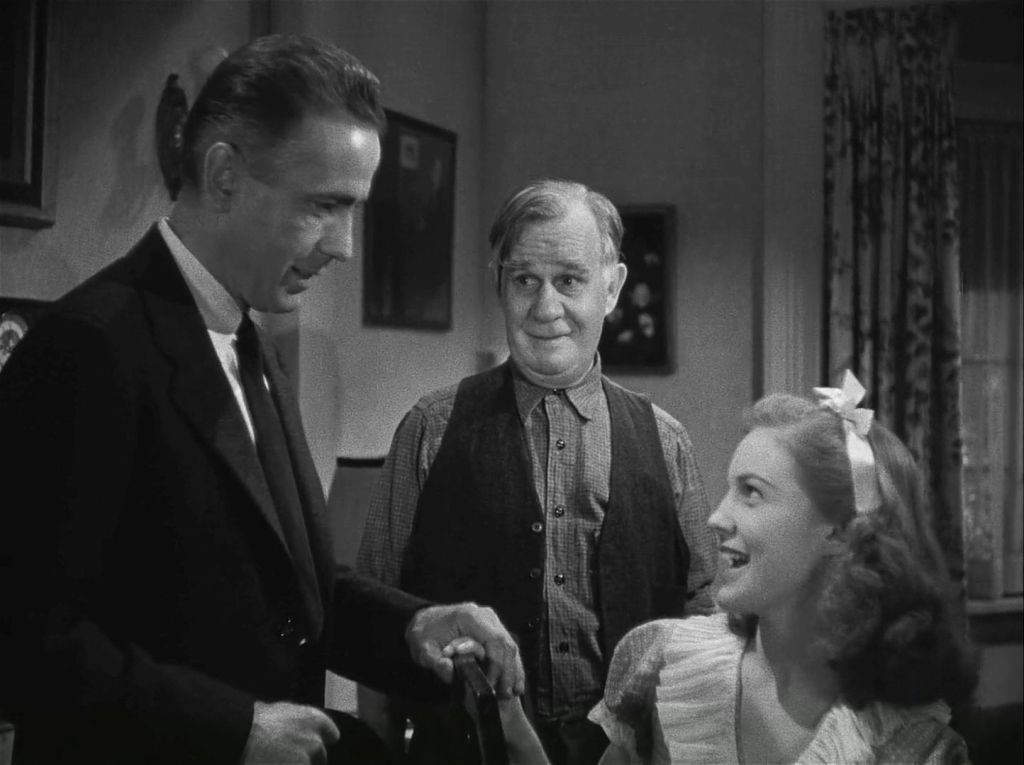
Above left to right, Humphrey Bogart, Henry Travers, and Joan Leslie.
W. R. Burnett’s story on-screen:
Aging gangster, “Big Mac M’Gann”, portrayed by Donald MacBride, is planning a robbery of a high class resort hotel in the Sierra Nevada town of “Tropico Springs”, and wants convicted bank robber, “Roy Earle” to head it. “Big Mac” had arranged his release from an Indiana prison by bribing the governor. “Earle” must drive from Indiana to an abandoned logging cabin in the Sierra Nevada’s where he will meet with the three men who will assist on the robbery. “Louis Mendoza”, portrayed by Cornel Wilde in his 4th-movie, “Red Hattery”, and “Babe Kozak”, are living at the camp. “Babe” brought his girlfriend, “a dime a dance girl”, from Los Angles, named “Marie Garson”.
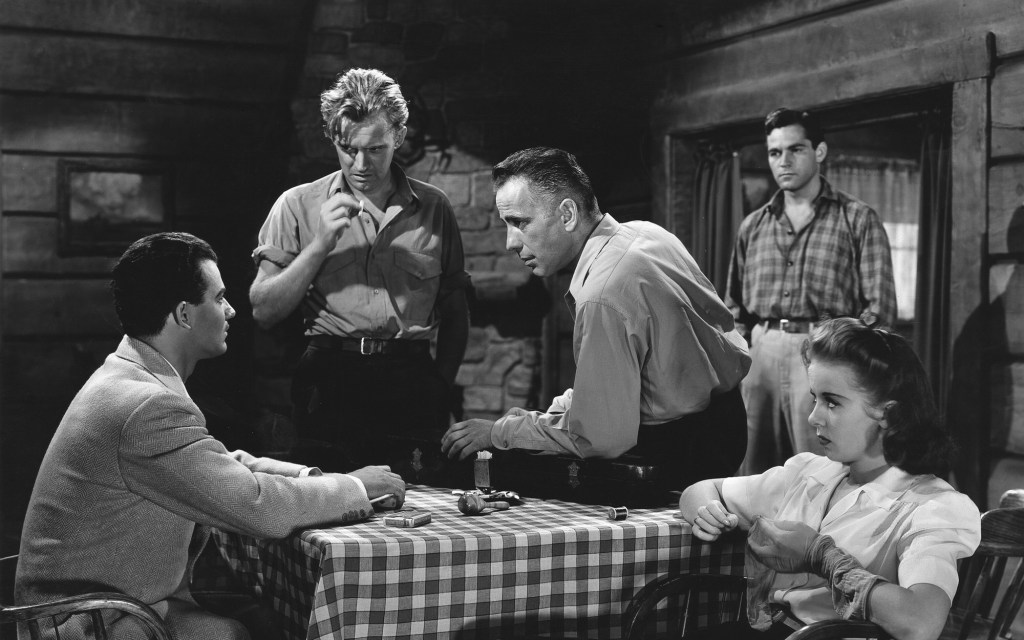
Above left to right, Alan Curtis, Arthur Kennedy, Humphrey Bogart, Ida Lupino, standing in doorway, Cornel Wilde.
“Earle” is against “Marie” being there and wants her to go home to Los Angeles, but give in and lets her stay. At the camp is the handyman, “Algernon”, portrayed by Willie Best, who introduces “Earle” to a dog name “Pard”, that the bank robber took at liking too, and “Roy Earle” adopts “Pard”. The dog was actually Bogart’s real pet.
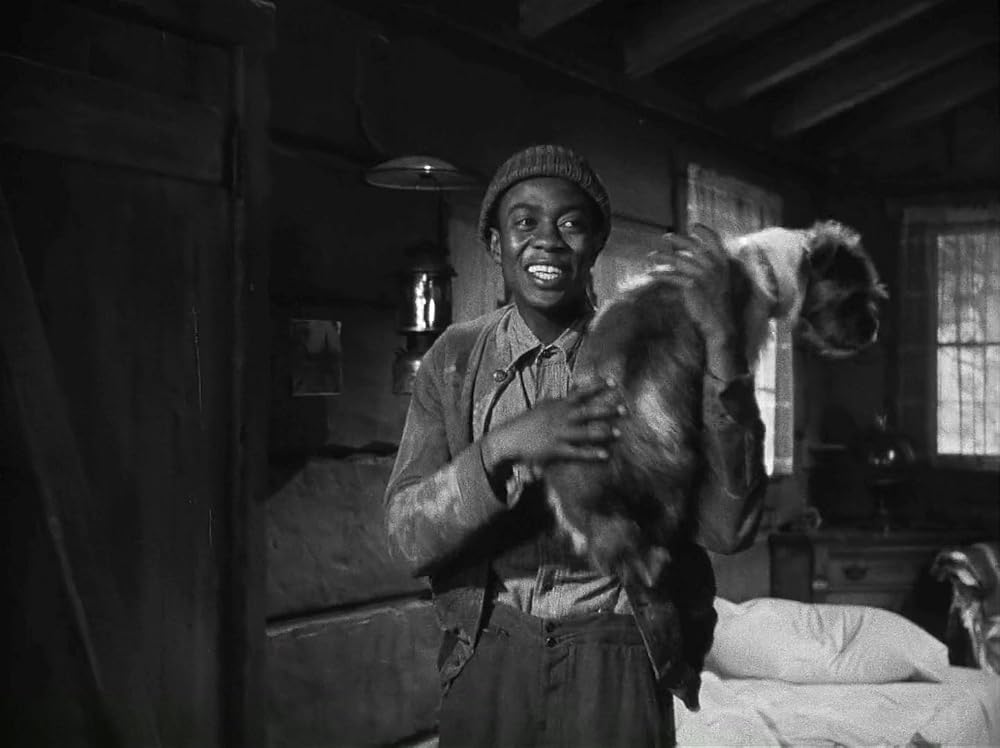
Meanwhile, “Marie” has fallen in love with “Roy Earle”, but he does not feel the same to her.
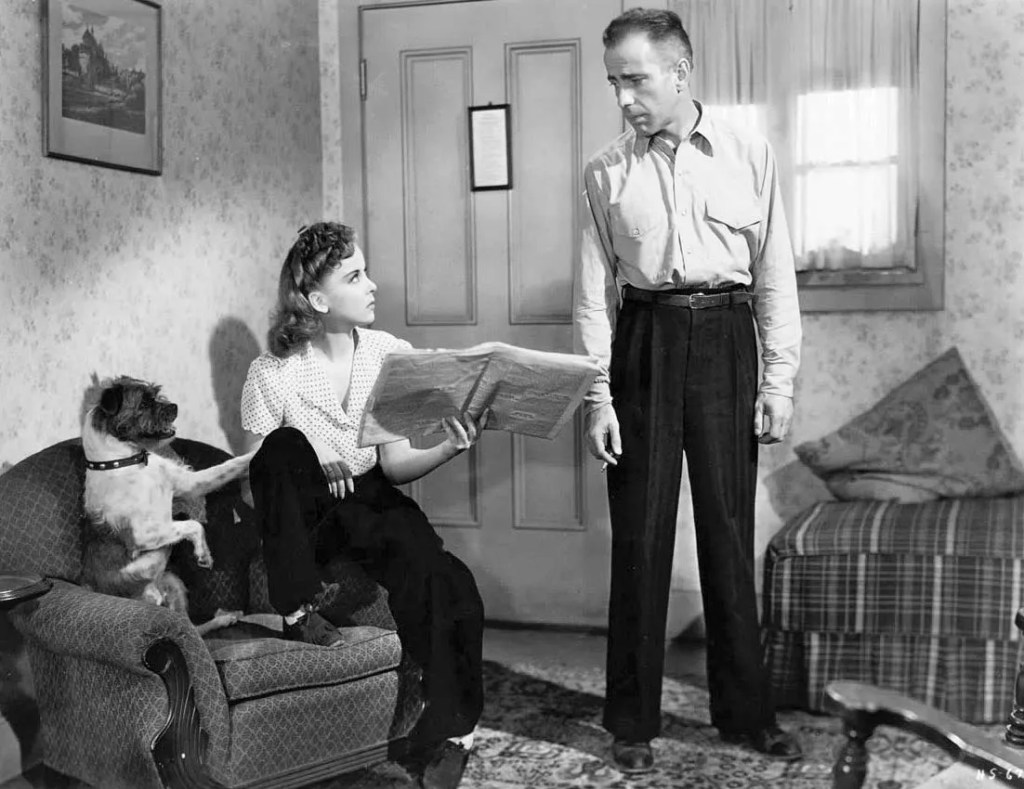
“Roy Earle” now goes into Tropico Springs, and observes a minor car accident, involving “Pa” and “Ma Goodhue”, portrayed by Elisabeth Risdon, billed as Elizabeth, and their granddaughter “Velma”, who has a clubfoot and walks with a limp.
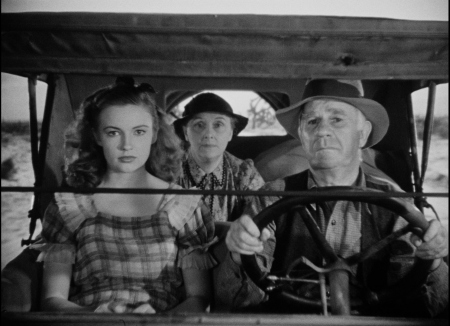
“Velma’s” grandfather, warns “Roy” who has fallen in love with her, that she has a fiancé back east. Ignoring her “Grandfather’s Warning”, “Roy Earle”, pays for corrective surgery that will allow “Velma” to walk normally.
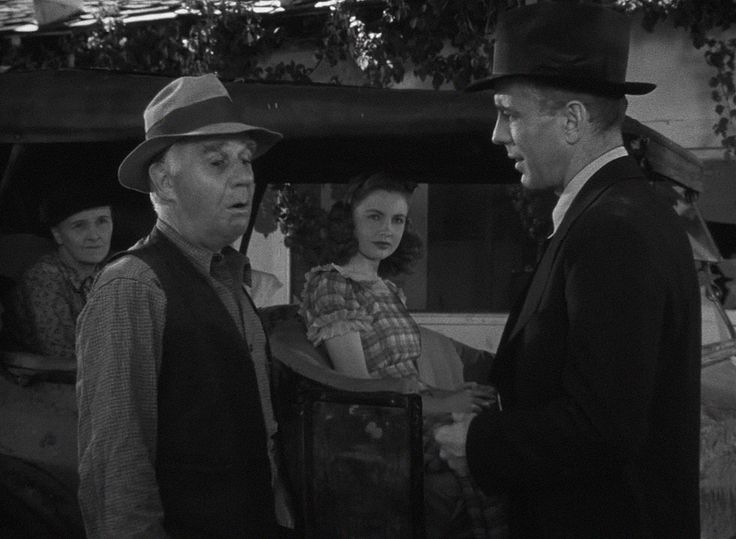
While “Velma” is recovering, “Roy” asks her to marry him, but she refuses, saying she has a fiancé back east.
The group now executes the hotel robbery, but things go wrong when a security guard intervenes. “Roy” and “Marie” back their get away with a stash of jewelry from the hotel safe. While, “Mendoza”, “Red” and “Babe” get involved in a car accident that kills “Red” and “Babe” men. Meanwhile, “Mendoza” is being questioned by the police, as “Roy” and “Marie”, with his dog “Pard”, drive to Los Angeles.
In Los Angeles, the two find out that “Big Mac” has died from a heart attack, and an ex-Police Officer, “Jake Kranmer”, portrayed by Barton MacLane, has taken over the operation. “Kranmer” attempts to force “Roy Earle” to turn the jewelry over to him.
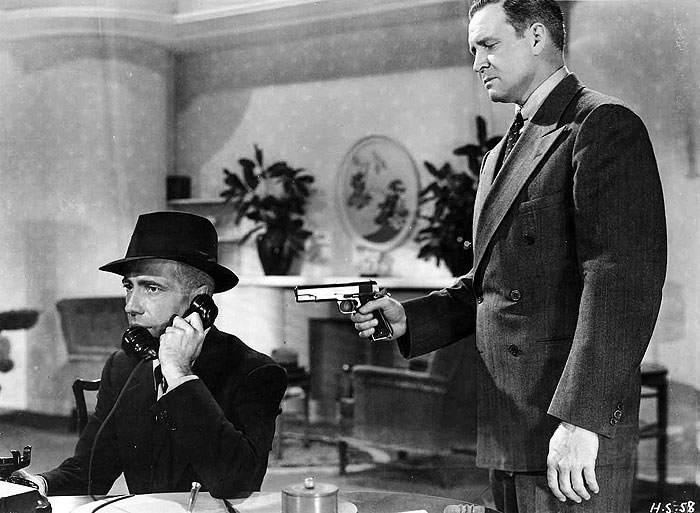
Instead, “Earle” kills him, and having promised “Velma” that he would visit her once she is able to walk, does. Next, “Roy Earle” meets with a fence named “Art”, portrayed by Robert Strange, who was to buy the stolen jewels, but “Art” claims he can’t pay the agreed $30,000 immediately. While “Art” holds onto the jewels, “Roy” gives “Marie” a wedding ring and the two go into hiding in a small out of the city hotel. However, their small time of bliss is interrupted. WHEN THEY SEE, “Roy’s” face on the television news, and the information not only mentions “Marie”, but “Roy’s” dog “Pard”. All gathered from what “Mendoza” told the police.
“Roy Earle” makes the decision that it will be safer, if both “Marie” and “Pard” go to Las Vegas by bus. Figuring he will collect from “Art” the $30,000, “Roy” gives “Marie” all his available money, and heads into Los Angeles. However, when his car becomes low on gas, “Earle” risks a small time hold up, but is recognized and flees back into the Sierra Nevada Mountains followed by the police, but his car finally runs out of gas and “Roy Earle” is now on foot heading for the cabin. “Marie” hears about the chase on another news broadcast and heads for the mountains. There she and “Pard’ walk right into a police roadblock. The police interrogate “Marie” about “Roy Earle”, with him watching from his hidden spot above them.
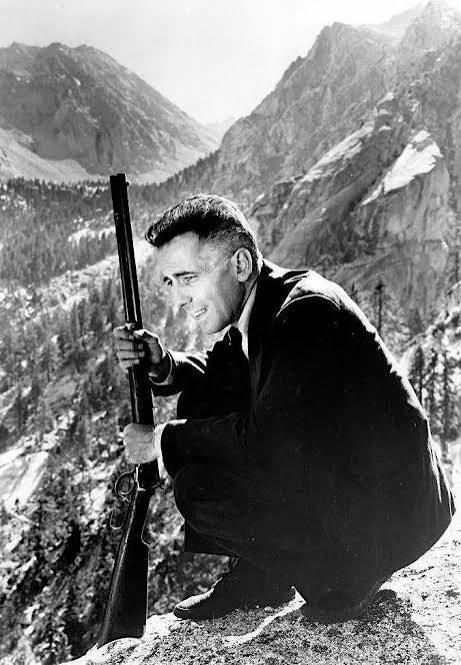
However, “Pard” gets free of “Marie’s” hold on his leash, and heads up the mountain barking happily, following his loving master’s scent. When “Roy” makes the mistake of standing up to greet his dog, a sharpshooter kills “Roy Earle”. When “Marie” finally reaches “Roy”, she finds “Pard” sitting beside him. A police officer mention that “Roy Earle” is finally free, and taking comforting that thought.”Marie” knows he would not have gone back to prison, and with “Pard”, “Marie” walks down the mountain.
EIGHT YEARS LATER, “Warner Brothers” made their first remake of W. R. Burnett’s, “High Sierra”. Although recognized for what it was, the screenplay was a bare bones treatment of the original screenplay, but with an interesting twist.
COLORADO TERRITORY premiered in Denver, Colorado, on June 3, 1949
However, would turning a gangster story, work as a Western? “Warner Brothers” was about to find out with a western based upon W. R. Burnett’s, 1940 novel, “High Sierra”. However, Burnett received no on-screen credit, but as owner of the original novel. W. R. Burnett was compensated, like what had occurred, previously, with 1942’s, “Bullet Scars”.
There were two screenplay writers, one was John Twist, who had co-written, 1947’s, “Tycoon”, starring John Wayne and Larrine Day. Twist followed this screenplay as the only writer on 1950’s, “Dallas”, starring Gary Cooper and Ruth Roman.
Edmund H. North was the other writer, and if you’re a fan of science fiction, but don’t recognize his name? Perhaps, you would his screenplay for 1951’s, “The Day the Earth Stood Still”, or if you’re into the Second World War, 1960’s, “Sink the Bismarck”, and 1970’s, “Patton”?
Raoul Walsh directed the motion picture. The perfect assignment by “Warner Brothers” of using the director of 1941’s “High Sierra” to turn his own film noir crime film into a Wild West picture. That same year, he had directed Errol Flynn and Olivia De Havilland in “They Died With Their Boots On”, and in 1947, it was Dennis Morgan and Jayne Wyman, in “Cheyenne”.
The Two Leads:
Joel McCrea portrayed “Wes McQueen”. McCrea had just been seen with Alexis Smith and Zachery Scott, in the 1949 western, “South of St. Louis”. He followed this movie with 1950’s, “The Outriders”, with Arlene Dahl and Barry Sullivan.
Virginia Mayo portrayed “Colorado Carson”. Mayo had just starred as 1949’s, “Flaxy Martin”, and followed this picture with 1949’s, “The Girl from Jones Beach”, co-starring with Ronald Reagan.
Dorothy Malone portrayed “Julie Ann Winslow”. Malone was 4th-billed in 1949’s, “South of St. Louis”. In 1946, as the “Acme Book Store Proprietess” stoled her scenes with Humphrey Bogart in “The Big Sleep”, for director Rodger Corman, Dorothy Malone was the tough sheriff up against John Ireland in 1955’s, “Five Guns West”, and in 1957, portrayed real life “Cleva Creighton Chaney”, in “The Man of a Thousand Faces”, starring James Cagney as “Lon Chaney”.
Henry Hull portrayed “Fred Winslow”, with deja vu, to his role in 1941’s, “High Sierra”. Hull had just been in the forgotten western, 1949’s, “Rimfire”, and followed this motion picture with 1949’s, “The Great Gatsby”
John Archer portrayed “Reno Blake”. Archer was a “B” leading man and appeared in several “Classic”, if that’s the right word, movies. These included 1941’s, “King of the Zombies”, the Basil Rathbone and Nigel Bruce, 1942, “Sherlock Holmes in Washington”, 1943’s, “Crash Dive”, 1943’s, ‘Guadalcanal Diary”, James Cagney’s 1949 “White Heat”, and producer George Pal’s, 1950, “Destination Moon”.
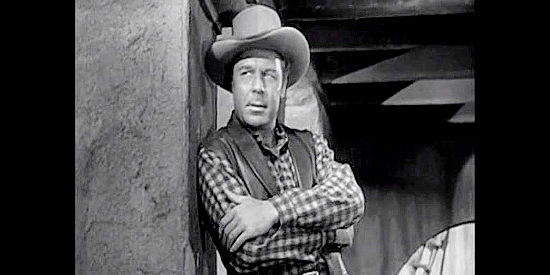
Morris Ankrum portrayed the head “United States Marshall”. In the 1950’s, Ankrum would become a familiar face in 1950’s science fiction movies, It would seem they didn’t make one without him, and on televisions “Perry Mason” were he portrayed a different “Judge”, 22-times. My article is, “MORRIS ANKRUM THE FACE OF 1950’S SCIENCE FICTION/HORROR MOVIES” at:
https://www.bewaretheblog.com/2016/02/morris-ankrum-face-of-classic-1950s.html
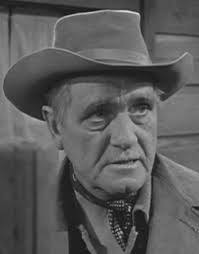
The Screenplay:
Notorious outlaw, “Wes McQueen” has been broken out of jail, and riding in a stagecoach, heads for the “Colorado Territory (February 28, 1861 to August 1, 1876, when it became the 38th State, Colorado)”. “Wes” is meeting with his friend, the man who arranged his escape, “Dave Richard”, portrayed by Basil Ruysdael. A band of outlaws makes the mistake of holding up his stage, and “Wes” either kills, or drives of members of that group. For his heroic stand, the others on the stage are extremely thankful to him. Two of the other passengers, are “Dreamer”, “Fred Winslow”, who bought a ranch, sight unseen, and dreams of making a fortune as a rancher in the “Colorado Territory”. Along with “Fred”, is his daughter, “Julie Ann”, who “Wes” falls for on sight.
Next, “Wes” arrives at the Ghost Town of “Todos Santos”, where three people await his arrival. They are “Reno Blake”, his part-Native American girl friend, “Colorado Carson”, and “Duke Harris”, portrayed by James Mitchell. After looking the three over, and not liking what he sees. “Wes” leaves them, and heads for a near-by town to meet the ailing “Richard”. Who wants him to do one last train robbery that will set both men for life. Although he wants to go straight, out of friendship, “Wes” agrees to lead the train robbery.
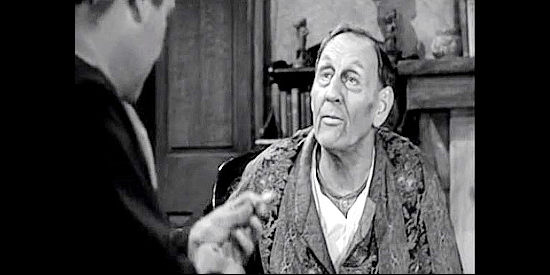
However, except, for “Richard”, “Wes McQueen” distrusts everyone else in the gang, including “Colorado Carson”, and two others, the ex-detective, “Pluthner”, portrayed by Harry Woods, and their contact with the railroad, “Homer Wallace”, portrayed by Ian Wolfe.
While waiting to pull off the robbery, “Wes” already sees trouble between “Reno” and “Duke” over “Colorado Carson”, and decides to keep her with him. This leads to “Colorado” falling for “Wes”, but he’s not interested.
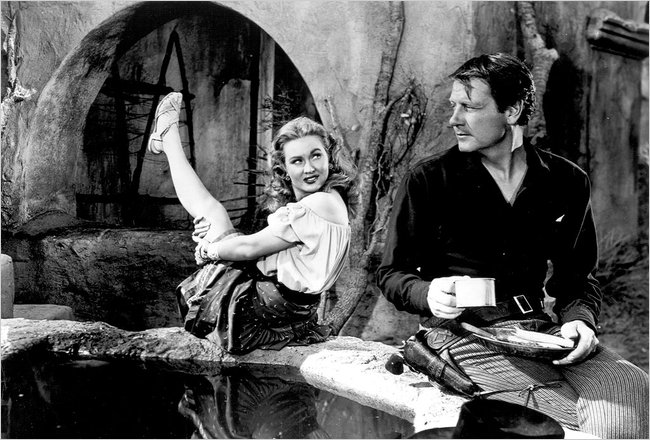
“Wes” rides to the “Winslow Ranch”, to discover its poor land, without any source of water. Still hoping to marry “Julie Ann”, but her father warns him that she has a rich fiancé, named “Randolph”, back east. However, that will not stop “Wes’s” feelings toward “Julie Ann”.
The day of the robbery, “Wes McQueen” is sill suspicious of “Homer Wallace”, and talks to “Mrs Wallace”, portrayed by Maudie Prickett. Who reveals that her husband has sold out for the reward money. Forewarned, “Wes McQueen” now uncouples the passenger car that the “Missouri Sheriff” portrayed by Victor Kilian and his men are waiting to ambush “Wes” and the others. The train pulls out, but the posse sits on the track, and the robbery goes off.
Next, expecting what follows, “Wes McQueen”, when “Duke” and “Reno” attempt to double-cross him, gets the drop on the two, and leaves them handcuffed, together, for the “Sheriff” and the “Marshall” to arrest and hang, and rides away with the money and “Colorado Carson”. The “Wes” and “Colorado” go to spilt the money with “Richard”, but now find “Pluthner” standing over the other’s body. “Wes” shoots and kills “Pluthner”, but is also shot in the arm.
A wounded “Wes McQueen” and “Colorado Carson” ride to the “Winslow” ranch being pursed by the “Marshall” with a posse. “Fred” helps “Colorado” remove the bullet in “Wes’s” shoulder, even now knowing who he really is.
“Julie Ann” is heard telling her father they should turn “Wes” in for the reward, but when the “Marshall” and his posse arrive. “Fred Winslow” lies to them, and they leave.
“Wes” now realizes he loves “Colorado”, and the two go into hiding in “Todos Santos”, and make plans of a life together in Mexico. However, they are discovered, and he gives her the money and tells her to bury it. Instead, “Colorado Carson” leaves the bag at the collection box for a mission. “Wes” has driven off her horse, so she cannot follow him, and makes a dash for the Mexican border.
The next climax to W. R. Burnett’s original novel:
“Wes” gets himself trapped in a hillside deserted Native American village, but he is too good a marksman for any of the “Marshall’s” and “Sheriff’s” posse to get near him. “Colorado” now appears on the scene.The scheming “Sheriff” devices a plan, he stations a Native American sharp shooter, and with all but two of his and the “Marshall’s” men, ride away. He plans to enter the abandoned Native American village by the back entrance. (A convenient plot addition, because there is no such thing to the hillside village being used).
Next, as the “Sheriff” had hoped would happen, “Colorado” grabs a gun from the two remaining men, orders them to walk away, takes two horses, and walks toward “Wes McQueen”. He emerges from hiding, is shot again, and the two take cover as the posse returns.
As “Wes” and “Colorado:” die in a volley of gunfire. Leaving the audience stunned!
Returning to full credit for W. R. Burnett was the second version of “High Sierra”.
I DIED A THOUSAND TIMES released November 9, 1955
I will let W. R. Burnett speak about the screenplay he solely wrote.
The director was Stuart Heisler, like director Robert Wise, Heisler started his career in 1921 as a film editor. His first film as an editor was 1921’s, “They Shall Pay”, starring Mary Pickford’s younger sister, Lottie Pickford, and his last film in that profession was 1936’s, “Poppy”, starring W. C. Fields. That same year, Stuart Heisler directed his first feature film, “Straight from the Shoulder”, that starred Ralph Bellamy. Heisler had just directed Linda Darnell in 1954’s, “This Is My Love”, and followed the movie with “The Bush Roper”, November 23, 1955, on the television anthology series, “Screen Directors Playhouse”, starring Walter Brennan and Edgar Buchanan.
Once more, according to Patrick McGilligan and Ken Mate’s, “W. R. Burnett: The Outsider”. Burnett had this to say about his screenplay and the director for this motion picture. Burnett stated the “I Died A Thousand Times” was:
“a better picture” than High Sierra because he “cleaned up the script” from the original, cutting it down and shortening it. “It’s a much better picture, script-wise, although not pictorially, because Raoul Walsh did a hell of a job. Stuart Heisler is also a fine director; he never gets the credit he deserves.”
I could not locate what cleaning to the script W. R. Burnett did, because the difference in the two films running times is one-minute.
The Two Leading Actors Plus Three:
Jack Palance portrayed “Roy ‘Mad Dog’ Earle”. Palance had just been in the historical drama, 1955’s, “Kiss of Fire”, co-starring Barbara Rush and Rex Reason. He followed this picture with the overlooked Second World War movie, 1956’s, “Attack”, co-starring Lee Marvin and Eddie Albert. “Attack” in many ways, should be compared to Kirk Douglas’s, 1957, “Paths of Glory”.
Shelley Winters portrayed “Marie Garson”. Winters had just co-starred with Rory Calhoun, and Gilbert Roland, in 1955’s, “The Treasure of Pancho Villa”. Shelley Winters had preceded that movie with the film-noir, 1955’s, “The Big Knife”, co-starring with Jack Palance, and Ida Lupino, directed by Robert Alrich.
Lori Nelson portrayed “Velma Goodhue”. Nelson was 6th-billed in the 1956 musical, “Sincerely Yours”, starring Liberace, Joanne Dru, and Dorothy Malone. She would follow this motion picture with the second entry in the “Creature from the Black Lagoon” trilogy, 1955’s, “Revenge of the Creature” co-starring with John Agar, and director Rodger Corman’s, 1955, “The Day the World Ended”, co-starring Richard Denning,
Lee Marvin portrayed “Babe Cossack”. Marvin was basically appearing on television when this movie came out, as compared to motion pictures. He did follow this picture with the 1955 film-noir, “Shack Out on 101”, with 4th-billing after Terry Moore, Frank Lovejoy, and Keenan Wynn.
Lon Chaney, aka: Lon Chaney, Jr. portrayed “Big Mac”. Lon had just been seen in director Stanley Kramer’s, 1955, “Not as a Stranger”, that starred Olivia de Havilland, Frank Sinatra, and Robert Mitchum. He followed this film noir with 1955’s, “The Indian Fighter”, starring Kirk Douglas. My article is, “LON CHANEY, JR: OF MICE AND WEREWOLVES” at:
https://www.bewaretheblog.com/2016/05/lon-chaney-jr-of-mice-and-werewolves.html
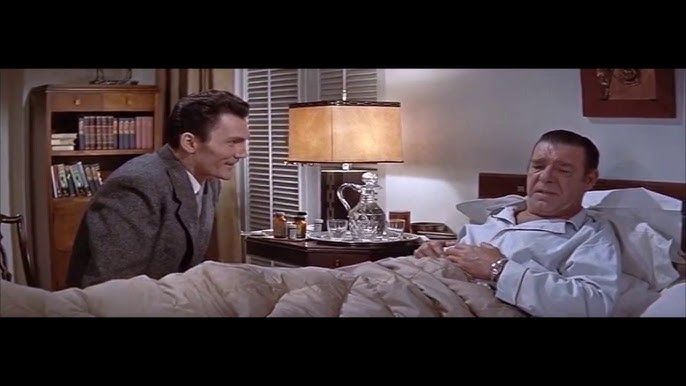
Most film critics and film historians disagree with W. R. Burnet’s view that this was a much better movie, because 1955’s, “I Died a Thousand Times” was almost a scene by scene remake of 1941’s, “High Sierra”. Even some of the dialogue is word for word from 1941, but because we’re talking 14-years-between the pictures. Some of the changes were just to update the background, like teenage dances, and update racial stereotypes. The camp handyman, “Algernon”, portrayed by African-American actor, Willie Best, became “Chico”, portrayed by Mexican-American comedian Pedro Gonzalez Gonzalez. Otherwise the name of the characters remained intact.
Writer W. R. Burnett might have liked the directing of Stuart Heisler, but the critics felt otherwise. In his November 10, 1955, the “New York Times“, film critic, Bosley Crowther described the film this way:
“Somehow it isn’t quite as touching as it was fourteen years ago. Not by a lot-—and the trouble is not wholly Mr. Palance…But the reason this film is not so touching is because it is antique and absurd—-the kind of glorification of the gunman that was obsolescent when High Sierra was made. It is an insult to social institutions and to public intelligence to pull this old mythological hero out of the archives and set him on a mountain top again. The pretense is so blunt and sentimental that it makes the whole thing a total cliché. And the acting does not greatly improve it…It is obvious that High Sierra has come to pretty low ground.”
The next motion picture I want to speak about had a screenplay that made Alan Ladd a star, and only after 46-other roles.
THIS GUN FOR HIRE premiered in Denver, Colorado, on April 24, 1942

In 1936, British author Graham Greene published “A Gun for Sale”, about a British criminal known as “Raven”. The novel came to the United States, with the title changed to “This Gun for Hire”. A selection of Greene’s other novels include 1943’s, “Ministry of Fear”, 1949’s, “The Third Man”, 1955’s, “The Quiet American”, and 1958’s, “Our Man in Havana”, all were turned into very successful motion pictures.
The motion picture was directed by Frank Tuttle. Tuttle started directing in 1922 and in 1929, he directed the sound sequences for the hybrid silent talkie mystery, “The Canary Murder Case”, with actor William Powell as author S.S. Van Dine’s “Philo Vance”. In 1930, Frank Tuttle, once again, directed William Powell as “Philo Vance” in “The Green Murder Case”. Tuttle’s 1929 silent, “The Studio Murder Mystery”, had cast members Neil Hamilton, Warner Oland, Fredric March, and Mischa Auer.
The screenplay was by two writers. This was only Albert Maltz’s fourth screenplay. He would be nominated by the “Academy of Motion Pictures Arts and Sciences”, for, “Best Adapted Screenplay”. Which told the true story of Marine “Al Schmid”, in 1945’s, “Pride of the Marines“. On the other hand, he became one of the “Hollywood Ten”, “Blacklisted”, in 1947, for refusing to answer questions about his alleged Communist Party membership, by the “House Committee on Anti-American Activities”. The “Hollywood Ten”, is part of my article, “MCCARTHYISM: LIGHTS, CAMERA, COMMUNISTS IN THE MOTION PICTURE INDUSTRY” to be read at:
https://www.bewaretheblog.com/2025/08/mccarthyism-lights-camera-communists-in.html
The second writer was W.R. Burnett. He had just co-written the screenplay for the musical comedy, 1941, “Dance Hall”, starring Cesar Romero and Carole Landis. Which was based upon his 1932 novel, “Giant Swing”, about a jazz musician. Burnett would follow this picture with the next two Second World War movies I will be mentioning.
The Four Actors on the Poster:
Veronica Lake portrayed “Ellen Graham”. Constance Francis Marie Ockleman started her on-screen acting career under her birth name with an uncredited role in 1939’s, “Sorority House”. For her next appearance, in a short subject, 1939’s, “The Wrong Room”, she was now Connie Keane, for 1939’s, “All Women Have Secrets”, Connie had become Constance, and for 1940’s, “Forty Little Mother’s”, the young actress was now Veronica Lake. Three movies later, Veronica Lake had co-starred with Joel McCrea, in director Preston Sturges’, 1941, “Sullivan’s Travels”, and this motion picture followed.

Robert Preston portrayed “Michael Crane”. Preston had just been seen in director Cecil B. DeMille’s, 1942, “Reap the Wild Wind”, and followed this feature with the Second World War entry, 1942’s, “Wake Island”. Much later in his career, my reader might know Preston as 1962’s, “Professor Harold Hill” aka: “The Music Man”, or “Centauri”, in 1984’s, “The Last Starfighter”.

Laird Cregar portrayed “Willard Gates”. Two opposite, but beautifully performed roles by Laird Cregar, are and the over the top, “Captain Henry Morgan”, in 1942’s, “The Black Swan”, and the “Jack the Ripper” character in 1944’s, “The Lodger”. My article is “Laird Cregar: An Excellent Character Actor’s Life Cut Short”, and can be read at:
https://www.bewaretheblog.com/2022/10/laird-cregar-excellent-character-actors.html

Alan Ladd portrayed “Philip Raven”. After his seventh billed role in 1942’s, “Joan of Paris” Ladd moved up to fourth billing in this feature, and third in his next motion picture, co-starring with Veronica Lake and Brian Donlevy, 1942’s, “The Glass Key”, based upon the Dashiell Hammett novel.

Graham Green’s novel was moved from England to the United States, and “Raven”, also became American.
In 1942, war-time San Francisco, chemist and blackmailer “Albert Baker”, played by Frank Ferguson, is the target of “Hit-Man Philip Raven”, and is killed.
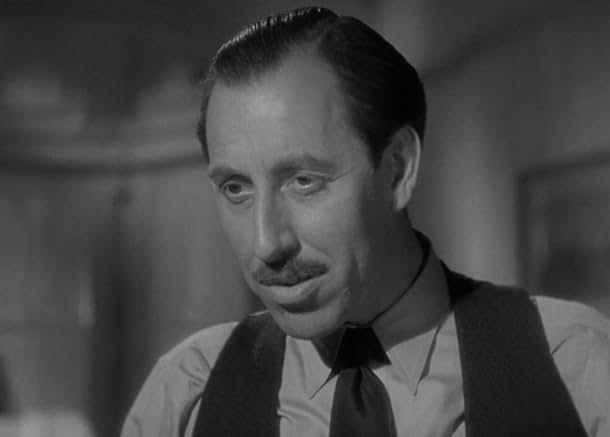
“Baker’s” secretary, portrayed by Bernadine Hayes, is also killed by “Raven”. Who also grabs some papers and places them in a satchel, then leaves.
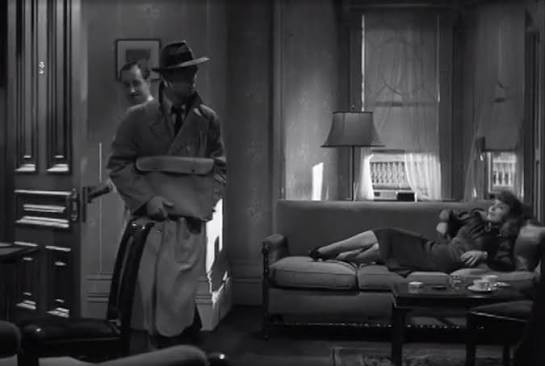
However, after turning the satchel over to his employer. “Raven” is doubled-crossed by that employer, “Willard Gates”, and paid with marked bills. “Gates” reports the bills to the Los Angeles Police Department, as stolen from his, “Nitro-Chemical Company of Los Angeles”.
.png)
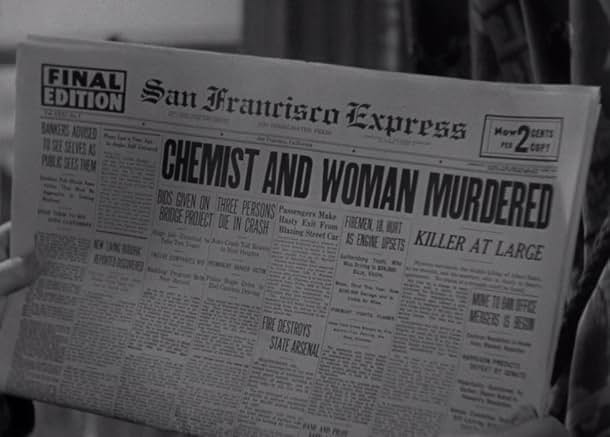
“Raven” learns of the set-up, and decides to get revenge upon “Gates”. In San Francisco, “Los Angeles Police Detective Lieutenant Michael Crane” is there to visit his girlfriend, nightclub singer and magician, “Ellen Graham”. He receives a call to take the case, but on his first attempt to capture “Raven”, he slips away.

Meanwhile, after an audition, “Ellen” is hired by “Gates” to work at his Los Angeles nightclub. Next, she finds herself meeting “Senator Burnett”, played by Roger Imhof, and learns that the government is investigating “Nitro Chemical”. The government believes, “Gates”, is actually a traitor, and “Ellen” becomes a spy for the United States government.
“Ellen” and “Gates” board a train for Los Angeles followed by “Raven”, who sits down in the chair next to “Ellen”.

The following morning, walking through the train, “Gates” spots the sleeping “Raven” with his head on the sleeping “Ellen”.
“Gates” wires ahead to alert the police about “Raven”, but “Raven” forces “Ellen”, at gunpoint to help him elude the police when the train arrives in Los Angeles. As “Raven” prepares to kill “Ellen” in a condemned warehouse, he is interrupted by workman and “Ellen” gets away. She goes to “Gates”s club and tries to contact “Michael”, only to find out he left San Francisco for Los Angeles.
That night, a suspicious “Gates” invites “Ellen” to his mansion. As soon as she enters, “Tommy”, portrayed by Marc Lawrence, “Gates’s” chauffeur knocks her unconscious.
Tipped off by one of “Ellen’s” co-workers at the club, “Michael Crane” now goes to “Gates’s” mansion looking for “Ellen”. “Tommy” tells “Crane” that she left over two-hours ago. While “Crane” questions “Tommy” and makes a phone call to “Ellen’s” hotel. Outside, “Raven” arrives to look the place over, looking through a window, he observes “Tommy” hiding “Ellen’s” purse from “Crane”. After “Crane” leaves, “Raven” knocks on the mansion’s front door and enters. When “Tommy” denies that “Ellen” is still there, “Raven” knocks “Tommy” down a flight of stairs for lying to him. While “Tommy” is out cold, “Raven” searches the mansion, locates “Ellen”, and rescues her.
As this is happening, “Tommy” recovers, and calls “Gates” to tip him off. At the time of the call, “Crane” is sitting with “Gates” in this club.
Arriving at the club, “Raven” and “Ellen” are confronted, and “Raven’s” now takes her as his hostage and he flees. Having picked up a some monogramed playing cards, “Ellen” starts leaving them as “Breadcrumbs” for “Michael Crane” to follow. As a result, the police have “Raven” and his hostage cornered in the railroad yard, but decide to wait until dawn to move in.
Waiting for the police to act, “Raven” now reveals to “Ellen” his history. He was orphaned at a young age and raised by an abusive aunt. One day, while she was beating him, he snapped, killed her, and ended up in reform school where the abuse just continued. In return, “Ellen” reveals that one of the documents he took from “Baker’s” was a formula for a poisonous gas that “Willard Gates” is selling tot he Japanese. “Ellen” begs “Raven” not to kill “Gates, until he gets a signed confession out of him. “Ellen” next helps “Raven” escape the police dragnet, in the hopes that she has gotten through to his patriotism, which he promises.
However, he breaks that promise by killing a police officer during his escape. “Raven” now arrives at “Nitro Chemicals” during a gas attack drill. Everyone is wearing gas masks except himself, and is spotted by “Tommy”. The two fight, and “Tommy” is knocked out, “Raven” puts “Tommy’s” clothes and gas mask on, obscuring his face like all the others. Locating “Willard Gates”, “Raven” now forces him to take the hit-man to “Alvin Brewster”, portrayed by Tully Marshall, the “President of “Nitro-Chemicals”, and the man directly responsible for the sale to the Japanese, and is confined to a wheel chair.
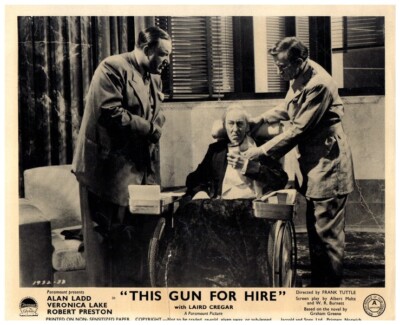
Meanwhile, “Ellen” has met with the police, and they go to “Nitro Chemicals”.
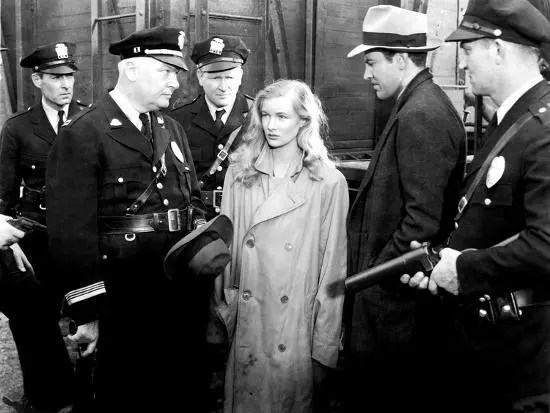
“Raven” barricades himself in with “Gates” and “Brewster” as “Ellen”, “Michael Craven” and the police arrive. Inside “Brewster’s” office, “Raven” gets both the company president and “Willard Gates” to write and sign. confessions. Next, with a pen that is really a one shot gun, “Brewster” attempts to kill “Raven”, but dies of a heart attack.
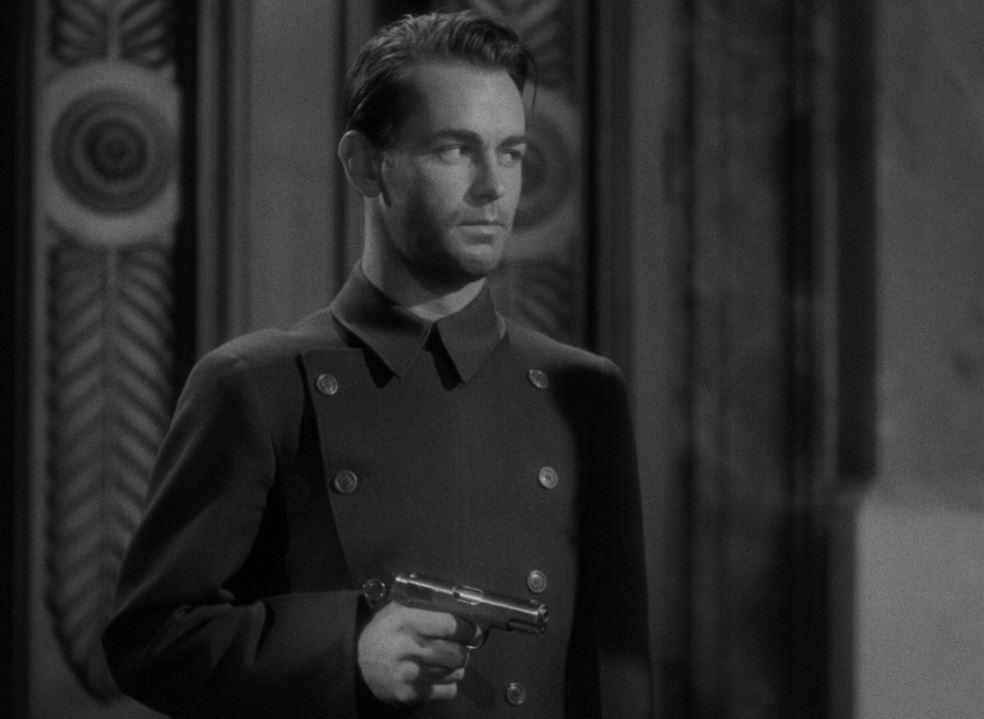
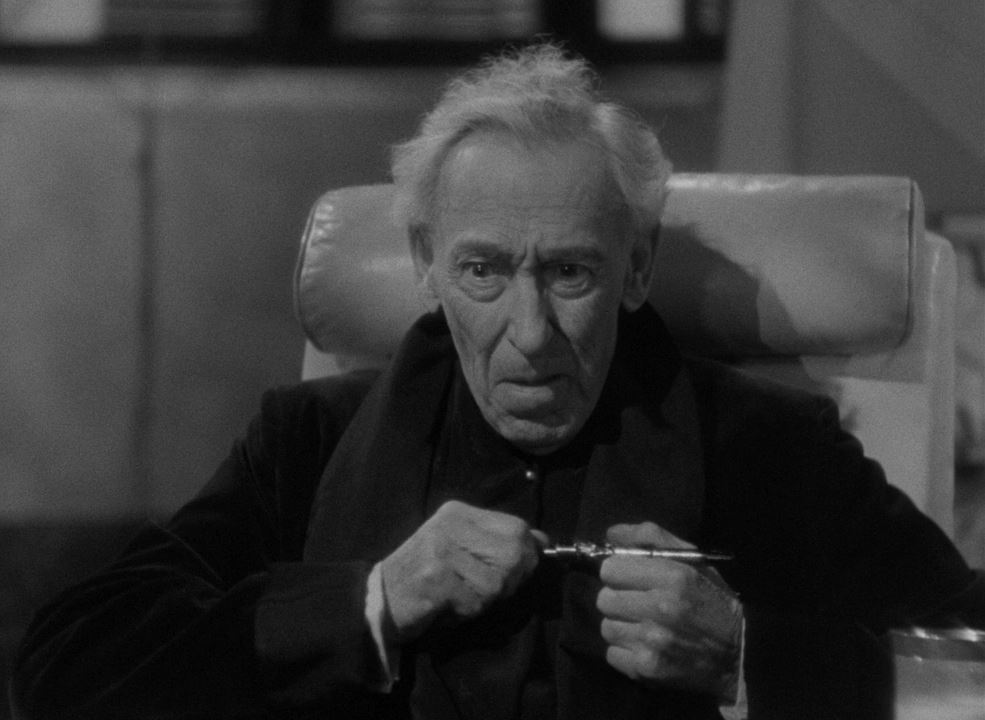
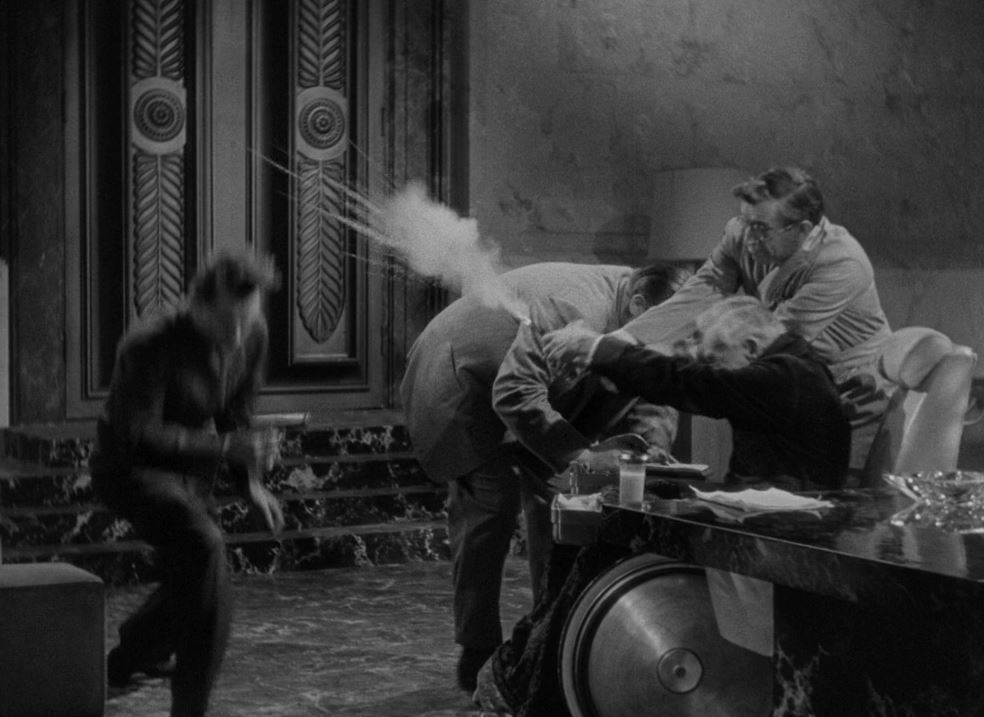
“Raven” kills “Gates”, outside, “Mike Craven” is being lowered on a scaffold to get a clear shot of “Raven”, and the two exchange gunfire. “Raven” is wounded, and when he sees “Crane” with “Ellen” helping him, he resists killing the police detective. Other police officers fire at the hit-man, and before “Raven” dies, “Ellen” tells him she did not turn on him, and “Raven” tells her about the confessions.
On December 7, 1941, the United States entered the Second World War the hard way, by a sneak attack on Pearl Harbor Hawaii. W. R. Burnett
WAKE ISLAND was released on August 11, 1942, although its official “World Premier” was in New York City, on September 1, 1942
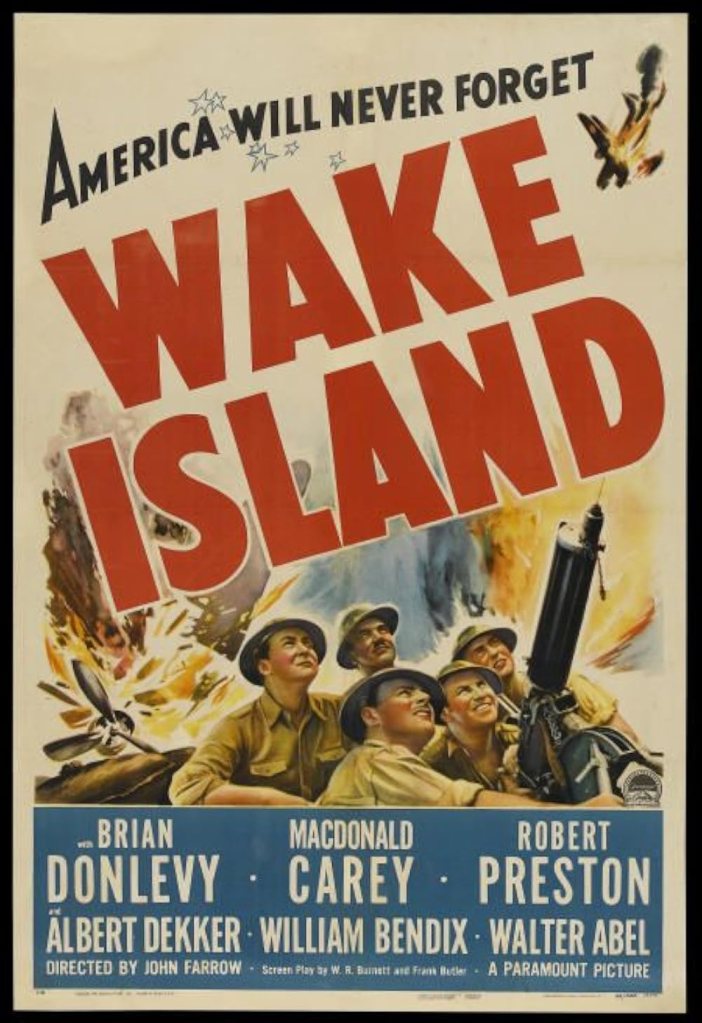
This is a “Gung-Ho Marine’s” pro-America, anti-Japanese story by W. R. Burnett. Who was also the primary screenplay writer.
Frank Butler was Burnett’s main co-writer. Butler had just co-written the Dorothy Lamour and Richard Denning’s, 1942, ” Beyond the Blue Horizon”, and followed this movie with the Bing Crosby, Bob Hope, and Dorothy Lamour, 1942, “The Road to Morocco”.
John Farrow directed the movie, he had just directed the Maureen O’Hara and Adolphe Menjou’s, 1940, “Bill of Divorcement”, and followed this war drama with Paul Muni in 1942, “Commandos Strike at Dawn”.
The Six Marines:
Brian Donlevy portrayed “Major Jeffrey Caton”. Donlevy had just been seen in 1942’s, Adventure Crime Drama, “A Gentleman After Dark”, and followed this picture with Dashiell Hammett’s, 1932, “The Glass Key”. My article is, “Brian Donlevy: Atomic Bombs, Space Aliens, Insects, and Daikaiju” found at:
https://www.bewaretheblog.com/2020/06/brian-donlevy-atomic-bombs-space-aliens.html
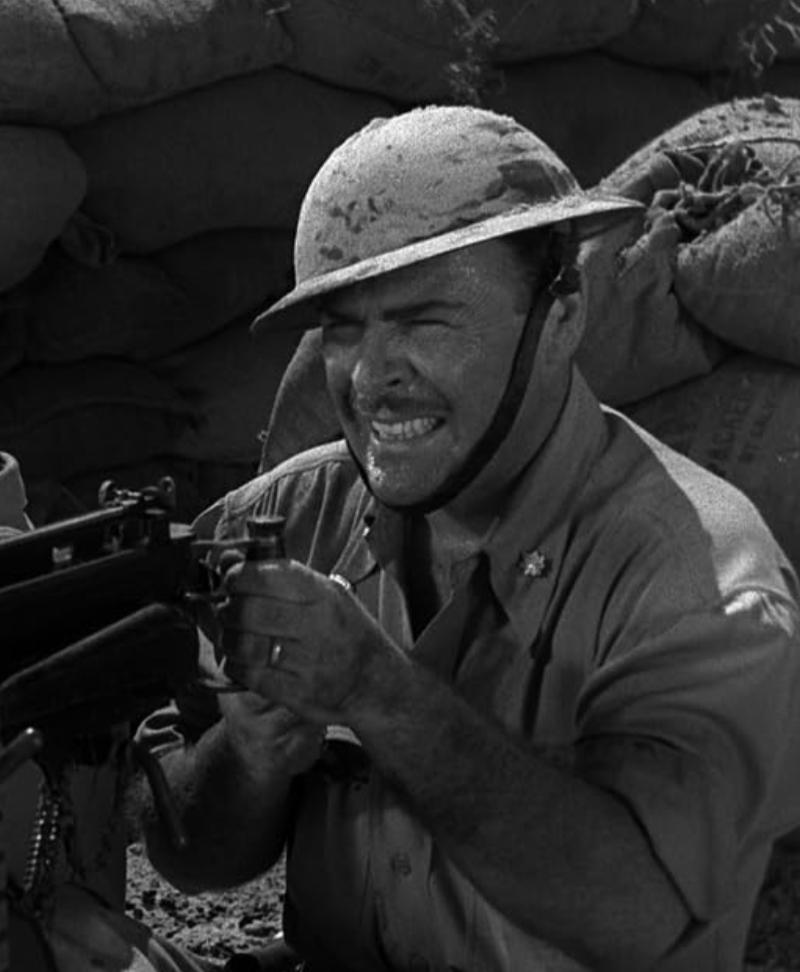
MacDonald Carey portrayed “Lieutenant Bruce Cameron”. Carey had just been seen in only his second motion picture in the title role of 1942’s, “Doctor Broadway”, and followed this feature with an All-Star morale promoting musical comedy, 1942’s, “Star Spangled Rhythm”.
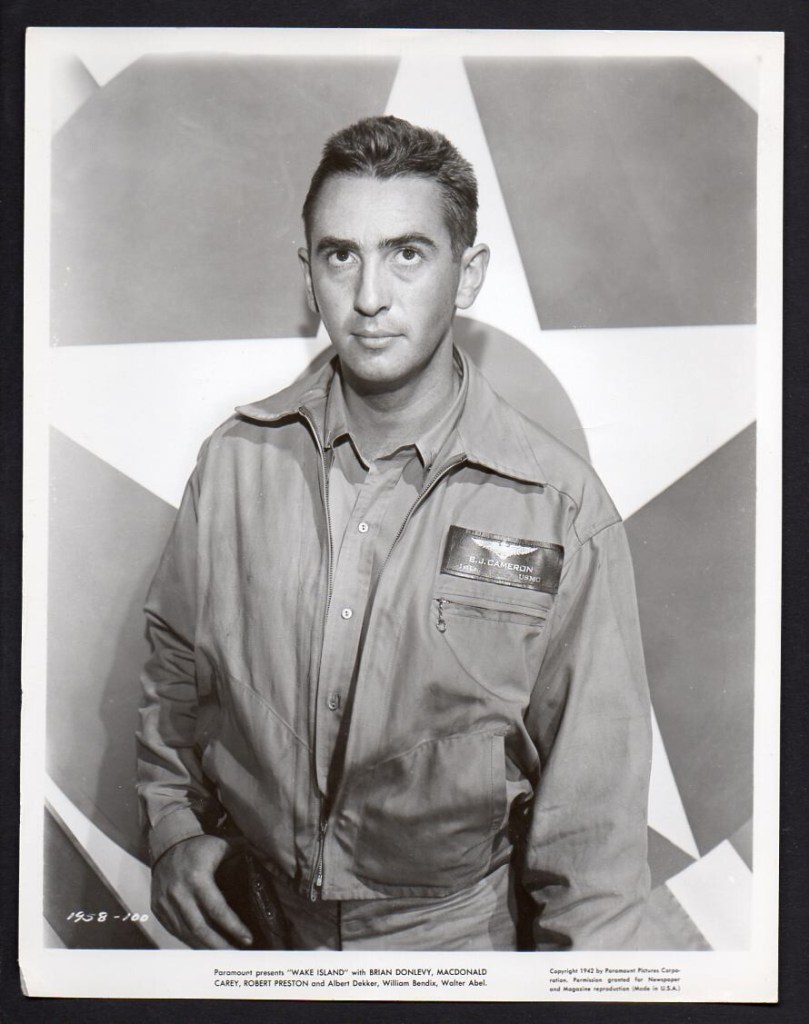
Robert Preston portrayed “Private Joe Doyle”. I just mentioned his previous motion picture and Robert Preston followed, also, with 1942’s, “Star Spangled Rhythm”.
Albert Dekker portrayed “Shad McClosky”. Dekker was usually a movie heavy, or villain. However, In 1939, he was “King Louis XIII of France”, in director James Whale’s version of French author, Alexander Dumas’s, “The Man in the Iron Mask”, and in 1940, Albert Dekker was “Dr. Cyclops” shrinking people to doll size. While, in film-noir director, Robert Siodmak’s, 1946, version of Ernest Hemmingway’s, “The Killers”, he was “Big Jim Colfax”.
William Bendix portrayed “Pvt. Aloysius K. ‘Smacksie’ Randall”. Bendix had just appeared in his 3rd-motion picture, 1942’s, “Woman of the Year”, that had starred Spencer Tracy and Katharine Hepburn. He followed this feature with the Dashiell Hammett, 1942, “Glass Key”. From 1953 through 1958, he was “Chester A. Riley”, in 219-episodes of the family television sitcom, “The Life of Riley”.
W. R. Burnett’s story consolidates December 8, 1941, on Wake Island. Which was the same physical day on the other side of the “International Date Line”, as December 7th at Pearl Harbor, Hawaii, and the battle that followed.
The Following facts are found on the “Naval History and Heritage Command” website at:
https://www.history.navy.mil/browse-by-topic/wars-conflicts-and-operations/world-war-ii/1941/philippines/defenders-of-wake.html
In the early morning hours of 23 December the Japanese landed 1,500 troops of their special naval landing forces on Wake. The Marines gave a very good accounting of themselves against a superior force, and fought ferociously throughout the morning and on into the next afternoon. When it became clear that they were not to be relieved or evacuated, Commander Cunningham, who later received the Navy Cross for his defense of the island, ordered the Marines to surrender. Even then, several of the artillerymen and aviators-turned-riflemen had to be persuaded by Major Devereux in person before they would put their weapons down. Devereux was also awarded the Navy Cross for his role in leading Marines in their first battle against Imperial Japanese forces. For the Marine Corps as a whole, it was clear that if their Marines were well-supplied and well-led, they could easily defend against anything the Japanese threw at them.
Of the nearly 449 Marines of the 1st Defense Battalion and VMF-211, 49 were killed and 32 wounded in action, while the rest became prisoners of war. Of the 68 Navy personnel, 3 were KIA and 5 WIA. The Army detachment did not lose any of its soldiers, while the 1,146 civilians lost 70 killed and 20 wounded. The Japanese lost 381 men, plus an unconfirmed number of wounded. Rear Admiral Shigematsu Sakaibara, the Japanese commander of Wake Island, was executed after the war when it was discovered that he had ordered the execution of 98 civilian contractors in October 1943. He had apparently feared a major landing by American forces around that time, which never materialized. The other American POWs were sent off to prison camps in occupied parts of China or to Japan to become slave laborers. All endured years of starvation, torture, disease, and despair until they were liberated at war’s end. Despite occasional Allied raids throughout the war, the Japanese remained in control of Wake Island until they finally surrendered on 4 September 1945.
W. R. Burnett’s Screenplay:
I gave my reader the above facts, because Burnett’s story and screenplay is not about giving American’s the facts. Its about giving them a reason to fight both the Japanese, and the Nazi’s, within a dose of propaganda. I would point out that filming on this motion picture started on April 17, 1942, and concluded on July 20, 1942.
Not to confuse his audience, the date of the attack on “Wake Island”, in W. R., Burnett’s screenplay was December 7th, not December 8, 1941. While, the trailers had told the potential audience that the movie was:
The actual movie opens with a narrator telling the audience, over a picture of a map of Wake Island, the history of the Marine’s stationed there. It then cuts to a “Pan American Airways” plane in flight, where the tough, no nonsense new commanding Marine Corps officer, “Major Geoffrey Caton” clashes with a civilian contractor named “McClosky”. “Caton” arrives and makes an inspection of the men and general area. On that inspection, he identifies both “Private Joe Doyle”, and “Private Randall” as “trouble makers”, and orders them to dig a large slit trench by hand. While, “McClosky” oversees the building of other trenches by the civilian construction workers, which will clash with the Marines over the many air raid practices “Major Caton” conducts.
It is now December 7th in Hawaii, and December 8th, on Wake.
“Randall’s” enlistment is up and he prepares to board a “Pan American” clipper to fly back to Hawaii and then the United States. Word of the “Pearl Harbor” attack reaches Wake, and the Marine’s are put on full alert. “Randall”, doesn’t know what to do in his new status, but goes to a bomb shelter with other civilians as Japanese aircraft is reported heading for the island. Four American planes are sent against the twenty-four approaching Japanese Zeros. They are able to shoot down a small number, but this doesn’t prevent the damage to the base and the civilian areas. Following the raid, “Randall” finds out where he is, when “Major Caton” informs him that he is still in the Marine Corps. Contractor McClosky has a change in view, and gets his men to clear the damages on the Marine base and dig more trenches and other civilian shelters. Upon returning from the combat with the Japanese, “Major Caton” has to inform “Lieutenant Bruce Cameron”, that his wife was killed at Pearl Harbor. The tone of the rest of the screenplay has been set.
The movie will end with Brian Donlevy’s, “Major Caton”, the last surviving star of the movie. Hearing again, another demand from the Japanese “To Surrender”, as their troops land on Wake Island. Maning a machine-gun position, Caton, replies:
“COME AND GET US!”
The narrator’s voice is again saying:
“THIS IS NOT THE END!”
Here are examples of the publicity for this movie showing the morale building used.
On March 4, 1943, W. R. Burnett and Frank Butler were nominated by the “Academy of Motion Picture Arts and Sciences” for “Best Original Screenplay”.
Above left is MacDonald Carey as “Lieutenant Bruce Cameron” with the Puncredited Barbara Britton, televisions “Mr. and Mrs. North” co-starring Richard Denning 1952-1954, portraying his wife, “Sally Cameron”.
Burnett would provide the story for 1943’s “Crash Dive”, and contribute “Additional Dialogue” to 1943’s, “Action in the North Atlantic”.
I started this article by referring to William Shakespeare’s “Macbeth”. So, how about a Shakespearian western, based upon the same play the 1956 science fiction classic “Forbidden Planet” was to have been?
YELLOW SKY released on December 22, 1948

The producer and screenplay writer were the same person, Lamar Trotti. As both producer and screenplay writer, Trotti’s double duty work prior to this feature film included, 1942’s “The Oxbow Incident” starring Henry Fonda and Dana Andrews, 1943’s “Immortal Sergeant” starring Henry Fonda and Maureen O’Hara, 1945’s “A Bell for Adano” starring Gene Tierney, John Hodiak, and William Bendix, and 1947’s “Captain from Castle” starring Tyrone Power, Jean Peters, and Cesar Romero.
The screenplay was based upon an unpublished novel by W. R. Burnett of the same title. However, in 1950, Burnett published his novel, by paperback publishing company, “Gold Medal”, under the title “Stretch Dawson”.
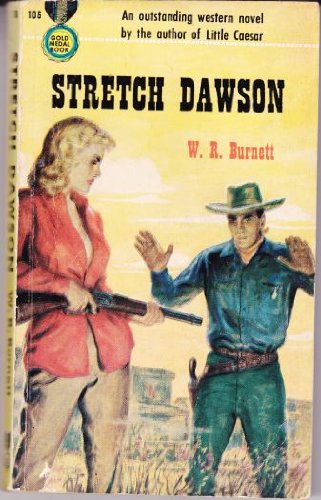
This motion picture was directed by William “Wild Bill” Wellman. He earned the nickname while flying for the French Air Force during the First World War. In 1927 Wellman directed the first motion picture, “Wings”, to receive the “Academy Award for Best Picture”. Among his films prior to this one is, 1931’s “Public Enemy” starring James Cagney, the 1932 version of authoress Edna Ferber’s “So Big” starring Barbara Stanwyck, and George Brent, the original 1937 “A Star is Born” starring Janet Gaynor, and Fredric March, and 1942’s “The Ox-Bow Incident”. My article, “William A. ‘Wild Bill’ Wellman: ‘3’ with John Wayne: ‘Island in the Sky’, ‘The High and the Mighty’, and ‘Blood Alley” will be found at:
http://www.bewaretheblog.com/2017/07/william-wild-bill-wellman-3-with-john.html
William A. Wellman requested cinematographer Joseph MacDonald, John Ford’s 1946 “My Darling Clementine”, and 1948’s “Call Northside 777”, to film the motion picture. The majority of the screenplay takes place in “Death Valley, California”, and Wellman wanted the picture shot in stark black and white to play off the contrast of the dark shadows and extremely bright desert sun light and MacDonald was the perfect choice.
Now comes the mystery of William Shakespeare’s, “The Tempest”. The screenplay has elements of that Shakespearian play, but director, William A. Wellman, has stated, in several interviews, that he had no idea he was directing a western version of Shakespeare. Screenplay writer, Lamar Trotti, has also stated he was only following W. R. Burnett’s manuscript to create the screenplay. While, Burnett, known for using themes of crime, greed, honor among thieves, and desperate survival, was never asked the question. Reviewers of his published, 1950 novel, and this screenplay, lean toward the known fact that W. R. Burnett was an avid reader of Shakespeare, and possibly had an unconscious use of the archetype “The Tempest”.
While you may debate Shakespeare, not up for debate, is that fact this was a FILM-NOIR WESTERN. Photographed by cinematographer Joseph MacDonald, director John Ford’s, 1946, “My Darling Clementine”, and director Henry Hathaway’s, 1948, “Call Northside 777”, in high-contrast, black-and-white cinematography using low-key lighting, deep shadows, and unbalanced camera angles.
The Cast of Players:
Gregory Peck portrayed “James ‘Stretch’ Dawson”. Peck had just appeared in Alfred Hitchcock’s “The Paradine Case”, and would follow this feature with a major box office flop, 1949’s “The Great Sinner”. Which was based upon Russian author Fyodor Dostoyevsky’s, 1866, “The Gambler”. The actor would redeem himself with the World War Two motion picture that followed, 1949’s “Twelve O’Clock High”. My article is “Gregory Peck: Five Different Westerns – Five Different Characters” at:
https://www.bewaretheblog.com/2022/02/gregory-peck-five-westerns-five.html

Anne Baxter portrayed “Mike (Constance Mae)”. Baxter had just appeared in 1948’s “Luck of the Irish” co-starring with Tyrone Power, and followed this feature with 1949’s “You’re My Everything” co-starring Dan Dailey.

Richard Widmark portrayed “Dude”. Widmark had just co-starred with Ida Lupino, Cornel Wilde, and Celeste Holm in the Film-Noir 1948’s “Road House”. The actor followed this feature co-starring with Lionel Barrymore and Dean Stockwell in 1949’s “Down to the Sea in Ships”.

Robert Arthur portrayed “Bull Run”. Arthur had just been seen in the 1949 Family Western “Green Grass of Wyoming” co-starring with Peggy Cummins, and Charles Coburn. He followed this feature with the romantic comedy 1949’s “Mother Is a Freshman” starring Loretta Young, Van Johnson, and Rudy Vallee.

John Russell portrayed “Lengthy”. The future “Marshall Dan Troop” on televisions “Lawman”, had just been seen in the family comedy 1948’s “Sitting Pretty” starring Robert Young, Maureen O’Hara, and Clifton Webb. Russell followed this picture with the Richard Widmark, Linda Darnell, and Veronica Lake 1949 “Slattery’s Hurricane”.

Harry Morgan portrayed “Half Pint”. The future “Colonel Sherman T. Potter” on televisions “M.A.S.H.”, had been in William Wellman’s, 1942, “The Ox-Bow Incident”, and was seen in the forgotten Film-Noir, 1948’s “The Saxon Charm” starring Robert Montgomery, Susan Hayward, and John Payne. He would follow this film with 1949’s “Down to the Sea in Ships”.

James Barton portrayed “Grandpa”. Character actor Barton had fifth billing in director Henry Hathaway’s 1941 remake of “Shephard of the Hills” starring John Wayne, Betty Field, and Harry Carey. Between that picture and this one, he was in 1948’s “The Time of Your Life” starring James Cagney, William Bendix, Wayne Morris, and Jeanne Cagney. He followed this movie with 1950’s “The Daughter of Rosie O’Grady” co-starring with June Haver, and Gordon MacRae.

Charles Kemper portrayed “Walrus”. Character actor Kemper’s work includes the Zachery Scott, Bette Field, and J. Carrol Naish, usually overlooked, 1945 “The Southerner”. Which was about tenant cotton workers in the South and directed by French director Jean Renior. Prior to this picture, Kemper was in 1948’s “Belle Starr’s Daughter” starring George Montgomery, Rod Cameron, and Ruth Roman. He followed this feature with 1949’s “Adventure in Baltimore” starring Robert Young, Shirley Temple, and her then husband, John Agar.
Charles Kemper’s “Walrus” is in front of the group in the following photo.

The Basic Shakespearian (?) Screenplay:
The year is 1867, and a gang of outlaws led by “James ‘Stretch’ Dawson” are in the saloon of a small California town, and being waited upon by the bartender, played by Victor Kilian.

In the above shot of “Stretch’s” gang, at the bar is Paul Hurst, as the unrelated drunk in the Union soldier’s hat.

The gang now robs the towns bank and will be chased by soldiers to the edge of Death Valley, in California.


The soldiers stop following, when “Stretch” takes his gang toward the deep Eastern desert.


After barely making across the desert, the bank robbers come upon the ghost town of the film’s title, “Yellow Sky”.


Next, “Stretch” and his gang spot an old run-down house, but out of it comes a young woman with a rifle. “Stretch” tells his men to wait, goes to speak to the girl, and discovers she is called “Mike”, and is as tough as her male nickname might imply. They are joined by her grandfather, and “Stretch” agrees that he and his men will remain in the ghost town until they’re able to ride out in a couple of days.


“James Dawson” is an honorable man, forced by circumstances into becoming an outlaw.
While “Stretch’s” men are recovering at a nearby spring, the gambler “Dude”, starts to snoop around, questioning why an old man and his granddaughter would be in the middle of Death Valley in an old ghost town? He discovers that “Mike’s” grandfather is a prospector, and has a gold mine. “Dude” goes to “Stretch” and tells him, but is surprised that the other doesn’t care and isn’t interested.

“Mike” and “Grandpa” are concerned about two things, the first is the gang now knows about his gold mine, but more importantly, “Dude” is making a move to take the gang over. The two, unseen, go up into the hills for protection, and watch what happens next. “Mike” observes “Stretch”, and “Dude”, in a heated confrontation. When ‘Dude” seems to be pushing some issue, “Mike” shoots between them, causing the two to take cover. The gang starts shooting back, and “Grandpa” is wounded in the leg by a ricochet. This forces “Mike”, who hoped to drive them off, to surrender.


Back in the house, “Grandpa” is forced to split his already mined gold, worth about $50,000, and any more the gang gets out of his gold mine.


“Mike” goes to the spring to get water, and “Lengthy” comes over, and starts to force himself on her. “Bull Run” sees what’s happening, and goes to “Mike’s” rescue, but “Lengthy” gets the upper hand and forces the young outlaw’s face under the water, “Stretch” arrives, frees “Bull Run”, and pushes “Lengthy’s” face under the same water, almost drowning him.


That night a cleaned up “James Dawson” approaches “Mike” and her “Grandpa”, and promises, on a bible, to keep to his end of their original bargain. However, “Dude” is at a window listening, and not liking what he is hearing.

“Mike” is falling for “James Dawson”, as he is for her.

The next morning, while the gang works the mine, Apaches arrive, worrying “Stretch” and his men, but they speak to “Grandpa” and leave. He explains to “Stretch” that they are his friends, and have returned to the reservation. Thus avoiding a major confrontation the bank robbers could never win.


“Stretch” goes to the others and explains what “Grandpa” told the Apaches. He emphasizes that the bank robbers will keep the bargain, and share the gold from the mine. However, “Dude” has already convinced the rest of the gang to take all the gold. He draws his gun, and a shootout begins with “Stretch” against everyone else.

“Mike” starts shooting at the others, gets to a wounded “James Dawson”, and manages to get him back into the house. Afraid that “Stretch” will come after each of them, the gang surrounds the house, with the intention of killing the three people inside.

During the gunfight that follows, the gang believes “Stretch” has been killed. Now, “Dude” reveals his true intentions of having all the gold for himself, and shoots at “Lengthy”, but misses. “Dude” next fatally wounds “Bull Run”, and goes after “Lengthy” in the ghost town. Discovering that “Stretch” is still alive, “Walrus” and ‘Half Pint” decide to help him, but “Stretch” now heads for the ghost town, and what will be a deadly three-way shootout in the old saloon.
When “Mike” arrives at the saloon, she finds an unconscious, but still breathing, “James ‘Stretch’ Dawson”, and the other two men dead. The picture ends with “Stretch”, “Half Pint”, and “Walrus” returning the bank’s money, and joining “Mike”, and her “Grandfather”, waiting at a wagon, and the five ride off with the gold.
In Season Two, Episode 31, of the “Kraft Mystery Theatre”, if you owned a television set, on April 20, 1949, you watched a live production of “The Whole Town’s Talking”. This was a shortening of W. R. Burnett’s, 1935, feature film of the same name, that had originally starred Edward G. Robinson. This “Kraft Mystery Theatre” production was the first time Burnett and television programing met.
Next was a classic film-noir heist crime thriller.
THE ASPHALT JUNGLE was released on May 12, 1950

The screenplay was based upon W. R. Burnett’s 1949 crime novel. The main screenplay writer was Ben Maddow, and he had just written the screenplay for the 1949 crime drama, “Intruder in the Dust”, with William Faulkner. Maddow followed this screenplay with
John Huston was the co-screenplay writer, co-producer of the picture, and the film’s director.
The two screenplay writers were nominated by the “Academy of Motion Picture Arts and Sciences” for “Best Adapted Screenplay”. The two were nominated by the “Golden Globe’s” for the “Best Screenplay”. The “Writers Guild of America” nominated the two for two awards, “Best Written Drama”, and the “Writers Guild of America Award for Best Written Film Concerning American Scene”, but they won “Best Motion Picture Screenplay” from the “Edgar Allan Poe Awards”.
At no time, was the source novel by W. R. Burnett ever mentioned as the screenplay’s source.
The Actors of W. R. Burnett’s Story:
Sterling Hayden portrayed “Dix Handley”. Hayden had a varied film career, in 1954, he was “Sir Gwain” in “Prince Valiant”, he was the title character opposite Joan Crawford in director Nicholas Ray’s, 1954 psychological western, “Johnny Guitar”, in 1955, Hayden was “Jim Bowie”, in “The Last Command”, in 1964, he was “Brigadier General Jack D. Ripper”, in director Stanley Kubrick’s, “Dr. Strangelove or: How I Learned to Stop Worrying and Love the Bomb”, and of course, the actor was “Police Captain McCluskey” in director Francis Ford Coppola’s, 1972, “The Godfather”.
Louis Calhern was “Alonzo D. Emmerich”. Calhern had been 4th-billled in director Alfred Hitchcock’s, 1946, “Notorious”, he was “Oliver Wendell Holmes” in 1950’s, “Magnificent Yankee”, and would be “Julius Caesar” in the 1953 movie version of Shakespeare’s play co-starring with Marlon Brando as “MarK Anthony”, and James Mason as “Brutus”.
Jean Hagen was“Doll Conovan”. Hagen would portray “Lina Lamont” is 1952’s, “Singin’ the Rain”, Fred MacMurray’s wife in Walt Disney’s original 1959, “The Shaggy Dog”, and Ray Milland’s wife in his produced and directed, mostly overlooked, second red scare feature, 1962’s, “Panic in the Year Zero”. Below, Jean Hagen and Sterling Hayden.

James Whitmore was “Gus Minissi”. He had just been in the Joel McCrea western, 1950’s, “The Outriders”. My article is “JAMES WHITMORE: World War 2, Film-Noir, Musicals, Science Fiction, Racial Prejudice, Westerns, and Harry Truman” to read at:
https://www.bewaretheblog.com/2021/05/james-whitmore-world-war-2-film-noir.html

Sam Jaffe was “Doc Erwin Riedenschneider”. In 1937, Jaffe with the “High Lama of Shangri-la”, in director Frank Capra’s, “Lost Horizon”, three more films after this one. An Sam Jaffe was “Professor Jacob Barnhardt” in director Robert Wise’s, “The Day the Earth Stood Still”.

John McIntire was “Police Commissioner Hardy”. McIntire had also been in 1950’s, “Ambush”, in 1960, he was the “Sheriff”, in Alfred Hitchcock’s, “Psycho” However, he is probably best known to 1950/1960’s television audience’s for taking over from Ward Bond on “Wagon Train” for 152-episodes.

The screenplay takes an unflinching look at a group of men coming together to pull off a jewelry store robbery.
However, the motion picture industry’s own censors, the “Hays Office“, had wanted to cut two “Objectionable” scenes and change some dialogue to keep to their goal of protecting the morality of American’s. They believed those scenes made committing crime look good to the picture’s audience. John Huston and co-producer Arthur Hornblow, Jr. ,won the small battle of words, and the film stayed as written, directed and edited.
When “Doc Riedenschneider” is released from prison, after serving a 7-year sentence. He goes to a “Bookie” named “Cobby”, portrayed by Marc Lawrence, on the far right below.

“Doc” wants “Cobby” to arrange a meeting with Lawyer “Alonzo Emmerich”. Meeting “Emmerich”, “Doc”, explains his plans to rob a jewelry store of $500,000 (as of this writing, $6,927,759) in merchandise.

“Doc” needs $50,000 from “Emmerich” to hire three men. These are a “Boxman (Safecracker)”. a “Driver”, and a Hooligan (Ordinary Hoodlum)”.”Emmerich” agrees to give “Doc” the money, and to dispose of the “Loot” after the successful robbery.
After getting the money, “Doc” hires a “Boxman” named “Louis Ciavelli” portrayed by Anthony Caruso, lower front right.

The driver is hunchback, “Gus Minissi”, and the “Hooligan” is “Dix Handley”. “Dix’s” girlfriend, who is actually in love with him, is “Doll Conavan” and unlike the others in the group. “Dix” dreams of buying back the Kentucky horse farm his father lost during the “Great Depression”.
During John Huston’s 11 minute robbery sequence, that the censors thought made crime look good, “Ciavelli” hammers through a brick wall to enter the jewelry store, deactivates the only alarm to let “Doc” and “Dix” in, and makes home made “Soup (nitroglycerin)” to blow the safe.
Everything is running like clockwork until the unexpected happens. It is not the arrival of a Security Guard, BUT the dropping of his gun. The gun goes off after hitting the ground, and wounds “Ciavelli” in the stomach. “Ciavelli”, “Doc” and “Dix” escape in the car driven by “Gus”, but now a police manhunt has started.
“Ciavelli” insists that “Gus” take him home. Meanwhile, “Doc” and “Dix” take the stolen goods and head for “Emmerich’s”. “Emmerich”, who is actually broke, had sent a Private Detective name “Bob Brannon”, portrayed by Brad Dexter, to collect debts owed him. “Brannon” returned without any money, but “Emmerich” plots with “Brannon” to double cross the others, and split the money from the fenced jewelry.
“Doc” and “Dix” arrive and “Emmerich” suggests the two leave the jewels with him. Both men now become suspicious, “Brannon” pulls a gun, but “Dix” is too fast, and kills the detective.
Thinking fast, “Doc” tells “Emmerich” to contact the Insurance Company and ask for 25 percent to return the stolen items. “Emmerich”, next, disposes of “Brannon’s” body in the river, but the body is discovered by the police.
Enter, MARILYN MONROE, in her 3rd-credited role, portraying “Angela Phinley” the mistress of “Alonzo Emmerich”.
My article is “MARILYN MONROE: Mentally Unstable Baby Sitter and Misfit” at:
https://www.bewaretheblog.com/2019/04/marilyn-monroe-mentally-unstable.html
When questioned by “Police Commissioner Hardy” at his office. “Emmerich” tells the “Commissioner” that he was with “Angela” at her apartment during the robbery. As soon as they leave, “Emmerich” contacts “Angela”, to set up an alibi for him.
IN THE END:
A Police Lieutenant named “Ditrich”, portrayed by Barry Kelley, beats a confession out of “Cobby”. Only, to have himself arrested by “Police Commissioner Hardy” for corruption, because he was protecting, for money, the bookie.
“Hardy” arrests “Emmerich”, and tells “Angela” its best for her to tell the truth about what she knows. “Emmerich” is permitted to leave the room for a minute to call his wife, “May”, portrayed by Dorothy Tree, but commits suicide. This is the second sequence the “Hayes Office” objected too, because it showed a crook beating the law ‘s justice, by committing suicide.
The Police are seen breaking down “Louis Ciavelli’s” door. Only to discover his funeral is in progress.
“Doc” hires a cab to take him out of state and when they stop at a Diner to eat. Two police officers recognize him and make the arrest.
“Dix” and “Doll” head for Kentucky in a car. However, he was shot by “Brannon”, and passes out from loss of blood. “Doll” takes him to a doctor, that calls the police, after examining the gunshot wound. “Dix” and “Doll” manage to get away, and make it to his father’s horse farm. Where he dies from loss of blood.
VENDETTA premiered in New York City on December 25, 1950
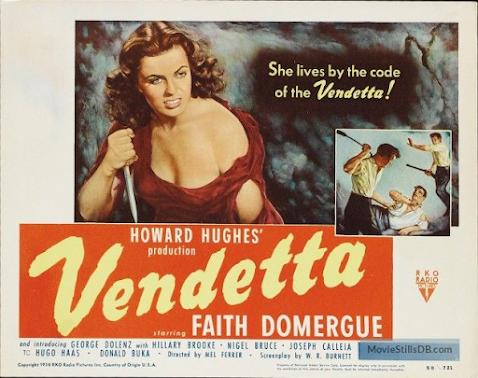
At a Yacht Party in May 1941, Howard Hughes met 16-years-old “Faith Dorn”, actually Faith Domergue, using the contract name from “Warner Brothers”. From that meeting, he bought out her contract, for $50,000 (as of this writing equal to $1,135,771), and put her back under her name of Faith Marie Domergue, and started “Grooming Her”. That “Grooming Period” lasted into 1945, during which he had her take intensive voice and drama lessons. Preparing Faith for what Howard saw as motion picture “Stardom”. The following photo is in either June 1924, or, June 1925.
My article about one year in her later career is “FAITH DOMERGUE: 1955 A. D.” at:
https://www.bewaretheblog.com/2019/09/faith-domergue-1955-ad.html
However, the “BACK STORY” for the production of “Colombia/Vendetta”, started FOUR-YEARS earlier than the movie’s release, in AUGUST 1946.
French Romanticism novelist, Prosper Merimee, between 1837 and 1845, was the French “Inspector General of Historical Monuments”, and wrote three novels. The most famous was his 1845 novel, “Carmen”, which would be turned into a world famous opera by French composer, Georges Bizet. 1837’s, “La Venus d’Ille”, was based upon a medieval story by William of Malmesbury. However, it was during his travels to the Island of Corscia, that Merimee was inspired to write his 1840 novel, “Colombia”. About how, “Colombia”, convinces her brother to murder (Vendetta), a man who wronged their family.
In 1944, Howard Hughes became a business partner with American playwright, screenplay writer, the first to win the “Academy of Motion Pictures Arts and Sciences, Best Original Screenplay” award, director, and occasional inventor, Preston Sturges, and the two formed “California Pictures”.
Howard Hughes was looking for a story to turn into a motion picture for his “Protege”, Faith Domergue. In September 1945, “California Pictures” had acquired the film rights to Prosper Merimee’s, “Colombia”. Peter O’Crotty was hired to adapt the novel, he only worked on three titles between 1941 and 1948, and was actually a Canadian stage actor. As a personal favor for Hughes, Preston Sturges had agreed to write the screenplay. It should be noted that between September 12, 1945 and January 29, 1946, Preston Sturges was directing the feature film, “The Sin of Harold Diddlebock”. Which he was also, the only screenplay writer.
However, doing triple duty, Preston Sturges completed his screenplay, and suggested that German Director, Max Ophuls, be announced as the Director of “Colombia”. This was to be his first American motion picture. However, the filming of the screenplay by Ophuls was going very slow, and was overly artistic for Hughes’s taste. So, Hughes fired him, and replaced Ophuls with his business partner, Preston Sturges, as the director.
Seeing the rushes of what Sturges was shooting, upset Hughes even more. Preston Sturges was fired, and he would start writing the screenplay for the, Deanna Durbin ,musical, “I’ll Be Yours”, that went into production on August 13, 1946.
It was now time for director “Number Three”, Stuart Heisler, who was under a personal contract with actor Gary Cooper. Howard Hughes approached Cooper about using Heisler, and bought out his contract, the year was now 1947. Stuart Heisler’s last completed motion picture had starred Susan Hayward, and was 1947’s,”Smash-Up: The Story of a Woman”, production had ended in August 1946.
With me so far?
It was Stuart Heisler, that brought in W. R. Burnett to edit the Sturges screenplay. After reading it, Burnett literally threw it away, and went back to Prosper Merimee’s original novel and wrote an entirely new screenplay. To Howard Hughes’s delight, W. R.Burnett expanded the role of “Colombia”.
Stuart Heisler became ill, and not to stop shooting. Which had reached an incredible 88 days. Howard Hughes had film Editor Paul Weatherwax take over as director, during Heisler’s illness. After seeing the completed footage Howard Hughes was still upset over the film. In May 1947, Heisler was paid off, and left the production. Although he was pleased with W. R. Burnett’s, tough, no nonsense screenplay, Hughes still wanted a different ending.
Enter the fifth Director, actor Mel Ferrer, who on December 3, 1949, had finished directing and post production on “The Secret Fury”, starring Claudette Colbert and Robert Ryan. He was to re-shoot a new ending and some additional scenes.
However, Hughes, himself, became director number six, and re-shot some more sequences and that ending.
Portraying, “Columbia della Rabia”, was that new “Protege” of Howard Hughes, Faith Domergue.

As to how good, Howard Hughes’s new discovery looked on-screen, is one thing. However, the motion picture review, in the “New York Times”, for December 26, 1950, may not have completely agreed to everything about her:
“Faith Domergue, the heralded newcomer, is less than a fiery heroine. But despite the flamboyant lines that are her lot, the attractive Miss Domergue does occasionally contribute genuine emotional acting to the proceedings.”
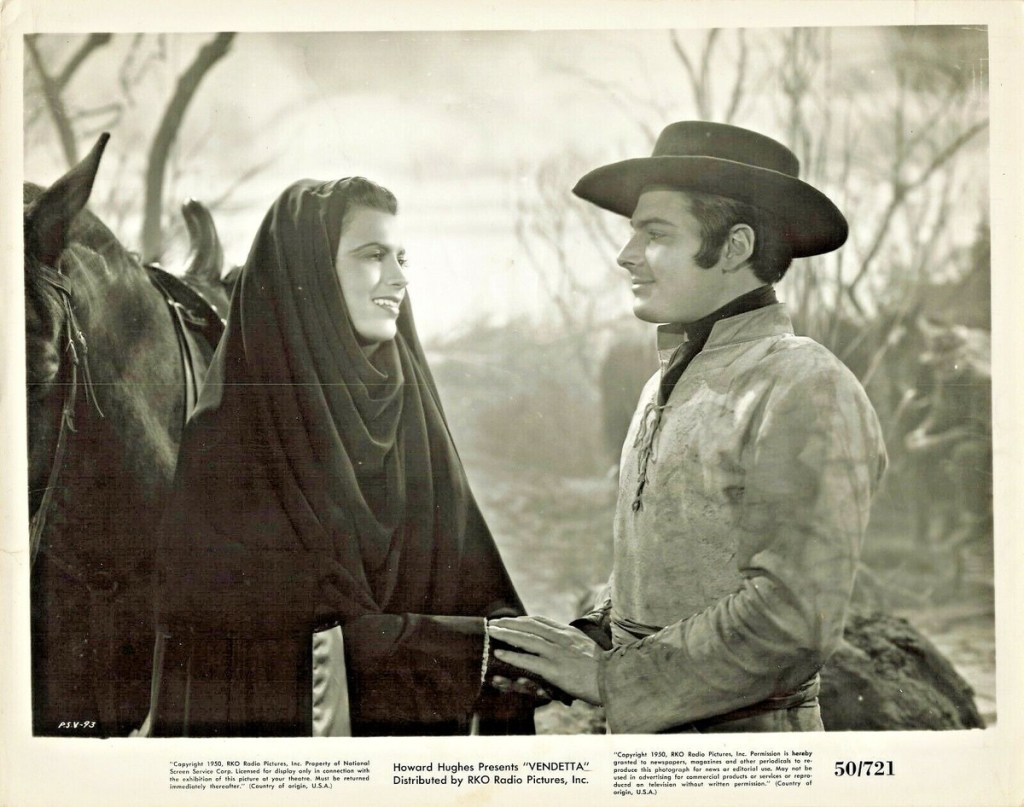
Above, Faith Domergue portraying “Colombia”, and, Donald Buka portraying “Padrino – the Bandit”.
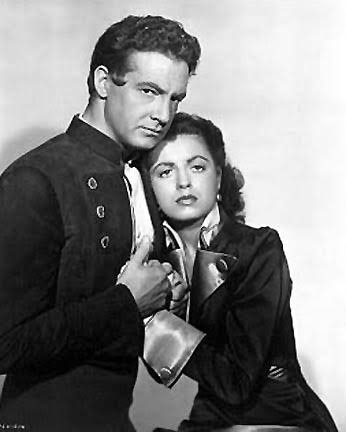
Above George Dolenz portraying “Colombia’s” brother, “Lt. Orso Antonio della Rabia”, and Faith Domergue.
Rather than explain W. R. Burnett’s screenplay to my reader, as they say, “A Picture is Worth a Thousand Words”. The following link, at the time of this writing, will take my reader to the “Howard Hughes Production”, now called “Vendetta”.
https://ok.ru/video/7208827488824
Which the opening credits state, was from a screenplay by W. R. Burnett, that was adapted from the novel by Peter O’Crotty. I’ll let my reader think of the time those screenplay credits give.
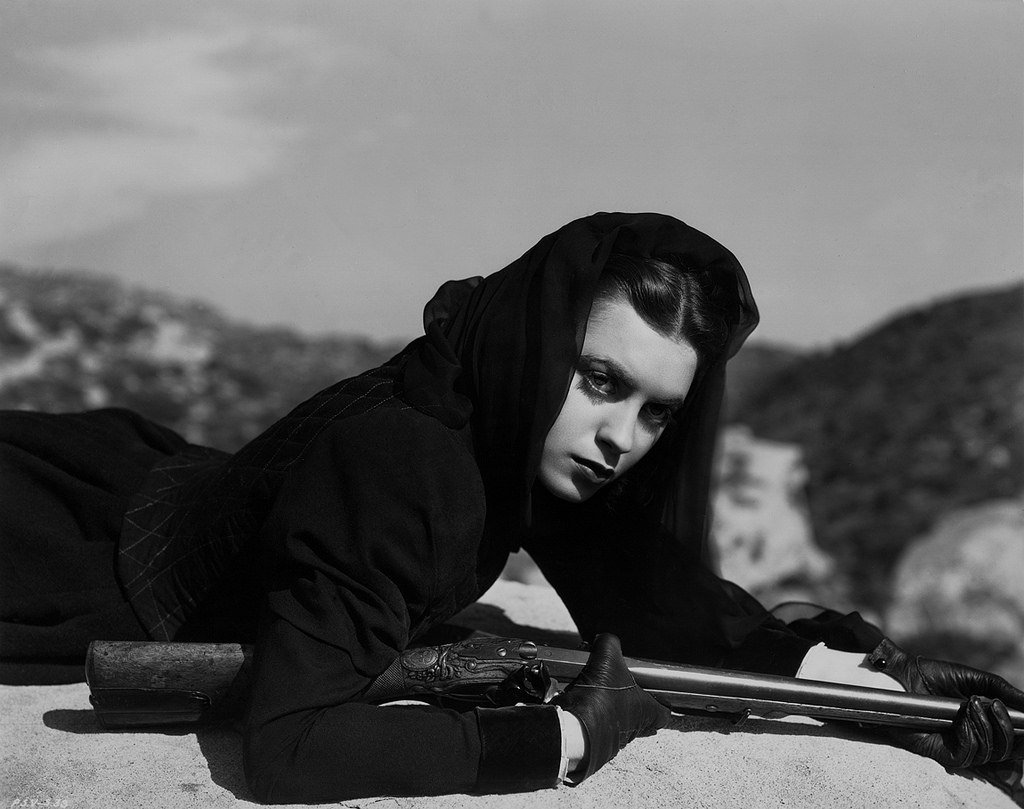
This is a look at a “Remake”, but first a quick look of the original:
THE RACKET premiered on June 30, 1928
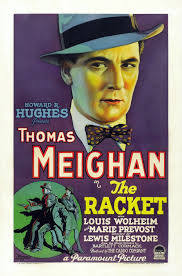
Howard Hughes’s was the producer and the silent movie was directed by the Lewis Milestone, 1930’s, “All Quiet on the Western Front”, and the 1939 version of author John Steinbeck’s, “Of Mice and Men”.
The original Broadway play and the main screenplay writer were the same person, Bartlett Cormack.
Louis Robert Wolheim portrayed the main Chicago gangster, “Nick Scarsi”, below left, and Thomas Meigham, portrayed “Police Captain James McQuigg”, below right.
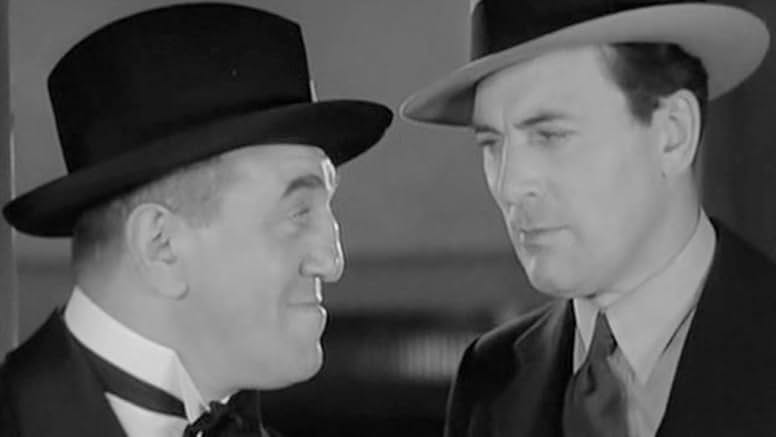
While, Burr McIntosh portrayed “The Old Man – Political King Pin”, I could not locate a still of the actor in this role. The below picture was taken in 1918.
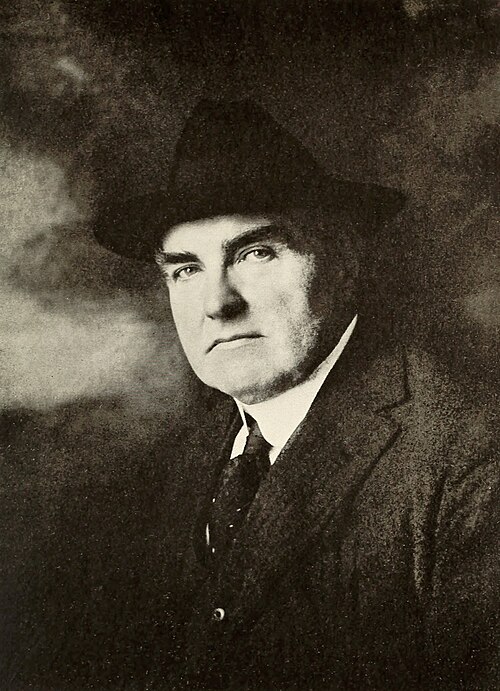
Howard Hughes’s motion picture was nominated, at the very first ceremony of the “Academy of Motion Picture Arts and Sciences”, for what would later be called, “Best Picture”, in 1929.
THE RACKET, a remake of the 1928 title, premiered in Philadelphia, Pennsylvania, on October 25, 1951
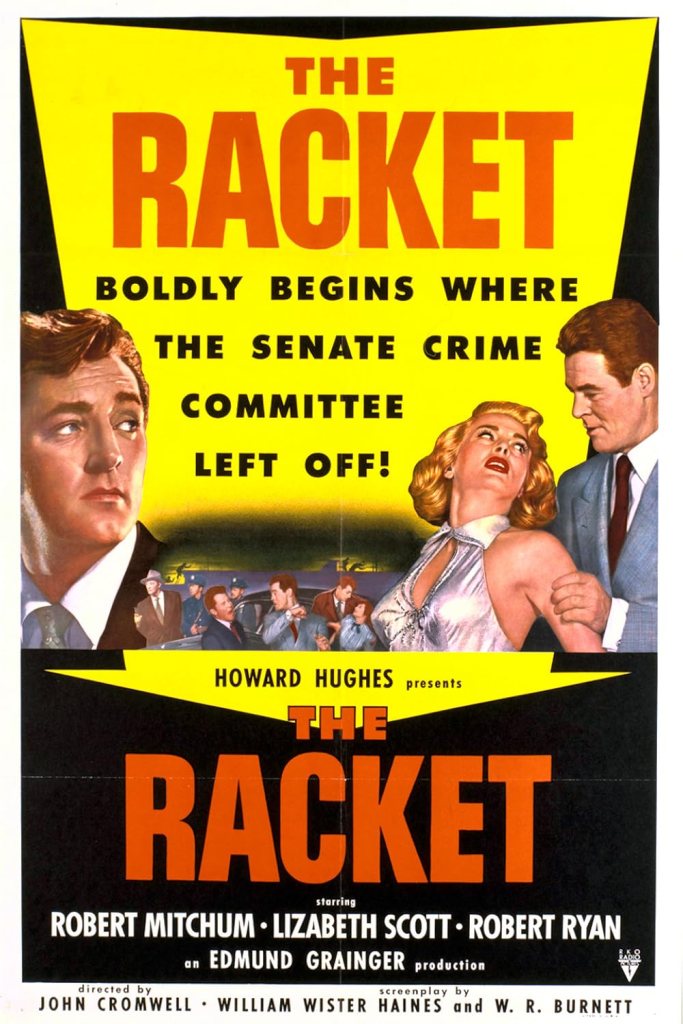
On the above poster, note the “Tag Line”:
“Boldly Begins Where the Senate Committee Left Off”
For those of my readers, who were not clued to their 13, or 17 inch television screens in 1951, I was 4-years-old and sat with my parents, and do not know the name of the committee, or its purpose, that the tag line refers too?
This was the ,“Kefauver Committee”, named for its head, Senator Estes Kefauver, of Tennessee.
Actually, the official, much longer, and more correct title of this committee, was the “United States Senate Special Committee to Investigate Crime in Interstate Commerce” A little explanation about the committee is required from the “United States Senate” website at:
https://www.senate.gov/about/powers-procedures/investigations/kefauver.htm
“The broadcasts made the Kefauver Committee a household name; in March 1951, 72 percent oLf Americans were familiar with the Kefauver Committee’s work. Schools dismissed students to watch the hearings. Blood banks ran low on donations, prompting one Brooklyn Center to install a television and tune in to the hearings, and donations shot up 100 percent. “Never before had the attention of the nation been riveted so completely on a single matter,” explained Life magazine. “The Senate investigation into interstate crime,” it concluded, “was almost the sole subject of national conversation.”
For Howard Hughes’s’ remake of his 1928 motion picture. Hughes initially hired screenplay writer, William Wister Haines, who had written the Second Word War Broadway play, “Command Decision”, which became the 1948 movie starring Clark Gable. Haines went back to the original 1927 play by Bartlett Cormack and not the 1928 screenplay. Also by Cormack, but with co-writer Tom Miranda. The two writers had been were forced to use “Title Cards”, limiting the dialogue for the silent movie’s audience.
However, deja vu, Howard Hughes, after reading the screenplay, bought in W. R. Burnett to rewrite all of Haines’s screenplay, and toughen up the story. Just as he had done with “Colombia/Vendetta”.
Later, the producer used the “Uncredited”, contract writer, Sam Fuller to add some scenes to Burnett’s screenplay. My article is, “Samuel “Sam” Fuller: The Ever Present Cigar and Six Movies: “I Shot Jesse James” 1949, “The Baron of Arizona” 1950, “The Steel Helmet” 1951,”Pick Up on South Street” 1951, “Shock Corridor” 1963 and “The Big Red One” 1980″, at:
https://www.bewaretheblog.com/2017/02/samuel-sam-fuller-ever-present-cigar.html
Then there were the director’s, and initially it was to be only John Cromwell, 1938’s, “Algiers”, starring Charles Boyer and Hedy Lamarr, and 1948’s, “Anna and the King of Siam”, that Rodgers and Hammerstein would turn into “The King and I”. However, Cromwell came under the eye of the “House Committee on Un-American Activities” for being an “Alleged”, never proven, “Communist”.
Anti-Communist Hughes would replace Cromwell with FIVE DIRECTORS, each doing one small part of the final film. These were:
Nicholas Ray, 1955’s “Rebel Without a Cause”, hired by Hughes to direct entirely new, crucial scenes, shot late during production to punch up the tension.
Tay Garnett, 1943’s “Bataan”, was hired to shoot short sequences, pickup shots, and fix pacing issues.
Sherman Todd, the film editor and “Oscar Winner”, for the 1943 Gary Cooper and Ingrid Berman version of Ernest Hemingway’s, “For Whom The Bells Toll”, was Primarily the film’s editor, but was tasked with directing minor insert sequences to help stitch the disparate pieces of the movie together.
Mel Ferrer was utilized by Hughes to co-direct and clean up the screenplay.
The Cast:
Robert Mitchum portrayed “Detective Captain Thomas McQuigg”. Mitchum had just appeared in the film-noir crime movie, Howard Hughes’s, 1951, “His Kind of Woman”, co-starring with another “Protege” of the producer, Jane Russell. My article is “Robert Mitchum: The ‘Anti-Hero Tough Guy’ As A Motion Picture Singer” at:
https://www.bewaretheblog.com/2021/03/robert-mitchum-anti-hero-tough-guy-as.html
Lizabeth Scott portrayed “Irene Hayes”. Scott was the late 1940’s, and 1950’s major “Femme Fatale”, and would follow this movie with 1952’s, “Stolen Face”. Which is an interesting title, because Scott is often compared with looking like Lauren Bacall. “Stolen Face” is about a disfigured female prison inmate That a plastic surgeon remakes her face into the face of the woman he loves, but who left him.
Above, Lizabeth Scott and Robert Mitchum.
Robert Ryan portrayed “Nick Scanlon”. Ryan had just co-starred with John Wayne in the Second World War, 1951, “The Flying Leathernecks”. He followed this feature film by co-starring with the picture’s co-director Ida Lupino, in the 1951, psychological drama, “On Dangerous Ground”. Lupino’s co-director was Nicholas Ray.
Above, Lizabeth Scott and Robert Ryan.
Instead of explaining the remakes plot. I am going to compare selected portions of the Bartlett Cormack and Tom Miranda‘s, 1928, original screenplay, to W. R. Burnett’s, 23-years-later.
Chicago Mayor William Hale “Big Bill” Thompson, below, and the “Chicago Press”, knew, even from the 1927 play. That the “Old Man” was a thinly veiled, “Big Bill”. He hated both the play and now Howard Hughes’s feature film.
What he did, even after the 1928, “The Racket”, won what later would be called an “Oscar”, was to ban the movie from being shown in Chicago.
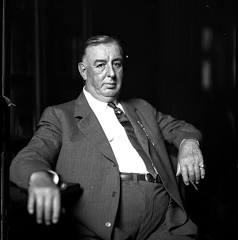
Another reason to ban the movie in Chicago, was that 1928’s “Nick Scarsi” was a very thinly veiled Al Capone.
The connection between Capone and Thompson was a $250,000 (today equal to a $4,797,672) campaign donation for his 1927 re-election.
Then there was the Mayor’s public relations with the citizens of Chicago. He was known for “Yelling Down” anyone who criticized Chicago, and claimed to the citizens that crime was always going down. Because the 1928 movie was very gritty and realistic, and the obvious references to real people, himself and Al considered, he banned the movie.
Mayor Thompson weaponized the cities censorship board to bury 1928’s, “The Racket”, but the result brought more publicity in the nationwide press. It is felt, that the Mayor actually helped get the movie its “Best Picture Award”.
In the 1951 remake, the character of “The Old Man – Political King Men”, exists, but W. R. Burnett removed him from sight. The audience knows he’s manipulating “Nick Scanlon”, but he’s never seen in the movie. He’s like the head of the crime syndicate that Senator Estes Kefauver was investigating and American’s had watched on television. Invisible, but with power over the whole country, and something called “The Mafia”.
Where in 1927, and 1928, “Nick Scarsi”, was Al Capone, and had all of Capone’s recognizable power and idiosyncrasies. “Scarsi” is a bombastic bootlegger, using direct street violence, and direct blackmail to get what he wants in Chicago.
While, “Nick Scanlon” is a whole different matter. He controls the government and police officials, but they’re all only in one city. He seems a major crime boss, but he’s only running a single city. “Nick” is part of the larger, unseen, nation wide crime organization. All taking orders from the unseen “Old Man”, who is real life was the target of the “Kefauver Committee”.
In 1928, Marie Provost, portrayed “Helen Hayes”, not the actress, but the girlfriend of “Nick Scarsi” and a nightclub singer. In the film she is a gold digger, and the character fits the stereo type that would be seen in 1931’s, “Public Enemy“, with “Kitty”, portrayed by Mae Clarke, who, in a classic scene, gets a grapefruit pushed in her face by James Cagney.
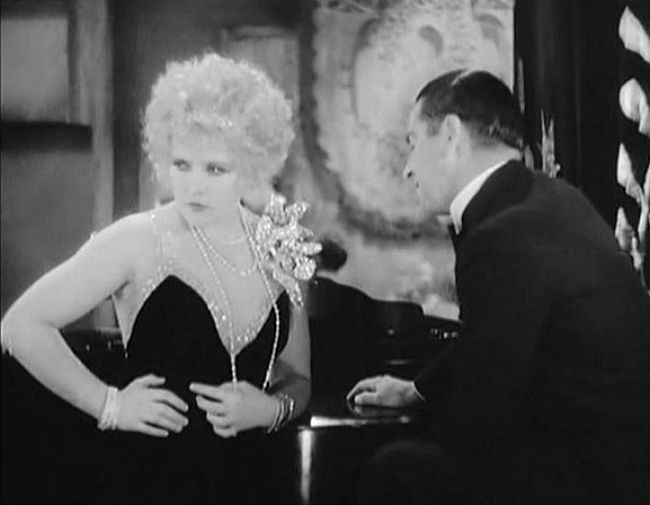
While in 1951, Lizabeth Scott’s “Irene Hayes”, is not a side character nightclub singer, but in W. R. Burnett’s world. She is moved to a pivotal role in his toughen up screenplay. As the audience sees, “Detective Captain Thomas McQuigg”, use “Irene”, as his star witness to dismantle the entire crime ring, putting a massive target on her back, and intensifying the film’s suspense.
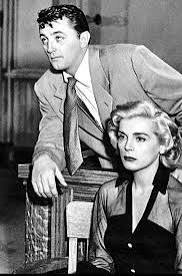
I have been mentioning the “Motion Picture Production Code”, administered by the “Hayes Office”. With the 1928 and 1951 versions of “The Rackett”. My reader can really understand the office’s effect on film making.
1928:
Pre-code shows the mayor and other important figures being controlled by the mob, aka: “Nick Scarsi” aka: Al Capone, “The Puppet Master” of Chicago. It also has a more edgier tone to the story.
1951:
Even though people were watching the “Kefauver Committee” going after real mob figures on their television sets, and Producer Howard Hughes owning “RKO Pictures”, he had to bow to Joseph Breen of the “Hays Office”.
“Hollywood Censorship” required that W. R. Burnett’s new screenplay could not indicate, crime syndicate control, of American politicians. So, instead of an already “Sitting Corrupt Mayor”, based upon real life Chicago Mayor, “William Hale “Big Bill” Thompson. Burnett, had to create, two characters, to get a similar, approved, result.
The audience now saw a race for the open Mayor’s office, and a corrupt District Attorney, “Mortimer Welsh”, portrayed by Ray Collins. Along with a corrupt police officer, “Detective Sergeant Turk”, portrayed by William Conrad. This move by W.R. Burnett, bypassed the strict, “Hollywood”, censorship rules. Which forbade showing active high-ranking government officials, or political groups, as completely corrupt.
Which in hindsight, seemed ridiculous, as in American homes, as I just mentioned, families were watching, live, the Senate, “Kefauver Committee”, going after corrupt politicians. While, on their nightly news, or in their morning and evening newspaper’s. American families were reading about the work of “The House Committee on Un-American Activities”, going after the motion picture industry and its connections to Communism. My article is “MCCARTHYISM: LIGHTS, CAMERA, COMMUNISTS IN THE MOTION PICTURE INDUSTRY” to be read at:
https://www.bewaretheblog.com/2025/08/mccarthyism-lights-camera-communists-in.html
So, W. R. Burnett’s screenplay now shows that the shadow crime syndicate is secretly funding “Welsh’s” race for mayor. “Welsh’s” problem is “Nick Scanlan’s” uncontrolled violent outbursts that are making the newspapers cover him. “Welsh” orders “Turk” to cover-up, or put an end to “Scanlan’s” outbursts. At the end of the story, “Turk” puts an end to the outbursts with a bullet in “Scanlan”, killing him. Which is followed by both “Welsh” and “Turk”, being “detained”, by Government Investigators. “Irene” leaves with her new boyfriend, the reporter covering the story, “Dave Ames”, portrayed by Robert Hutton, and “McQuigg”, just goes home to his wife, “Mary”, portrayed by Joyce MeKenzie.
Although, William Riley Burnett was still working on the occasional crime film, such as the Edgar G. Robinson, 1955, “Illegal”, and a small number of western features, such as the Alan Ladd and Ernest Borgnine, 1958.”The Badlanders”. He had become mainly a television writer on programs that including his own 1950’s, “The Asphalt Jungle”, “The Untouchables”, and “77 Sunset Strip”.
In 1890, British India born writer, Rudyard Kipling, wrote a poem entitled, “Gunga Din”. In 1939, Gary Grant, Victor McLaglen, and Douglas Fairbanks, Jr., starred in the classic movie adapted from that poem, “Gunga Din”, portrayed by Sam Jaffe.
Twenty-three-years-later, enter Producer, Frank Sinatra, and his “Rat Pack”.
SERGEANTS 3 released February 10, 1962

John Sturges was hired to direct the feature. For motion pictures with a Western theme, Sturges was the perfect choice. His films included 1953’s, “Escape from Fort Bravo”, starring William Holden and John Forsythe, 1957’s, “Gunfight at the O.K. Corral”, starring Burt Lancaster and Kirk Douglas, and 1960’s, “The Magnificent Seven”, starring Yul Bryner and Steve McQueen. He had also directed, Frank Sinatra, in the 1959, World War 2 drama, “Never So Few”, with Peter Lawford. In 1963, John Sturges, directed “The Great Escape”, and later in 1968, “Ice Station Zebra”.
The screenplay was written solely by W.R. Burnett, based upon the 1939 screenplay. He went against his unflinching characters for a little bit of “Rat Pack” style comedy. John Sturges, later brought Burnett along, as his main screenplay writer, on both, “The Great Escape” and “Ice Station Zebra”
The Main Cast that came from “The Rat Pack”, or where personal friends of Frank Sinatra, the “Chairman of the Board”.
Frank Sinatra portrayed “First Sergeant Mike Merry ( Victor McLaglen’s, MacChesney)”. Sinatra had just co-starred with Spencer Tracy, in 1961’s, “The Devil at 4 O’Clock”, and followed this picture with director John Frankenheimer’s, original, 1962, “The Manchurian Candidate”. My article is “FRANK SINATRA: Three Dramatic Motion Picture Roles” at:
https://www.bewaretheblog.com/2015/11/frank-sinatra-three-dramatic-motion.html
Dean Martin portrayed “Sergeant Chip Deal (Cary Grant’s, Cutter)”. Martin had just co-starred with Susan Hayward in the political drama, 1961’s, “Ada”, and followed this picture by co-starring with Lana Turner, in the comedy, 1962’s, “Who’s Got the Action?”
Sammy Davis, Jr. portrayed “Jonah Williams (Sam Jaffe’s, Gunga Din)“. Davis was guest appearing on several television shows at this time.
Peter Lawford portrayed “Sergeant Larry Barrett Douglas Fairbanks, Jr’s, Ballantine) “. Lawford had just co-starred with Lee Remick in the made-for-televison-movie, 1962’s, “The Farmer’s Daughter”. He followed this movie with the political drama, 1962’s, “Advise and Consent”.

Above seated, Dean Martin, standing left to right, Frank Sinatra, Sammy Davis, Jr. and Peter Lawford.
Joey Bishop portrayed “Sergeant-Major Roger Boswell”. Bishop had just appeared in a cameo as himself, in the musical comedy, 1960’s, “Pepe”. He followed this picture with the gangster picture, 1963’s, “Johnny Cool”, starring Henry Silva and Elizabeth Montgomery.

Henry Silva portrayed Native America “Mountain Hawk”. Silva was born in Brooklyn, and was part Sicilian, and part Portuguese. He is probably best known as the North Korean agent, in director John Frankenheimer’s, 1962, “The Manchurian Candidate”.

Ruta Lee was “Amelia Parent”. Lee was a Canadian actress and dancer. In 1964, Ruta Lee phoned Soviet Premier Nikita Khrushchev asking him to release her grandmother Ludvise Kamandulls. Who had been in an internment camp since World War 2. It worked and for the next two years she lived until her death in freedom with Lee. In 1987, Lee was able to rescue an 18 year old cousin Maryle Kaseta.

The screenplay follows closely the 1939 original, but W. R. Burnett moved the story from the British Raj to the American Indian Territory of 1870.
The three title “Sergeants” are fun loving and get themselves in and out of trouble.

As with, “Ballantine, in Gunga Din, wanting to marry Emmy Stebbins, when he gets out of the Army”. “Sergeant Larry Barrett” plans to leave the Army to be married to the beautiful “Amelia Parent”. While, “First Sergeant Mike Merry” and “Sergeant Chip Dale” plan to stop him, and keep their fun loving group together, as with the three soldiers in “Gunga Din”.
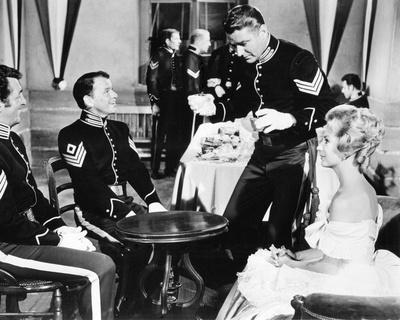
Later, “Jonah” entertains the a group of trappers at a local saloon with his trumpet playing. (In the movie that is Sammy Davis, Jr. playing the trumpet).
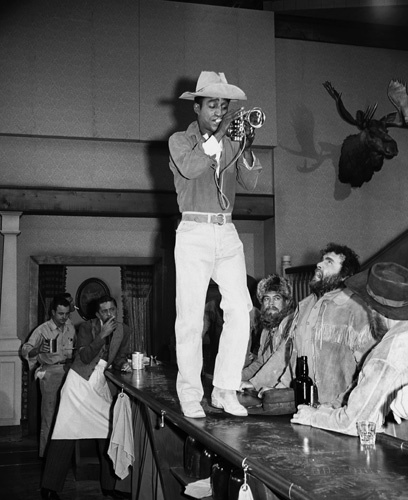
Out one night, and at the salon, the three “Sergeant’s” befriend, “Jonah Williams”, the trumpet playing former slave, with dreams of becoming a trooper.

Next, a tribe of renegade Native American’s (Fanatical “Thuggee’s” in the 1939 movie), begin to terrorize the area led by “Mountain Hawk”.

Accompanied by the hopping to be a trooper, “Jonah”, “Chip”, goes to investigate the renegade tribe. However, he is caught, and “Jonah” hurries back to the fort to tell “Mike” and “Larry”. “Larry” is set to go after “Chip”, but his enlistment is up that day. So, the cunning “Mike”, gets him to sign a re-enlistment form, for another year, “just to make his help official”, and promises to destroy the paper after the mission, or at least he tells “Larry” that.

The three would be rescuers make it to the renegade tribe’s location, but all three are also captured by “Mountain Hawk”.
The Cavalry troops are heading into a trap being outnumbered by “Mountain Hawk” and over 1,000 others.. “Jonah” in able to get free, and with his trumpet warns the troops, by blowing the regiments favorite tune and the tide is turned.
Unlike “Gunga Din”, who dies, “Jonah Williams”, becomes a real trooper.
“Larry” marries “Amelia”, and they leave the fort for their new life together. BUT the crafty “Mike”, never tore up “Larry’s” reenlistment papers, and heads for the Post Commanding Officer.
“Variety” wrote at the time of the pictures release, that “Sergeants 3” was a:
“—-warmed-over Gunga Din in a westernized version of that epic, with American-style Indians and Vegas-style soldiers of fortune. The essential differences between the two pictures, other than the obvious one of setting, is that the emphasis in Gunga was serious with a tongue-in-cheek overtone, whereas the emphasis in Sergeants is tongue-in-cheek with serious overtones.”
“Variety”, like other critics, just didn’t get what, Sinatra, Sturrges, and Burnett made. However, the “Rat Pack” fan base loved the film. Part of the dislike was from so-called film credits that did not like parodying 1939’s, “Gunga Din”.
At the end of his career, William “W. R.” Riley had publish 39-novels, 4-short stories, and written screenplays for 30-feature films, and scripts for 10-television programs, and had 13-episodes of television’s “Asphalt Jungle” credited to his novel.
On April 25, 1982, W. R. Burnett passed away in Santa Monica, California.
 THE FILM MADNESS OF FRADKIN-STEIN
Leave a comment