Mention Maureen O’Hara, and many of her fans would also mention, John Wayne, in the same breath. However, O’Hara and Wayne didn’t come together until 1950, in Director John Ford’s, “Rio Grande”. In fact, she wasn’t Maureen O’Hara until 1939.
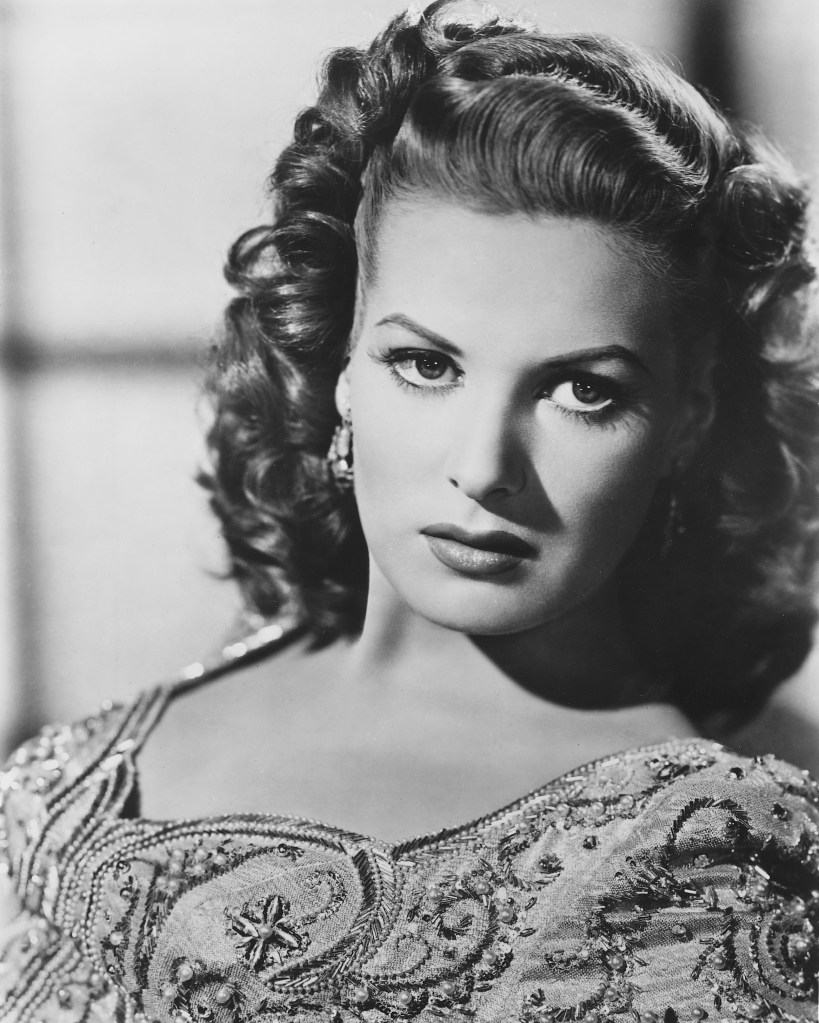
The date was August 17, 1920, in Dublin, Ireland, and according to her 2005, autobiography, “Tis Herself: An Autobiography”, Maureen FitzSimons was:
“born into the most remarkable and eccentric family I could have possibly hoped for”
She was the second eldest of six children, her father was Charles FitzSimons, and owned a clothing business. He would become part owner of the “Shamrock Rovers Football Club”.

Maureen’s mother was Marguerite (née Lilburn) FitzSimons, a former opera contralto, and a successful women’s clothier. At the age of six, Maureen joined her siblings at the “Ena Mary Burke School of Drama and Elocution”, in Dublin, learning to act. According to Aubrey Malone’s, 2013, “Maureen O’Hara: The Biography”, she referred to her family as the “Irish von Trapp Family”. At the age of 10, she was performing with the “Rathmines Theatre Company”, on the Southside of Dublin.
Maureen was a tomboy and as a teenager, wanted her father to establish a women’s soccer team, at the same location as the “Shamrock Rovers”. At the age of 12, her mother panicked when her daughter reached the height of 5 feet 6 inches, and worried she would become the tallest girl in Ireland. Her father stood, 6 feet 4 inches, but to Maureen’s mother’s relief, she only would grow another 2 inches.
At the age of 14, Maureen FitzSimons joined the prestigious “Abby Theatre”. At 15, she won the “Dublin Feis Award”, the “First Dramatic Prize” at the “Ireland National Performing Arts Competition”, for portraying William Shakespeare’s “Portia”, in “The Merchant of Venice”. When not on stage, she was working as a typist for two Dublin companies. This knowledge would lead, in 1951, to Maureen O’Hara actually typing the screenplay for director John Ford’s, “The Quiet Man”.
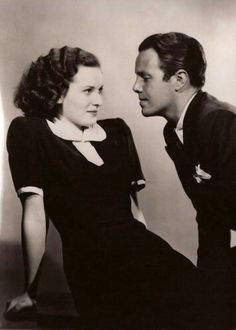
In 1936, Maureen FitzSimons, became the youngest graduate of the “Guildhall School of Music and Drama”, in London, England. She was offered a major role in an “Abby Theatre” production, but “2-FATE’S” stepped in.The first “FATE” was American actor and entertainer, Harry Richman, seen below in 1935.
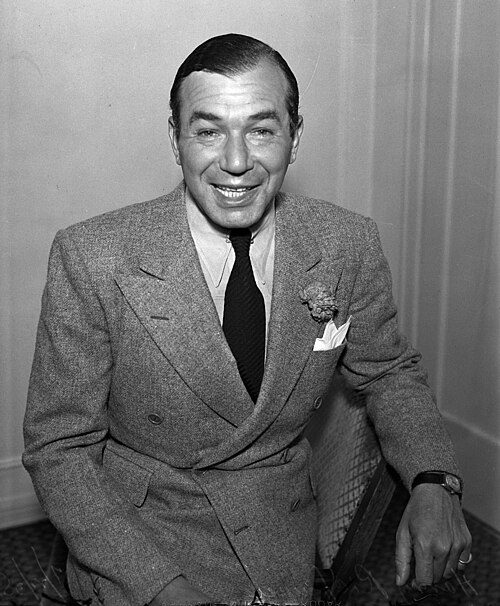
Maureen FitzSimons was out for dinner with her entire family at a restaurant in a Dublin Hotel. About to be seated, at another table, was Harry Richman, who was taken back by the young woman’s beauty. He arranged a meeting with her and talked Maureen into thinking about the motion pictures. He further arranged a screen test with “Elstree Studios”, but it was disastrous. Because they had the young woman in very heavy make-up. Harry, also arranged for Maureen FitzSimons to have an uncredited movie role of a “Secretary”, in “Kicking the Moon Around”. The motion picture was released on March 30, 1938, by “Vogue Film Productions”, and renamed, “The Playboy”.
FitzSimons’s second “FATE” was producer Charles Laughton. He saw Maureen’s “Expressive Eyes” through the heavy make-up, and also realized she could act. Laughton went to his business partner, Erich Pommer, considered the most powerful German producer during the “Expression Period”. Among his films are 1920’s, “The Cabinet of Dr. Caligari”, director Fritz Lang’s, 1922, “Dr. Mabuse the Gambler”, and 1927’s, “Metropolis”, to get Pommer to agree to put Maureen FitzSimons under contract to them.
Meanwhile, Maureen FitzSimons appeared, with full on-screen credit, in her second motion picture, made by “John Argyle Productions”, “My Irish Molly” aka: “Little Miss Molly”, starred 6-year-old, Binkie Stuart in the title role, and was released in the United Kingdom in December 1938.
Having gotten the go ahead with his business partner, Charles Laughton called Maureen FitzSimons to come in for an interview. She was offered a 7-year-contract with the newly formed “Mayflower Pictures”. After some discussion with family members, the young actress accepted the offer.
Before filming was completed on her first contracted feature film, Maureen FitzSimons’s last name, had become O’Hara. The reasons given were, Pommer believed that the name of “Maureen FitzSimons”, would not fit on most movie theatre marquee’s, and Laughton thought it would be too hard for foreign box office audiences to pronounce, or remember.
O’Hara is on record hating the new last name of “O’Hara”, but agreed to the change.
The following are 26 motion pictures made by Maureen O’Hara, some I lightly mention, others I go into detail. I start with her First Motion Picture for Charles Laughton and Erich Pommer’s production company, and end, just before, her First Motion Picture with John Wayne.
The following is modified from my article, “HITCHCOCK: A Scarf and a Medical Bag, A Conscience, 19th Century Ship Wreckers, The Third Dimension, and A Roving Dead Body”, found at:
https://www.bewaretheblog.com/2022/01/hitchcock-scarf-and-medical-bag.html
For this story, Alfred Hitchcock, had turned to his friend, Sir Gerald Hubert Edward Busson du Maurier’s daughter.
JAMAICA INN released in the United Kingdom on May 15, 1939

Director Alfred Hitchcock had just released 1938’s “The Lady Vanishes”, starring Margaret Lockwood, Michael Redgrave, and Paul Lukas. He would follow this motion picture with 1940’s “Rebecca”, starring Laurence Olivier, Joan Fontaine, and George Sanders.

The screenplay was based upon Dame Daphne du Maurier, Lady Browning’s 1936 novel. Hitchcock would film two more works by the authoress, the 1938 novel “Rebecca”, and a 1952 short story “The Birds”.

Three screenplay writers were involved with turning the novel into a motion picture.
Sidney Gilliat was a writer on Hitchcock’s ,1938, “The Lady Vanishes”, and wrote the original storyline for Robert Taylor’s, 1938, “A Yank at Oxford”. Before those pictures, Gilliat wrote the Boris Karloff horror film, 1936’s “The Man Who Changed His Mind” aka “The Man Who Lived Again”.
For Joan Harrison, this was her first screenplay, but she followed it with, in order, both Alfred Hitchcock’s, 1940, “Rebecca”, and 1940’s, “Foreign Correspondent”, his 1941, “Suspicion”, starring Cary Grant, Joan Fontaine, and Sir Cedric Hardwick, and, 1942’s, “Saboteur”, starring Priscilla Lane, Robert Cummings, and Otto Kruger.
J.P. Priestley added additional dialogue. Priestley was a novelist, playwright, broadcaster, and social commentator, and wrote the 1927 novel, “Benighted”, that became the classic 1932 horror movie “The Old Dark House”, directed by James Whale, and would be remade by director William Castle in 1963, and, as 1964’s, “The Horror of It All”, directed by Terence Fisher.
Charles Laughton portrayed “Sir Humphrey Pengallan”. Laughton proceeded this picture with 1938’s “Sidewalks of London”, co-starring with Vivien Leigh, and Rex Harrison. He followed this feature with 1939’s “The Hunchback of Notre Dame”, portraying “Quasimodo”. My article is “CHARLES LAUGHTON: A Little H.G. Wells, A Little Victor Hugo, A Little Robert Louis Stevenson and Boris Karloff X 2”, found at:
https://www.bewaretheblog.com/2024/09/charles-laughton-little-hg-wells-little.html

Maureen O’Hara portrayed “Mary Yellan”. The opening credits for the film, imply, that this was her first motion picture. Which, as my reader knows, is incorrect. However, you could look at the following title card as a play on words, BECAUSE the feature did “INTRODUCE” an actress by the name of Maureen O’Hara.


Leslie Banks portrayed “Joss Merlyn”. Just prior to the release of “Jamaica Inn”, Banks, had the title role of “Cyrano de Bergerac”. In an early 1938 British television live broadcast with co-stars Constance Cummings, and James Mason.

Emlyn Williams portrayed “Harry the Peddler–Sir Humphrey’s Gang”. Writer and actor Williams, had just starred in the British crime drama 1938’s “They Drive by Night”, not to be confused with the American film of that same name from 1940, starring George Raft, Humphrey Bogart and Ann Sheridan.
Banks would follow this picture, with a role in the Michael Redgrave and Margaret Lockwood, 1940, “The Stars Look Down”. Working as a screenplay writer, Emlyn Williams had added dialogue to director King Vidor’s, 1938 version, of the A.J. Cronin novel, “The Citadel”, starring Robert Donat, Rosalind Russell, Sir Ralph Richardson, Rex Harrison, and Williams.

Robert Newton portrayed “James ‘Jem’ Trehearne–Sir Humphrey’s Gang”. Newton would be best remembered for portraying “Long John Silver, in Walt Disney’s, 1950 “Treasure Island”, and recreating the role twice. First in the Australian motion picture, 1954’s, “Long John Silver’s Return to Treasure Island” and the 1956, Australian television series, “The Adventures of Long John Silver”. My article “Robert Newton IS ‘Long John Silver’: The Definitive Motion Picture Pirate of the Caribbean” is ready for your enjoyment at
http://www.bewaretheblog.com/2017/06/robert-newton-is-long-john-silver_17.html

One does not normally think of Alfred Hitchcock making what the trades call “an Adventure film”, but that was what “Jamaica Inn” was, with just a touch of “the Thriller” thrown in.
The real problem for director Alfred Hitchcock, was Charles Laughton.
Charles Laughton was originally cast by Hitch as “Joss Merlyn”. However, Laughton “recast himself”, as “Sir Humphrey Pengallan”. Described in the original screenplay, and by Daphne du Maurier, as a villainess preacher.
However, the American Production Code got in the way of “Sir Humphrey Pengallan preacher”, if the producers wished to show the motion picture in the very profitable United States. That Code would not permit “unsympathetic portrayals of the clergy” and this resulted in Laughton’s character being changed to “a squire” to get around it.
Next, Charles Laughton demanded more on-screen time than the screenplay had his character, and this forced Alfred Hitchcock to “reveal Pengallan as the villain” far earlier than the director had wanted, killing the suspense.
The Screenplay:

The setting is 1820 during the reign of King George IV. On the outside, “Jamaica Inn”, is a friendly rural English hostelry, but inside, it is the headquarters of a gang of cut-throats and thieves led by the innkeeper “Joss Merlyn”. The gang are wreckers, responsible for engineering the wrecks of several merchant ships on the Cornish coast, killing any survivors, and taking the cargo.

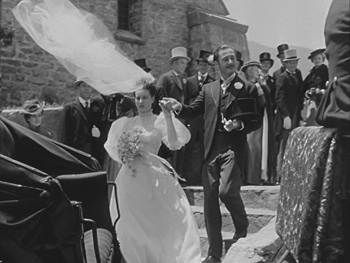
One evening, a coach drops off a young Irish-woman named “Mary Yellan”. This is at the house of the local Justice of the Peace, “Squire Pengallon”, close to the “Jamaica Inn”.

“Mary” asks the kindly Squire for the loan of a horse. So she can ride to the “Jamaica Inn” to reunite with her “Aunt Patience”, portrayed by Marie Ney, the wife of “Josh Merlyn”. Despite warnings from the squire, “Mary” plans to live at the Inn.


Shortly after “Mary” is reunited with her aunt. She discovers the truth about “Jamaica Inn”, and that the kindly Squire is really the ring leader of the wreckers. He learns the details of a ship’s cargo from his friends and acquaintances in their small talk, and picks the ships to be wrecked. After he fences the cargo, “Squire Pengallon”, pays the wreckers, but keeps the majority of the money to maintain his lifestyle.

“Mary” discovers the part of the Inn that the paying patron’s never sees, and is where the gang members meet. One time, she overhears them discussing why they’re not getting more money for their work. It is decided that a new member of only two months, “Jem Trehearne”, is embezzling from them. The others hang him from the rafters in the room. After they leave, “Mary” cuts the rope, frees “Jem”, and the two swim to safety just avoiding being captured.


The following morning, the two take a boat, and row to shore, and go to “Squire Pengallan” for perceived safety. “Jem” reveals that he is a British undercover agent on a mission to find, and take down the wreckers. “Pengallan” feigns surprise at this news, and promises to assist him with his mission.


Having over heard the two men’s discussion, “Mary” leaves, and goes to “Jamaica Inn” to warn her “Aunt Patience”, but her aunt will stay with her husband. Meanwhile, “Squire Pengallan” learns of another ship, and informs “Joss”, and “Joss” in turn, informs the gang of wreckers.

The wreckers go to the beach, and put out the coastal warning beacon fire and await the ship to crash upon the rocks. However, “Mary” relights the beacon, and the ship sails to safety. The gang wants “Mary” killed, and capture her, but “Josh” has developed a reluctant admiration for his wife’s niece, rescues “Mary”, and the two escape in a horse-cart.
“Josh” and “Mary” reach “Jamaica Inn”, but he is shot in the back by one of the gang members. Just as “Patience” is about to reveal that “Squire Pengallan” is the leader of the gang, she is shot, off camera, by “Pengallan” and both husband and wife die from their wounds. The Squire now takes “Mary” as a hostage, ties her up, but as she has nobody else, he will keep her for himself. Next, the squire has both of them driven to a large ship in the harbor that is going to set sail for France.

Back at the “Jamaica Inn”, “James Trehearne” arrives with a group of soldiers, and they arrest the remaining wreckers. Finding out where “Mary” and the Squire have gone, “Jem” takes a horse and rides to the harbor, boards the ship, and goes for “Squire Pengallan”.


Squire Pengallon” now attempts to escape, a small chase on deck takes place as the Squire climbs up to the top of the ship’s mast, and seeing no escape, jumps to his death yelling:
Make way for Pengallan!
PERSONAL:
While on the set of “Jamaica Inn”, Maureen O’Hara met George H. Brown. Mentioning this is Wilkipedia” under her page at:
https://en.wikipedia.org/wiki/Maureen_O’Hara#Personal_life_and_death
“In 1939, at the age of 18, O’Hara secretly married Englishman George H. Brown, a film producer, production assistant and occasional scriptwriter whom she had met on the set of Jamaica Inn. They married at St Paul’s Church in Station Road, Harrow, Harrow, on 13 June 1939, shortly before she left for Hollywood. Brown stayed behind in England to shoot a film with Paul Robeson. Brown announced that he and O’Hara had kept the marriage a secret and that they would have a full marriage ceremony in October 1939, but O’Hara never returned.The marriage was annulled in 1941.”
What the movie with the great Paul Robson was in is unknown. The closest Robson motion picture to the above, is 1940’s, “The Tunnel”, according to IMDb at:
https://www.imdb.com/name/nm0113627/?ref_=nmbio_ov_bk
However, there in no mention of O’Hara’s husband on the shown cast list. Nor does he show for Robeson’s previous film, 1937, “Dark Sands”. This does not mean George H. Brown wasn’t present on the set for “Jamaica Inn”, in some capacity.
On March 16, 1831, Victor Hugo published a French gothic novel, originally entitled, “Notre-Dame de Paris (Our Lady of Paris), 1482”. Which gave the reader the specific year his story takes place, but the year was removed for the second printing. Later, the entire title would be changed once again. Reflecting one of his novel’s two major characters, and it became “The Hunchback of Notre-Dame”.
Charles Laughton was going to the United States to make a movie for “RKO Pictures”. He asked his leading lady to accompany him, and play the leading female character. Along with Maureen’s mother as chaperon, the three took a leisurely cruise from England to New York, on the “RMS Queen Mary” and a train ride from New York City to California, and “Hollywood”.
The 1939 motion picture version of Victor Hugo’s, “The Hunchback of Notre Dame”, is still considered, by many film historians, as the definitive screen version. It was also a major Hollywood motion picture in a year dominated by, “Gone With the Wind”, “The Wizard of Oz”, John Ford’s “Stagecoach”, and Frank Capra’s, “Mr. Smith Goes to Washington”.
THE HUNCHBACK OF NOTRE-DAME premiered at the Cannes Film Festival on August 31, 1939_02.jpg)
In 1939 Hollywood was now working under the “Motion Picture Production Code of 1934”, or in short, major censorship. For example, specific changes needed to be made to Victor Hugo’s characters of the “Frollo” brothers, see next paragraph, as compared to who they were in the novel. The 1923, production, starring Lon Chaney, wasn’t under the “Code”, but “Universal Picture’s” had made some changes to these same characters, but for narrative purposes only. While, the 1939 changes were for the protection of American Morality. As determined by the powerful chief government censor, William H. Hays, of what was now called “The Hays Office”. Which would rule the American film industry for the next 29-years.
For the 1939 production, the novel was adapted into a screenplay story line by Bruno Frank. Frank changed, “Archdeacon Claude Frollo”, from a villainous priest to a good man, and promoted the character to “Archbishop”. Leaving Victor Hugo’s original character in place, would have brought down the wrath of the “Catholic League of Decency”, and other Christian religious groups.
The age of his brother, “Jehan”, as in 1923, was raised from a teenager to that of an older man by Frank, and his first name was now changed to “Jean”. Frank further changed the character, by making “Jean Frollo” French monarch, Louis XI’s, “Chief Justice of Paris”. Thus putting the new “Jean Frollo”, in charge of prosecuting all crimes in Paris, and, again, as in 1923, the villain of the film, instead of being a troubled teenager.
The actual screenplay was written by lawyer turned screenplay writer, Sonya Levien. Among her work was writing the screenplays for both the 1933 non-musical, “State Fair”, and the 1945, Rodgers and Hammerstein musical version. The 1955 screenplay for Rodgers and Hammerstein’s “Oklahoma”.
William Dieterle was the director of the feature. His “Life of Emile Zola”, starring Paul Muni, had won the 1937 Best Picture Oscar. Prior to this motion picture, Dieterle directed the historical drama, 1939’s, “Juarez”, starring Muni and Bette Davis. He followed this feature film with 1940’s, “Dr. Ehrlich’s Magic Bullet”, starring Edward G. Robinson.
The motion picture was the 3rd film editing assignment of a young Robert Wise. He followed this major project with the Screwball comedy, 1940’s, “My Favorite Wife”, starring Irene Dunne, Cary Grant, and Randolph Scott.
Charles Laughton portrayed the title character, “Quasimodo”. Laughton was nominated for the “Academy of Motion Picture Arts and Sciences, Best Actor Oscar”, for his role as “Captain Bligh” in 1935’s, “Mutiny on the Bounty”.
Maureen O’Hara was “Esmeralda, the Gypsy Woman”.+101.jpg)
Alan Marshall was “Captain Phoebus”. Marshall was mainly a legitimate stage actor who appeared in several motion pictures. This same year, he appeared in “The Adventures of Sherlock Holmes”, starring Basil Rathbone, Nigel Bruce, and Ida Lupino.
Sir Cedric Hardwicke portrayed “Jean Frollo”. In 1935, he was in Victor Hugo’s “Les Miserables”, portraying “Bishop Bienvenue”. In 1936, Hardwicke appeared in only one of screenplays written by H.G. Wells ,”Things to Come”, starring Raymond Massey. In 1937, he was “Allan Quartermain”, in the excellent and forgotten British production of “King Solomon’s Mines”, co-starring the great African American singer Paul Robeson.
Walter Hampden was now “Archbishop Claude Frollo”. Hampden was both a major Broadway actor and a legitimate theater manager.
Thomas Mitchell was “Clopin”. He would win the “Academy of Motion Pictures Arts and Sciences, Best Supporting Oscar” as “Doc Josiah Boone”, in John Ford’s, 1939, “Stagecoach”. Also in 1939, he was “Diz Moore” in Frank Capra’s, “Mr. Smith Goes to Washington”, and “Gerald O’Hara” in “Gone with the Wind”.
Edmond O’Brien, in his first motion picture role, portrayed “Pierre Gringiore”. His next feature film was the comedy-romance, 1941’s, “A Girl, A Guy, and a Gob”, co-starring George Murphy, and Lucille Ball.
Henry Davenport portrayed the kindly “King Louis XI”. The character actor was known for playing country doctors, grandfathers, judges, and ministers.
The motion picture opens with a written prologue scrolling on-screen:


With the end of the 15th century, the Middle Ages came to a close. Europe began to see great changes. France, ravaged by a hundred years war, at last found peace. The people under Louis XI felt free to hope again ~ to dream of progress. But superstition and prejudice often stood in the way, seeking to crush the adventurous spirit of man.
A series of seemingly unrelated events follows the written prologue. As first the audience meets “Jean Frollo”, who is determine to stop anything “HE” deems evil from entering Paris. This includes printing presses, and gypsies without a permit. “Frollo” is seen visiting a print shop as the picture opens.
It is the “Day of Fools”, and playwright, “Pierre Gringiore”, is performing a play until it is interrupted by “Clopin”, the leader of the Paris thieves. The play is replaced by the young gypsy woman “Esmeralda”,and she dances. 
Next, the bell ringer of Notre Dame Cathedral, “Quasimodo”, is crowned “King of Fools”, but “Jean Frollo” drags him away, and back to the cathedral.

The following day, “Esmeralda” seeks out “King Louis XI”, to ask him to protect her people. However, she is captured by some guards for entering Paris without a permit. The girl escapes them, runs into Notre Dame, and is given sanctuary by “Archbishop Claude Frollo”. A short while later, the Archbishops brother, “Jean Frollo”, confronts “Esmeralda”, and calls her a heathen.
Later, within Notre Dame, “Esmeralda” meets the kindly “King Louis XI”, who agrees to help the gypsies. Afterward, “Jean Frollo” takes the girl up into one of the church towers. On the way up the staircase, the two encounter “Quasimodo”, who frightens her. “Esmeralda” turns, and runs away from her sanctuary, and the church. “Jean Frollo” orders “Quasimodo” to go after the girl, and, bring her back to him.
“Pierre Gringorie” witnesses the chase, and goes for “Captain Phoebus”. Who gets his guards, and goes after “Quasimodo”. He is captured ,and the love story between “Esmeralda” and “Phoebus” begins.
Later, “Gringorie”, accidentally enters the beggars, “Court of Miracles”, and is saved from death, by “Esmeralda”, who agrees to marry him. “Pierre” takes this seriously, but “Esmeralda” tells him. It was just to save him, and she loves another.
The next day, for his crime, “Quasimodo” is sentenced to be lashed and publicly humiliated. “Jean Frollo” doesn’t help the confused bell ringer, and ignores his pleas. During his lashings, “Quasimodo” asks for water, but not one person comes to his aide, until “Esmeralda” appears.


Later, “Phoebus” invites “Esmeralda” to a party with the nobles. At the party, “Jean Frollo” turns up, and he confesses his evil lust for the girl.
“Phoebus” approaches the two, and with “Esmeralda”, they go off together. In a rage, “Jean Frollo” kills him, and then, puts the blame upon the gypsy girl.
“Jean” confesses to his brother the “Archbishop”, but his brother will not help him, as he’s a murderer. “Gringorie” attempts to get his “wife” freed, but to no avail. Even after “Archbishop Claude Frollo” proclaims her innocence. A trial is held and “Esmeralda” is sentenced to death.


Make way for Pengallan!


As she is led ,on a cart, to the execution site, surrounded by the “Good” citizens of Paris. Suddenly, “Quasimodo”, comes down from the bell tower of Notre Dame, and grabs “Esmeralda”. He takes her into the cathedral, and up to his bell tower. While holding “Esmeralda” up, “Quasimodo” calls for “Sanctuary”, to the cries of delight by the Paris crowd, and the beggars.
“Quasimodo” attempts to befriend “Esmeralda”, and tells her of how the bells, that he loves, made him deaf.

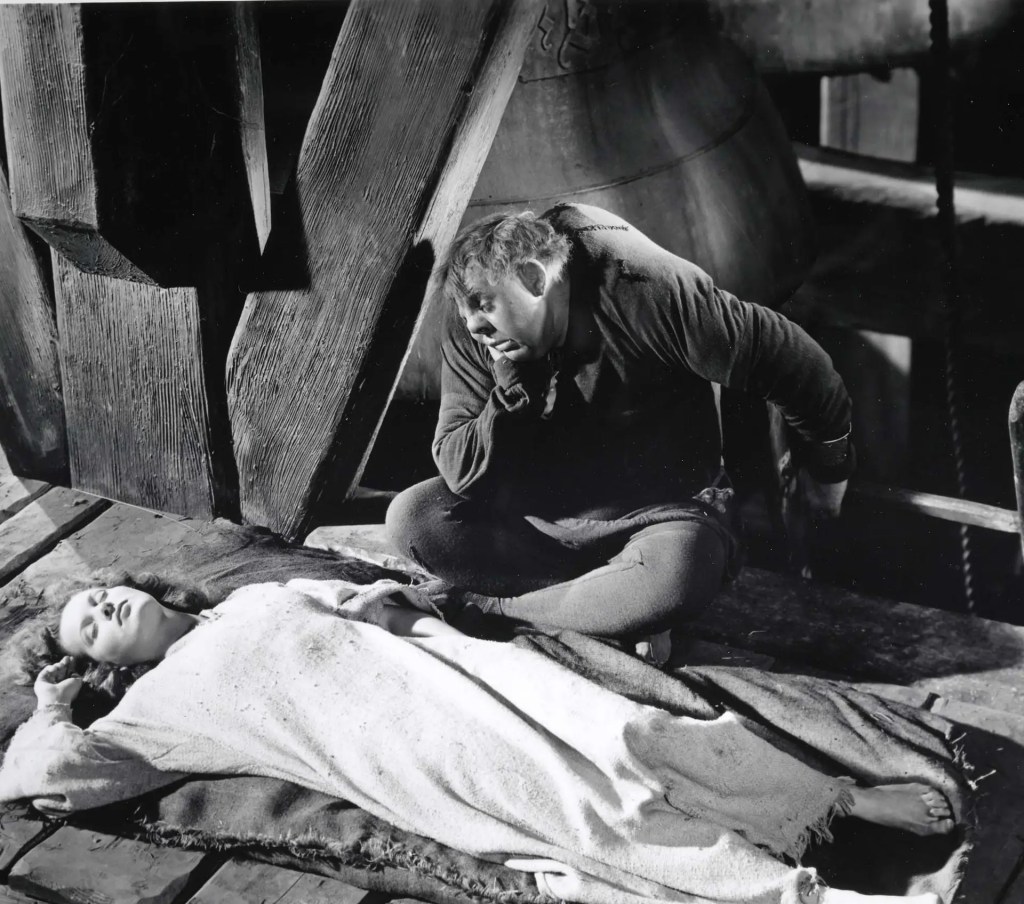

This leads to a second series of events. “Gringorie” prints a pamphlet to save “Esmeralda”, and for the gypsies to have the same rights as citizens. He is able to get it to the King, who agrees. However, the beggars, under “Clopin”, attack Notre Dame to save “Esmeralda”, and “Quasimodo”, and the guards fight them off.
As the battle is occurring, the bell ringer sees “Jean Frollo” harming the gypsy girl. “Quasimodo” throws “Jean Frollo” off the battlements to his just reward.
The King frees “Esmeralda”, and the gypsies. While, the girl has come to love her poet savior, “Gringorie”.
The film ends with “Quasimodo” up in his tower by one of the gargoyles. He is talking to it of his love for “Esmeralda”, and says:
Why was I not made of stone, like thee?”.
Maureen O’Hara moved up in billing for:
A BILL OF DIVORCEMENT released on August 30, 1940
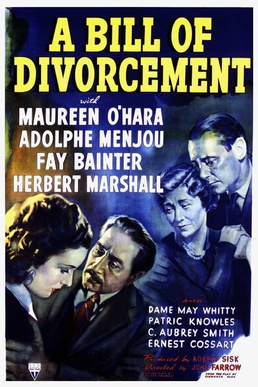
“A Bill of Divorcement” was a 1921 British play written by playwright and screenplay writer, Clemence Dane, the pen name of Winfred Ashton. The original London run starred Malcom Keen portraying “Hilary Fairfield”, and 21-years-old Maggie Albanesi portraying his 17-years-old daughter, “Sydney”. In the original play, she is 14-years old when her father is committed, for only 3-years.
In 1922, a silent British motion picture was released with Malcolm Keen repeating the role of “Hillary Fairfield”, but with 24-years-old, American Actress, Constance Binniey portraying “Sydney”. The British film followed the play completely.
The first American film version of “A Bill of Divorcement” was released in 1932. It starred John Barrymore portraying “Hilary Fairfield”, and 25-years-old Katharine Hepburn, in her first motion picture, portraying 17-years-old, “Sydney”.
Which brings me to this motion picture version, starring 19-years-old, Maureen O’Hara, portraying 17-years-old, “Sydney Fairfield”.
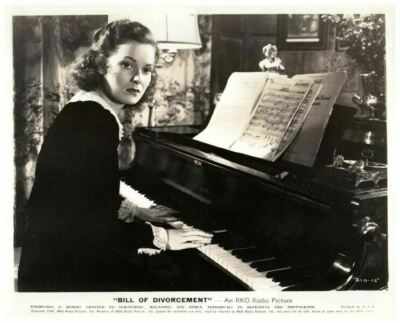
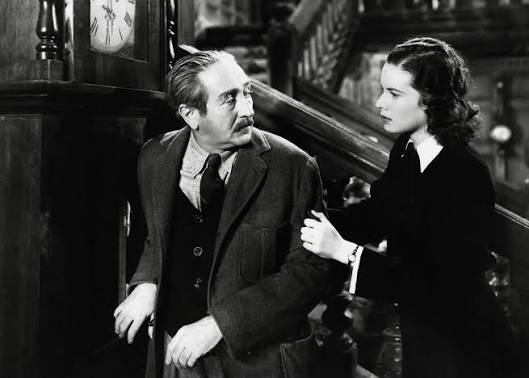
Adolphe Menjou portrayed “Hilary Fairfield”. Menjou had just co-starred with Carole Landis is the slapstick comedy, 1940’s, “Turnabout”, he followed this feature with the slapstick comedy, 1941’s, “Road Show”, also co-starring with Carole Landis.
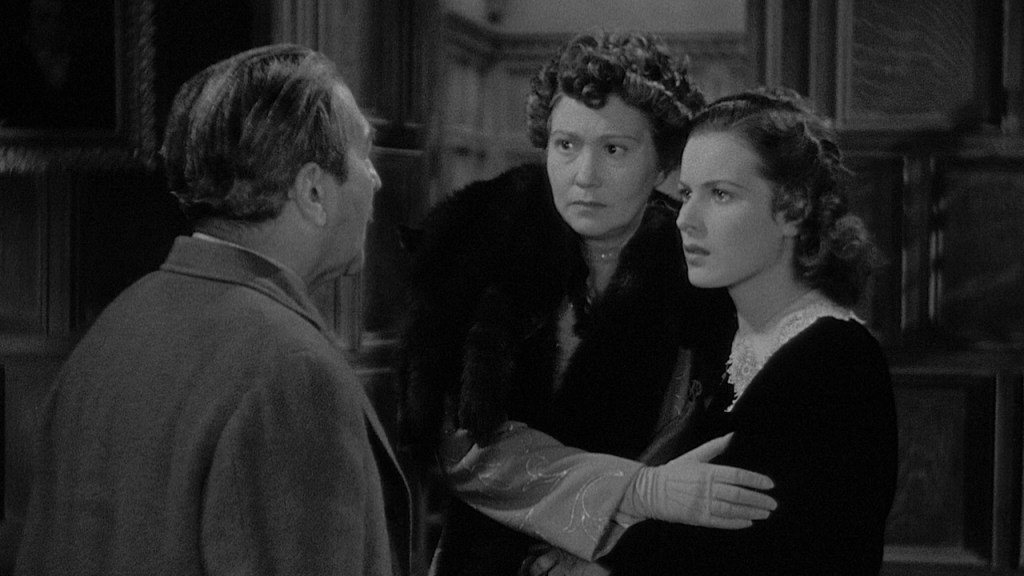
Fay Binter portrayed “Margaret ‘Meg’ Fairchild”. Binter had just co-starred in the 1940 version of Thorton Wilder’s, “Our Town”, and followed this movie with the Mickey Rooney and Judy Garland, 1941, “Babes on Broadway”.
Herbert Marshall portrayed “Gray Meredith”. Marshall’s 3rd on-screen appearance had been Alfred Hitchcock’s, 1930, “Murder”, and he would follow this picture with Hicthcock’s, 1940, “Foreign Correspondent”, fans of 1950 science fiction know Marshall for Ivan Tor’s 1954, “Raiders to the Stars”, and the same year’s, 3-D, “GOG”. In 1958, he co-starred with Vincent Price in the original, “The Fly”.
The screenplay was written by Dalton Trumbo, who would be “Blacklisted” during the 1950’s, but among his screenplays are 1944’s, “Thirty Seconds Over Tokyo”, 1956’s, “The Brave One”, and both, 1960’s, “Spartacus”, and “Exodus”.
The Basic Story:
Due to severe Shell Shock during the First World War, married “Hilary Fairfield”, was confined to a mental hospital. Twenty-years has past since that confinement, and suddenly, “Hilary”, appears at home. His wife “Meg”, has divorced him under a British law related to being married to a person in a mental institution. His daughter, “Sydney”, is now 17-years old, and engaged to “Gray Meredith”. “Sydney” is the center of the drama that follows. Ending with Sydney and her father together.
On July 12, 1940, the “New York Times” film critic, Theodore Strauss wrote:
“Under the restrained direction of John Farrow, the performances of an ably selected cast are fused into a film that is continuously eloquent and moving. … Out of a familiar play the producers have again drawn a suspensive drama of courage and despair.”
Contrary to the above review, Maureen FitzSimons’s 5th motion picture, and her 3rd as Maureen O’Hara. Showed a loss of $104,000, over the final budget.
Part of the problem may have been with Dalton Trumbo’s screenplay. Which, because the studio wanting a contemporary setting for the audience. He overlooked a glitch in the backstory, raising the Unasked Question:
How can a man, who returns from being placed in a mental institution, 20-years earlier. As a result of “Shell Shock” from the First World War. That ended in 1918, have a daughter, who is 17-years-old, in 1940?
For the Katharine Hepburn screenplay, the writers just slipped past the question, but probably didn’t realize it existed. They had “Hilary Fairfield” in the mental institution for 15-years. Which is slightly more plausible, because that meant, “Hilary” was committed in 1915. England had entered the First World War on August 4, 1914. It would also have meant that “Sydney” was born the same year her father was committed.
However, in the Maureen O’Hara screenplay, “Sydney” would need to have been born in 1923, but the screenplay states that her father has been away for 20-years. Placing “Hilary” being committed in 1920. Luckily, no one seemed to pick-up on the timeline.
Next, “RKO” made a comedy drama built around burlesque, or perhaps (?)
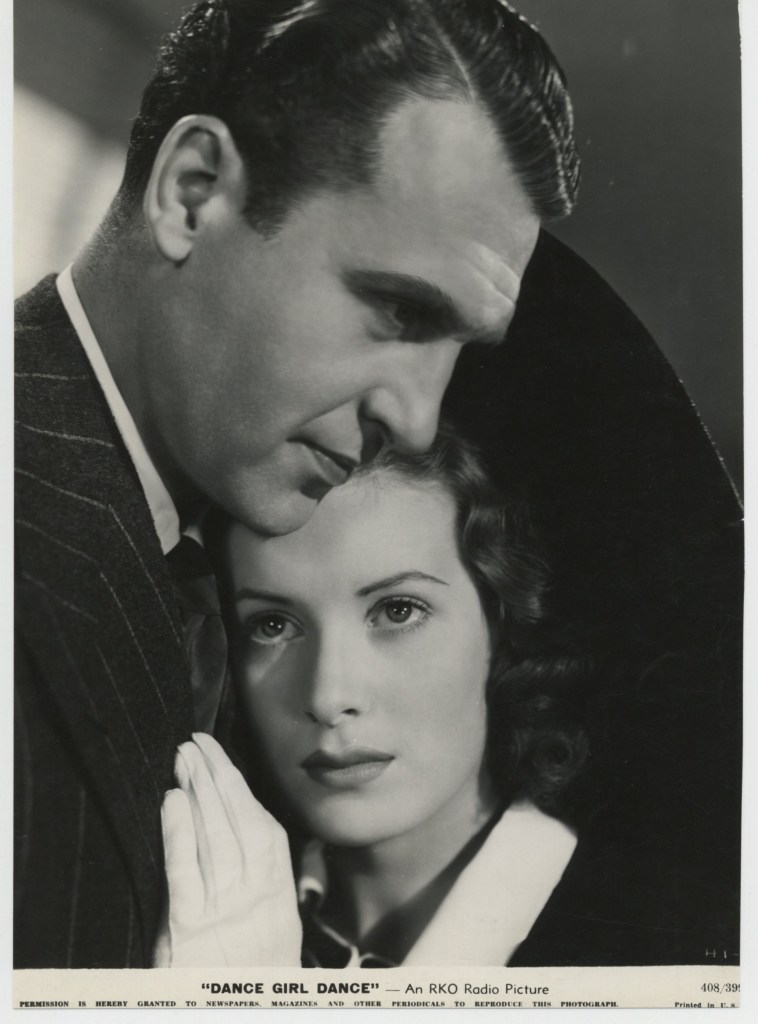
DANCE, GIRL, DANCE released August 30, 1940

This was a woman’s picture, had it been released in 1968, there’s no question this would have been labeled: “FEMINIST!”
The motion picture was directed by Dorothy Arzner. She had been directing since 1922, and this was her 20th, of only 21 films. At the time of this release, Arzner was one of only two ladies directing in the American film industry. Among her work was 1933’s, “Christopher Strong”, starring Katharine Hepburn and Colin Clive, and French author Emile Zola’s, “Nana”, in 1934, starring Anna Sten. Just before this picture, Arzner directed Joan Crawford, Franchot Tone, and Robert Young in the 1937 comedy, “The Bride Wore Red”.
The story was by novelist Vicki Baum, who wrote the 1932 novel, “Grand Hotel”. Which was turned into a classic, multiple-star, actually every contract player “Metro-Goldwyn-Mayer” had on the lot, and not working a specific feature film.
The screenplay was the work of Tess Slessinger. She wrote director Arzner’s, 1937, “The Bride Wore Red”, and director Eliza Kazan’s version of Betty Smith’s novel, 1945, “A Tree Grows in Brooklyn”.
This motion picture was edited by Robert Wise, who followed this feature as the editor on, 1941’s, “Citizen Kane”. Later, taking over the directing from Orson Welles, for 1942’s, “The Magnificent Ambersons”. While the other was in South America for FDR.
Maureen O’Hara portrayed “Judy O’Brien”. This was a “B plus” motion picture, that was designed to push her into “A” list movies on a regular basis.
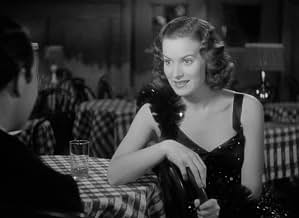
Louis Hayward portrayed “Jimmy Harris”. Hayward was the London stage protege of Noel Coward, billed as C. Louis Hayward (His name was Louis Charles Hayward). Do not ask why the “C” was put before Louis. In 1927, he originated the role of “Lord Gadalming”, the name would be changed later to “Arthur Holmwood” in North America. This was in the original production of playwright, Hamilton Deane’s “Dracula”. On film, Louis Hayward had starred in the 1939 version of Alexander Dumas’s, “Man in the Iron Mask”, directed by James Whale, and a created sequel of his “Count of Monte Cristo”, called the“Son of Monte Cristo”, in 1940, directed by Roland V. Young.
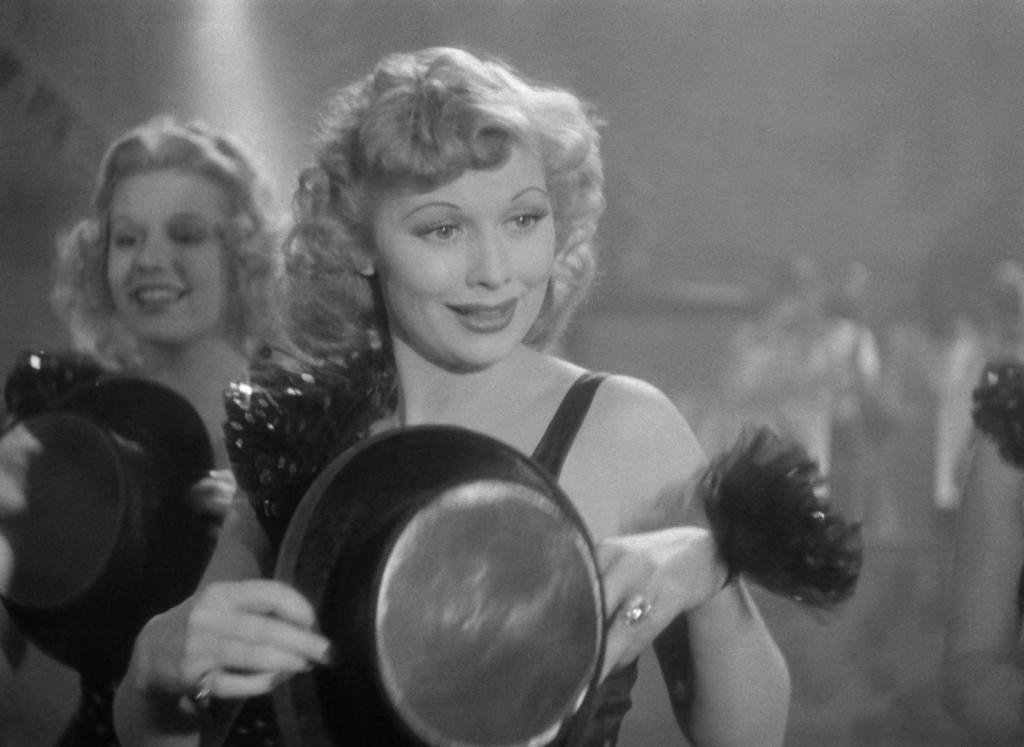
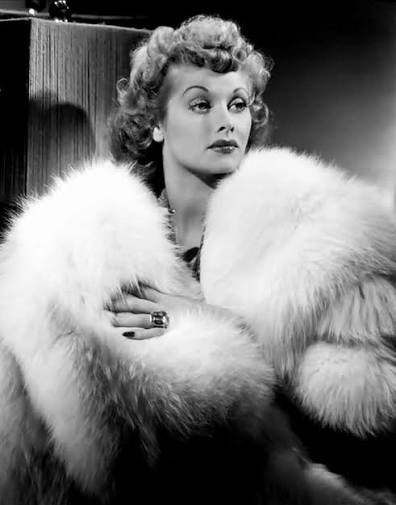
Lucille Ball portrayed “Bubbles/Tiger Lilly White”. Ball had just been seen in 1940’s, “You Can’t Fool Your Wife”, and followed this feature film with 1940’s, “Too Many Girls”, co-starring Richard Carlson and Ann Miller. Ball begin as a serious actress and not a comedian. My article is “Lucille Ball Dramatic Actress 1933 to 1949” to be read at:
https://www.bewaretheblog.com/2024/10/lucille-ball-dramatic-actress-1933-to.html
Virginia Field portrayed “Elinor Harris”. Field just had 4th billing in 1940’s. “Waterloo Bridge” starring Vivian Leigh and Robert Taylor. She would follow this feature with Paul Muni’s, 1940, “Hudson’s Bay”.
Ralph Bellamy portrayed “Steve Adams”. Bellamy just had portrayed “G-Man, Scott Langham” in 1940’s, “Queen of the Mob”, see my J. Edgar Hoover article. In 1941, Bellamy was in “Universal Pictures”, “The Wolf Man”, and followed it with 1942’s, “The Ghost of Frankenstein”.
Maria Ouspenskaya portrayed“Madame Lydia Basilova”. Ouspenskaya is probably best known for portraying the Gypsy woman, “Maleva” in 1941’s, “The Wolf Man”, and 1943’s, “Frankenstein Meets the Wolf Man”. However, look for the actress in 1937’s, “Conquest”, starring Greta Garbo and Charles Boyer, see my article on “Napoleon”1940’s. Then there was “Waterloo Bridge”, and co-starring with Maria Montez, and Patric Knowles, in Edgar Allan Poe’s, 1942, “The Mystery of Marie Roget”. My article is “MARIA OUAPENSKAYA: “The ‘Romani’ Mother of Bela Lugosi’s Werewolf” at:
https://www.bewaretheblog.com/2026/02/maria-ouspenskaya-romani-mother-of-bela.html
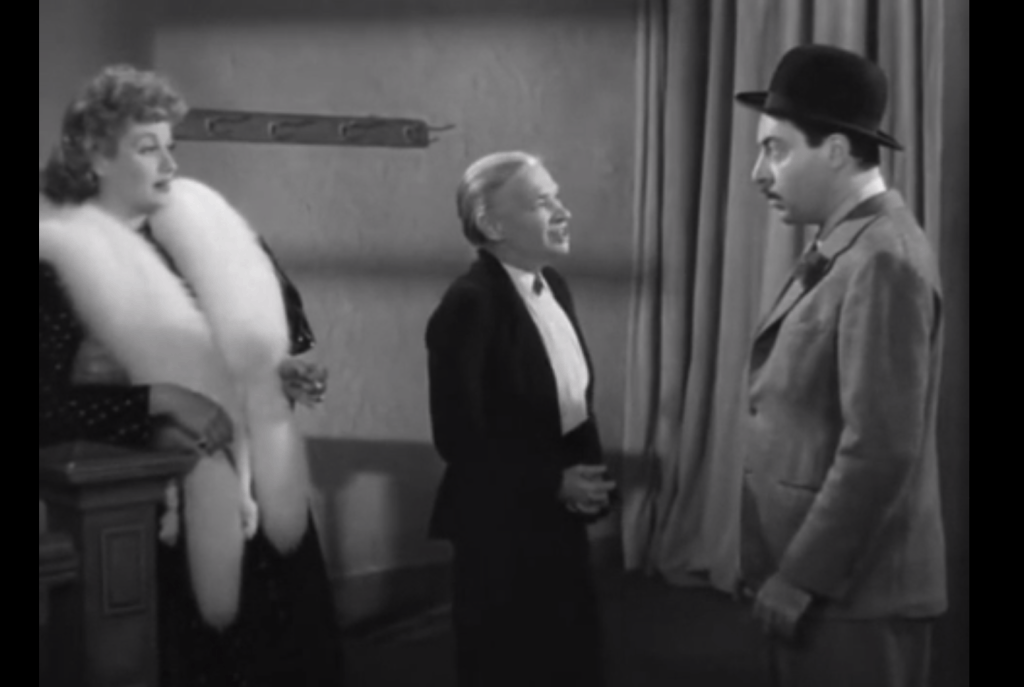
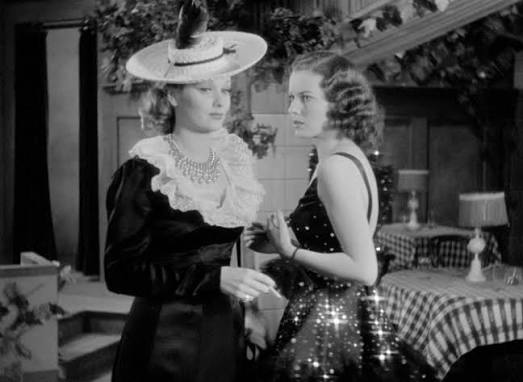
Above left to right, Lucille Ball, Maria Ouspenskaya, and Harold Huber portraying Kashulian.
This is a story of two women, friends, one, “Bubbles”, dreams of being a burlesque queen, the other, “Judy”, wants to become a classical ballerina. Both seem to be in love with the same man, the wealthy heir, “Jimmy Harris“, but “Jimmy” is in love with his estranged wife, “Elinor”, that he is loosing. As “Judy” and “Bubbles”, two worlds clash with their dreams.
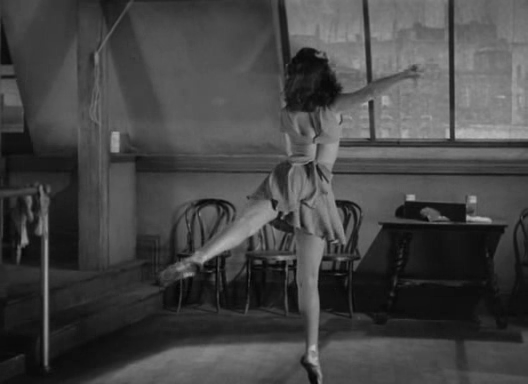
“Judy” gets her chance to make her dream come true though a Russian ballet instructor, teacher, and mentor, the tough, sometime harsh, “Madame Lydia Basilova”. Below, is Maureen O’Hara performing, “Judy’s” ballet practice sequence:
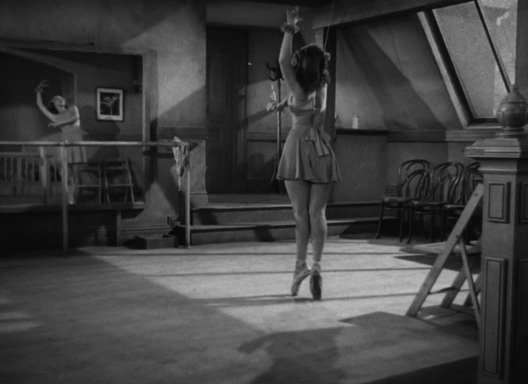
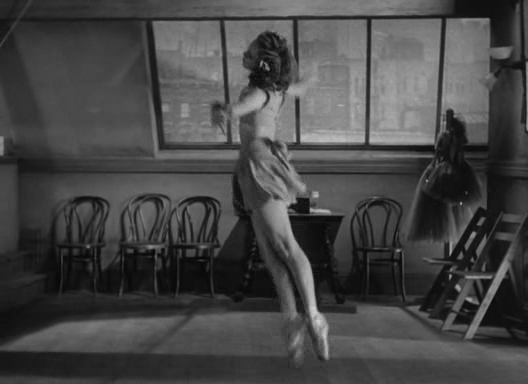
In comparison to her friend “Judy”, “Bubbles” is entirely unapologetic about her pursuit of wealth and fame. She rises to the top of her profession as “Tiger Lily White” and looks down upon the hard working ballerina.
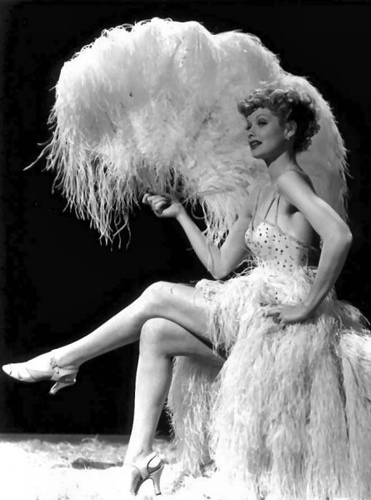
Meanwhile, “Lydia ” emphasizes the art of dance over the commercialism of “Bubbles”, and even “Judy” is are performing. She arranges an audition for “Judy” with the prestigious dance producer, “Steve Adams”. However, on her way to see “Judy’s” audition, “Madame Basilova” is hit by a car and dies.
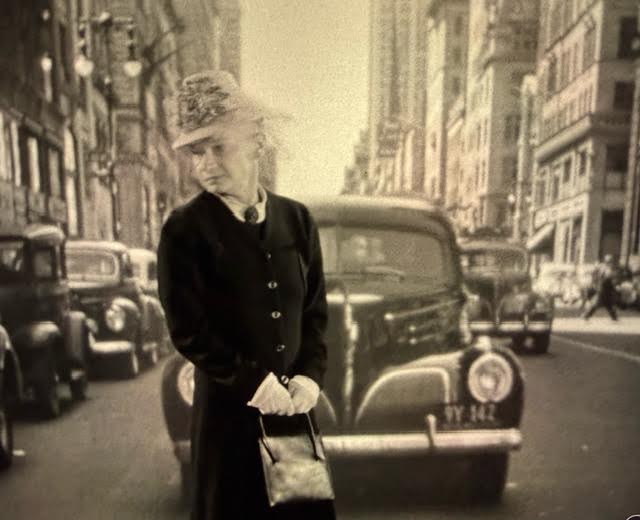
“Judy” arrives at “Steve’s” office for the audition and his secretary, “Miss Olmstead”, portrayed by Katharine Alexander, asks her to take a seat with other dancers waiting to see the producer. However, without her mentor, “Judy” feels lost, and doesn’t go through with the audition and leaves the office. She enters the elevator with a man, who once at the ground floor, offers her a life. She rejects the offer, not knowing it is from “Steve Adams”.
“Judy” is finding it hard to get a ballet dance position, and she goes to “Bubbles”. “Tiger Lily White” offers “Judy O’Brien” the position of her stooge. “Judy” will dance ballet, and the other were mock her on stage. One night, both “Jimmy” and “Steve” attend the show at the “Bailey Brothers Burlesque”, and the two watch “Tiger Lily White’s” routine. “Steve” notices the ballet being performed by “Judy”. He writes a note on a business card, but without reading it. “Judy” leaves with “Jimmy”, tearing up the card.
Later that night, at a nightclub, “Judy” is photographed in the background of fist fight between “Jimmy” and “Elinor’s” new husband. The following day, “Miss Olmstead” sees the photo of the fight with “Judy’s” in the background, and points her out to “Steve Adams”.
“Steve” attends that nights performance. He joins the audience of men, and listens to “Judy” give a lecture about the “EVIL OF VIEWING WOMEN AS OBJECTS”. This is followed by “Bubbles” and “Judy” having a major fight over “Jimmy”. The police arrive, and “Judy” finds herself being hauled into night court. She is sentenced to ten days in jail, but “Steve” bails her out. On the next day, “Judy” goes to find out who her unknown benefactor was, and re-meets “Steve Adams” dancing producer. Who tells her, she is his new discovery, and next star.
Maureen O’Hara’s batting average still wasn’t very good. As this film was a critical and commercial failure, and its theatrical release lost RKO Studios roughly $400,000. However, today, the picture’s place in history has been changed. It is considered an example of the “Feminism” I mentioned at the my start.
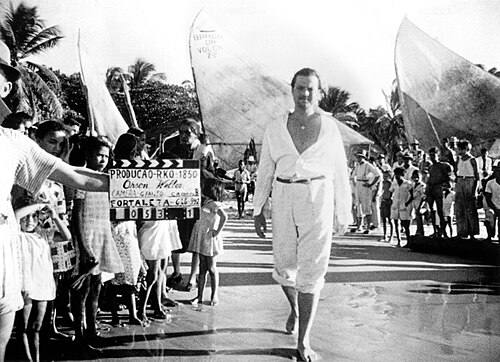
In 1933, President Franklin Delano Roosevelt established “The Good Neighbor Policy” toward Latin America. The main part of the policy was that the United States would not interfere with what was happening in the Latin American countries. However, FDR wanted the American film industry to support his policy. I’ve mentioned that Robert Wise took over the directing of “The Magnificent Ambersons” for Orson Welles, below, who was in Fortaleza, Brazil, filming for “The Good Neighbor Policy”, documentary, the unfinished, “It’s All True”.
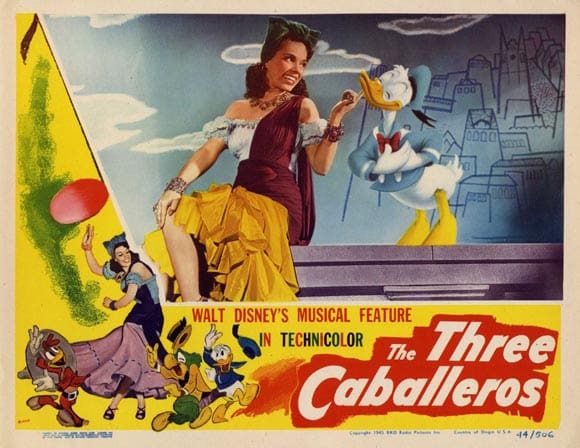
Another example of American film companies participation in FDR’s project came from Walter Elias Disney with his live action/animated “The Three Caballeros”.
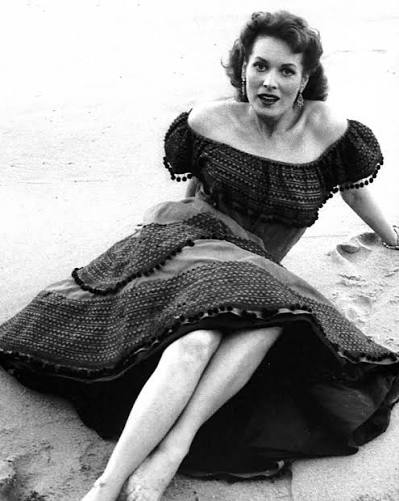
For her next motion picture, Maureen O’Hara made an “RKO Pictures” contribution to the President’s Latin American policy.
THEY MET IN ARGENTINA released on April 25, 1941

The motion picture’s story came from its producer, by Lou Brock. Who was able to get songwriters Richard Rodgers and Lorenz Hart to write 12-songs for the motion picture, but only 7 remained in the Final Cut.
The actual screenplay was written by Jerome Cady. Among his screenplays was the excellent survival in the jungle drama, featuring dramatic actress, Lucille Ball, 1939’s, “Five Came Back”. Another was for director Lewis Milestone’s, 1944, “The Purple Heart”.
Initially the picture was directed by Leslie Goodwins, who was among others assignments, the director for the Lupe Velez popular “Mexican Spitfire” slapstick comedies. However, he developed pneumonia and was replaced by:
Jack Hively, who had been the main director on “The Saint” mystery series. starring George Sanders as “Simon Templar” aka: “The Saint”.
Maureen O’Hara portrayed Irish-Argentinian “Lolita O’Shea”.
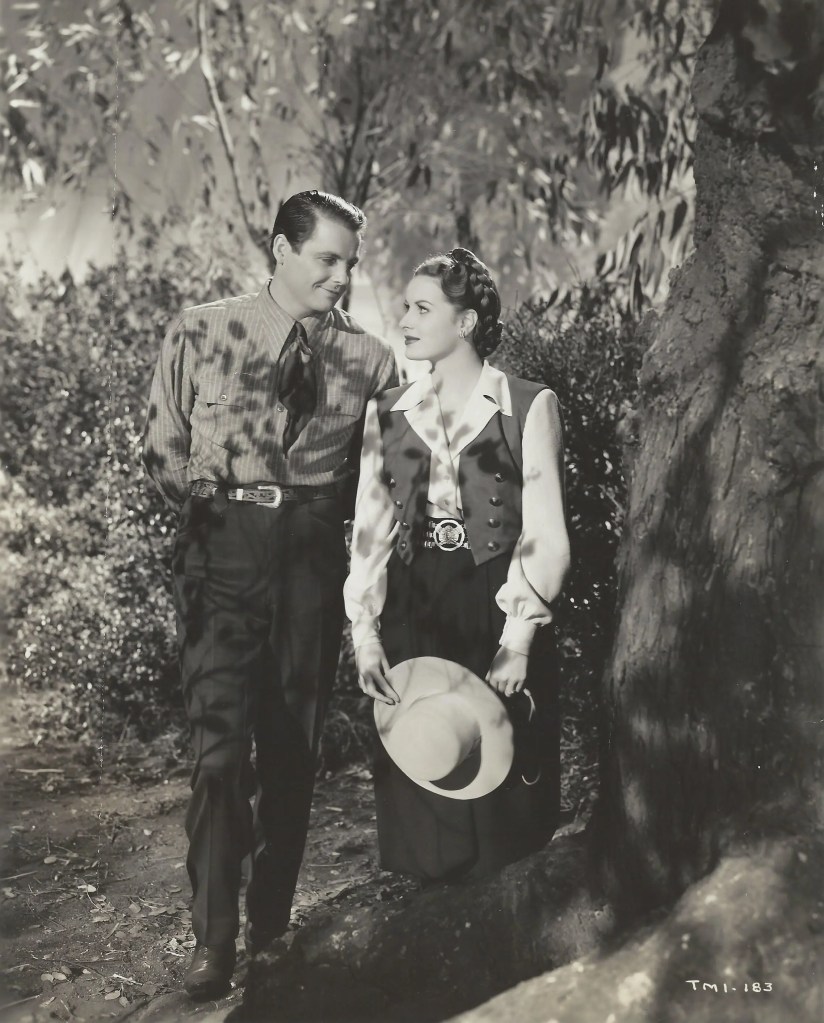
James Ellison portrayed “Tim Kelly”. For eight of William Boyd’s “Hopalong Cassidy” motion picture, Ellison was sidekick and the leading ladies love interest,
“Johnny Nelson”. However, there are two films that he made that showed a different side to him. First, was portraying “Buffalo Bill Cody”, in director Cecil B. DeMille’s, 1936, “The Plainsman”, starring Gary Cooper and and Jean Arthur. The second is probably James Ellison’s best performance in a motion picture. As “Wesley Rand”, in producer Val Lewton’s, 1943, “I Waked with a Zombie”, directed by the great Jacques Tourneur. After this movie, he was back to seven”B” cowboy features as “Shamrock Ellison”, billed as “Jimmy ‘Shamrock’ Ellison”.
Alberto Villa portrayed “Alberto Delmonte”. The Uruguay born singer/actor had just been in the Spanish musical, 1940’s, “Confesion”, and would follow this motion picture with the Spanish musical, 1942’s, “Mañana me suicido”.
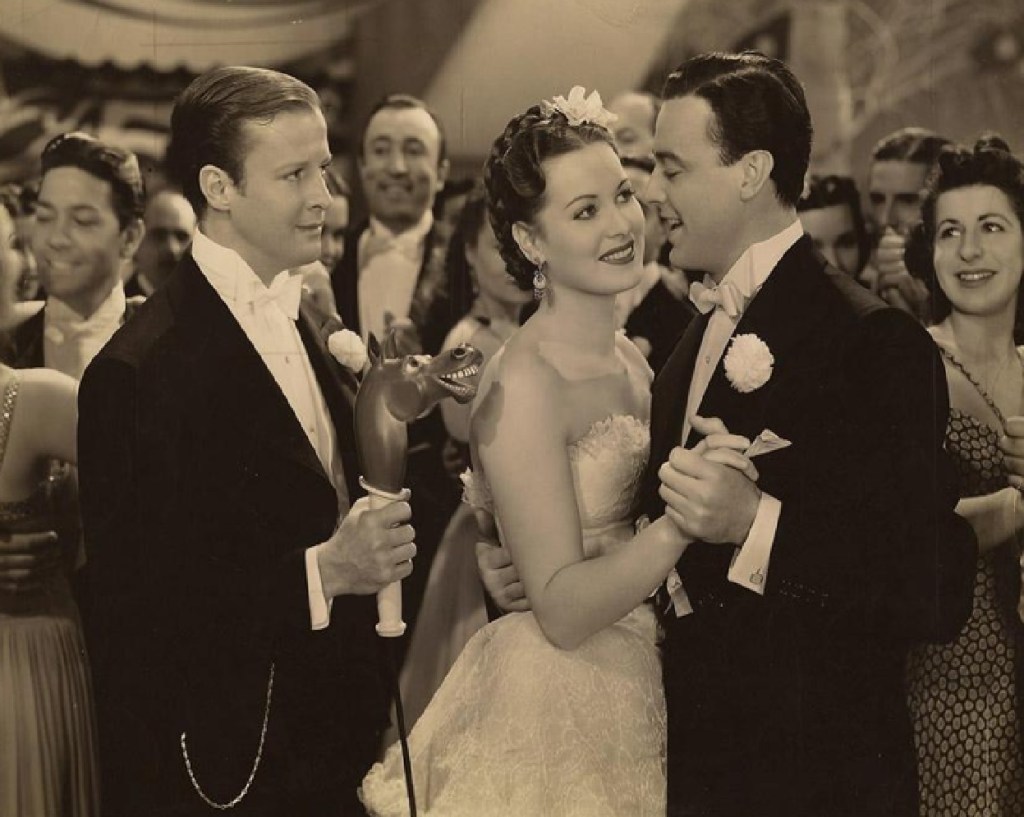
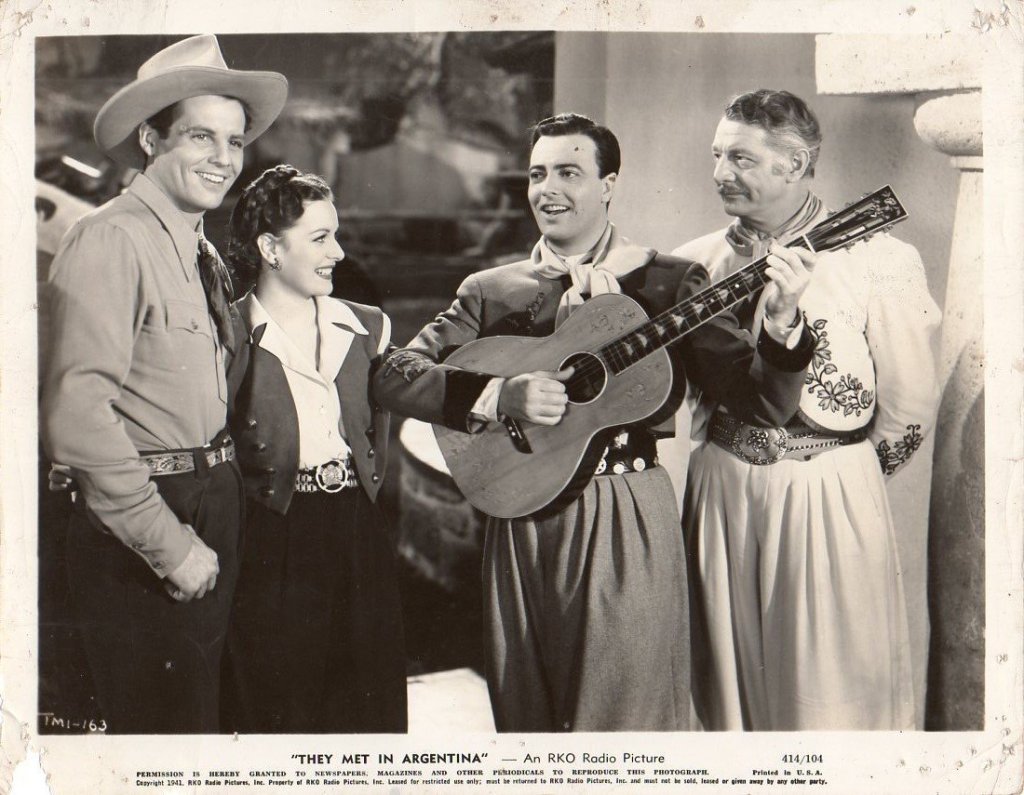
Above left to right, Alberto Villa, Maureen O’Hara, and James Ellison.
Buddy Ebsen portrayed “Duke Ferrell”. Just prior to this motion picture, Ebsen was filming the role of the “Tin Man” for 1939’s, “Wizard of Oz”, and became hospitalized for an allergy to the make-up. A make-up changed for Jack Haley. My article is “BUDDY EBSEN: From the ‘Baby Astaire’s’ to ‘Davy Crockett”, at:
https://www.bewaretheblog.com/2022/04/buddy-ebsen-from-baby-astaires-to-davy.html
Diosa Costello portrayed “Panchita, Duke’s Girlfriend“, This was the first of only three movies for the Puerto Rican actress.

Above, Buddy Ebsen, and Diosa Costello .
This was a light comedy, musical romance, about a Texas employee, “Tim Kelly”, of an oil billionaire who travels to Argentina to bid on some land, but his bid is unsuccessful. Not wanting to go back to the United States without something for his employer. With his partner, “Duke Ferrel”, they decide to buy a race horse. The horse in question is named “Lucero”. “Tim” meets the horse’s owner, “Don Enrique de los Santos O’Shea”, portrayed by Luis Alberni, who is not interested in selling. “Tim” also meets “Don Enrique’s” daughter, “Lolita O’Shea”, and the two will fall in love. All “Tim” has to get around is “Lolita’s” father, who does not want to sell “Lucero”, and another for her hand, “Alberto Delmonte”.
Wanting to stop his daughter’s love for the American, “Don Enrique” offers “Tim” the horse, IF he will immediately leave for the United States. “Tim” does, but “Lolita” finds out and races to the airport on horseback.
True love wins out, below the Argentine movie poster, pushing the music and the extremely popular Alberto Villa.
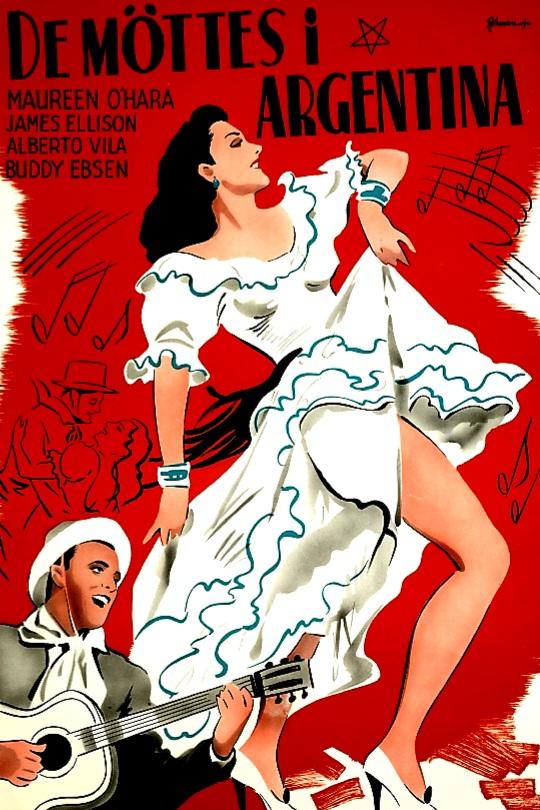
The motion picture lost $270,000., the situation was so bad. That the Argentine Government went on record speaking out against the movie, pulling it from their cinemas, and banned them movie.
Things changed for the actress when MAUREEN O’HARA MET JOHN FORD.
HOW GREEN WAS MY VALLEY premiered in New York City on October 28, 1941
In 1939, English novelist of Welsh decent, Richard Dafydd Vivian Llewellyn Lloyd, published his novel, “How Green Was My Valley”. He claimed this was based upon his own experiences, but after his death that was found to be untrue.
Philip Dunne was the screenplay writer, his previous five screenplays were the Tyrone Power and Loretta Young, 1938, “Suez”, the Spencer Tracy, 1939, “Stanley and Livingstone”, the Myrna Loy and Tyrone Power, 1939, “The Rains Came”, the Don Ameche and Al Jolson’s, 1939, “Swanee River” and the Tyrone Power and Dorothy Lamour, 1940, “Johny Apollo”. He would follow this picture with the Tyrone Power and Gene Tierney, 1942, “Son of Fury: The Story of Benjamin Blake”.
The movie was Directed b y John Ford. Ford had just filmed the Erskine Caldwell novel as 1941’s, “Tobacco Road”. Ford’s next released was a short subject, “The Battle of Midway”. That he had personally filmed on “Midway Island”, as the Japanese attacked in June 1942. My article is “John Wayne in John Ford’s CAVALRY TRILOGY: ‘Fort Apache’, 1948, ‘She Wore a Yellow Ribbon’, 1949, and ‘Rio Grande’, 1950”
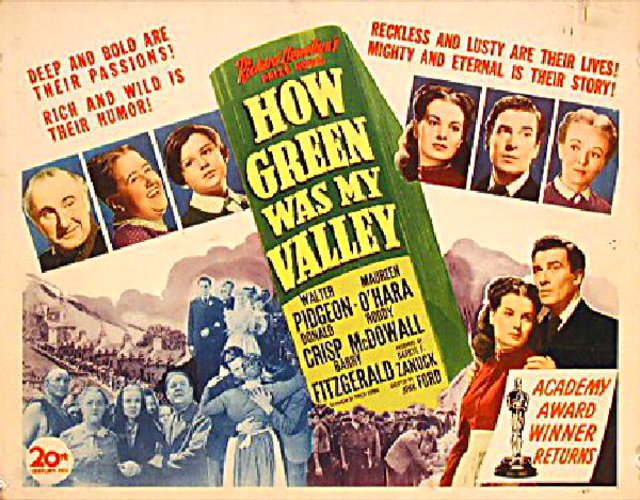
The Cast as shown on the above poster:
Walter Pidgeon portrayed “Mr. Gruffydd”. Pidgeon had co-starred with Greer Garson in the 1941 biographical movie about Edna Gladney, “Blossoms in the Dust”, and followed this feature film by co-starring with Rosalind Russell, in the 1941, screwball comedy, “Designed for Scandal”.
Maureen O’Hara portrayed “Angharad Morgan”.
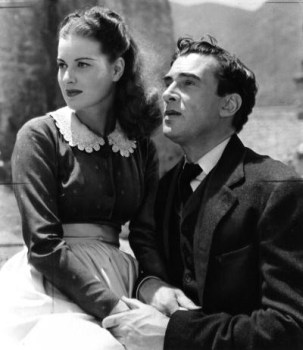
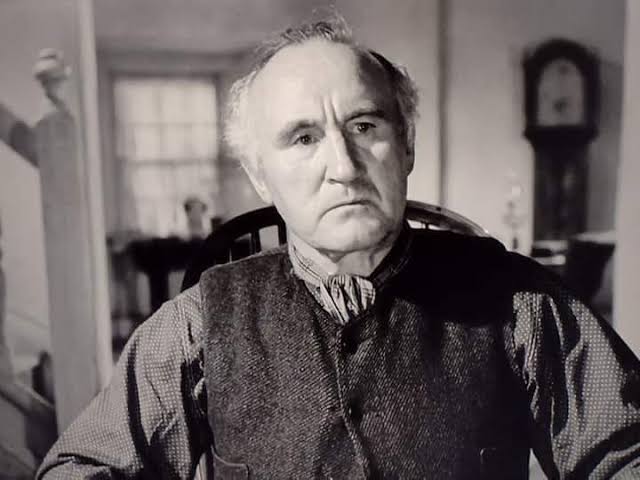
Donald Crisp portrayed “Mr. Gwilym Morgan”. Crisp had just been seen in 1941’s, “Dr. Jekyll and Mr. Hyde”, starring Spencer Tracy, Ingrid Bergman, and Lana Turner. He followed this motion picture with the legal drama, 1942’s, “The Gay Sisters”, starring Barbara Stanwyck.
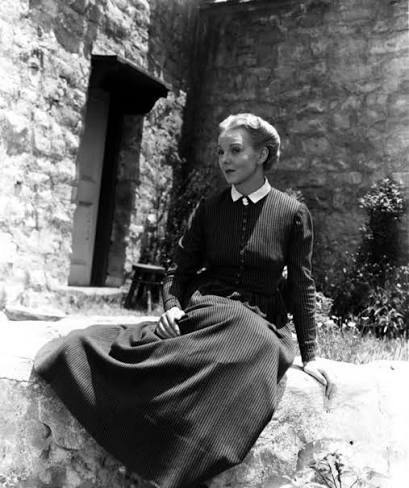
Anna Lee portrayed “Bronwyn”. Lee had just co-starred with Roland Coleman in the holiday romance, 1941’s, “My Life with Caroline”. She followed this feature film with the John Wayne and John Carroll, 1942, “Flying Tigers”.
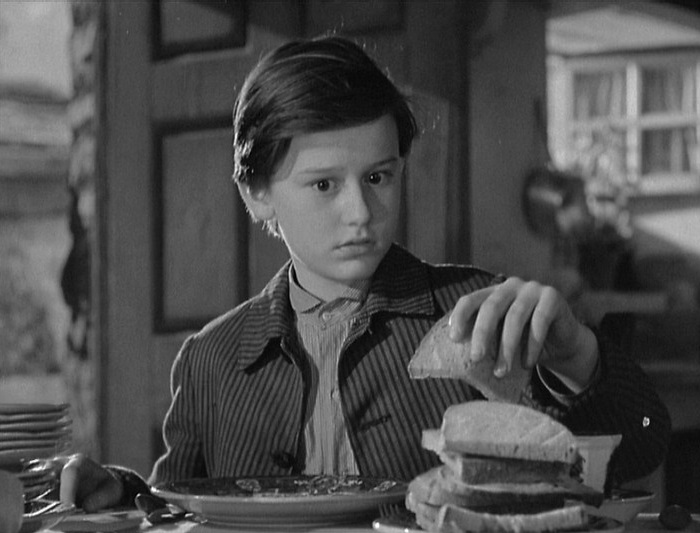
Roddy McDowall portrayed “Huw Morgan”. McDowall was in the All-English-Actors in “Hollywood”, 1941’s, Second World War, “This England”, a historical look at the country. He followed this feature film with another piece of war time propaganda, 1941’s, “Confirm or Deny”, co-starring with Don Ameche, and Joan Bennett.
Barry Fitzgerald portrayed “Cyfartha”. Fitzgerald was just in the 1941 version of Jack London’s “The Sea Wolf”, starring Edward G. Robinson, Ida Lupino, and John Garfield. He followed this motion picture with 1941’s, “Tarzan’s Secret Treasure”, starring Johnny Weissmuller, and Maureen O’Sullivan.
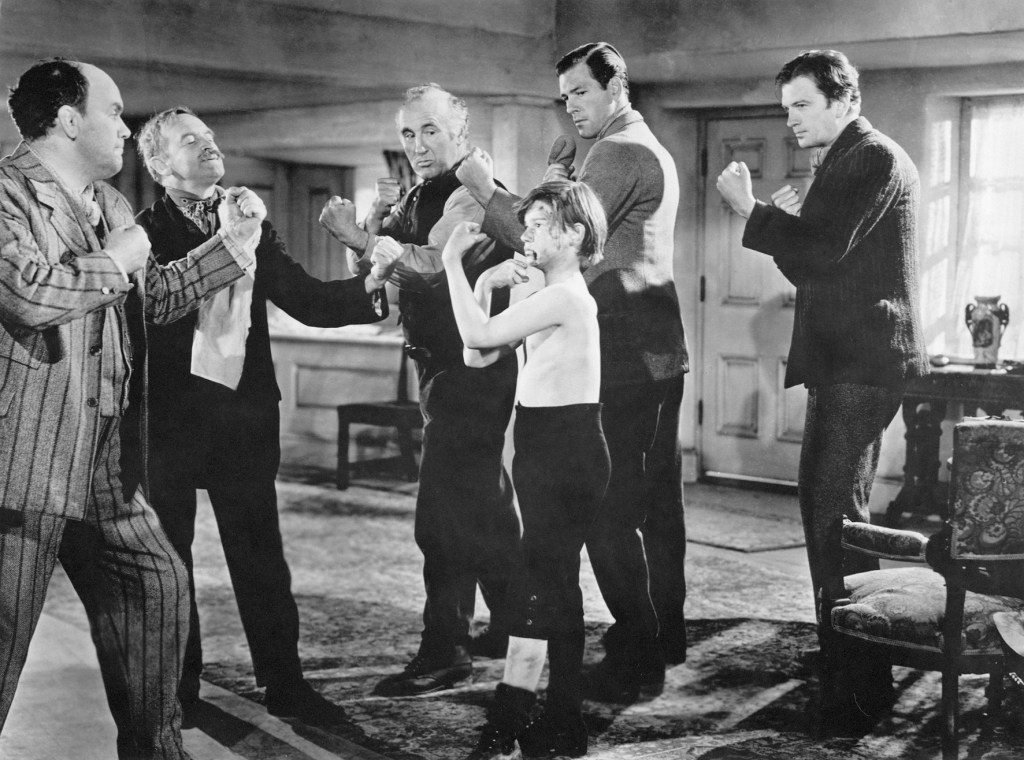
Above left to right, Rhys Williams portraying “Dai Bando“, Barry Fitzgerald, Donald Crisp, Roddy McDowall, Richard Fraser portraying “Davy Morgan”, and John Loder portraying “Ianto Morgan”.
The Story:
The story of “How Green Was My Valley” is told from the memories of the adult “Huw Morgan”. At the film’s opening scenes and its closing, “Huw’s” narrative voice is provided by a friend of John Ford, actor, and director, Irving Pichel. My article about this forgotten film maker is, “Irving Pichel: Producer, Actor, Director, and the Guardian of a VAMPIRE” found at:
The audience meets the “Morgan Family”, miners in the valleys of South Wales, under the rule of Queen Victoria. “Huw’s” family consists of brothers, “Ianto”, “Davy”, “Ivor” portrayed by Patrick Knowles, “Gwilym, Jr” portrayed by Evan S. Evans, and “Owen” portrayed by James Monks. Who all work in the mines with their father, “Gwilym”. “Huw’s” mother is the loving, “Beth Morgan”, portrayed by Sara Allgood, and his sister, who keeps the house with their mother, is “Angharad”. “Huw” has a crash on “Bronwyn”, who is engaged to marry “Ivor”. Into this idyllic setting comes “Mr. Gruffydd”, the new parish minister, whom “Angharad” falls in love with, and he with her.
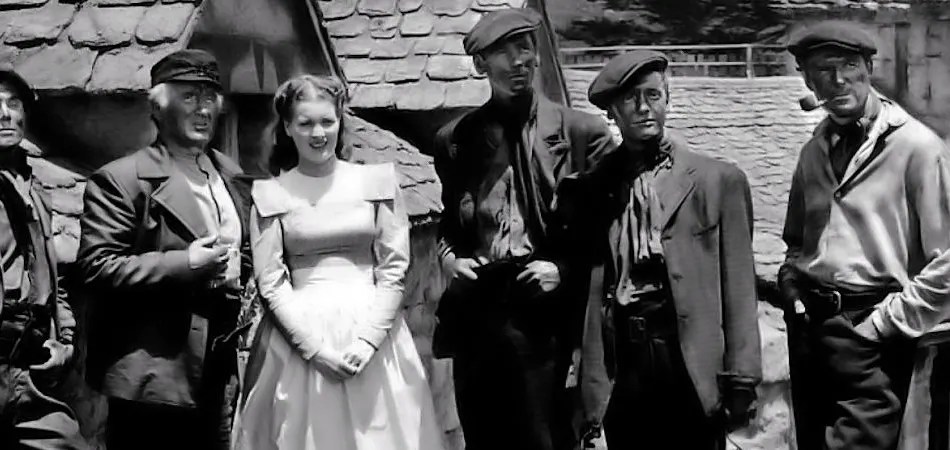
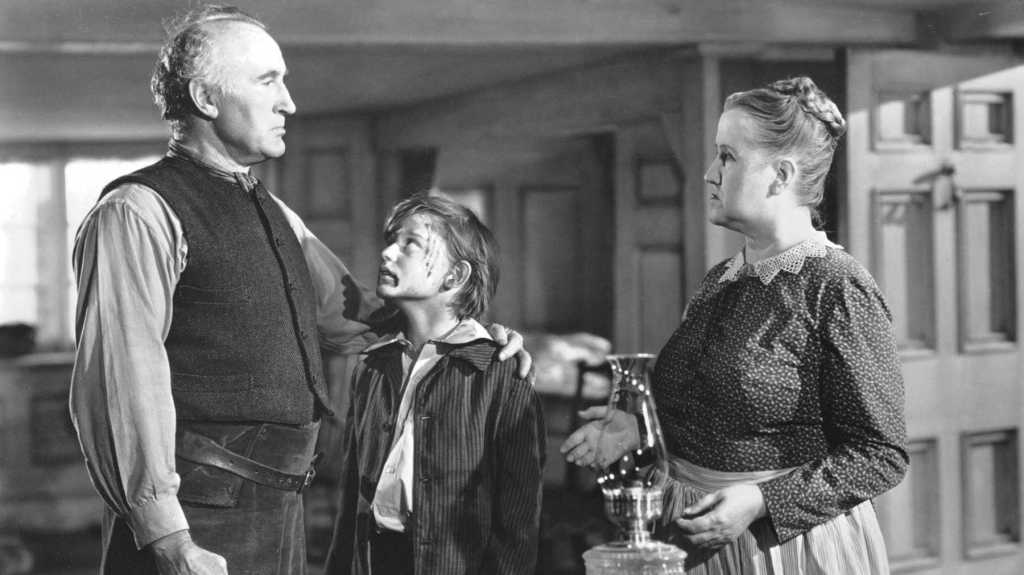
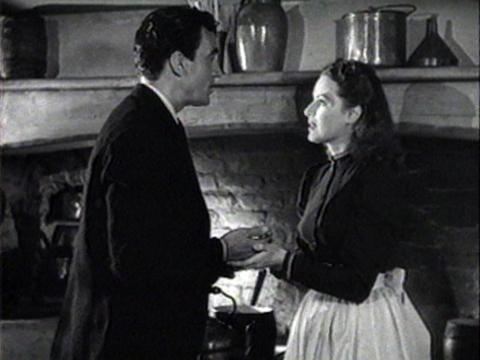
The first of a series of events that affects this setting, comes, when the owner of the coal mine cuts the wages of the miners. The miners, including “Gwilym Morgan’s” sons, want to strike, he attempts to mediate, but fails and loses his son’s to the strike.
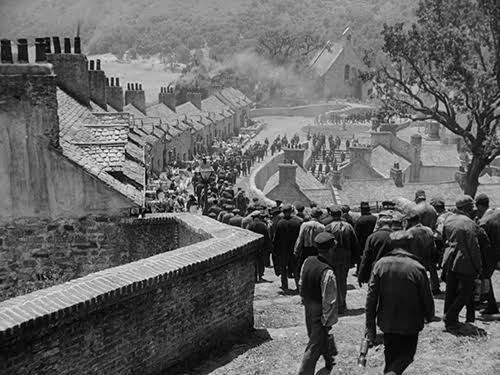
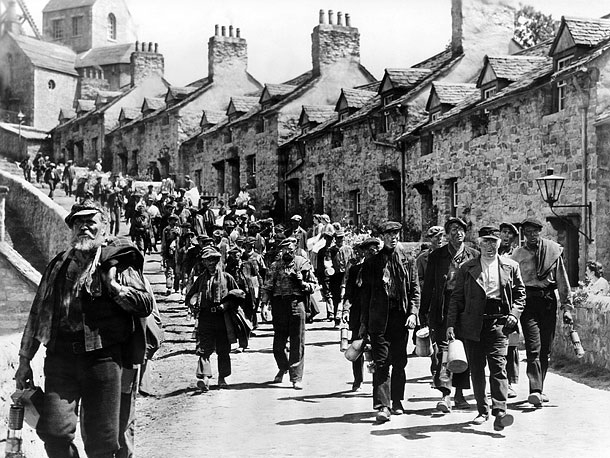
“Beth” taking “Huw” with her, interrupts a late night miner’s strike meeting and tells those assembled. That if anyone harms her husband, she will kill them. The two leave late at night in a snow storm and cut across the fields, but falls into the river. Miner’s on their way home, hear the two yelling for help, and rescue them. The doctor examines both, and for a short time, “Beth” loses the use of her legs, but the concern is that “Huw” may never walk again. Below, “Bronwyn”., “Ivo’s” wife, reads to the bedridden “Huw”.
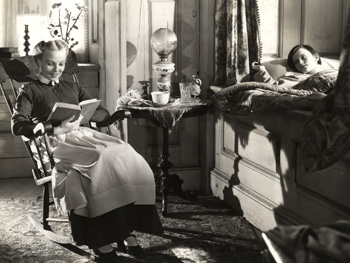
“Huw” will recover, because of the help of “Mr. Gruffydd”, further endearing the minister to “Angharad”.
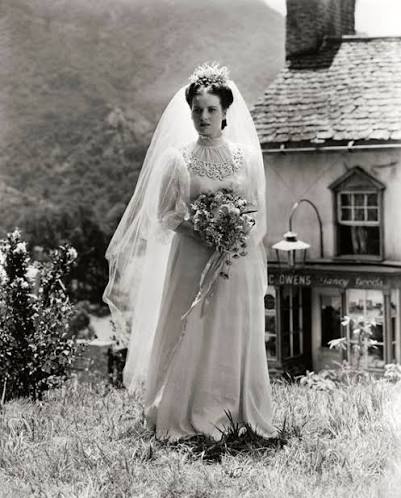
The strike is finally settled, and father and sons reconcile, but many miners lost their jobs and will move their families away. To “Angharad’s” disappointment, “Mr. Gruffydd”, will not suffer her to the impoverished life of a poor minister, and will not marry “Angharad”. However, the mine owners son, “Iestyn Evans”, portrayed by Marten Lamont, is courting “Amgharad”. To the family’s surprise. she next submits to this loveless marriage and two will move out of Wales.
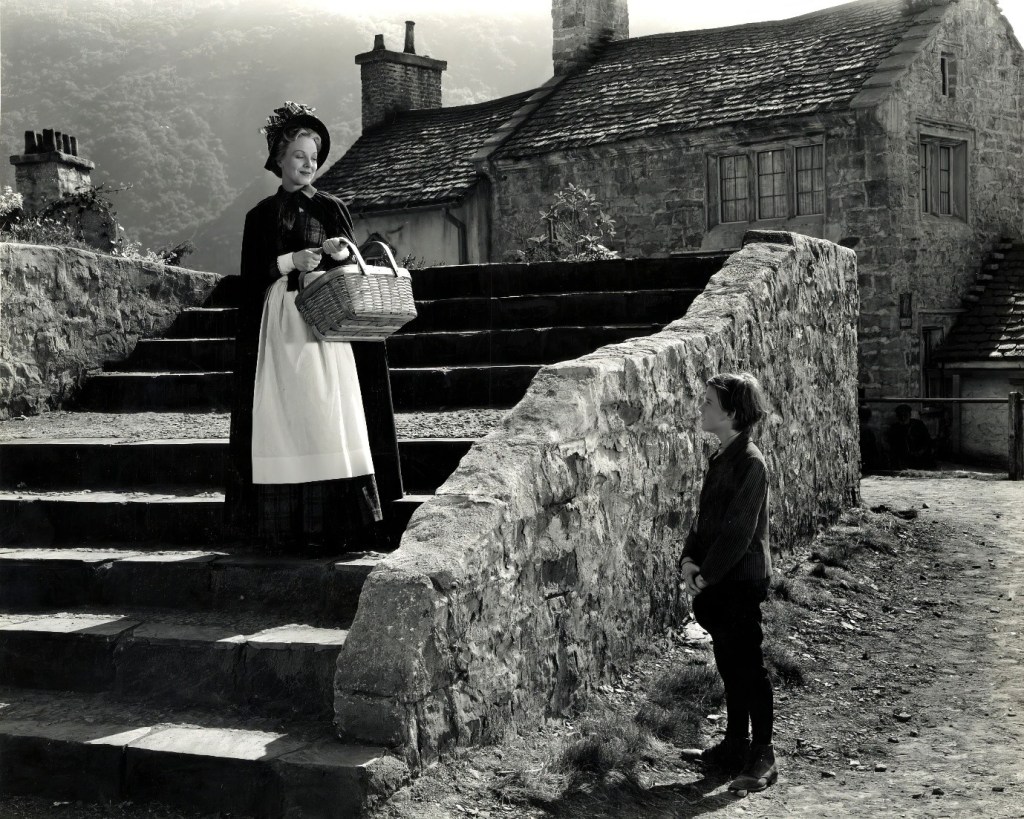
“Huw” goes to a school in a nearby village, and I bullied by other boys. He is taught by boxed “Dai Bando”, and his crony “Cyfartha”, how to box. After “Huw” suffers a severe beating by a cruel teacher, “Mr. Jonas”, portrayed by Morton Lowry, “Dad Bando” avenges “Huw”, by having an impromptu boxing match to the delight of the students using “Mr. Jonas”.
When the pregnant “Bronwyn” learns the her husband has been killed in a mine accident, that shock causes her to go into premature labor and she gives birth to a son. This is followed by two “Morgan” son’s be dismissed from the mines, and the owner hires two men at far lesser pay. The two sons now leave the village to seek employment elsewhere. “Huw” is offered a solar ship to a University, but to his father’s dismay, refuses it. Instead, he wants to go and work in the mines, and moves in to “Bronwyn’s” to help feed her and his brother’s son.
This is all followed by the arrival of “Angharad” WITHOUT A HUSBAND. This causes vicious gossip about her and an appending divorce spreading through the town. This in turn leads to the announcement of a meeting of the Deacons. Which is the governing council of the local Calvinistic Methodist chapel, to discuss excommunicating “Angharad”. This prospect enrages “Mr. Gruffydd”, who knows, she has returned home from Cape Town, South Africa, unaccompanied by her husband.
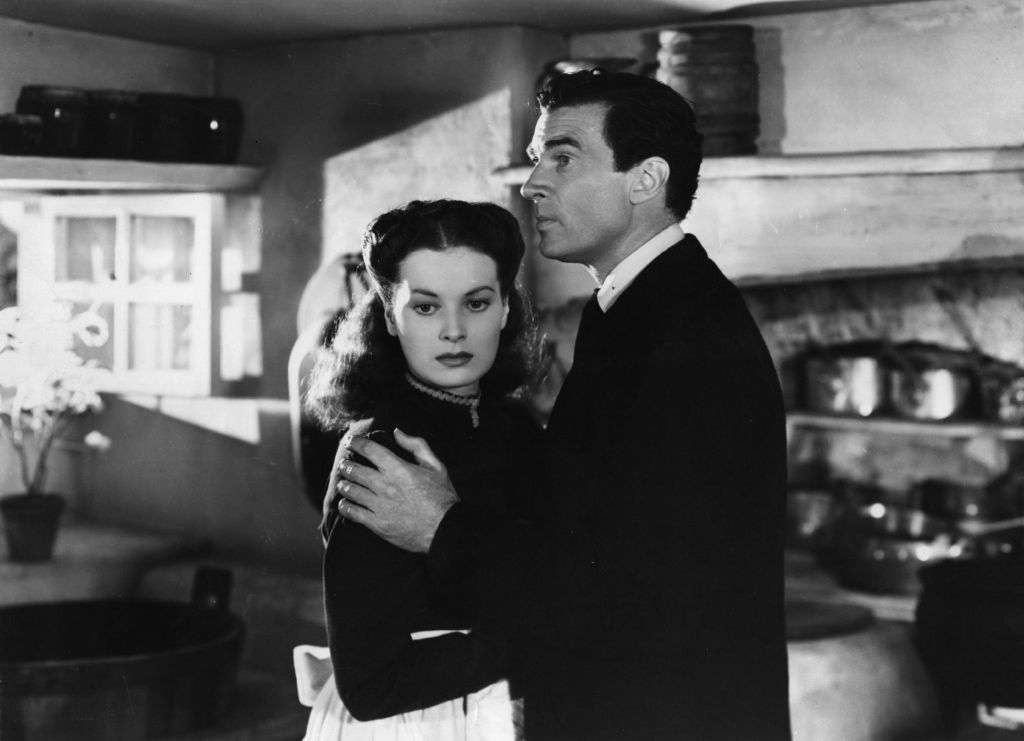
After condemning the Deacons small-mindedness, he storms out before the meeting actually will start with the intention of leaving the town forever.
That same evening, the alarm bell sounds, singling a mine disasters with several men, including “Huw’s” father, trapped inside. “Gruffydd”, spots “Angharad” at the mine looking for her father, or news of him.
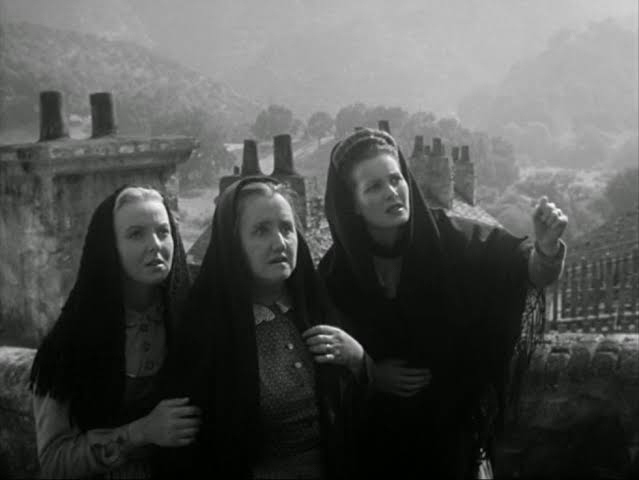
Above, “Bronwyn”, her mother-in-law, “Beth Morgan”, and her sister-in-law, “Angharad”, have come together as mother and daughter’s awaiting news.
“Angharad” looks pleading at “Mr. Gruffydd”, and he asks the on-lookers:
“Who is for Gwilym Morgan and the others?”
Only “Mr. Gruffydd”, “Dai Bando”, and “Huw” enter the mine. There, father and son are reunited, before “Gwilym Morgan” succumbs to his injuries.
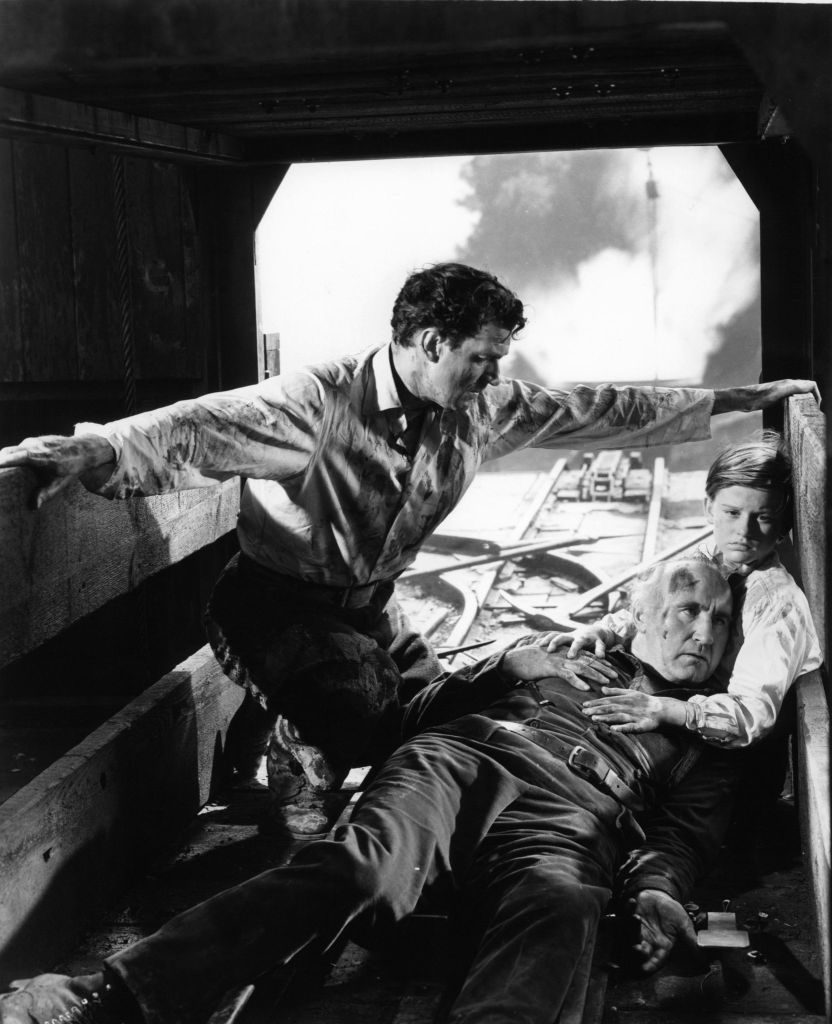
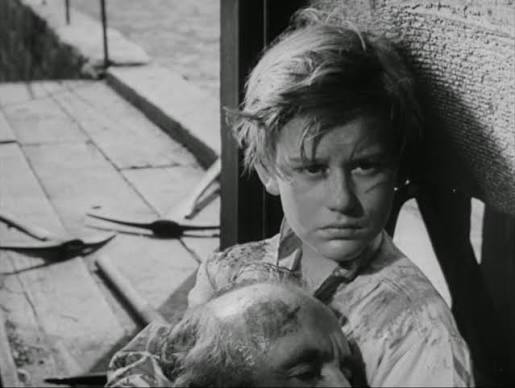
The motion picture ends with Irving Pichel’s voice for the older “Huw”. Telling the audience of the continued downfall of the coal mine and town, and remembering:
HOW GREEN WAS MY VALLEY!
The motion picture won, for Darryl F. Zanuck, the “Academy of Motion Picture Arts and Sciences”, at time, the “Outstanding Motion Picture, Oscar”.
John Ford won the “Best Director Oscar”, Donald Crisp won the “Best Actor Oscar”, Sara Allgood was nominated for “Best Supporting Actress Oscar”, Philip Dunne was nominated for the “Best Screenplay Oscar”. There were five other technical “Oscar” nominations. winning two.
Coming from such a major production and award winning motion picture. Maureen O’Hara was dropped into a “B” love triangle.
TO THE SHORES OF TRIPOLI released in San Diego, California on March 24, 1942
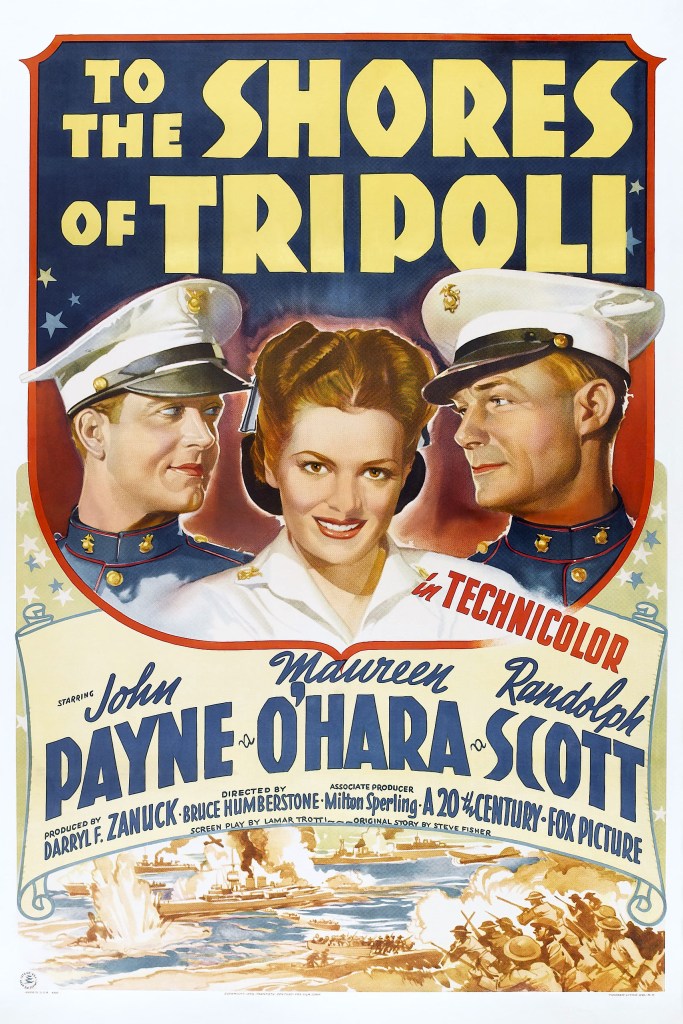
The motion picture went into production on NOVEMBER 3, 1941, at the San Diego Marine Corps base. The original story was by novelist Steve Fisher, 1941’s, “I Wake Up Screaming”, starring Victor Mature, Betty Grable, and Carole Landis.
The screenplay was by Lamar Trotti, contributing writer to 1941’s, “A Yank in the RAF”, starring Tyrone Power, and Betty Grable. That original screenplay was a simple “Hollywood” love story set around the United States Marines. Trotti finished his final draft on October 29, 1941.
The movie was directed by H. Bruce Humberstone. He had just directed 1941’s, “I Wake Up Screaming”.
George Raft was meant to be the star, but “Warner Brothers” refused to release him. John Payne was about to start the shooting on the picture, the “Song of the Islands”, opposite Betty Grable. He was moved to this picture, and Victor Mature to the Grable film.
John Payne portrayed “Chris Winters“. His last released motion picture was Claudette Colbert’s, 1941, “Remember the Day”.
Maureen O’Hara portrayed “Navy Nurse, Lieutenant Mary Carter”.
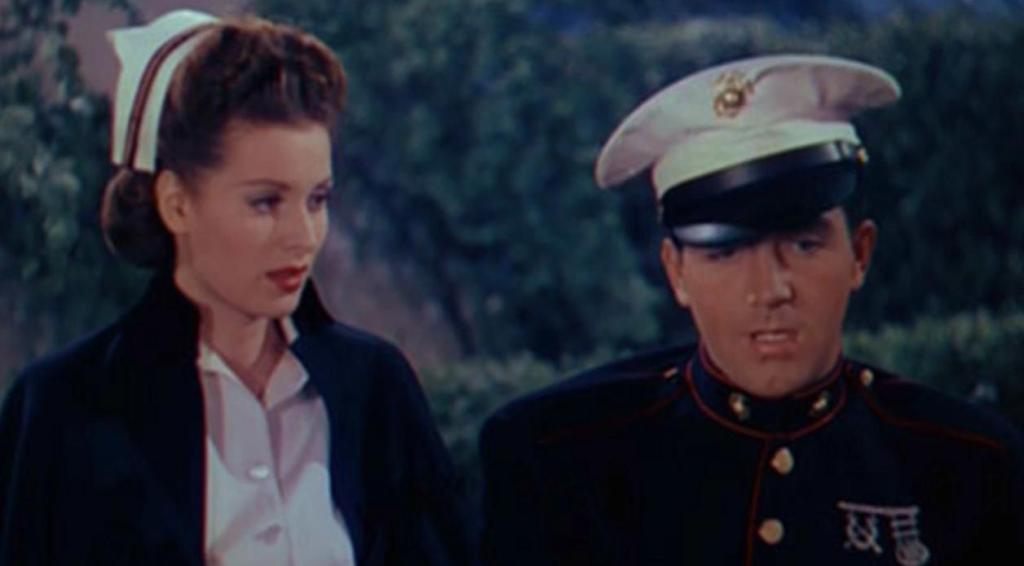
Above, Maureen O’Hara and John Payne.
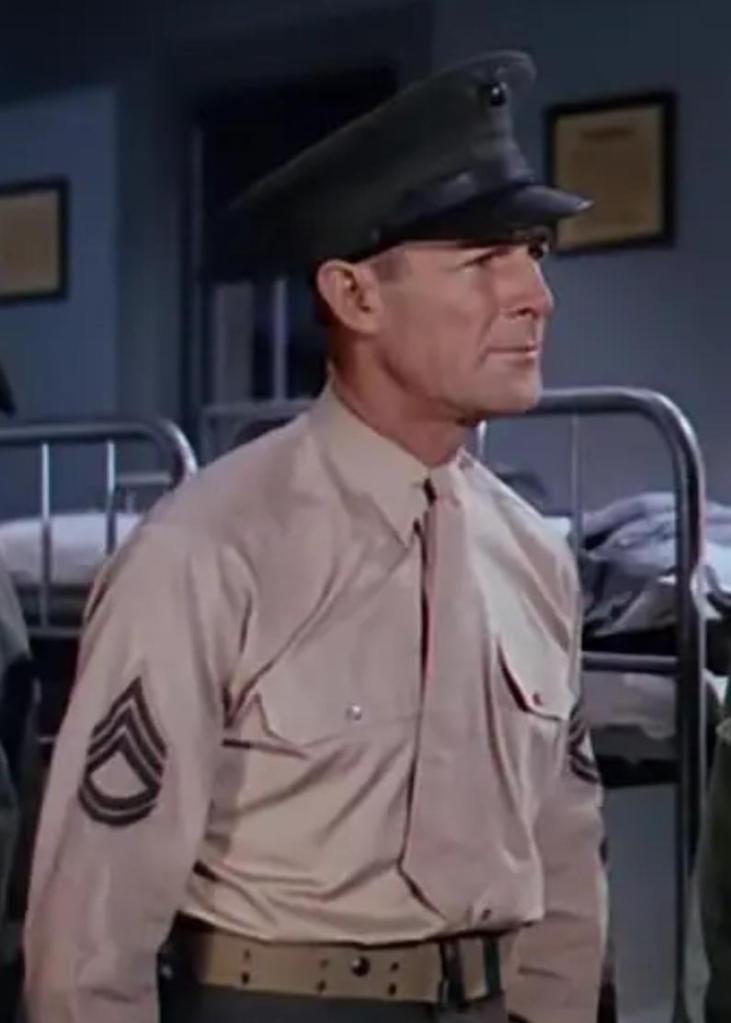
Randolph Scott portrayed “Marine Drill Sergeant Dixie Smith”. Scott had been filming the pro-French underground against the Nazi occupation of France, “Paris Calling”. Which had just wrapped shooting in September.
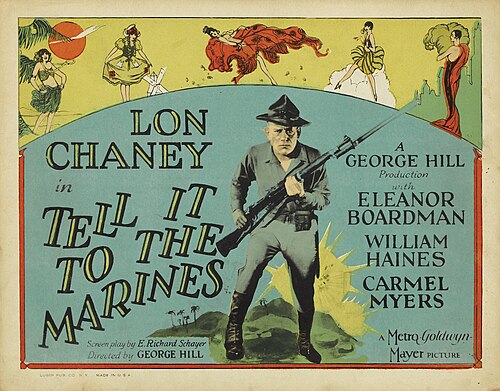
As originally written, this was a typical military love triangle, going back to 1926’s, “Tell It to the Marines”. You had the by the book, hard nosed drill sergeant, the rule breaking recruit, and the Navy nurse, that they both love. The first half of the movie was also filmed at the San Diego Marine Corps Base. The love triangle was Lon Chaney’s “Drill Instructor”, William Haines’s recruit, and Eleanor Boardman’s Navy Nurse.
In “To The Shores of Tripoli”, you have “Chris Winters”, a rich, playboy, “Culver Military School”, in Indiana, drop out. Who enlists in the Marine Corps, and is assigned, with other recruits, to “Marine Gunnery Sergeant/Drill Instructor Dixie Smith”, for training. On the base, “Chris” meets Navy Nurse, “Lieutenant Mary Carter”, and falls for her. Add in, is “Chris’s” society girlfriend, “Helen Hunt”, portrayed by Nancy Kelly. “Helen” wants to use her father’s influence to get “Chris” a “Cushy” Washington, D. C. job, and out of the Navy.
This is all a very familiar story line from the 1930’s.
I now direct my reader, if they haven’t picked up on it, to the dates I have mentioned above.
Lamar Trotti’s original ending had:
Rich, playboy, irreverent Marine recruit “Chris Winters”, starting to experience Marine Corps training under “Sergeant Dixie Smith”, and wanting out anyway he could find. His rich, society girlfriend, “Helen Hunt”, has been trying to use her father’s clout to do just that. However, things change, after “Chris” meets Navy Nurse, “Mary Carter”, and the film’s simple “Hollywood” love story comes into play with its expected “Hollywood Ending” of Boy gets Girl.
DECEMBER 7, 1941:
The Japanese attacked Pearl Harbor, Hawaii, the United States officially entered the Second World War and the ending of this motion picture was rewritten.
Now, “Chris Winters” pending his official resignation date from the Marine Corps. Now hears of the Japanese attack on Pearl Harbor. Instead of walking away into a peaceful civilian romance with “Helen Hunt”. He tears up his resignation, searches out “Sergeant Smith”, clearly re-enlists, boards the transport ship with “Smith”, and meets “Nurse Mary Carter”.
The audiences loved this truly “PATRIOTIC” motion picture, but not so, the film critics. The “New York Times” film critic, Bosley Crowther, wrote on March 26, 1942, that the movie was:
“—-a compound of familiar cliches … If this film is a fair estimation of Marine discipline and tradition, then wire Congress. For, with typical cinematic license, it assumes that one arrogant kid, protected by a sergeant’s strange sentiment, could violate every rule in the book. Further, it does not lay emphasis upon a genuine spirit de corps. Contrary to military nature, the Marines fall in around a self-willed lad.”
TEN GENTLEMEN FROM WEST POINT released on June 26, 1942

This was a troubled production before it even started filming, and the backstory is probably more interesting than the motion picture.
“20th Century Fox” executives, assigned the production to director Henry Hathaway. Whose 1941, “Sundown”, had just been released and was another pre-Pearl Harbor Second World War story about British soldiers in Somaliland fighting the Nazi’s. The film had starred Gene Tierney, Bruce Cabot, and George Sanders, and had just been released. He would follow this feature with another Second World War film, 1942’s, ‘China Girl”, starring Gene Tierney, George Montgomery, and Lynn Bari.
Malvin Wald had come-up with the story about the re-established West Point, and the first class there. This was only Wald’s second story idea for a motion picture.
The first problem came with turning Wald’s idea into a screenplay. Initially the screenplay, “School for Soldiers”, was written by Richard Maibaum, 1937’s, “They Gave Him a Gun”, that starred Spencer Tracy, Gladys George, and Franchot Tone.
Next, Talbot Jennings was hired to rewrite the whole screenplay. Jennings had written the Clark Gable and Charles Laughton, 1935, “Mutiny on the Bounty”, 1937’s, and “The Good Earth”, starring Paul Muni and Louise Rainer.
Still not satisfied with the screenplay, “20th Century Fox”, hired George Seaton,to rewrite some of the dialogue. Seaton had written the original screenplay for the Marx Brothers, 1935, “A Night at the Opera”, the screenplay for the brothers, 1935, “A Day at the Races”, and the screenplay for Jack Benny’s, 1941, “Charley’s Aunt”.
Which was followed by Darryl F. Zanuck being asked to go over the screenplay, without credit, and make any corrections he thought needed.
Finally, not satisfied with the screenplay, director Henry Hathaway asked playwright and screenplay writer Ben Hecht, 1932’s, “Scarface”, 1934’s, “Viva Villa”, and 1939’s, “Wuthering Heights”, to completely, without credit, rewrite the entire screenplay.
Which brings me to the casting, the role of “Joe Dawson”. The role was originally written for Tyrone Power, but he wasn’t available. As Power had enlisted in the Marine Corps, next it was given to Henry Fonda, but his schedule was full, and he was enlisting in the Navy. The studio, next, decided to give the role to Randolph Scott, but Scott was at Universal Pictures filming “The Spoilers”, co-starring with Marlene Dietrich, and John Wayne. So, the studio gave the role to John Payne, which was welcomed by his co-star, Maureen O’Hara. However, he became ill for an unstated “Emotional Upset”, and the role went to George Montgomery. Who had just appeared opposite Ginger Rodgers in 1942’s, “Roxie Hart”, and would be a problem for O’Hara. He made unwanted passes at her, and in one scene, wouldn’t stop kissing the actress, even though the scene was over.

Maureen O’Hara portrayed “Carolyn Bainbridge”.

John Sutton portrayed “Howard Shelton”. Sutton had just appeared in 1942’s, “My Gal Sal”, co-starring with Rita Hayworth and Victor Mature. He followed this feature with the Second World War story, 1942’s, “Thunder Birds: Soldiers of the Air”, co-starring Gene Tierney and Preston Foster.

Laird Cregar portrayed “Major Sam Carter”. Cregar had just appeared in the motion picture that introduced Alan Ladd, 1942’s, “This Gun for Hire”, starring Veronica Lake and Robert Preston. My article is “Laird Cregar: An Excellent Character Actor’s Life Cut Short” at:
https://www.bewaretheblog.com/2022/10/laird-cregar-excellent-character-actors.html

With Twenty-sixth billing is African American actor Noble Johnson as one of only five real people in the screenplay, “Native American Chief Tecumseh”. Most people know Johnson for portraying the stereo-typed “Native Chief of Skull Island” in 1933’s, “King Kong”. However, that role overshadows an excellent character actor and early Civil Rights advocate My article, “Noble Johnson African-American Pioneer Actor”, will be found at:
http://www.bewaretheblog.com/2015/06/noble-johnson-african-american-pioneer.html

Above, Noble Johnson is on the left.
The final screenplay is very routine and has “Major Sam Carter”, who does not believe you can make soldiers, let alone officers, from text books. Being put in charge of the “West Point Academy”. “Carter” is also against the re-establishment of West Point, and his feelings are shared by the regular army soldiers stationed at the Point, especially “Sergeant Scully”, played by Ward Bond.
“Cadet Dawson” is a backwoodsman and sees things from that perspective. While, “Cadet Shelton” is an aristocrat, believes everything is owed him, but is trying to recover his families honor as the fictional nephew of “Benedict Arnold. However, because of this his fiancée is “Carolyn Brainbridge”. Who “Joe Dawson” plans to conquer and marry.

“Carolyn” writes a letter to Congress complaining about “Carter”, but he believes one of the cadets wrote it. Demanding that the letter writer be revealed, the cadets band together not to reveal the name of the letter writer. In retaliation, “Major Carter” makes every cadet all ride a canon as horses drag it over rough terrain throughout the night. Should a “Cadet” fall off the canon, they will be expelled from the academy. The following morning ten cadets remain on the canon. What “Carter” didn’t expect to see was “Joe Dawson” having shamed “Howard Shelton” into staying on the canon throughout the punishment. “Major Carter” now receives orders to take the cadets and his regular army soldiers to report to “General William Henry Harrison”, portrayed by Douglas Dumbrille, into the Indian Territory.
“Major Carter” is put in charge of the fort, Native American Chief “Tecumseh” attacks, and takes “Carter” prisoner. It is the “Ten Gentlemen from West Point” that save him. At graduation, the changed “Carter” is proud of the cadets and new United States Army Officers, while, “Joe” gets “Carolyn”.

From the fictional creation of the Army Academy at West Point. Maureen O’Hara moved to the Pirates of the Caribbean.
THE BLACK SWAN released on December 4, 1942

The screenplay was co-written by Ben Hecht , based upon Italian born British author Rafael Sabanti’s novel. In 1954, Hecht took Homer’s “The Odyssey” and wrote the screenplay for Italian director Mario Camarini’s, excellent, “Ulisse (Ulysses)”, starring American actor Kirk Douglas.
The other co-writer was Seton I. Miller, Errol Flynn’s, 1938, “The Adventures of Robin Hood”, and Flynn’s, 1940, “The Sea Hawk”.
The motion picture was directed by Henry King. King had already directed Tyrone Power in 1936’s, “Lloyd’s of London”, 1938’s, “In Old Chicago”, 1938’s, “Alexander’s Ragtime Band”, 1939’s, “Jesse James”, and 1941’s, “A Yank in the RAF”.
Tyrone Power portrayed “Jamie Waring”. Power had just co-starred with Joan Fontaine in 1942’s, “This Above All”, and followed this motion picture billed as Tyrone Power U.S.M.C.R., in 1943’s, “Crash Dive”.

Maureen O’Hara portrayed “Lady Margaret Denby”.

Laird Cregar portrayed “Captain Henry Morgan”. In 1944, Laird Cregar portrayed authoress Marie Belloc Lowndes, “Mr. Slade” in her novel “The Lodger”, aka: “Jack the Ripper”.

Thomas Mitchell portrayed “Tommy Blue”. Mitchell had just been seen in 1942’s, “Tales of Manhattan” and followed this picture with 1943’s “Immortal Sergeant”.

George Sanders portrayed “Captain Billy Leech”. Sanders had just portrayed “Charles Strickland”, in author W. Somerset Maugham’s fictional life of “Gauguin”, in 1942’s, “The Moon and Sixpence”. The actor would follow this film with the crime film-noir, 1942’s, “Quiet Please: Murder”.

Anthony Quinn portrayed “Wogan”. Quinn had just portrayed “Juan Martinez” in director William ‘Wild Bill’ A. Wellman’s, 1942, “The Ox-Bow Incident”, starring Henry Fonda. He would follow this feature film with 1943’s, “Guadalcanal Diary”.

George Zucco portrayed “Lord Denby”. Zucco had just portrayed “Andoheb” in 1942’s, “The Mummy’s Tomb”, the first motion picture with Lon Chaney, Jr. as “Kharis, the Mummy”. The actor would follow this motion picture with the Basil Rathbone and Nigel Bruce, 1943, “Sherlock Holmes in Washington”.

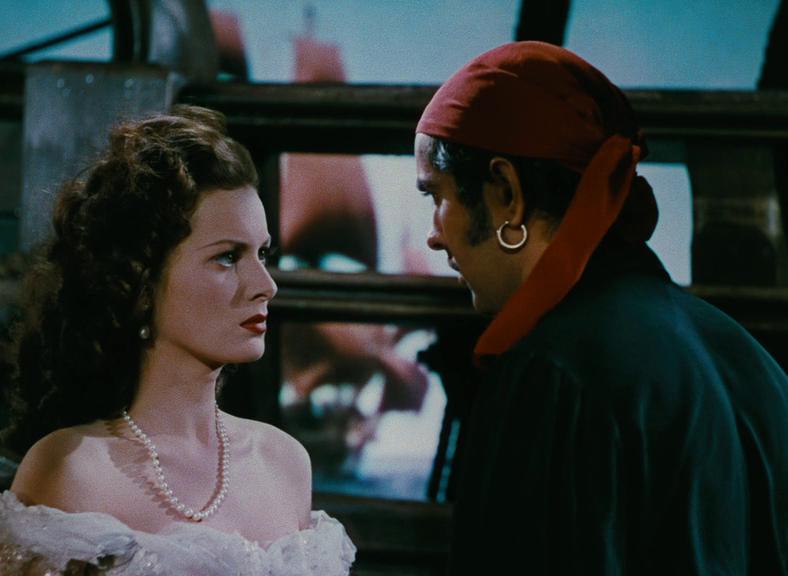
This is a lavish tale of pirates and buccaneers, as the notorious pirate “Captain Henry Morgan” wants to reform, and is made Governor of Jamaica, taking the place of “Lord Denby”. “Morgan” has a mandate to rid the seas of the pirates he once led. Of course, the English, and the Jamaican’s, don’t trust him, and definitely the pirates don’t.

“Captain Jamie Waring” and his lieutenant “Tom Blue”, willingly give-up the trade out of their friendship with “Morgan”.

However, “Captain Billy Leech” and “Wogan” feel otherwise. Meanwhile, “Waring” is falling for the beautiful daughter of the former governor, “Lady Margaret Denby”, but she is engaged to the dashing “Roger Ingram”, played by Edward Ashley, below left. Who is actually a spy for “Leech” and the other pirate captains that want to stay in the trade.
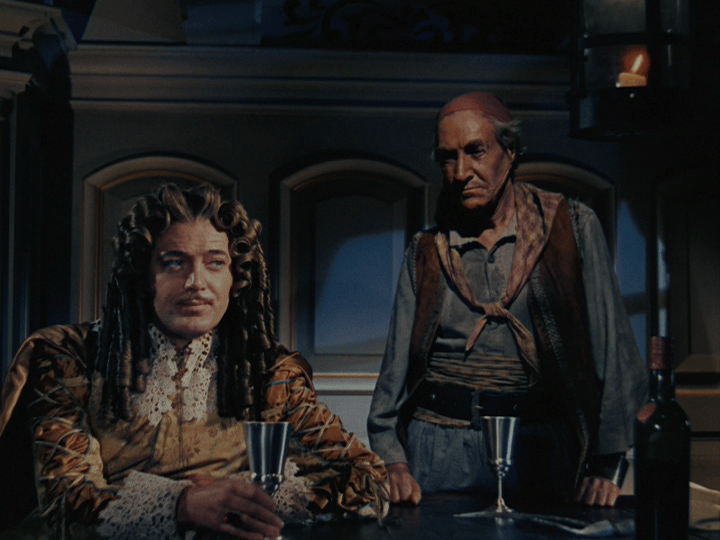
The Jamaican assembly wants “Leech” and the rogue pirates stop.

“Morgan”, below, orders “Captain Jamie Waring” to find Leech’s, “The Black Swan”, and stop them.

“Jamie” doesn’t want “Margaret” to marry “Ingram”, and before he sets sail. He goes to the “Denby” house, gags her, and takes her on board his ship.
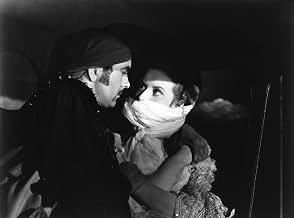

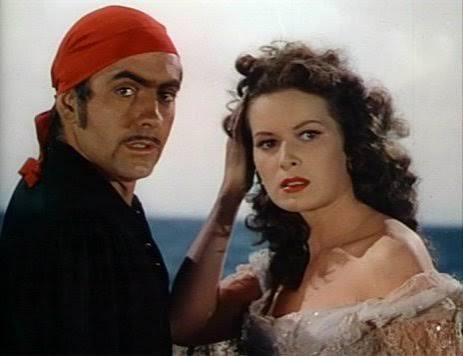
However, “The Black Swan” and the pirate fleet over take “Jamie’s” ship and he is captured. “Jamie” claims that he ran away to marry “Lady Margaret Denby”, and join “Leach”. “Lady Margaret” goes along with ruse.
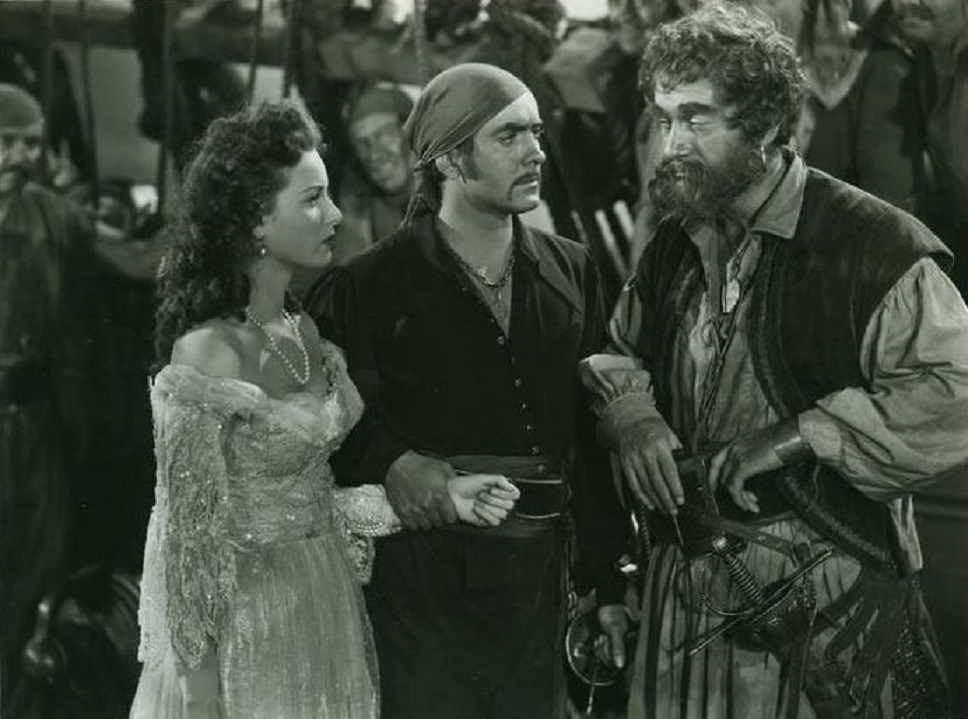

“Henry Morgan” hears of “Jamie Waring’s” betrayal and sets sail to bring him back. While, except for “The Black Swan”, the other pirate ships head to a safe harbor. As the “Swan” heads to the meeting place, “Leach” discovers “Jamie’s” ruse, captures him, puts in with his old crew, and arriving upon the harbored pirate ships. “Leach” uses the more power cannon of the “Swan” to destroy the others. While, “Leach” is firing upon the other pirated, “Jamie” manages to escape. This leads to a duel between the two men and the death of “Leach”, as “Captain Morgan” arrives.
He wants to hang “Jamie” for kidnapping “Lady Margaret”, but she tells him this was all of her own free will. Leading to the happy ending.

The movie starred Henry Fonda portraying “Corporal Colin Spence” and Maureen O’Hara portraying “Valentine Lee”, but the title character was the first other actor’s name, Thomas Mitchell, portraying “Sergeant Kelly”, the “IMMORTAL SERGEANT”, released on January 11, 1943.
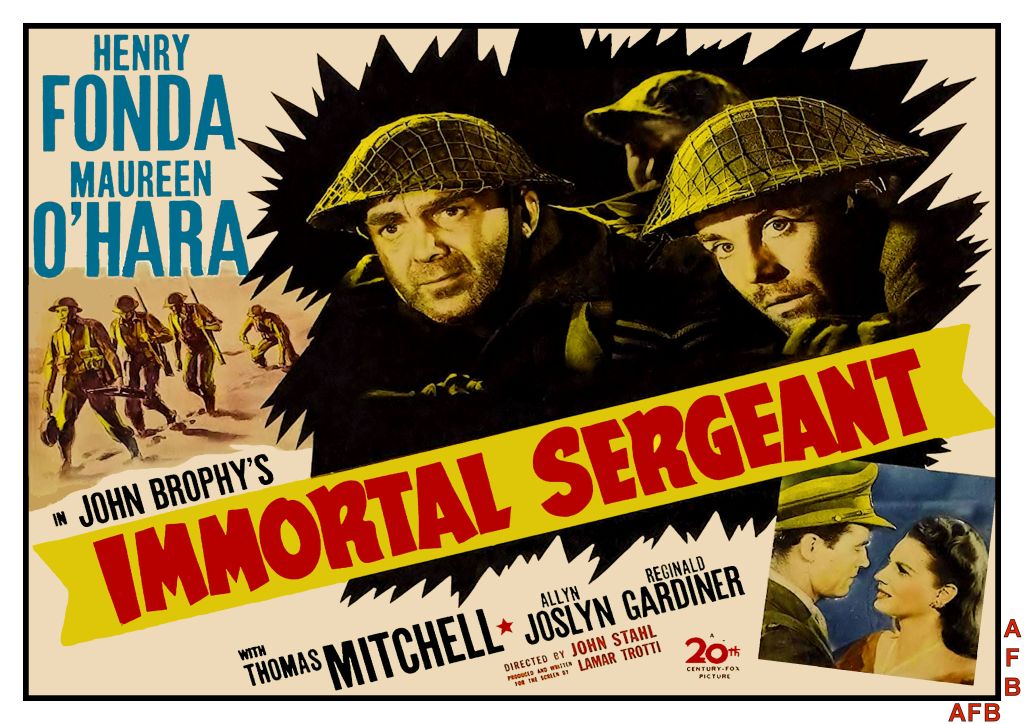
The screenplay was by Lamar Trotti based upon a 1942 novel by John Brophy. The story is about a British patrol is North Africa during the Second World War. The patrol is led by “Sergeant Kelly”, who is accompanied by “Corporal Spence”, a Canadian who has many doubts about himself. They’re attacked by Italian aircraft, and manage to shoot it down. However, it crashes on one of the patrol’s vehicles killing all eight men inside. The remains six men attack an Italian armored vehicle, and in the fight, “Kelly” is mortally wounded. He orders “Spence” to leave him behind, “Spence” refuses, shoots himself, forcing “Corporal Spence” to face his doubts and take command of the remaining four men.
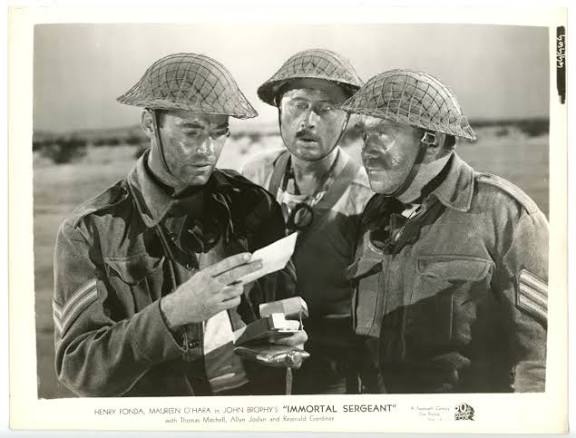
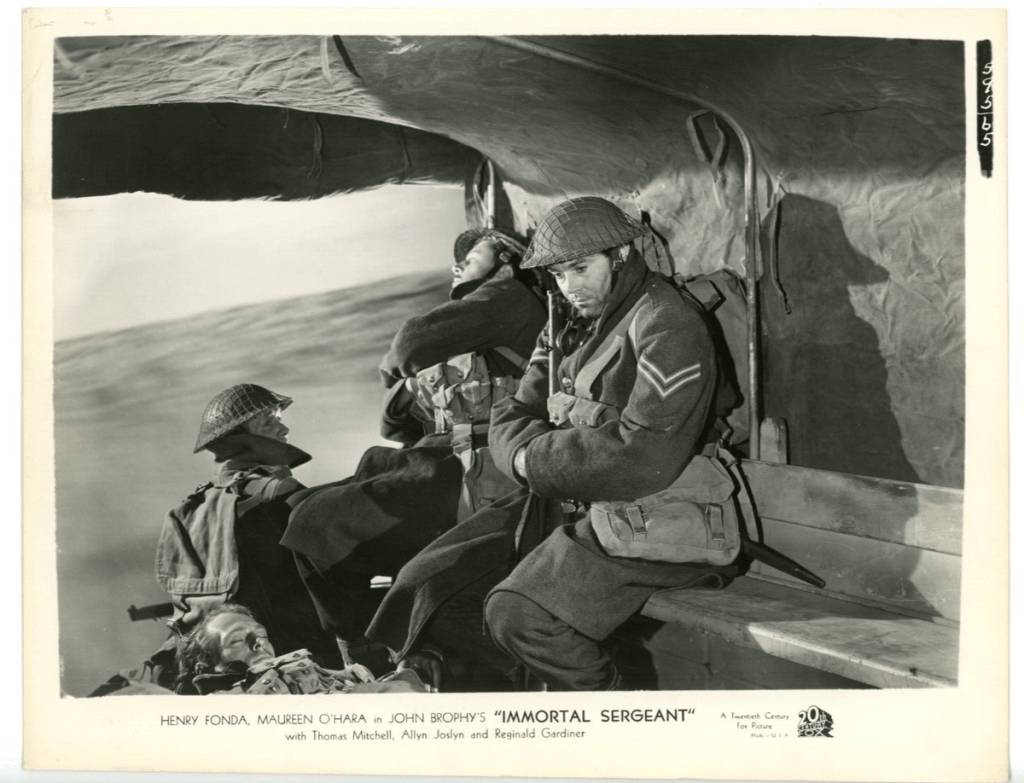
Oh, my reader is looking for Maureen O’Hara? She only appears in flashbacks of “Spence” remembering her.
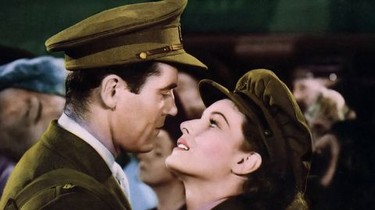
The critics called the film dull and too long, at only 98-minutes. They were mixed about the performances, but this following quote by the “New Yorker” magazine’s, David Larder, on February 6, 1943, about O‘Hara, covers the overall view of her performance and her:
“the strange difficulty O’Hara seems to have in pronouncing polysyllabic words.”
Next, Maureen O’Hara was reunited with both Charles Laughton and George Sanders.
THIS LAND IS MINE released May 7, 1943
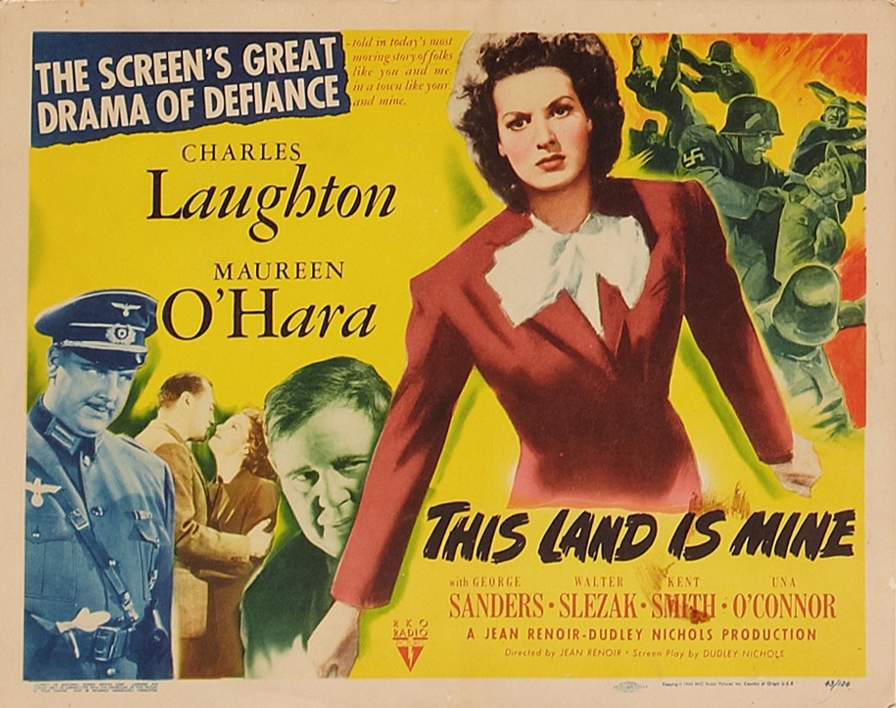
The director of the motion picture was also an uncredited screenplay writer. He was French born Jean Renoir, the director of two classic French motion picture’s, 1937’s, “The Grand Illusion”, and 1939, “The Rules of the Game”. He left France with the invasion of the Nazi’s.
The main writer was Dudley Nichols, John Ford’s, 1935, “The Informer”, and 1939’s, “Stagecoach”. He had just co-wrote, 1943’s, “Air Force”, and followed this motion picture with Ernest Hemmingway’s, 1943, “For Whom the Bell Tolls”.
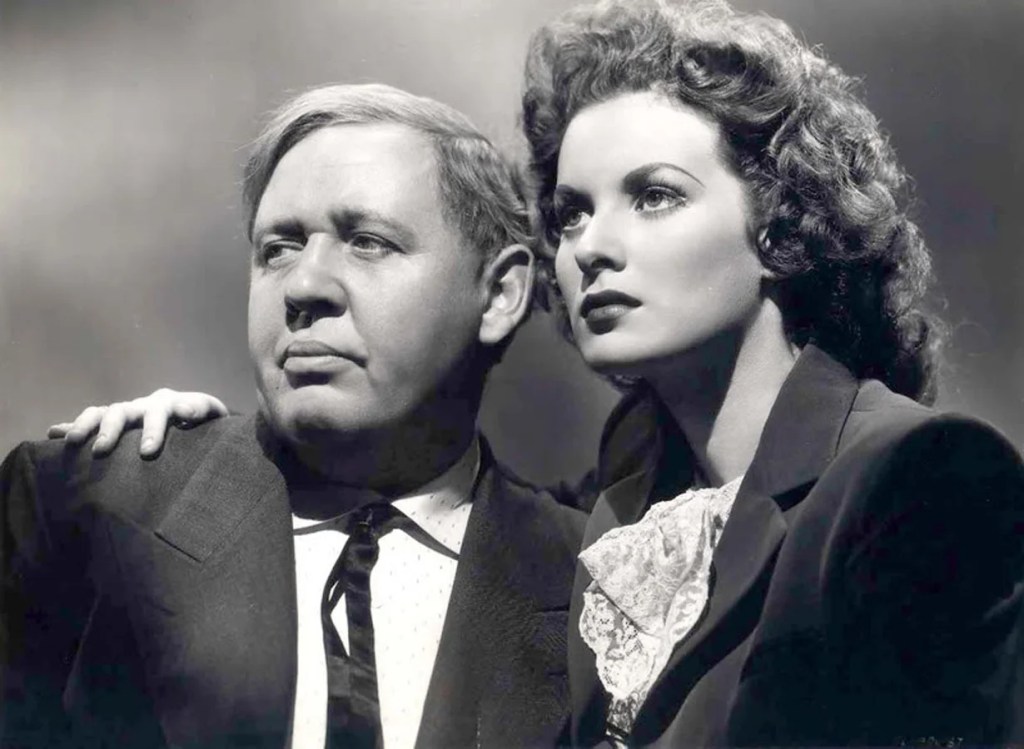
Charles Laughton portrayed “Albert Lory”. Laughton was just seen as part of the All-British-Actors-In the United States, historical story of England, 1943’s, “Forever and a Day”, and followed this feature film with the comedy, 1943’s, “The Man from Down Under”.
Maureen O’Hara portrayed “Louise Martin”.
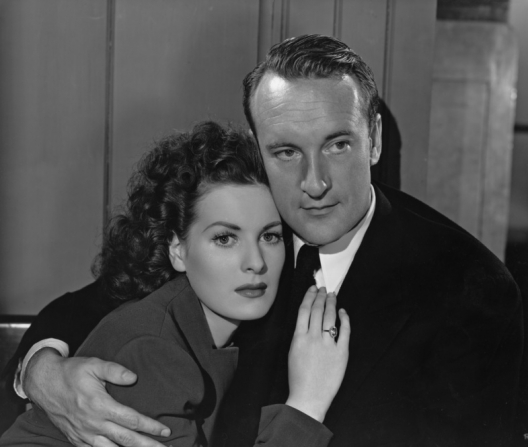
George Sanders portrayed “George Lambert”. In just appeared in the Second World War spy thriller film-noir, 1942, “Quiet Please: Murder”, and followed this picture with “They Came to Blow Up America”.
Walter Slezak portrayed “Major Erich von Keller”. Slezak was just seen in the Cary Grant and Ginger Rodgers comedy, 1942’s, “Once Upon a Honeymoon”, and followed this picture with the next one I will be mentioning.
Kent Smith portrayed “Paul Martin”. To fans of classic horror movies, Kent Smith starred in producer Val Lewton, and director Jacques Tourneur’s, 1942, “Cat People”, and returned in the role, in director Robert Wise’s sequel, 1944’s, “Curse of the Cat People”.
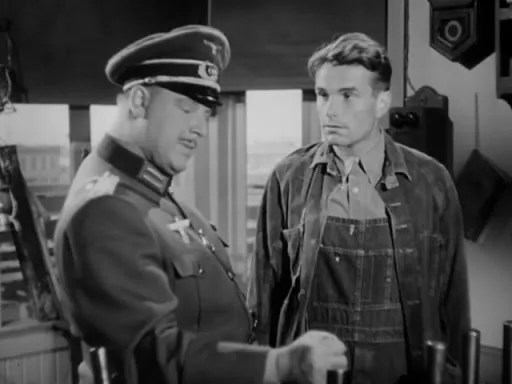
Above, Walter Slezak and on his right, Kent Smith.
The movie is Renior and Nichol’s unusual attack on Nazism, as Walter Slezak’s character is somewhat elegant and obviously very well educated, as the following speech would indicate:
“After all, what is the United States? A charming cocktail of Irish and Jews. Very spectacular; but, very childish. And England? A few old ladies wearing their grandfathers’ leather britches.“
His opponent in this small railway town, will turn out to be Charles Laughton’s shy., introvert, considered ineffectual, school teacher, “Albert Lory”,who lives with his domineering mother, “Mrs. Emma Lory”, portrayed by Una O’Connor, 1933’s, “The Invisible Man”, and 1935’s, “Bride of Frankenstein”.
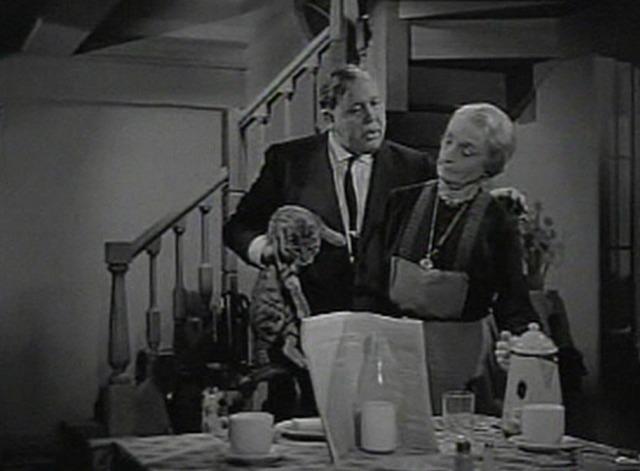
“Louise Martin” is another school teacher, and is engaged to “George Lambert”, the head of the rail yard. Like many in this small town, “George” believes that collaboration with the German’s IS THE ONLY LOGICAL COURSE OF ACTION to keep things peaceful.
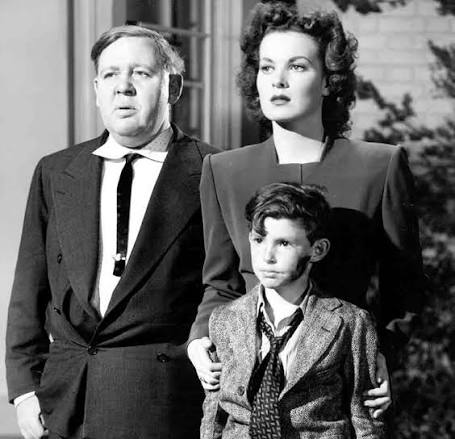
It should be noted, that “Albert” is secretly in love with “Louise”.
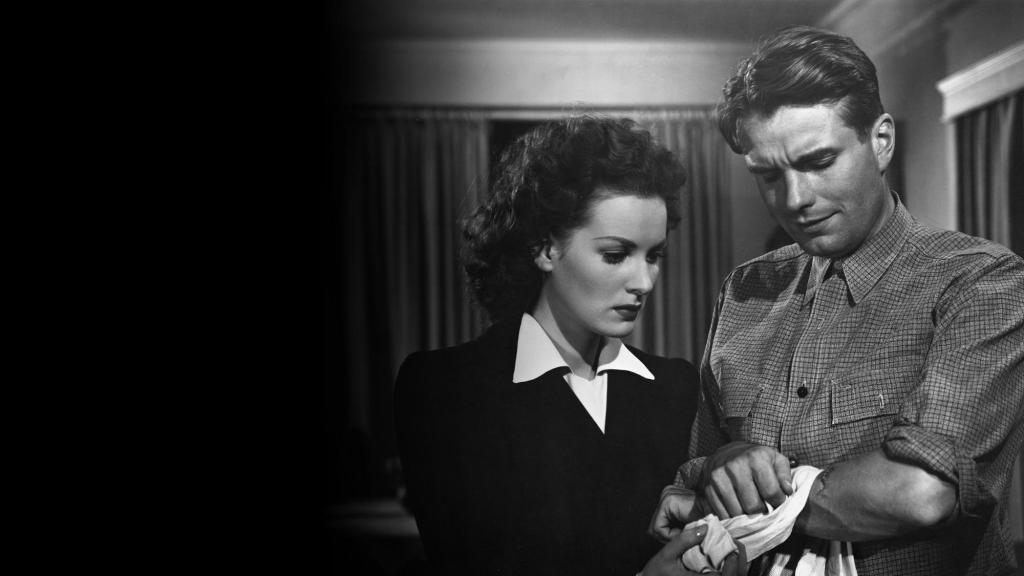
Then there’s “Paul Martin”, “Louise’s” younger brother, a resistance member who attempts to blow up “Major von Keller” with a hand grenade. It doesn’t work as planned, but two other German soldier’s are killed.
After turning a blind eye to previous resistance attacks, such as wrecking a train, the educated “Major Erich von Keller”, becomes the Nazi German commandant of the town and has 10-HOSTAGES taken, one is “Albert”.
IF THE MAN WHO TOSSED THE GRENADE IS NOT REVEALED. In one-week, all ten hostages will be executed.
Next, “Albert’s” mother, who is jealous of “Louise”, whom she believes is taking over control of her son’s affectiond’s tells “George” about her competition’s brother. “Paul” in turn, informed “von Keller”, and “Paul” is ambushed and killed.
“Albert” is released, and “Louise” assumes he told on “Paul” to gain his freedom. The German commandant now tells “George” to use “Louise’s” grief to get the names of “Paul’s” accomplices, but instead, “George” kills himself, realizing what he has done. “Albert” burst’s in to “George’s” house, having learned what his mother did, and of “George’s” role. German soldiers enter and find “Albert” holding “George’s” pistol and arrest him for murder.
The German’s consider the murder a civilian matter, and “von Keller” expects “Albert” to convicted in court. Instead, “Albert” starts an impassioned plea for his country. The prosecutor immediately had the trial stopped, and “Albert” returned to his cell. THAT NIGHT, “Major Erich von Keller” comes to “Albert Lory’s” cell and tells him, that if, he keeps quiet, forged evidence will prove his innocent.
The next morning the “von Keller”, to prove his point of keeping quiet, below “Albert Lory’s” cell window, SHOOT THE REMAINING NINE HOSTAGES. In. court. “Albert” gives an even more impassioned speech for liberty and freedom, and the jurors free him, and the teacher returns to his students.
In class, “Albert Lory”, with a proud “Louise” my his side. Starts reading to his student’s from a book, the French, “Déclaration des droits de l’Homme et du citoyen de 1789 (Declaration of the Rights of Man and of the Citizen 1789)”.
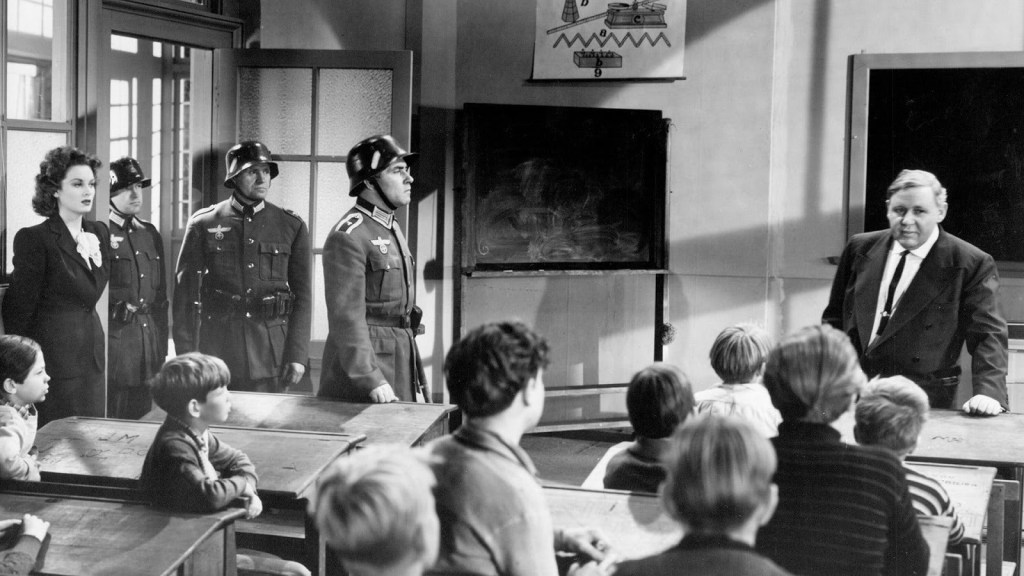
German soldiers enter the school room to arrest “Albert”. He calmly hands the book to “Louise”, who continues to read the rest of the “1789, Declaration”.
Maureen O’Hara followed this excellent piece of Second World War propaganda with a film-noir, psychological, spy drama:
THE FALLEN SPARROW premiered in New York City on August 19, 1943
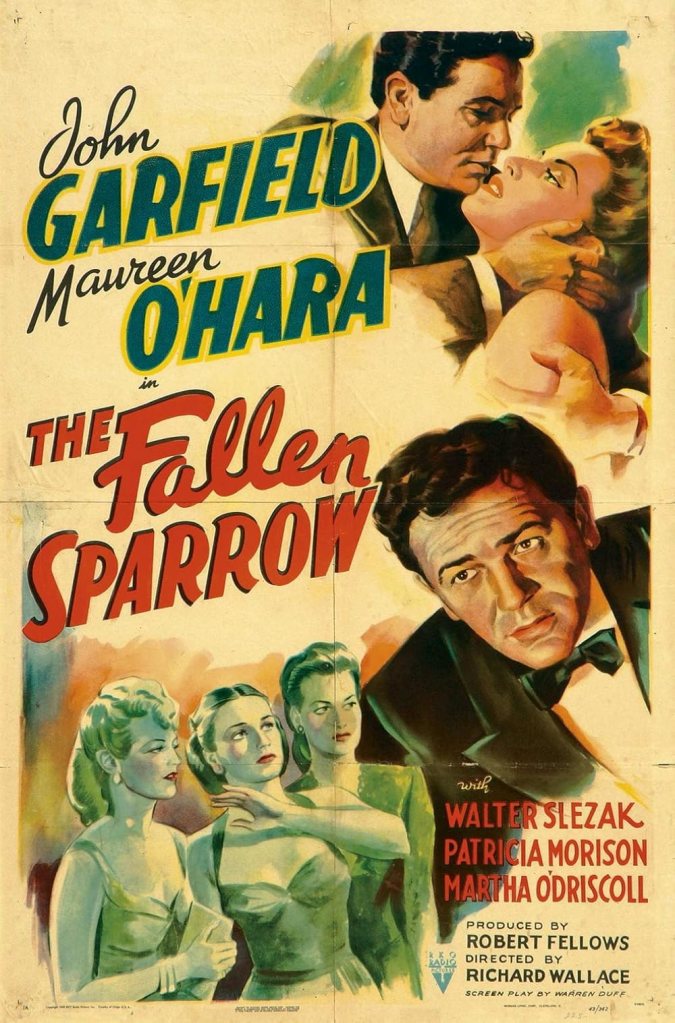
The screenplay was based upon Dorothy B. Hughes novel of the same name. Her novel was turned into a screenplay by Warren Duff, the movie was directed by Richard Wallace, and film edited by Robert Wise. That’s the technical end of the production.
John Garfield portrays a American veteran of the Spanish Civil War, “John ‘Kit’ McKittrick”. Captured, during the war, “McKittrick” was able to withhold vital information, under extreme torture, from a Nazi working for the enemy. However, this trauma has affected his mind. There are only two clear things that “Kit” seems to remember about his torturer. Is that the man was a Nazi, and had a limp. He now leaves his long medical convalescence in Arizona for New York City. Where his boyhood friend, a “Lieutenant” in police force, and was the man who had arranged his escape during the war, was killed under mysterious circumstances. Leaving the train that took him across country to the New York City train station. “Kit” just happens to meet another passenger, who is also departing in New York City. This young woman is a true film-noir, femme fatale, named “Toni Donne”, portrayed by Maureen O’Hara. Whose daughter is a hostage of the Nazi’s somewhere in Europe.
“Kit” wants to find the truth about his friend’s death, and locate an old battle standard that belonged to his All-American company during the Spanish Civil War. He plans to give the battle standard to those of his company now fighting the Nazi’s overseas. His search for both, will move “Kit” into a web of Nazi Spies. Which may, or may not include Walter Slezak portraying “Dr. Christian Skass”.
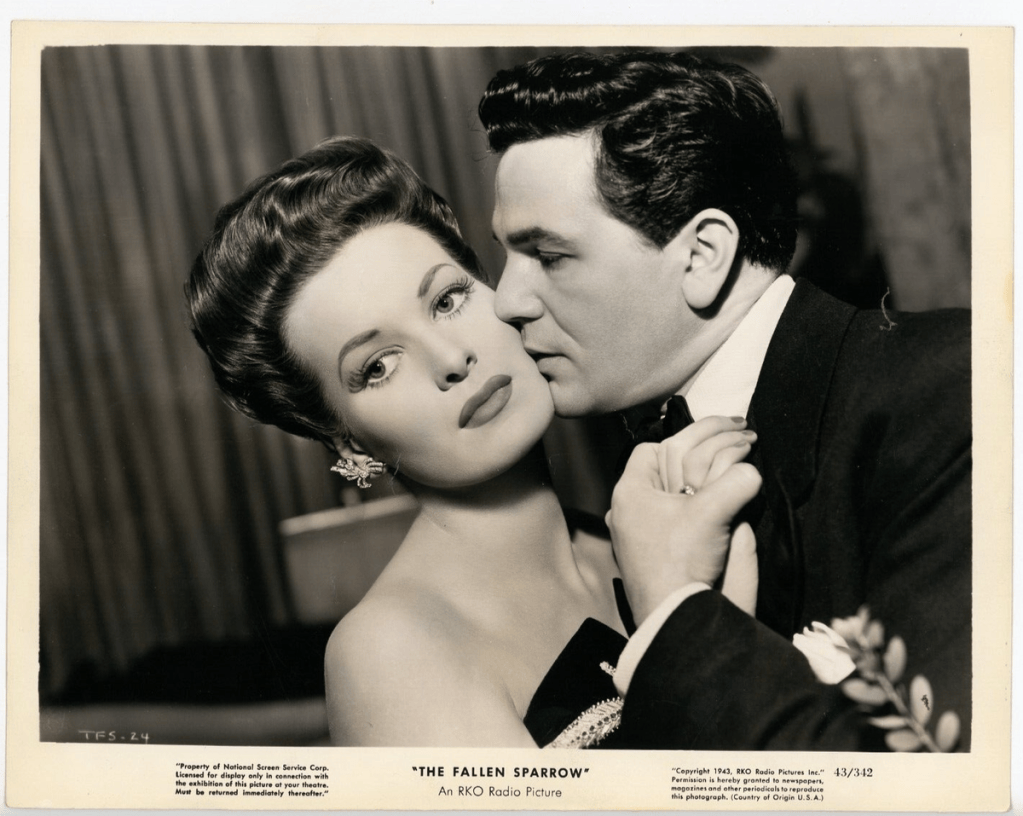
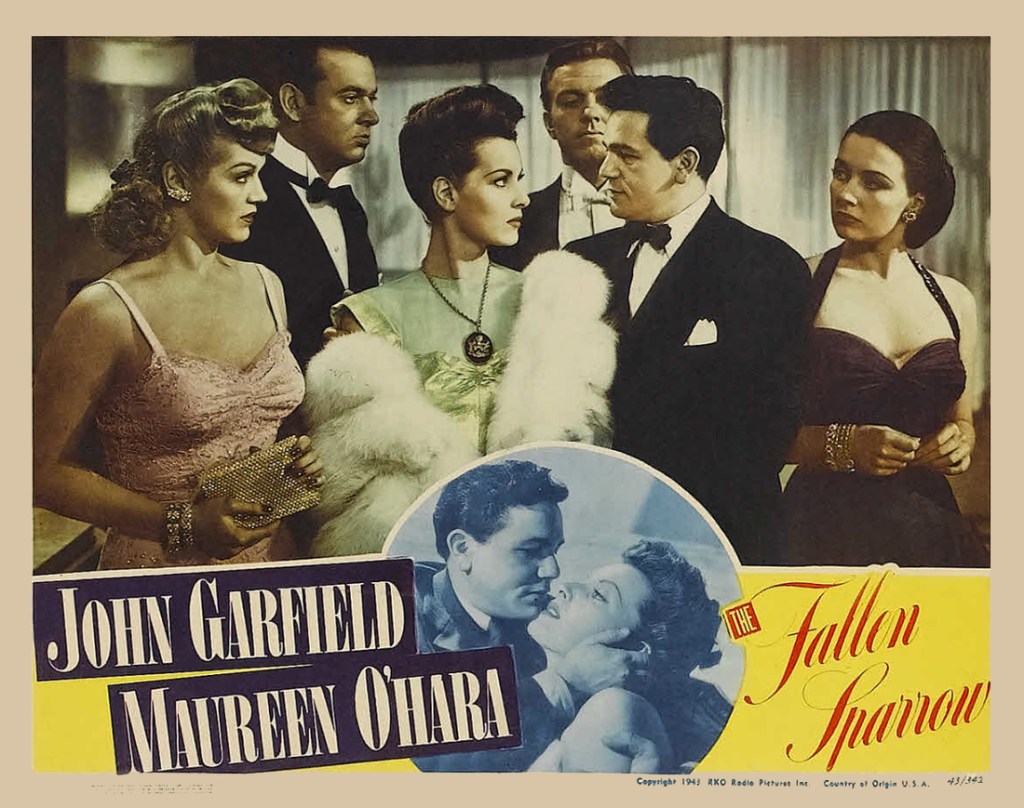
It will take “Kit” and the audience to the final scenes of the screenplay to find out what the film’s title, “The Fallen Sparrow”, means.
Next, it was a typical “Hollywood” biography of:
BUFFALO BILL premiering April 13, 1944 in Los Angeles, California
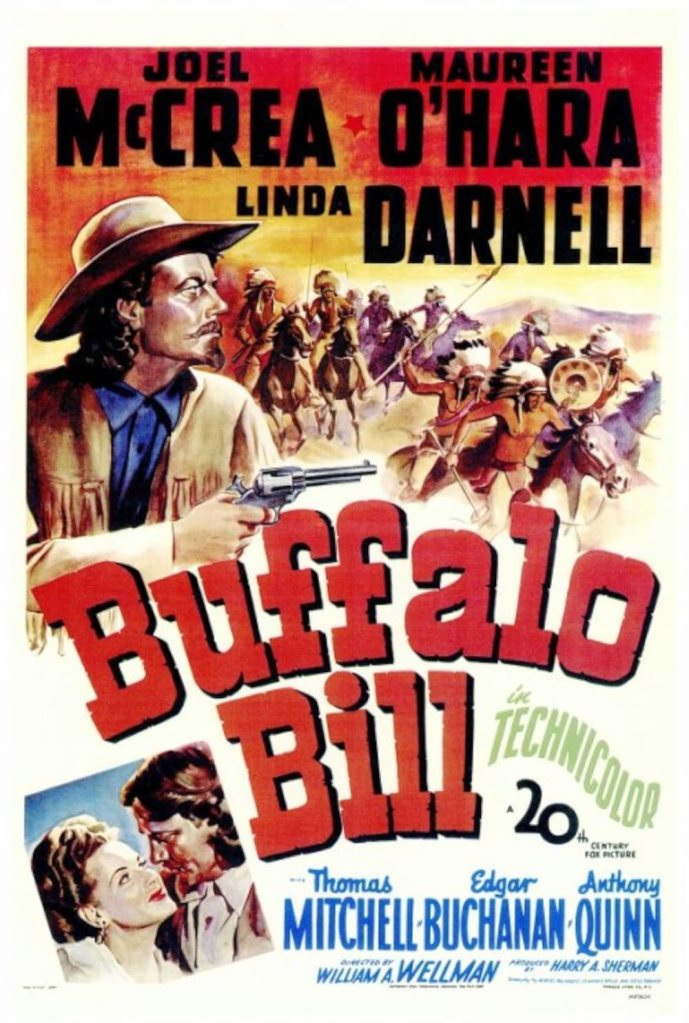
The fictional story of the life of William F. “Buffalo Bill” Cody” came from a Frank Winch. This is all we know about him. Then it took, Aeneas MacKenzie, Clements Ripley, Cecile Kramer, and John Francis Larkin, to turn Winch’s story into the screenplay.
The motion picture was directed by William “Wild Bill” Wellman. He had just directed 1943’s, “The Ox-Bow Incident’, and followed this feature film with 1945’s, “This Man’s Navy”. My article is “WILLIAM A. “WILD BILL” WELLMAN: “3” with JOHN WAYNE: “Island in the Sky”, “The High and the Mighty” and “Blood Alley”, found at:
https://www.bewaretheblog.com/2017/07/william-wild-bill-wellman-3-with-john.html
Joel McCrea portrayed “William Frederick ‘Buffalo Bill’ Cody”. McCrea was last seen in director George Stevens’s, 1943 comedy, “The More the Merrier”, and would follow this feature with director Preston Sturges’s biography of “Dr. W. T. Morgan”, who introduced anesthesia to dentistry, 1944’s, “The Great Moment”.
Maureen O’Hara portrayed “Louisa Frederici Cody”.
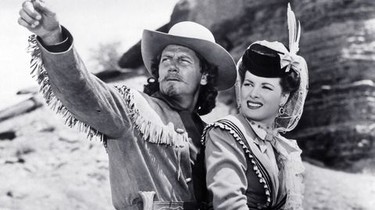
This piece of fiction, follows “Cody’s” life from a United States Cavalry Scout to his Wild West Shows. However, it makes a very enjoyable 90-minutes.
Not to be out done by:
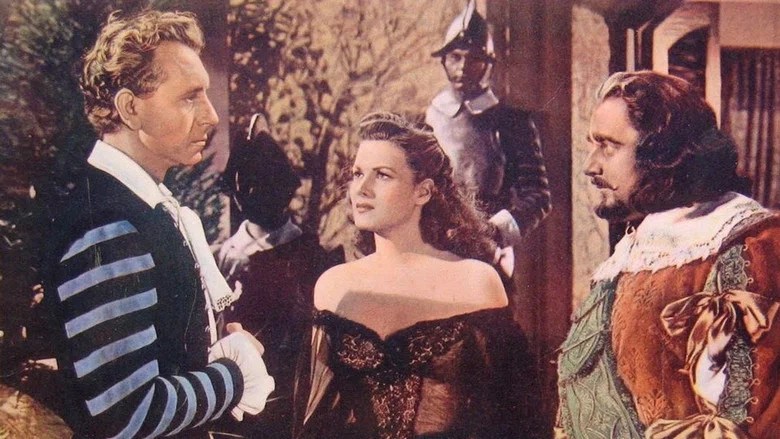
THE SPANISH MAIN premiering on October 10, 1945, in San Francisco, California
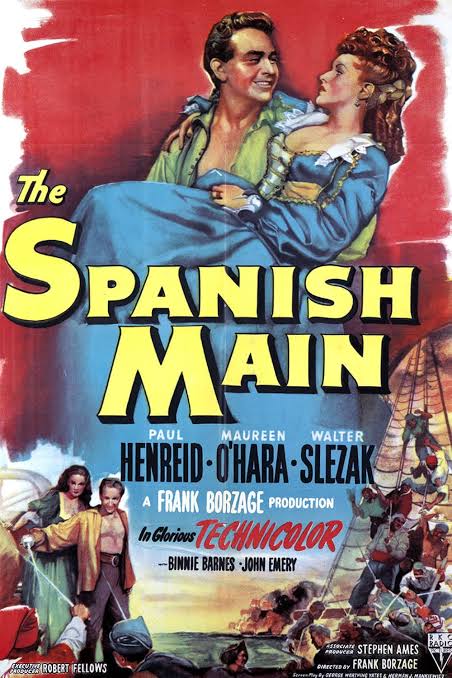
The story came from Aeneas MacKenzie, who had just done the same for 1945’s, “Back to Bataan”. The main screenplay writer was George Worthington Yates, my article is “George Worthing Yates: Screenplays from 1927’s LIGHTNING LARIATS to 1962’s KING KONG VS GODZILLA” found at:
https://www.bewaretheblog.com/2021/01/george-worthing-yates-screenplays-from.html
The second screenplay writer was Herman J. Mankiewicz. who co-wrote with Orson Welles, 1941’s, “Citizen Kane”.
The motion picture was directed by its producer, Frank Borzage. He would direct 107 feature films, produce 31, and act in another 113.
Paul Henreid portrayed “Captain Laurent Van Horn”. Henreid had just been seen in the war thriller, 1944’s, “The Conspirators”, co-starring Hedy Lamarr. In 1946, he co-starred with Ida Lupino, Olivia DeHavilland, and Sydney Greenstreet, in a biography of the Bronte Sister’s, “Devotion”.
Maureen O’Hara portrayed “Contessa Francesca”.
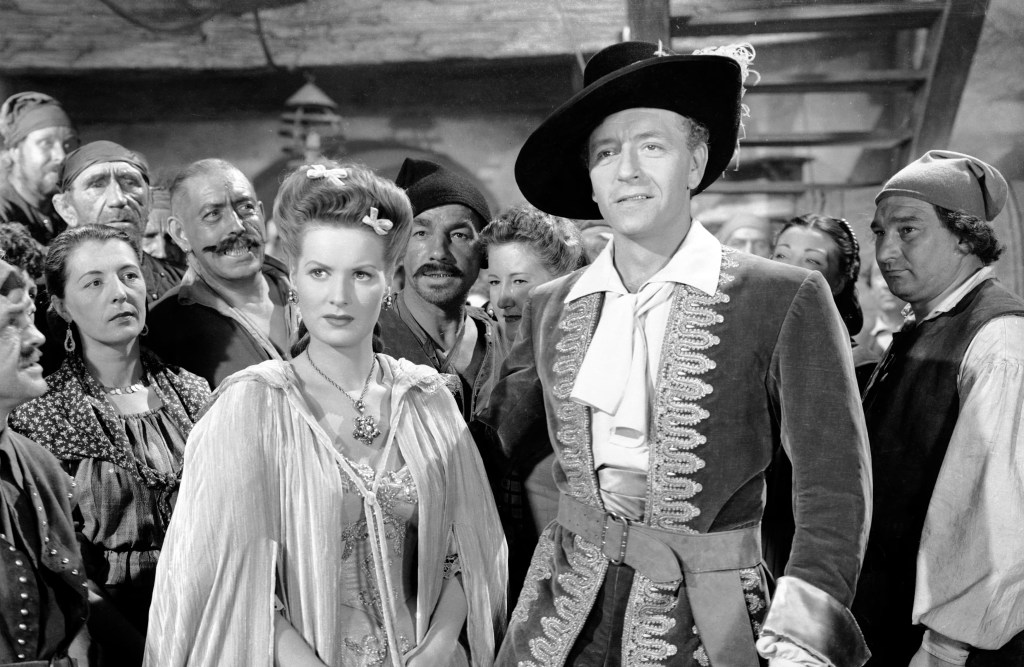
Walter Slezak portrayed “Don Juan Alvarado“. He had co-starred in the Yvonne DeCarlo and Rod Cameron, 1945, “Salome, Where She Danced“, and followed this picture with 1945’s, “Cornered”, starring Dick Powell in a film-noir thriller.
Binnie Barnes portrayed the only real pirate name in the picture. The feared female pirate leader, “Anne Bonney”. Barnes had co-starred with Don Ameche, and the comic “Ritz Brothers”, in a musical comedy version of Alexander Dumas’s, “The Three Musketeers” in 1939. The same year he co-starred in the first sound movie about the gunfight at the O.K. Corral, 1939’s “Frontier Marshall”, with Randolph Scott as “Wyatt Earp”, and Cesar Romeo as “Doc Holliday”.
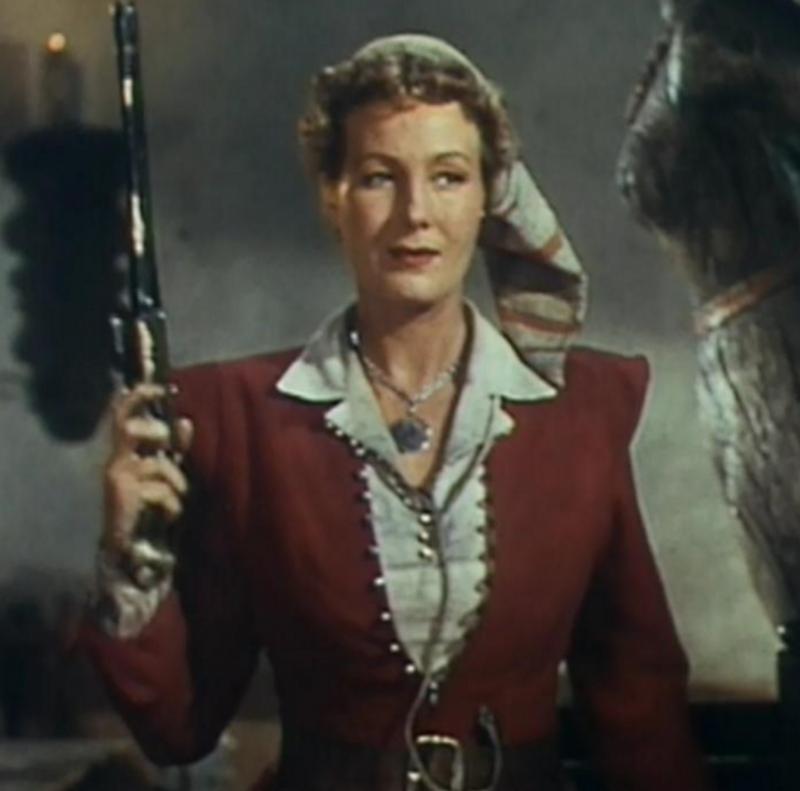
The Basic Pirate Plot:
Dutch “Captain Laurent Van Horn” and his crew are shipwrecked off the Spanish coast and sentenced to death. However, they manage to escape, move five years later, the one time merchant is now a feared pirate sailing the seas on his ship the “Barracuda”. However, he has the dual identity of still a merchant and being the unknown captain of the “Barracuda”.
“Van Horn” captures a ship carrying “Contessa Francesca Alvarado” to her marriage to the Spanish governor “Don Juan Alvarado”. who originally imprisoned him. Don’t ask who came up with the last name of “Alvarado” for two of the main characters, who are unrelated to each other.
In short, “Francesca” and “Van Horn” fall in love, defeat “Don Alvarado”, and two other evil pirates, “Mario Da Bilar”, portrayed by John Emery, 1950’s, “Rocketship X-M, Expedition Moon”, and,, 1957’s, “KRONOS”, seen below, left.
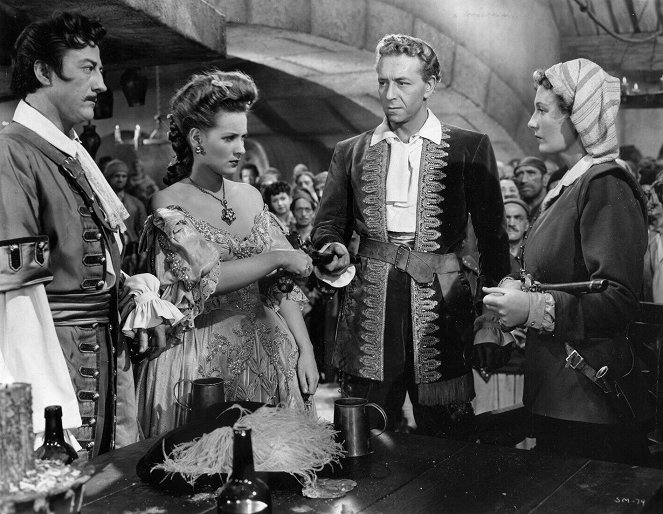
Along with “Captain Black”, portrayed by Barton MacLane, below right..
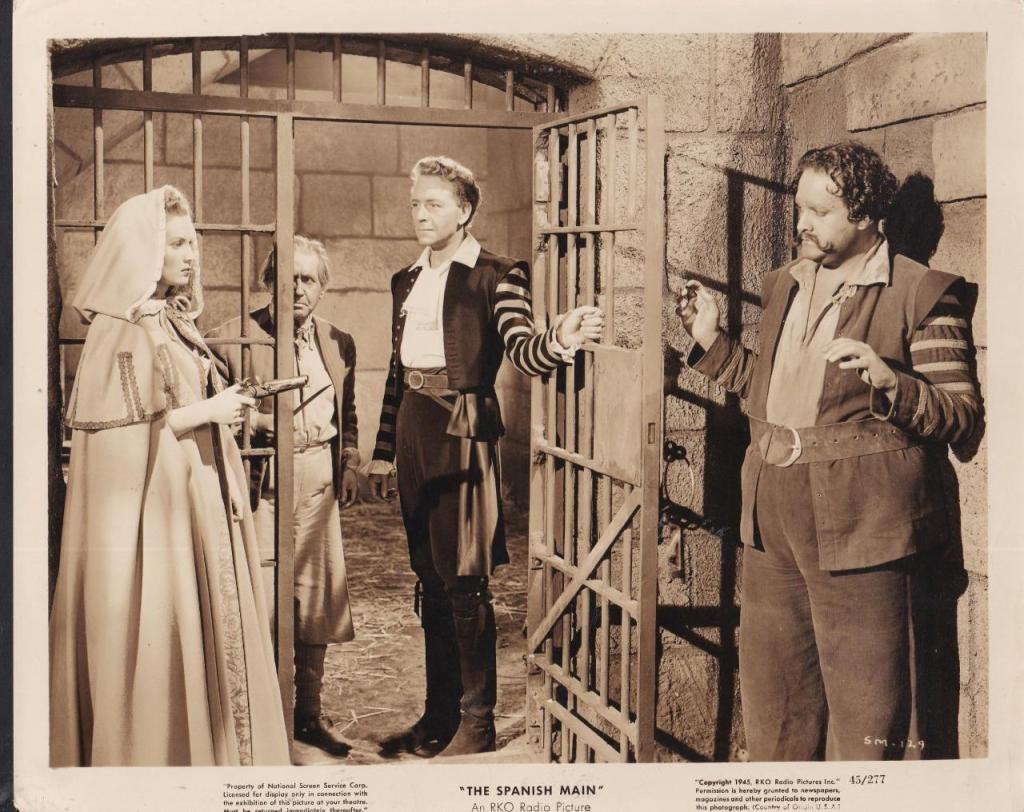
Next came a motion picture that both Maureen O’Hara and John Payne wanted to forget.
SENTIMENTAL JOURNEY premiered in New York City, on March 6, 1946
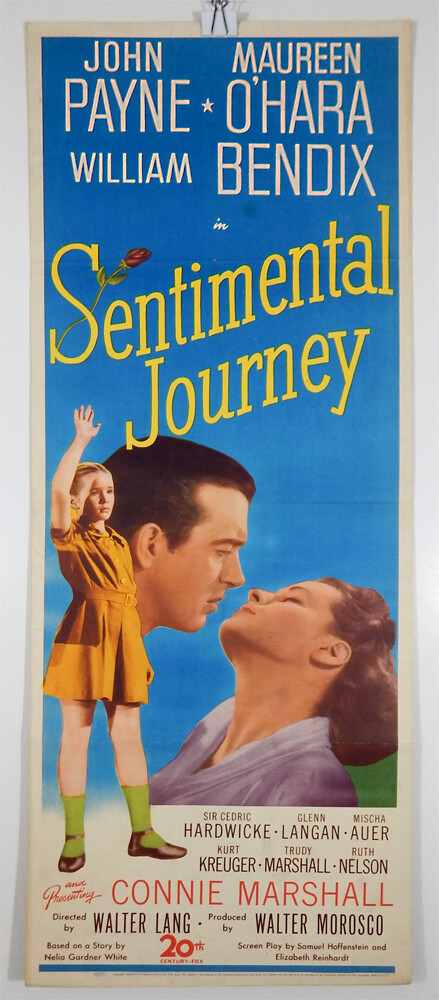
This was supposed to be an uplifting “Tear Jerker”, based upon authoress Nelia Gardner White’s, short story “The Little Horse”, in a 1944 issue of “Good Housekeeping Magazine”.
Note the large lettering on the above poster for CONNIE MARSHALL. Actually Constance Beekman “Connie” Marshall. She was a descendant of the 4th-Chief Justice of the Supreme Court, John Marshall.This was the 13-year-old young actress’s second movie, and the motion picture is built around her character of “Mehitabel “Hitty” Weatherly”. The reason for the large lettering was to draw attention to her and the plans of making her a young star like Elizabeth Taylor had been at her age. That did not work out and her career ended 21-roles later in 1954. Ten of Connie’s role were in episodes television shows.
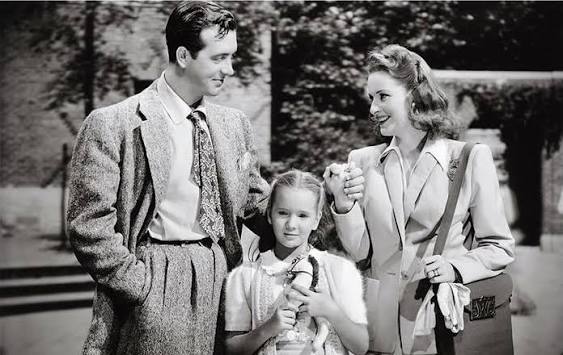
Above, John Payne portraying “William O. Weatherly”, Connie Marshall, and Maureen O’Hara portraying “Julie Beck Weatherly”.
The above still looks like a happy family, but it’s misleading. John Payne and Maureen O’Hara portray a couple who can’t have children, so they adopt Connie Marshall. However, his work as a Broadway producer takes precedence over his family life, and it is “Julie” that becomes close to “Hitty”. Suddenly, “Julie” dies from a heat attack, and “Bill” is totally lost.
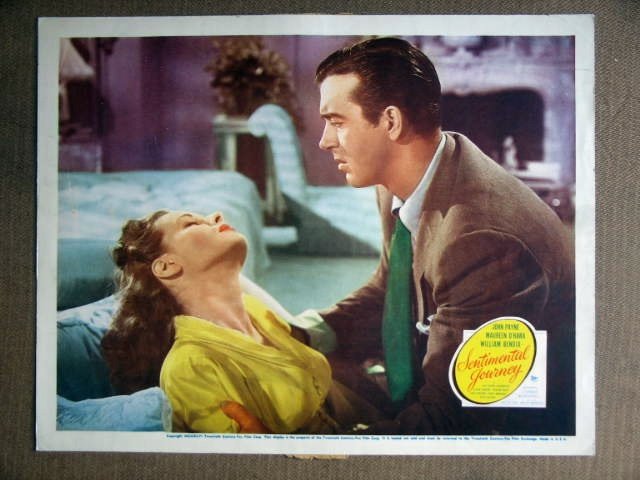
His work becomes his only outlet, and as a result he is driving “Hitty” further from him.
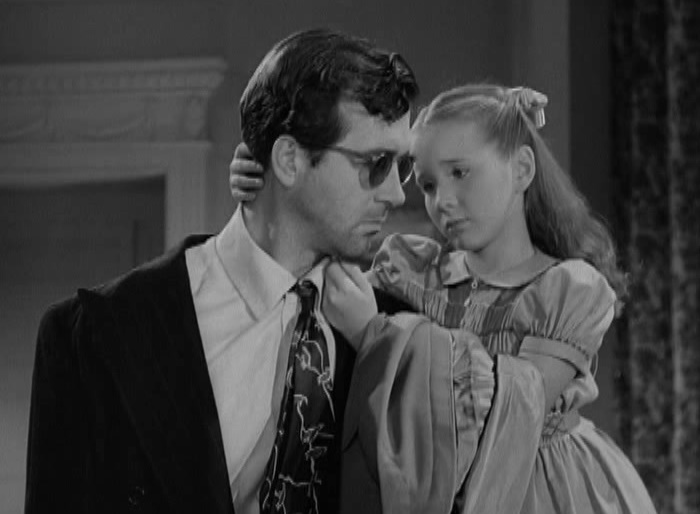
Now enter the “Ghost of Julie” in visions of both “Bill” and “Hitty” to bring them together.
Typical of the reviews of the motion picture came from John McCarten of “The New Yorker”, for March 9, 1946, described the plot as:
“dismal”, adding, that “not the merest trickle of a tear ran down my cheeks”, from a motion picture, “plainly designed to break my heart.”
While the “New York Times” movie critic, Bosley Crowther, March 7, 1946, ripped the movie apart. writing that the picture was:
“utterly mawkish picture … a compound of hackneyed situations, maudlin dialogue and preposterously bad acting and is illogic all the way through.”
From a downbeat story, Maureen O’Hara was co-starring with Band Leader, Benny Goodman, in a “Swinging” movie.
DO YOU LOVE ME premiered in Los Angeles, on May 17, 1946
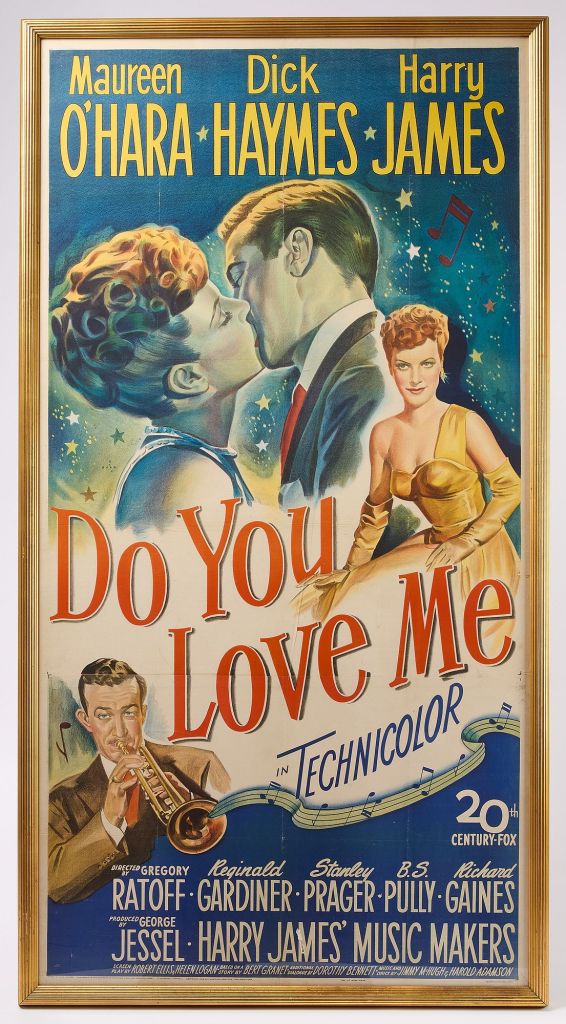
The story is built around band leader Harry James portraying “Barry Clayton”, and his male singer at the time, the popular Dick Haymes, portraying “Jimmy Hale”. The two men are competing for a “PRIM” music school dean, “Katherine ‘Kitten’ Hilliard”, portrayed by Maureen O’Hara.
The audiences wanted to hear music, and Harry James performed three made for the motion pictures songs, “I Didn’t Mean a Word I Said,” “Moonlight Propaganda,” and “Do You Love Me?”. James also performed some classical pieces. Dick Haymes was the main singer on those three songs, but Maureen O’Hara didn’t sing one note. In her autobiography, she complains of that fact and added, she didn’t like this movie.
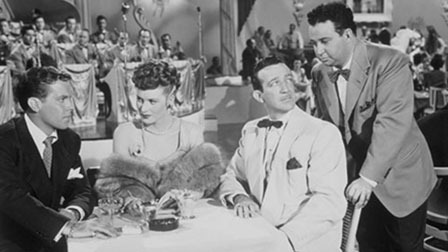
Above seated to Maureen O’Hara’s left is Dick Haymes, to her right, Harry James.
Next, came what this writer considers is the best “All Live Action” movie about the “Arabian Nights” character of “Sinbad the Sailor”.
SINBAD THE SAILOR released January 13, 1947.

The original story was from the previously mentioned George Worthing Yates. The actual screenplay was from John Twist, who just provided the story for the Randolph Scott, and Pat O’Brien, Second World War, 1943, “Bombardier”.
Douglas Fairbanks, Jr. portrayed “Sinbad the Sailor”. Fairbanks, Jr. was still considered on active duty with the with the United States Navy, and had to wear his uniform when he was not filming. The actor was embarrassed having to wear his uniform what not filming. As he was a highly decorated Naval Officer with rows of ribbons for actual combat, and some from France and England for his service.
Maureen O’Hara portrayed the harem girl, “Shireen”.
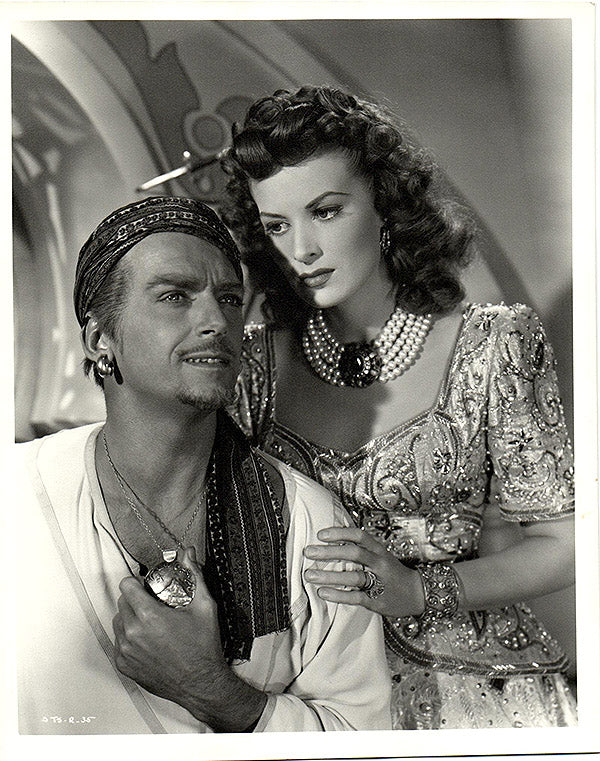
Walter Slezak portrayed the barber “Melik”, or is he the assassin known as “Jamal”? Third billed Slezak will always be remembered for his understated role of the U-Boat Captain in Alfred Hitchcock’s, 1944, “Lifeboat”. His comedic talents were used in 1949’s, “The Inspector General”, starring Danny Kaye, or stealing the picture from Rock Hudson ,and, Gina Lollobrigida, in 1961’s, “Come September”. Which co-starred, the married couple of Sandy Dee, and teen idol, Bobby Darin.
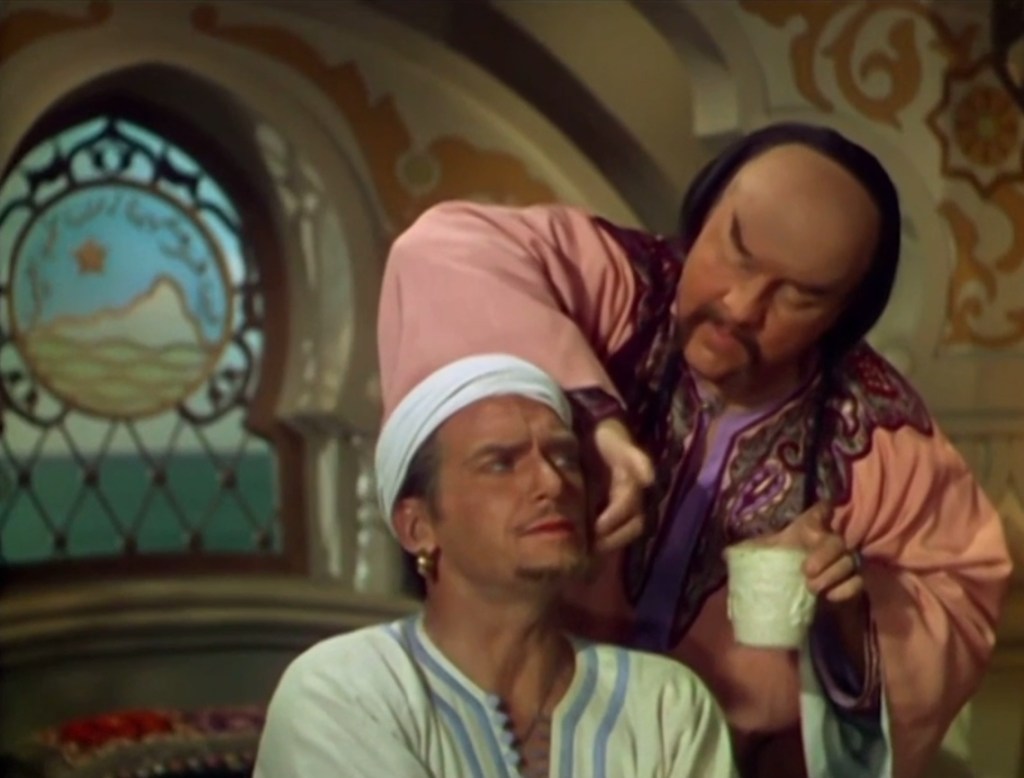
Anthony Quinn portrayed “Emir of Daibul”. Although, Quinn, had appeared in Cecil B. DeMille’s, 1938, “The Buccaneer”, DeMille’s 1939, “Union Pacific”, the Bob Hope and Paulette Goddard, 1940, “Ghost Breakers”, Raul Walsh’s, 1941, “They Died With Their Boots On”, the aforementioned, 1942, “Black Swan”, director William “Wilkd Bill” Wellman’s classic, “The Ox-Bow Incident”, in 1943, and had second billing behind, John Wayne, in 1945’s, “Back to Bataan”. Anthony Quinn was still not considered a star by Hollywood.
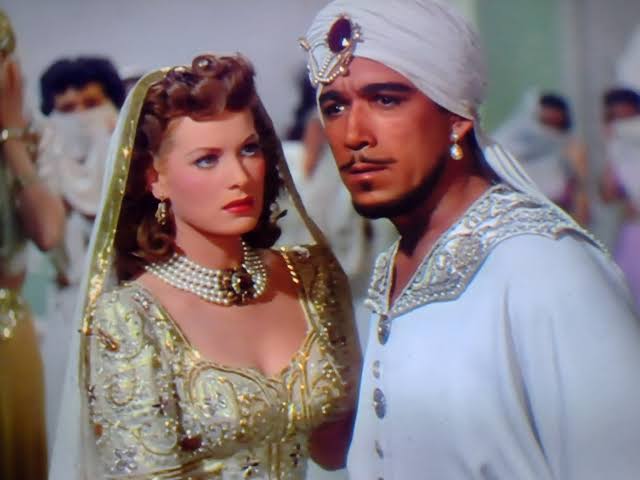
As with most “Arabian Nights” movie, this is a tale told in flashback by “Sinbad”, himself, to an assembled audience around a fire by the boat dock. The movie is about his “Eighth” voyage and opens with:
O Masters, O Noble Persons, O Brothers, know you that in the time of the Caliph Harun-Al-Rashid, there lived on the golden shore of Persia a man of adventure called Sinbad the Sailor. Strange and wondrous were the tales told of him and his voyages. But who, shall we surmise, gave him his immortality? Who, more than all other sons of Allah, spread glory to the name of Sinbad? Who else, O Brother, but – Sinbad the Sailor! Know me, O Brothers, for the truth of my words, and by the ears of the Prophet, every word I have spoken is truth.
The story is about a quest for the lost treasure of Alexander the Great, on the mythical island of “Deryabar”.
As with most “Arabian Nights” movies. This is a tale told in flashback by “Sinbad” himself to an assembled audience around a fire by the boat dock. The movie is about his “Eighth” voyage and opens with:

“O Masters, O Noble Persons, O Brothers, know you that in the time of the Caliph Harun-Al-Rashid, there lived on the golden shore of Persia a man of adventure called Sinbad the Sailor. Strange and wondrous were the tales told of him and his voyages. But who, shall we surmise, gave him his immortality? Who, more than all other sons of Allah, spread glory to the name of Sinbad? Who else, O Brother, but – Sinbad the Sailor! Know me, O Brothers, for the truth of my words, and by the ears of the Prophet, every word I have spoken is truth.”
The story is about a quest for the lost treasure of Alexander the Great on the mythical island of “Deryabar”.
Around “Sinbad’s” neck is a medallion he has worn since birth, or so he says.
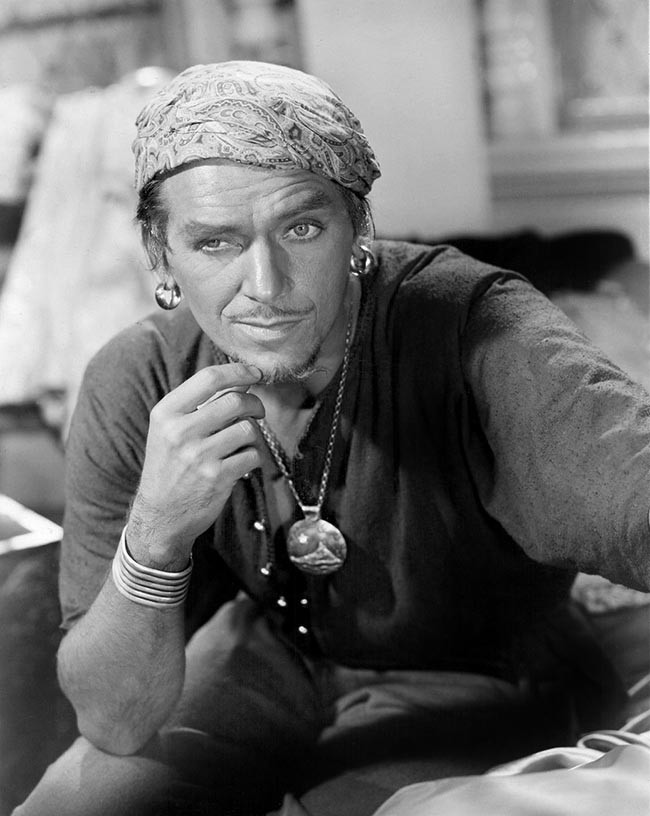
The Medallion has a map on it, showing the way to the fabled Treasure Island of “Deryabar”, or so it is thought.
The fun, and this film still is, starts when Fairbanks, Jr. first sees O’Hara and decides to sneak into the harem of the evil “Emir of Daibul”.
The “Emir” catches “Sinbad” in his harem and is about to order his execution, but notices the medallion. He immediately apologizes to “THE PRINCE OF DERYABAR”.

Meanwhile, “Sinbad” goes on board a ship flying the colors of the “Prince of “Deryabar”. That had been found a by the “Emir’s” men and brought to him. What happened to whomever was onboard was a mystery. While on the ship, “Sinbad” meets the barber “Melik”, who seems to know more than what he saying about the crew’s disappearance. “Sinbad” puts together a crew to sail the small ship, kidnaps “Shireen”, and with “Melik”, they leave “Daibul”. However, the “Emir” in a large ship powered by men chains to its oars followed and overtakes “Sinbad’s” ship. The soldiers of the “Emir” board, and his crew is captured and chained to the oars. While, “Sinbad” becomes the “Emir’s GUEST” and the barber, “Melik” is given some freedom on the ship under watchful eyes.
What follows is a strange alliance of the “Emir”, “Sinbad”, and “Melik”, in search for Alexander the Great’s Treasure Island, “Deryabar”. As the ship moves closer to where, the medallion’s map indicates the island to be. It also becomes clear, that “Melik” is not a barber by trade, but the paid assassin, “Jamal”.

When they arrive at the island, it is deserted, and everything is in ruins. However, there is an old man, referred to as the “Alga”, portrayed by Alan Napier. Character actor, Napier, would become “Alfred”, “Bruce Wayne’s” butler, on television’s “Batman”, starring Adam West and Bruce Ward.

It becomes obvious that the “Alga” was the last real king of the island, and it was he, that placed the medallion on his son. It is also obvious, that “Sinbad” is “Aga’s” real son, and heir to the treasure. To protect the old man/his father, he reveals himself not to be the lost “Prince of Deryabar”, but the”
Greatest Liar in the entire Islamic word, “SINBAD THE SAILOR”.
Who stoled the medallion from another. Which causes “Shireen”, to admit her love of him.
The “Aga”, now relates the story of how he came to the island, and the Treasure of Alexander the Great, that had caused many men’s deaths. However, he also speaks of the real treasure of love, which “Sinbad”, and “Shireen”, appear to have.
The “Aga” next reveals the “Treasure of Alexander the Great” to the two treasure seekers, the “Emir”, and “Jamal”. “Sinbad” tells the “Emir” that “Jamal” plans to kill him with poison, as he did to others before. This leads to the “Emir” forcing “Jamal” to drink his own poison. While sitting in the treasure, “Jamal” finally dies from his own poison.

The “Emir” orders his men to bag up the treasure, and take it to the ship. He also has “Shireen”, against her will, taken there. What he does not know is that one of the bags contains “Sinbad”. Who now proceeds to free his imprisoned crew, and the other men chained to the oars. They take over the “Emir’s” ship, and as the “Emir” is returning from the island in a long boat. “Sinbad” has Greek Fire sent by a catapult at him. In the end, the “Emir” is hit by the balls of fire. “Sinbad’ ends his story at this point, but those he is talking too do not believe the tale. “Sinbad” first produces some of Alexander’s treasure, and then finally “Shireen”.
Next was a horse racing drama that was known more for the newsreel footage than its too routine plot.
HOMESTRETCH premiered in New York City on April 23, 1947
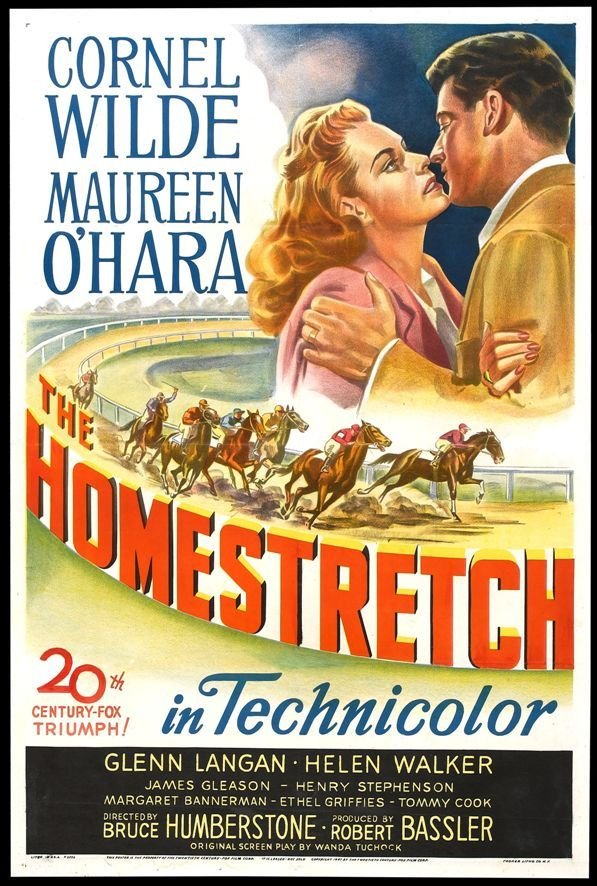
The story and screenplay was by Wanda Tuchock. She had just worked on 1945’s, “Within These Walls“, a prison drama with Thomas Mitchell, as a stern Judge turned Warden, who is just as strict on his two children as the inmate’s.
Bruce Humberstone directed, he had just directed the June Haver musical, 1946’s, “Three Little Girls”, and followed this picture with the Victor Mature, Coleen Gray, and Glenn Langan, western, 1948’s “Fury at Furnace Creek”.
Cornel Wilde portrayed “Jock Wallace”. Wilde had just been seen in director Otto Preminger’s, 1946, “Centennial Summer”, and followed this feature film with the forgotten musical, 1947’s, “Stairway for a Star”, which started filming at the start of the 1940’s, had scene pieced together and not released until this year.
Maureen O’Hara portrayed “Leslie Hale”
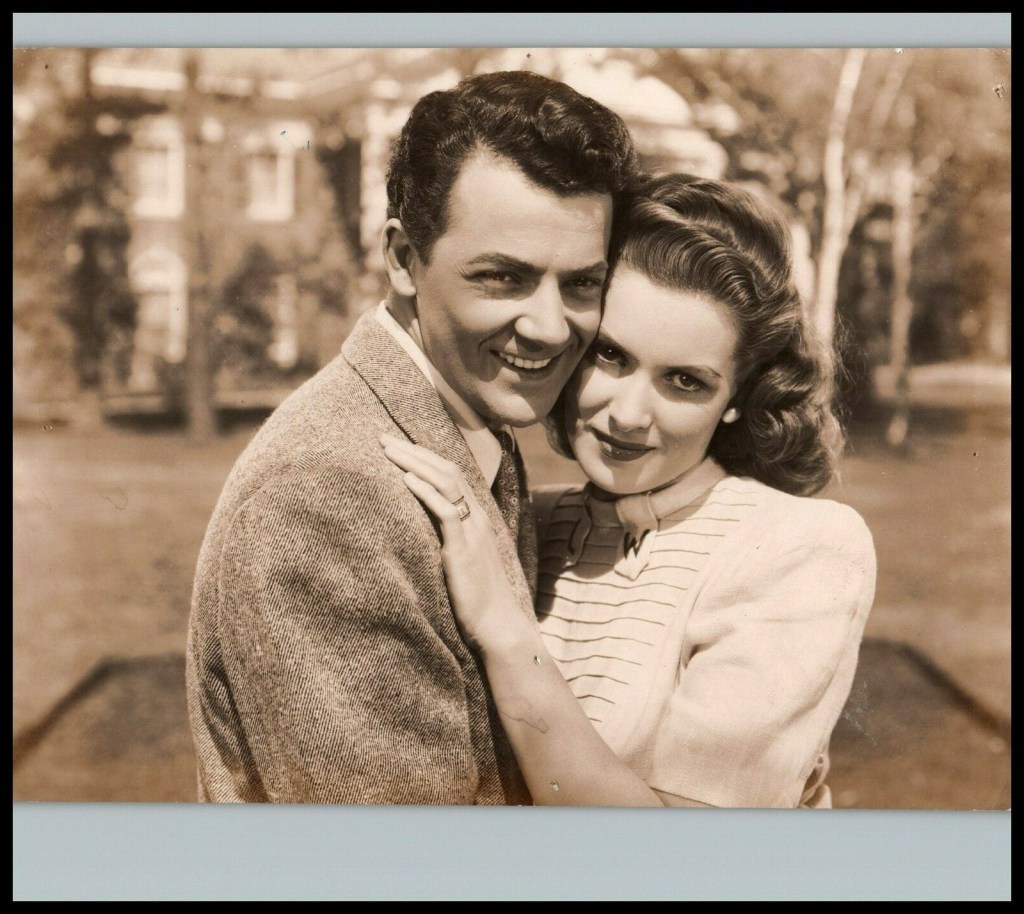
Glenn Langan portrayed “Bill Van Dyke III”. Langan’s career covered all genres of motion pictures and he was a solid supporting actor. However, his name by not be remembered, or known b y 1950’s science fiction fans, but his title role of “Army Lt. Col. Glenn Manning” in producer/director Bert I. Gordon’s, 1957, “The Amazing Colossal Man” is.
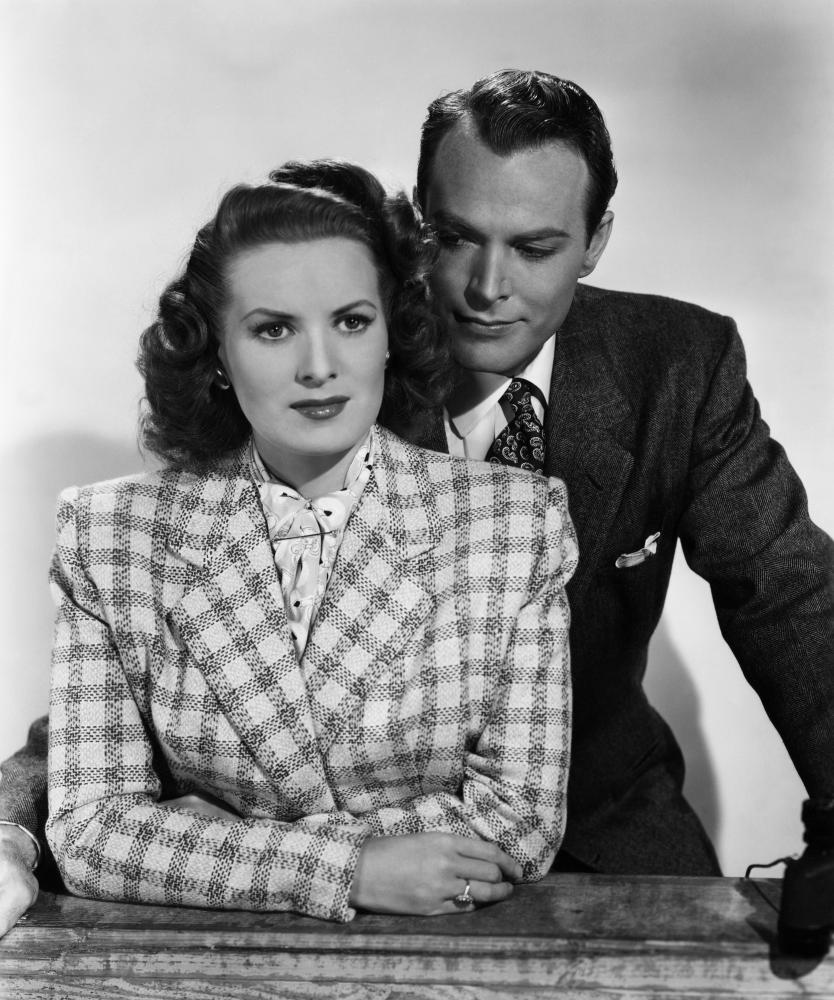
The storyline, such as it is, has horse breeders, “Jock Wallace”, and “Leslie Hale” competing with each other to bred the best race horse and win races over the other. “Leslie” is with an American Diplomat, “Bill Van Dyke III”, who is going to England for the coronation of King George VI, representing the United States. On the ship cruise to England, for an international horse race, during the coronation. “Leslie” and “Jock” fall in love, and are married. However, with the return of “Jock’s” old girlfriend, “Kitty”, portrayed by Helen Walker, and his broken promises, leads to “Leslie” having a miscarriage, and leaving him.
However, as with all good “Hollywood Woman’s Stories”, “Leslie” and “Jock” come together at the film’s end. The climax is set during the “Kentucky Derby”, where “Leslie’s” horse wins, and “Jock’s” horse loses.
As Les Adams <longhorn1939@suddenlink.net> wrote of the “IMDb” website for this motion picture perfectly wrote. Take away the to common drama, and this is:
“A film that qualifies as a Travelogue Documentary in that it contains footage of world famous race tracks such as England’s Ascot, Palermo in South America, and Churchill Downs, Jamaica, Aqueduct, Hollywood Park, Santa Anita, Belmont, Hialeah, Arlington and Saratoga in the United States”
Now for the return of John Payne, not John Wayne, and with a young actress asking is “Santa Claus Real?”.
MIRACLE ON 34TH STREET premiered in New York City on June 4, 1947
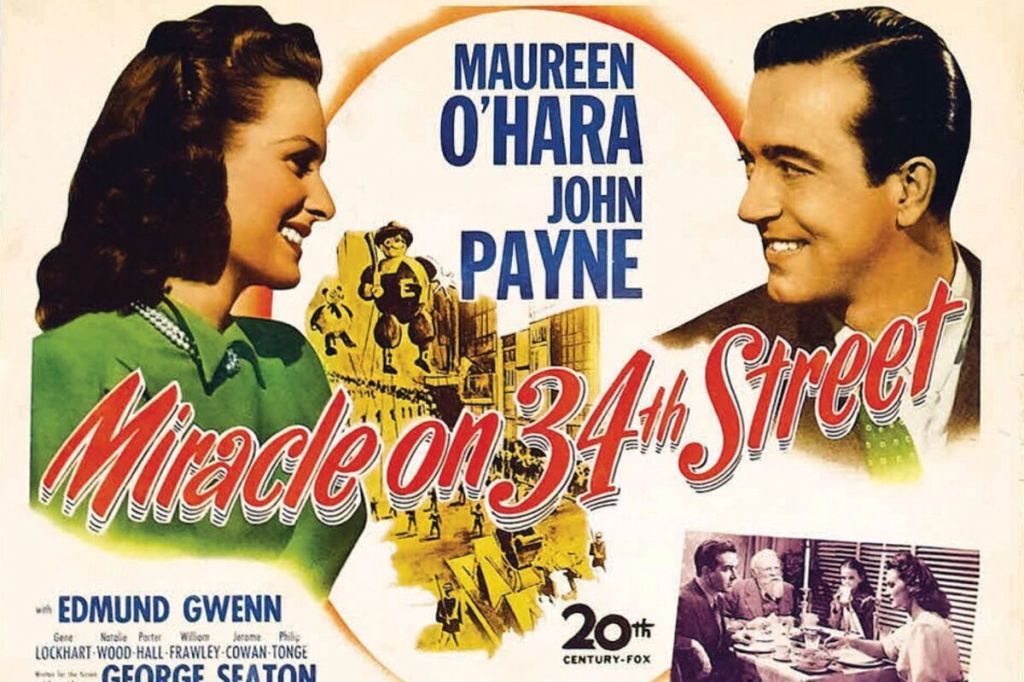
The original story was by Valentine Davies, the film’s producer, who had done both for 1946’s “Three Little Girls in Blue”.
The movies director was George Seaton. Seaton had just directed the Betty Grable, Dick Haymes, musical, 1947’s, “The Shocking Miss Pilgrim”. He followed this motion picture with the 1948 comedy, “Apartment for Peggy”, starring Jeanne Crain, William Holden, and Edmund Gwenn.
Davies won the “Academy of Motion Picture Arts and Sciences, Original Story”.
Seaton won the “Academy of Motion Picture Arts and Science,Best Writing Original Story”.
Maureen O’Hara portrayed “Doris Walker”.
John Payne portrayed “Fred Gailey”. Payne was June Haver’s co-star in the 1946 musical, “Wake Up and Dream”. He followed this feature with the film-noir crime drama, 1948’s, “Larceny”.
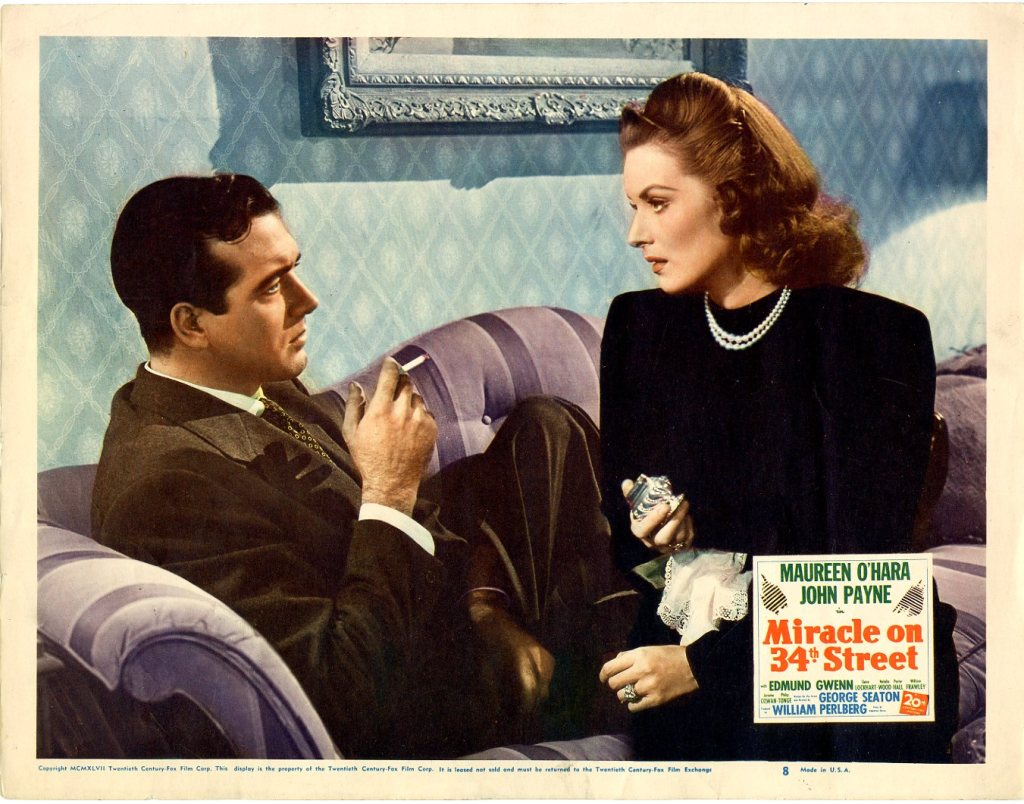
Edmund Gween portrayed “Kris Kringle”. Gween won the “Academy of Motion Picture Arts and Sciences, Best Supporting Actor” award. Gween is known to fans of 1950’s science fiction for his role of “Dr. Harold Medford” in 1954’s, “THEM!”.
Natalie Wood portrayed “Susan Walker”. Wood was 9-years-old, just had a full credited role as “Anna Muir as a Child”, in the 1947 classic, “The Ghost and Mrs. Muir”, starring Gene Tierney and Rex Harrison. She followed this picture with 5th-billing in the “Heart Warming Family Drama”, 1947’s “Driftwood”. Her sister “Lana Wood” had an uncredited role.
Above, Edmund Gween, Natalie Wood, and Maureen O’Hara.
This is the classic story of a divorced mother, “Doris Walker”, who works for “Macy’s Department Store”, and is put in charge of the annual “Thanksgiving”, “Christmas Parade”. The morning of the parade, the “Santa” actor is drunk. She sees a man who looks the part, and hires him to play “Santa Claus”, and is surprised to find out his name is “Kris Kringle”.
This will eventually lead to “Doris’s” neighbor, lawyer “Fred Gailey”, and now her boyfriend, proving in court that “Kris Kringle” is really “Santa Claus”. Along with a happy ending proving to “Susan” that there really is a “Santa Claus”.
From a family Christmas story, Maureen O’Hara moved to a pre-American Civil War, United States and United Kingdom co-production.
THE FOXES OF HARROW released September 24, 1947
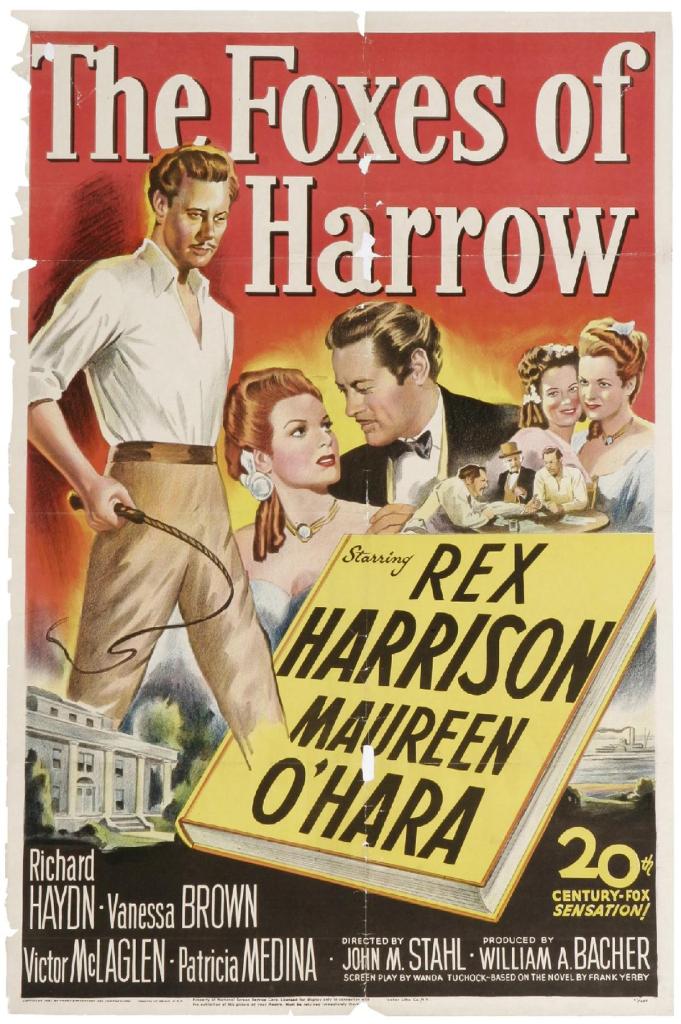
This is the sixth best-selling novel of 1946 in the United States. It was written by Frank Yerby, who once described himself as:
“a young man whose list of ancestors read like a mini-United Nations.”
His ancestry was Native American, African American, and Caucasian.
The screenplay was by Wanda Tuchock, who after this screenplay moved to television writing.
John M. Stahl directed the picture. He was one of two “Fill-In” directors on 1947’s, “The Shocking Miss Pilgrim”. He was the uncredited on director Otto Preminger’s, 1947, “Forever Amber”.
Rex Harrison portrayed “Stephen Fox”. Harrison had just been seen in the previously mentioned, 1947, “The Ghost and Mrs. Muir”, and would follow this feature with the British thriller, 1948’s, “Escape”.
Maureen O’Hara portrayed “Odalie ‘Lilli’ D’Arceneaux”.
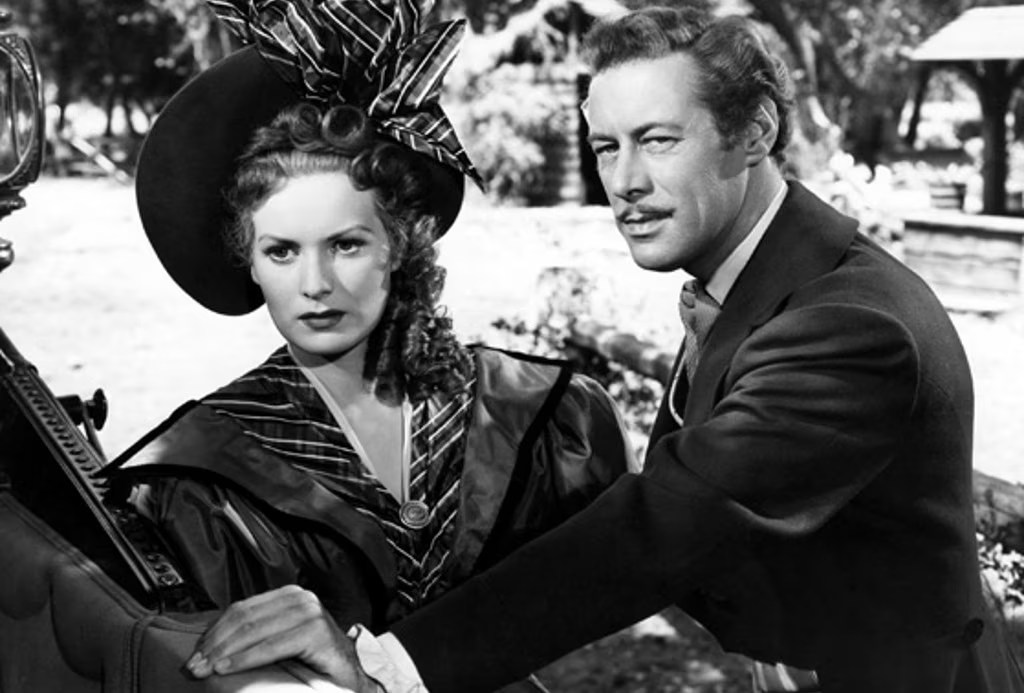
Patricia Medina portrayed “Desiree”. Medina, was a British/Spanish actress who had just been seen in the turn-of-the-century, 1900, London film-noir crime mystery, 1947’s, “Moss Rose”, that starred Peggy Cummins, Victor Mature, Ethel Barrymore, and Vincent Price. In 1956, Patrica Medina co-starred with Guy Madison in the first filmed version of Willis O’Brien’s “Valley of Gwangi” based story, “The Beast of Hollow Mountain”, and who can forget her evil queen in 1961’s, “Snow White and the Three Stooges”.
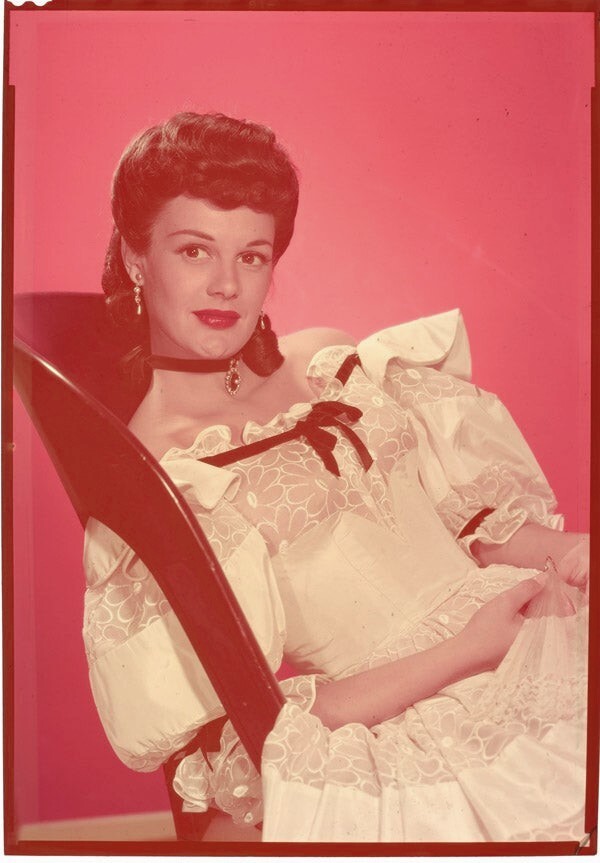
Based upon a best selling novel, and with this cast, the motion picture had the chance of being a major hit. Instead, it was a major box office flop. Which wasn’t the fault of the screenplay as originally written, or the the assembled cast. It was the fault of Joseph Breen of the “Hays Office” protecting American morality.
The very basic plot has “Stephen Fox”, the illegitimate son of an aristocratic Irish family in Ireland, coming to the United States. He is a gambler that is thrown off of a Mississippi River boat, and lands in New Orleans. There, he enters a high steaks poker game, wins a Louisiana Estate, and a small fortune. His estate now becomes “Harrow” a direct reference to his Irish aristocratic family. After entering New Orleans’s High Society. He falls in love with a Creole woman, “Odalie D’Arceneaux”, and the two marry. However, “Stephen” is a womanizer, and his mistress is “Desiree”. Luck runs out for “Fox”, and he loses his wealth gambling, but “Odalie” stays with him, and he finds true love and redemption.
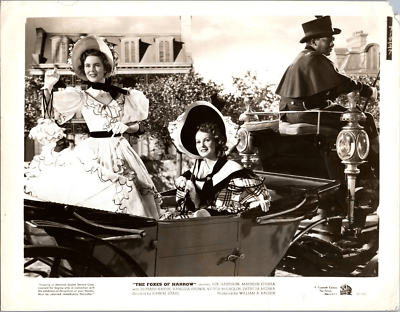
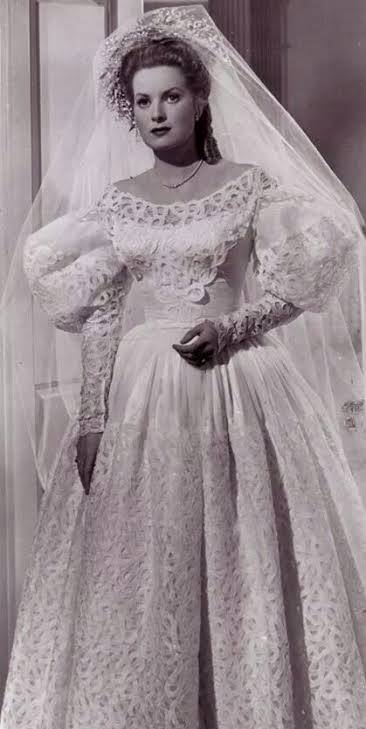
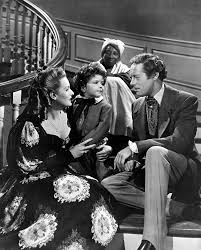
However, that was not the plot of the first best selling novel by a “Colored” writer. The original screenplay as written, followed the novel closely, and that’s what ran afoul of the “Hays Office”. Among their changes were:
In the novel, “Desiree” is part African-American, and the screenplay had to be rewritten making “Stephen’s” mistress a White Woman. The “Motion Picture Production Code” forbid any depiction of inner-racial marriage (miscegenation).
Under the code any extramarital affairs could not be shown as attractive, and never, explicitly detailed. In this case, the novel’s relationship between “Stephen” and “Desiree”, became strangely platonic.
Frank Yerby’s novel had realistic relationships between the White’s and African-American characters. He highlighted anti-slavery and African-American characters who fought for freedom and justice. These two areas were either very toned down, or eliminated altogether. This reduced the African-American character’s of Yerby’s novel to minor screenplay characters, if they were even mentioned.
From a pre-American Civil War drama, Maureen O’Hara’s next motion picture was a satirical comedy classic of the period.
SITTING PRETTY premiered in New York City on March 10, 1948
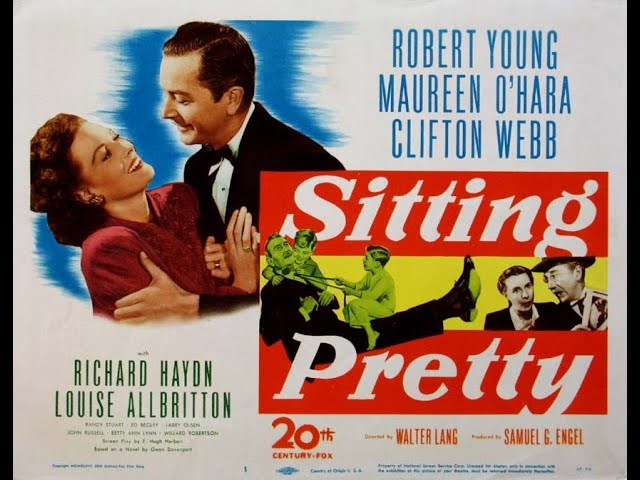
The above poster is how the original release was billed. However, after the film’s release, 3rd-billed Clifton Webb would be moved up and trade places with Maureen O’Hara.
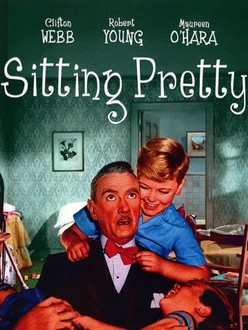
The screenplay was based upon Gwen Davenport’s, 1947, novel, “Belvedere”.
The screenplay was written by F. Hugh Herbert. He had just co-written the screenplay for the romantic comedy, 1946’s, “Margie”, that starred Jeanne Crain and Glenn Langan. Herbert wrote the Broadway comedy “The Moon is Blue”, and the screenplay for the 1953 motion picture. That was the shocking, motion picture code movie, because it made “light and gay treatment of the subject of illicit sex and seduction.”
Walter Lang directed, he had just directed the Betty Grable and Dan Dailey musical romance, 1947’s, “Mother Wore Tights”, and followed this film with the Betty Grable and Dan Dailey, 1948, musical romance, “When My Baby Smiles at Me”.
Robert Young portrayed “Harry King”. Young had just been seen in the 1948 western, “Relentless”, and followed this picture with the coming-of-age, 1949’s, “Adventure in Baltimore”, co-starring the teenage, Shirley Temple.
Maureen O’Hara portrayed “Tacey King”.
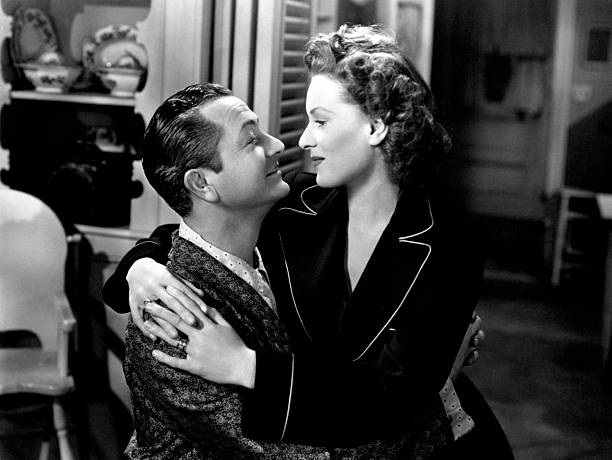
Clifton Webb portrayed “Lynn Belvedere”. Webb’s over the top “Belvedere”, led to 1949’s, “Mr. Belvedere Goes to College”, and 1951’s, “Mr. Belvdere Rings the Bell”.
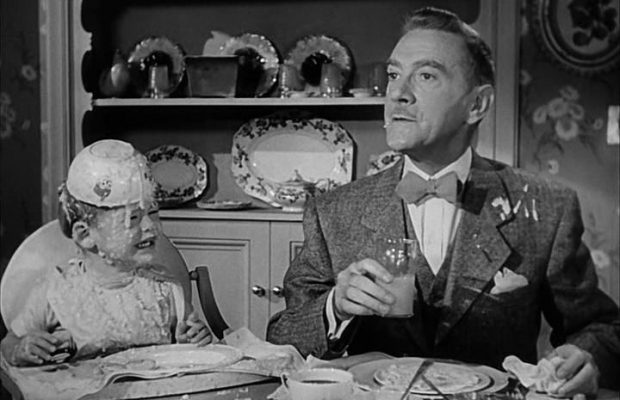
Young lawyer “Harry King” and his working wife, “Tacey”, have problems keeping a “Nanny” for their two rambunctious boys, “Larry”, portrayed by Larry Olsen, and “Tony”, portrayed by Anthony Snyder.Then there’s the baby, “Roddy”, portrayed by Roddy McCaskill, and also by the above baby, by Raymond C. Hair, Jr.
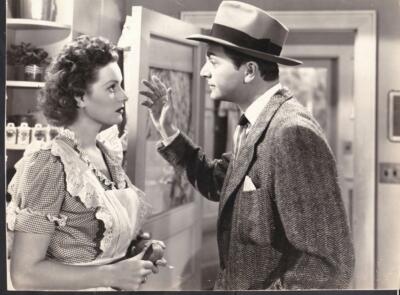
“Tacey” is fed up, and in a hurry, looks at list of applicant’s for the role of “Nanny”. She chooses a young woman named “Lynn Belvedere”.
When she arrives, SHE is a HE. Who immediately states that HE HATES KIDS!
However, “Mr. Belvedere” is a man of many talents and “Tacey” and “Harry” agree to give him a trial period, and the fun kicks in. I highly recommend this family film to my readers, if for no other reason. Than to see Clifton Webb steal the movie and reduce Young and O’Hara to his supporting actors.
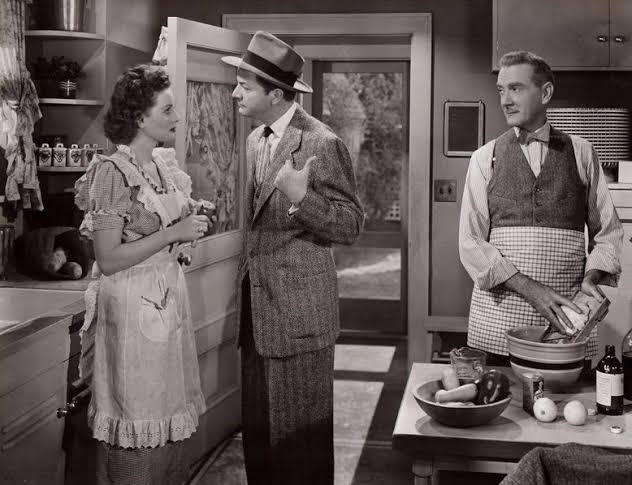
From a satirical comedy to MURDER!
A WOMEN’S SECRET released first in London, England, on January 13, 1949
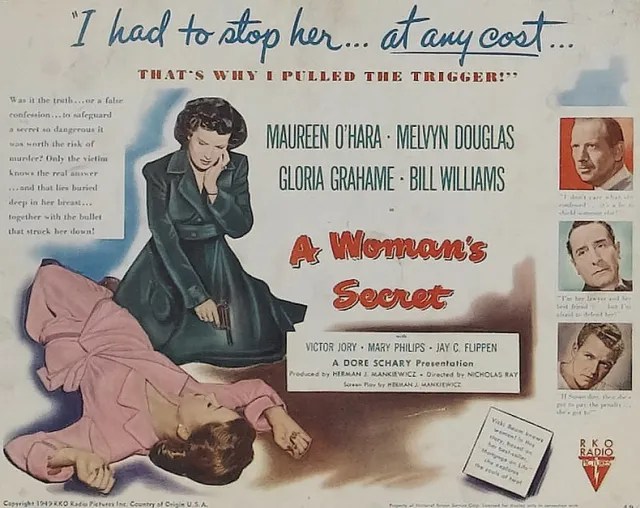
The screenplay was based upon Austrian writer Hedwig “Vicki” Baum’s,, 1946 novel, “Verpfändetes Leben (Mortgage on Life)”.
Herman J. Mankiewicz wrote the screenplay. His previous screenplay, I have already mentioned, was 1945’s, “Spanish Main”.
Nicholas Ray directed, among his films is the Joan Crawford, Sterling Hayden, and Mercedes McCambeidge, in 1954’s, “Johnny Guitar”, 1955’s, “Rebel Without a Cause”, starring James Dean, Natalie Wood, and Sal Mineo, and the epic, 1963, “55 Days at Peking”, starring Charlton Heston, Ava Gardner, and David Niven.
Maureen O’Hara portrayed “Marian Washburn”.
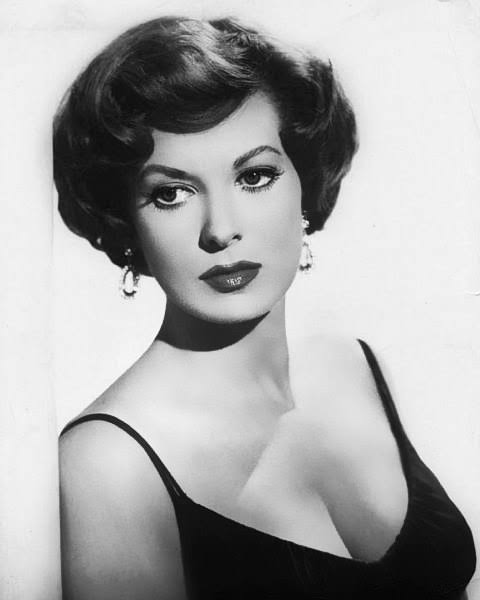
Melvyn Douglas portrayed “Luke Jordan”. Douglas had just appeared in 1948’s, “Mr. Blandings Builds His Dream House”, co-starring with Cary Grant and Myna Loy. He followed this movie with 1949’s, “My Own True Love”, co-starring Phyllis Calvert.
Gloria Grahame portrayed “Susan Caldwell/Estrellita”. Grahame had just co-starred with comic Red Skelton in 1947’s, “Merton of the Movies”. She followed this feature film with the 1949 western, “Roughshod”, co-starring with Robert Sterling.
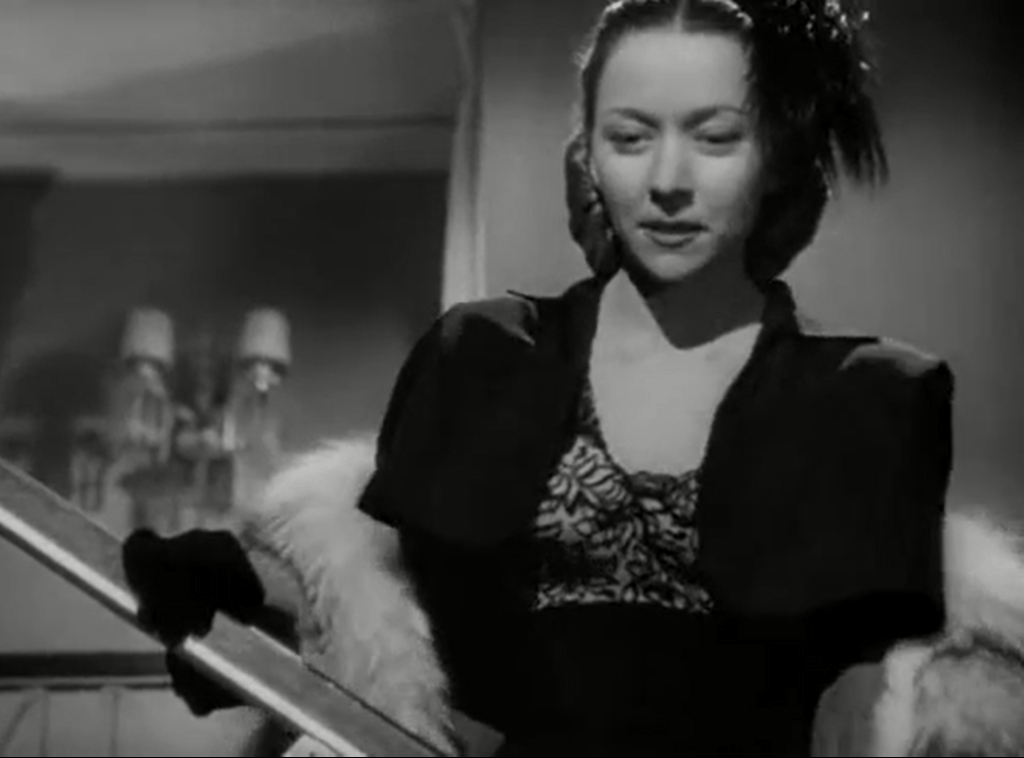
Bill Williams portrayed “Lee Crenshaw”. Williams, soon to be television’s “Kit Carson“, from 1951 through 1955, had just been in a one season, 1948, television series, “Tom, Dick, and Harry”, and his co-stars were June Allyson, and Don DeFore. Williams also starred in the cult science fiction film, 1958, “Space Master X-7”.
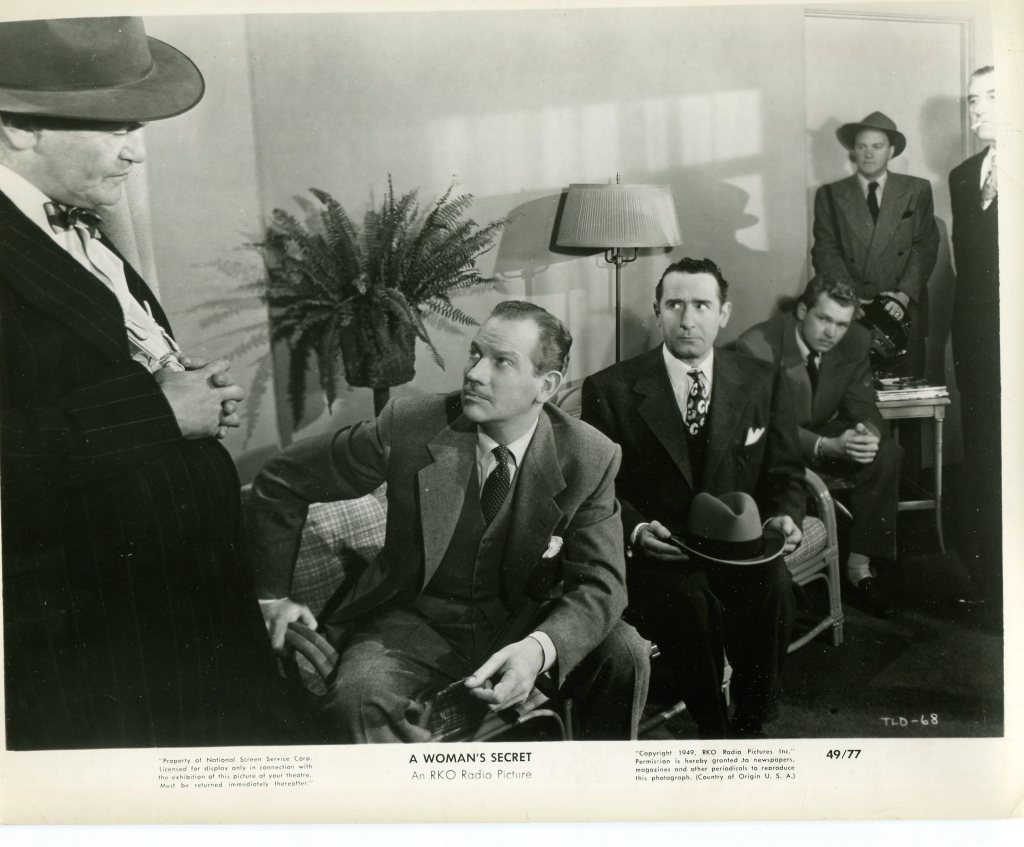
Above left to right, Jay C. Flippen portraying “Police Inspector Jim Fowler”, Melvyn Douglas, Victor Jory portraying “Brook Mathews”, and Bill Williams.
The Story Line:
Singing sensation “Estrellita”, the stage name of “Susan Crenshaw”, has a quarrel with her mentor, one time major singer, “Marian Washburn”. The police are called to the apartment the two women share, to find “Crenshaw” has been seriously wounded by a gunshot, and “Washburn” confesses, but is this what really happened?
Enter, “Marian’s” pianist and boyfriend, “Luke Jordan”, who hires attorney “Brook Mathews” to defend “Marian”. “Brook”, has a past with “Susan”, and was to have married her. However, his overly protective mother, portrayed by Ann Shoemaker, put a stop to it.
“Luke” starts to tell “Inspector Jim Fowler” about the two women in the first of a series of flashbacks. This one introduces, “rags to riches”, “Marian”, whose career is flourishing until she loses her voice.
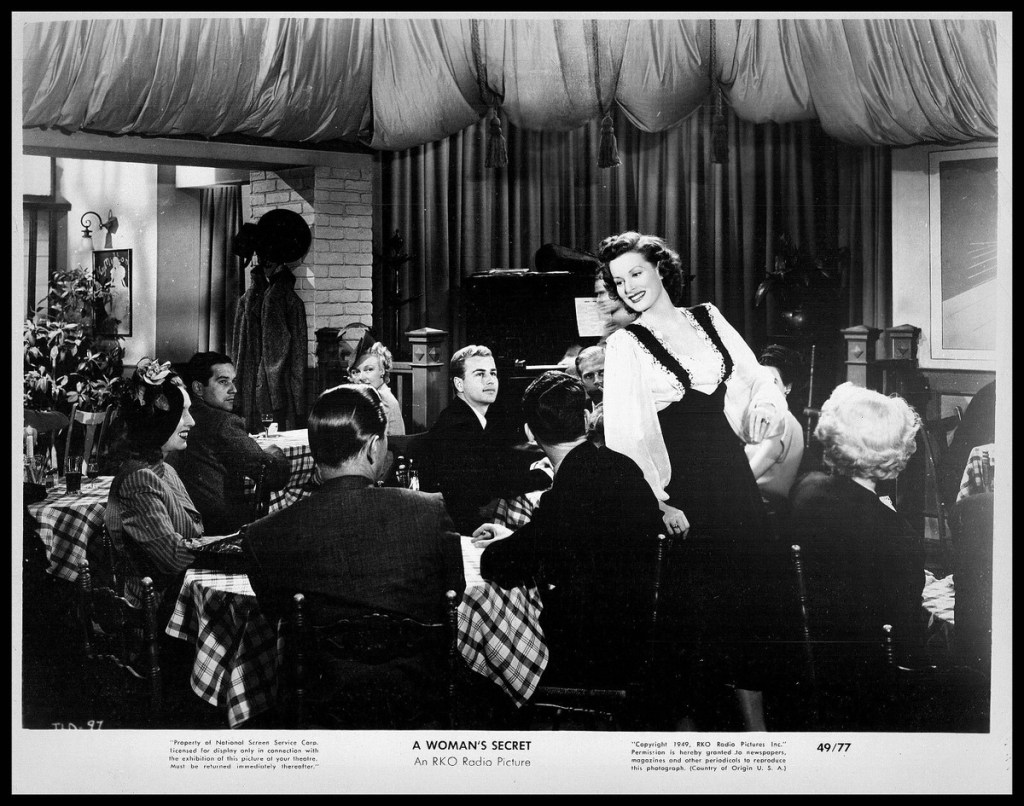
In the second flashback, “Susan Crenshaw”, attends an audition with “Luke” at the piano, and “Marian” listening to the different singers. “Susan” finishes her audition, but collapses from starvation. “Marian” and “Luke” take her to their home, feed “Susan”, who has a fantastic voice. As “Marian” becomes her mentor, and “Susan” becomes “Estrellita”.
In the present, as “Susan” fights for her life in the hospital, outside her room is a one time mysterious soldier that both women met while on tour in France. His name is “Lee Crenshaw”, in a flashback, the story of their meeting, and “Susan” marrying “Lee” is told.
I won’t give my reader the confusion to the screenplay, but on December 31, 1948, the staff for the “Hollywood Trade Paper”, ‘Variety” wrote:
“There’s too much unintended mystery about A Woman’s Secret for it to be anything but spotty entertainment … O’Hara gives a straightforward account of herself. Grahame carries handicap of bad makeup and unbecoming hairdress, and Douglas is too coy as the piano-playing friend. Flippen is topnotch as the detective, lifting his scenes, as does Mary Phillips as his amateur private-eye wife.”
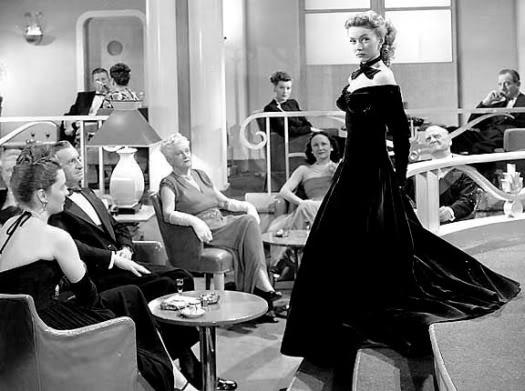
Going from an American movie that lost money, and was held up on release by new “RKO Pictures” owner, Howard Hughes, for no apparent reason. The filming was completed in MARCH 1948. Maureen O’Hara crossed the pond to make a British film.
BRITANNIA MEWS aka: THE FORBIDDEN STREET released in the United Kingdom on March 31, 1949
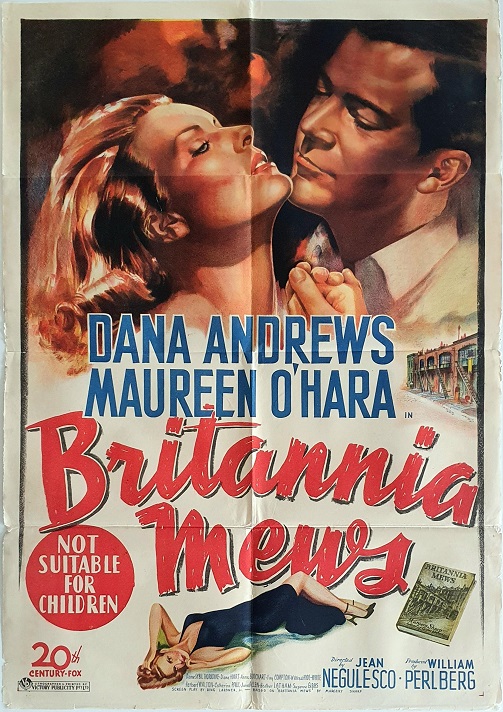
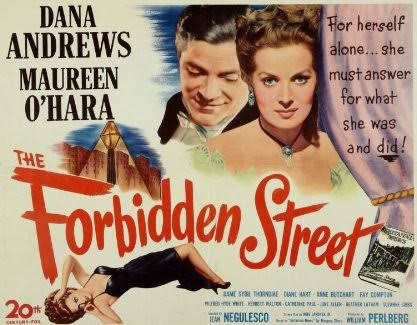
The screenplay was based upon the 1946 novel, “Britannia Mews”, by Clara Margery Melita Sharp, writing as Margery Sharp. For adults she wrote 25-novels, for children the number was 14, including 1959’s, “The Rescuers”, the first of a series of books. Walter Elias Disney turned that book into the 1977 animated feature.
Ring Lardner, Jr. wrote the screenplay. He became one of the “Hollywood Ten”, “Blacklisted” by the American film industry. For refusing to answer, in 1947, the “House Committee on Un-American Activities” question as to if, he was a member of the “Communist Party USA”. He was sentenced to one-year in Federal Prison. He couldn’t use his own name in the United States until 1965, when he wrote the screenplay for the Steve McQueen, Ann-Margaret, and Edward G. Robinson, “The Cincinnati Kid”, in 1970, Ring Lardner, Jr. received the “Academy of Motion Picture Arts and Science, Best Screenplay Oscar”, for “M.A.S.H.”
For those of my reader interested the “Blacklisting’s” within the motion picture industry. My article is, “MCCARTHYISM: LIGHTS, CAMERA, COMMUNISTS IN THE MOTION PICTURE INDUSTRY”, found at:
https://www.bewaretheblog.com/2025/08/mccarthyism-lights-camera-communists-in.html
This motion picture was directed by Jean Negulesco. In 1946, he directed Joan Crawford and John Garfield in “Humoresque”, in 1948, he directed Jane Wyman in “Johnny Belinda”, and just before this feature film. Jean Negulesco directed Ida Lupino, Cornel Wilde, and Celeste Holm in 1948’s, “Road House”. He would follow this picture, directing Claudette Colbert, Patric Knowles, and Florence Desmond, in the 1950, Second World War, “Three Came Home”.
Dana Andrews portrayed “Henry Lambert/Gilbert Lauderdale”. Andrews had just co-starred in the, 1948, comedy, “No Minor Vices”, with co-stars Lilli Palmer, and Louis Jourdan. He followed this motion picture with 1949’s, “Sword in the Desert”, about the founding of the “State of Israel”. Hiis co-stars were Marta Toren, and Stephen McNally. The 4th-billed actor, starting his film career, was Jeff Chandler.
Maureen O’Hara portrayed “Andelaide ‘Addie’ Culver”.
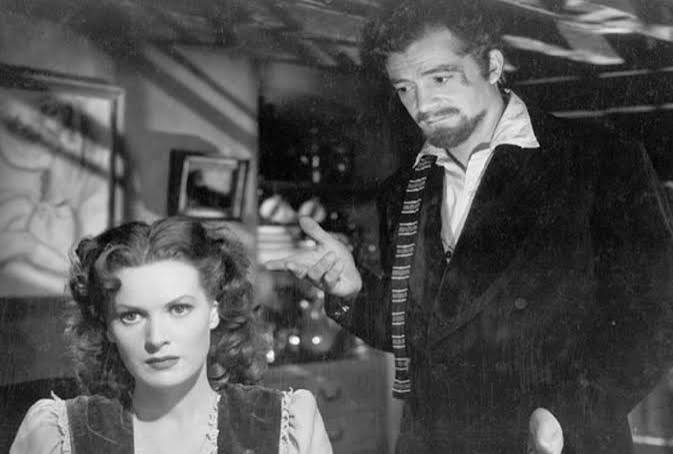
Dame Sybil Thorndike portrayed “Mrs. ‘Sow’Mounsey”. She was just seen in author Charles Dickens’s, 1947’s, “The Life and Adventures of Nicholas Nickleby”, and followed this feature film with 1950’s, “Stage Fright”, starring Jane Wyman, Marlene Dietrich, Michael Wilding, and Richard Todd.
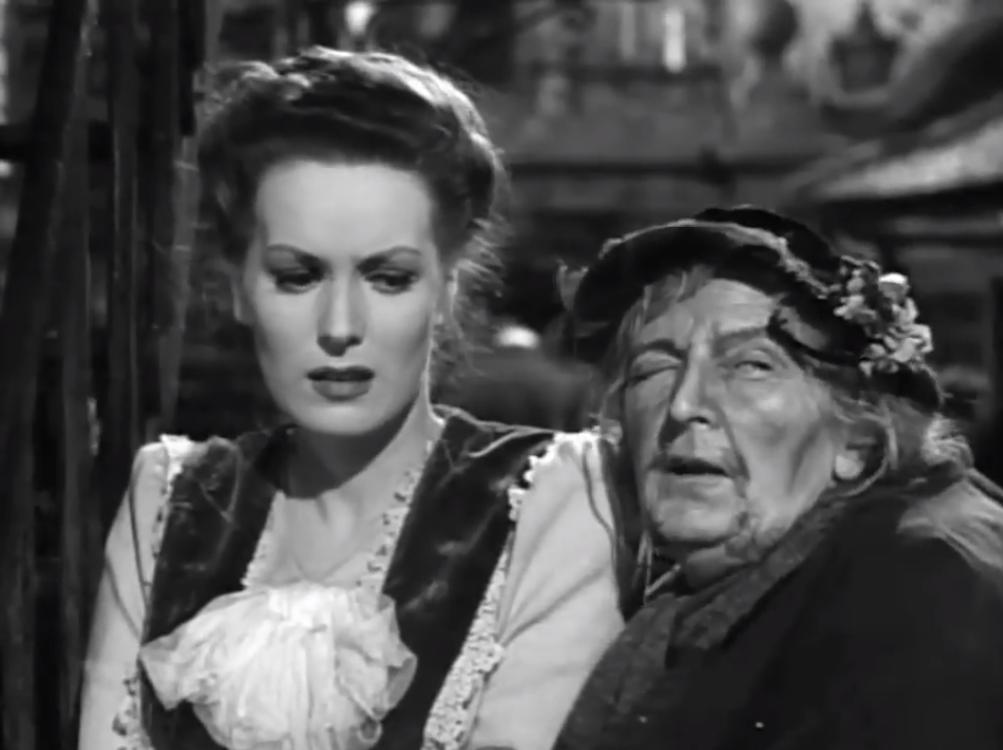
The Basic Story:
The setting is the late 1800’s, in London, England, the audience meets the wealthy “Andelaide ‘Addie’ Culver”. Who, over the objections of her family, marries her impoverished drawing teacher,“Henry Lambert”, and moves into “Henry’s” flat on “Britannia Mews”.
“Addie” thinks “Henry” will finish his the masterpiece she saw him painting. Afterwards, he will become a major artist, and prove to her family that he didn’t marry her for money. “Henry Lambert” is an alcoholic, interested in only two things, and neither is “Andelaide Culver”. The first, is drinking, second, is making his very elaborate marionettes.
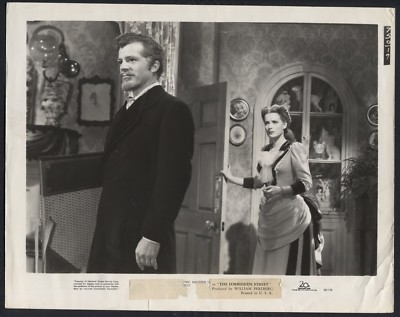
Without help from her family, starting to run out of her money, “Addie” confronts “Henry” at the top of some stairs in their flat. He reveals that he has always romanced wealthy women. He does not love her, but he married “Addie” to get her money. He realized she wanted marriage and he agreed to marriage a means to simply acquire her money. In a fit. “Henry” next grabs at this wife, but “Addie” pushes the extremely drunk and unstable “Henry” away from her. That causes him to fall to his death at the bottom of the stairs.
Next, “Addie’s” neighbor, “Mrs. Mounsey” starts to blackmail her, after she testifies that “Henry” just lost his balance and fell. The blackmailer wants her money regularly each month, or she will reveal the truth and “Addie” will be charged with murder.
“Andelaide Culver”, can’t go back to get family, she is now a prisoner of “Britannia Mews”.
Next, by chance, “Addie” meets a young barrister who is down on his luck. Strangely he looks exactly like “Henry”, but “Gilbert Lauderdale” hasn’t a beard.
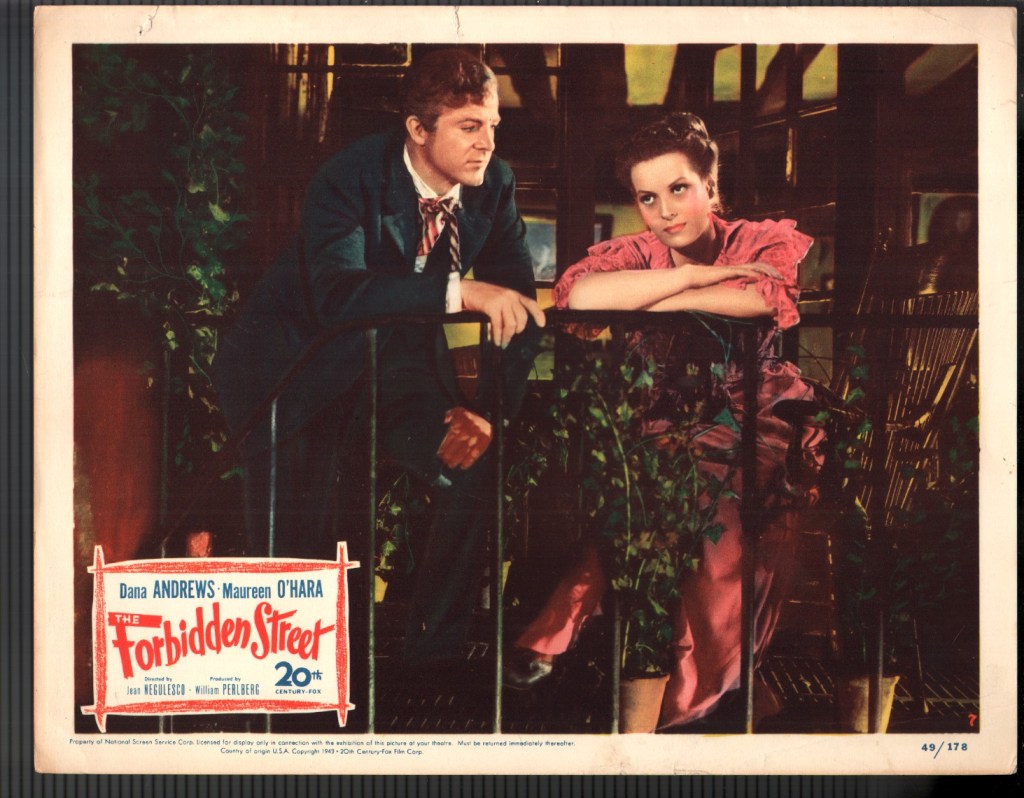
“Gilbert” is able to get rid of “Mrs. Mounsey”, by threatening to prosecute her for blackmail. Unfortunately, “Gilbert” is married to a wife who left him and went to America. He move into the flat, and they call themselves “Mr. and Mr. Lambert”. On “Addie’s” insistence, they sleep in separate bedrooms to avoid sexual temptations, but the two are truly in love.
Using “Henry’s” marionettes left behind by his death, “Addie” and “Gilbert” turn them into a successful puppet theatre
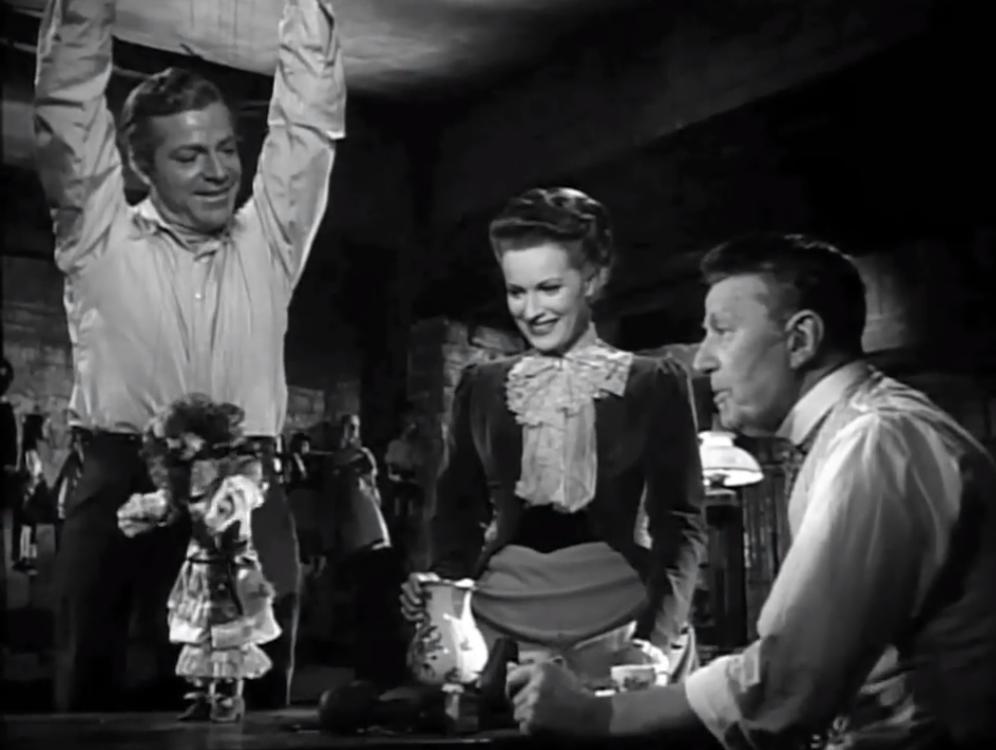
Left to right, Dana Andrews, Maureen O’Hara, and A. E. Matthews portraying “Mr. Bly”.
The puppet theatre is the means of reuniting “Addie” with her family and life seems perfect, UNTIL “Milly Lauderdale”, portrayed by Mary Martlew, appears at their front door.
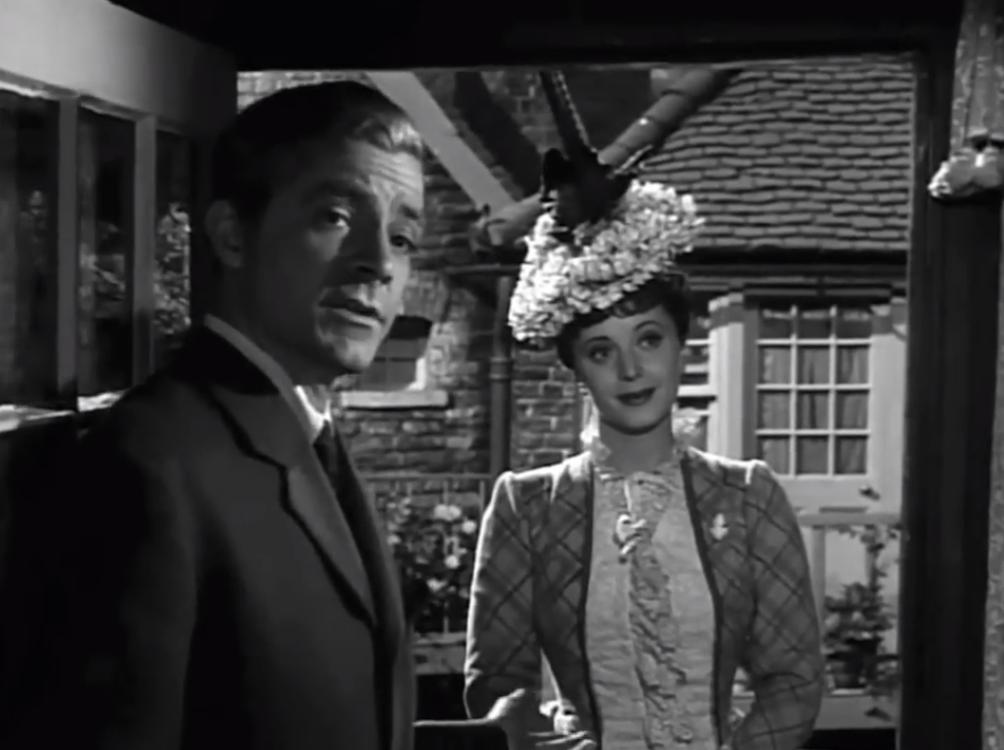
“Milly” insists on a pay off from “Gilbert” for “WRONGING HER”, and moving in with another woman. “Addie” tells “Gilbert” that he must return to his wife. However, at this point. “Milly” reveals that she divorced “Gilbert” years ago, and married another man. Now, leaving “Gilbert” free to marry “Addie’.
For her next motion picture, Maureen O’Hara turned to comedy.
FATHER WAS A FULLBACK premiered in Los Angeles on September 30, 1949
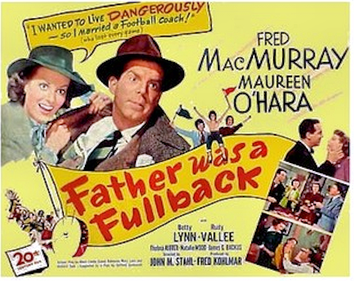
Clifford Goldsmith came up with the story idea. He had created the very popular “Henry Aldrich” and the “Aldrich Family” in Goldsmith’s 1938, Broadway play, “What a Life”, which ran for 538-performances. Next, in 1939, the play became the movie, “What a Life” starring Jackie Cooper as “Henry”. Then “Henry” and his family moved to radio, and was heard from 1939 through 1953. In 1940, Jackie Cooper starred in the movie, “Life with Henry”, and seven more movies followed, before this picture without “Henry Aldrich”.
It took four writers to turn Clifford Goldsmith’s story into a screenplay.
Aleen Leslie had worked on 4 of the “Henry Aldrich” movies, and right before this screenplay was 1948’s, “A Date with Judy”, starring Wallace Beery, and Jane Powell, as the parent’s of Elizabeth Taylor.
Casey Robinson was actually a dramatic screenplay writer. His work included 1927’s, “The Private Life of Helen of Troy”, 1935’s, “Captain Blood”, starring Errol Flynn and Olivia de Havilland, and 1942’s, “Kings Row”, starring Ann Sheridan, Robert Cummings, and Ronald Reagan. Right before this screenplay, Casey Robinson wrote 1947’s, “Desire Me”, starring Greer Garson, and Robert Mitchum.
Mary Loos, two films earlier, had written 1949’s, “Mother Is a Freshman”, that starred Loretta Young and Van Johnson. Right before this feature, she wrote 1949’s, “Mr. Belvedere Goes to College”.
Richard Sale also co-wrote the two Mary Loos screenplay I have mentioned, but he also wrote both the story and screenplay for 1954’s, “Suddenly”. In which Frank Sinatra is the leader of a group of men waiting for the President of the United States train to arrive in the small town of “Suddenly”. Where, Sinatra plans to ASSASSINATE THE PRESIDENT OF THE UNITED STATES, when his train stops, a must see,
John M. Stahl directed the comedy. This was followed by the director’s last, of 47, movies, 1949’s, “Oh, You Beautiful Doll”,a biographical musical starring Mark Stevens and June Haver. Stahl also produced 56-motion pictures.
Fred MacMurray portrayed “George Cooper“. He had just been seen in 1948’s, “Family Honeymoon”, co-starring with Claudette Colbert, and followed this feature film with the film-noir 1950’s, “Borderline” co-starring Claire Trevor, and Raymond Burr.
Maureen O’Hara portrayed “Elizabeth Cooper”.
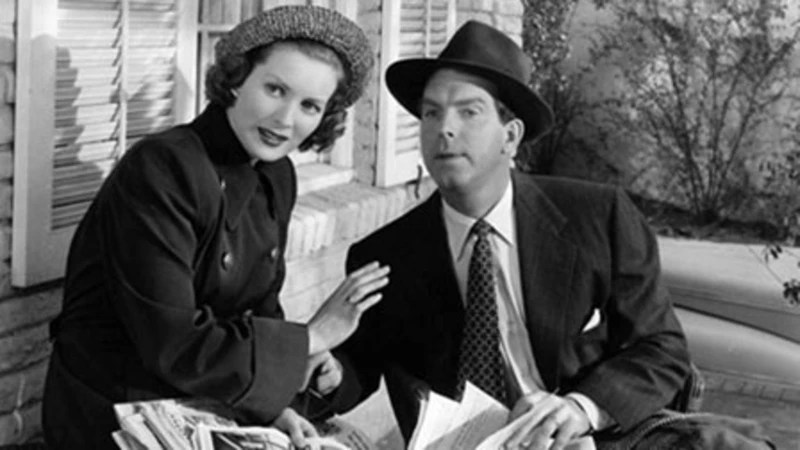
Betty Lynn portrayed older daughter, “Connie Cooper”. She was just in 1949’s, “Mother Was a Freshman”, and followed it with 1950’s, “Cheaper by the Dozen”.
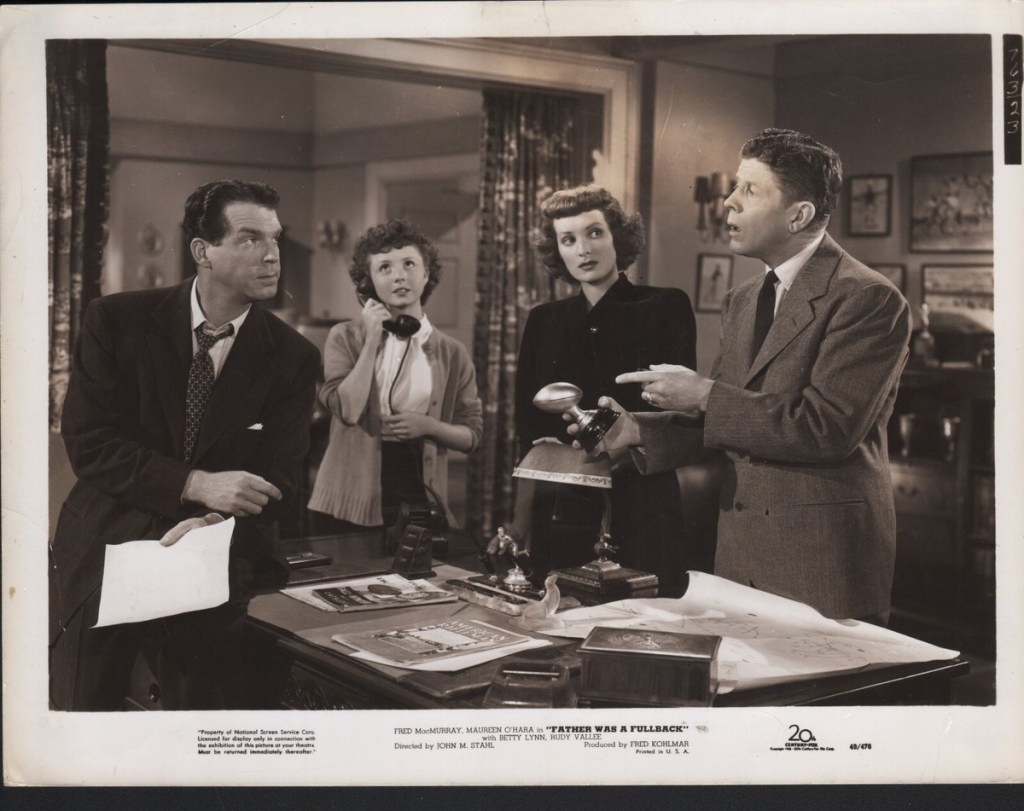
Natalie Wood was back with Maureen O’Hara, now 11-years-old, she portrayed younger daughter, “Ellen Cooper”. Wood was just seen, co-starring in, 1949’s, “The Green Promise”, with co-stars Marguerite Chapman, Walter Brennan, and Robert Paige. She followed this picture with the Margaret Sullivan, Wendell Corey, and Viveca Landfors, 1950 drama, “No Sad Songs for Me”.
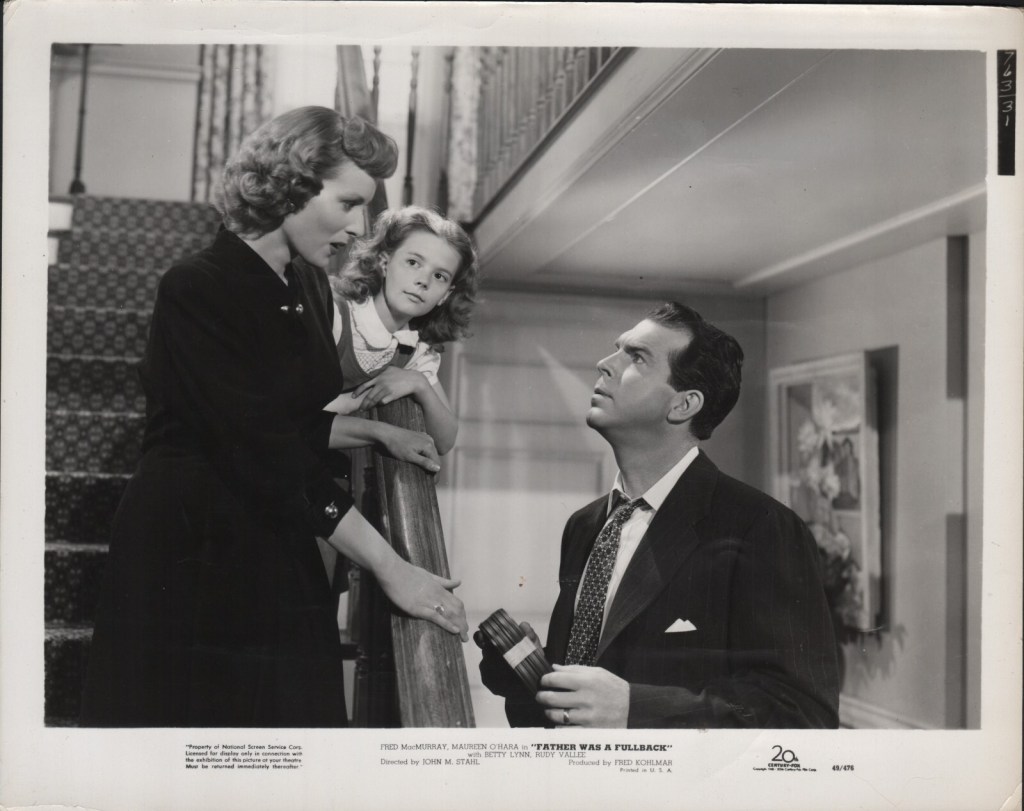
Having read several critic’s from the film’s release and much later. Most agree that the overall film reminded them of man episode of an earl television programs such as 1948’s, “Life of Riley”, 1953’s, “Make Room for Daddy”, or 1954’s, “Father Knows Best”, and yes, “Henry Aldrich”.
In her autobiography, Maureen O’Hara looked upon the picture as just a contractual obligation she had to do. Her only good memory was working with Natalie Wood again.
Maureen O’Hara found herself borrowed by “Universal International Pictures”. The motion picture was:
BAGDAD premiering in Chicago, Illinois, on November 23, 1949
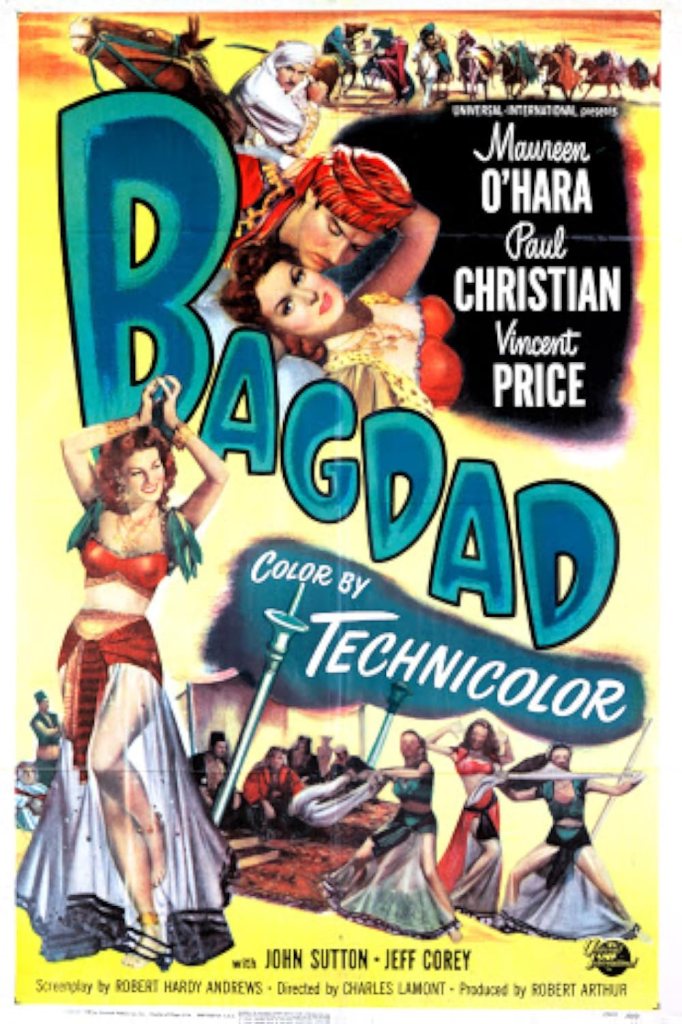
Tamara Hovey wrote the original story. Hovey only wrote for 4-movies, and before this picture was the 1949 musical, “That Midnight Kiss”, starring Kathryn Grayson, She followed this feature with the French crime drama, 1955’s, “Je suis un sentimental”, starring Eddie Constantine. Her fourth film was adapting the 1829 novel “Tamango” by Prosper Mérimée for the French/Italian 1958 film version.
Robert Hardy Andrews wrote the screenplay. His previous screenplay was for the Robert Ryan, Laraine Day, and John Agar movie, 1949, “The Woman on Pier 13”. The movie, the producers, the cast, and every member of the crew, were investigated by the “House Committee for Un-American Activities” as being influenced by Communist agents. Andrews followed this feature film with the screenplay for the Audie Murphy, Gale Storm, and Albert Dekker, Billy the Kid, 1950’s, “The Kid from Texas”.
Charles Lamont directed the movie. He had just directed 1949’s, “Ma and Pa Kettle”, starring Majorie Main and Percy Kilbride, and followed this film with 1950’s, “Ma and Pa Kettle Go to Town”.
Maureen O’Hara portrayed “Princess Marjan”, can you say “Shireen”?
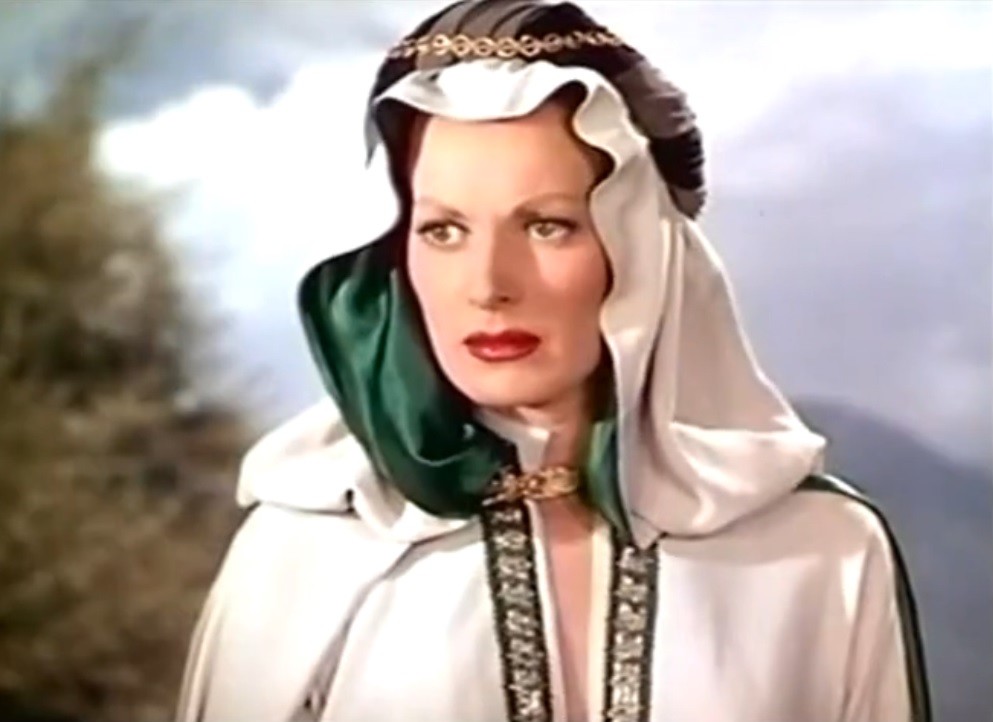
Paul Hubschmid portrayed “Hassan”. Don’t recognize the name of the very popular in Europe, Swiss born German actor? In the United States, to avoid problems with his German sounding name, he used the name of Paul Christian as in this feature film. Fans of Stop Motion Animator Ray Harryhausen will recognize Christian for 1953’s, “The Beast from 20,000 Fathoms”.
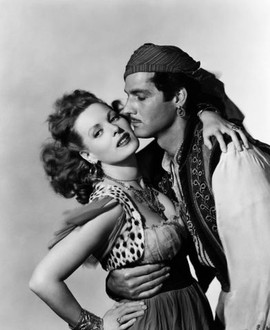
Vincent Price portrayed “Pasha Ali Nadim”. Price followed this movie with an excellent true story about JAMES ADDISON REAVIS. Who became known as the “Baron of Arizona”. When he forged Spanish land grants that would give his wife, ownership 18,600 square miles of the Arizona Territory. In director and screenplay writer, Sam Fuller’s, 1950, “The Baron of Arizona”, Price played Reavis. One of my articles about Vince Ont Price is “Vincent Price: The 1950’s Horror of It All” at:
https://motion-picture-history.com/2026/06/25/vincent-price-the-1950s-horror-of-it-all/
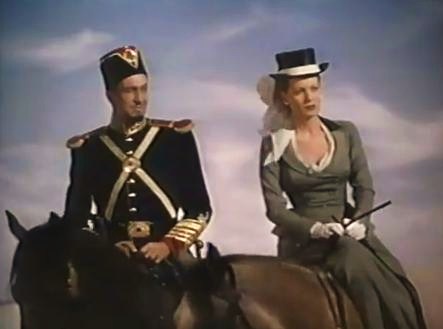
John Sutton portrayed “Raizul”, “Hassin’s” brother. Sutton had just been seen in the “Lucretia Borgia” story, 1949’s, “Bride of Vengeance”, with Paulette Goddard as “Lucretia”.
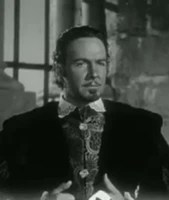
The Plot Was Described By Maureen O’Hara, in Her Autobiography, as:
“a ‘tits and sand’ picture…one of the films that I point to as part of my decorative years but audiences love them.”
Bedouin “Princess Marjan”, returns to Bagdad from England, where her father sent her to be educated. However, she finds her father was murdered by a band of renegades, or says “Pasha Ali Nadim”.
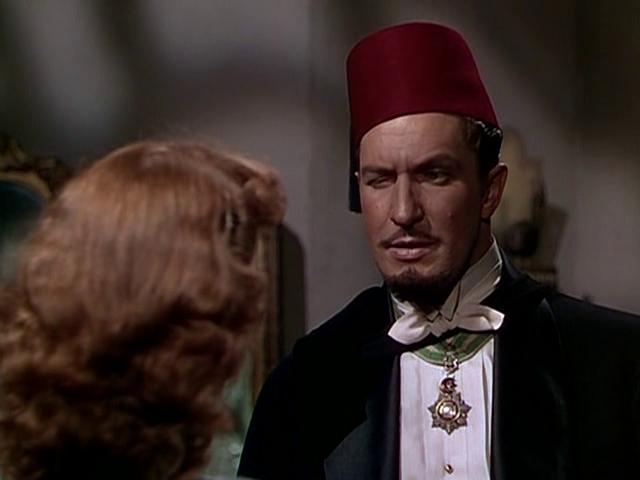
“Marjan” meets “Prince Hassan”, who is accused of the murder of her father.
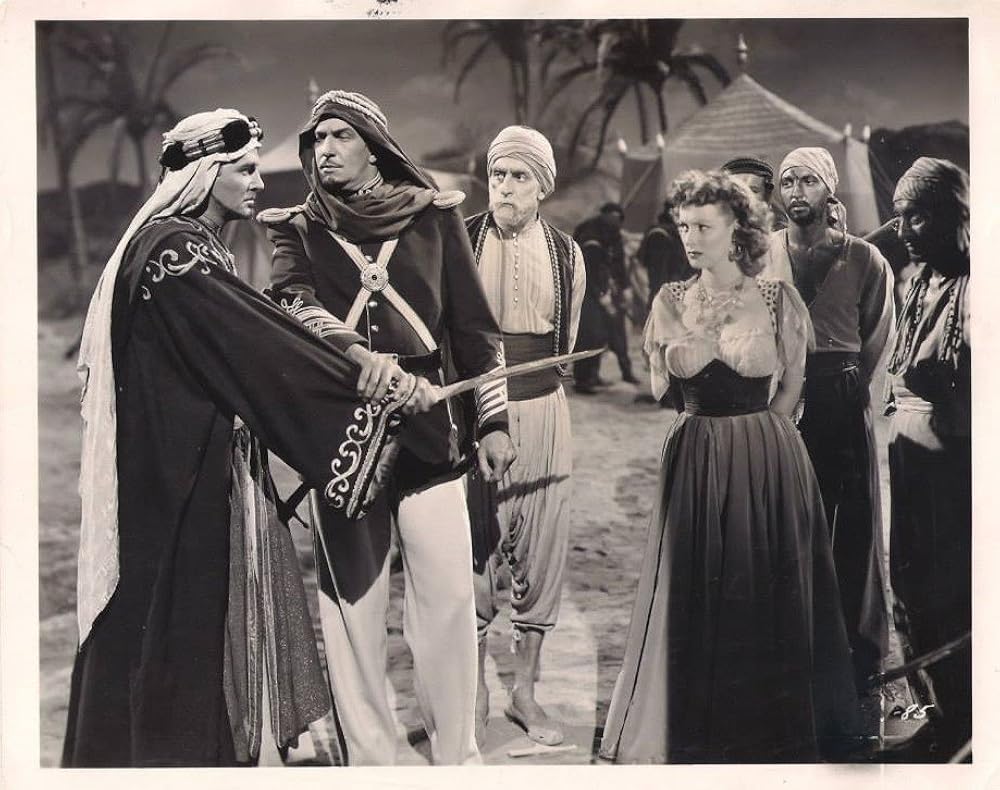
“Princess Marjan” and “Prince Hassan” will fall in love as they hunt for her father’s murderer.
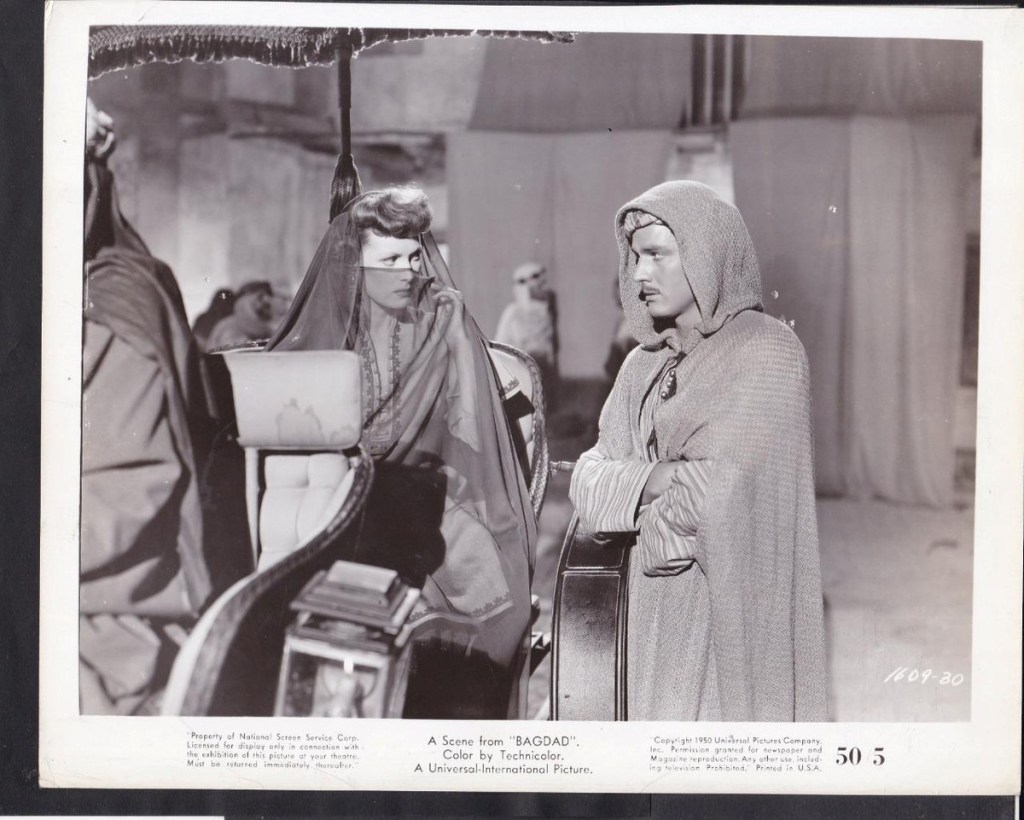
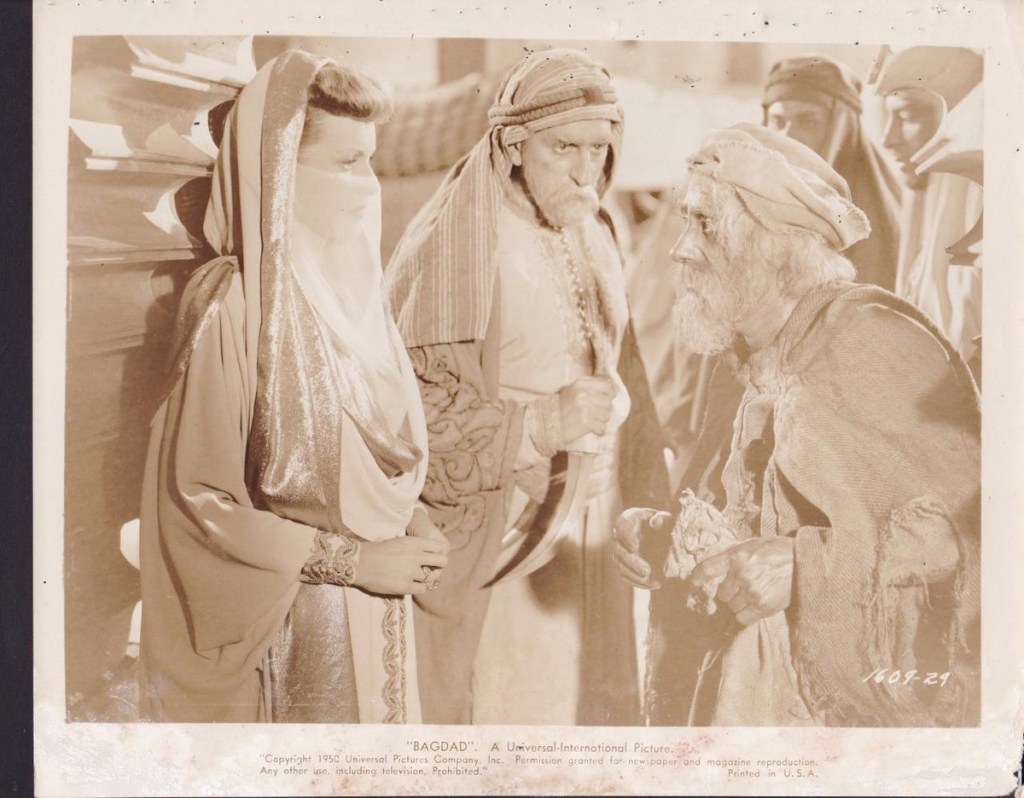
“Marjan’s” father was killed by the “Black Robes”, and their search, of course, will reveal that “Hassan’s” brother “Raizul”, is the leader of the “Black Robes“ and “Pasha Ali Nadim” works for him. I mean the moment Vincent appeared, he was labeled by every member of the movie theater audience as a “Villain”!
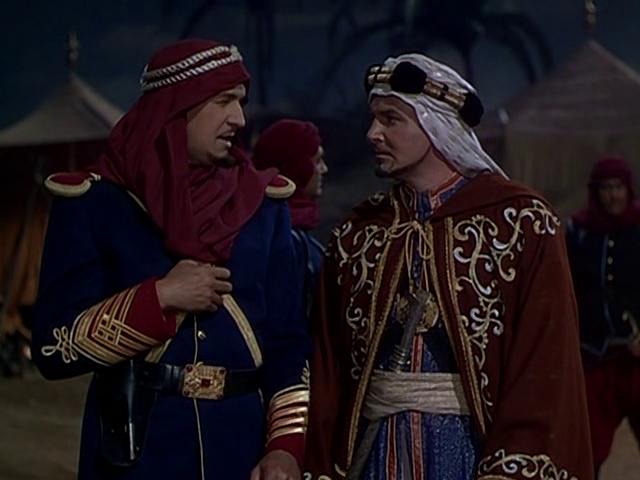
Maureen O’Hara’s “Tits and Sand” comment described movies being turned out by even the major studies, because of the attack on the industry by the “House Committee on Un-American Activities”. (See my above “McCarthyism” article). “Arabian Night” movies were considered a “Safe Film Genre”, from attack. Just for the record, in 1951, Maureen O’Hara co-starred wirth Jeff Chandler, in “The Flame of Araby”, also directed by Charles Lamont.
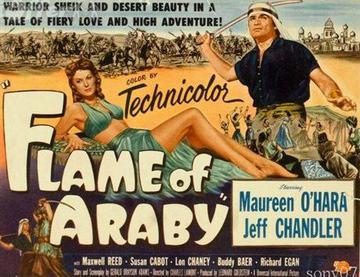
I now return to the last motion picture that Maureen O’Hara made before her first film with John Wayne, it was also a Western, a “Safe Film Genre”.
COMANCHE TERRITORY premiered in New York City on April 7, 1950
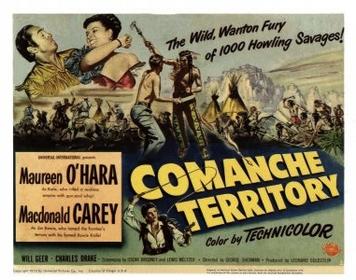
Lewis Meltzer created the story that was originally a biography of “Jim Bowie”. and co-wrote the screenplay. Meltzer also co-wrote the screenplay for the Danny Thomas version of “The Jazz Singer” in 1952. In 1955, he co-wrote “The Man With the Golden Arm”, starring Frank Sinatra and Kim Novak.
The other screenplay writer was Oscar Brodney. Rodney created the screenplay for the James Stewart comedy classic, “Harvey”. He co-wrote three of the “Francis, the Talking Mule” movies. In 1954, it was “The Glenn Miller Story”, “The Black Shield of Falworth”, and “The Sign of the Pagan”.
George Sherman directed, he had just directed the previously mentioned 1949, “Sword in the Desert”. He followed this western, with the film-noir, 1950’s, “The Sleeping City”, starring Richard Conte.
Maureen O’Hara portrayed “Katie Howard”.
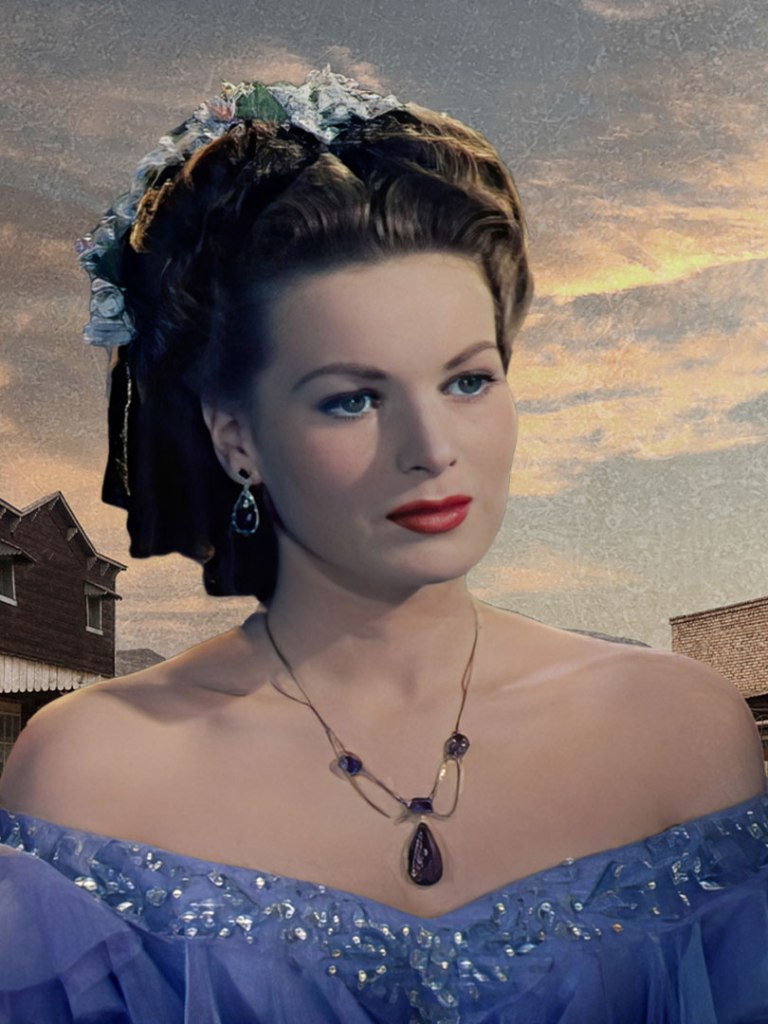
Macdonald Carey portrayed “Jim Bowie”. Carey had just co-starred with Ray Milland and Hedy Lamarr in the 1950 Western, “Copper Canyon”. He followed this movie with the film-noir, 1950’s, “The Lawless”, co-starring Gail Russell.
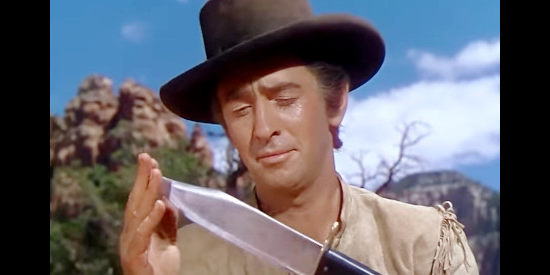
Wil Geer portrayed “Dan’l Seeger”. Geer had just been in 1950’s, “The Kid from Texas”, and followed this picture with director Anthony Mann’s classic Western, 1950’s, “Winchester ’73”, starring James Stewart.
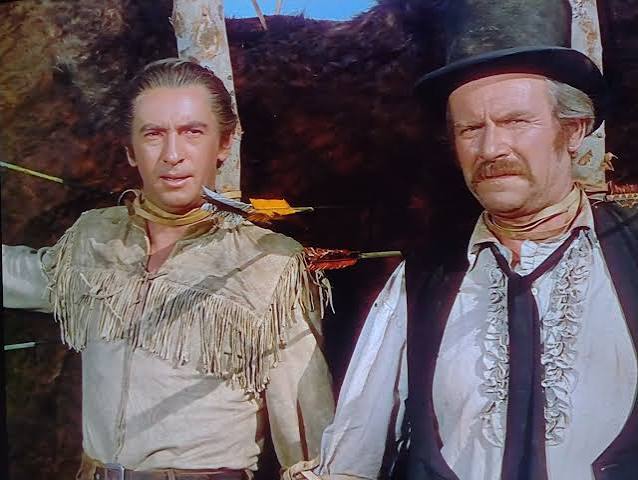
Charles Drake portrayed “Stacey Howard”. Drake had just been seen in 1949’s, “Tarzan’s Magic Fountain”, starring Lex Barker and Brenda Joyce.
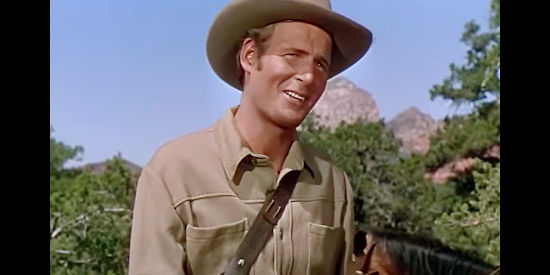
This Western was one of the rare one’s that tried a faithful portrayal of the Comanche tribe. The White men who ignore the Indian Treaty are the villains. My short article on how Native American’s were portrayed in motion pictures is “Native American’s Hollywood Style” at:
https://www.bewaretheblog.com/2015/08/native-americans-hollywood-style.html
The plot has “Jim Bowie” asked to go to the “Comanche Territory” to help keep peace under the current “Peace Treaty”. Along with “Dan’l Seeger”, the two men head for a town at the border between the Native American and White lands.
Enter brother and sister, “Katie”, and “Stacey Howard“. “Katie” is the owner of the local town’s salon, and the sibling’s are plotting to get the local “White’s” to raid the Comanche land for settling.
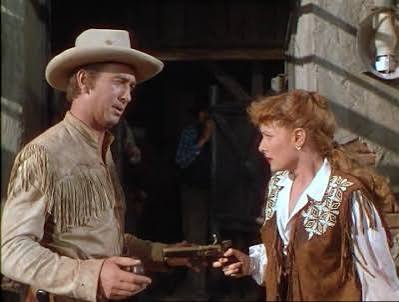
However, the two know there is silver on the Comanche land, that the others don’t know about. After the Native American’s are driven from their land, they will set up a mining operation.
However, “Katie” falls for “Bowie”, and the two must stop her brother, “Stacey”, from the starting a war between the Native Americans and the misinformed “White Settlers”.
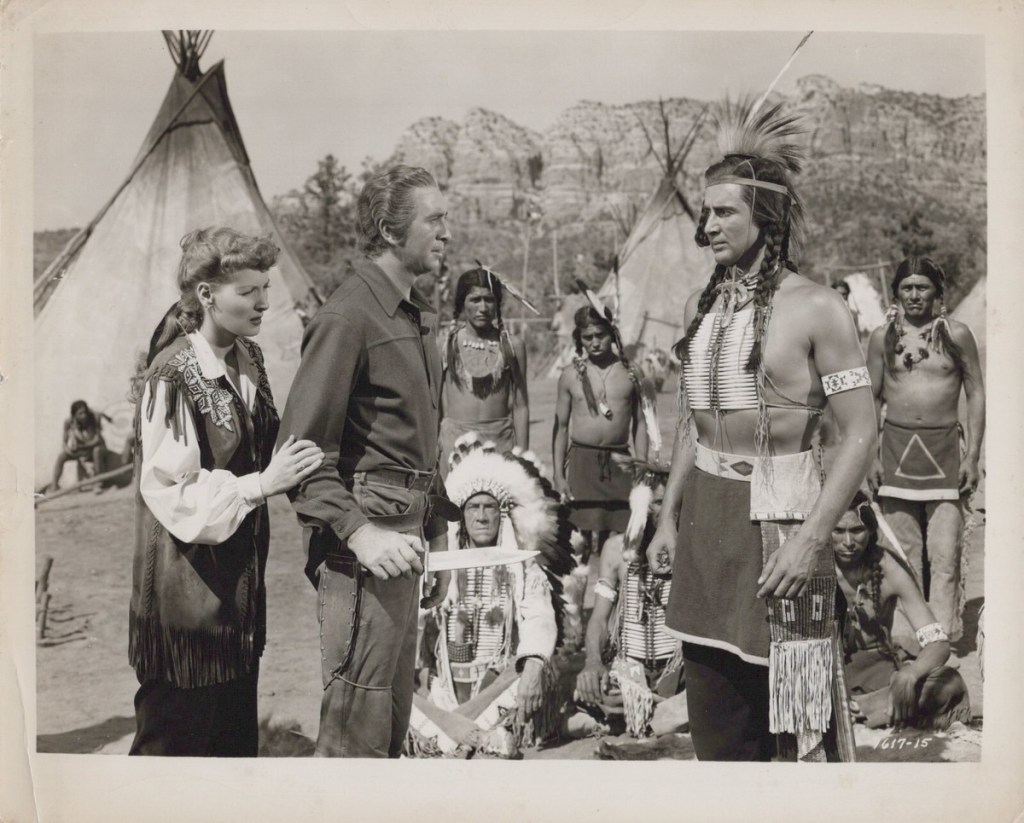
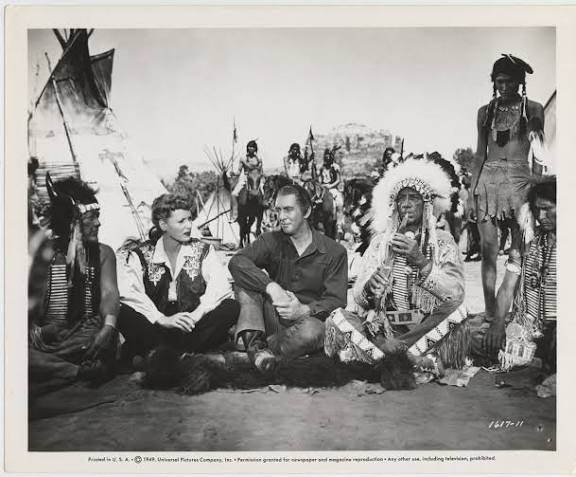
Two months after the release of “Comanche Territory”, in June 1950, filming began on director John Ford’s, “Rio Grande”, and Maureen O’Hara first worked with John Wayne.
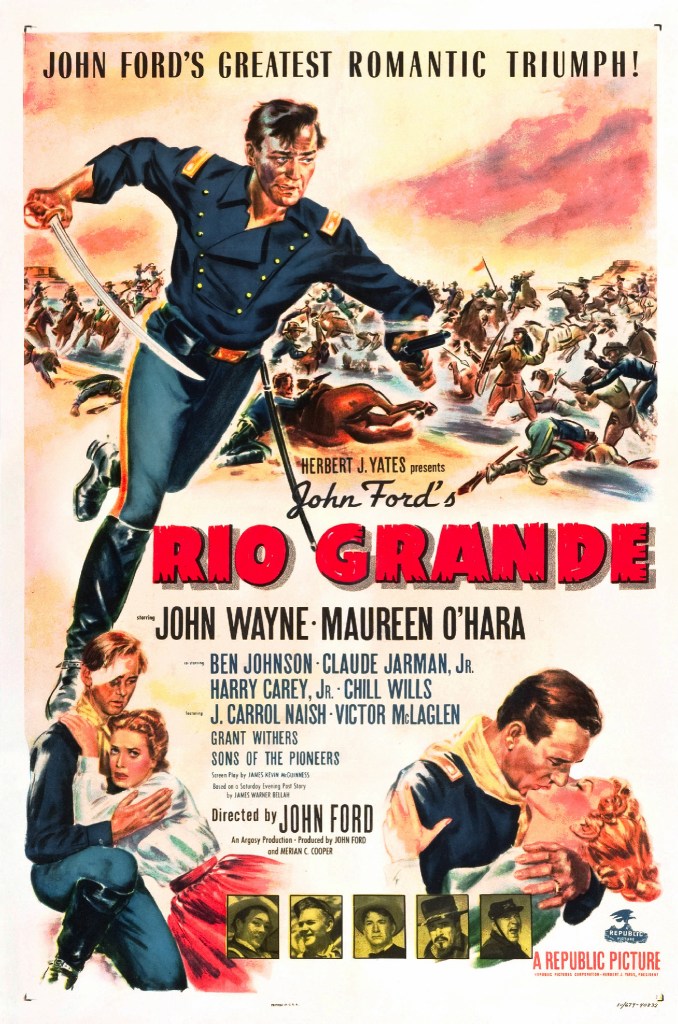


Leave a comment